
Sacrifice. Duty. Remember. Visitors use words like these as they descend into the Vietnam Veterans Memorial in Washington, D.C. Located on the National Mall near the Korean War
Veterans Memorial and west of the Washington Monument, “The Wall” draws about five million visitors a year. Jim Knotts, President of the Vietnam Veterans Memorial Fund, said, “For many years, the Vietnam Veterans Memorial just by itself has been in the top 10 of all national park sites, nationwide.”
The Memorial honors 58,281 men and women who served courageously and sacrificed their lives and those who remain missing in the Vietnam War during the most divisive war in U.S. history. The Vietnam Veteran Project recorded 2,709,918 Americans who served in uniform in Vietnam.
Members of the Vietnam Veterans Memorial Fund, a nonprofit organization, gathered private donations that funded and built the Memorial. Today, they continue to meet groups, like Honor Flights, and answer questions.

Paying Their Respects
George Gagan, a 20-year Navy Seabee from Dayton, Ohio, stood with his family and found the name of Marvin G. Shields who was killed in Vietnam and posthumously awarded the Medal of Honor.
It’s an emotional experience for Ray Dilba of Cherry Hill, NJ, visiting for the third time. He enlisted from 1966-1969 and served in Da Nang as a Medical Service Specialist with an aeromedical evacuation unit. “I have to compose (myself) every time to reflect on what happened. I almost come to tears,” he said.
For veterans like Dilba, the names etched in stone are not abstract-they are friends, brothers, and fellow service members whose absence is still felt.
Design of the Memorial
In March 1981, a national design competition drew 1,421 entries. The winning concept came from Maya Ying Lin, then a 21-year-old senior at Yale University. Her vision was simple but powerful: a park within a park, a place set apart for quiet reflection.
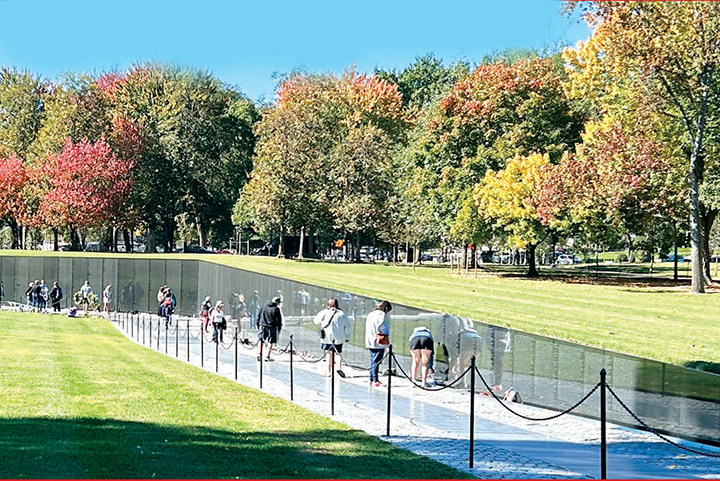
Dedicated on November 13, 1982, the Memorial’s polished black granite walls cut into the earth, listing the fallen in chronological order. The first casualty in 1959 appears at the center, at the lowest point of the walkway. Names continue along the east wall toward the Washington Monument, then resume at the west wall near the Lincoln Memorial, concluding again in the center with those lost in 1975.
Knotts explained its design. “(The) Vietnam Veterans Memorial, ‘The Wall,’ as we call it, is sometimes called ‘The Wall that Heals,’ because so many of the Vietnam veterans or family members of those listed here begin their healing journey by coming here and visiting the Memorial.
“One of the purposeful aspects of this design is the choice of the solid black granite. The designer chose this for two primary reasons. One, because black is the color of earth and also because she knew that when it was highly polished, it would have this reflective nature. So, if you serve with someone or you’re a family member or just a visitor, you can come up, you can touch a name on the wall. And when you do, you’ll see your own reflection in the wall. So, it’s almost as if you are joining them to visit with them. But the hopeful part of the design is that at the end of your visit, you’ll go up one of the walkways, back above ground level, to the land of the living.”
Knotts estimates that half of all visitors were not even born when the Vietnam War ended 50 years ago. “Many of them don’t have a direct connection to the Vietnam War, but when they come to D.C., they always want to come to the war Memorial.”
Sister statues
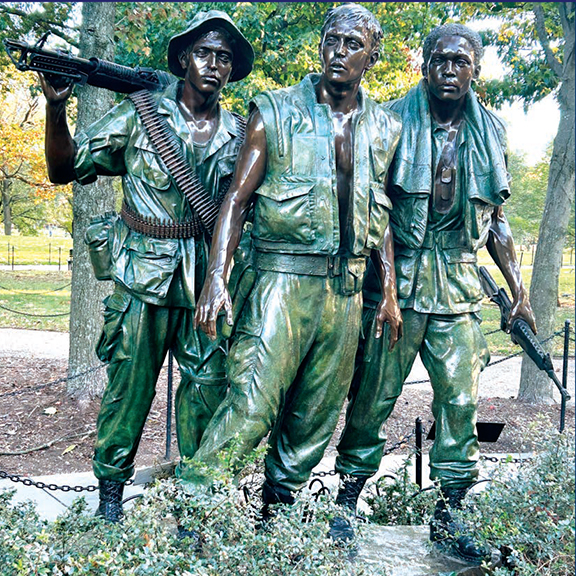
Nearby is the Three Servicemen Statue by Frederick Hart, dedicated in 1984, depicting young, alert, weapon-carrying Vietnam soldiers. Hart said, “The contrast between the innocence of their youth and the weapons of war underscores the poignancy of their sacrifice…Their strength and their vulnerability are both evident.”
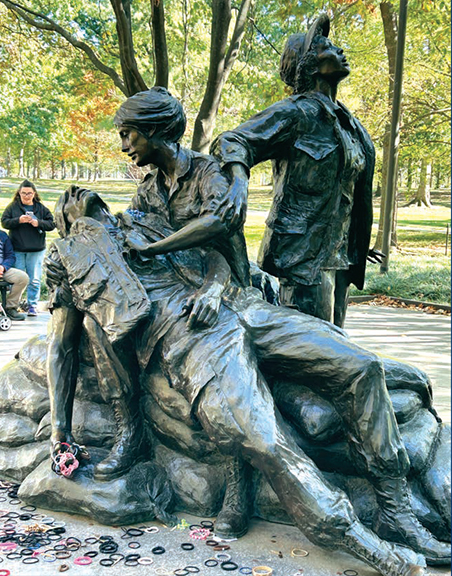
Nearby, the Vietnam Women’s Memorial from 1993, sculpted by Glenna Goodacre, honors women who served in Vietnam. The statue shows three nurses caring for a wounded soldier, reflecting the critical roles women played. Eight servicewomen died in Vietnam, and their names are inscribed on The Wall.
“The Wall that Heals” brings Americans and overseas visitors, those who served in our armed forces and civilians, together to connect, reflect and quietly honor American fallen men and women.
Learn more. The Vietnam Veterans Memorial Fund, https://www.vvmf.org/.
Vietnam Era Registry of Service, registry.vvmf.org.
Vietnam Veteran Project,
https://vietnamveteranproject.org/. Or scan the QRCODE below.
• story and photos by Lt Col Richard Stephens, Jr., USAFR, Ret.