
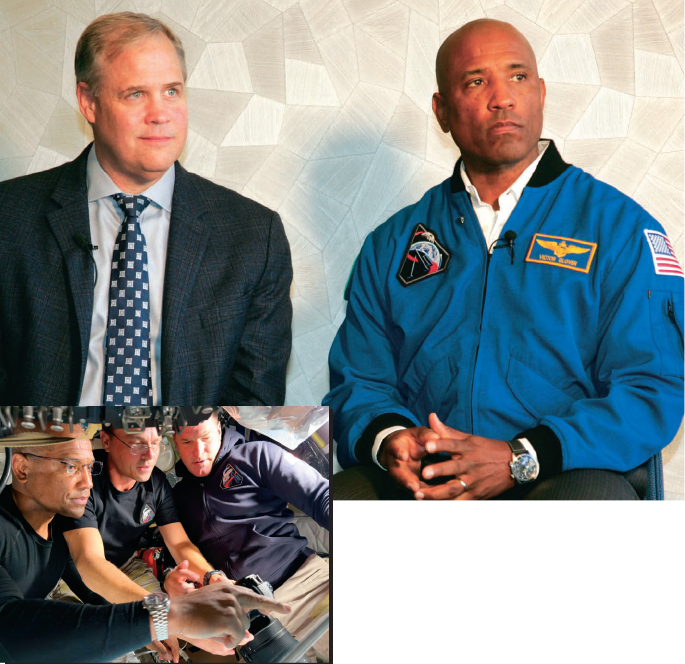
Inset: At a news conference on Oct. 8 during the Oklahoma Aerospace Forum in Oklahoma City, another Navy Veteran F-18 Hornet pilot, former NASA administrator Jim Bridenstine, introduces astronaut Victor J. Glover, Jr., who piloted the Artemis II mission around the Moon in April.

This summer, America commemorated its 250th anniversary and the 56th anniversary of the historic Apollo moon landing. In April, NASA astronaut and U.S. Navy Capt. Victor J. Glover, Jr., a former Navy F/A-18 Hornet pilot who flew two dozen combat missions, took another giant leap for humanity in piloting the Artemis II lunar flyby mission.
The 10-day loop around the far side of the Moon was the first time humans traveled beyond low Earth orbit since 1972. Another Navy Veteran F-18 Hornet pilot, Jim Bridenstine, profoundly influenced that leap. He attended Jenks High School before becoming a U.S. Congressman from Tulsa and then the NASA administrator who shepherded the Artemis missions into reality.
Bridenstine introduced new Astronaut Emeritus Glover to an appreciative audience on Oct. 8 at the Oklahoma Aerospace Forum, held at the Omni Hotel in downtown OKC. The gathering of 400 aerospace attendees was in its ninth year under the direction of Brenda Jones Barwick, APR. The men seemed to speak from the same script, from the news conference to Glover’s keynote speech.
This same unison began when Bridenstine called Glover many times during his 2018-2021 tenure as NASA head to ask what a fellow F-18 pilot thought was going on. Glover was NASA’s pilot for Crew-1 Dragon Resilience, launched in November 2020 to the International Space Station.
Long after the April attention, Glover repeated in his keynote speech what he had shared at the earlier news conference about young people leaning into aerospace. “Find some area to grow. And education isn’t just what you can do with your head – it’s your hands. As pilots, we know how important hand-eye coordination is. So, find a place to lean in and grow,” Glover said. “We need welders. We need electricians. There are so many trade and apprenticeship programs that lead to great jobs in science and technology.”
Bridenstine is now CEO of Quantum Space in Tulsa, a space defense and orbital mobility company, and introduced Glover at the luncheon keynote.
“Oklahoma is a heartland hub for aerospace innovation,” Bridenstine said. “The state has built an ecosystem where innovation moves rapidly from initial testing to commercial application. Whether developing autonomous flight capabilities or supporting deep space infrastructure, Oklahoma is an essential hub for national security and commercial space growth.”
Glover concluded his active spaceflight career in September. He stepped away from active flight rotation to create opportunities for other astronauts and focus on mentoring the next generation. The inaugural members of the new NASA Astronaut Emeritus Program are former Navy F-18 pilots Reid Wiseman, commander of the historic Artemis II mission, and Glover.
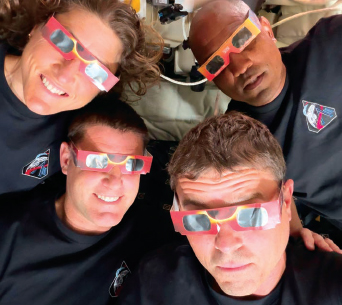
NASA record-holder Christina Koch and Canadian Space Agency astronaut Jeremy Hansen completed the four-person Artemis II crew. They traveled 694,481 miles on a fuel-efficient “free-return” trajectory that took them 4,600 miles beyond the Moon’s far side before Earth’s gravity pulled them back.
That day’s Forum breakout sessions emphasized strengthening collaboration across the many sectors needed to sustain Oklahoma’s role in space, defense and autonomous aviation. Sessions focused on the aerospace workforce, building the region’s talent pipeline, and advancing autonomous systems to shape the future of flight. Sessions on space, propulsion and the emerging aerospace economy addressed their impact on Oklahoma’s economy. Glover cited Oklahoma’s major military installations for their contributions to defense sustainment, investment and aerospace growth.
In his keynote remarks, Glover cited Frontier Electronic Systems, based in Stillwater, as an example of how Oklahomans develop and manufacture sophisticated human-interactive hardware. He thanked them for their brilliance in providing the controls he used in the Orion Capsule and the Artemis mission. The system let him steer and adjust the capsule’s orientation manually and precisely.
Because Jones is always looking ahead, just as our nation awaits the upcoming Artemis III lunar landing, students were invited to attend afternoon sessions in a dedicated block
at the Forum. This allowed them to learn from and meet with local aerospace companies, corporate hiring managers, and defense contractors actively looking to fill Oklahoma’s critical workforce gap.
Student groups and department heads, including Southwestern Oklahoma State University (SWOSU) and Oklahoma State University, attended the training for the next generation of aerospace talent at no cost.
Sponsored by Oklahoma ACES, the event was a glimpse of the future of Oklahoma’s aerospace economy through its rousing keynote presentation, panel discussions, and networking.
One way to show the robust support this Forum has built beyond the highest-status aerospace leaders in its keynote speaker this year is to list its steering committee. The event was the result of the work of Leshia Pearson – Oklahoma Department of Commerce / Oklahoma Aerospace Commerce Economic Services (ACES), Keith Rash – Consolidated Turbine Specialists, Tim Frisby – Critical Components Aerospace, Justin Cockroft and Douglas Rodzon- Federal Aviation Administration (FAA), James Peake – Frontier Electronic Systems, Tom Okeefe -INTRUST Bank, Brenda Jones-Barwick – Jones Strategies, Colin Oetken – L3Harris Technologies, Greg “Sven” Smith- M1 Composites, Chris Van Denhende – Mint Turbines, Janelle Stafford – Moog, Mandy Monahan – NORDAM, Allyson Carson – OK Defense Industry Association (ODIA), Grayson Ardies and Craig Smith- OK Department of Aerospace and Aeronautics (ODAA), Eddie Compton -Oklahoma CareerTech, Rob Clouse – OSU Oklahoma Aerospace Institute for Research and Education (OSU OAIRE), Clay Pearce – Spirit AeroSystems, Daniel Regan- Tulsa Airports Improvement Trust, Chase Beasley – Tulsa Innovation Labs, David Hanisch – Tinker Air Force Base.
Many of these steering committee members’ concerns also engaged directly with students and resume-holders during the “Upcoming Talent” networking session in the after noon. • Story and photos by Darl DeVault, contributing editor