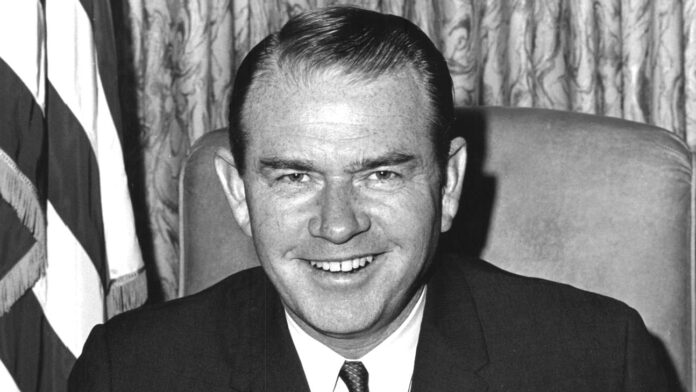
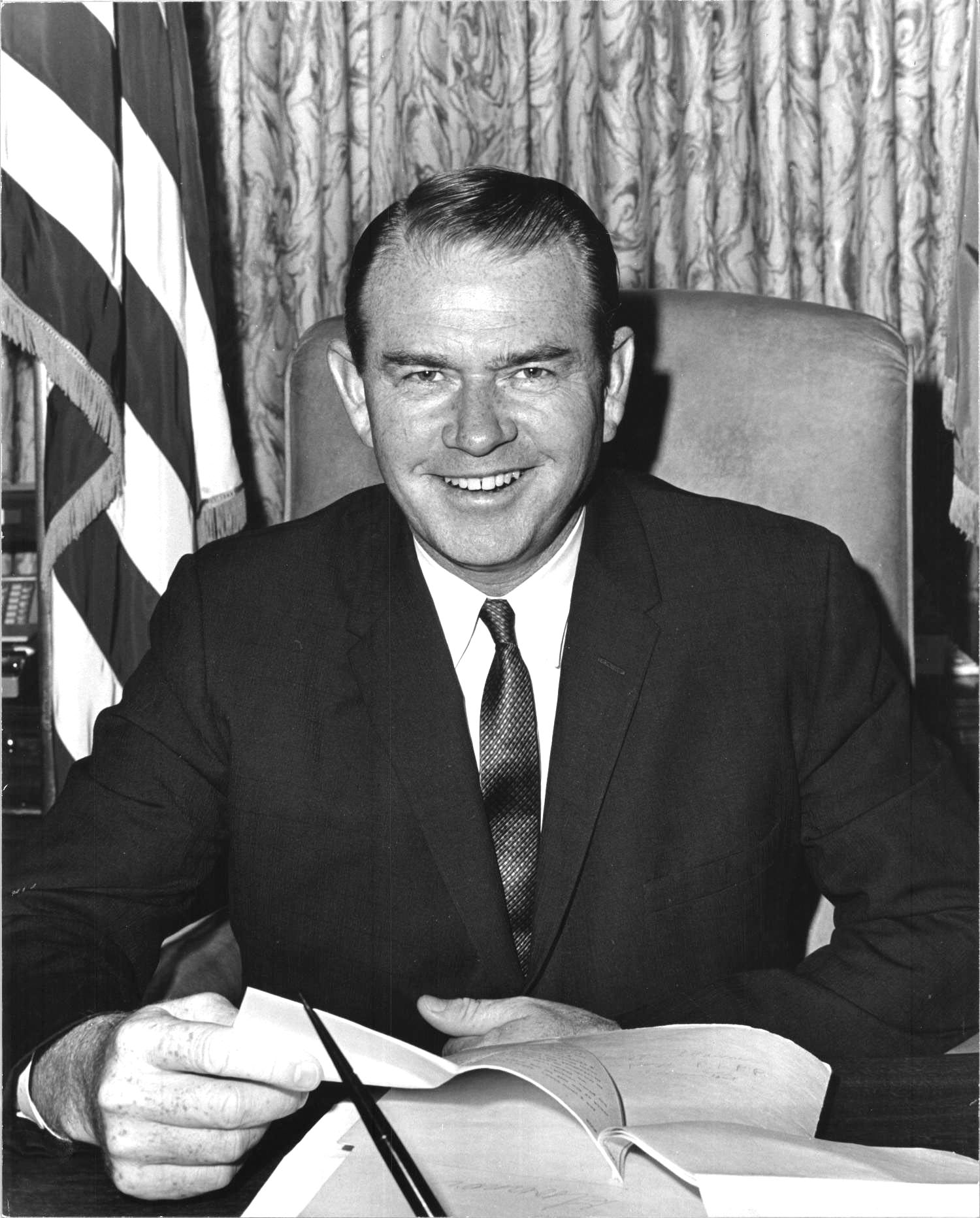
Marine Corps First Lieutenant Henry Louis Bellmon displayed heroism and leadership as a tank platoon commander during four WWII Pacific Island landings. He earned a Silver Star for bravery and inspired admiration among infantrymen who could draw water from his tank platoon.
He served one term as an Oklahoma State Legislator from 1946 to 1948 before a prolific career that included serving as Oklahoma’s first Republican Governor and U.S. Senator. He was governor from 1963 to 1967. Under Oklahoma law at the time, he was not allowed to run for a second term. He was then elected twice as U.S. Senator from Oklahoma, serving from 1968 to 1980, when he chose not to run again. In 1986, he was re-elected as governor, a position he held until 1990. Born in 1921, he seldom, if ever, discussed his gallant service during campaigns.
Bellmon first caught his superiors’ attention during his initial tank-commanding training in the United States, where he demonstrated mechanical skills he had learned on the family homestead in Billings, Oklahoma. When his M4 Sherman tank lost a track, he instructed his driver to move forward and backward slowly, and two crew members used hand tools to quickly realign the track back on.
After observing his ingenuity during training, Captain Robert M. Neiman, who took command of the forming Company C, 4th Tank Battalion, chose Second Lt. Bellmon as a platoon leader. A recent graduate of Oklahoma A&M College (now Oklahoma State University), he was soon training as a platoon leader of five tanks.
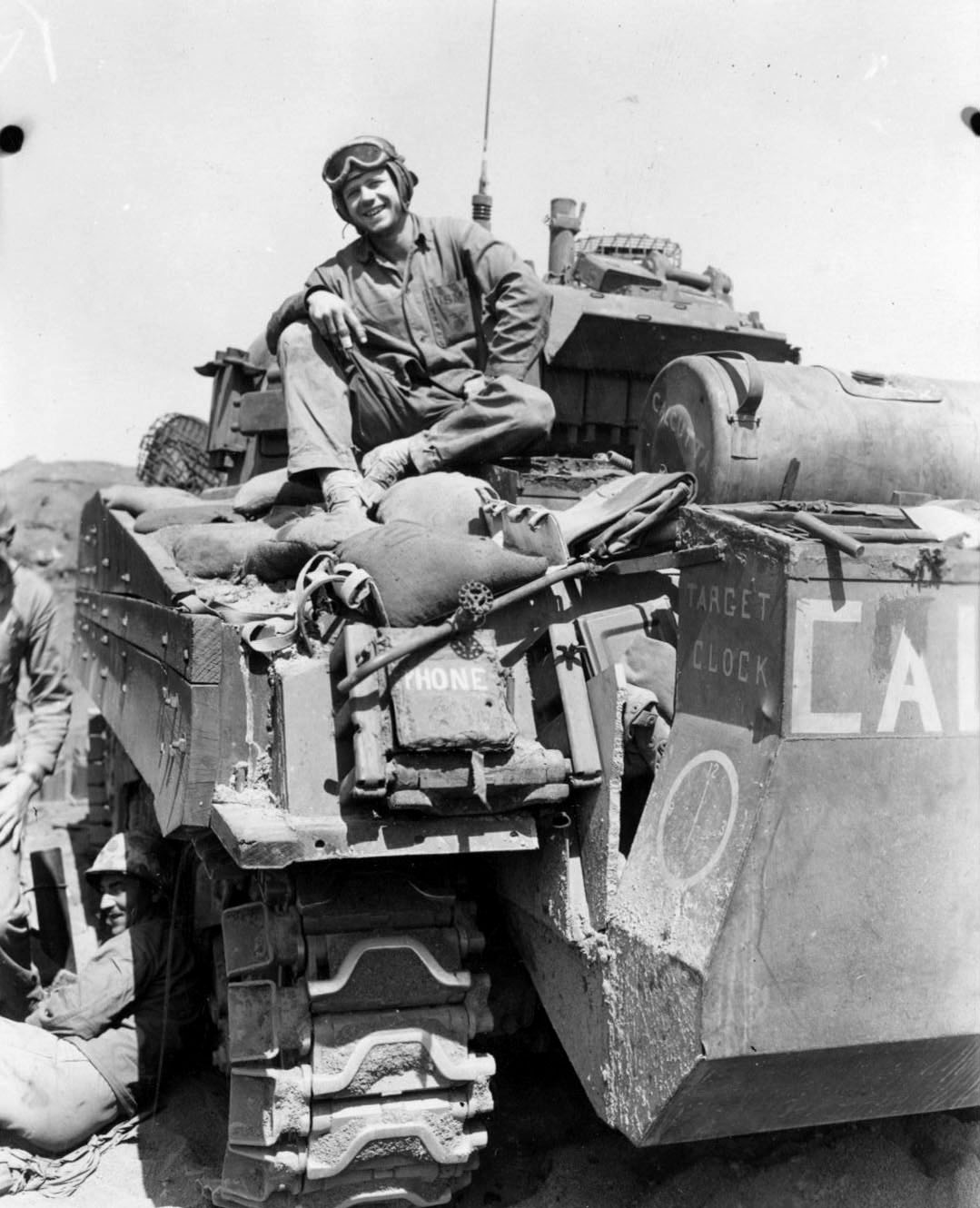
As members of the 4th Marine Division, his platoon took part in four major amphibious landings across the Central Pacific, ending with intense fighting in the battle for Iwo Jima.
Tanks served as infantry support weapons in the rugged island and jungle terrain. Their firepower helped the infantry counter Japanese defensive tactics. They were considered one of the most important weapons in the Pacific War for breaching stubborn Japanese entrenchments.
In their first combat landing at Roi-Namur (Kwajalein Atoll) in February 1944, Bellmon’s unit supported the assault on these twin islands in the Marshall Islands.
The unit returned to base on Maui, Hawaii, where Bellmon and other tank crews began modifying their tanks to enhance survival and effectiveness, showcasing their ingenuity and dedication to protecting the infantry.
Marines adapted existing equipment to demonstrate that unconventional leadership and rapid adaptation could build an elite force in significant engagements of the Pacific War.
With each return to Maui, new features were added until the modifications were deemed complete. These included water tanks to supply the infantry, wooden planking on the sides to prevent magnetic mines, radios welded to the back so the infantry could communicate with the tanks without opening hatches, protection for all hatches, and protection against mines.
These modifications clearly exemplify the Marines’ concept of adapting and improvising to defeat a resourceful enemy.
In June of 1944, during the invasion of Saipan, Bellmon’s leadership and technical skill with heavy equipment were duly noted by his commanders. He was awarded the Legion of Merit for his tank platoon’s frequent success in attacking fortified positions and traversing minefields.
In July, Bellmon’s platoon took part in the landing on Tinian, where his unit fought for all but one day of the campaign. Once again, they destroyed many enemy installations while under heavy fire.
In February 1945, Bellmon’s final combat landing at Iwo Jima was the most harrowing, as his tank was immobilized by a land mine immediately after landing.
The island, just 8 square miles in size, was key to the Pacific campaign. Its three airfields could support heavy bombers within a close 750-mile strike range of mainland Japan, making Bellmon’s actions essential to the broader war effort.
Bellmon was quoted in an interview with Jim Stafford with “The Daily Oklahoman” in 1995 on the 50th anniversary of the invasion, as remembering his tank being stranded because of Japanese fire later in the battle.
“It disabled the tracks, Bellmon said. “It was impossible to get out and fix it with all the machine gun fire, so we just sat there.”
“When we would spot a machine gun nest, we’d take it out, and of course, that drew artillery fire,” Bellmon said his tank took numerous hits. “They (the Japanese) were stupid,” he said. “They were using high-explosive artillery that exploded on impact. We would just get sparks.”
Despite the tank being a prime target for artillery, he remained inside to direct his platoon’s fire and movements by radio. Over the many days of the long battle, he had two more tanks destroyed beneath him, but continued the attack in new vehicles. Bellmon was known for his aggressive leadership. This courageous effort earned him the Silver Star for his gallantry.
He remembered taking over command of the five tanks of another platoon leader who was killed for several days.
At age 24, Iwo Jima was his most significant and last battle of the war. Approximately 70,000 Marines and Sailors participated; over 6,800 were killed, and nearly 20,000 were wounded. About 22,000 Japanese were killed or captured.
Iwo Jima lasted for 36 days of continuous combat. While military planners initially estimated the island would be secured in just three to four days, Japanese defensive strategies extended the conflict into a grueling five-week campaign.
His unit returned to Maui to train troops for the planned invasion of Japan. The use of the two atomic bombs ended the war.
Navy Fleet Adm. Chester Nimitz, commander in chief of the U.S. Pacific Fleet, said of the Battle of Iwo Jima, “If there had been any question whether there should be a Marine Corps after this war, the Battle of Iwo Jima will assure that there will always be a Marine Corps.”
Bellmon’s political achievements, including his principled approach and impact on Oklahoma’s Republican party, exemplify how his military leadership translated into public service.
After his distinguished service in Oklahoma and Washington, D.C., he taught government and political science at Oklahoma City University, Central State University, Oklahoma State University, and the University of Oklahoma, shaping future generations.
He retired to the family farm and then retired from his wheat and cattle operations in his late 70s. He died at the age of 88 in 2009 following a long struggle with Parkinson’s disease. • by Darl Devault, contributing editor