Wednesday, March 11, 2026

Care Plus Home Care Providing Services to Keep Seniors, Veterans Home

0


Right: Care Plus Home Care services of Oklahoma City is a family-owned business that has a reputation for giving quality care and attention to their clients, which includes Veterans. Pictured left to right is Katie West, Kristi Brewer-Campbell and Jaiden Campbell.


Care Plus Home Care services of Oklahoma City was established in 1993 by local businesswoman Nancy Brewer and her daughter Kristi Brewer-Campbell.

Together they have earned a reputation for giving quality care and attention to their clients, which includes Veterans.

Care Plus Home Care, located at 9828 NE 23rd Street, provides an alternative for seniors wanting to remain independent and in the comfort of their own home.

“Being family owned and operated, we have been able to provide better one-on-one service to the client,” Brewer-Campbell said. “We love helping Veterans because they served our country and we want to help them stay at home.”

She continued, “It’s so important. If you saw some of the Veterans that we take care of and know there’s backstories, you’d understand. Some of these people are young and it’s incredible to be able to make a difference for them so they don’t have to go to an institution. They get to stay in their own home because of what the VA allows us to do. It’s just an incredible program that we’re passionate about.”

Brewer-Campbell said Care Plus Home Care works with the VA to help clients with respite care options for their primary caregiver.

“Well, let’s just say a husband and wife live alone, and the husband’s a Veteran and the wife may be ill as well, and so it’s hard for her to take care of her Veteran husband,” she said. “And so, the VA sometimes will pay for respite each week as well, and so we’re able to do more that helps the whole family. We can go in and do housekeeping and laundry assistance, be there and let the family member take a break, because they’re the main caregiver.”

Brewer-Campbell said once a Veteran is approved for home care via the VA, they will do a nurse evaluation to put the care plan together.

“We go there with our nurse first for their evaluation,” she said. “And then we work with a Veteran on their days and times requested. We want to keep them at home. And if they need someone every morning, then that’s what we do, we go in every morning and we get them ready for the day. And everybody’s different and their needs are different as well.”

Care Plus Home Care also offers a variety to its senior clients including:

Round-the-clock care is a cost-effective arrangement that provides individuals 24-hour service.

Transportation is one of the most common needs expressed by older people. If mobility is a concern, the caregiver can attend any function, doctor’s appointment or errand with the client. Caregiver transportation services make it possible for individuals who do not drive to obtain rides for all their important appointments.

Alzheimer’s & Dementia Care
Most people hope to age safely and comfortably in their own homes, including those managing Alzheimer’s & Dementia. As the disease progresses it carries with it a tremendous burden on the family members who are providing the care.

“Our highly qualified caregivers are ready to provide these helpful and necessary services that can reduce the difficult and often stressful aspects of a caregiver for your loved one,” Brewer-Campbell said.

Managing medications properly is vital to a loved one’s health.

“Our caregivers can assist with opening medication containers, reading labels, and reminding the client of their scheduled medications,” she said.

Brewer-Campbell said her company has a motto they strive to reach every day. “Our motto is ‘stay home, stay well.’ And who doesn’t want to be at home? It’s just part of our passion to be able to help people who want to be at home,” she said. “Who doesn’t love being home? You’re happy if you’re at home, you’re healthier at home, and it’s just how people want to age, they want to age in place, and we help people do that.”

Brewer-Campbell praised her office staff for their dedication and service helping seniors.
“We have a really great office staff who’s worked for me for 10 plus years,” she said. “Every single one of them has worked for me for that long. And we are a good team. We really try to have great customer service. We get compliments all the time because we give attention to our clients, much needed attention. And so, we’ll follow up with them. They’re not just a number. They’re important to us, every single client. And we want every single one to be satisfied and have the best care possible.”

For more information about Care Plus Home Care call (405) 769-2551 or visit www.CarePlusatHome.com. •

by Van Mitchell, staff writer

New Book Highlights the 100-year History of Route 66

0
Shellee Graham and husband Jim Ross. Jim Ross is a Vietnam Veteran, U.S. Army 1969-1971.

Route 66 turns 100 years old in 2026, and the historic highway is highlighted in a new book “Route 66-The First 100 Years,” co-authored by acclaimed Route 66 ambassadors Jim Ross and Shellee Graham.

The book is crafted from crafted from three decades of traveling, photographing, and writing about the route by Ross and Graham.

Previous books by them include “Route 66 Sightings, Tales from the Coral Court, Route 66 Crossings, and Secret Route 66.”

Their new book explores the route from its birth in 1926 through its centennial, and experience the events, people, and places that created the legacy ensuring America’s Mother Road a place in the hearts and minds of the nation.

Route 66 was one of the United States’ first continuous stretches of paved highway and served as a major path for those who migrated to the West.

The numerical route designation “66” was assigned to the Chicago-to-Los Angeles route on April 30, 1926. “The Mother Road” was officially established on November 11, 1926, and ultimately stretched 2,448 miles (3,940 kilometers) from Chicago to Los Angeles. It became the shortest, year-round route between the Midwest and the Pacific Coast, and was also known as “The Main Street of America” and the “Will Rogers Highway”. On that date, only 800 miles of Route 66 were paved, the rest being graded dirt, gravel, bricks, or planks of wood. It took 11 more years before the entire road would be paved.

From its beginning in Chicago, Route 66 headed southwest through Illinois and Missouri, and a small section of southeast Kansas. From there it turned in a more westward direction through Oklahoma and Texas, with the final stretches in New Mexico and Arizona before its termination point in Los Angeles.

During the Dust Bowl era of the 1930s, the diagonal course of Route 66 was the primary route for migrating farm workers from the Midwest to California. The migration continued during World War II due to job availability in California.

It linked small, rural towns to larger cities, and markets. The fact that it covered mainly flat areas and featured moderate year-round weather made it an attractive route for travelers, and truckers. During this time, it also became one of the key routes for moving military equipment across the country.

Due to the efforts of the U.S. Highway 66 Association, Route 66 became the first highway to be completely paved, in 1938. In the 1950s, Route 66 became the main highway for vacationers heading to Los Angeles.

As the world’s most famous highway, Route 66 conjures up images of dreamers, road-trippers, migrants, and nomads.

The co-authors state that on a deeper level, it is a story of escape, triumph, deliverance, and adventure during the best and worst of times. From the dawn of the auto age to surviving the Great Depression and Dust Bowl years to memorable mid-century family vacations, destinies were played out on the route, leaving indelible impressions on millions.
Ross and Graham said those pilgrimages, embedded in our history, continue today, undertaken by millions more seeking to follow the same path and reimagine those times.

“Ladies of legend, the influence of Indigenous America, neon-splashed boulevards, tourist traps, motor courts, trading posts, and heroes both remembered and forgotten-all these and more await discovery between these covers,” the co-authors said.”

Ross and Graham said their new book is beautifully illustrated with hundreds of photographs, many of them vintage. The saga of Route 66 is uniquely told in a compelling narrative that celebrates the centennial of the route and pays homage to all whose lives were shaped or changed by this wondrous road.

Ross and Graham said the history of Route 66 is a story worth telling.

“Route 66 conjures up images of dreamers, road trippers, migrants, and nomads,” they said. “On a deeper level, it is a story of escape, triumph, deliverance, and adventure during the best and worst of times. From surviving the Great Depression and Dust Bowl years to memorable mid-century family vacations, Route 66 pilgrimages became embedded in our history. Today, they continue, undertaken by those seeking to follow the same path and reimagine those times.” •

by Van Mitchell, staff writer

Top Scores for VA Cemetery Services: By Freddy Groves

0

It comes as a big surprise, given the seriousness of burying a loved one, but the VA’s National Cemetery Administration (NCA) just earned an extremely high score on satisfaction with its services. As measured by the American Customer Satisfaction Index (ACSI) of over 100 government services and agencies for 2025, the NCA ranked 98 out of 100, the highest score ever. The NCA twice earned a score of 97, while the average of other government agencies was 70.4.

Last year the NCA buried over 130,000 veterans and their family members at the 157 national cemeteries in 44 states. Burial and memorial benefits include a gravesite, perpetual care of the site, a Presidential Memorial Certificate, a marker or medallion, a burial flag given at the funeral and military funeral honors that include the playing of “Taps.”

If you’re a veteran, have you made your final plans yet? Are they in writing? When the time comes, it will be easier on your family if arrangements have already been concluded. You can do this by having a pre-need determination done (VA Form 40-100007) to determine your eligibility and approval for burial.

Start with va.gov/burials-memorials and click “Eligibility.” Have your DD-214 in hand. If you need help, call them at 800-535-1117.

To learn more about your burial and memorial benefits, see
www.cem.va.gov/burial-memorial-benefits.

As part of advance planning, consider the Veterans Legacy Memorial website (www.vlm.cem.va.gov)]. Each veteran buried at a VA national cemetery has a webpage listing name, dates of birth and death, war period served, decorations, rank and more. Family members can later add photos and documents if they wish. Your advanced planning might include a handful of photos and information you’d like to see added later. Include the phone number 866-245-1490 in your information in case your family needs help with uploading files when the time comes.

Be sure your family knows where you’re keeping your pre-need approval and Veterans Legacy Memorial documents.•


(c) 2026 King Features Synd., Inc

Pennsylvania Native Completes Command Tour Aboard Future Navy Submarine

0
Capt. Aaron Stutzman (right) recently completed his command tour as the first commanding officer aboard PCU Oklahoma, a future Virginia-class submarine.

Capt. Aaron Stutzman, a native of Acme, Pennsylvania, recently completed his tour as the first commanding officer aboard Pre-Commissioning Unit (PCU) Oklahoma.

Oklahoma recently held a change of command ceremony at the Vista Point Conference Center on Naval Station Norfolk, where Stutzman turned over command of the future submarine to Cmdr. Jason C. Kim.

“I am proud of my sailors onboard PCU Oklahoma,” Stutzman said. “I was the first commanding officer and they bought into our philosophy, valuing gaining experience at sea to prepare to take Oklahoma to sea in the future. While I won’t get to take Oklahoma to sea, my sailors will, and they will be ready.”

Stutzman, a 1999 graduate of Connellsville Area High School, earned a bachelor’s in mechanical engineering from Penn State in 2003. While in the Navy, Stutzman earned a master’s in engineering management from Old Dominion University in 2012, a master’s in national security and strategic studies from the Naval War College in 2016, and a Doctorate of Education in interdisciplinary leadership from Creighton University in 2024.

Virginia Class, Fast Attack Nuclear Submarine USS Oklahoma.

The skills and values needed to succeed in the Navy are similar to those found in Acme.

“I grew up on a small farm in southwestern PA and learned the grit it takes to do the hard jobs,” Stutzman said. “I was able to apply that in my command tour of PCU Oklahoma to build a culture for new submariners that highlighted the importance of a hard work ethic, especially in a shipyard environment for sailors who joined the Navy to see the world. On Oklahoma, we lived by the ‘Code of the West’ and built our homestead.”

Stutzman has served in the Navy for 22 years.

“I joined the Navy because I was inspired by my grandfather’s service as an Army radio operator in World War II,” Stutzman said. “I stayed in the Navy and continue to serve because of the people I get to work with every day. Submariners are a very small portion of the Navy and the longer you stay in, the smaller that population gets. It becomes a family.”

Oklahoma is the second Navy vessel and the first submarine named for the Sooner State. The previous USS Oklahoma, a battleship, was sunk by nine torpedoes during the surprise attack on Pearl Harbor in 1941. The ship capsized within 15 minutes of the attack, trapping its sailors inside. Thirty-two sailors were rescued after welders on shore jumped onto the upside-down battleship and cut holes in the hull. The bodies of the 429 sailors who were trapped inside the ship were later recovered.

One of the newest of the Navy’s Virginia-class submarines, Oklahoma was designed with stealth and surveillance capabilities, as well as special warfare enhancements, to meet the Navy’s multi-mission requirements. At 377 feet long and 34 feet across at its widest point, Oklahoma is only slightly longer than a football field and is crewed by about 135 enlisted sailors and officers.

Known as America’s “Apex Predators,” the Navy’s submarine force operates a large fleet of technologically advanced vessels. These submarines are capable of conducting rapid defensive and offensive operations around the world, in furtherance of U.S. national security.

There are three basic types of submarines: fast-attack submarines, ballistic-missile submarines and guided-missile submarines.
Fast-attack submarines, like Oklahoma, are designed to hunt down and destroy enemy submarines and surface ships; strike targets ashore with cruise missiles; carry and deliver Navy SEALs; conduct intelligence, surveillance, and reconnaissance missions; and engage in mine warfare. The Virginia-class fast-attack submarine is the most advanced submarine in the world today. It combines stealth and payload capability to meet Combatant Commanders’ demands in this era of strategic competition.

Strategic deterrence is the nation’s ultimate insurance program, according to Navy officials. As a member of the submarine force, Stutzman is part of the rich 125-year history of the U.S. Navy’s most versatile weapons platform, capable of taking the fight to the enemy in the defense of America and its allies.

The U.S. Navy is celebrated its 250th birthday last year.

According to Navy officials, “America is a maritime nation and for 250 years, America’s Warfighting Navy has sailed the globe in defense of freedom.”

With 90% of global commerce traveling by sea and access to the internet relying on the security of undersea fiber optic cables, Navy officials continue to emphasize that the prosperity of the United States is directly linked to recruiting and retaining talented people from across the rich fabric of America.

Stutzman serves a Navy that operates far forward, around the world and around the clock, promoting the nation’s prosperity and security.

“Serving in the Navy means protecting our American way of life,” Stutzman said. “Providing a future for my family and my children is why I continue to do what I do.”

Stutzman is grateful to others for helping make a Navy career possible.

“I want to thank all those in Oklahoma who welcomed us with open arms to build relationships that will last the life of the ship,” Stutzman said. “Especially to the USS Oklahoma Commissioning Committee for stepping up and showing us what the Oklahoma Standard really means.” •
by Ashley Craig, Navy Office of Community Outreach

SPECIAL FROM A VETERAN: The Crossing by James Ferguson

0
S.S. Joseph N. Teal, a Liberty ship, brought Private Jim Fergeson and hundreds of troops to Bari, Italy, from April-May,1944. Photo by Multnomah County Library, Oregon.

“When my son was learning about WWII in the 1970’s, I prepared this article to document my journey to Europe.

I left the United States for an unknown destination on 21 April 1944 on the S.S. Joseph N. Teal with my 420th Signal Company (120 men) and hundreds more onboard.

After being at sea a few days, we learned we were going to Italy. At that time, Italy was the only place on the European continent where the US Army was actively engaged in ground combat with Germany.

While crossing the Atlantic in early 1944 was still very hazardous because of the German U- boat threat, the Mediterranean was a much greater risk. I was not concerned. Youth and ignorance were on my side.

The convoy stretched from horizon to horizon. Among the many ships were an aircraft carrier and other warships. Even our ship, a merchant carrier, was fitted with some formidable weapons operated by a US Navy gun crew. I felt safe and secure. This was a great adventure and I was looking forward to the crossing.

Progress was slow as the ships in the convoy zigged and zagged, in unison, across the Atlantic.

Our own company cooks prepared the meals…Fresh fruit and vegetables, which were plentiful the first few days, soon were exhausted. Rice and dehydrated eggs and potatoes replaced the fresh food.

Second servings, which had been standard, were no longer available. For the first time in my life, I experienced real, genuine hunger…(Only after reaching Italy and observing real starvation among the local population did I finally realize what hunger really was.)

The great adventure I had envisioned slowly gave way to reality. The daily routine of calisthenics, meager meals that looked and tasted pretty much the same as yesterdavs, the lack of fresh water showers, and general boredom soon took its toll on morale.

I would slip up on deck at night just to get away from the mass of humanity. Rows of bunks, five high, about eighteen inches apart, filled the ship’s cargo hold…Those in the lower bunks were in jeopardy of nausea showers from sea sick GIs above.

The morale officer organized USO type skits for entertainment. GIs, dressed as females, brought howls of laughter. They looked comically ridiculous in their make shift skirts, Improvised breast augmentation, rag mop hairpieces, hairy legs, and clumsy Gl boots.

Another morale booster was the Red Cross gifts. We each received a drawstring bag filled with toilet articles, a sewing kit and a candy bar. The candy was a single Baby Ruth bar. It was indeed a welcome sight, a magnificent feast…I lay in my bunk, slowly removed the wrapper and took a small nibble…I slowly devoured the entire bar in this manner, making it last as long as possible.

As we approached Gibraltar, the Navy gun crews uncovered their weapons and fired a few practice rounds. Most of us sat on deck and watched attentively as the crew prepared to load and fire.

Early the next morning…The ship was silent. There was no sound from the engine room or no sound of the screw moving the ship though the water…I rushed up on deck. There ahead about a mile was the rock of Gibraltar.

However, the convoy was gone. True to plan, if any ship experienced trouble, the convoy would continue. Overhead was a British flying boat at mast altitude slowing circling our ship and watching for submerged German submarines. German U-boats favored the Straits of Gibraltar.

The narrowing of the Atlantic Ocean to meet the Mediterranean Sea provided a narrow funnel through which all allied convoys bound for Italy must pass. Eventually, a British tug towed the ship into the safety of Gibraltar harbor.

We remained there for a week for repairs…Just prior to leaving the safety of the harbor, we assembled on the ship’s fantail for an unexpected briefing. German planes using remotely controlled glider bombs had attacked the convoy…There was a loss of ships and lives.

When exiting the harbor, massive underwater gates were opened to let our ship through…

The next day, two German planes observed us from a distance, but did not attack. Then, the Mediterranean experienced a severe storm with heavy seas and low visibility. This storm slowed our progress, but provided much needed protection until we were near Sicily and allied naval and air power.

Finally, on 23 May 1944, we reached the safety of harbor at Bari, Italy. Thirty-three days had elapsed since departing the United States.” •
story and photos submitted by James Ferguson

Changes in VA Law May Affect How Veterans’ Claims Are Processed Over the Recent Years

0

Veterans who applied for U.S. Department of Veterans Affairs benefits in the past – or who have never applied – may want to review their eligibility as changes in federal law and VA policy can affect how claims are processed.
The U.S. Department of Veterans Affairs, a federal agency, administers benefits through separate systems with different eligibility requirements. VA health care is managed by the Veterans Health Administration, while disability compensation and other benefits are handled by the Veterans Benefits Administration. Eligibility decisions in one system do not automatically determine eligibility in the other.
Recent updates to VA law and policy, including expanded presumptive conditions and revised service-connection guidance, may affect how claims are reviewed today. Veterans who were previously denied, paused the claims process, or have not revisited their eligibility in several years may benefit from having their information reviewed.
The Oklahoma Department of Veterans Affairs (ODVA), a state agency, works with the federal VA to help veterans understand the claims process and available options. Veterans are encouraged to review their service history and medical conditions and to speak with an accredited Veteran Service Officer (VSO). VSOs provide free assistance and help ensure claims are submitted with current information.
In addition to claims assistance, ODVA offers state-level programs for veterans and their families, including a Women Veterans Program, employment assistance, entrepreneurship support, long-term care services, and the Oklahoma Veterans Registry, which helps connect veterans with available resources and outreach opportunities.
Veterans seeking more information can contact the Oklahoma Department of Veterans Affairs at 405-523-4026 or visit oklahoma.gov/veterans.gov
About the Oklahoma Department of Veterans Affairs:
The Oklahoma Department of Veterans Affairs (ODVA) delivers high-quality care, benefits, and support to Oklahoma veterans and their families through programs such as State Veterans Homes, Claims & Benefits, OKVetWorks, Women Veterans, Health & Wellness, Mental Health, and the Veterans Registry.

Scottish Rite Temple Has Unique History

0
The Scottish Rite Temple in Guthrie has served multiple functions in Oklahoma history including as the first capitol building of Oklahoma. The building features several prominent rooms including a theater.

The Scottish Rite Temple located at 900 E. Oklahoma Avenue in Guthrie has served multiple functions in Oklahoma history, including as the first state capitol building, as a location for TV and film production and as a site used by Freemasonry for educational and gathering purposes.
On April 22, 1889, Harper Samuel Cunningham, 33°, made the Run of the Unassigned Lands which opened for settlement. He came to practice law in the newly opened Territory. And he came to establish the Ancient and Accepted Scottish Rite of Freemasonry in what would soon become Oklahoma.
Designed for the use and benefit of the Masonic Fraternity in Oklahoma, the original Temple was situated at the northeast corner of Harrison and Broad Streets in downtown Guthrie. It served the Masons well from 1899 to 1923.
The original building in this complex, now named the East Annex, was constructed in 1908 by the city of Guthrie and called Convention Hall. It was intended as the meeting place for the Oklahoma State Legislature. It was a rectangular brick structure with two two-story wings flanking a two-story atrium having a gallery promenade. A basement completed the internal space.
The East Annex was used for one regular session of the Legislature in 1909 and one special session in 1910.
After the Legislature agreed to move the state capital from Guthrie to Oklahoma City in 1910, the city of Guthrie offered to sell the Convention Hall complex, including Capitol Park, to the Scottish Rite Masons, who wanted to construct a temple in Guthrie.
A deal was concluded with the Parr & Hawk, an Oklahoma City architectural firm, to design the western building (designated as the Temple), and the James Stewart Construction Company began construction in May 1920. Construction of the Guthrie Scottish Rite Temple was completed in 1924, at which time the Masons occupied the building, though interior finishes were not finalized until 1929.
It was listed on the U.S. National Register of Historic Places in 1987.
The Scottish Rite is one of the most widely practiced rites within Freemasonry, comprising 33 degrees that build upon the ethical teachings of the first three degrees conferred in Blue Lodges. The Scottish Rite emphasizes moral and philosophical education, allowing members to deepen their understanding of Freemasonry and its values.
The Scottish Rite Temple is a significant Masonic building that serves as a center for the Ancient and Accepted Scottish Rite of Freemasonry, offering education, fellowship, and community service.
“We’re like a college-level class of the usual Masonry that you see in hometown lodges,” Masonic Rite Temple General Secretary Glen Chaney said. “We have a continuation of the same purpose, which is to take good men and make better men. We are a philosophy, not a religion. We require that our members be eligible, that they do believe in a god, a greater spirit. We do not dictate who that is or what that is. It must be a force of good that all humankind has a soul that is immortal. And past that, we leave religion to individuals. What we do is try to make this world better.”
Chaney said the Scottish Rite takes Masons through philosophical degrees and ceremonies and teaches lessons of moral and integrity through theatrical team performances.
“We in Guthrie are very proud because we are the mecca for this level of Masonic instruction,” Chaney said. “We have been the guiding light that other people come to see how we do it.”
Chaney said Masons come from across the country as well as far away as Brazil, Canada and Germany/
“We’re one of the few temples that do all 29 degrees. We do that once a year. That takes three days,” Chaney said. “We have theatrical teams for each of those degrees, and they come in and do that. We call that drinking from the fire hydrant of knowledge because it just knocks you down, overwhelms you.”
Chaney said each fall they do a two-day version of instruction, which encompasses 14 degrees.
Tim Heaton, Facilities Manager, said the Temple is large enough to house the Masons while in Guthrie.
“This building’s so huge that we just have the space,” he said.
Heaton said the housing includes 19 apartments plus other bed spaces throughout the Temple.
“They look like Warren and June Cleaver’s bedroom with an ensuite. Completed in 1952. They still look like 1952,” he said. “They’ve been featured in several movies.”
Heaton said they feed members on-site as well as eat at various Guthrie restaurants.
Heaton said public Temple tours take place Monday to Thursday at 10 a.m.
“People from every walk of life like to find out, want to come see this place,” he said. “We get a lot of Masons from around the country as well who know this place and it becomes a destination for them to come see.”
The Scottish Rite Temple in Guthrie has served as a filming location for several movies and TV shows, including the 2020 film “Reagan.”
“They (film crew) built the (replica) of the Oval Office here,” he said.
Heaton added that the Temple served as the backdrop of the White House for the “Reagan” movie, as well as scenes replicating a train station.
The Scottish Rite Temple has members that are Veterans, including Chaney an U.S. Army Veteran.
“A number of our members are Veterans,” he said. “Masonry is something that is appealing to Veterans. I have seen young men that came in and they didn’t know what they’re getting into and suddenly, it’s like the whole world is lit up and they could see so many avenues for thought, for service in the community, for just being a better person.”
Chaney said becoming a Mason was a defining moment in his life.
“This has been, for me, one of the most defining aspects of my life,” he said. “It’s made me look at the way I treat the world and try to do a little better.”
For more information about the Guthrie Scottish Rite Temple call (405)282-1281 or visit www.guthriescottishrite.org. • by Van Mitchell, staff writer

Oklahoma City Native Supports U.S. Navy’s “Take Charge and Move Out” Mission in the Heartland

0
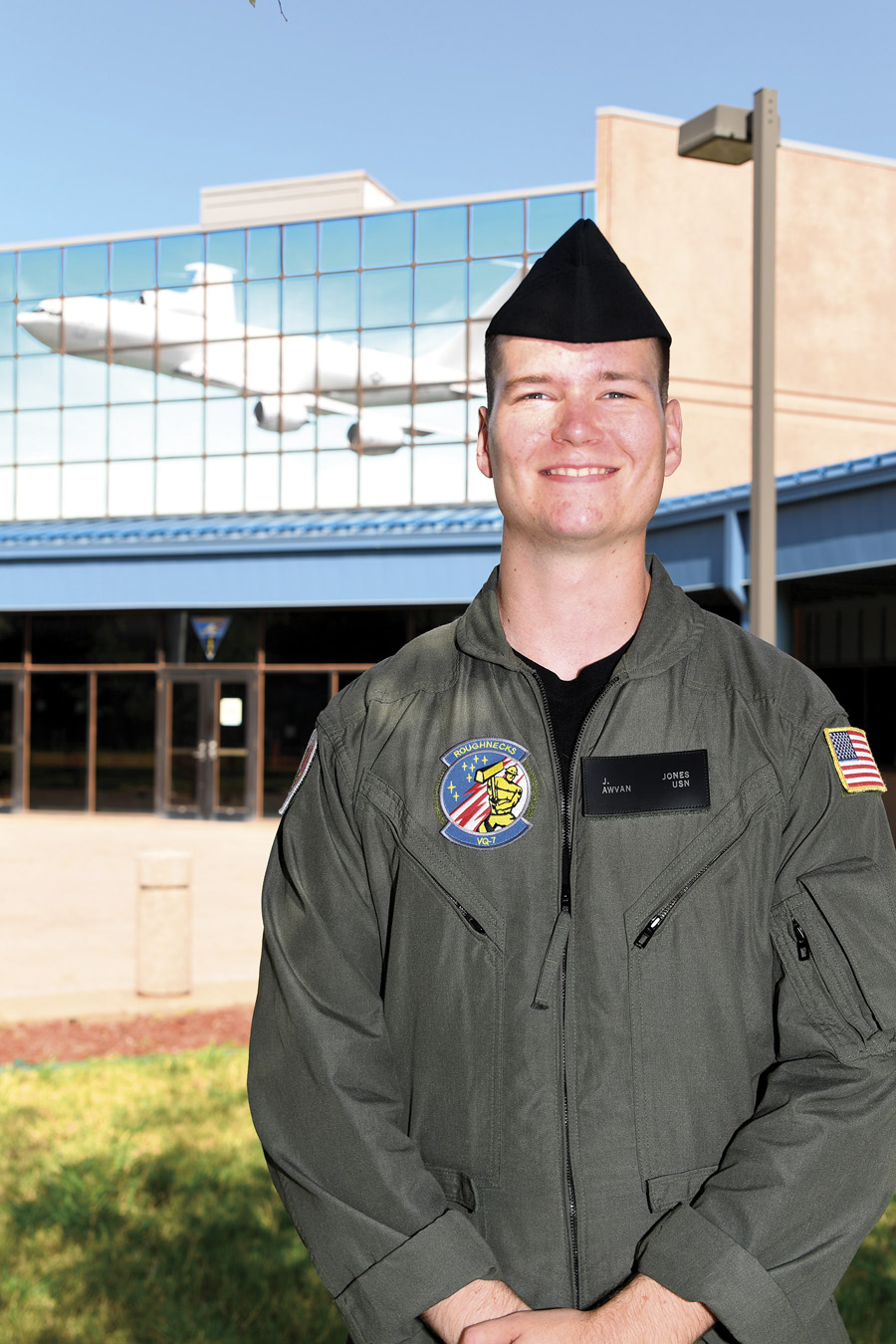
Airman Jensen Jones graduated from Southmoore High School. Photo by Mass Communication Specialist 1st Class Justin Johndro.

Airman Jensen Jones, a native of Oklahoma City, learned skills and values in the Heratland that would be foundational to their success in the Navy.

“Growing up, I learned the importance of patience and trying to understand the perspective of others,” Jones said.

Jones graduated from Southmoore High School in 2024.

Jones joined the Navy one year ago.

“I joined the Navy because I wanted to do something with meaning,” Jones said. “When I was in Boy Scouts, we got to spend the night aboard the retired aircraft carrier, USS Lexington, and I really enjoyed it.”

Today, Jones serves as a naval air crewman (avionics) assigned to Fleet Air Reconnaissance Squadron Seven (VQ-7) in Oklahoma City. Jones supports the nation’s nuclear deterrence mission at Strategic Communications Wing One (STRATCOMMWING ONE). Its “Take Charge and Move Out” (TACAMO) mission provides airborne communication links to nuclear missile units of U.S. Strategic Command.

The TACAMO mission originated in 1961 when a Marine Corps aircraft was used to test the feasibility of an airborne Very Low Frequency (VLF) communications system. Once the test was successful, funding for the program was granted, and it has continued to grow ever since.

The U.S. Navy’s presence on an Air Force base in a landlocked state may seem strange, but the position is strategic, allowing squadrons to quickly deploy around the world in support of the TACAMO mission.

The U.S. Navy is celebrating its 250th birthday this year.
According to Navy officials, “America is a maritime nation and for 250 years, America’s Warfighting Navy has sailed the globe in defense of freedom.”

With 90% of global commerce traveling by sea and access to the internet relying on the security of undersea fiber optic cables, Navy officials continue to emphasize that the prosperity of the United States is directly linked to recruiting and retaining talented people from across the rich fabric of America.

Jones has many opportunities to achieve accomplishments during military service.
“I’m proud that I graduated in the top 10% of my class for Navy training school,” Jones said. “I’m also proud that I earned two promotions while in boot camp.”

Jones serves a Navy that operates far forward, around the world and around the clock, promoting the nation’s prosperity and security.

“It’s an honor doing a job that actually makes a difference,” Jones said. “I am proud to be able to protect the freedom of all Americans.”

Jones is grateful to others for helping make a Navy career possible.

“I want to thank all my family for their support,” Jones added. “I especially would like to thank my parents, Jeff and Kristi Jones, for their continued support and for all they taught me growing up, which made me the person I am today.” •
By Alvin Plexico, Navy Office of Community Outreach

Word Search – 03-01-26

0

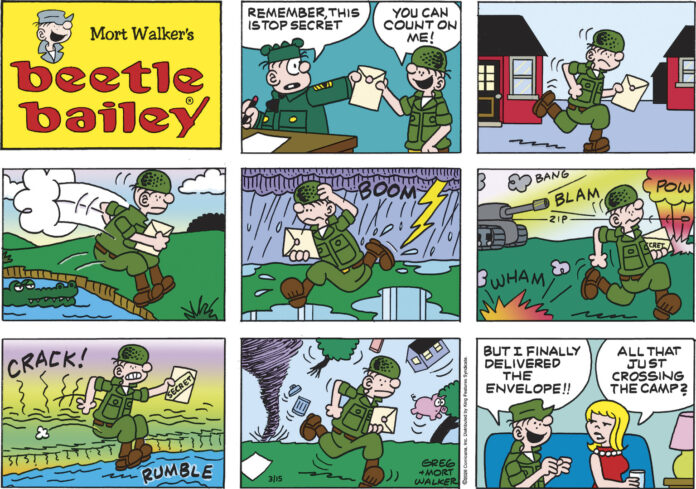
Beetle Bailey – 03-01-26

0

Social

0FansLike
0FollowersFollow
0SubscribersSubscribe