Cory Jeans is Chaplain at Miller Hospice, Tulsa, OK.
Father, I thank you for this day. This simple prayer is how I begin and end each day. As someone who has had a few near-death experiences, I find it necessary to thank Him for every day He blesses me with. Being thankful can be easy when life is great, but finding reasons to be thankful is difficult during life’s trials. Our faith allows us to be grateful for these days, even when things look bleak. The unknowns of life have a way of weighing on us and hurting our faith.
Faith is an amazing thing; we trust in Him, not knowing what lies ahead. My grandfathers kept their faith during the Korean War, and my brother kept his faith during Operation Enduring Freedom. These three men did not know what the next ten minutes would hold, let alone the next day. I have listened to their stories of what they endured during those times of chaos, and it made me realize that my own struggles and trials seemed trivial compared to what they faced daily. Yet we all face something in life that feels like it can break us, maybe even draw us away from our faith.
Even through my own struggles, near-death experiences, and heartbreaks, my faith has never wavered, just like those brave men I call family. Going into each day knowing that our Father in Heaven knows our stories, every detail of our lives, assures us that even through the bad moments, He will use them for His good and bring us through our storm. Knowing that our Father gives peace and strength to face trials and tribulations gives us a shining light at the end of that journey. A comfort that is supernatural and can not be explained to those who do not know Him.
When we thank Him in the midst of hurt, we are letting Him know our faith is in His plan. The lessons learned from our journeys are that, whether times are good or bad, He never leaves our side. We must stay focused on Him so we can walk through the storms, but when the storms distract us, He will be there to pull us up above the water. So, during the hard times and the fantastic times, take time to thank Him for the day He has given you to be here and to work for Him.
Having faith that Jesus is who He said He is gives us salvation and a place in the Kingdom with the Father. Faith that He knows what is best for us lets us live a life that is glorified. Yet faith does not come without struggles. We are never guaranteed a life without problems, just that we will have a Savior and a Father who will never leave us. So, Father, I thank you for this day, a day when I can talk to those who know You and those who will come to know You. Guide us through this life and build our Faith in You. •
by Cory Jeans
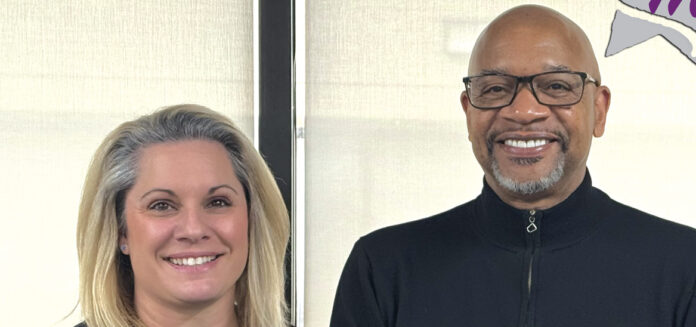
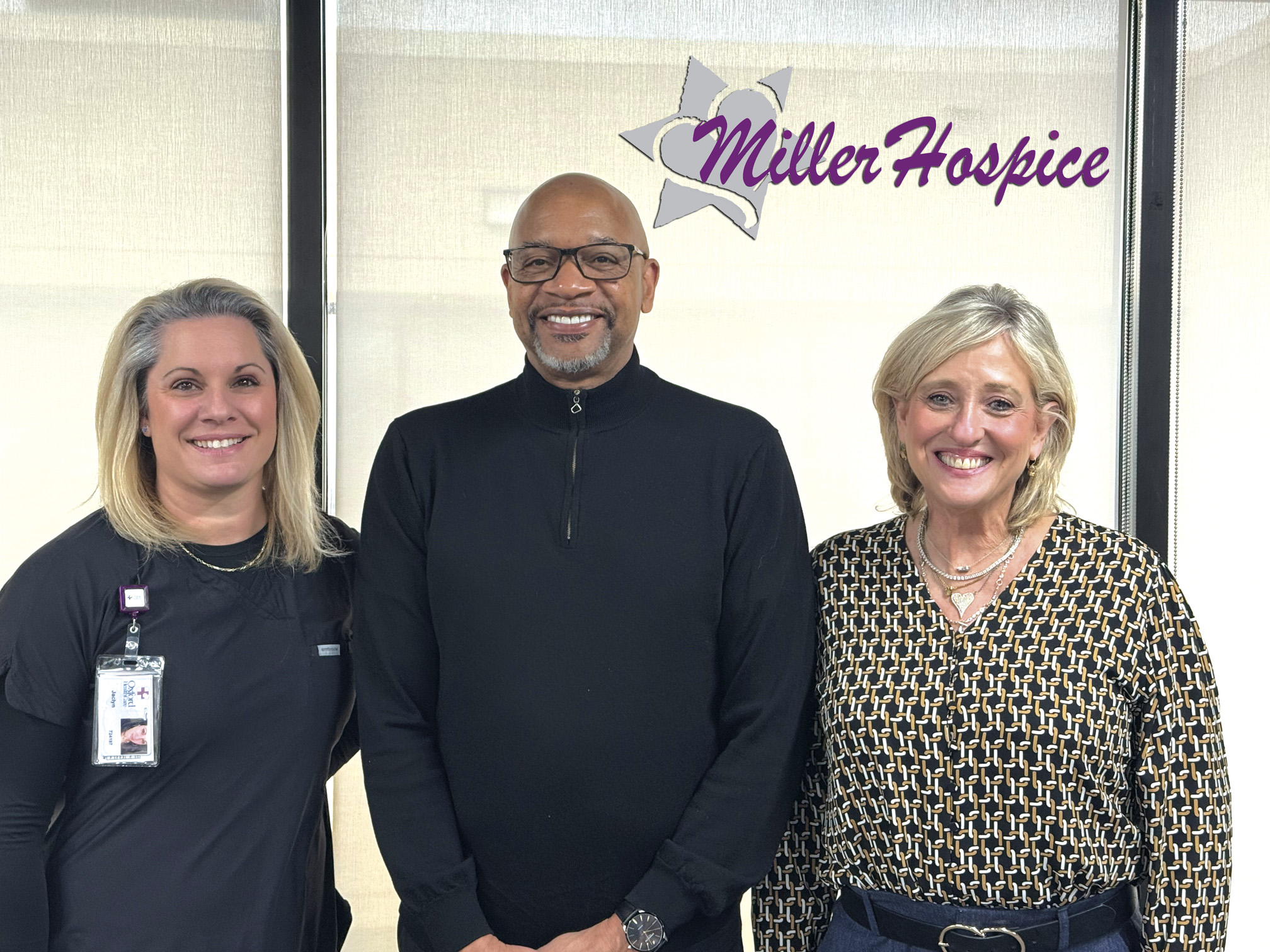
Pictured above are: Jaclyn Solomon, Oxford HealthCare, Tony MicMillan and Michelle Fox with Miller Hospice.
Tulsa based Miller Hospice and Oxford Healthcare will be hosting an inaugural event for veterans on March 13th at VFW Post 557. The event will be called a “Day of Honor”. Mission BBQ is an event sponsor and will provide a free lunch.
Highlights of the event include: • Giveaways and door prizes. • Veteran Service Officer will be present to help with benefit needs/questions. • A Keller Williams real estate representative will be on sight to help with obtaining a veteran certificate to purchase a home. • Derrick Ogle, Chief of Engineering for the VA, will be present. • Guest speakers and the singing of the national anthem by a local singer.
Tony McMillan, Miller Hospice’s Bereavement and Veteran Outreach coordinator shared that they wanted to do something outside of Veteran’s Day to salute and thank veterans and show them that they can be taken care of by both entities.
McMillan, a retired Desert Storm combat veteran whose spouse also served more than twenty years in the Army, developed his passion for veterans by being one and is committed to helping them. He went on to say, “A Day of Honor is about recognition, dignity and connection. Veterans carry a lot with them in relation to their service, especially as they age”. Miller Hospice wants veterans to know that their service, their life and their stories matter. Many veterans are alone or isolated at the end stages of their life and find it difficult to connect with people outside of their home. Miller Hospice partners with the VA to help veterans have the best possible experience. They offer educational programs in relation to sicknesses that may be related to specific times of service. They understand that Post Traumatic Stress may also come with moral injuries related to combat service. Miller Hospice wants veterans to know they have great love, respect and compassion for them. They are committed to helping veterans have access to the resources they have earned. Additionally, McMillan and Michelle Fox, the Executive Director of Miller Hospice, understand that veterans grieve differently and deserve care from people who honor their individual experience in a place that is safe to share. Grief groups for them and their families is one of the ways they do this.
Jaclyn Solomon who is a licensed Occupational Therapy Assistant and currently the Account Executive for Oxford HealthCare, has served veterans for nearly two decades. She is the former spouse of a Marine, and her father also served in the Army as a Buck Sergeant. She has worked at Quantico and Cherry Point serving active and retired service members. Oxford HealthCare serves a 50 mile radius of Tulsa and has a 4.5 star rating from CMS.gov (Center for Medicare and Medicaid Services), offers a variety of services that allows care for those that served while working closely with VA contracts.
Miller Hospice serves an approximate 50 mile radius of Tulsa. They have earned a five star rating from CMS.
McMillan added that the objective of the event is to make veterans feel honored and said that honor is not something they just say, it is what they do!
Miller Hospice is a locally owned, non-profit care provider that is committed to caring for the body, mind, and spirit of each individual along with his or her family. Being local and a non-profit are both important because it means the patient care is our priority, ensuring excellent, compassionate care. We serve people of all denominations, nationalities, races and creeds. As a non-profit, our patients will never pay for our services, even if they are not eligible for Medicare or private insurance coverage.
Our expert care team provides services including: nursing, home health aides, medical social workers, chaplains, durable medical equipment, medical supplies, medications and volunteers FREE of charge.
At Miller Hospice we are committed to focus not only on the patient but on the family, too. We understand that the end-of-life care journey can be demanding and stressful for everyone. Therefore, our hospice team is there to help meet the emotional and spiritual needs of the patients as well as their loved ones. The hospice team is highly skilled and will be available to assess both your needs and your family’s.
The “Day of Honor” is a free event for veterans only. Veterans are asked to call 918-742-6415 to RSVP. The address of VFW Post 557 is 1109 E. Sixth Street, Tulsa. •
by Jill Stephenson, staff writer
Capt. Aaron Stutzman (right) recently completed his command tour as the first commanding officer aboard PCU Oklahoma, a future Virginia-class submarine.
Capt. Aaron Stutzman, a native of Acme, Pennsylvania, recently completed his tour as the first commanding officer aboard Pre-Commissioning Unit (PCU) Oklahoma.
Oklahoma recently held a change of command ceremony at the Vista Point Conference Center on Naval Station Norfolk, where Stutzman turned over command of the future submarine to Cmdr. Jason C. Kim.
“I am proud of my sailors onboard PCU Oklahoma,” Stutzman said. “I was the first commanding officer and they bought into our philosophy, valuing gaining experience at sea to prepare to take Oklahoma to sea in the future. While I won’t get to take Oklahoma to sea, my sailors will, and they will be ready.”
Stutzman, a 1999 graduate of Connellsville Area High School, earned a bachelor’s in mechanical engineering from Penn State in 2003. While in the Navy, Stutzman earned a master’s in engineering management from Old Dominion University in 2012, a master’s in national security and strategic studies from the Naval War College in 2016, and a Doctorate of Education in interdisciplinary leadership from Creighton University in 2024.
Virginia Class, Fast Attack Nuclear Submarine USS Oklahoma.
The skills and values needed to succeed in the Navy are similar to those found in Acme.
“I grew up on a small farm in southwestern PA and learned the grit it takes to do the hard jobs,” Stutzman said. “I was able to apply that in my command tour of PCU Oklahoma to build a culture for new submariners that highlighted the importance of a hard work ethic, especially in a shipyard environment for sailors who joined the Navy to see the world. On Oklahoma, we lived by the ‘Code of the West’ and built our homestead.”
Stutzman has served in the Navy for 22 years.
“I joined the Navy because I was inspired by my grandfather’s service as an Army radio operator in World War II,” Stutzman said. “I stayed in the Navy and continue to serve because of the people I get to work with every day. Submariners are a very small portion of the Navy and the longer you stay in, the smaller that population gets. It becomes a family.”
Oklahoma is the second Navy vessel and the first submarine named for the Sooner State. The previous USS Oklahoma, a battleship, was sunk by nine torpedoes during the surprise attack on Pearl Harbor in 1941. The ship capsized within 15 minutes of the attack, trapping its sailors inside. Thirty-two sailors were rescued after welders on shore jumped onto the upside-down battleship and cut holes in the hull. The bodies of the 429 sailors who were trapped inside the ship were later recovered.
One of the newest of the Navy’s Virginia-class submarines, Oklahoma was designed with stealth and surveillance capabilities, as well as special warfare enhancements, to meet the Navy’s multi-mission requirements. At 377 feet long and 34 feet across at its widest point, Oklahoma is only slightly longer than a football field and is crewed by about 135 enlisted sailors and officers.
Known as America’s “Apex Predators,” the Navy’s submarine force operates a large fleet of technologically advanced vessels. These submarines are capable of conducting rapid defensive and offensive operations around the world, in furtherance of U.S. national security.
There are three basic types of submarines: fast-attack submarines, ballistic-missile submarines and guided-missile submarines.
Fast-attack submarines, like Oklahoma, are designed to hunt down and destroy enemy submarines and surface ships; strike targets ashore with cruise missiles; carry and deliver Navy SEALs; conduct intelligence, surveillance, and reconnaissance missions; and engage in mine warfare. The Virginia-class fast-attack submarine is the most advanced submarine in the world today. It combines stealth and payload capability to meet Combatant Commanders’ demands in this era of strategic competition.
Strategic deterrence is the nation’s ultimate insurance program, according to Navy officials. As a member of the submarine force, Stutzman is part of the rich 125-year history of the U.S. Navy’s most versatile weapons platform, capable of taking the fight to the enemy in the defense of America and its allies.
The U.S. Navy is celebrated its 250th birthday last year.
According to Navy officials, “America is a maritime nation and for 250 years, America’s Warfighting Navy has sailed the globe in defense of freedom.”
With 90% of global commerce traveling by sea and access to the internet relying on the security of undersea fiber optic cables, Navy officials continue to emphasize that the prosperity of the United States is directly linked to recruiting and retaining talented people from across the rich fabric of America.
Stutzman serves a Navy that operates far forward, around the world and around the clock, promoting the nation’s prosperity and security.
“Serving in the Navy means protecting our American way of life,” Stutzman said. “Providing a future for my family and my children is why I continue to do what I do.”
Stutzman is grateful to others for helping make a Navy career possible.
“I want to thank all those in Oklahoma who welcomed us with open arms to build relationships that will last the life of the ship,” Stutzman said. “Especially to the USS Oklahoma Commissioning Committee for stepping up and showing us what the Oklahoma Standard really means.” •
by Ashley Craig, Navy Office of Community Outreach
Right: Care Plus Home Care services of Oklahoma City is a family-owned business that has a reputation for giving quality care and attention to their clients, which includes Veterans. Pictured left to right is Katie West, Kristi Brewer-Campbell and Jaiden Campbell.
Care Plus Home Care services of Oklahoma City was established in 1993 by local businesswoman Nancy Brewer and her daughter Kristi Brewer-Campbell.
Together they have earned a reputation for giving quality care and attention to their clients, which includes Veterans.
Care Plus Home Care, located at 9828 NE 23rd Street, provides an alternative for seniors wanting to remain independent and in the comfort of their own home.
“Being family owned and operated, we have been able to provide better one-on-one service to the client,” Brewer-Campbell said. “We love helping Veterans because they served our country and we want to help them stay at home.”
She continued, “It’s so important. If you saw some of the Veterans that we take care of and know there’s backstories, you’d understand. Some of these people are young and it’s incredible to be able to make a difference for them so they don’t have to go to an institution. They get to stay in their own home because of what the VA allows us to do. It’s just an incredible program that we’re passionate about.”
Brewer-Campbell said Care Plus Home Care works with the VA to help clients with respite care options for their primary caregiver.
“Well, let’s just say a husband and wife live alone, and the husband’s a Veteran and the wife may be ill as well, and so it’s hard for her to take care of her Veteran husband,” she said. “And so, the VA sometimes will pay for respite each week as well, and so we’re able to do more that helps the whole family. We can go in and do housekeeping and laundry assistance, be there and let the family member take a break, because they’re the main caregiver.”
Brewer-Campbell said once a Veteran is approved for home care via the VA, they will do a nurse evaluation to put the care plan together.
“We go there with our nurse first for their evaluation,” she said. “And then we work with a Veteran on their days and times requested. We want to keep them at home. And if they need someone every morning, then that’s what we do, we go in every morning and we get them ready for the day. And everybody’s different and their needs are different as well.”
Care Plus Home Care also offers a variety to its senior clients including:
Round-the-clock care is a cost-effective arrangement that provides individuals 24-hour service.
Transportation is one of the most common needs expressed by older people. If mobility is a concern, the caregiver can attend any function, doctor’s appointment or errand with the client. Caregiver transportation services make it possible for individuals who do not drive to obtain rides for all their important appointments.
Alzheimer’s & Dementia Care
Most people hope to age safely and comfortably in their own homes, including those managing Alzheimer’s & Dementia. As the disease progresses it carries with it a tremendous burden on the family members who are providing the care.
“Our highly qualified caregivers are ready to provide these helpful and necessary services that can reduce the difficult and often stressful aspects of a caregiver for your loved one,” Brewer-Campbell said.
Managing medications properly is vital to a loved one’s health.
“Our caregivers can assist with opening medication containers, reading labels, and reminding the client of their scheduled medications,” she said.
Brewer-Campbell said her company has a motto they strive to reach every day. “Our motto is ‘stay home, stay well.’ And who doesn’t want to be at home? It’s just part of our passion to be able to help people who want to be at home,” she said. “Who doesn’t love being home? You’re happy if you’re at home, you’re healthier at home, and it’s just how people want to age, they want to age in place, and we help people do that.”
Brewer-Campbell praised her office staff for their dedication and service helping seniors.
“We have a really great office staff who’s worked for me for 10 plus years,” she said. “Every single one of them has worked for me for that long. And we are a good team. We really try to have great customer service. We get compliments all the time because we give attention to our clients, much needed attention. And so, we’ll follow up with them. They’re not just a number. They’re important to us, every single client. And we want every single one to be satisfied and have the best care possible.”
For more information about Care Plus Home Care call (405) 769-2551 or visit www.CarePlusatHome.com. •
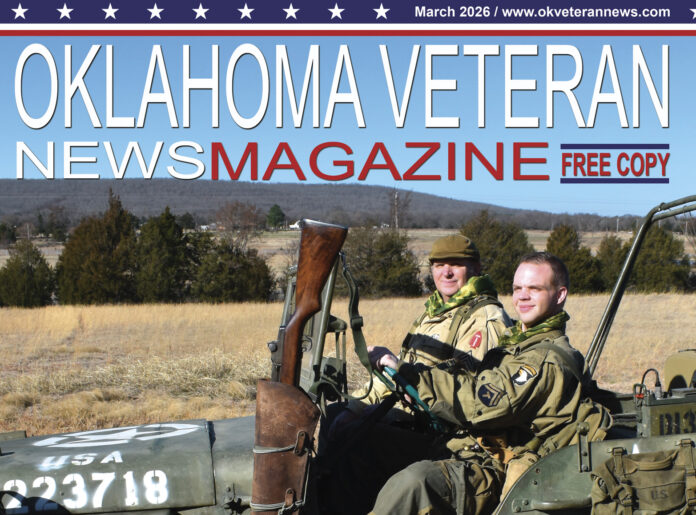
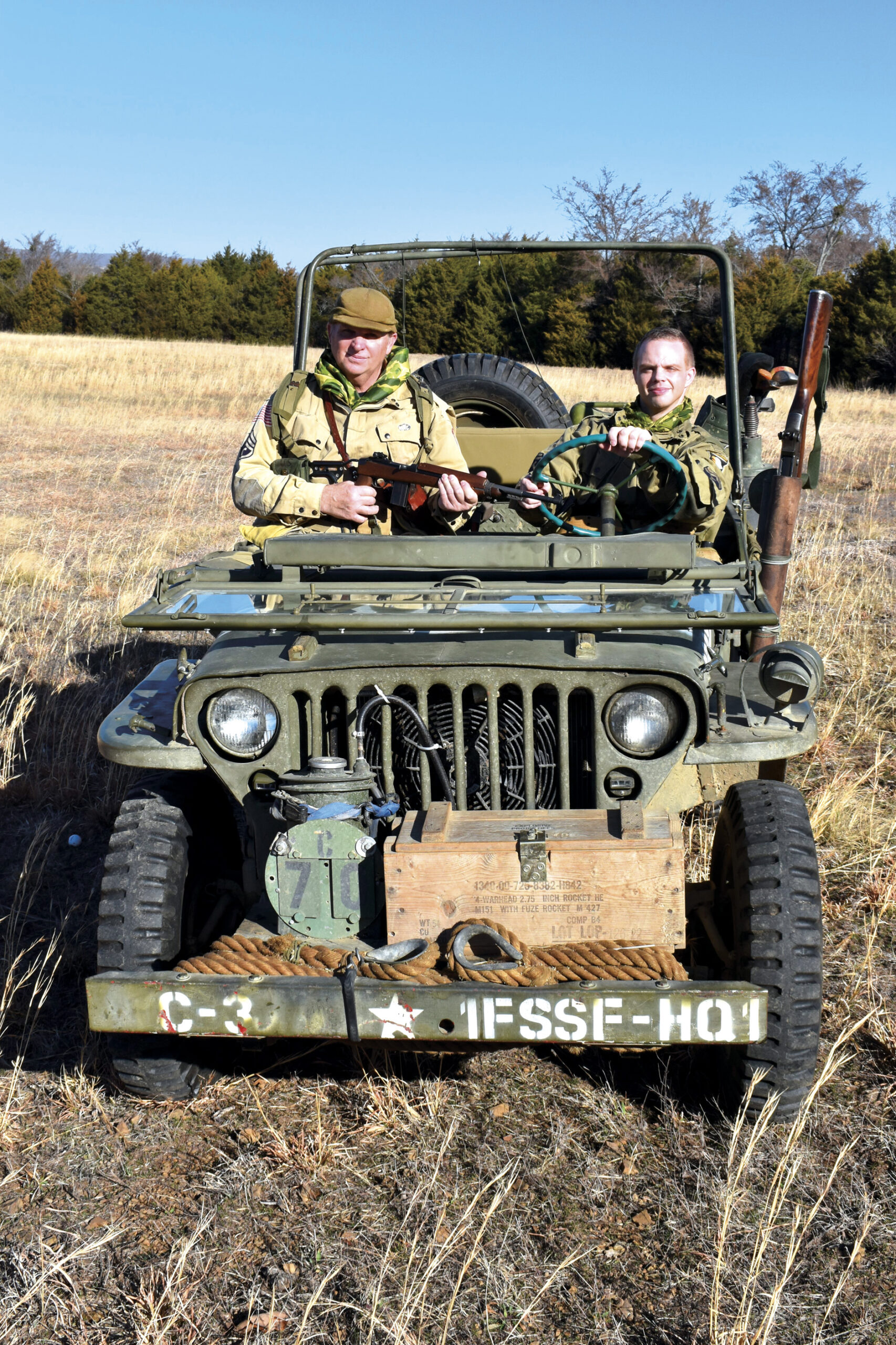
Neal Fisher, left, and his son, Gunnar, are patrolling a field in their 1942 Ford General Purpose Willys jeep. They are dressed in WWII paratrooper uniforms. The jeep has an artillery shell casing in the front to catch radiator overflow, rifle scabbard for M-1 rifle, gas jerry can and even a golf club bag.
Neal Fisher, age 63, is content to let today’s servicemen and women defend our nation. After all, he has already done his part. He gave the U.S. Army and Air Force 22 years of his life, deploying to Iraq twice during Operation Iraqi Freedom and to Saudi Arabia once for Operation Enduring Freedom.
Today, Fisher and his wife of 30 years, Debra, live in Quinton, Oklahoma, and they and their son, Gunnar, often volunteer at local VFWs and DAVs. Fisher used his mechanical and welding skills to rebuild a 1942 Ford General Purpose Willys jeep, which he proudly drives in veteran parades.
Duty Calls
Was he nervous about deploying to Iraq? No. “I wanted to serve my country…I was trying to do a job, this big job to work on vehicles and recover vehicles and do metal fabrication…I didn’t worry about being shot at.”
First Deployment to Iraq
Fisher deployed to Camp Taji, 20 miles north of Baghdad, from January 17, 2005, to December 31, 2005. He served with the 637th Maintenance Battalion, 3rd Infantry Division from Fort Stewart, Georgia. Coalition forces invaded Iraq on March 19, 2003, and when major military combat actions ended on May 1st, 2003, they occupied Iraq.
From left, Neal Fisher, Debra, his wife, and Gunnar, his son, pose outside their home in Quinton, Oklahoma.
Keeping the Army Rolling
“We (16-person mechanic team) worked as welders, fabricators. We’d go to vehicles that were blown up and cutting the up-armored off of, like tanks and MRAP (Mine-Resistant Ambushed Protected) vehicles, and tracks, and putting them up on HMMWV (High Mobility Multipurpose Wheeled Vehicles) because they were soft skin vehicles.”
As he described long days in the motor pool, Fisher’s voice quickened and his hands gestured. His passion for repairing machinery was obvious.
The team also worked on the Family of Light and Medium Tactical Vehicles (FMTVs), which are 2.5-ton and 5-ton cargo trucks, Bradley Fighting Vehicles and Abrams tanks. If the Army drove it, Fisher’s team could repair it.
Field work “was hot, humid, sticky weather. In the summertime, we got up to 140 (degrees).” Mortars occasionally exploded.
“They’d also wake me up in the middle of the night because I was a journeyman heavy duty welder, and they’d have me repairing equipment that was just brought in at 12 o’clock at night. It had to be up to 100% standard grade to support the soldiers in the field that needed it immediately.”
Any additional duty? “Sometimes they’d have me on guard tower work (sentry) around the FOB (Forward Operating Base) and they’d have me drive that FMTV truck, and I dropped all the soldiers off and there was like 10 towers.”
When his unit returned to Fort Stewart, he received orders to Fort Carson, Colorado.
Back to Iraq
Although Fisher spent nine months at Fort Carson with the 2nd Infantry Division before deploying again, “We were out in the field every month for three weeks. And I never got to spend any time with my family when I was there at Fort Carson because we were training to go back to Iraq.”
On October 6, 2006, Fisher deployed again – this time to Camp Rusty Meyer (Camp Rustamiyah), near Sadr City, Baghdad, through December 22, 2007 – 14 months. This deployment was worse, much worse. “We called it Mortar Alley because every week we’d get shelved with motors like two or three times a day.”
One day, insurgents unloaded a hail of gunfire at the motor pool. Fisher excitedly recalled, “We were under a mortar attack. I didn’t know it. And sniper attack. I was being shot at. I was working underneath a HMMWV as a welder, fabricator on a frame. They’re up on a tall building.”
Unaware of the attack because of loud generators nearby, he continued repairing the vehicle outside. Fellow soldiers ran and took cover. Two hours later as they looked for him, Fisher emerged from underneath, unharmed. The HMMWV over him saved his life.
Other close calls followed. “We were doing PT, like I and five other soldiers, it was like 5:00, 6:30 in the morning roughly, you know? And we get a mortar attack. Missed us about 20 feet.” The soldiers dove into a concrete shelter, escaping injury.
Burn Pits
Deployed coalition soldiers saw, smelled and walked through the smoke from burn pits as they consumed plastic, paper, wood – anything that would burn. “The burn pits were constantly going; a constant black cloud. And that was at Camp Taji and Rusty Meyer. We basically ran PT, we welded and was breathing in the smoke from the burn pits all the time, 24 hours a day. It came into the AC, everything.”
A fun moment stands out. “I and a friend of mine went into the chow hall for Christmas dinner and Kid Rock (Robert Ritchie) was there and we just had a mortar attack that morning. And Kid Rock said he wanted to see the troops, regardless.”
The Lasting Impact of War
Returning home after a long deployment can be difficult for many veterans. “That last tour, that was pretty rough. I had a lot of anxiety when I came back. Debra added, “On edge. Fourth of July still bothers him, the smell and the sound.” Gunnar said, “After that one, no one was the same, meaning our home life was different.” All three adjusted because Debra was working and Gunnar had “became the man of the house as a young teenager.”
Debra is worried about his health. “I remember about a month ago, he had a blood clot in the lung. And he also is fighting bladder cancer. Every four months he gets checked.” Those could be a result of the burn pits. Since Fisher has a 100% rating from the DAV, they haven’t filed a claim for that.
Fisher enlisted in August 1986 and served 10 active duty years in the Army, seven years in the Army National Guard, and five years in the Air Force Reserve (activated for a year after 9-11). He retired with the rank of E-4 Specialist in 2010. His decorations include two Army Commendation Medals, Army Achievement Medal, Armed Forces Expeditionary Medal and Iraq Campaign Medal with Campaign Star.
Serving Veterans
At the Disabled American Veterans Chapter 20 in Krebs, Oklahoma, he’s the Sergeant at Arms (also for the state), fundraises and participated in McAlester’s Armed Forces Day parade three times with the jeep. Debra is a member of the DAV’s Auxiliary as a local and state officer. Luke Armstrong, DAV Commander, said, “Neal is the perfect example of a combat veteran who is willing to volunteer his time to assist any other veterans and their families.”
Fisher also belongs to McAlester’s VFW Post 1098, where he participates in the Honor Guard and volunteers during bingo nights. Father and son participated in 2025’s Veterans Day parade in Hartshorne, Oklahoma, driving the WWII jeep and displayed military uniforms and gear in the town’s old Armory.
If you drop by the DAV or VFW, have a talk with Fisher because he enjoys discussing our military from the far past (WWII), past (Iraq), and present. Maybe he’ll tell you about being a paratrooper (Airborne!) with the 19th Special Forces Group in the Air National Guard. You’ll have an interesting talk reminiscing with this combat veteran who answered the call to duty. •
story and photos by Lt Col Richard Stephens, Jr., USAFR, Ret.
S.S. Joseph N. Teal, a Liberty ship, brought Private Jim Fergeson and hundreds of troops to Bari, Italy, from April-May,1944. Photo by Multnomah County Library, Oregon.
“When my son was learning about WWII in the 1970’s, I prepared this article to document my journey to Europe.
I left the United States for an unknown destination on 21 April 1944 on the S.S. Joseph N. Teal with my 420th Signal Company (120 men) and hundreds more onboard.
After being at sea a few days, we learned we were going to Italy. At that time, Italy was the only place on the European continent where the US Army was actively engaged in ground combat with Germany.
While crossing the Atlantic in early 1944 was still very hazardous because of the German U- boat threat, the Mediterranean was a much greater risk. I was not concerned. Youth and ignorance were on my side.
The convoy stretched from horizon to horizon. Among the many ships were an aircraft carrier and other warships. Even our ship, a merchant carrier, was fitted with some formidable weapons operated by a US Navy gun crew. I felt safe and secure. This was a great adventure and I was looking forward to the crossing.
Progress was slow as the ships in the convoy zigged and zagged, in unison, across the Atlantic.
Our own company cooks prepared the meals…Fresh fruit and vegetables, which were plentiful the first few days, soon were exhausted. Rice and dehydrated eggs and potatoes replaced the fresh food.
Second servings, which had been standard, were no longer available. For the first time in my life, I experienced real, genuine hunger…(Only after reaching Italy and observing real starvation among the local population did I finally realize what hunger really was.)
The great adventure I had envisioned slowly gave way to reality. The daily routine of calisthenics, meager meals that looked and tasted pretty much the same as yesterdavs, the lack of fresh water showers, and general boredom soon took its toll on morale.
I would slip up on deck at night just to get away from the mass of humanity. Rows of bunks, five high, about eighteen inches apart, filled the ship’s cargo hold…Those in the lower bunks were in jeopardy of nausea showers from sea sick GIs above.
The morale officer organized USO type skits for entertainment. GIs, dressed as females, brought howls of laughter. They looked comically ridiculous in their make shift skirts, Improvised breast augmentation, rag mop hairpieces, hairy legs, and clumsy Gl boots.
Another morale booster was the Red Cross gifts. We each received a drawstring bag filled with toilet articles, a sewing kit and a candy bar. The candy was a single Baby Ruth bar. It was indeed a welcome sight, a magnificent feast…I lay in my bunk, slowly removed the wrapper and took a small nibble…I slowly devoured the entire bar in this manner, making it last as long as possible.
As we approached Gibraltar, the Navy gun crews uncovered their weapons and fired a few practice rounds. Most of us sat on deck and watched attentively as the crew prepared to load and fire.
Early the next morning…The ship was silent. There was no sound from the engine room or no sound of the screw moving the ship though the water…I rushed up on deck. There ahead about a mile was the rock of Gibraltar.
However, the convoy was gone. True to plan, if any ship experienced trouble, the convoy would continue. Overhead was a British flying boat at mast altitude slowing circling our ship and watching for submerged German submarines. German U-boats favored the Straits of Gibraltar.
The narrowing of the Atlantic Ocean to meet the Mediterranean Sea provided a narrow funnel through which all allied convoys bound for Italy must pass. Eventually, a British tug towed the ship into the safety of Gibraltar harbor.
We remained there for a week for repairs…Just prior to leaving the safety of the harbor, we assembled on the ship’s fantail for an unexpected briefing. German planes using remotely controlled glider bombs had attacked the convoy…There was a loss of ships and lives.
When exiting the harbor, massive underwater gates were opened to let our ship through…
The next day, two German planes observed us from a distance, but did not attack. Then, the Mediterranean experienced a severe storm with heavy seas and low visibility. This storm slowed our progress, but provided much needed protection until we were near Sicily and allied naval and air power.
Finally, on 23 May 1944, we reached the safety of harbor at Bari, Italy. Thirty-three days had elapsed since departing the United States.” •
story and photos submitted by James Ferguson
The Scottish Rite Temple in Guthrie has served multiple functions in Oklahoma history including as the first capitol building of Oklahoma. The building features several prominent rooms including a theater.
The Scottish Rite Temple located at 900 E. Oklahoma Avenue in Guthrie has served multiple functions in Oklahoma history, including as the first state capitol building, as a location for TV and film production and as a site used by Freemasonry for educational and gathering purposes.
On April 22, 1889, Harper Samuel Cunningham, 33°, made the Run of the Unassigned Lands which opened for settlement. He came to practice law in the newly opened Territory. And he came to establish the Ancient and Accepted Scottish Rite of Freemasonry in what would soon become Oklahoma.
Designed for the use and benefit of the Masonic Fraternity in Oklahoma, the original Temple was situated at the northeast corner of Harrison and Broad Streets in downtown Guthrie. It served the Masons well from 1899 to 1923.
The original building in this complex, now named the East Annex, was constructed in 1908 by the city of Guthrie and called Convention Hall. It was intended as the meeting place for the Oklahoma State Legislature. It was a rectangular brick structure with two two-story wings flanking a two-story atrium having a gallery promenade. A basement completed the internal space.
The East Annex was used for one regular session of the Legislature in 1909 and one special session in 1910.
After the Legislature agreed to move the state capital from Guthrie to Oklahoma City in 1910, the city of Guthrie offered to sell the Convention Hall complex, including Capitol Park, to the Scottish Rite Masons, who wanted to construct a temple in Guthrie.
A deal was concluded with the Parr & Hawk, an Oklahoma City architectural firm, to design the western building (designated as the Temple), and the James Stewart Construction Company began construction in May 1920. Construction of the Guthrie Scottish Rite Temple was completed in 1924, at which time the Masons occupied the building, though interior finishes were not finalized until 1929.
It was listed on the U.S. National Register of Historic Places in 1987.
The Scottish Rite is one of the most widely practiced rites within Freemasonry, comprising 33 degrees that build upon the ethical teachings of the first three degrees conferred in Blue Lodges. The Scottish Rite emphasizes moral and philosophical education, allowing members to deepen their understanding of Freemasonry and its values.
The Scottish Rite Temple is a significant Masonic building that serves as a center for the Ancient and Accepted Scottish Rite of Freemasonry, offering education, fellowship, and community service.
“We’re like a college-level class of the usual Masonry that you see in hometown lodges,” Masonic Rite Temple General Secretary Glen Chaney said. “We have a continuation of the same purpose, which is to take good men and make better men. We are a philosophy, not a religion. We require that our members be eligible, that they do believe in a god, a greater spirit. We do not dictate who that is or what that is. It must be a force of good that all humankind has a soul that is immortal. And past that, we leave religion to individuals. What we do is try to make this world better.”
Chaney said the Scottish Rite takes Masons through philosophical degrees and ceremonies and teaches lessons of moral and integrity through theatrical team performances.
“We in Guthrie are very proud because we are the mecca for this level of Masonic instruction,” Chaney said. “We have been the guiding light that other people come to see how we do it.”
Chaney said Masons come from across the country as well as far away as Brazil, Canada and Germany/
“We’re one of the few temples that do all 29 degrees. We do that once a year. That takes three days,” Chaney said. “We have theatrical teams for each of those degrees, and they come in and do that. We call that drinking from the fire hydrant of knowledge because it just knocks you down, overwhelms you.”
Chaney said each fall they do a two-day version of instruction, which encompasses 14 degrees.
Tim Heaton, Facilities Manager, said the Temple is large enough to house the Masons while in Guthrie.
“This building’s so huge that we just have the space,” he said.
Heaton said the housing includes 19 apartments plus other bed spaces throughout the Temple.
“They look like Warren and June Cleaver’s bedroom with an ensuite. Completed in 1952. They still look like 1952,” he said. “They’ve been featured in several movies.”
Heaton said they feed members on-site as well as eat at various Guthrie restaurants.
Heaton said public Temple tours take place Monday to Thursday at 10 a.m.
“People from every walk of life like to find out, want to come see this place,” he said. “We get a lot of Masons from around the country as well who know this place and it becomes a destination for them to come see.”
The Scottish Rite Temple in Guthrie has served as a filming location for several movies and TV shows, including the 2020 film “Reagan.”
“They (film crew) built the (replica) of the Oval Office here,” he said.
Heaton added that the Temple served as the backdrop of the White House for the “Reagan” movie, as well as scenes replicating a train station.
The Scottish Rite Temple has members that are Veterans, including Chaney an U.S. Army Veteran.
“A number of our members are Veterans,” he said. “Masonry is something that is appealing to Veterans. I have seen young men that came in and they didn’t know what they’re getting into and suddenly, it’s like the whole world is lit up and they could see so many avenues for thought, for service in the community, for just being a better person.”
Chaney said becoming a Mason was a defining moment in his life.
“This has been, for me, one of the most defining aspects of my life,” he said. “It’s made me look at the way I treat the world and try to do a little better.”
For more information about the Guthrie Scottish Rite Temple call (405)282-1281 or visit www.guthriescottishrite.org. • by Van Mitchell, staff writer
Veterans who applied for U.S. Department of Veterans Affairs benefits in the past – or who have never applied – may want to review their eligibility as changes in federal law and VA policy can affect how claims are processed.
The U.S. Department of Veterans Affairs, a federal agency, administers benefits through separate systems with different eligibility requirements. VA health care is managed by the Veterans Health Administration, while disability compensation and other benefits are handled by the Veterans Benefits Administration. Eligibility decisions in one system do not automatically determine eligibility in the other.
Recent updates to VA law and policy, including expanded presumptive conditions and revised service-connection guidance, may affect how claims are reviewed today. Veterans who were previously denied, paused the claims process, or have not revisited their eligibility in several years may benefit from having their information reviewed.
The Oklahoma Department of Veterans Affairs (ODVA), a state agency, works with the federal VA to help veterans understand the claims process and available options. Veterans are encouraged to review their service history and medical conditions and to speak with an accredited Veteran Service Officer (VSO). VSOs provide free assistance and help ensure claims are submitted with current information.
In addition to claims assistance, ODVA offers state-level programs for veterans and their families, including a Women Veterans Program, employment assistance, entrepreneurship support, long-term care services, and the Oklahoma Veterans Registry, which helps connect veterans with available resources and outreach opportunities.
Veterans seeking more information can contact the Oklahoma Department of Veterans Affairs at 405-523-4026 or visit oklahoma.gov/veterans.gov
About the Oklahoma Department of Veterans Affairs:
The Oklahoma Department of Veterans Affairs (ODVA) delivers high-quality care, benefits, and support to Oklahoma veterans and their families through programs such as State Veterans Homes, Claims & Benefits, OKVetWorks, Women Veterans, Health & Wellness, Mental Health, and the Veterans Registry.