Saturday, March 7, 2026

SENIOR TALK: What does volunteering do for you?

0

What does volunteering do for you? Norman Regional Health System Volunteers

It fills my soul. I’ve been doing it for a year-and-a-half.  Dana Cantwell

It truly gives me an opportunity to give back to a community that’s given me so much. Hailey Dycus

It’s a community and it’s giving back to that community and interacting with a wonderful set of people.  Jonnina Benson

It gives me something to do on Wednesdays and it’s something to look forward to that’s fun. Dixie Hurd

March AARP Drivers Safety Classes

0

Date/ Day/ Location/ Time/ Registration #/ Instructor

Mar 1/ Thursday/ Okla. City/ 9 am – 3:30 pm/ 951-2277/ Varacchi
Integris 3rd Age Life Center – 5100 N. Brookline, Suite 100
Mar 2/ Friday/ Okla. City/ 9 am – 3:30 pm/ 681-3266/ Hughey
Woodson Park Senior Center – 3401 S. May Ave.
Mar 6/ Tuesday/ Moore/ 9 am – 3:30 pm/ 307- 3177/ Palinsky
Norman Regional Hosp Moore (Conf. Center) – 700 S. Telephone Rd
Mar 9/ Friday/ Okla. City/ 9 am – 3:30 pm/ 951-2277/ Edwards
S.W. Medical Center – 4200 S. Douglas, Suite B-10
Mar 9/ Friday/ Okla. City/ 9 am – 3:30 pm/ 297-1455/ Palinsky
Will Rogers Senior Center – 3501 Pat Murphy Dr.
Mar 10/ Saturday/ Moore/ 9 am – 3:30 pm/ 799-3130/ Hughey
Brand Senior Center – 501 E. Main St.
Mar 13/ Tuesday/ Midwest City/ 9 am – 3:30 pm/ 691-4091/ Palinsky
Rose State Conventional Learning Center – 6191 Tinker Diagonal
Mar 21/ Wednesday/ Okla. City/ 10 am – 4 pm/ 605-6900/ Harms
Grand Tapestry – 14201 N. Kentucky
Mar 24/ Saturday/ Shawnee/ 9 am – 3:30 pm/ 818-2916/ Brase
Gordon Cooper Tech. Center – One John C. Burton Blvd.
The prices for the classes are: $15 for AARP members and $20 for Non-AARP. Call John Palinsky, zone coordinator for the Oklahoma City area at 405-691-4091 or send mail to: [email protected]

AHCA honors 11 Oklahoma nursing care centers

0

Eleven Oklahoma skilled nursing care centers, their nurses and other staff members were recently recognized by the American Health Care Association and National Center for Assisted Living.
The centers, located throughout the state, were recognized through AHCA/NCAL’s Quality Initiative Recognition Program for quality and service improvements. Facilities honored were:
*Cedar Creek Nursing Center – Norman
*Claremore Nursing Home – Claremore
*Forrest Manor Nursing Center – Dewey
*Grace Living Center – Edmond
* Grace Living Center-Southwest – Oklahoma City
*Emerald Care-Southwest – Oklahoma City
*Medicalodge of Dewey – Dewey
*Montevista Rehabilitation and Skilled Care – Lawton
*Rainbow Health Care Community – Bristow
*Shanoan Springs Residence – Chickasha
*The Village at Southern Hills – Tulsa
AHCA’s Quality Initiative Recognition Program recognizes association members who attain at least four of eight quality initiative goals, President/CEO Mark Parkinson said. Those objectives include:
*Reducing hospitalizations – Facilities are assessed either for their safe reduction of long-stay resident hospital stays of at least 15 percent from December 2014 or for achieving or maintaining a 10 percent or lower rate.
*Minimizing nursing staff turnover – Centers that either accomplish a 15 percent decrease from 2015 levels or maintain less than 40 percent total nursing turnover rates meet this criteria.
*Cutting hospital readmissions – This goal aims at safely reducing hospital readmissions, within 30 days of first admission, by 30 percent, compared to December 2011 levels or maintaining a 10 percent readmission rate overall.
*Decreasing off-label antipsychotics use – Long-stay nursing resident use of off-label antipsychotics must be reduced by 30 percent from December 2011 levels to qualify for this particular achievement.
*Reducing unintended health care outcomes – Accomplishing this goal “improves the lives of the patients, residents and families skilled nursing care providers serve,” the Office of Inspector General found, according to a 2014 report.
*Improving discharge rates – Facilities are tasked with maintaining a 70 percent rate, or 10 percent improvement since December 2014, of patient discharges back to the community.
*Boosting functional outcomes – Centers must improve functional outcomes by 10 percent since December 2015 or maintain a 75 percent improvement rate to attain this goal.
*Adopting Core-Q questionnaire – AHCA developed the Core-Q questionnaire specifically for use by post-acute and long-term care providers, Parkinson said. Adopting the practices outlined, measuring and uploading results may satisfy this particular program aspect.
“Improving quality care as a profession requires dedication from many organizations,” Parkinson said. “The program provides an opportunity to shine a spotlight on the progress that our members have made by achieving the quality initiative goals and improving care for individuals living in their communities, and I commend their hard work.”
Oklahoma Association of Health Care Providers is the AHCA state affiliate. More information about AHCA may be found on its website, located at https://www.ahcancal.org/Pages/Default.aspx; OAHCP’s site is http://www.oahcp.org/index.php.

SAVVY SENIOR: Tips and Resources for Older Job Seekers

0

Dear Savvy Senior,

What resources can you recommend to help older job seekers? I’m 60 and have been out of work for nearly a year now and need some help.

Seeking Employment

Dear Seeking,
While the U.S. job market has improved dramatically over the past few years, challenges still persist for many older workers. To help you find employment, there are job resource centers and a wide variety of online tools specifically created for older job seekers. Here’s where you can find help.
Job Centers
Depending on where you live, there are career service centers located throughout the U.S. that can help you find a job. One of the best is the American Job Center (AJC) that has around 2,500 centers nationwide. Funded by the U.S. Department of Labor’s Employment and Training Administration, AJCs are free-to-use resource centers that can help you explore your career options, search for jobs, find training, write a resume, prepare for an interview and much more. To find a center near you, call 877-872-5627 or go to CareerOneStop.org.
Some other good programs for older workers include the Senior Community Service Employment Program (SCSEP), and AARP’s Back To Work 50+ program.
The SCSEP – sponsored by the Department of Labor – helps place income-eligible workers over age 55 in part-time, temporary community service positions where they can learn job skills. To learn more or locate a program in your area visit DOLETA.gov/seniors or call 877-872-5627.
AARP’s Back To Work 50+ program currently offers workshops in 19 locations around the U.S. that provide career counseling, job coaching and skills development for 50-plus job seekers. Or, if you can’t attend their workshop, they also offer an excellent guide called “7 Smart Strategies for 50+ Jobseekers.” To get a free copy, or see if there’s a workshop in your area call 855-850-2525.
If none of the above programs are available in your area, check with your local public library or nearby community college to see if they provide career services.
Job Search Sites
There are also a number of online job search sites that can help you connect with companies that are looking for mature, experienced workers.
Some good sites for 50 and older job seekers include: WhatsNext.com, which offers a job search site and has online assessment tools, calculators, career guides and career coaches to help you; RetiredBrains.com that provides information on finding temporary or seasonal jobs, as well as starting your own business, working from home, writing your resume, finding full-time work, and continuing your education; RetirementJobs.com that lets you post your resume and search for full-time or part-time jobs online; and Workforce50.com, which has job search functions and a list of favorite age-friendly employers by industry. It also gives you the ability to sign up for job alerts.
Work at Home
If you’re interested in working at home, there are many opportunities depending on your skills, but be careful of work-at-home scams that offer big paydays without much effort.
Some popular work-at-home jobs include sales and marketing, customer service, teaching and tutoring, writing and editing, Web development and design, consulting, interpreting and medical coding just to name a few.
To find these types of jobs, a good place to start is FlexJobs.com, which filters out the job scams and lists thousands of legitimate work-at-home jobs in dozens of categories. You can gain access to their listings for $15 for one month, $30 for three months or $50 for a year.
Start a Business
If you’re interested in starting a small business but could use some help getting started, the U.S. Small Business Administration offers tips, tools and free online courses that you can access at SBA.gov. Send your senior questions to: Savvy Senior, P.O. Box 5443, Norman, OK 73070, or visit SavvySenior.org. Jim Miller is a contributor to the NBC Today show and author of “The Savvy Senior” book.

TRAVEL/ ENTERTAINMENT: Indian Artist Jerome Tiger, is focus of Luncheon Program, Noon, March 21

0

Photography and Text by Terry “Travels with Terry” Zinn [email protected]

March 21, M.J.Van Deventer will be the guest speaker for a noon “Brown Bag Luncheon” at the National Cowboy & Western Heritage Museum. She will speak on “Jerome Tiger ~ The Enduring Legend.” Her talk, which is open to the public free of charge, is one of several activities about the late artist’s life and influence, complementing a retrospective of Jerome’s influence and art, which hangs through May, 2018.
Jerome Tiger began to paint in “Indian Style” in 1962. Nettie Wheeler of Muskogee, Oklahoma, recognized Jerome’s talent and encouraged him in his artistic endeavors. Jerome submitted his early work to the 1962 Philbrook Art Center’s Annual Indian Art Exhibition and later was invited to have his first major exhibition where nearly all of his images sold out. A full blood Muscogee Creek-Seminole, Tiger’s style is said to be a combination of “spiritual vision, humane understanding, and technical virtuosity” but with traditional subject matter and composition.
Speaker, M.J. Van Deventer-Shelton says, “I grew up in Muskogee and became acquainted with Jerome Tiger through an English class at Muskogee Central High School in the late 1950s. Sitting next to Jerome in that class, I often watched him draw while the rest of the class labored over diagramming complex sentences.”
Fast forward to 1967 and the untimely accidental death of Jerome Tiger. By the late 1970s, M. J. embarked on a research journey to piece together the fragments of Jerome’s life, visit the artists and collectors he influenced and research the enduring quality of his art ~ paintings that changed the face of Native American art.
While serving as the Director of Publications and editor of Persimmon Hill for the National Cowboy & Western Heritage Museum for 18 years, Van Deventer had the opportunity to study Jerome’s art and become friends with Arthur and Shifra Silberman, whose gift of Jerome’s art has made this museum’s Jerome Tiger paintings, the largest archive of his art.
Van Deventer is a graduate of Northeastern State University in Tahlequah and received a Master’s Degree in Communications from Oklahoma State University. She did post graduate work in the pre-law program at Tulsa Junior College and also studied at Syracuse University in New York on a Wall Street Journal Fellowship.
For 25 years, she was a newspaper reporter/editor for the Stillwater News Press, Tulsa World, the Daily Oklahoman, Fort Worth Star Telegram and the Tulsa Tribune, which nominated her for a Pulitzer Prize for public service reporting. During that time, she also was an adjunct professor of journalism at OSU and the University of Central Oklahoma.
An award-winning journalist, her articles have appeared in Southwest Art, Oklahoma Today, Tulsa People, Oklahoma Magazine, Traditional Home, Art Gallery International, Cowboys & Indians and Triple AAA’s Home & Away. She is the author or co-author of 10 books and is currently completing a biography on Jerome Tiger and the well-known Oklahoma sculptor, Harold T. Holden.
Her passions are writing, cooking, gardening and traveling, especially to Santa Fe, New Mexico. She is a past chairman of the Muskogee Area Master Gardeners, and current President of the Muskogee Area Arts Council. She is a board member of the Five Civilized Tribes Museum, which has the second largest holding of Jerome’s art, including his only sculpture and his last work, The Stickballer.
The National Cowboy & Western Heritage Museum is America’s premier institution of Western history, art, and culture. Founded in 1955, the Museum, located in Oklahoma City, collects, preserves, and exhibits an internationally renowned collection of Western art and artifacts while sponsoring dynamic educational programs to stimulate interest in the enduring legacy of the American West. More than 10 million visitors from around the world have sought out this unique museum to gain better understanding of the West: a region and a history that permeates our national culture.
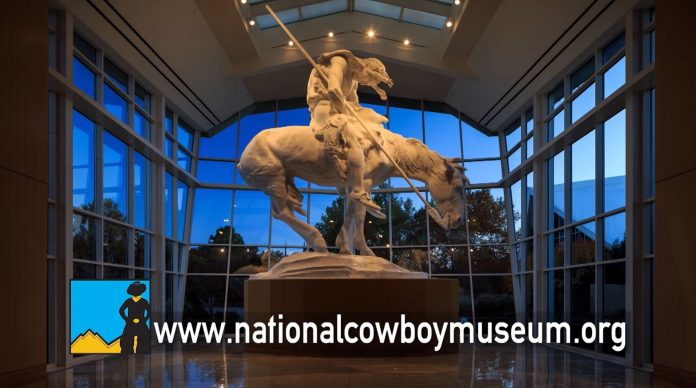
The National Cowboy & Western Heritage Museum features a superb collection of classic and contemporary Western art, including works by Frederic Remington and Charles M. Russell, as well as sculptor James Earle Fraser’s magnificent work, The End of the Trail. The exhibition wing houses a turn-of-the-century town and interactive history galleries that focus on the American cowboy, rodeos, Native American culture, Victorian firearms, frontier military, and Western performers. Outside, beautifully landscaped gardens flank the Children’s Cowboy Corral and interactive children’s space.
Additional information about the Brown Bag Luncheon Series is available by contacting Tara Carr at the National Cowboy Museum, (405) 478-2250.

OMRF postdoc receives national aging Award

0
Program Chair Holly Van Remmen, Ph.D. (left) and Oklahoma Medical Research Foundation scientist Rizwan Qaisar.

Oklahoma Medical Research Foundation scientist Rizwan Qaisar has been awarded an Irene Diamond Fund/AFAR Postdoctoral Transition Award in Aging.
The award, presented by the American Federation for Aging Research (AFAR) with support from the Irene Diamond Fund, will provide $120,000 in flexible transitional funding to Qaisar, who is researching age-related muscle loss called sarcopenia at OMRF. Postdocs are individuals conducting research after finishing their doctoral studies and are pursuing further training and a well-defined career path.
AFAR is a leading nonprofit dedicated to advancing healthy aging through biomedical research. The goal of this program, according to AFAR, is to provide portable and flexible transitional funding for senior postdoctoral fellows as they develop and negotiate for faculty positions and research programs. The award provides full-time research training and grant support.
Founded in 1981, AFAR has awarded more than $175 million in grants to investigators and students across the U.S., Ireland, Israel, Italy and the United Kingdom.
“By giving these postdoctoral fellows this extra boost at a critical moment in their career path, AFAR is helping create a research pipeline that is essential to advancing better therapies for age-related diseases and discoveries that will help us all live healthier and longer,” said Jeremy Walston, M.D., Chair of the 2017 Selection Committee for the Irene Diamond Fund/AFAR Postdoctoral Transition Awards in Aging.
At OMRF, Qaisar works in the Aging and Metabolism Research Program with under the guidance of Program Chair Holly Van Remmen, Ph.D. looking specifically at the role of oxidative stress, or free radicals, in the long-term deterioration of muscle. Qaisar researches potential interventions for the disease pathways for sarcopenia, specifically the activation of the SERCA ATPase.
Qaisar earned his Ph.D. at the University of Uppsala, Sweden. His academic focus was looking at the mechanisms of muscle aging, and evaluating potential therapies to counter age-related weakness and muscle loss.
“I am extremely grateful and honored to receive this award,” said Qaisar. “This funding will provide me with a real opportunity to push my research forward and make a difference for our aging population.”

21st Century Norman Seniors Association Announces Resolution

0

The 21st Century Norman Seniors Association is pleased that members of the Norman City Council have taken a bold step forward in an effort to create a world-class multigenerational cultural facility that all members of the Norman community can be proud of. They have requested a resolution be placed on the February 27th agenda to authorize a Senior & Cultural Facility to be built on land previously leased from the University of Oklahoma.
The City of Norman has made significant progress in developing quality of life programs and facilities for many of its citizens over the past several years and, if successful, this new effort will bring seniors into the same position. This can be a unique and visionary asset for the city over the next fifty years. We laud the courage and vision it takes to create this concept.
Our Board of Directors has voted unanimously to support the development of a Senior & Cultural Facility located on the site recently leased from the University of Oklahoma near the YMCA.
This proposal has many advantages:
*$8.75 million has been budgeted and funded for a project creating a cultural center which has been authorized by the TIF oversight committee.
*Five acres are already leased and dedicated for a senior facility, and there is open space around the site for future creative initiatives.
*The location is adjacent to the YMCA and the future Norman Forward projects of an indoor aquatic facility and a multi-sport facility. These projects include a redesign of Berry Rd. and the intersection at Westheimer Dr. where the Senior & Cultural Center would be located. Legacy Trail will be extended to this area and additional public transportation will be implemented with the new Norman Forward projects. It will be a senior friendly location.
*Creating the concept of cultural activities combined with a senior center broadens the scope and type of activities that would naturally occur in this new facility. These would include joint activities between seniors and creative organizations from the Norman community such as art shows, dance or theater productions, educational programs, etc. Seniors can bring the enormous value of experience, time and dedication to bear in helping develop these activities. It could lead to Norman being a nationwide model in the evolution of senior friendly communities.
Although there is a lot of work to do and many decisions that will have to be made to finalize the concepts in this revolutionary proposal, we urge all members of the City Council and the Mayor to vote for this resolution. It will move Norman Forward.

Legacy Builder: Owens opens affordable living

0
For nearly 40 years now Gary Owens has poured his heart and soul into building homes people are proud to live in.

by Bobby Anderson, Staff Writer

Several decades ago Gary Owens and his family were grazing Angus cattle on the hundred acres near SW 17th and Czech Hall Road.
Little did the future home builder know that that patch of Oklahoma prairie would be a once-in-a-lifetime opportunity for seniors searching for affordable living.
“It’s just a good deal for someone that’s a working class person and just doesn’t have tons of income,” he said of his current home building project.
For the last 39 years the Owens name has been synonymous with quality homes in the Mustang area.
Now it’s also becoming known for truly affordable senior living with the opening of Belmont Cove.
That grazing land has given way to beautifully appointed homes seniors can afford to lease at $1 a square foot.
AMENITIES ABOUND
The luxury two-bedroom homes are 1,000 square feet of handicap-accessible living space. Baths are adorned with granite vanity and ceramic tile flooring.
Granite countertops and beautiful wood flooring spill into the kitchen with a host of stainless steel appliances.
Enclosed washer and dryer connections and a one-car garage add to the residence.
Fenced backyards and a covered porch allow for easy pet-friendly outdoor living.
There’s no costly buy-in to get into Belmont Cove either.
A deposit and first month’s rent allows residents to move in.
Belmont Cove is two miles away from Wal-Mart, Target, Homeland and other shopping venues.
Integris Canadian Valley Hospital is three miles away and the senior center is five miles down the road.
“You can be just about anywhere in Oklahoma City in 15 minutes,” Owens said.
Owens made sure that all leases included a buyout clause in the case that someone’s circumstances changed and they needed to move into an assisted living facility.
For the cost of a month’s rent residents are able to make that needed move.
It’s personal for Owens, who made sure he built the type of residence he would want his mother to live in. That’s because his mother did live in one of those homes until she was in her 90s.
Owens built a similar community in the 1990s and it was quickly purchased by a California investor.
Then Owens and his three brothers had to pool their resources when their mother required around-the-clock care.
“We wished we hadn’t sold it,” Owens said of the 47-home project.
That was an inspiration for Belmont Cove which is opening in three phases with a 2,500-square-foot clubhouse.
“The biggest thing is we do all the maintenance,” Owens said. “They can even take off for two or three months and we’ll watch after it for them.”
Mowing the yard, changing the light bulbs or air filters – it’s all included.
And it’s all markedly cheaper than any comparable property.
It’s truly a once-in-a-lifetime opportunity.
“It’s pretty hard for anybody to compete with us on price because we’ve owned the land so long,” Owens explained.
Owens also passes along deep discounts to residents at Galleria Furniture, which he also owns.
LOCAL HISTORY
Owens built his first house in 1978, while still in high school. Overcoming many obstacles due to beginning at such a young age, he has now built some 2,000 homes and 135 commercial buildings. He has also developed 26 housing additions in the Yukon/Mustang area.
Creating a fully integrated construction company, Owens performs a lot of work that would normally be contracted out by other builders, including carpeting, dirt work and sand and gravel delivery. This keeps costs low, allowing savings to be passed on to customers.
It’s always been about family for Owens, who has taught son Justin to carry on the legacy he’s built. Justin serves as construction superintendent, overseeing day-to-day operations and working with his dad since 1996.
His mother-in-law is expecting to move into Belmont Cove in the coming months.
Spend a few minutes with Owens and a couple things become obvious.
The elder Owens is relational and foundational. A handshake with Owens is a promise that he’ll deliver exactly what he says he will, even if it costs him more.
Many of Owens’ contractors have been working with him since the late 1970s. Most grew up with him in the Mustang area.
That shared foundation was carried over into the home building process and attention poured into the details.
For instance, everyone knows that a prefab cabinet will never enter an Owens home.
All wood cabinets are built from scratch with raw wood, stained and then finished.
It’s just another example of how every home is unique.
And he takes great pride in developing land that sustained his family into affordable homes that will be a blessing for more Oklahoma families.


http://belmontcove.com/

Significant Women in Oklahoma Agriculture Highlight: Clara Wichert

0
Clara Wichert, pictured at the Oklahoma Farm Bureau Convention, is being recognized as a Significant Woman in Oklahoma Agriculture for her contributions to the industry.

by Kaylee Snow

When Clara Wichert fell in love with a farmer by the name of Lloyd Wichert, she did not realize what she was getting herself into.
“I was very naïve,” Wichert said. “I was barely 19, and we went over to his parents to talk about the wedding. I remember Lloyd’s father saying, ‘We cannot have the wedding until after the wheat is planted and it is up a couple of inches.’ I thought, ‘really?’”
The two married in 1959, and Wichert began farming with him immediately. The operation consisted of 600 acres of canola, alfalfa, wheat and cattle. Wichert had grown up on a farm, but her father thought women belonged inside the house. Because of this, Wichert didn’t have much farm experience.
“He told me my job was in the house to iron and starch his shirts, to cook and to clean,” she said. “My job was to learn how to do things in the house.”
However, Lloyd didn’t think so. Wichert laughs about it now, but she recalls how difficult the transition was for her.
“I always got yelled at, so that was very difficult for me,” Wichert said.
She described herself as a “tender soul” and often just “went in the house and cried.”
“One time, he needed me so bad when we were planting wheat that … I had to drive the tractor home because we had four or five plots of land that were at a distance,” Wichert recalled. “I cried so hard all the way home that when I got out of the tractor, he said, ‘I didn’t know. I won’t ever make you drive the tractor again.’”
Wichert was “scared to death” and recalls rolling backwards at a stop sign while in front of another tractor.
“It was not a pleasant experience for me,” she said.
Dust Bowl Days
Wichert was born in 1940 in Fairview, Okla., at the end of the Dust Bowl and in the middle of World War II. Her father grew wheat and had a few chickens and cattle.
I was born on the farm in a bedroom, in the southwest bedroom,” Wichert laughed. “I was born in a home. I don’t know if they had a doctor or not.”
While the family did have water and electricity, they didn’t have all luxuries.
“We had an outdoor toilet, and I remember that very well, and it was a long way out there,” Wichert said.
While Wichert has sweet memories of playing on the farm, it was hard back then.
“I watched my father with tears in his eyes stand by the window,” she said, “and it was very imprinted on my mind that the wind was blowing and the sand hills were blowing too, and he had resowed his wheat at least three or four times. Farming is a lot different now.”
Tough Times, New Beginnings
When Lloyd passed away in 1998, Wichert surprised everyone, including herself, and continued farming.
“I had to keep track of all the expenses, and I had to go and sell wheat,” she said. “I had never done that before. I had to learn to watch the wheat prices.”
Wichert sought help from the Oklahoma Farm Bureau (OFB) and Oklahoma State University on when to sell her wheat.
“I even asked the top wheat guy at OSU, and he told me you’ll never go wrong when you sell the wheat at three different times: at harvest, right after the first of the year, and then you might keep some a little bit later. I thought, this is complicated,” she laughed.
Wichert’s sons, Jeff and Rex, pushed her to continue farming.
“My son [Jeff] said, ‘You will learn how to do this,’” Wichert said.
She took classes to learn how to use a computer and type so she could keep better track of the expenses.
“I felt pretty good about myself that my son Jeff made me do it all,” Wichert said.
For the next 15 years, Wichert would farm alongside her sons and was fully responsible for the farm.
“The day I had to write a check for $15,000 for spray and fertilizer,” she said, “I could hardly make myself write that check.”
During this time after her husband’s death, Wichert found new beginnings with the OFB and Oklahoma Ag in the Classroom (AITC). She served on the OFB Women’s Committee for 15 years and chaired the committee for nine years.
“I never thought I would do that in my life,” she said.
Wichert gained immense knowledge about agriculture during her time as chair. Her involvement with AITC began at Fairview Public Schools (FPS) before there was an organization.
“I would come in every month and do a class about agriculture,” she said. “Some of those kids are in high school now, and they said, ‘Oh, we remember you Mrs. Clara. You always came to our classroom and did Ag in the Classroom.’ I always enjoyed that very much. That was very much a part of my life after my husband died.”
Wichert said she loves teaching agriculture because it’s fun for both her and the children, and it became her “heart.” The kids still know her as “Mrs. Agriculture” and the “Ag Lady.”
“I remember in 1981 going to the first Ag in the Classroom event, and I’ve been very involved with that ever since,” she said. “Even now, last week I went to a couple schools and read some books that Ag in the Classroom sponsors. I have learned so much.”
Living and working on the farm helped Wichert become a better agricultural educator. She said AITC is important because there are many children who don’t know much about where their food comes from.
“There’s not very many of us left that live on a farm,” she said. “Oh, they would be eager to tell me they live in the country, but they knew nothing about agriculture, and the kids today don’t. It’s just a foreign word.”
Wichert was recognized as the 2012 National AITC Ag Advocate for her efforts in creating agricultural curriculum and increasing agricultural literacy at FPS. She was awarded the 2017 Volunteer of the Year by the Fairview Chamber of Commerce and the 2012 Distinguished Service to OFB award winner. She was also recently recognized as Mentor of the Year through Mission Mentors at FPS for continuing to serve as a one-on-one mentor to students.
Wichert continues to stay active with Major County Farm Bureau and keeps herself up-to-date on AITC events. She still mentors a little girl at Fairview Elementary School once a week.
She’s a breast cancer survivor since 1982 and “not because of the two years of chemo, but it’s through God.”
She’s watched her husband lose his battle with colon cancer and her barn burn to the ground a couple years ago. Still, she keeps her faith.
When asked what keeps her going, she said, “Definitely my faith in God and realizing that he has a plan for my life. As I look at my life, I think, ‘Who would’ve dreamed I’d get a national award for Ag in the Classroom?’ I just have to believe that God had a plan.”
Now in her late ’70s, she gave the farm to her sons a couple years ago.
“That’s what Lloyd made me promise to do before he died,” she said.
Her sons still say she owns the land until she dies. Jeff lives on the farm and is a crop adjuster, and Rex works for Syngenta in Tennessee. Wichert has three grandchildren and two great-grandchildren. When it comes time for harvest, everyone comes home to help. They think it’s fun, which makes Wichert smile as she recalls the hard times.
“I know my two sons, they wouldn’t sell an inch of their land that my husband and I farmed, oh no,” she said. “They are men of the soil, and I know that doesn’t happen very often today … [Agriculture] is very important. It keeps us alive. If you’re alive, you use agriculture from the minute you get up to the minute you go to sleep.”
When asked about Wichert’s transition from someone who nearly hated agriculture to someone who is heavily involved and an agricultural advocate, she simply said, “It happened gradually.”
“I often think my husband is laughing in heaven because I have turned out such a neat agricultural person,” she said, because agriculture became so important to her, particularly after he died.

Sleep or exercise: Which is more important?

0
OMRF President Stephen Prescott, M.D..

Jobs. Kids. Commutes. Spouses.
With wall-to-wall daily schedules, it’s tough to carve out time for healthy habits. Too often, packed days claim two victims: adequate sleep and exercise. But if you’re forced to choose between the two, should you hit the gym or the pillow?
“That’s like asking whether food or water is more important,” said Oklahoma Medical Research Foundation President Stephen Prescott, M.D. “Both are cornerstones of good health.”
Still, he said, “If we could get everyone exercising regularly, we would be better off as a society than if everyone was getting eight hours of sleep nightly.” Working out helps stave off the effects of aging, fights heart disease and type 2 diabetes, and controls obesity, which has reached epidemic levels.
That certainly doesn’t make sleep less important, though, said Prescott. Adequate sleep helps maintain a healthy immune system and, like exercise, plays a role in maintaining healthy weight. “Most of all, it keeps us alert and allows us to concentrate, whether at our jobs or while driving,” he said.
Indeed, the National Highway Traffic Safety Administration estimates that drowsy driving is responsible for 72,000 accidents in the U.S. each year. An analysis found that those who’d had 5 to 6 hours of sleep in the previous 24 hours were twice as likely to get in an accident as drivers who’d slept for 7 hours or more.
“Sleep needs vary by individual, but most of us fall somewhere between 7 and 9 hours a night to get all the health benefits needed,” said Prescott. Hitting that 7-hour mark, he said, is crucial. But, perhaps, he suggested, once you reach that mark, if you have to choose between an extra hour of sleep and exercising, getting up to hit the gym could be worthwhile.
“If you can do this and not suffer any consequences from it—falling asleep during the day, disrupted metabolism, reduced energy—then I believe it’s a worthwhile pursuit,” said Prescott.
“Still, I don’t like the having to pick between the two,” he said. “And if we’re really honest with ourselves, most of us don’t have to sacrifice one for the other. We can find the time if we make it a priority.”
“I would encourage anyone with a 15-minute window to get up and do something,” said Prescott. “Even if you can’t make it to the gym, take a quick walk. Go up and down the stairs. Do something that gets your heart rate up and makes you work.”
These quick bursts of exercise aren’t optimal, said Prescott, but they’re preferable to inactivity.
“Once you start any type of regular exercise, you’ll sleep better,” he said. “And better sleep means more energy. It’s a wonderful cycle of positive effects; you just have to commit to finding the time.”

Social

0FansLike
0FollowersFollow
0SubscribersSubscribe