Sunday, December 7, 2025

NOMINATIONS OPEN FOR LAURA CHOATE RESILIENCE AWARD

0

Award to be Presented at Oklahoma Kids Count Conference


Nominations are now open for the 2016 Laura Choate Resilience Award.
The Laura Choate Resilience Award will be presented in November at the 2016 Oklahoma Kids Count Conference, sponsored by the Oklahoma Institute for Child Advocacy (OICA) and Sunbeam Family Services.
The award was created to celebrate individuals who have been significantly impacted by adverse childhood experiences but have overcome obstacles, made a lasting contribution to the lives of young people, exhibit bravery and demonstrate dedication to fostering resilience in youth by exhibiting the characteristics of the “7 Cs of Resilience:” competence, confidence, connection, character, contribution, coping and control.
This award is named for Laura Choate who has served as a lifelong advocate for Oklahoma children and was the first recipient of the Resilience Award. Choate has worked with the OICA to reform the state’s child welfare and juvenile justice system to better serve and protect Oklahoma children. As a youth, Choate served as a plaintiff in a class-action lawsuit that resulted in dramatic changes to Oklahoma’s juvenile justice system and was used as a model by many other states to establish higher standards.
Last year’s Resilience Award was presented to Treba Shyers, an advocate for children in the foster care system who serves as adjudication and post adjudication review board coordinator for the Tulsa County Juvenile Bureau.
Nominations are due July 29 at 5 p.m. and can be made online at http://oica.org/laura-choate-resilience-award/.
The Oklahoma Kids Count Conference is the state’s premier event providing training to improve the lives of Oklahoma children and discuss issues impacting children in the state. Topics for discussion at this year’s conference include: foster parent training, early childhood development, mental health, substance abuse, family preservation and poverty. The conference will be hosted November 2-3 at the University of Central Oklahoma.

July AARP Drivers Safety Classes

0

Date/ Day/ Location/ Time/ Registration #/ Instructor
July 7/ Thursday/ Okla. City/ 9:30 am – 4 pm/ 951-2277/ Edwards
Integris 3rd Age Center – 5100 N. Brookline suite 100
July 8/ Friday/ Okla. City/ 9 am – 3:30 pm/ 951-2277/ Edwards
S.W. Medical Center -4200 S. Douglas, Suite B-10
July 12/ Tuesday/ Midwest City/ 9 am – 3:30 pm/ 691-4091/ Palinsky
Rose State, Professional Tng. & Ed. Ctr. – 1720 Hudiberg Drive
July 15/ Friday/ Okla. City/ 9 am – 3:30 pm/ 297-1455/ Palinsky
Will Rogers Senior Center – 3501 Pat Murphy Drive
July 19/ Tuesday/ Edmond/ 9 am – 3:30 pm/ 210-6798/ Palinsky
AARP State Office – 126 N. Bryant
July 22/ Friday/ Okla. City/ 9 am – 3:30 pm/ 752-3600 478-4587/ Reffner
Mercy Hospital – 4300 W.Memorial Rd.
July 25/ Monday/ Shawnee/ 9 am – 3:30 pm/818-2916/ Brase
Shawnee Senior Center – 401 N. Bell St.
Aug 4/ Thursday/ Okla. City/ 9:30 am – 4 pm/ 951-2277/ Palinsky
Integris 3rd Age Life Center – 5100 N. Brookline, Suite 100
Aug 16/ Tuesday/ Norman/ 9 am – 3:30 pm/ 307-3176/ Palinsky
Norman Regiional Hospital – 901 N. Porter
Aug 19/ Friday/ Okla. City/ 9 am – 3:30 pm/ 376-1297/ Palinsky
Woodson Park Senior Center – 3401 S. May Ave.
Sept 1/ Thursday/ Okla. City/ 9:30 am – 4 pm/ 951-2277/ Edwards
Integris 3rd Age Life Center – 5100 N. Brookline, Suite 100
Sept 7/ Wednesday/ Norman/ 9 am – 3:30 pm/ 307-3176/ Palinsky
Fowler Toyota – 4050 Interstate Drive
The prices for the classes are: $15 for AARP members and $20 for Non-AARP. Call John Palinsky, zone coordinator for the Oklahoma City area at 405-691-4091 or send mail to: johnpalinsky@sbcglobal.net

Senior Helpers Opens Doors in Oklahoma City

0
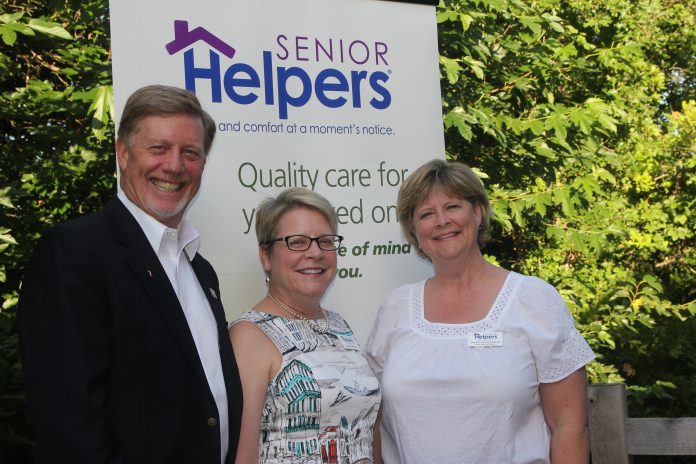
Left to right: John and Laurie Stansbury partner with Sharon Johnson MSN, RN, CNE open the Greater OKC North Senior Helpers location.

Local In-home Senior Care Company to Bring 50 New Jobs to the Area

Senior Helpers, the nation’s premier provider of in-home senior care, today announced the official opening of its Greater Oklahoma City North location, to be managed and operated by husband and wife team John and Laurie Stansbury together with their partner, Sharon Johnson MSN, RN, CNE, who will serve as president and chief nursing officer. The new franchise will serve senior citizens and their families throughout the Greater Oklahoma City area, which includes Edmond, Deer Creek, Piedmont, Warr Acres, Bethany, Yukon, Mustang, Midwest City, Del City, Moore-Norman, and Guthrie. It hopes to bring more than 50 new jobs to the region over the next year. Senior Helpers’ professionally trained caregivers will help local seniors continue to enjoy the comfort of their own home despite age-related illnesses and mobility challenges.
“All three of us have personal experience caring for a family member living with early onset Alzheimer’s, and we understand profoundly how challenging it can be without the proper care,” said Laurie. “Through Senior Helpers, we’re providing a valuable resource by helping to alleviate this stress and ensure a better quality of life for families in our community through personalized in-home senior care.” Sharon adds, “Over the years, Senior Helpers has established itself as the best option for navigating the challenges of in-home senior care today, and we are proud to be a part of this company.”
Founded in 2001, Senior Helpers operates with a vision to be the leading home care company in each community it serves. Its caregivers in Oklahoma City are fully trained and certified to offer the highest level of care possible based on the company’s Senior Gems® Alzheimer’s and Dementia care program. As the gold standard for excellence in personalized in-home senior care, the program was developed in conjunction with nationally recognized dementia care expert Teepa Snow and is endorsed by the Alzheimer’s Foundation of America and the American Society on Aging. Local residents will also benefit from the company’s new Parkinson’s Care Program, a specialized training and certification program created in conjunction with leading experts from the National Parkinson Foundation’s Center of Excellence.
“We’re pleased to welcome Laurie, John and Sharon to our team as the newest Senior Helpers franchise owners,” said Chris Buitron, vice president of marketing for Senior Helpers. “This amazing triobrings a passion for their community and an acute understanding of in-home senior care to their new roles. This will serve them well and also will be rewarding for seniors and families living in Oklahoma City and the surrounding area.”
Senior Helpers is the nation’s largest premier in-home senior care company in the U.S. with over 270 franchised businesses operating across the country. Founded in 2001 with a vision to help seniors who wish to remain in their homes despite age-related illnesses and mobility challenges, Senior Helpers has now cared for tens of thousands of seniors with a pledge to provide “care and comfort at a moment’s notice.” Senior Helpers offers a wide range of personal care and companion services, including trained Alzheimer’s, dementia and Parkinson’s care, to assist seniors who wish to live independently. Learn more by visiting http://www.seniorhelpers.com.

Battle at the scale: How your body fights to regain lost weight

0
A regular exercise regimen appears to be the best hope for those who have lost weight to maintain that new body weight. Here, Oklahoma Medical Research Foundation employees Anne Zike, Kelie Ashley and Jonathan Myers attend a Tabata class.

Losing weight is hard. But as anyone who has dropped a few pants sizes can tell you, keeping it off can be every bit as challenging.
It turns out, though, that it likely takes more than just staying committed to a maintenance diet once you reach your goals. Scientists believe your body might actually be fighting to get back to where it was previously in a phenomenon called the ‘set point’ theory.
The idea is that, for some reason, your body has an idea of what weight it wants you to be, said Oklahoma Medical Research Foundation President Stephen Prescott, M.D. So whether you’ve lost 40 pounds or gained 15, your hormones will adjust in an effort to get you back to a particular point.
“A person’s weight may not always go all the way back to the original weight, but there appears to be some kind of intrinsic desire on the body’s part to get back to a certain weight and stay there,” said Prescott. “It’s not been proven scientifically, but there is increasing evidence to support it.”
The set-point theory isn’t new, but it has been re-popularized because of a recent study by scientists at the National Institute of Diabetes and Digestive and Kidney Diseases, who tracked the progress of contestants from the reality television show “The Biggest Loser.” For six years, they followed contestants after they shed massive amounts of weight for the popular competition.
The researchers’ discoveries gave the set-point theory a lot of ammunition, as the former contestants packed the pounds back on regardless of how strictly they adhered to their diets. Some even gained to a point higher than their original weight.
“It was a really dramatic, attention-grabbing example of the theory as it had previously been described,” said Prescott. “It also shows that there are mysteries we don’t quite fully understand, and you can’t just blame people for getting fat again. Some may not follow their diets as closely as they should, but it appears likely that people also end up fighting their own biology.”
Prescott said the study’s findings point to resting metabolism, or basal metabolic rate, which determines how many calories your body burns at rest.
Our bodies burn energy just keeping us alive. Prescott said somewhere around 70 percent of the calories you use each day are going to get burned no matter what, even if you’re just sitting on the couch or at your desk.
Your age, muscle mass, fitness level and height all contribute to how many calories your body burns. But the findings presented a paradox: The people who gained the weight back appear to have lower metabolic rates than expected based on these factors.
“It’s thought that this could be a result of a complex interplay between hormones that regulate how our bodies burn energy,” said Prescott. “These people were not burning as many calories as you would think based on their height, weight or age. They were gaining weight even on what would be considered a maintenance diet.”
In other words, if you should be burning around 2,000 calories on a maintenance diet based on your personal combination of factors but you have recently lost 20-30 pounds, your actual metabolic rate might have dropped to somewhere around 1,700 or so.
So if your body is determined to gain the weight back even after all your hard work to lose it, does this mean it’s time to throw in the towel and raid the freezer for that pint of rocky road?
“That’s a little too dramatic,” said Prescott. “There may be a tendency to do that, but I think there is hope that there are things you can do to alter or reset your set point.”
To influence this process in your favor, the best solution may rely on an old standby—the gym.
“An exercise regimen often leads to more success in maintaining a new, lower weight,” said Prescott. “Maintaining your new weight may tough, but increased understanding can help you start to rebuild your behavior and habits around a new number for better long-term outcomes.”

OMRF scientist receives American Aging Association award

0
Oklahoma Medical Research Foundation scientist Holly Van Remmen, Ph.D.

Oklahoma Medical Research Foundation scientist Holly Van Remmen, Ph.D., has received the Denham Harman Award from the American Aging Association. The honor, the highest bestowed by the organization, was presented to Van Remmen at the Aging Association’s annual meeting in Seattle earlier this month.
Established in 1978, the prize is a lifetime achievement award that recognizes scientists who have made significant contributions to the field of research in aging.
Van Remmen joined OMRF in 2013 and heads the foundation’s Aging & Metabolism Research Program. Prior to that, she spent more than two decades as an aging researcher at the University of Texas Health Sciences Center in San Antonio, where she earned her Ph.D. in 1991.
Her work has focused on age-related muscle loss and amyotrophic lateral sclerosis, also known as Lou Gehrig’s disease. During her career, she has made a series of important insights on muscle degeneration, and this past year she led study that found new links between traumatic brain injuries and neurodegenerative conditions.
“This is such a nice honor for me personally,” said Van Remmen, who was named the G.T. Blankenship Chair in Aging Research at OMRF in April. “But this award also lets me know that our colleagues across the country now recognize Oklahoma as a force in research on aging.”
In 2015, working with scientists at the University of Oklahoma Health Sciences Center and the VA Medical Center, she helped secure a Nathan Shock Center of Excellence in the Biology of Aging grant—one of only six awarded nationwide—from the National Institutes of Health. With OUHSC’s Arlan Richardson, Ph.D., she now serves as co-director of the Shock Center, which focuses on geroscience, the study of how aging impacts disease and changes that occur in aging that predispose people to disease.
The long-term goal of this work, she said, “is not to find a fountain of youth, but to address the declining quality of life as we age. We want people’s ‘healthspans’ to match their lifespans.”

Wellness program reels in senior men

0
Participants like Ronald Haywood, Anthony Hudspeth, Ronnie Pruiett, Tony Hooks and Glenda Nash recently enjoyed a morning of fishing at Lake Hefner thanks to the Oklahoma City Community Foundation and Salvation Army Central Oklahoma.

Fishing add72

by Bobby Anderson, Staff Writer

The fishing line hit the water at Lake Hefner and a Lisa Sydnor teared up.
The senior programs manager for The Salvation Army Central Oklahoma couldn’t help but getting a little misty-eyed watching the collection of senior men fishing from the docks on a picturesque June morning.
“It makes me cry,” Sydnor said. “The people that we are serving the majority of them live on virtually nothing. Can you imagine living on $750 a month? For them to be able to do something that they can enjoy and relax and they don’t have to worry about how much it costs …”
The Salvation Army Central Oklahoma recently received an $11,600 grant from the Oklahoma City Community Foundation and its Wellness Initiative grant program.
The grant will be used to assist in funding senior men’s activity programs, which will allow The Salvation Army to increase its level of service to men at their five senior centers.
On this morning everything was paid for and all the men had to do was reel in the striped bass.
The Salvation Army received the funding the third week of June and by the end of the month Oklahoma City seniors were already dipping their lines into Lake Hefner and pulling out fish.
Sydnor said The Salvation Army received a similar elder grant last year that centered around dance instruction.
“Lots of ladies enjoyed that. We had a great time and a great turnout but the guys didn’t participate,” she said. “They don’t really participate (overall). The focus of this grant was to identify things men would enjoy.”
The funding has helped purchase all needed fishing gear and tackle plus the cost of permits.
“We wanted to find things our seniors could participate in and enjoy and get out. The more you’re out and the more you do the better your are, the better you feel and the better your health is. Our goal is to get our men up and moving.”
Leatherworking and woodworking classes are planned for July and August.
“As we evaluated our activities at the senior centers, we discovered the men’s interest and participation was significantly lower than the women’s,” Sydnor said. “We are so pleased to receive this grant as it will allow us to provide the activities our senior men have told us they want.”
The Wellness Initiative grant will fund wood and leather craft kits; sports equipment for pool, darts, indoor golf and horseshoes; fishing equipment; and, tickets to sporting events. By providing these activities, The Salvation Army strives to increase participation of both men and women in their senior programs.
The Salvation Army Central Oklahoma operates five senior centers throughout the Oklahoma City metro. The centers are open every weekday to seniors ages 55 and older. Seniors have the opportunity to socialize, enjoy lunch and participate in numerous activities that include Bible study, exercise classes, crafts, dancing and much more.
Sydnor said the program is available at no charge to seniors.
Approximately 139,000 Oklahomans receive assistance from The Salvation Army Central Oklahoma Area Command each year through the broadest array of social services that range from providing food for the hungry, relief for disaster victims, assistance for the disabled, outreach to the elderly and ill, clothing and shelter to the homeless and opportunities for underprivileged children.
For more information on the programs and services at The Salvation Army Central Oklahoma, please visit www.salvationarmyokcac.org.
If you would like more information on the centers or other programs you can contact Sydnor at her office at 405-246-1120.
Centers are open 8 a.m. to 3 p.m. Monday through Thursday. On Fridays the centers are open 8 a.m. until noon. Coffee and snacks are served each morning with lunch at 11:30.
“The best way to plug into a center is just to call us. We can tell you where all the centers are,” Sydnor said.

Fraud Advisory: Social Security Inspector General Warns Public About Email Phishing Scheme

0
The Acting Inspector General of Social Security, Gale Stallworth Stone, is warning citizens about a suspicious email “phishing” scheme that recently surfaced. The Office of the Inspector General (OIG) received reports that several hundred employees of a private company, with offices across the country, recently received an email message that appears to be from the Social Security Administration (SSA). The message alerts a recipient of “unusual” activity with his or her Social Security number (SSN).
The email subject line reads, “Review Your Social Security Activity”, and while the email sender displayed is “Social Security Administration,” the corresponding email address is ceriley@centurytel.net. The message includes a PDF attachment with the heading “Notification.” It advises the recipient, “We detected something unusual about a recent use of your SSN” and “to help keep you safe, we required an extra security challenge.” The message states that if the recipient did not recently use his or her SSN, then a “malicious user” might have misused the recipient’s number. It asks the recipient to review recent activity via an embedded link, which links to a suspicious SSA-like site. Further, to appear legitimate, the notice includes SSA’s official seal and the words “Social Security Administrator, United States Of America” in the signature.
This type of phishing scheme could lead to identity theft or Social Security benefit theft. Therefore, Acting Inspector General Stone urges all citizens to be extremely cautious when receiving requests to provide personal information over the internet or the telephone. “Don’t provide your Social Security number, bank account numbers, or other personal information, including account passwords, over the internet or by telephone unless you know and trust the source requesting it,” Stone said. “You should be extremely confident that the source is a legitimate entity, and that your information will be secure after you provide it.”
Before clicking an embedded email link, try to verify the source. One method of verifying the true source is to hover over the linked text, without clicking, to reveal the destination address. For instance, in the email described above, the attachment includes the text “Review your activity,” which links to www.ssa.gov.kerodun.net/activity. While ssa.gov appears in the destination address, the “kerodun.net/activity” portion of the address is suspicious; users should be vigilant of similar questionable web addresses.
If a person has questions about any communication—email, letter, text, or phone call—that claims to be from SSA, Stone recommends contacting a local Social Security office, or calling Social Security’s toll-free customer service number at 1-800-772-1213, 7 a.m. to 7 p.m., Monday through Friday, to verify its
Fraud Advisory
legitimacy. (Those who are deaf or hard-of-hearing can call Social Security’s TTY number at 1-800-325-0778.)
Individuals may report suspicious activity involving Social Security programs and operations to the Social Security Fraud Hotline at https://oig.ssa.gov/report, or by phone at 1-800-269-0271, 10 a.m. to 4 p.m., Eastern Time, Monday through Friday. (Those who are deaf or hard-of-hearing can call the OIG TTY number at 1-866-501-2101.)
For more information, please contact Andrew Cannarsa, the OIG’s Acting Communications Director, at (410) 965-2671.

HIT A HOME RUN WITH SOCIAL SECURITY

0
By Jose M. Olivero
Social Security Public Affairs Specialist in Oklahoma

A home run is a highlight of any baseball game. The fans cheer with excitement to see a player rocket the ball into the stands. So, what are you doing to prepare for your retirement home run? Your goal should be to get past 1st, 2nd & 3rd base and make it home with a hefty plate of savings.
Social Security has many tools to help you achieve financial security. 
Take the first step and visit www.socialsecurity.gov/myaccount. The benefit of having a my Social Security account is that it gives you access to your personal Social Security Statement, verification of correct earnings, and an estimate of your early retirement benefits at age 62, full retirement age of 66, and delayed age at 70. 
We protect your information by using security features and strict identity verification to detect fraud. In several states including the newly added Idaho, Mississippi, and North Dakota, you can request a replacement Social Security card online. Find out if your state offers the service at www.socialsecurity.gov/ssnumber.
In addition to using your personal my Social Security account to prepare for a comfortable retirement, you can visit www.myra.gov. At myRA, you can access new retirement savings options from the Department of the Treasury. This service is designed for the millions of Americans who struggle with saving for retirement — it’s an easy and safe way to help you take control of your future.  
myRA is designed for people who don’t have a retirement savings plan through their employer, or are limited from other savings options. If your employer provides a retirement savings plan, such as a 401(k), learn more about that plan’s potential for matching contributions or other benefits.
Since myRA isn’t connected to any employer, it allows workers to hold on to it when they move to different jobs. myRA makes your money grow faster than a traditional savings account. 
Having both my Social Security and myRA accounts in place, you’re guaranteed to hit a home run in successfully planning for your future. Learn more about all of your choices at www.socialsecurity.gov.

Prescription Drug Abuse Threatens Lives of Oklahomans

0

It is no secret that prescription drug abuse is Oklahoma’s largest drug problem, taking a toll on too many Oklahomans and their families. Of the more than 5,300 unintentional poisoning deaths in Oklahoma from 2007 to 2014, about 80 percent involved at least one prescription drug and nearly 90 percent of those deaths involved prescription painkillers (opioids).
In recent years, the numbers of unintentional poisoning deaths have surpassed deaths from motor vehicle crashes. More unintentional poisoning deaths involve hydrocodone or oxycodone, both prescription painkillers, than alcohol and all illicit drugs combined. Adults ages 35-54 years have the highest death rate of any age group for prescription overdoses.
The Oklahoma State Department of Health (OSDH) offers the following suggestions for preventing prescription drug overdoses: * Tell your healthcare provider about all medications and supplements you are taking. Opioids, in combination with other depressants such as sleep aids, anti-anxiety medications, or cold medicine, can be dangerous. * Only take medications as prescribed and never more than the recommended dosage. Use special caution with opioid painkillers. * Never share or sell prescription drugs. * Dispose of unused, unneeded, or expired prescription drugs at approved drug disposal sites. * Call 211 for help finding treatment referrals. * Keep all pain medications in a secure place to avoid theft and access to children. * Keep medicines in their original bottles or containers. * Never drink alcohol while taking medication. * Put the Poison Control number, 1-800-222-1222, on or near every home telephone and cell phone for 24/7 access. * If you suspect someone is experiencing an overdose, call 911 immediately.
For more information on prescription drug overdose prevention, contact the OSDH Injury Prevention Service at (405) 271-3430 or visit http://poison.health.ok.gov. For help finding treatment referrals, call 211. To report illegal distribution or diversion of prescription drugs, call the Oklahoma Bureau of Narcotics and Dangerous Drugs Control at 1-800-522-8031.

SAVVY SENIOR: Who’s Eligible for Social Security Survivor Benefits?

0

Dear Savvy Senior, Who all is eligible for Social Security survivor benefits? My ex-husband died last year at the age of 59, and I would like to find out if me, or my two kids – ages 13 and 16 – that we had together are eligible for anything?  Divorced Widow

Dear Divorced,
If your ex-husband worked and paid Social Security taxes, both you and your kids may very well be eligible for survivor benefits, but you need to act quickly because benefits are generally retroactive only up to six months. Here’s what you should know.
Under Social Security law, when a person who has worked and paid Social Security taxes dies, certain members of that person’s family may be eligible for survivor benefits including spouses, former spouses and dependents. Here’s a breakdown of who may be eligible.
Widow(er)’s and divorced widow(er)’s: Surviving spouses are eligible to collect a monthly survivor benefit as early as age 60 (50 if disabled). Divorced surviving spouses are also eligible at this same age, if you were married at least 10 years and did not remarry before age 60 (50 if disabled), unless the marriage ends.
How much you’ll receive will depend on how much money (earnings that were subject to Social Security taxes) your spouse or ex-spouse made over their lifetime, and the age in which you apply for survivors benefits.
If you wait until your full retirement age (which is 66 for people born in 1945-1956 and will gradually increase to age 67 for people born in 1962 or later), you’ll receive 100 of your deceased spouses or ex-spouses benefit amount. But if you apply between age 60 and your full retirement age, your benefit will be somewhere between 71.5 – 99 percent of their benefit.
To find out what percentage you can get under full retirement age visit ssa.gov/survivorplan/survivorchartred.htm.
There is, however, one exception. Surviving spouses and ex-spouses that are caring for a child (or children) of the deceased worker, and they are under age 16 or disabled, are eligible to receive 75 percent of the worker’s benefit amount at any age.
Unmarried children: Surviving unmarried children under age 18, or up to age 19 if they’re still attending high school, are eligible for survivor benefits too. Benefits can also be paid to children at any age if they were disabled before age 22 and remain disabled. Both biological and adoptive children are eligible, as well as kids born out of wedlock. Dependent stepchildren and grandchildren may also qualify. Children’s benefits are 75 percent of the workers benefit.
Dependent parents: Benefits can also be paid to dependent parent(s) who are age 62 and older. For parents to qualify as dependents, the deceased worker would have had to provide at least one-half of the parent’s financial support.
But be aware that Social Security has limits on how much a family can receive in monthly survivors benefits – usually 150 to 180 percent of the workers benefit.
You also need to know that in addition to survivor benefits, surviving spouses or children are also eligible to receive a one-time death benefit of $255.
Social Security also provides surviving spouses and ex-spouses some nice strategies that can help boost your benefits. For example, you could take a reduced survivor benefit at age 60, and could switch to your own retirement benefit based on your earnings – between 62 and 70 – if it offers a higher payment.
Or, if you’re already receiving retirement benefits on your work record, you could switch to survivors benefits if it offers a higher payment. You cannot, however, receive both benefits.
You also need to know that if you collect a survivor benefit while working, and are under full retirement age, your benefits may be reduced depending on your earnings.
For more information, visit ssa.gov/survivorplan or call 800-772-1213.

Send your senior questions to: Savvy Senior, P.O. Box 5443, Norman, OK 73070, or visit SavvySenior.org. Jim Miller is a contributor to the NBC Today show and author of “The Savvy Senior” book.

Social

0FansLike
0FollowersFollow
0SubscribersSubscribe