The Oklahoma Department of Mental Health and Substance Abuse Services (ODMHSAS) has announced the results of its annual inspection of tobacco outlets to measure compliance with laws restricting underage tobacco sales. This year’s non-compliance rate of 14.1 percent is more than twice the 6.8 percent recorded only four years ago, which was the lowest ever for the state.
Oklahoma retail outlets such as convenience and grocery stores are monitored to ensure they follow all laws prohibiting the sale of tobacco products to minors. Each year, hundreds of random checks are completed across the state through the agency’s partnership with the state Alcoholic Beverage Laws Enforcement (ABLE) Commission. States must maintain a non-compliance rate below 20 percent regarding sale of tobacco products to minors or risk losing federal funding for substance abuse prevention and treatment efforts. ODMHSAS Commissioner Terri White said she is concerned that non-compliance is increasing and that some retailers seem unconcerned about illegally selling tobacco products to minors.
“Store owners who ignore compliance requirements are putting their own profits ahead of our children’s health,” she said. “Fortunately, the vast majority of retailers are abiding by the law and aren’t the ones putting tobacco into the hands of our youth. The fact that so many retailers didn’t sell these products to minors suggests there is no excuse for the others to continue breaking the law.”
The 2013 Oklahoma Youth Tobacco Survey notes that nine out of 10 smokers tried their first cigarette before age 18, and that 22.7 percent of Oklahoma high school students are current tobacco users. Tobacco use prematurely kills thousands of Oklahomans every year, yet it remains a leading preventable cause of death. “The most effective way to stop future problems caused by tobacco use is to prevent it from ever occurring in the first place,” White added.
In addition to health risks faced by tobacco users, White said the potential loss of federal substance abuse treatment funding would seriously impact already limited addiction treatment services. “Significant budget cuts have severely limited the services we can provide,” she said. “Already, only about 20 percent of those needing substance abuse services receive the help they need.”
Community-based education is available to business owners and clerks regarding youth access to tobacco. Additional information related to Synar compliance is available on the ODMHSAS website at http://ok.gov/odmhsas/Prevention_/Prevention_Initiatives/Synar_Compliance/.

ILLEGAL TOBACCO SALES TO MINORS DOUBLE IN ONLY FOUR YEARS
POKEMON GO HELPS OCCUPATIONAL THERAPY PATIENTS
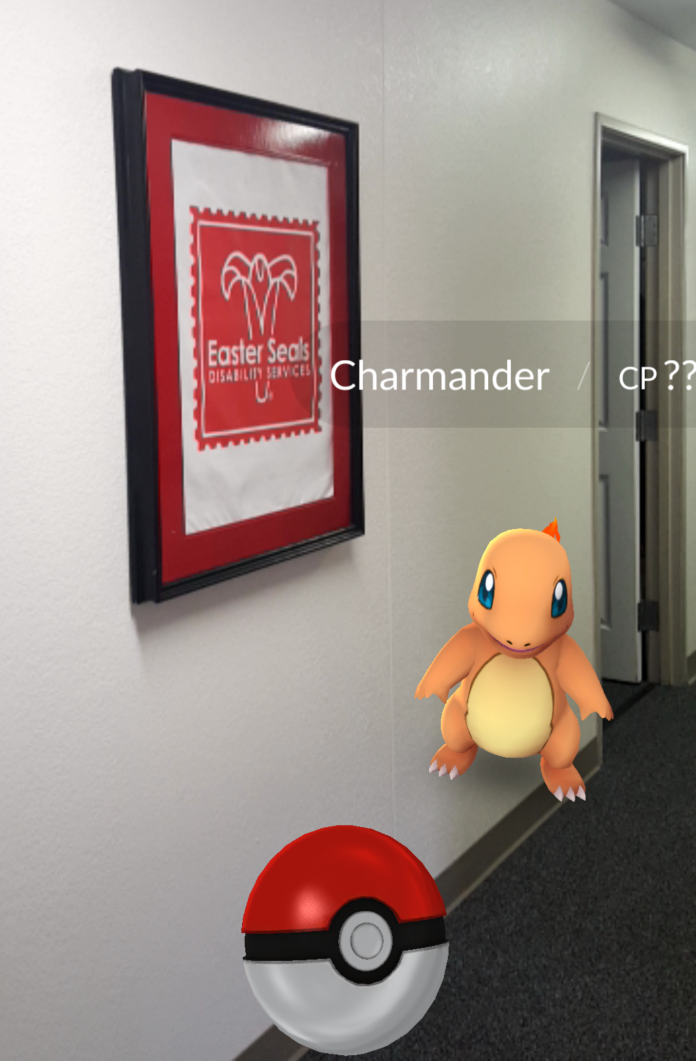
Easter Seals Oklahoma Occupational Therapists are utilizing the popular phone app game Pokemon Go with patients to help with hand-eye coordination when looking for and catching Pokemon. It also helps with spatial awareness, visual perception skills, following directions and instructional cues, fine motor skills, impulse control and social skills in taking turns with peers.
Easter Seals Oklahoma invites Pokemon Go players to consider scheduling a tour of its facility while playing the game. Easter Seals Oklahoma is open Monday through Friday, 7:30 a.m. -5:30 p.m.
For more than 90 years, Easter Seals Oklahoma has provided services to children and adults with disabilities and other special needs and support to their families. Services include an early learning and inclusion academy, adult day health center, therapy services, screenings and financial assistance. For more information, please visit www.eastersealsoklahoma.org.
National Cowboy Museum announces unique opportunity for metro volunteers to Find their West
Museum partnering with University of Central Oklahoma to offer special fall course for history majors and future Museum docents
The National Cowboy & Western Heritage Museum is excited to announce a unique program for adult metro-area volunteers, art enthusiasts and history lovers to become a Museum docent who provides guided tours at the National Cowboy Museum. For the first time, the Museum is partnering with the University of Central Oklahoma to offer students and Museum docent candidates a university-level Western History and Museum course.
“Docents play a crucial role in the experience of each visitor to the National Cowboy Museum,” said Museum Chief Public Experience Officer Inez Wolins. “With increasing traffic through our galleries this year, we are excited both to offer our volunteers the opportunity of a unique partnership with UCO and new resources to make their experience as a docent the best it can be.”
Patti Loughlin, Ph.D., chair of the UCO Department of History and Geography, will lead an engaging 12-week course focusing on history of the American West and the National Cowboy Museum’s world-class collections. Participants will research selected art and artifacts and share presentations in collaborative groups. Upon completing the course, participants are eligible to apply for docent candidacy.
“Historians at UCO have a strong tradition of researching and teaching the history of the American West and museum studies,” Loughlin said. “My colleagues and I have put together a series of exciting presentations ranging from environmental history to Native American history to popular culture. We look forward to sharing engaging Western history content and interpretation with course participants and viewing and interpreting the art of the National Cowboy & Western Heritage Museum together.”
Founded in 1965, the Museum’s program is one of the largest and most celebrated docent groups in the nation. Docents are awarded discounted Museum membership, enjoy free Museum admission and other discounts and are invited to behind-the-scenes opportunities.
An uptick in Museum tourism, particularly among school groups, is anticipated due to the Museum’s recent efforts to raise more than $40,000 to offset transportation and other costs for public school field trips this academic year.
Registration for the course is open now through Aug. 17. The course will run Aug. 22 through Nov. 14 from 9 a.m. to 10:15 a.m. at the Museum. College students will have the opportunity to receive one credit hour upon completion. The class enrollment fee for incoming docents is $125, or free for those older than 65 with the purchase of a $30 reading packet. The tuition rate is $228.20 for matriculated UCO students.
Register online at http://go.uco.edu/cowboy-link or call the UCO Customized Education Office at 405-974-3030. For questions, call Gretchen Jeane, Museum Director of Education at 405-478-2250 ext. 277.
Oklahoma horse shows carry many dreams to reality


photos by Shane Rux
The champion’s ribbon that had glistened in 5-year old Maguire Biggs’ dreams is now clutched between her tiny hands each night as she sleeps.
Biggs, who lives in the Chickasha area, showed her 15-year-old bay leopard mare TXS Dinas Real Miracle to a win of the Leadline 6-Under Trail class this week during the 2016 Pony Of the Americas Club (POAC) National Congress at Tulsa.
The win came on Sunday but each night since she has toted the long blue, red and gold Champion’s ribbon with her to bed.
Maguire was asked Thursday how often she plans to sleep with the ribbon next to her.
The kindergartner-to-be at Amber-Pocasset Public Schools grinned widely and replied, “A lot.”
The 2016 POAC National Congress began July 7 and continues through Friday (July 15) at the Built Ford Tough Complex at the Expo Square in Tulsa. The national show has featured 2,675 entries and about 370 ponies. Participants and family members come to the show from Oklahoma, Florida, Wisconsin, Illinois, Oregon and many other states. Biggs said she heard a report in recent years that the show has an annual economic impact on the city of more than $1 million.
The POAC National Congress is just one example of how equestrian events in Tulsa, Oklahoma City and throughout the state allow children of varying ages to live out their dreams while forming a bond with their horses and making long-lasting friendships with other exhibitors.
Maguire is the daughter of State Representative Scott Biggs and Dr. Rosslyn Biggs.
Rosslyn Biggs is the show chairman for the POAC National Congress in Tulsa and she the represents the second of three generations of their family to show the Pony Of the Americas breed.
“I think every exhibitor that’s here, and we have both adults and youth, everyone dreams for titles,” she said. “Frankly, if I’m showing, I’m still dreaming for that title today as an adult.”
The awards represent more than a national championship in a particular class.
“It’s a culmination of practice and desire,” Biggs said. “Even as a small child, she’s willing to put in the hard work because she makes the connection between ‘If I practice then I do well and I get rewarded for that by ribbons.’ So, the things we’re building beyond just prizes at the end of the day are a group of exhibitors, a group of young people that understands what it takes to get the job done, understands hard work and understands determination and perseverance. Even from kindergarten age they are making that connection. Beyond the ribbons and the trophies, and don’t get me wrong those are nice, we’re creating the future of successful professionals in the workplace and in our communities.”
Maguire rides about six days a week, anywhere from 15 to 20 minutes to as much as an hour a day. Each day she’s at the back door of the house with her boots on ready to go to the barn to spend time with her friend TXS Dinas Real Miracle. On Thursday, Maguire was asked what she likes about her friend.
“She does good things and I like her spots,” Maguire said. “She likes people to scratch her legs. I do like her a lot.”
What did you think when they called your name as the champion?
The big grin returned, “I was so excited.”
Watching that excitement is gratifying to a parent whether their child is 5 years old and headed for kindergarten or in the case of Shari Clymer’s daughter Sarah, 19 years old and headed for college.
Shari Clymer of Edmond said her daughter clings to the words, “Living the dream.” Sarah’s has been an impressive dream that continues on.
“My husband and I knew nothing about horses,” Shari said. “We knew to go to the fair, stick your hand through the stall door and pet them, but she has always wanted to have a horse.”
So finally one year they decided to let her attend a horse camp in the Oklahoma City area. Sarah “loved it.”
So she started lessons and found a trainer and a POA. She has continued on with her dream, winning numerous titles and now will be a member of the Oklahoma State University Equestrian Team.
“She’s come from an accomplishment like being able to lope her pony around the arena one time to now this at OSU,” Shari said. “That really is a dream.”
As a parent she values the hard work that her daughter has put into achieving those dreams and the lessons she has learned.
Rosslyn Biggs echoed the importance of what is gained aside from awards.
“I think one of the biggest things it teaches from a personal aspect is the value of hard work, and that hard work will pay off,” Biggs said. “Another thing you learn is that sometimes life rolls your way and sometimes it doesn’t. Sometimes you get a break and sometimes you don’t. Perseverance is a key because the hard work and the dedication will be rewarded.”
LETTER TO THE EDITOR: “Invention of the Year”
Dear Editor,
Recently I saw an advertisement that shouted “Invention of the Year” and then admitted “they’re not hearing aids.” Hearing loss is a major problem in Oklahoma and it is growing. Hearing loss is one of the most prevalent complaints among returning veterans. Hearing loss is big business too. Don’t believe it? Look at the TV and print advertising that is done here in central Oklahoma by hearing aid companies. Hearing aids can be expensive and they are not covered by most insurance companies or Medicare and that is why we are seeing “buy one and get one” or “30 day free trial” offers. Oklahoma state law requires a 30 day trial period on hearing aid purchases. If it does not work out, your money must be refunded less applicable fees. You cannot be charged more than $150 per hearing aid if you return them. Be sure that you understand all the costs and fees charged when making a purchase. Most quality distributors will work with you to solve any difficulties and make adjustments as required.
Hearing Loss Association of America Central Oklahoma Chapter (HLAA) encourages you to have your hearing tested if you think it might be failing. The test doesn’t hurt and many audiologists offer free hearing screenings. HLAA is working to help those with hearing loss live successfully in a hearing world. Attend an HLAA meeting to get answers to your questions about hearing loss, for yourself or a loved one. There are three meeting times in the OKC metro for your convenience. For more information visit the HLAA website, WWW.OKCHearingLoss.org
Ron Hendricks, Oklahoma City
SAVVY SENIOR: How to Find Financial Assistance for Elderly Parents
Dear Savvy Senior, Where can I go to locate financial assistance programs for seniors? I have been helping support my 70-year-old mother the past couple years and really can’t afford to do it any longer. Feeling Overwhelmed
Dear Overwhelmed,
There are actually a wide variety of financial assistance programs and government benefits that can help seniors in need. But what’s available to your mom will depend on her income level and where she lives.
To find out what types of assistance your mom may be eligible for, just go to BenefitsCheckUp.org, a free, confidential Web tool designed for adults 55 and older and their families. It will help you locate federal, state and private benefits programs that can assist with paying for food, medications, utilities, health care, housing and other needs. This site – created by the National Council on Aging – contains more than 2,000 programs across the country.
To identify benefits, you’ll first need to fill out an online questionnaire that asks a series of questions like your mom’s date of birth, her ZIP code, expenses, income, assets, veteran status, the medications she takes and a few other factors. It takes about 15 minutes.
Once completed, you’ll get a report detailing all the programs and services she may qualify for, along with detailed information on how to apply.
Some programs can be applied for online, some have downloadable application forms that you can print and mail, fax or email in, and some require that you contact the program’s administrative office directly (they provide the necessary contact information).
If you don’t have Internet access, you can also get help in-person at any of the 47 Benefit Enrollment Centers located throughout the U.S. Call 888-268-6706 or visit NCOA.org/centerforbenefits/becs to locate a center in your area. Some centers also offer assistance over the phone.
Types of Benefits
Depending on your mom’s income level and where she lives, here are some benefits that she may be eligible for:
Food assistance: Programs like the Supplemental Nutrition Assistance Program (SNAP) can help pay for groceries. The average monthly SNAP benefit is currently around $127 per person. Other programs that may be available include the Emergency Food Assistance Program, Commodity Supplemental Food Program, and the Senior Farmers’ Market Nutrition Program.
Healthcare: Medicaid and Medicare Savings Programs can help or completely pay for out-of-pocket health care costs. And, there are special Medicaid waiver programs that provide in-home care and assistance.
Prescription drugs: There are hundreds of programs offered through pharmaceutical companies, government agencies and charitable organizations that help lower or eliminate prescription drug costs, including the federal Low Income Subsidy known as “Extra Help” that pays premiums, deductibles and prescription copayments for Medicare Part D beneficiaries.
Utility assistance: There’s the Low Income Home Energy Assistance Program (LIHEAP), as well as local utility companies and charitable organizations that provide assistance in lowering home heating and cooling costs.
Supplemental Security Income (SSI): Administered by the Social Security Administration, SSI provides monthly payments to very low-income seniors, age 65 and older, as well as to those who are blind and disabled. SSI pays up to $733 per month for a single person and up to $1,100 for couples.
In addition to these programs, there are numerous other benefits they can help you locate such as HUD housing, home weatherization assistance, tax relief, veteran’s benefits, senior transportation, respite care, free legal assistance, job training and employment and debt counseling.
Send your senior questions to: Savvy Senior, P.O. Box 5443, Norman, OK 73070, or visit SavvySenior.org. Jim Miller is a contributor to the NBC Today show and author of “The Savvy Senior” book.
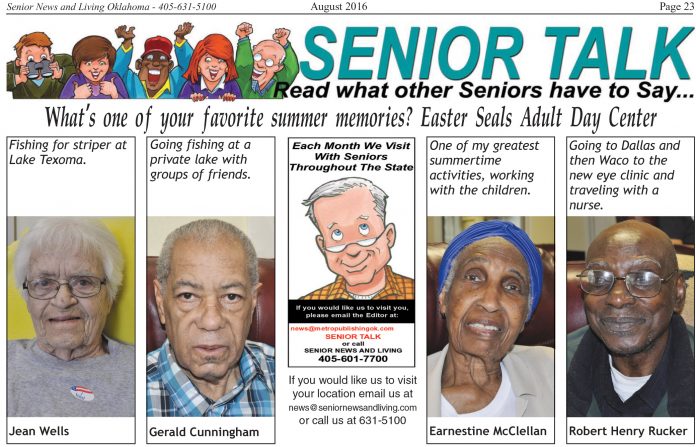
SENIOR TALK: What’s one of your favorite summer memories?
What’s one of your favorite summer memories? Easter Seals Adult Day Center
Fishing for striper at Lake Texoma. Jean Wells
Going fishing at a private lake with groups of friends. Gerald Cunningham
One of my greatest summertime activities, working with the children. Earnestine McClellan
Going to Dallas and then Waco to the new eye clinic and traveling with a nurse. Robert Henry Rucker
HEALTH: A SEASONED NURSE

LPN Returns to her Beloved Field
by Jason Chandler
Staff Writer
Caren Graham was a CNA for Golden Age Nursing Center in 2001. Graham is now a licensed practical charge nurse at the Guthrie nursing center. She works with a myriad of patients from skilled nursing to long-term care.
She is grateful that Golden Age paid for her scholarship to attend nursing school at Metro Tech in 2002 in Oklahoma City.
Graham loved school and signed a two-year contract with Golden Age stating that she would come back to work there. Before returning to Golden Age, Graham went into the field of home health when she graduated.
“The reason being is that I wanted it to be a slower pace so that I could get more familiar with patients and their diagnosis,” she said. “So I did that for a year and then I came back here and did my two years.”
The one year of home health did her a world of good, she said of being a seasoned nurse.
Graham then went to work with pediatric patients for eight years. She said being a pediatric nurse is good or bad with no in-between.
“I taught a 7-year-old how to smile but then again I had to say goodbye to some really young kids,” she said. “So for eight years I did that and was really happy, but just needed a break. So I came back to Golden Age.”
Golden Age provides a professional and efficient environment for nursing care, she said. That is what she likes about it.
“You know I don’t have to worry about my license being at risk,” Graham said. “I have been in some facilities where it’s everybody flies by the seat of their pants. We don’t do that here. It’s just very professional.”
She always wanted to be a nurse, she said. At age 16 she was a CNA living in Nevada. That was when nurses wore all white attire in a different era.
“My youngest son had passed away when I was 28,” Graham said. “And he was just an infant and it was very upsetting. I didn’t deal with that very well so I got out of nursing. As a matter of fact, I was a 21 blackjack dealer for quite a while in Vegas.”
There was some healing that had to happen within her spirit, Graham said. Then 20 years ago, she returned to Oklahoma to continue her journey as a nurse.
“The spirit knew where I was supposed to be,” she said.
She worked at a daycare in Guthrie for several years and met a nurse who worked at Golden Age. The conversation led her to work at Golden Age as a CNA. Everything fell into place for Graham.
“It’s my bliss. It’s what I was always meant to do,” Graham said. “I’m sure of that.”
Golden Age sets a high standard with their employees, she said.
Her second time at Golden Age is different than it was when she first worked here in a world of paper, she said. Learning the digital age of computers applied to nursing was intimidating at first for Graham, she said.
“You had to drag me into the technology era,” said Graham, 51. “I’m from the old school. So I worked with the young nurses. I have some experience they pull from and I pulled from their experience on the computers. So that’s working out great.”
Nurses in any field want to help someone who can’t help themselves, she said. So geriatric care is very gratifying for Graham. Helping the residents is more than giving them medicine. It’s determining what works for them by knowing their nuances, Graham said.
“I enjoy that. I enjoy a continuity of care when I can see people over and over. I learn their nuances, so I can see if their diet is working for them, so it’s the little, tiny nuances that I pick-up on when I have that continuity of care. And that’s a big thing here,” she said. “You don’t get switched around a lot. You’re not with somebody new the first day trying to figure out something that is chronic.”
She can put her head down at night and feel satisfied, Graham said. That is also the time she thinks of some of the best interventions for her residents.
“When I’m thinking about my day it’s like, ‘That’s it. That will help,’” Graham said. “When it’s quiet and all your tasks are done for the day, you can just lay there and reflect.”
During her leisure time, she and her husband like to travel. Their children are grown now. Graham enjoys listening to music and her husband plays golf.
“I have a granddaughter that just moved in with me so I’m kind of getting back into that role,” she said.
Coffee shop to benefit community

by Bobby Anderson
Staff Writer
For nearly 20 years Bridget Hefner worked as an aircraft mechanic at Tinker Air Force Base.
So when retirement came around she thought it was time to finally pursue her dreams.
The money she earned she decided to pour into what has become a labor of love and Norman’s newest gathering place.
August 8 will be the official opening of The Screen Door, an event center and coffee shop that Hefner hopes fascinates the community as it has her for the past few months.
Hefner, her mother Patricia Whaley, daughters and even her grandchildren have been painting and prepping for months now.
The search for a building was a long one with plenty of properties getting checked off the list.
“It just happened the building itself happened to have everything,” Hefner said of the building at 408 W. Main. “I looked at buildings that didn’t have restrooms, buildings that didn’t have air conditioning and buildings that didn’t have the fire system in it. This building was perfect.”
The former Coneys and More location has a patio that looks down Main Street onto a thriving business district.
Inside is a spacious, steampunk-themed cafe with seating ranging from tables and stools to cushy leather oversized chairs.
Hefner eventually would like to free herself up enough where she can offer seminars revolving around dreams and philosophy.
For now, poetry slams and musicians have been scheduled.
The space is available for free for those who just want to meet up, Hefner said.
“The point of it is to bring the community together and make things more social,” said Hefner, a Navy veteran. “It’s a place where people can gather, meet or just hang out.”
Sandwiches, salads, soups and desserts will be offered with the menu ranging from meat to gluten free and vegan. Coffees, teas and frozen fruit smoothies are also on the menu.
The Screen Door is open seven days a week from 5 a.m. to 10 p.m. Free WIFI will be available for those who want to drop by and surf the web for an hour or two over coffee.
“Hopefully there will be different types of groups and meetings will come in,” Hefner said.
Hefner put out the word well before she left Tinker. Once she rented the building she began canvassing the neighborhoods.
“I’ve been going house to house just to let people know we’re here,” Hefner said. “I thought it would be a little more personable.”
Hefner welcomes feedback. A large chalkboard will even allow patrons to put up their comments, sayings or thoughts for the day.
The sky is the limit for The Screen Door which plans on hosting wine tastings, murder mysteries, Mad Hatter tea parties and a 1920s dance in addition to whatever else guests can think up.
The location is directly across from Republic Bank. It’s within walking distance of the Cleveland County Courthouse, Norman High School and Norman’s original downtown.
A portion of the 5,800 square-foot building will be available for private use as well for $50 per hour.
The idea has been ruminating in Hefner’s head for two years now. She wanted a space she could invite others into as well as a space people would feel welcome.
Making a difference daily is the theme for the new venture. In keeping with that, all of The Screen Door’s paper products are eco-friendly and biodegradable.
“I’m hoping our product will be good enough quality that word of mouth will get out,” Hefner said.
Every week discounts will be offered to different groups of people like firefighters, police officers, medical professionals or teachers. A different charity each week will also be able to receive some of the proceeds of the sales.
Right now Hefner’s mom and her oldest daughter are her best employees. But she has hired a sous chef from Packard’s kitchen to put together a menu ranging from strawberry jam muffins with streusel to roasted vegetable and goat cheese grits.
The Screen Door’s Facebook page is one of the best places to get information about what’s coming up but the business also has a website at www.screendoorok.com where you can find out more information.
Six shoots straight with MWC seniors

Story and photo by Mike Lee, Staff Writer
Depending on the day you come, you may find Mike Six behind a broom at the Midwest City Senior Center.
You might also see him behind the wheel driving seniors where they need to go or simply pulling up and cooling off their car on a hot day.
Then again he might be calling out bingo numbers or laying a spinner down during a daily game of dominoes.
But whatever he’s doing you’ll find the 27-year Midwest City Police Department veteran with a smile on his face
“This is the best job I’ve ever had,” said Six the center’s assistant coordinator under Fredia Cox.
After 27 years on the force, Six retired and decided to try a few things. He spent a year teaching before kicking around some different jobs.
He came back on with the city and shortly the job at the senior center opened up.
“I snagged it up quick as I could,” he said. “These are great people. I tell people all the time it’s the best job I’ve ever had. It’s not a six-figure job for sure but it’s not the money what I like, it’s the people.”
Cox estimates nearly 6,000 seniors each month are served at the Midwest City facility.
All of them know Mike, or just Six.
“He’s vital,” Cox said simply of her assistant, who also handles all the building’s maintenance.
It’s the time he spends at the facility that Six counts as his most important contribution.
“I guess in general you want to be available for them,” Six said. “That’s what I do. The senior center is part of the city of Midwest City. It’s a facility we’ve made that really belongs to the seniors. What we try to do is give them a destination, a place to come a reason to get up in the morning.”
A lot of counseling goes on within these walls, but there’s no couches or co-pays involved. The kind of counseling Six and Cox deliver is a smile, a cup of coffee and a willingness to listen.
“We visit with them. It’s really a quality of life issue for them,” Six said.
The center schedules three dances a week for the seniors plus many other activities.
Six and Cox both serve as resources for seniors. If someone is having a problem in an area of life their combined 70 years of experience in the community is there to help.
The Midwest City Senior Center offers programs, classes, events and activities for citizens, age 55 and older, who have a common interest in fellowships, leisure pursuits and mutual respect for one another.
The center is managed by Cox under the direction of the Midwest City Parks and Recreation Department. All programs and activities offered at the center are supervised by Cox and Six.
The center encourages ideas, input and involvement from senior citizens. It keep them going and it keeps Six going.
“Kind of like with the police department it does make you feel good when someone comes to you and identifies you as someone who might be able to help them,” Six said. “When you do help them it really does make you feel good.”
Six’s roots run deep in Midwest City after spending his career policing the streets. He was part of the department’s various community policing projects which focused on community relations as well as tackling the city’s gang problems.
“We were real visible and we made sure (the criminals) were real visible,” Six said. “People were living like prisoners in their homes. We cleaned up the neighborhoods and had people barbecuing in their front yards. We made a big difference.”
Funny, but nearly three decades later he still is. “You can’t be there to supervise. You can’t be there just to monitor,” Six said. “You have to be involved.”
The Midwest City Senior Center offers several weekly classes and activities including:
-Bible Study
Bible study class is Wednesdays from 10 – 11 a.m. in the Mistletoe Room.
-Gospel Music
Gospel music is Fridays from 10 – 11:15 a.m. in the Grand Room.
– Oil Painting Classes
Oil painting classes are offered Wednesdays and Fridays from noon – 4 p.m. in the Mistletoe Room. Participants are responsible for providing their supplies for the class. Please call 405-737-7611 for a list of supplies.
-Quilting
Quilters meet Tuesdays and Thursdays from 9 a.m. – 2 p.m. in the Dogwood Room.
-Woodcarving
Woodcarving classes are offered every Tuesday from 1 – 4 p.m. in the Mistletoe Room. Participants are responsible for bringing supplies for class. Please call for a list of supplies.
“The main thing at the senior center, plain and simple, it addresses quality of life,” Six said. “That’s the only way I know how to put it. I’ve adopted some of them and I think they’ve adopted me.”