Saturday, January 31, 2026

INTEGRIS Family Care Clinics Continue to be Nationally Recognized

0

The National Committee for Quality Assurance (NCQA) recently announced that fifteen INTEGRIS Family Care Clinics earned Patient-Centered Medical Home (PCMH) Recognition renewal.
The clinics received the initial recognition in 2016 for using evidence-based, patient-centered processes that focus on highly coordinated care and long-term, participative relationships.
The facilities receiving the PCMH Certificate of Recognition renewal are listed below:
INTEGRIS Family Care Baptist
INTEGRIS Family Care Central
INTEGRIS Family Care Norman
INTEGRIS Family Care Yukon
INTEGRIS Family Care Coffee Creek
INTEGRIS Family Care Edmond East
INTEGRIS Family Care Edmond Renaissance
INTEGRIS Family Care Memorial West
INTEGRIS Family Care Northwest
INTEGRIS Family Care Southwest
INTEGRIS Family Care Lake Pointe
INTEGRIS Family Care Moore
INTEGRIS Family Care Surrey Hills
INTEGRIS Family Care South
INTEGRIS Family Care Mustang
The NCQA Patient-Centered Medical Home is a model of primary care that combines teamwork and information technology to improve care, improve patients’ experience of care and reduce costs. Medical homes foster ongoing partnerships between patients and their personal clinicians, instead of approaching care as the sum of episodic office visits. Each patient’s care is overseen by clinician-led care teams that coordinate treatment across the health care system. Research shows that medical homes can lead to higher quality and lower costs and can improve patient and provider reported experiences of care.
To date, sixteen INTEGRIS Family Care Clinics have achieved this distinction. INTEGRIS Family Care South Penn has a different renewal cycle.

Mayfair Church of Christ: Blessed to Serve

0
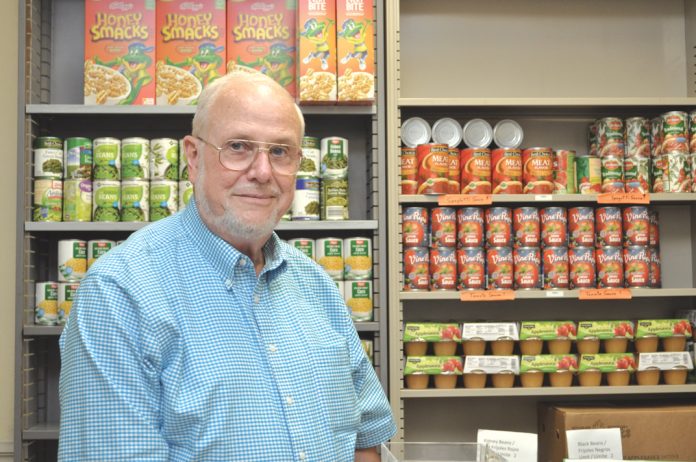
David Ellis, member and deacon of Mayfair Church of Christ is also the coordinator of the food pantry at the church.

by Vickie Jenkins
Staff Writer

There are a few churches around the metro area that offer a food pantry to those people that need a little extra hand every now and then. Mayfair church of Christ is one of those generous churches.
Meet David Ellis where you will find him here at the church different days of the week, different times of the day, and a lot of his time is spent in a room at the back of the church; designated as The Food Pantry. He will be doing his job as he serves as the food pantry coordinator.
“It all started fourteen years ago with a man named Jerry Bostick who actually started the food pantry at the church. Things were a little different back then,” David said. “There was a closet, literally, a closet, on the other side of the church, where a few boxes of food were stored and a few people picked up a few things. It was twelve years ago that I volunteered to help out. I’m still doing it,” he said with a smile. “Sometimes, I feel like maybe I got shanghaied into it, he laughed. “I really do enjoy it and it makes me feel good to be helping out. Since I am retired, I consider this my full-time job.”
Just for an update, In June, the pantry served 84 households consisting of 251 persons, (40 seniors, 122 adults and 89 children) we have received 34 cases (40 pounds each) of canned food as our portion of the Mail Carriers Food drive held in May. Distributions will begin when the Pantry opens on July 10, 2019. The hours of the Pantry will be each Wednesday 3-5 and the last Monday of each month 10-noon.
How do people hear about the Food Pantry? “Word of mouth is the biggest. Most of the people that come by to pick up food have been coming for several years. On the other hand there are some people that come one time during the whole year. We are here, come rain or shine,” David replied.
David explained how the people get approved to accept food from the food pantry. “The people have to qualify to register for the food pantry; they have to be in one of the six approved zip codes, meet federal income guidelines, show a picture ID and bring some type of document that verifies their address. We get shipments of food from the food bank which includes USDA meats, bread, vegetables, fruit, staples, canned goods and dry goods. We then take special care to bag the groceries according to the size of their family.”
How does David feel about being the food pantry coordinator? “It makes me feel good about the situation, especially when the people come in the very first time. They are not sure what to expect or not sure how to accept the help. I just want to make them feel comfortable and let them know that we are willing to help them,” David replied
“Even though I am the food pantry coordinator, there are plenty of others that use their time to serve others too; the volunteers…say there is a lot of work that goes into the food pantry but it is all well worth it. I am thankful for the people here at the church that are willing to serve,” David said. “I call that teamwork, he added.
On a personal note, David and his wife Elaina just celebrated their 50th anniversary on June 21st. Their families, along with their four grandchildren, were fortunate to be in town for the big celebration.
Because of his past experiences in life, his organizations skills were remarkable. ‘I didn’t realize it at the time, but God was preparing me for this job back then,” he said with a smile. “Running the food pantry takes a lot of organization, from ordering the food, to making sure there is enough for the families each month. We usually distribute about 3000 pounds of food, a little less than a ton. That is a lot of food!”
Asking if David had any words of encouragement, he said, “Well, my daughter said, ‘you are really a glass-half-full guy, aren’t you?’ I agreed with her, wondering what she meant. I laughed at the thought. All in all, yes, I am the Food Pantry Coordinator at Mayfair Church of Christ. I am happy to serve others.”
If you would like more information about Mayfair Church of Christ, located at 2340 N.W. 50, Oklahoma City, OK 73112 or call 405-842-2993

www.harborchase.com

On a whim: Senior finds pageant success

0

story by Bobby Anderson, Staff Writer

2019 Ms Oklahoma Senior America Deborah Wedel.

When Deborah Wedel received a business card from a friend a few years back she tucked it safely inside her purse.
It came after a session at the gym with friend Zenetta Kendricks and an urging for Wedel to sign up for the Ms. Oklahoma Senior America pageant.
Still working at the time, Wedel appreciated the gesture but figured it wasn’t for her.
That was until a few months ago when cleaning out that purse the card once again was in her hands.
“I thought ‘Oh, I’m retired now I might try this and I did,’” Wedel said.
And that was the beginning of a life-affirming journey for Wedel that culminated when she was crowned the 2019 Ms. Senior Oklahoma winner earlier this summer in Ada.
The night of the pageant Wedel’s nerves were flowing.
“They were all firing,” she laughed. “It’s amazing. I just want to say how encouraging we all tried to be for each other. I know it was a pageant but it was more like a sisterhood.”
“I didn’t think it was going to be my name,” she continued. “I thought it would be one of the ladies who had been in it before and I was just fine with that. The people in it before were such incredibly beautiful people inside and out.”
It was Wedel’s first pageant but an experience she wanted to use to get out of her comfort zone.
START TO FINISH
Back in 2013, Wedel went to the same gym as Kendricks, the 2013 Ms. Oklahoma Senior winner.
Kendricks handed her her card.
Wedel didn’t think much of it at the time. She was flattered but thought it wasn’t for her.
She was working full-time then, finishing up a 36-year teaching career that included a stint as a counselor at Mount St. Mary’s.
She loved the experience being around high school students. To this day she felt like she never met a single student she didn’t enjoy.
“Some people are really good with younger kids and I just really love the age,” she said. “It felt like I clicked with them.”
Most days as a counselor she was working on scholarship applications, which produced about an 86 percent success rate.
She retired about the time her husband, who served as a high school principal for a couple decades. During those years the two went to a lot of basketball, football and athletic events as well as drama and band productions.
After retiring the couple spruced up their rent homes and booked a trip to Switzerland coming up in September.
Nobody planned on a pageant win in between.
“Luckily, the national contest isn’t until October,” said Wedel, who will represent Oklahoma in Atlantic City, New Jersey.
“It was just incredible,” Wedel said of the experience. “I don’t think it was like a regular pageant in the fact we were all rooting for each other. Quite honestly, if I had not done anything and still been standing on the stage after they crowned that queen I would be alright with that.”
Her stage fright was in full effect when she performed a dramatic reading of an Elizabeth Barrett Browning poem.
“You would think that would go away after awhile but it doesn’t appear to,” said Wedel.
While most people expected the life-long singer to sing, she wowed the crowd with her tear-filled performance.
“Every time I read it I weep,” she said. “It’s a mother who lost both of her sons in the Italian war for independence. She encouraged them to give everything but when they actually do … she goes back and questions why.”
“I think most of us would question if we lost both of our children in a way but there are some things you can’t change.”
For Wedel it’s all about staying active with her husband, Bruce, of 46 years. She has two children of her own with a pair of grandchildren involved in the arts.
Exercise is still a priority. The other day she went over to mow her 92-year-old old mother’s yard.
She stays active at the house and civic events and sporting events as well as the local arts.
She wants to reach out to the community, helping with fundraisers and appearances. “I just stay active, hopefully helping others,” Wedel said. “I’m hoping for some events.”
Those who would like to get in touch with Wedel can contact her through her cell phone at (405) 274-2627.

Senior fight club: Concordia residents punch back aging

0
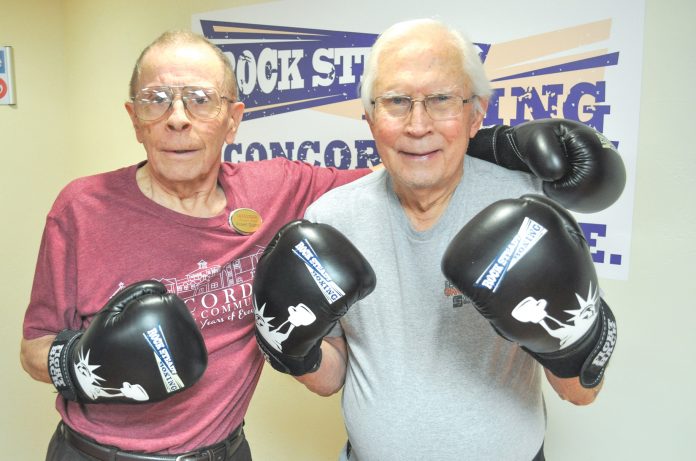
Residents at Concordia Life Care Community in Oklahoma City are fighting back against aging with weekly Rock Steady Boxing classes.

Story and photos by Bobby Anderson

The first rule of Rock Steady Boxing at Concordia Life Care Community is that everyone is encouraged to talk about Rock Steady Boxing.
Resident Ramona Duff says the weekly classes are packed with useful information, stress relief and good, old-fashioned fun.
“It’s really good for balance,” said Duff, who attends Monday and Friday classes. “I had watched other people box and I knew we wouldn’t be hitting each other. It keeps me on my feet longer.
“I like the camaraderie. It’s a great group of people.”
Chris Coleman is the wellness coordinator at Concordia and is responsible for bringing the program to the community.
“We brought it here for the Parkinson’s program and after we got trained in that we realized the same principles could be applied to anyone who wants to reduce falls, build stamina and just be a little bit more active,” Coleman said.
Wednesday classes are open to anyone in the community affected by Parkinson’s. Attendees are encouraged to call first for an evaluation.
“We had to let people know it was just going to be fun and not anything that’s going to be aggressive,” Coleman said.
Concordia’s Dovie Kasper has been coming to the classes since they started five months ago.
“I just love hitting those bags,” Kasper said. “It gets you a lot of energy when you start.”
When she’s hitting the bag Kasper said she may or may not picture a particular face or annoying situation while she punches away.
“It’s good for that, too,” she laughed.
I FIGHT BACK
The Parkinson’s Disease Foundation estimates there are more than one million people in the United States diagnosed with Parkinson’s disease, and more than 60,000 people are diagnosed each year. Rock Steady Boxing is the first gym in the country dedicated to the fight against Parkinson’s.
As word of this unique program spread and the demand for the classes increased, Rock Steady Boxing created classes to meet the fitness levels at all stages of Parkinson’s – from the newly diagnosed to those who had been living with it for decades plus.
“When I think about exercise it’s diversifying the muscles you use,” said Coleman, who obtained Rock Steady certification. “It’s just an excuse to work on a new movement pattern. At the very least it can create new neural pathways. Do what you can but take what you can from the principles.”
SPARRING SCIENCE
Various studies in the 1980s and 1990s supported the notion that rigorous exercise, emphasizing gross motor movement, balance, core strength, and rhythm, could favorably impact range of motion, flexibility, posture, gait, and activities of daily living.
More recent studies, most notably at Cleveland Clinic, focus on the concept of intense “forced” exercise, and have begun to suggest that certain kinds of exercise may be neuro-protective, i.e., actually slowing disease progression.
Rock Steady Boxing, the first boxing program of its kind in the country, was founded in 2006 by former Marion County (Indiana) Prosecutor, Scott C. Newman, who is living with Parkinson’s.
Work done through the Parkinson’s Outcome Project, an ongoing study involving more than 12,000 patients in five countries, suggests that patients should exercise at least 2.5 hours each week to slow decline and maintain a better quality of life. A similar study advised that patients should begin regular exercise at diagnosis.
Still, this research stops short of recommending a specific exercise regimen as a best strategy.
In Parkinson’s, neurons in a brain area called the substantia nigra that are responsible for producing a neurotransmitter called dopamine gradually die off, leading to motor symptoms such as tremor and bradykinesia (slow movement).
Levodopa — which works to increase dopamine levels in the brain but cannot rescue damaged neurons — is currently the front-line treatment for the disease.
Some evidence suggests that, like levodopa, exercise may exert some of its effects by increasing dopamine.
At Concordia, the benefits are evident. Walk into the gym and you’ll see people laughing and smiling, before they even strap on the gloves.
Coleman likes the more intimate environment and says people can let their guard down – pun intended – while raising the level of their health and well being.
“We all kind of laugh at ourselves,” Coleman said. “It’s a camaraderie builder.”


Dogs Are Born to Love: RSVP Volunteer Shares Therapy Dog with Children and Elderly

0

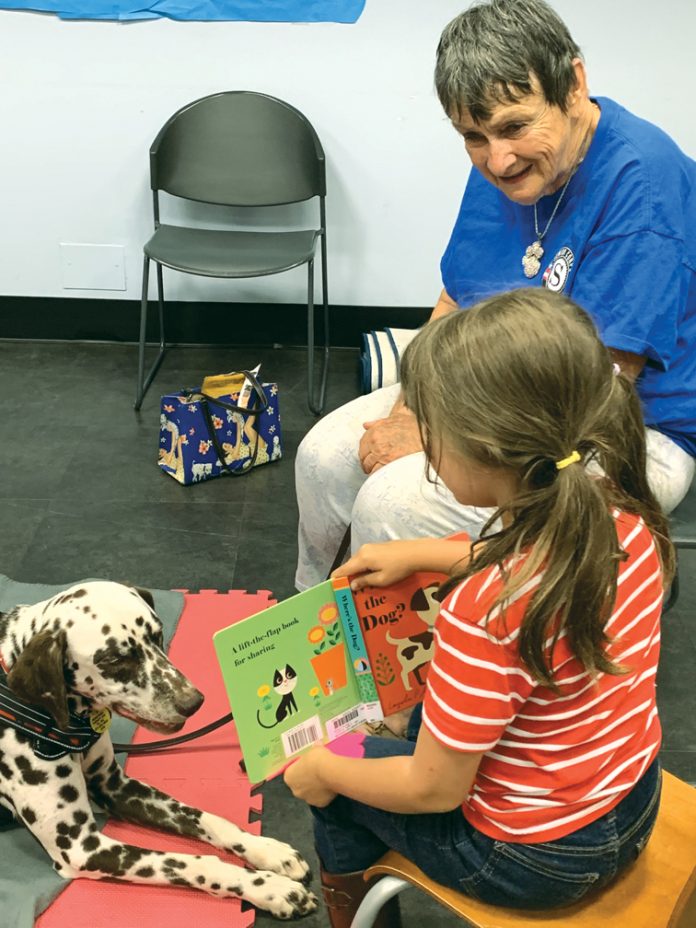
Macaroni “Mackee”, a 10-year-old Dalmatian therapy dog, walks close by owner Jane Neely and settles on the floor surrounded by children and books at the Midwest City Library.
After a little girl reads a book to Jane, while showing pictures to Mackee, a young boy comes in near the spotted dog and begins reading a book about cougars.
“Children are so open. They just sit down without any inhibitions and pet Mackee or read to him,” said Jane, a Retired and Senior Volunteer Program (RSVP) of Central Oklahoma volunteer since 2005. “Sometimes they read to me and sometimes they like me to help them with their reading. Mackee is patient and just loves the kids.”
Jane is an active member of Therapy Dogs International, the leader in training and certifying therapy dogs, and Mackee is a certified therapy dog. She has had a love of Dalmatians for years, having owned nine. When she first began volunteering with RSVP, she gave her time delivering meals, but the love she has for her dogs and sharing them with others blossomed into a new volunteer opportunity reading to children at libraries and visiting nursing homes, where sometimes Mackee performs tricks for the residents.
Laura McPheeters, RSVP of Central Oklahoma volunteer coordinator, said that Jane’s dog is an icebreaker and comfort to children and the elderly, and that people feel no judgment and feel unconditionally supported by the dogs almost instantaneously.
“I think it’s fun to be a volunteer with RSVP and share my dog with people,” Jane said. “Dogs are born to love.”
Since 1973, RSVP of Central Oklahoma has helped senior adults continue to live with purpose and meaning by connecting them with rewarding community volunteer opportunities, including RSVP’s Provide-A-Ride Senior Transportation Program. RSVP is a partner of Senior Corps and the United Way of Central Oklahoma. To learn more about becoming a volunteer, call Laura McPheeters at 405.605.3110 or visit rsvpokc.org. You can also follow RSVP on Facebook at facebook.com/RSVPokc.

www.fullcircleok.com

Presbyterian Health Foundation awards $3.9 million in new research grants

0

Presbyterian Health Foundation (PHF) is awarding $3.9 million in research dollars to Oklahoma Medical Research Foundation and University of Oklahoma Health Sciences Center, funding a total of 64 new grants during its June grant cycle in the areas of cancer, diabetes, heart, aging, and pediatrics.
Since revitalizing funding of medical research in Oklahoma, PHF has granted more than $20 million to the two research powerhouses, and the foundation doesn’t see its funding focus slowing any time soon.
“We are committed to funding the best, cutting-edge science to secure life-enhancing treatments for people in Oklahoma, across the country, and world,” said PHF’s President Tom R. Gray, III. “Getting scientists together who can combine their know-how in a collaborative way plays a critical role in achieving meaningful results. We’re excited about the many grants that were presented to us this round, in particular the team science awards.”
PHF team science grants are intended to foster innovative, collaborative approaches to research projects involving multiple researchers. These grants focus on collaborative relationships with at least two or more investigators on each project, combining and integrating basic, clinical, community-based and translational research endeavors.
A collaborative project funded at OMRF will continue its investigation on therapies for amyotrophic lateral sclerosis (ALS), also known as Lou Gehrig’s disease. Scientists Holly Van Remmen, Ph.D., and Rheal Towner, Ph.D. will work in concert to test a new compound designed to ameliorate the effects of the disease. “The PHF funding will allow us to test the preliminary hypothesis that OKN-007, an anti-inflammatory compound with neuroprotective effects, can have a beneficial effect on the initiation and progression of ALS,” said Holly Van Remmen, Ph.D., chair of OMRF’s Aging and Metabolism Research Program. “The data we obtain from this study will be used to help us secure further funding to move this drug forward to a clinical trial for ALS.”
One particular team of scientists at OUHSC will focus its efforts on pancreatic cancer, one of the deadliest forms of cancer affecting people today. The team, including Courtney Houchen, M.D., Min Li, Ph.D., and CV Rao, Ph.D., is exploring how to improve treatment methods with this diagnosis.
Pancreatic cancer is particularly deadly because the way it grows is not highly responsive to available chemotherapies. In addition, patients often struggle with complications like cachexia, a muscle-wasting condition that affects at least 80 percent of people with pancreatic cancer. Because cachexia takes such a toll on patients, many cannot withstand surgery and they respond poorly to chemotherapy and radiation.
“Pancreatic cancer is a very tough disease, and novel therapies like treating cachexia are the only way we’re going to make progress because the traditional approach of trying to destroy the tumor isn’t enough,” Houchen said.
“We’ve seen an encouraging uptick in collaborative proposals over the last few years, indicating to us that the teamwork amongst Oklahoma’s researchers in stronger than ever,” said Gray. “We are confident these continued efforts will translate into better quality of life for us all.”

OU Running Back Legend Joe Washington Tries Pickleball

0
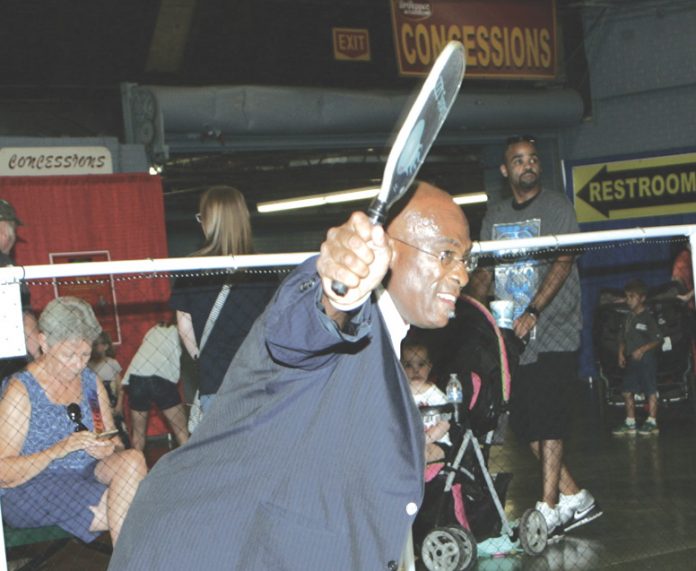
Running Back Legend Joe Washington and long time NFL great picks up a Pickleball racquet for the first time.

Story and photos by Darl DeVault

When active people first see athletes playing pickleball the first thing they say is “Can I try it.” That is exactly what happened last Fall when University of Oklahoma football running back legend Joe Washington saw pickleball demonstrations during the Oklahoma State Fair.
Once on the court and swinging a pickleball racket, Washington’s interest grew with each volley, as his first exposure lasted a vigorous 15 minutes.
Washington dresses more formally than some, as he played in the NFL for nine years. But his manner of dress did not stop him that day. The former football star, 65, was so taken with the sport he forgot to take off his sports jacket as he applied his talent as an athlete.
“I had no idea a sport would let you smash the ball like a pro tennis player and yet not be afraid you would hurt the player on the other side of the net,” Washington said recently. “Playing pickleball made me feel like I was a tennis pro while giving me that feeling of being a kid again.”
Many seniors have caught on to the sport as well, as the sport is exploding in popularity. The court (44 by 20 feet) is about the size of the inner third of a tennis court. For seniors this means it is easier to keep the ball in play.
Players get their exercise in each of the 11-point games lasting about 15 minutes because the ball stays in play longer on the small court.
When Washington first saw that he could easily return each volley he stopped a minute and really examined the paddle. The paddle doesn’t have strings. Using a soft ball makes this a low intensity stroke that puts minimal stress on the tendons and muscles of the arms.
“With the serve done underhanded, I could easily concentrate on moving into position to return serve,” Washington said. “The game became easier to play with every point, as learning it is quick and the effort so easy on your arm.”
The demonstration Washington attended was a part of the run up to the Oklahoma Senior Games last year. The Games held in the Fall in Oklahoma have seen a major spike in pickleball participants in the last few years, as more players catch on to the low stress paddle sport.
Nationally the number of places to play has more than doubled since 2010. There are now nearly 4,000 locations around the country on the national associations Places to Play map. On the road to forming the USA Pickleball Association, the sport really started in 1967 when Joel Pritchard and Bob O’Brian played the fledgling game they helped create.
By 1990 all 50 states were roaring with the sound of ball against paddle. This year the USAPA says the sport has seen a 650 percent increase in numbers over the last six years.
Because of its appeal to all levels of athletes, the sport is gaining popularity within community centers, PE classes, YMCA facilities and retirement communities. Growth worldwide is seen in many new international clubs forming and national governing bodies now established in Canada and India.
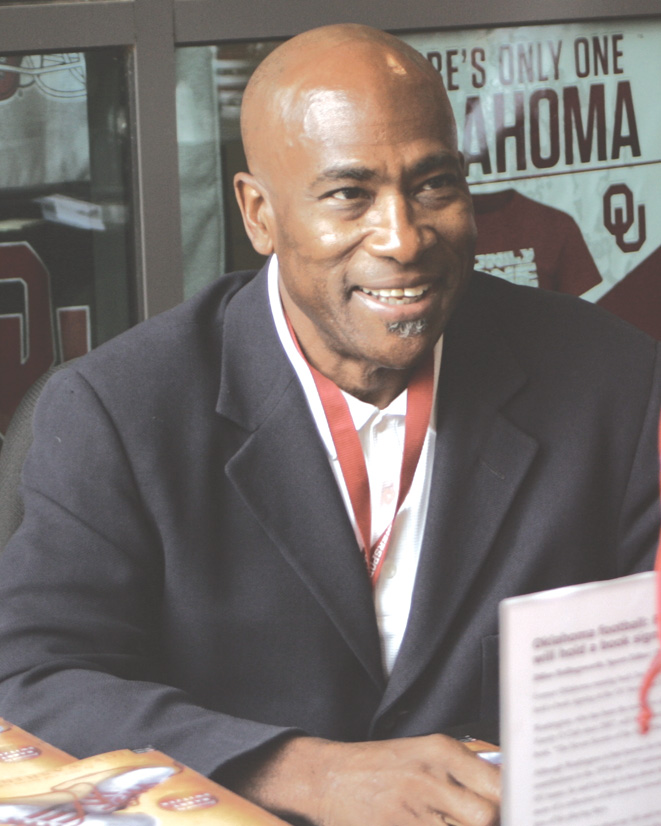
Washington is a Crimson and Cream football legend. He helped win two national championships as the marquee running back. As a wishbone running back, receiver, punt and kick-off returner he fueled the head-coach-Barry-Switzer-led back-to-back national championships glory days of 1974-75 in Norman.
Difficult to tackle in the open field, he was one of the most complete offensive players to ever play on Owen Field. His nine-year NFL career was also successful, earning him Pro Bowl status and playing time in a winning Super Bowl with the Washington Redskins in 1982.
Then “Little Joe” returned to OU to run the Varsity “O” Association in 2007 for sports letterwinners and has been helping all things OU sports ever since.
One of the smallest and most elusive running backs at 5-foot-10, 175-pounds, he was one of the few players to ever leave the Sooners holding their yards-from-scrimmage record with 4,248 yards. His track-star speed was his ticket to greatness, although he is quick to explain he is proud he was also a spirited blocker when anyone else ran with the ball at OU. Selected consensus All-American and 1974 NCAA Football Player of the Year and later a 2005 College Football Hall of Famer, he is now the author of The Seven Secrets of the Silver Shoes: Principles for Success On and Off the Field.
This year the Oklahoma Senior Games pickleball tournament runs September 27-29 at the OKC Tennis Center at Will Rogers Park with an entry deadline of September 13. Go to okseniorgames.org to enter.
For those active seniors who want to see pickleball played and explained before they try it, the USAPA Web site features many videos on its Pickleball Channel.

www.tealridge.com

What Is Venous Stasis Disease: Are You Affected And What It Means

0

Do you have swelling in your legs that will not go away?
Do your legs get red and warm?
Are your legs discolored or “stained”?
Do you have “weeping” from the lower legs?
Have you had a blood clot in your legs or in your lungs?
Do you have an ulcer or wound in your lower legs that will not heal, or has to be treated by a wound care specialist?
If one or more of these symptoms apply to you, then you could have Venous Stasis Disease
What is Venous Stasis Disease (VSD)?
Veins are the blood vessels which collect blood from tissues and organs all over the body. These veins are filled with carbon dioxide and waste products of metabolism from the tissues and organs. The veins return the blood to the right side of the heart and lungs to be replenished with oxygen and nutrients. It is then pumped out again to the tissues and organs of the body by the left side of the heart. In VSD the veins are not working effectively and blood flow back to the heart is slowed causing poor circulation and pooling of blood in the legs which leads to swelling.
Who is affected?
Primarily older men and women, but VSD can affect all ages. It becomes increasingly common with each year of life. Men are affected earlier, but women catch up quickly. People who have had blood clots in the legs or lungs, pelvic injury or surgery are at higher risk. This can also occur in some people because of the way their bodies are built. People who tend to stand in one position for prolonged periods or who sit at a desk for extended times are at increased risk.
How is it diagnosed?
Careful history and physical exam of an individual by a healthcare professional. After a physical exam, if venous stasis disease is suspected specialized ultrasound exams of the veins in the leg are performed . Oftentimes, specialized testing such as venograms or ultrasound with a probe or camera inside the vein is used to further diagnose.
What are the consequences of the disease?
Pain, cramping in the legs, burning pain, numbness, and tingling in the feet are common symptoms of venous stasis disease. Wounds or infections that are slow to resolve or do not resolve are also signs of the disease. Feet that turn blue, have constant severe pain, ulcers or dark “staining” of the skin may be a result of VSD. If left untreated or treated too late, it can lead to amputations or spread of infection into the bone or blood stream. Eventually, it can also lead to marked thickening of the skin in the legs and transformation to skin more like a thick hide in the lower legs.
Is it preventable?
Try to avoid sitting or standing in position for prolonged periods. Avoid periods of more than 2 hours at a time. Try to spend a few minutes walking and exercising the muscles in your legs, this helps “pump” blood back to the heart.
* Diabetes – it is very important to work with your primary healthcare professional to control your diabetes with a combination of medication, healthy diet, lifestyle modification, and weight loss
* Right heart failure – this can lead to swelling of both legs and requires management by a cardiologist
* Smoking – never start, or if you still smoke – QUIT!
* Overweight – manage with diet modification, weight loss, regular exercise
How is Venous Stasis Disease treated?
* Initially, conservative treatment such as compression stockings is used to put pressure on the legs, reduce swelling, and help pump blood back up to the heart. Diuretics or “water pills” may need to be supplemented to help reduce swelling.
* If there is a wound present, sometimes treatment by a wound care specialist is required
* Minimally invasive (percutaneous) procedures through an iv placed into the vein – in the neck or groin.
*Angioplasty – balloons of various sizes are used to expand a vein to its natural size – the balloon is removed after treatment is complete
*Stents – used in select situations to expand a vein to its normal size, and hold it open with a “scaffold” – these are permanent implants.
Who can treat it?
This can be treated by select cardiologists, vascular surgeons, and interventional radiologists. If you feel that you may be at risk for venous stasis disease, or have some of the above symptoms, you should consult your primary healthcare professional to screen for it, and to discuss treatment options.
Dr. C.V Ramana is a vascular and interventional radiologist with more than 20 years of practice experience. He has expertise in all areas of vascular and interventional radiology. Dr. Ramana has a Ph.D from Yale University and MD from CWRU in Cleveland, Ohio where he subsequently completed his fellowship in Vascular and Interventional Radiology at the Cleveland Clinic.

www.fountainbrookliving.com

SENIOR TALK: What do you like about the summer? Concordia Life Care Community

0

I like the nice weather and getting out in it and maybe walk. Joan Quatro

I used to jog a lot but now I just do boxing. Dovie Kasper

Vacation. I used to hike, backpack and rock climb. Now I don’t do much of anything. Robert Quatro

I like to camp, boat, ski and fish. I’m an outdoor person – have been all my life. Chris Offerson

https://www.aefuneral.com/


Oklahoma Field Agent Wins National Award

0

On July 8, Joe Rackley was named the 2019 Cooperative Agricultural Pest Survey Recognition Award recipient for his contributions and outstanding efforts in support of the Oklahoma CAPS Program.
Rackley, a field inspector for the Oklahoma Department of Agriculture, Food and Forestry, voluntary took on the added role of State Survey Coordinator while the vacancy was being filled.
“Joe’s primary responsibility is to be a nursery field inspector,” said Blaine Powell, Oklahoma State Plant Health Director. “But, he has done an excellent job maintaining both duties despite the heavy work load.”
Rackley worked to draft and summit work plans which ensured Oklahoma’s participation in survey activity for the 2019 CAPS Program. With Rackley’s knowledge and understanding of the CAPS Program, he was able to smoothly facilitate program duties, Powell said.
Rackley has delivered multiple program presentations at various meetings across the state, and he worked with Agreement Specialists to resolve problems and discuss options for potential survey issues. He also completed activities for the 2018 season by entering all data and writing final reports. “Joe is extremely goal oriented and has a keen eye for details, ensuring all aspects of work and financial plans are written correctly and closely monitors field work for accuracy,” Powell said.
CAPS pest detection program supports the USDA Animal and Plant Health Inspection Service as it works to safeguard U.S. agricultural and environmental resources. The CAPS Recognition Award is designed to recognize individuals or groups for specific achievements and accomplishments resulting from work done in support of Pest Detection activities in the previous calendar year, and more information can be found at http://caps.ceris.purdue.edu/caps-recognition.

Social

0FansLike
0FollowersFollow
0SubscribersSubscribe