The Walk to End Alzheimer’s – Southwest Oklahoma, held in Lawton, Okla. on Saturday, August 27, had a record-breaking year with over 300 people in attendance and nearly $45,000 raised to support the mission of the Alzheimer’s Association. To show your support in OKC, join us at the Chickasaw Bricktown Ballpark on Sept. 24. Visit OKCwalk.com to start, register or donate to a team today.
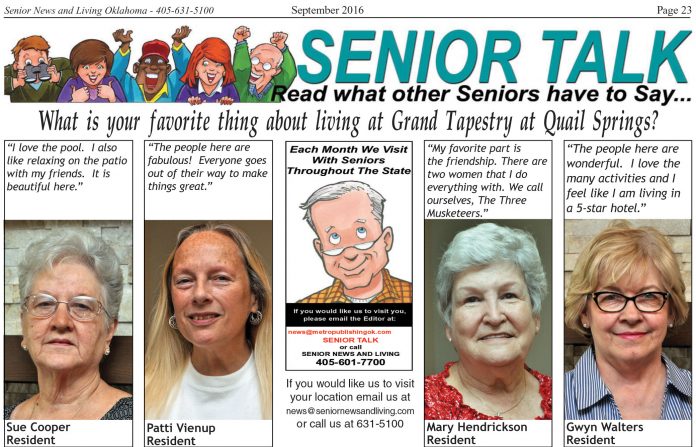
SENIOR TALK: What is your favorite thing about living at Grand Tapestry at Quail Springs?
What is your favorite thing about living at Grand Tapestry at Quail Springs?
“I love the pool. I also like relaxing on the patio with my friends. It is beautiful here.” Sue Cooper
Resident
“The people here are fabulous! Everyone goes out of their way to make things great.” Patti Vienup
Resident
“My favorite part is the friendship. There are two women that I do everything with. We call ourselves, The Three Musketeers.” Mary Hendrickson
Resident
“The people here are wonderful. I love the many activities and I feel like I am living in a 5-star hotel.” Gwyn Walters
Resident
Transplant Recipient Pays it Forward
Karen Hoyt, of Tulsa, Okla., lives her life in honor of the stranger who gifted her a second chance at life. Now, an active community volunteer, she encourages those in need of that same gift.
Karen lives every day with a grateful spirit and the heart to be an encouragement and motivation to others. She had always lived a healthy life despite being born with only one kidney. She was active in her community as a volunteer, teacher and Sunday school teacher at her church. In 2010, she learned that her liver was failing, and she was later diagnosed with the Hepatitis C virus.
She was sent home thinking her days were numbered. Despite this news, she clung to her faith and began eating even healthier than she had before the diagnosis. Luckily, antiviral medication came out and she was cured of Hepatitis C by 2011 but end stage liver failure still loomed over her.
Karen went back to her career as a teacher and continued to live as healthy as possible. During one of her screenings, the doctor determined that her damaged liver was not removing toxins from her blood, which diminished her mental capabilities. She also became limited on what she could do as she frequently had muscle fatigue, liver pain and joint pain.
After learning to manage her pain, Karen’s luck began to worsen. When she was at one of her regular check-ups, the doctors found a cancerous tumor on her liver. Her doctors recommended a liver transplant, and in the midst of the listing process, she began to make end-of-life plans with her daughter. To cheer their spirits, they began to look online at stories of hope from others who had received a transplant. Karen was encouraged, and continued to eat healthy and walk when she could.
When Karen was fully listed on the transplant waiting list, she was humbled to think that at someone’s greatest crisis in life they would make a decision which would eventually grant her many more years to live. She was so humbled that she called her transplant coordinator and almost asked them to remove her from the list.
As she waited for a second chance at life, Karen underwent many procedures to shrink the tumor on her liver so that she could remain on the transplant waiting list. Twice, Karen was called in hopes that she would receive her liver, but neither were a good fit.
However, on April 13, 2015, Karen received her liver from a selfless donor and learned that her donor was the same age as many of the students she was teaching in school. Karen had the privilege of advising one more English class full of seniors after her transplant.
Karen continues her work with senior high school students. To this day, Karen volunteers at the school she taught at for many years and at the hospital with people who have just received a transplant.
Karen is a motivation and encouragement to many. She encourages others waiting to receive their life saving transplant, and she spends her time teaching nutrition classes. The classes help those struggling with kidney or liver disease learn to eat better in order to live a healthier life.
Driven to honor her donor, Karen participated in the 2016 Transplant Games of America. She began entering 5K runs to raise awareness for organ donation. She also is more adventurous and does things she wouldn’t have tried before to honor him and his life.
Karen has had the opportunity and privilege to be involved in her grandkids lives and is thankful for the chance to be a sister, mother and wife.
While Karen has never had the opportunity to meet her hero’s family, she truly lives her life in honor of the young man who saved her life.
About LifeShare
LifeShare is a nonprofit, federally designated organ procurement organization (OPO) dedicated to the recovery of organs and tissue for transplant purposes. We work closely with five transplant centers and 145 healthcare organizations in the state of Oklahoma to facilitate donation. Additionally, we strive to raise awareness for organ, eye and tissue donation and transplantation through public education.
For more information about LifeShare, please visit:
www.LifeShareOK.org.
Schmidt to Compete in National Pageant

Dove Schmidt from Depew, OK, was crowned Ms OK Senior America on June 25. She will be competing in the National pageant for Ms Senior America in Atlantic City, NJ in October. The Ms. Senior Oklahoma Foundation is having a CASINO PARTY FUNDRAISER at the Quail Springs Grand Tapestry located at 14201 N Kentucky, Oklahoma City, Oct. 8th from 6:00 to 9:00 pm with hors d’ oeuvres and beverages. Join us as we help to provide a special send off and encourage her in the final step of competition.
SAVVY SENIOR: Meal Service Delivery Options for Seniors Who Don’t Cook
Dear Savvy Senior, What types of healthy meal delivery options can you recommend for seniors who live at home, but don’t cook and don’t get out much. Since mom passed away, my dad’s diet is terrible and I worry about his health. Long-Distance Daughter
Dear Long-Distance,
There are various healthy meal service delivery options available to non-cooking seniors who live at home, but what’s available to your dad will depend on his location and budget. Here are several to check into.
Senior Meal Programs
A good place to start is to find out if there’s a senior home delivery meal program in your dad’s area. Meals on Wheels is the largest program that most people are familiar with, but many communities offer senior meal delivery programs sponsored by other organizations that go by different names.
To find services available in your dad’s area, visit MealsOnWheelsAmerica.org, which offers a comprehensive directory on their website, or call the area aging agency near your dad. Contact the Eldercare Locator at 800-677-1116 to get the number.
Most home delivered meal programs across the U.S. deliver hot meals daily or several times a week, usually around the lunch hour, to seniors over age 60 who have problems preparing meals for themselves, as well as those with disabilities. Weekend meals, usually frozen, may also be available, along with special diets (diabetic, low-sodium, kosher, etc.). Most of these programs typically charge a small fee (usually between $2 and $6) or request a donation, while some may be free to low-income seniors.
Online Meal Delivery
Another option that’s a bit more expensive is to purchase your dad’s meals online and have them delivered to his home. There are a number of companies that offer this type of service like Magic Kitchen (magickitchen.com), Home Bistro (homebistro.com), Personal Chef To Go (personalcheftogo.com), Good Measure Meals (goodmeasuremeals.com), and many others.
These companies offer a wide variety of tasty meal choices, and will usually post the nutrition information for their meals right on their website. Most companies will also cater to a host of dietary and medical needs, such as low-sodium and low-carb meals, diabetic meals, gluten-free, dairy-free, and vegetarian options.
Most of the food arrives frozen, but a few companies ship food fresh. Prices generally start at around $10 to $13 per meal, plus shipping, however most companies provide discounts or free shipping when you order meals in bulk.
Grocery Stores and Restaurants
Depending on where your dad lives, he may also be able to get home delivered meals from local grocery stores or restaurants. Some grocery stores offer a selection of pre-cooked meals and foods, including roasted chicken, mashed potatoes, and fresh soups and salads. Contact the grocery stores in your dad’s area to inquire about this option. Or check with some of his favorite restaurants to see if they offer home delivery.
Personal Chefs
Another option for non-cooking seniors with a bigger budget is to hire a personal chef from time to time. A personal chef can provide your dad with a do-it-all service that will help plan his meals, do the grocery shopping and prepare him several weeks worth (or more) of tasty meals in his home, which he can freeze and eat whenever he wants. Or, they can prepare it in their own kitchen and deliver it. Chef’s fees range between $200 and $300 plus groceries. He may be able to save money by sharing meals with you or another family member, or a friend or neighbor.
To find a personal chef in your dad’s area, check the listings at the American Personal & Private Chef Association (personalchef.com) or the United States Personal Chef Association (hireachef.com).
Send your senior questions to: Savvy Senior, P.O. Box 5443, Norman, OK 73070, or visit SavvySenior.org. Jim Miller is a contributor to the NBC Today show and author of “The Savvy Senior” book.

Sept/Oct AARP Drivers Safety Classes
Date/ Day/ Location/ Time/ Registration #/ Instructor
Sept 1/ Thursday/ Okla. City/ 9:30 am – 4 pm/ 951-2277/ Edwards
Integris 3rd Age Life Center – 5100 N. Brookline, Suite 100
Sept 7/ Wednesday/ Norman/ 9 am – 3:30 pm/ 307-3176/ Palinsky
Fowler Toyota – 4050 Interstate Drive
Sept 9/ Friday/ Okla. City/ 9 am – 3:30 pm/ 951-2277/ Edwards
SW Medical Center – 4200 S. Douglas, Suite B-10
Sept 10/ Saturday/ Moore/ 9 am – 3:30 pm/ 799-3130/ Palinsky
Brand Senior Center – 501 E. Main
Sept 13/ Tuesday/ Midwest City/ 9 am – 3:30 pm/ 691-4091/ Palinsky
Rose State – 6191 Hudiberg Drive
Sept 14/ Wednesday/ Okla. City/ 9 am – 3:30 pm/ 522-6697/ Palinsky
Office of Disability Concerns – 2401 NW 23rd, Ste 90
Sept 16/ Friday/ Okla. City/ 9 am – 3:30 pm/ 752-3600/478-4587/ Reffner
Mercy Hospital – 4300 W. Memorial Rd.
Sept 20/ Tuesday/ Warr Acres/ 9 am – 3:30 pm/ 789-9892/ Palinsky
Warr Acres Community Center – 4301 Ann Arbor
Sept 24/ Saturday/ Shawnee/ 9 am – 3:30 pm/ 818-2916/ Brase
Gordon Cooper Tech. Center – Sky Lab 1 Room-1 John C. Burton Blvd.
Oct 1/ Saturday/ Newcatsle/ 9 am – 3:30 pm/ 392-4466/ Palinsky
1st Baptist Church of Newcastle – 1650 N. Main
Oct 6/ Thursday/ Okla. City/ 9:30 am – 4 pm/ 951-2277/ Palinsky
Integris 3rd Age Center – 5100 N. Brookline suite 100
Oct 14/ Friday/ Okla. City/ 9 am – 3:30 pm/ 951-2277/ Edwards
S.W. Medical Center -4200 S. Douglas, Suite B-10
The prices for the classes are: $15 for AARP members and $20 for Non-AARP. Call John Palinsky, zone coordinator for the Oklahoma City area at 405-691-4091 or send mail to: johnpalinsky@sbcglobal.net
New OMRF grant will study immune cell linked to asthma
The National Institute of Allergy and Infectious Diseases has awarded Oklahoma Medical Research Foundation scientist Xiao-Hong Sun, Ph.D., a five-year, $2.76 million grant to investigate a recently discovered immune cell involved in asthma.
The role of the new cell, called an innate lymphoid cell, is to protect the body from parasitic infection. However, when too much of this cell type is present, it seems to result in asthma.
“These cells were previously thought to be made only in bone marrow,” said Sun, who holds the Lew and Myra Ward Chair in Biomedical Research at OMRF. “We discovered that they are also made in the thymus, which brings up some interesting connections to asthma.”
The thymus, which sits on top of the heart, is a major site for the creation of T cells, a type of specialized white blood cell that plays a central role in immunity. During childhood and through puberty, the thymus generates a lifetime supply of T cells—enough to carry through adulthood. When the supply of T cells is adequate, the thymus has done its job and begins to shrink.
Sun postulates that innate lymphoid cells are also present in the thymus and might explain why children have higher rates of asthma than adults.
“Since kids have a very active thymus when they’re born and up to puberty, they’re more likely to have a large number of innate lymphoid cells coming from the thymus along with the T cells,” said Sun. “This is also the stage of life where many kids tend to develop asthma. People often say they ‘grow out” of asthma as they get older, so maybe it’s linked to this later decrease in thymus function. That’s what we hope to find out with this grant.”
According to the Centers for Disease Control and Prevention, 7.7 percent of people in the United States suffer from asthma. The highest rates of asthma occur in the 5-14 age group at 10.3 percent and decline over time, reaching a low point of 6.9 percent in Americans over the age of 65.
“We don’t yet know the significance of this finding, but if we determine this hypothesis to be true, it would have great clinical relevance,” she said. “Perhaps the thymus is where we need to look for ways to control asthma in children. That’s what we hope to learn.”
The grant will also allow Sun and her lab to further investigate whether the innate lymphoid cells produced in the thymus differ from the ones made in the bone marrow.
Sun said their discovery of innate lymphoid cells in the thymus came about by accident through study of a particular mouse model in their lab—a model they’ve used for more than two decades to study T cell development.
“This research builds on our experience and what we have been working on the past 25 years, so it puts us in a unique position to do this work,” she said. “I am very excited to see how this cell is controlled and hope we can learn what happens in the thymus and how it might be linked to asthma. It really fits really well with the overall research of this lab and comes back to what started this lab in the first place.”
TRAVEL – OKLAHOMA – Thrive on I-35

Adventure Road offers up Oklahoma sights
by Bobby Anderson,
Staff Writer
If you’ve gotten your kicks on Route 66 then you’ll love the drive along I-35.
That’s the thought behind a new Chickasaw Nation tourism campaign centered around the sights, sounds and tastes along the 130-mile stretch of the interstate affectionately called Adventure Road.
Some 230 partners have come together to highlight what’s available to see and do on less than a tank of gas.
Paige Williams is the director of corporate development and tourism for the Chickasaw Nation. She says the initiative highlights parts of Oklahoma some have never seen.
“It’s not just what is around (I-35) but it goes into the communities and cities that are unique destinations and attractions. It’s an initiative to promote people getting out and exploring Oklahoma’s adventures.”
Oklahoma has long been famed as one of the top road-trip destinations in the U.S., featuring a stretch of the iconic Route 66 slicing a winding path straight through the Sooner State. It’s another stretch of highway, however, that is putting Oklahoma on the map for the next generation of leisure travelers.
The state’s Adventure Road corridor – a 130-mile stretch of restaurants, shops, attractions, sporting and entertainment options along and adjacent to Interstate 35 – is making its mark as a top driver in Oklahoma’s growing tourism industry.
Adventure Road, an initiative of the Chickasaw Nation aimed at promoting tourism during the summer vacation season, is in its second year, following a vibrant 2015 travel season.
Chickasaw Nation Governor Bill Anoatubby says the program has been wildly successful and is expanding this year.
“We are very pleased Adventure Road has helped draw more attention to the diverse landscapes, outstanding attractions and retail opportunities this area has to offer,” said Gov. Anoatubby. “We hope to continue that success as we move forward with Adventure Road in 2016.”
SMARI Insights, an independent market research firm, found the Adventure Road initiative generated 385,000 new trips to Oklahoma in 2015, resulting in approximately $647 million in visitor spending from March to September 2015. An evaluation of the initiative’s supporting marketing campaigns showed it generated more than 210 million overall impressions as well as over 230,000 visits to AdventureRoad.com.
Bill Lance, Chickasaw Nation Secretary of Commerce, reiterated the initiative’s main focus for 2016 is to raise awareness of all tourism partners to both in- and out-of-state audiences, but that it will also focus on feedback from travel partners to enhance the experience.
“With tourism as the state’s third-largest industry, it is proven that millions of visitors consider this region to be a top travel destination,” said Lance. “Adventure Road, through the willingness and enthusiasm to collaborate among travel partners, helps visitors realize the hundreds of diverse cultural, entertainment and adventure experiences that await to be explored.”
Adventure Road is a collaborative effort between the Chickasaw Nation and partners, which are comprised of businesses, attractions, organizations, restaurants, shops and boutiques, hotels and bed and breakfasts. The Adventure Road territory follows I-35 from the Red River to just north of Oklahoma City, expanding more than 100 miles east and west.
For the 2016 travel season, the number of Adventure Road partners has grown 53-percent – from 150 at the time of 2015 launch to 230 just one year later – in more than 25 cities. Travel partners consist of both Chickasaw Nation and non-tribal businesses.
This season, visitors also can expect to see a new travel guide and map as well as additions to AdventureRoad.com, including downloadable travel deals and discounts, and more customized travel destinations that target specific areas of interest.
A multimedia campaign will feature Adventure Road collections in major markets throughout Texas, Kansas and Oklahoma. For more information about travel partners, or to plan your own Adventure Road trip, visit adventureroad.com.
The interactive web site allows travelers to create their own custom adventures.
“You can create an itinerary that fits your need and your friends’,” she said. “Maybe you’re a grandparent taking your grandkids on an adventure. It allows you to create this adventure online and you can share it with someone.”
From tours of the Bedre Chocolate Factory to taking a ride on the Air Donkey Zip Line, the web site offers an almost endless list of things to do. And many of the sites have special promotions just for those following Adventure Road.
The second year features a unique CD with travel music to help cruise down the road. Iconic road trip tunes have been redone to keep you company.
NRH building smoke – free families

by Bobby Anderson
Staff Writer
It’s the gamut of reactions that Jerry Deming, TTS-CTS, receives when she counsels patients in the Norman Regional Health System about their tobacco use.
In her tobacco cessation role she’s been screamed at. She’s been stared at, through and around.
She’s been shunned and she’s even been hugged.
But this year she’s been able to help Norman Regional’s nurses develop a new Smoke-Free Families campaign that is gaining traction.
Deming began working with the Women’s and Children’s unit after Norman Regional nurses and managers sought help.
“There was an understanding that there were a lot of women leaving the hospital to smoke,” Deming said. “This is a very common problem. I’m in contact with people worldwide and we all deal with this problem in our hospital and clinic settings.
“We all scratch our heads and think ‘what are we going to do to handle this.’ It’s a big problem. It comes up again and again.”
Staff understood that once a mother and her baby went home then it would be easier for the patient not only to smoke, but smoke around the child.
Deming brought forward the idea that it’s a population issue and not one of monitoring.
“We needed to drill down a little bit deeper and figure out how we can help these people get through a hospital visit staying away from tobacco use and even contemplating the idea of … even quitting to have a smoke-free family.”
When leaders got together to decide a plan of action they realized they were entering uncharted landscape. Nowhere could they find a comprehensive plan dealing with the in-hospital maternity population.
Hospital stays are often so short that no one had really figured a good way to approach the issue.
Planning meetings included physicians and nurses. A craving scale – much like a pain scale – was developed.
Nurse Manager Alyson Heeke, RN, saw an opportunity.
“Part of the reason we started this in the first place is we noticed there was an awful lot of times our babies were traveling back and forth to the nursery so their parents could go outside and smoke,” Heeke said. “That became a big concern for us just in the fact they were only with us 24 to 48 hours and a good portion of the time these folks who were really addicted the babies were in the nursery sometime 20 out of 24 hours.
“We couldn’t provide what we needed for our patients if they were always outside.”
Nursing became involved in the LEAN (Lean Education Academic Network) team project helping develop educational material including posters for the room and signage for outside.
“The nurses really did want it to be a successful process for the patient as much as possible and not to be the police officer,” Heeke said. “They wanted to help them understand this also impacts how well they bond with their baby, how they do with their breastfeeding issues and all those other things which are complicated by smoking.”
Director of Patient Care Services, Susie Graves, RN, said many women who are able to quit smoking for their pregnancy often will allow themselves to resume after they deliver.
“Part of what we wanted to do was help them through. Don’t have a start date. Let that continue,” Graves said. “They all know they shouldn’t smoke … but we’re just there not as judges but as support and giving them the resources they need.”
If the patient agrees, nurses are assessing each patient every shift regarding their tobacco usage and craving level.
“(Before) nurses felt pretty helpless,” Heeke said. “Their patients would come from a C-section and be begging for a wheelchair the second the baby was born to go outside and have a cigarette.
“At this stage, with all the things we’ve created it’s given our nurses an opportunity to have something to say to the patient beyond ‘don’t you think it would be a good idea to quit.’”
Deming travels through the halls of both Norman Regional hospital complexes visiting with patients who have indicated a history of tobacco use.
For nine years now she has worked with smokers. Some are just thinking about quitting. Others are desperately looking for a way out.
And some won’t even acknowledge she’s standing in front of them.
She terms her approach as “motivational interviewing.” She stresses to her patients that she’s not there to judge.
Nearly every person Deming visits understands that they need to quit tobacco. Many have tried multiple times on their own without success.
“When we look at this population it’s the most difficult population to approach,” Deming said. “Most people smoking during their pregnancy feel ashamed of it. They don’t like to talk about it. Of course, they are very addicted to tobacco at this point because they haven’t stopped smoking. Most people know there’s going to be a health issue related to that.”
And now Norman Regional nurses have even more to offer to help these patients quit.
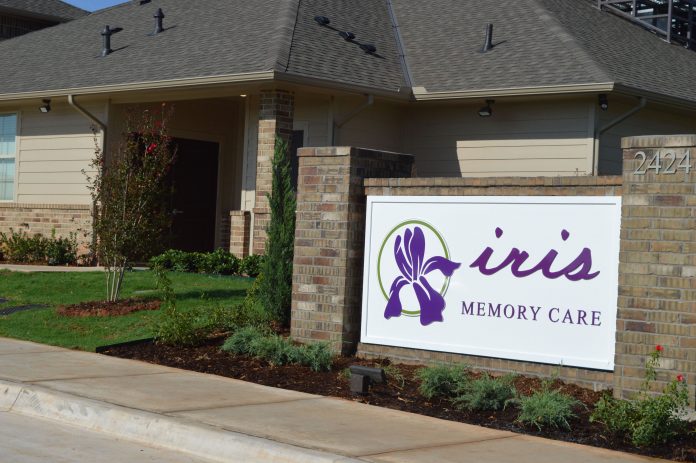
Iris brings memory care home

story and photo by Traci Chapman
David Krukiel and Brandon Meszaros had a dream – an idea that could impact how the world saw memory care and change the lives of those people who needed that care.
That dream should become a reality in a few short weeks, when Iris Memory Care opens in Edmond.
After working together for many years, Krukiel and Meszaros decided to strike out on their own. The first step was research – a lot of it, market studies and long days formulating just how they wanted to move forward with their new project. The location actually came relatively easy to the partners.
“We saw that there was a strong need for memory care in Edmond, so we decided to start here,” Krukiel said.
As the partners worked on the physical concept for Iris Memory Care, the most important component would be the caregivers who provide residential care. That’s where Leslie Stone came in, someone Krukiel said he knew would be the key to making sure the foundation of Iris was not only maintained, but would flourish.
“What we always felt was lacking to a degree (in other facilities) was compassion, dignity and comfort, and we searched for someone with a like mind on those concepts,” Krukiel said. “The mission is impossible without the perfect staff.”
“The main thing we always want to remember is how our residents will be feeling, the challenges they face and how we can make every day better for them,” Stone said. “Their families also deserve to know that someone who truly cares for them is there for them every day.”
With Stone on board, the work began in earnest on the building itself, something that would be different than any other memory care facility the team had ever seen, Krukiel said.
“Most of the times you see these large buildings with lots of people, but we don’t believe that’s conducive to the best, the quality care, that people with these challenges face,” he said. “So, we decided – we knew that home is where people feel the most comfortable, and that’s what we did in building Iris.”
The two-building complex will therefore be home to 40 people, 20 in each home. Rooms are set back from the hall, so it doesn’t feel like a hospital or hotel, Krukiel said. The large main room, where residents will eat their meals, is also a gathering place and one set up for recreational activities and visits. A second, smaller day room will provide more of the same, as well as a salon-inspired area.
“Many of memory care residents don’t like to have their hair washed; we thought the idea of the salon could bring back good memories of when they saw their friends at the beauty parlor,” Stone said. “Everything we’re doing is a way to make them feel comfortable and so they want to come out and interact, which can be a challenge with memory care patients.”
Perhaps the main physical feature of the Iris philosophy is its kitchens, designed as an open space, much like in a home. Featuring a granite bar where residents can sit and watch meals prepared or sometimes interact in that preparation, the space is fundamental to the team’s concept.
“It all goes together – we don’t want the residents to feel like numbers, we want them to know they’re cared for, that this really is their home,” Krukiel said. “Staff members will take their meals with the residents, so they have that interaction, as well.”
“They (staff members) are caregivers first, but friends also,” Stone said.
While recreation will play an important part of Iris’ residents lives, so too will something not found at any other Oklahoma memory care facility. Its long name is “Snoezelen Multi-Sensory Environments.”
“Basically, Snoezelen is a term for a variety of relaxing spaces that can help reduce agitation and anxiety, but they are also something that can stimulate the user, encourage communication and help them to interact – with both the unit and with others,” Snoezelen consultant Carolyn Jackson said.
For Iris Memory Care residents, that can be particularly helpful, as those patients frequently encounter “sensory overload.” The soothing lights and colors of the Snoezelen unit can also be accompanied by music, aromatherapy and images, can be something that might make the difference in reaching a particular patient.
“We’ve been told no one else in Oklahoma has a Snoezelen; for the places that do, many of them have a dedicated room for it,” Krukiel said. “We decided to get a smaller unit, but one that would have the ability to be moved from room to room – that way our residents will have better access to it.”
“We just want them to always feel comfortable, always feel safe and loved,” Stone said. “This is just another great way for us to be able to accomplish that.”