Many people may be unaware of the services and items covered by Medicaid for residents in long term care. Nursing care for at least 80 percent of the residents in Oklahoma Long Term Care facilities is paid for through Medicaid and includes certain services and items. Long Term Care facilities are reimbursed a standard rate per day for each resident living in the facility who qualifies for Medicaid. Nursing care in a Long Term Care facility includes routine items and services that must be provided directly or through appropriate arrangement by the facility when required by Medicaid residents. Charges for routine services may not be made to residents’ personal funds or family members, guardians or other parties who have responsibility for the resident.
Routine services include but are not limited to, a semi-private room and dietary services, which would include supplements and equipment required for preparing and dispensing tube and oral feedings. Social services including mental health counseling, should be provided to attain or maintain the highest physical, mental and psycho social well being of each resident. Personal care hygiene items should be provided like shampoo, bath soap, razor, toothbrushes, toothpaste and sanitary napkins. The facility must also provide the resident with incontinence supplies, which include disposable briefs and skin care supplies, when ordered by the physician. The facility is required to pay for all of a resident’s prescription medications and over-the-counter drugs as well as any equipment needed to administer these medications.
The facility should furnish or obtain any necessary equipment to meet the needs of the resident upon physician order. Such items may include, but are not limited to, wheelchairs, walkers, overhead frames, commode extenders and/or bedside commodes, canes and oxygen.
Payment for the cost of dentures and related services are included in the daily rate for routine services. When the need for dentures is identified, one set of complete dentures or partial dentures. One dental examination is considered medically appropriate every three years. Dental cost also includes realignment of dentures when needed.
Routine eye examinations for the purpose of medical screening or prescribing and or changing glasses as well as the cost of glasses are also included in the daily rate for routine services. For eligible individuals there is an allowance for one routine eye examination and one pair of glasses every 12 months. When the provision of vision or denture services is medically appropriate, the Long Term Care facility must make timely arrangements for the provision of these services. It is the responsibility of the Long Term Care facility to ensure that the resident has adequate assistance in the proper care, maintenance, identification and replacement of these items.
Ombudsmen are available to assist residents and families or other concerned parties with issues such as these. Right now, the program is looking for people interested in helping Oklahoma’s most vulnerable population. If you are interested, go to the Areawide Aging Agency website at www.agingcare.com. You can also contact an Ombudsman Supervisor at (405)942-8500 or follow Areawide Aging Agency on Facebook. Be the difference!
Medicaid Services in Oklahoma Long Term Care Facilities
OMRF events raise $671,000 for research

At a pair of events Sunday and Monday, the Oklahoma Medical Research Foundation raised $671,000. Proceeds from the events will support medical research projects at the Oklahoma City nonprofit.
The foundation’s annual “241” events—two events for one great cause—consisted of a wine festival and concert by Country Music Association and Grammy award-winning band The Mavericks at OMRF on Sunday. The fundraiser was capped off with a golf tournament Monday at Stillwater’s Karsten Creek Country Club.
This was OMRF’s sixth year to hold the benefit, which has raised $3,832,119 since 2012. Funds raised this year will be used for research areas where the need is greatest and for promising projects that need additional funding. In the past, event proceeds have gone to support research in cancer, multiple sclerosis and cardiovascular disease.
“The funds raised at events like 241 are vitally important, because they provide OMRF’s scientists with the essential resources to continue their work,” said OMRF President Stephen Prescott, M.D. “Thanks to those who support this event, our researchers can continue their search for new diagnostics and treatments for a wide range of diseases.”
Honorary co-chairs for this year’s events were Cathy Keating and Larry Nichols. Mark and Beverly Funke served as event co-chairs.
Lead event sponsors included The Chickasaw Nation, American Fidelity/InvesTrust, Virginia and John Groendyke, Presbyterian Health Foundation, Glenna and Richard Tannenbaum, Allen Family Foundation, Arnall Family Foundation, Carl E. Gungoll Exploration, LLC, Devon Energy Corporation, H.A. and Mary K. Chapman Charitable Trust, Hardesty Family Foundation, Tim Headington, Leslie and Cliff Hudson, OPUBCO, Gene Rainbolt, Katie and Tony Say, and Tyler Media.
County Health Departments to Begin Flu Clinics Oct. 2
With flu season upon us, the Oklahoma State Department of Health (OSDH) announced county health departments will offer flu vaccine statewide beginning Monday, Oct. 2.
Flu vaccination is recommended each year for everyone 6 months of age and older. When more people are vaccinated against the flu, there is less opportunity for flu to spread in families, schools and communities. Cases of influenza hospitalizations have already been reported for this season.
“We are especially encouraging those in the age group of 18-64 to get their flu vaccination,” said State Health Commissioner Dr. Terry Cline. “During the 2016-17 flu season, there were 715 hospitalizations and 28 deaths among this age group.”
In addition to getting a flu vaccination, people 65 years of age and older, and those with chronic health conditions, should ask their health care provider about being vaccinated against pneumococcal pneumonia. Pneumococcal pneumonia is a common and potentially serious complication of the flu. Unlike the influenza vaccine, the pneumococcal vaccine does not need to be given every year. This vaccine is also available at county health departments.
County health departments will accept SoonerCare, Medicare, all private health insurance, cash, checks, or credit cards as payment for flu vaccine. The following fee schedule will apply:
* All individuals with health insurance should bring their card. Their insurance company will be billed for the vaccine and an administration fee.
* Children 18 years of age and younger who have no health insurance, whose health insurance does not cover flu vaccine, who are eligible for SoonerCare or are Native American or Alaskan natives may receive their vaccine at no charge through the Vaccine for Children Program.
* All others will be charged a fee of $25 to cover the cost of the flu vaccine and the cost of administering the vaccine.
Oklahoma County and Tulsa County residents should check with their city-county health departments for fee schedules available for those county residents.
Generation Builder: Price is right for community health

by Bobby Anderson
Staff Writer
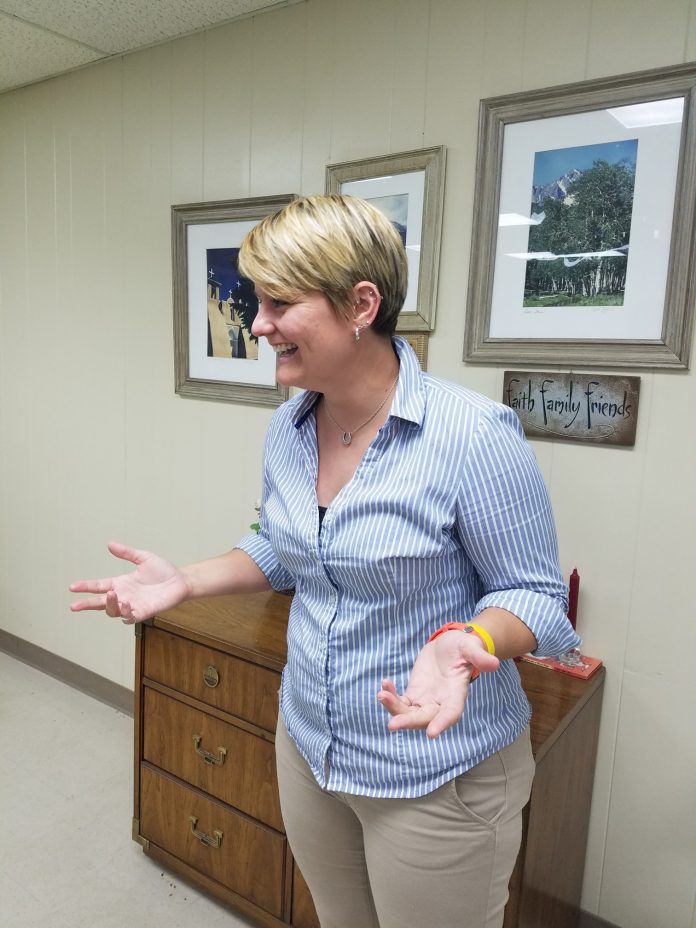
A convincing argument can be made that few people have done more for the health and wellbeing of Cleveland County residents than Norman Regional’s Paula Price, RN.
Not only has Price secured millions in funding for public health programs the last few years, she began at the bedside advocating for her patients back in 1975 when she first earned her LPN.
Price credits her parents with guiding her into nursing.
“They thought it would be a great career for me because I liked to help people and was kind, caring and supportive – those were things they always noticed about me,” Price said. “That’s how I started in nursing and ended up realizing after a few years it was a passion for me and that my parents really knew me well.”
And for nearly 20 years now Norman Regional Health System has relied on Price as the Health System’s Director of Health Promotion and Community Relations.
That heart for the community, coupled with her business acumen, led her to be called again to serve on the healthcare front lines.
New Norman Regional Health System President and CEO Richie Splitt recently announced Price would lead the Health System’s efforts as the new Vice President of Strategy and Growth.
“That’s really what we’re focusing on now is keeping patients out of the hospital and keeping them from being re-admitted or helping them prevent the onset of a chronic disease,” Price said, mentioning Oklahoma’s top conditions like cancer, lung disease, heart disease and diabetes.
Price has worn many hats in her career from medical surgical, surgical, and outpatient settings.
She earned her RN in 1990, but there’s always been a next step for Price.
While she always knew how to heal patients in an acute care setting she always wondered what she could do on a larger scale.
Price received a Bachelor’s of Nursing from the University of the State of New York, a Master’s of Public Health from the University of Oklahoma Health Sciences Center and a Master’s of Nursing from Southern Nazarene University
Most recently, Price has served as the Health System’s Director of Health Promotion and Community Relations for the past 19 years.
Her healthcare experience includes nursing, public health, community relations, marketing and communications. During her career she has received numerous recognitions and honors.
She was honored for her work in the wake of the May 20, 2013 tornado with a 2014 Healthcare Marketing IMPACT Award from Modern Healthcare and Advertising Age.
She also received the Oklahoma City University Kramer School of Nursing Silver Salute Award. In 2016, the Norman Chamber of Commerce recognized her with the Women in Leadership award.
She currently serves on the United Way of Norman Board of Directors, and Norman Chamber of Commerce board.
She makes sure she’s out in the community because it’s the best way to reach so many. It’s one of the reasons she spent 10 years on the board of Health for Friends, which was charged with reaching the underserved population without health insurance.
She led the system’s efforts to provide in-kind contributions of x-rays and diagnostic testing and even pharmacy vouchers that for some patients truly meant the difference between life and death.
She’s dove deep into advocacy especially the last 15 years serving as the Chair of Oklahoma Turning Point and securing millions in local funding through the Tobacco Settlement Endowment Trust.
“One thing about nursing is that I think it’s a very exciting time for nurses because you can really choose your path and choose your career,” Price said. “Now that midlevels are so key in access to healthcare nurses have so many more opportunities and can be a part of this new push of population health.”
And she’s done it while working for one of the few remaining municipal hospitals in Oklahoma.
There’s no corporate bottom line to answer to at the end of the day, only the local patient population that continues to make its approval known by patronizing any of the three health system campuses.
“The challenge of being independent is you really have to manage your resources and capital investment because you have to depend on yourself,” Price said. “We have to be very smart about being efficient and having the quality patient outcomes so we can do everything to maximize our efficiency and the care we provide.”
“We have a wonderful relationship with the community. We have a hometown feel. People know us and they’re comfortable with us. They trust us.”
And Norman Regional trusts Price to lead it into the future.
Dennis the builder

story and photos by Bobby Anderson, Staff Writer
Dennis Johnson spent the first half of his professional life working with his hands, building things that would stand the test of time.
“It’s hard to go up and down Interstate 95 and not cross a bridge I didn’t have a hand on,” Johnson says proudly.
But a shoulder injury would bring Johnson to a crossroads.
His days working with steel were over and he had to take a hard look at what his financial options were.
At a relatively young age Johnson was forced to deal with his 401k, the loss of his primary income as well as the only profession he had ever known.
It was overwhelming. And he knew it had to be the same for others.
So instead of self pity Johnson poured himself into the only thing he ever knew: figuring out a way to build something for others.
“I’ve been 1,200 feet in the air and pushed a hundred tons of iron around and I know what a hard day’s work is,” said Johnson, who absorbed everything he could get his hands on to become a self-taught financial advisor. “I’m a blue collar guy. I’ve always told my clients I know how hard it is to make a buck. I know how hard it is to swing a beater for eight hours just to get one pin in.”
Just like swinging that hammer, Johnson approached his new career with a laser focus. Registered designations, licenses and accolades followed.
The third-generation iron worker from Baltimore built a multimillion-dollar portfolio in Arizona before selling it all and moving to Oklahoma in 2014 with the intention to retire with his love Cathy Belzer.
Retirement did not suit Johnson at all. With plenty of time to do whatever he wanted he realized he missed taking care of people.
Johnson is a veritable Swiss Army knife when it comes to financial services work. His registered investment advisor license dates back more than 20 years. Along the way he’s picked up life and health insurance licenses and registered advisor status.
“I used them when a client needed them,” ” said Johnson, now an advisor at Tree Line Capital in Edmond. “I never made a big deal about pushing any of it.”
A friend, Robert Ford at Tree Line Capital, convinced him to join his burgeoning firm.
“Why don’t you come over here with me,’’ Johnson remembers hearing his friend say. “We’ll build something.”
Those were the magic words.
“I just want to help,” Johnson said. “Everybody needs a second opinion. That’s the guy I want to be. I’m really enjoying it. I’m having fun again and enjoying the business again.”
Johnson’s not the kind of guy you’ll find behind a desk all day wearing a suit and tie. You’re more apt to find him playing a round of golf or sitting down with buddies talking football.
There’s an ease about Johnson that goes with his blue-collar roots and his genuine desire to help people.
So it’s no surprise people gravitate toward him.
Today’s financial services industry is filled with fresh-faced, college graduates begging to take a crack at people’s portfolios.
Johnson has had individual clients longer than most of those new advisors have been alive.
Some clients Johnson will never let go, or more precisely, they won’t let him go.
“I have a client who is 93 years old and it feels so good because she tells everybody ‘If it wasn’t for (Dennis) I never would have made it,’” Johnson said. “We started with a relatively small amount of money and she’s lived and lived well for 25 years now and she’s still going.
“I have so many clients like that.”
Johnson relishes the fact that his clients see hard work pay off.
“In the beginning you don’t see that,” Johnson said. “The first five six or 10 years you’re building clients. But after they’re with you and you know them and you see (everything) … it’s so satisfying to have their children come up. When every month that checks shows up in their mailbox and you know you’re the guy that put it together that’s a great feeling.”
He even helped his partner get her insurance license after 30 years working in health care.
Belzer and Johnson are gearing up for their busy season.
Enrollment for Medicare Advantage begins this month.
Medicare Advantage enrollment has increased in virtually all states over the past year. Almost one in three people on Medicare (31% or 17.6 million beneficiaries) is enrolled in a Medicare Advantage plan in 2016.
Plans like these are just one piece of the puzzle that Johnson and Belzer work on for people every day.
“I’ve always had to have a plan and I’ve always had to be organized,” he says.
“You need somebody who is a team, who wants to listen to you and find out about your family and your kids.“
And, most importantly, you need someone who knows how to build something that will stand the test of time.
Local nonprofit sets fall schedule
By story and photo by Ron Hendricks
Central Oklahoma Chapter of Hearing Loss Association of America proudly announces the program/speaker schedule for the fall of 2017. Day group will host John Vincent, Oklahoma Insurance Division, speaking on “Medicare Changes” in October. M/Sgt Robert Shalla, OKCPD will talk about “How to interact with Police Officers” for the hearing impaired in November, Dr. R. Kent Dyer, an otolarnology physician, from Hough Ear Institute will discuss “Balance Issues.” All Day group meetings are held on the 3rd Thursday, 2-3PM with a social time 30 earlier. For December, both the Day & Night groups hold Christmas parties. Everyone brings snacks and enjoys traditional Christmas games. Last Monday, the Night group’s speaker was, Katie Gallager of Physical Therapy Central. She explored the dangers of falls and how hearing loss can contribute to loss of balance. A lively group discussion followed. October we will hear Sheryl Presley, OKCPD Triad Coordinator, discussing “Senior Safety Issues” while in November COCHLA will host Gloria Evans, Hough Hearing & Speech Institute, telling us “How to Effectively Self Advocate.” Night group meetings are held on the 2nd Monday, 7-8PM beginning with a social time 30 minutes prior. All meetings are held at the Lakeside United Methodist Church, 2925 NW 66th Street.
COCHLAA is now in the 27th year of serving Oklahomans with hearing loss and is looking forward to many more years of service. You will see Central Oklahoma Chapter of Hearing Loss Association of America at the State Fair & many other community outreach events such as Health Fairs, Senior events, demonstrations, and consultations as well as at the Hearing Helper’s Room, 5100 N Brookline, Suite 100. For more information visit the website, WWW.OKCHearingLoss.org
Hearing Loss Association encourages all to obey police
By Ron Hendricks
Regarding the sad news or the Oklahoma City Police officer fatally shooting a deaf man; We at Central Oklahoma Chapter Hearing Loss Association of America, encourage everyone to comply with police orders. If you are detained by a policeman –STOP what you are doing, stand still, and drop anything in your hand. The above applies if you can hear or not, however, if you are hard of hearing, after the officer approaches you, show him your pocket card that indicates the fact that you don’t hear well. A police officer will respect that. It is our goal to reach every Oklahoman with hearing loss to educate them and to help with listening skills, hints, and tricks. Central Oklahoma Chapter Hearing Loss Association of America, has been about the business of helping people with a hearing loss live successfully in the hearing world for 26 plus years. We are available to assist you, including meetings that are always open to the public and are free. We can supply a speaker for your group. See COCHLAA at the State Fair & many other community outreach events such as Health Fairs, Senior events, demonstrations, and consultations as well as at the Hearing Helper’s Room, 5100 N Brookline, Suite 100. We invite you to join Central Oklahoma Chapter of the Hearing Loss Association of America. For more information visit the website, WWW.OKCHearingLoss.org.
Classic Car Show to Benefit Sunbeam Family Services
The Mercedes-Benz Club of Central Oklahoma, the Porsche Club of the War Bonnet Region and the Boathouse Foundation have partnered to host the annual “Classics on the River” car show Saturday, September 30, 2017 from 9 a.m. to 2 p.m. at the Boathouse District located at 800 Riversport Drive OKC, OK 73129. Admission is free, but donations are welcome and will benefit the programs of Sunbeam Family Services. To register a car for the show, the fee is $30 for pre-registration ($25 for additional cars) and $35 for late registration on the day of the event. All proceeds benefit Sunbeam.
The classic car show will feature various classes of vintage and modern Mercedes-Benz and Porsche cars in judged and display classes. Brand new Mercedes and Porsche models will also be on display. For more information, visit http://centralok.mbca.org/ or email central.ok.mbca@gmail.com.
”We are thrilled that the Mercedes-Benz Club and Porsche Club have chosen Sunbeam for this incredible opportunity once again,” says Jim Priest, Sunbeam’s CEO. “Thanks to their generosity, we will have more funds to serve Oklahoma City children, families and seniors.”
About Sunbeam Family Services: Founded in 1907, Sunbeam Family Services is one of Oklahoma’s longest serving nonprofits, providing help, hope and the opportunity to succeed to people of all ages and all stages of life in central Oklahoma through early childhood, foster care, counseling and senior services. To learn more, visit www.sunbeamfamilyservices.org or follow them on Facebook, Twitter and Instagram.
Every Two Minutes, Someone in the U.S Dies from Sepsis
Here are some facts from Sepsis Alliance, the nation’s leading sepsis advocacy organization, about sepsis in the U.S. and how simply knowing the signs can save a life.
You probably have never heard of it. In fact, only 55 percent of adults in the U.S. ever have. It’s sneaky and is the result of your body’s immune system turning on itself instead of fighting the cause – an infection. It can start from something as simple as a tiny cut. It doesn’t discriminate and can happen to anyone – young or old, healthy or ill. Every year, more than 258,000 people in the U.S. die from it, more than from prostate cancer, breast cancer, and AIDS combined. The most devastating part is that it’s treatable, especially when it’s caught early and treated properly. What is it? Sepsis.
“Sepsis is the overreaction of the body’s immune response to an infection. This can lead to organ damage and even death,” said John Hurst, St. Anthony Infectious Diseases Pharmacist and Director of Antibiotic Stewardship. “Anything from pneumonia to a UTI can progress to sepsis. The most common causes of sepsis are infections of the lungs, skin, abdomen and urine. It’s important to know that 80 percent of sepsis cases start outside of the hospital setting.”
So what symptoms should you look for? “When someone has an infection along with any combination of the following signs it could be sepsis: shortness of breath or rapid breathing, confusion or disorientation, fever or shivering, high heart rate, extreme pain, and/or pale clammy skin,” said Hurst.
The quicker sepsis is diagnosed and treated, the higher the chance of survival with no or minimal long-term after affects, such as amputations. “The best thing you can do is seek medical care. Sepsis is a medical emergency and every minute counts when we look at sepsis survival,” stated Hurst. “Call your doctor or go to the emergency room immediately if you think you or someone you are caring for has sepsis. Don’t be afraid to ask your doctor ‘Could this be sepsis?,’” he added.
So you know what sepsis is and the symptoms, now what? Prevent infection in the first place by using good hygiene – wash your hands, properly care for open wounds, get vaccinations, and seek medical attention if you suspect sepsis. “Vaccinations are extremely important in the prevention of sepsis, especially the flu and pneumonia vaccines,” said Hurst. “Seeking medical care for infections before they get out of control can help prevent progression to sepsis. For patients with diabetes, skin and foot care can prevent infections from taking hold and putting you at risk for sepsis.”
Remember, every two minutes someone dies from sepsis – a treatable condition that can start from any kind of infection. So don’t hesitate if you suspect sepsis and get medical help as soon as you see the signs. You could save a life.
ANA Calls for Action in Wake of Police Abuse of RN
The American Nurses Association (ANA) is outraged that a registered nurse was handcuffed and arrested by a police officer for following her hospital’s policy and the law, and is calling for the Salt Lake City Police Department to conduct a full investigation, make amends to the nurse, and take action to prevent future abuses.
The incident occurred July 26 at University Hospital in Salt Lake City, Utah and video footage of the incident was recently released. Registered nurse Alex Wubbels was arrested after refusing to draw blood from an unconscious patient who had been injured in a collision and was a patient on the burn unit.
According to the video, Nurse Wubbels shared details about the hospital’s policy with the police officers and consulted her supervisors in responding to the detective’s request. Wubbels cited the hospital’s policy, stating that blood could not be taken from an unconscious patient unless the patient is under arrest, a warrant had been issued for the blood draw, or the patient consents. The police officers stated that they had implied consent to get the blood sample and they believed that the hospital’s policy contravened their duty to enforce the law. However, “implied consent” has not been Utah law for more than a decade. Additionally, the U.S. Supreme Court ruled in 2016 that warrantless blood tests go against privacy interests and public safety and therefore are not allowed. “It is outrageous and unacceptable that a nurse should be treated in this way for following her professional duty to advocate on behalf of the patient as well as following the policies of her employer and the law,” said ANA President Pam Cipriano, PhD, RN, NEA-BC, FAAN.
According to the Code of Ethics for Nurses with Interpretive Statements, “the nurse promotes, advocates for, and protects the rights, health, and safety of the patient.” Unfortunately, nurses often are victims of violence on the job. In 2015, ANA adopted a policy of “zero tolerance” for workplace violence and called on nurses and their employers to work together to prevent and reduce the incidence of workplace violence. “Nurses and police officers work collaboratively in many communities,” said Cipriano. “What occurred is simply outrageous and unacceptable. Nurse Wubbels did everything right. It is imperative that law enforcement and nursing professionals respect each other and resolve conflicts through dialogue and due process.”