Sunday, November 8, 2026

KIRKS EMS: Five Decades of Quick, Courteous, and Compassionate Care

0
Kirk and Betty Kuykendall 1980.
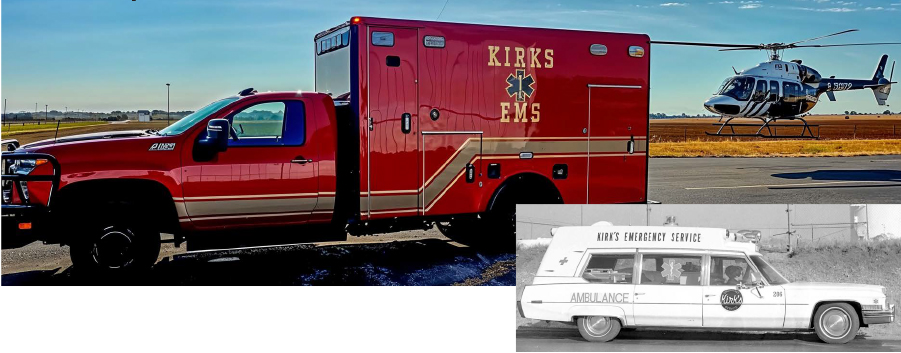
KIRKS EMS modern day rig and helicopter. KIRKS EMS vintage ambulance (right).

Kirk’s EMS began with the Kuykendall family’s wrecker service.


They recognized a need for ambulance services in the community,
which led to the founding of Kirk’s EMS in 1972 by H.P. (Kirk) and
Betty Kuykendall with a single station in southwestern Oklahoma.
The first ambulances were two 1972 Oldsmobile limousines
purchased for $8,000. Replacing them with a modern equivalent
would cost roughly $350,000, a measure of how much emergency
medicine has changed. Over more than fifty years, KIRKS has
grown to five stations with 109 employees. Its mission has stayed
constant: providing the community with quick, courteous, and
compassionate care.
KIRKS is a family business at heart whose history is a story of continuity. Paul, the founders’ son, sits on the company’s board, carrying the family’s service into a second generation. Many employees have been there since the earliest days. The current director was on staff during the September 11th terrorist attacks, proving the longevity of the company’s values.
With nine ALS ambulances on call daily and stations in
Lawton,Walters, Elgin, Apache and Carnegie, KIRKS covers 2,000 square miles of service area in Comanche, Cotton, portions of Caddo, portions of Kiowa and Washita Counties. Last New Year’s Eve, the service reached a milestone of 15,000 calls for the year. An EMS workers stated the reason people should choose KIRKS over other EMS services is for their compassion, dedication, and training of its employees, which they refer to as their grade “A” care.
KIRKS operates under Heartland Medical Direction, which holds the service to a higher standard than state and national requirements and allows crews to do substantially more in the field. The clearest example of this is blood. Last year KIRKS partnered with Our Blood Institute and began carrying blood on its ambulances. It is the only ground service in southwest Oklahoma to do so, with blood typically only carried by helicopters. So far, crews have given it in the field six times.
Simulation competitions, known as SIM games, are a staple
of EMS events. Teams of paramedics and EMTs work through timed, high-pressure scenarios. Actors or high-fidelity mannequins play the patients, and judges score triage, protocol adherence, communication, and hands-on treatment. The games are also a competitive way for responders to sharpen practical knowledge, learn from peers, and practice crisis management. KIRKS recently won a competition at a three day state wide event. Two KIRKS teams reached the finals, with one taking home the trophy as state champion.
Military service runs through KIRKS’s workforce, which includes many veterans and former combat medics. H.P. “Kirk”, the founder, served during the Korean Conflict and with the Oklahoma National Guard following that tour Amongst the others are a married couple who also work as flight paramedics with Airevac. KIRKS offers internships to medics coming off active duty to help them transition into civilian EMS, though they must first earn their EMS certification. The company also directs staff to military resources as needed, including the Warriors Rest Program, however, Heartland PEER Support is their primary mental health and peer support resource.
Many of KIRKS workforce come from law enforcement and fire service backgrounds. A number of them are pursuing further medical careers and include generations and decades of invested service professionals working together.
Historically, EMS has less mental health support than fire and police departments. KIRKS is working with the state of Oklahoma to change this. Recognizing the importance of caring for the caregivers, five staff members are trained as peer supporters with one of them holding a certification in Critical Incident Stress Debriefing (CISD), a structured way of helping crews process difficult calls.
Nine staff members recently earned certification in community paramedicine which extends the service beyond emergency response. KIRK’s paramedics have received Oklahoma Paramedic of the Year and National Paramedic of the Year and one of KIRKS ambulances is set to appear on the big screen in an upcoming feature film.
The KIRKS culture includes a family first environment with an emphasis on supporting neighboring first responder agencies. They are proud to serve the SW Oklahoma communities and view growth as a responsibility, not simply to add territories or more ambulances.
From a pair of ambulances at one station, to blood on board and a
state championship team, KIRKS EMS has stayed true to its founders’ commitment: people who stay, train hard, and treat every call with care.The equipment, medicine and footprint have changed dramatically, yet the foundation of family, community and taking care of people, has remained the same. •story by Jill Stephenson, contributing writer

 

A Keen Eye Saves Marines from Artillery Barrage in Vietnam

0
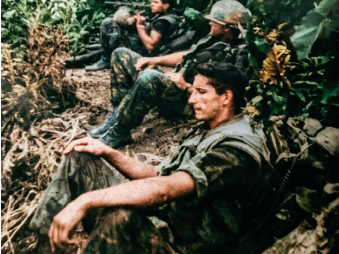
Paul Braun rests with his Marine company somewhere in Vietnam in 1968 or 1969. Notice the radio equipment next to him. Photo from Paul Braun


Green lights flickered in the dark distance. U.S. Marine Michael Paul Braun knew what they meant-artillery lining up. Friendly or foe? His fellow Marines’ lives in Vietnam depended on the answer.
“I marked that spot with a rock there, where I saw that hill. And so, I went up and asked my Captain (Edward F. Riley). I said, Did we have artillery up here? And he goes, No. I said, Somebody does. He said, Well, how do you know that? Well, I said, I saw one of those three quadrant lights that they used to line the guns up at night and that’s what it was.’”
Riley went to the spot with a rock and confirmed Braun’s observation. ‘’That’s right… He started sending out messages right then and they were all scrambled (coded). And a little longer, along comes B-52s with the bombs. I mean, 1,200-pound bombs going off all night long. It was biggest fireworks show I’ve ever seen.’”

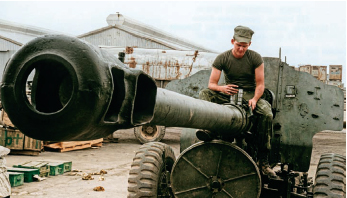
Captured 122 mm North Vietnamese fieldpiece from Operation Dewey Canyon. Photo from U.S. Marine Corps, 1969.

This occurred during Operation Dewey Canyon, “the biggest operation that we ever went on,” said Braun. “We captured three Russian artillery pieces, brand new…They
(North Vietnamese) tried to destroy it and…we captured around 500 tons of arms and ammunition…It was a storage area to supply the south…That was a 58-day operation. We never seen the rear.” Jack Revis recorded Braun’s recollections in October 2024 for the Veterans History Project.
How did Braun know what the green lights meant? “I had read the ‘Guns of Navarone’ when I was in high school…where the Germans had their guns set up…they used those at night to line the guns up.”
Braun enlisted in the U.S. Marine Corps in January 1968 at age 19, fully aware he would likely fight in Vietnam, an unpopular war. “I didn’t have any qualms about not being able to do it.” He served in Vietnam from June 25, 1968 – July 25, 1969.
His unit, the 1st Battalion, 9th Marines, 9th Marine Regiment, 3rd Marine Division, carried the grim nickname, “The Walking Dead.” As Braun explained, “we had taken so many casualties…because of where we were in Vietnam, right there along the DMZ (Demilitarized Zone), at times we were in the DMZ. Because they (enemy) had no respect for it, so we didn’t either.” Their area of operation stretched from the South China Sea to Laos.
As the company commander’s radio operator, Braun held a dangerous job in the field. Enemy forces deliberately targeted Marines with visible antennas.
He was promoted to E-5 Sergeant based on excellent war service. “They asked me about four or five times, would I reenlist and go to OCS
(Officers Candidate School). And I told them no.” Why? Braun told his company commander that his father and mother served during the Second World War and he grew up with seven brothers and sisters and his grandfather. I said, “That’s how come I know how to handle chores and how to tell people to do theirs…I did 18 years in their little army…I’ve done two years in your Marine Corps…That’s 20 years and I’m getting out,” Braun said, smiling.
Braun was discharged in December 1969 with Vietnam Service and Campaign Medals and a Navy Achievement Medal with Combat V (valor), among others.
Returning to Tahlequah, Braun earned a degree from Northeastern State University, bought a convenience store, and later earned a Class A commercial driver’s license to drive his own truck from 1987-2005 for companies like PAM Transport, YAFFE Iron and Metal and Ellsworth Trucking.
But service came with a price: Post-Traumatic Stress Disorder, depression, diabetes, neuropathy, hearing loss and four marriages. He received a 100% VA disability rating.
Despite these challenges, Braun remains committed to helping others. He is
active in the Veterans of Foreign Wars Post 3707, Disabled American Veterans Post 31, and the Military Order of the Purple Heart (MOPH).
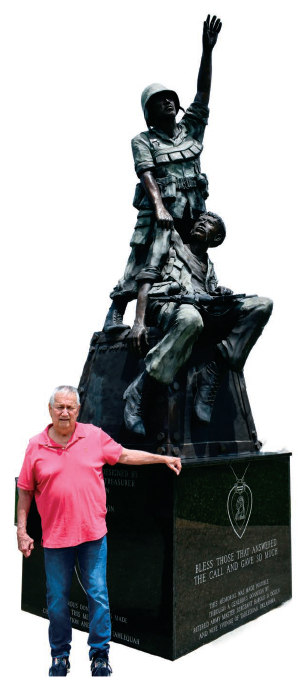
Don Nichols of Muskogee’s MOPH, Chapter 617, wrote, “He’s always there to encourage me. He’s that way with everybody. Very honorable, very principled man…Paul helped get the National Purple Heart Monument (in Tahlequah) going by meeting with the Cherokee Nation and getting a donation of about $25,000.” Braun is a citizen of Cherokee Nation.
Braun raised three daughters -”I feel like they are all very accomplished”- and has five grandchildren and five great-grandchildren. He lives in Cookson.
Was he glad he served in Vietnam? “Yes. I did something that a lot of guys ran from.” Patriotism? “It’s getting better…I think it’s our young people that are really picking up on what it means to be at patriot.”
Story by Retired Lt. Col. Richard Stephens, Jr., USAFR website: Rick Travel Niche

Former Marine Paul Braun points to the National Purple Heart Monument in Tahlequah. Troy Jackson sculpted it. Although Braun was not wounded in war, he supports veteran organizations like the VFW, DAV and Military Order of the Purple Heart. Photo from R. Stephens

A Tale of Two Countries: Deserting One to Fight for the Other, Part 3

0
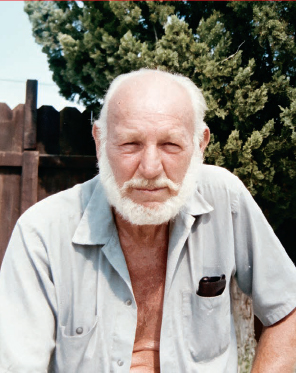
Daughter Sandy Bishop provided this photo of Mildred ‘Tex’ Allison after he retired from work.


EDITOR’S NOTE: This is the third of a three-part story on WWII hero Mildred Allison. Parts one and two published in August and September; please read them online at www.okveterannews.com

Arrested for Desertion, Court-Martialed!
Born into poverty in Farrar, Texas, in 1913, Mildred Jasper Allison served in the U.S. Army from 1936 to 1941. He deserted on August 10, 1941, and two days later enlisted as Corporal Millard (Tex) Allison with Canada’s British Columbia Regiment to fight in WWII.
He met Elizabeth (Betts) Garner during a confrontation on a bus while training in Ontario province. Their whirlwind romance led to marriage on Jan. 8, 1942.
On July 28, 1944, Allison’s unit, the 28th Armoured Regiment, landed in Normandy, France. In September, captured by German forces, he spent nine days as a POW with others before Free French of the Interior (FFI) forces freed him in Rouen. He rejoined his unit.
By mid-April 1945, Corporal Allison, crew commander of a Sherman tank equipped with a 75-mm gun, arrived in Germany. He led his unit’s tank advance along the Küsten Canal, shielded by a boxcar on a railroad. He used a pistol
and grenades to kill over 50 enemy soldiers. Under fire, he rescued his troop commander, Captain Bell, and crewmen from their burning tank.
Corporal Allison received the Distinguished Conduct Medal, the British military’s second-highest medal. He was honorably discharged from the Canadian Army on Nov. 5, 1945. On Dec. 12, 1945, he returned to Texas with Canadian citizens Elizabeth and their three-year old daughter, Sandy.
Their oldest daughter, Sandy Bishop, transcribed recordings for the family – and now the public. Allison’s own quotations are provided. Grandson Marc Bishop conducted additional research.

Building a New Life
The family traveled to Norman, Okla., where relatives lived, before settling in Fort Worth, Texas. In July 1946, Allison became a mineral mixer at Ralston-Purina Mills. With low wages, the family lived in a trailer court at 2312 East Lancaster.

Arrest for Desertion
The U.S. Army ordered an arrest warrant for “Recruit” (E-1) Allison because he deserted military service, violating the 58th Article of War. Detectives arrested him on July 2, 1948. Elizabeth learned of his desertion only when he was arrested. Sandy said that was because her father did not want her mother to worry about what might happen. “He never burdened my mother with it.”

Allison, age 35, was restricted to performing duty at Camp (now Fort) Hood from July to his trial in December.
U.S. Congressman Wingate Lucas of Texas heard about his case and wanted to defend him at the upcoming court-martial. Lucas told reporters covering the sensational event, “Once we get him restored to active duty (a non-guilty verdict), then we can get him an honorable discharge.”

Court-Martial
The one-day trial, Dec. 16, 1948, had a nine-man jury of officers. Allison’s U.S. and Canadian military records were presented by the prosecution and defense. Captain Bell and others submitted letters documenting his competence and valor. Allison pleaded not guilty and truthfully answered questions.
Lucas led an impassioned defense. While acknowledging Allison deserted, he declared, “He served us better where he was than he could have served had he remained where he was stationed…We don’t believe this man deserved punishment…We want the (service) record clear….Shall you punish him for having the wisdom to foresee the world on fire and having the courage to fight before we were alerted to fight?”
Elizabeth attended the trial with their three children: six-year-old Sandy, two-year-old Austina and ten-month-old Paula.

Trial Results
Allison was found guilty of desertion and was sentenced to hard labor and forfeiture of $35 a month for six months. The jury recommended clemency. The reviewing
commander remitted execution of the sentence, resulting in it being cancelled. In February 1949, the Army gave Allison a dependency discharge, which is an administrative separation from military service to support one’s family, with a “General Discharge Under Honorable Conditions” certificate – not an Honorable Discharge – because of his court-martial conviction. Allison told reporters, “It’s a good Army. I’ve got no bitterness. I’ve been treated square.”

Devoted Wife
“She loved the man. She waited for the man,” said Sandy about her mother, Elizabeth. “She went through the trial with three children by herself with her, with his father living with her in a one-room trailer. She followed him all through all of that. Absolutely dedicated.”

Compassion Over Profit
After the trial, Allison was offered a job in Canada, but he told reporters, “I want to live here. I wouldn’t lose my U.S. citizenship for the world.”
Years later, after leaving Ralston-Purina Mills, Allison owned two businesses, including an automobile gas and repair shop on Porter Avenue in Norman in the 1950s. His generosity hurt his bottom line. “But he wasn’t successful in that because he wouldn’t charge a man enough money (for repair) to survive” if they couldn’t afford to pay, said Sandy.

Later life
In retirement, Mildred and Elizabeth traveled and grew a garden they both cared for, Sandy explained. “And he decided that last year, he’d put in a big garden and worked in the yard and just did the things that he hadn’t done in years and years.”
After Mildred died August 18, 1976, Elizabeth moved to Edmond to be near Sandy and Melvin Bishop. She worked at a TG&Y discount store to remain active, but loneliness marked her final years. Sandy recalled, “She worked till she died…Except for the ladies at work, she really didn’t have any friends. She had no family (Canadian).”
Elizabeth died on June 18, 1979. She joined Mildred at Sunset Memorial Park Cemetery, Norman. Their daughters, Sandy Bishop, Tina White and Paula Allison, are alive; son Michael Allison, is deceased.

Headstone Dedication
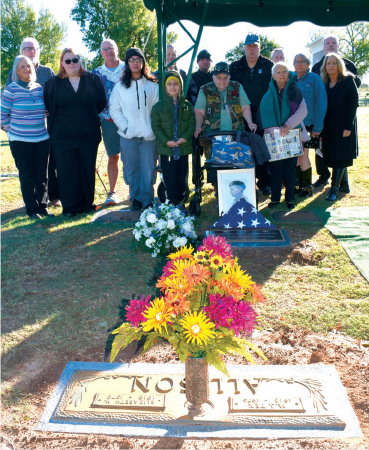
On Oct. 17, Allison’s descendants installed a headstone with Mildred’s military information on it in a ceremony where he is buried. At the thoughtful event, organized by Primrose Funeral Service, Marc Bishop led the family’s remarks. “I would like to take a minute to again recognize another veteran, my hero, my father, Melvin Bishop, who we lost last October, who is part of the reason we are here today. My father is the only person that my grandfather confided in with his full war experiences. My father then passed on my grandfather’s stories and his own war stories, which led me to serving in the Army and creating my own.”
Robbie Richter, one of Allison’s granddaughters, read a speech written by Sandy Bishop. “Mildred ‘Tex’ Allison chose to go to war for whatever motives impel a man to go where there is action. He served his country and displayed valor of the highest order. His legacy as a soldier reminds us of the debt we owe to all who have served.”
The Patriot Guard Riders, a veteran group who attend military and first-responder funerals and ensure veterans are not forgotten, posted American flags and presented a folded one to the Allison family.
William Whalen, President of the British Columbia Regiment Museum in Canada, designed the headstone and used year-long fund raiser money to purchase one from Southwest Monument & Bronze Memorials, Oklahoma City.

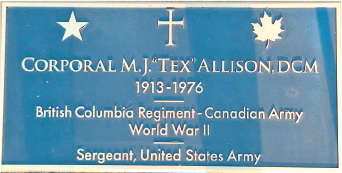
The decendants and family members of Mildred and Elizabeth Allison pose after a military headstone was laid at Sunset Memorial Park, Norman, OK
Mildred Allison’s new headstone dedicated in a military service on Oct 17, 2026. Headstone was paid for by British Columbia Regiment Museum in Canada.

Epilogue
Fifty years after Mildred “Tex” Allison was laid to rest, he received a long-overdue military honors ceremony that pleased the family and marked the close of another chapter of his life’s book. • Story by Retired Lt. Col. Richard Stephens, Jr., USAFR website: Rich Travel Niche


Broadway Extension VA opens Behavioral Health Wing

0


The Oklahoma City VA Health Care System (OKC VAHCS) is making it easier for Veterans in Oklahoma and North Texas to get the care they need.
With several new and expanded outpatient clinics opening soon, Veterans will have access to more services, closer to home.
These projects are all about delivering timely, high-quality care. The VA is adding and expanding services like primary care, mental health, dental, rehabilitation, specialty care, and diagnostics throughout the region.
“Expanding access to care remains one of our highest priorities,” said Wade Vlosich, Director of OKC VAHCS. “These new and expanded clinics reflect our continued investment in the health and well-being of the Veterans we serve. By increasing capacity and offering more services closer to home, we’re making it easier for Veterans to receive the care they’ve earned.”
One of those expansion sites is at the Broadway Extension
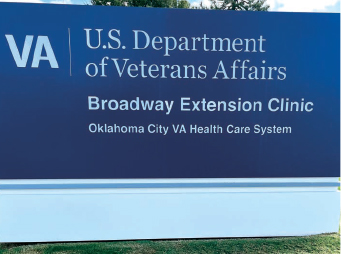
VA Clinic, located at 9400 Broadway Extension, Suite 300, in Oklahoma City.
A ribbon cutting ceremony was held Oct. 13 for the opening of the new addition.
This clinic is where Behavioral Health services relocated from the VA medical center near downtown Oklahoma City.
“So, this is a full-service mental health clinic for our Veterans,” Casey Zwirtz, Assistant Director of Operations said. “This is one of our domino moves to prepare us for our future expansions at the main facility. And so, what we’re doing is we’re taking a lot of our mental health services for outpatients and bringing them here, expanding services. This is our next phase of trying to expand and give more access to mental health care.”
Zwirtz said 70 Behavioral Health employees have relocated to the Broadway Extension VA, which offers everything from individual mental health therapy to group therapy.
“We also offer psychotherapy and various other mental health related services,” he said.
Zwirtz said taking care of your mental health is important for everyone.
“So, I think we do a really good job of making sure that veterans know that we’re here to help and to get them back to where they want to be mentally,” he said. “We’re trying to get them into our classes and get them into our sessions and we can help normalize the need for mental health, not just for veterans, but for everyone, that mental health is a need and we need to make sure that we’re supporting each other and giving people the resources they need to be successful in their day-to-day life.”
Zwirtz said the new Behavioral Services wing has 70 individual offices for their mental health providers to be able to meet with veterans and their family members if needed.
“We also have three group rooms for group therapy. And then
we have a couple different offices that are set up specifically for things like psychotherapy or cognitive therapy and then also with any type of brainwave and things like that that we might adhere to,” he said.
Zwirtz said the new clinic has one exam room used primarily for nurse intake.
“We have one exam room and it’s mainly for nurse intake clinics where we’re going to do a blood draw. So, if they need to get labs done, they can get them done here or we’ll do a physical exam here from a nursing standpoint just to make sure that they’re ready for their appointments. And then sometimes we’ll do drug screens and things like that if they’re in a program that requires them to stay clean or sober.”
Zwirtz said the VA has utilized various media outlets to get the word out about the new Behavioral Services clinic.
“So, we’ve done multiple tele town halls where we’ve had veterans from different locations throughout our catchment area where we’ve updated them on the opening of the clinic,” he said. “We’ve also sent out emails and gov delivery, which is our email service where we send out those notifications and then also tap into our local media to help notify them.”
Zwirtz said the new clinic is designed to make mental health access easier.
“This is our first mental health only clinic that’s outside of our main facility. So, this was exciting to be able to put this one together and get it to this step,” he said. “It’s providing the care that we need for our veterans in this area and being able to expand and grow our mental health care. And this clinic is going to provide a less stressful environment for our veterans to come into.”
For more information call the Broadway Extension VA main number at (405) 456-7200.