Tuesday, December 2, 2025

Vision Research Receives $2.9 Million Boost at OU Health Sciences Center, Dean McGee Eye Institute

0

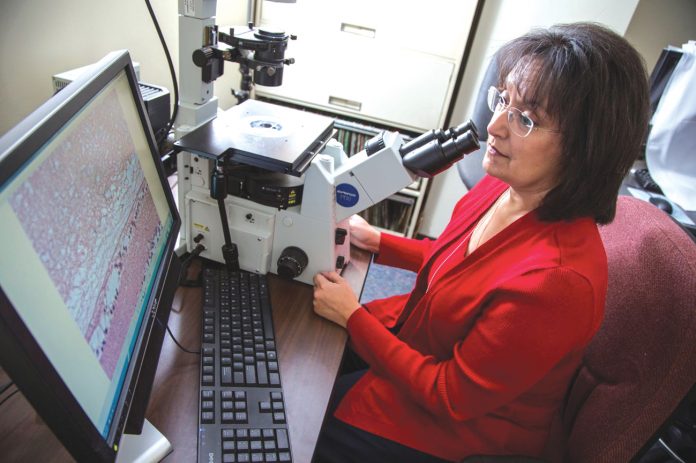
The vision research program at the University of Oklahoma Health Sciences Center and Dean McGee Eye Institute recently received a five-year, $2.9 million grant renewal from the National Eye Institute. Called a P30 Vision Core grant, it supports the work of researchers in 21 laboratories with advanced equipment, sophisticated software, and other innovations to drive research that ultimately will improve the quality of life for patients seeking care for their vision.
Vision research is among the most highly funded areas of investigation at the OU Health Sciences Center. The current grant was originally awarded in 2011 and included several “cores” of specialized equipment available to vision researchers across the campus and at the neighboring Oklahoma Medical Research Foundation (OMRF). The grant renewal expands those cores, giving researchers additional tools to more quickly translate their findings into treatments.
“The amount of this grant renewal is based on the fact that most of our individual researchers hold R01 grants from the National Eye Institute, which is considered the gold standard in vision research funding,” said Michelle Callegan, Ph.D., Director of Vision Research at Dean McGee Eye Institute and Professor in the Departments of Ophthalmology and Microbiology and Immunology in the OU College of Medicine. “Because our vision researchers have been so successful in attracting federal grant funding, we were able to renew this P30 grant, which not only advances their efforts, but helps us to recruit new vision researchers and trainees interested in vision science.”
The grant will also fund the creation of a new core in Ocular Immunobiology, providing researchers advanced methods of analyzing the immunological underpinnings of eye disease. “There is an immune-related slant to every model of eye disease,” Callegan said, “so the development of this core is really important to us.” The Ocular Immunobiology Core will be led by Darren Lee, Ph.D., whose own research focuses on autoimmune uveitis, an inflammation of the eye that is the third-leading cause of blindness in the United States.
Other cores include a Model Imaging Core that allows researchers to analyze visual function and other physiological parameters of eye disease models. The core also includes an emphasis on genotyping to ensure the genetic consistency of research models. It is led by Raju Rajala, Ph.D., whose research focuses on neurodegenerative diseases of the retina. The Cellular Imaging Core provides sophisticated equipment that allows researchers to visualize physiological processes at the cellular and subcellular levels. That core is directed by Michael Elliott, Ph.D., whose research focuses on cellular membranes and how they control cellular signaling in vision.
“The technology in these cores is very expensive. One individual researcher could not afford the equipment that we have,” said Callegan, who leads the overall administration of the grant. “Not only do many different researchers use the equipment, but the cores also facilitate multidisciplinary collaboration between researchers from ophthalmology, physiology, pathology, microbiology and other areas across campus, as well as OMRF.”
Since the original P30 grant was awarded in 2011, vision research has significantly increased at the OU Health Sciences Center and Dean McGee Eye Institute. Nearly 30 research laboratories across the OU Health Sciences Center and at OMRF are focusing on eye diseases, and multidisciplinary collaborations between vision and non-vision research laboratories have flourished. Several new vision researchers have been recruited, launched their own laboratories and gained their own independent funding.
“Many exciting things have occurred because of this P30 grant,” Callegan said. “This funding has provided resources that our investigators otherwise would not have access to, and it has advanced research toward our ultimate goal, which is improving and restoring vision.”
Research reported in this press release is supported by the National Eye Institute, a component of the National Institutes of Health, under the award number 2P30EY021725-11.

Greg Schwem: Would the ghost in my closet kindly return my shorts?

0

by Greg Schwem

I know my memory is ebbing as I age. Why else would I run to the Apple Store at least twice a year to replace charging chords I was CERTAIN I had packed before leaving the hotel room or home share property where I spend so much of my time now that I’m traveling again?
But I refuse to blame the alarming disappearance of wardrobe items on my mental faculties. Especially when my daughters are convinced a haunted spirit, one that seems to grow more annoying each day, lives within my family’s confines.
As I write this, I am still searching for a sweatshirt, adorned with my youngest daughter’s college emblem, that I planned to wear on a recent campus visit. I ended up having to purchase one at the university bookstore. Is it me or do colleges double the prices on souvenirs when parents’ weekend rolls around?
My oldest daughter, living at home while she completes an online master’s degree, is convinced the ghost took it.
“What ghost?” I asked, while tearing apart my closet and finding, among other things, an insurance card from 1997 and a receipt from a local paint store.
“The one that randomly closes my door,” she said. “And turns on the ceiling fan light when I’m sleeping. That happened last week.”
She is also convinced the ghost is male, as evidenced by the low voice she claimed to have heard one night while watching television; a voice her sister also heard from the other room.
“He took your sweatshirt for sure,” she said.
I scoffed at her supernatural beliefs, certain the shirt would turn up eventually.
Until my shorts disappeared too.
I had returned from a workout and, a day later, realized they were missing. Normally I wouldn’t care; I do possess other exercise attire, unlike some of the guys at my gym. I don’t know the name of the dude who spends 30 minutes every morning on the elliptical machine, but I do know he is very fond of his 1985-86 Chicago Bears Super Bowl T-shirt. On the rare day he is absent, I assume he is doing laundry.
But then I remembered I had put my driver’s license in these shorts. Ever lose your driver’s license? It limits your ability to perform a myriad of functions, only one of which is driving.
I searched my closet. I emptied my laundry hamper. I did the same to a half-unpacked suitcase from a previous trip. I strained my back pulling the washer and dryer away from the wall, convinced the shorts had fallen behind one of them. I checked unlikely places, including under my bed, my office desk drawers and even our kitchen pantry. I know that’s weird, but I once shut the pantry door not realizing our dog was in there. Never a barker, she simply laid down and napped until dinner time.
Meanwhile, my daughter watched from the doorway.
“It’s the ghost,” she said.
“It’s not the ghost,” I yelled in frustration, gesturing with a hand dripping in last week’s garbage. The shorts weren’t in there either.
“I know I did not leave the gym without pants. Somebody would have noticed. Probably the police.”
That evening I announced I would be getting up early to obtain a new license at the Illinois Department of Motor Vehicles. If the shorts turned up, I gave my wife and daughter strict instructions not to move them.
“Do not disturb the crime scene,” I said.
The next morning the shorts were neatly folded on my bathroom vanity.
“They were in my suitcase,” my wife said. “Don’t ask me how they ended up there.”
But I know EXACTLY how they ended up there.
The male ghost is trying to drive me insane.
So he can move in on my wife.
(Greg Schwem is a corporate stand-up comedian and author of two books: “Text Me If You’re Breathing: Observations, Frustrations and Life Lessons From a Low-Tech Dad” and the recently released “The Road To Success Goes Through the Salad Bar: A Pile of BS From a Corporate Comedian,” available at Amazon.com. Visit Greg on the web at www.gregschwem.com.
You’ve enjoyed reading, and laughing at, Greg Schwem’s monthly humor columns in Senior Living News. But did you know Greg is also a nationally touring stand-up comedian? And he loves to make audiences laugh about the joys, and frustrations, of growing older. Watch the clip and, if you’d like Greg to perform at your senior center or senior event, contact him through his website at www.gregschwem.com)

Brightmusic Chamber Ensemble Presents “Symphonic Strings”

0
Shaohong Betty Yuan, Amy I-Lin Cheng, Parthena Owens.
L-R Tanya Bannister, Katrin Stamatis, Gregory Lee, Mark Neumann, Jonathan Ruck.

Strings take center stage in Brightmusic Chamber Ensemble’s third concert, “Symphonic Strings,” 7:30 pm on January 11 at First Baptist Church in Oklahoma City. The concert will present Ravel’s Sonata for Violin and Cello, which marked a turning point in his career, Gerald Finzi’s powerfully expressive Interlude for Oboe and String Quartet and Pyotr Ilyich Tchaikovsky’s only sextet, his “Souvenir de Florence,” which has been described as a symphony for six strings.
The concert takes place at the First Baptist Church, 1201 N. Robinson Ave., Oklahoma City. Season passes, available on the website, are $125 for the five regular-season concerts and all concerts of the summer festival. Single admission tickets are $20 at the door. Admission is free for students and active-duty military with ID.
Maurice Ravel composed his four-movement Sonata for Violin and Cello between 1920 and 1922 and dedicated it to the memory of Claude Debussy, who had died in 1918. Described as “lean” and “linear,” the sonata stood in sharp contrast to the lush harmonies and textures of his earlier works and was, Ravel wrote, “stripped to the bone; harmonic charm is renounced, and there is an increasing return of emphasis on melody.” The sonata would, as the composer predicted, mark a turning point: after Debussy’s death, Ravel was widely considered the leading French composer of the era.
British composer Gerald Finzi’s personal and introspective Interlude for Oboe and String Quartet was written between 1932 and 1936 and, along with his clarinet concerto, is one of his best-known instrumental compositions. The one-movement work was subsequently arranged for oboe and string orchestra and for oboe and piano. Despite its brevity, the Interlude is a big, passionate piece with wide-ranging moods and may have originally been intended as part of a concerto.
Tchaikovsky’s four-movement sextet, “Souvenir de Florence,” is a romantic symphony in microcosm. The work is so titled because one of the principal themes was sketched while the Russian composer was visiting Florence, Italy, but it is distinctly Russian. The composer wrote to a friend, “I am, in essence, composing for the orchestra, and only then arranging it for six string instruments,” a task he described as “unimaginably difficult.” The result is a small-ensemble work with the grandeur of a symphony and the grace of his ever-popular “Serenade for Strings.”
The Brightmusic Chamber Ensemble is Oklahoma City’s foremost presenter of classical chamber music. For more information, visit us at www.brightmusic.org and follow us on Facebook at https://www.facebook.com/BrightmusicOK.

OU Public Health Dean Is Senior Author for Global Study

0
Gary Raskob, Ph.D., Dean of the Hudson College of Public Health at the University of Oklahoma Health Sciences Center

Blood clots are a major concern for people facing various health situations, including surgery, hospitalization and cancer. While current medications lower the risk of clots, they increase the chance of bleeding complications, to an extent that some people cannot take them. However, a new option may be on the horizon — a research study published today in the prestigious New England Journal of Medicine shows promise for a new oral medication that is effective for preventing clots without increasing bleeding.
Gary Raskob, Ph.D., Dean of the Hudson College of Public Health at the University of Oklahoma Health Sciences Center, is senior author of the publication and chair of the steering committee for the study. The study tested the drug Milvexian in patients undergoing knee replacement surgery, who have a high risk of developing clots in the deep veins of their legs. More than 1,200 patients undergoing surgery at 118 health centers in 18 countries participated in the trial. Results showed that a daily dose of 100 milligrams or more of Milvexian was more effective for preventing clots than the current standard of treatment and, importantly, it had a low risk of bleeding.
“We are encouraged by these initial results with this new oral anticoagulant that works differently from existing medications,” Raskob said. “We may finally be able to realize the longstanding goal of separating the benefit of anticoagulant medication for preventing clots from its side effect of increasing bleeding complications.”
There is an enormous need for drugs to prevent clots — two of the top 10 drugs sold across the world are anti-clotting medications, Raskob said. Blood clots can cause serious illness and disability. As the underlying cause of most heart attacks and strokes, and of clots in the legs that move to the lungs, they are responsible for about 1 in 4 deaths worldwide. Blood clots in the lungs, known as pulmonary embolism, are fatal for about 100,000 people each year in the United States, according to the Centers for Disease Control. Because so many people require the medications to reduce the risk of clots, researchers are devoting significant time and resources to developing new therapies that are effective and improve patient safety.
Researchers chose the drug Milvexian to study because of the way it reacts with a protein in the blood called Factor XI. People who have a genetic deficiency of Factor XI (a condition known as hemophilia C) have a lower chance of developing clots later in life, and they don’t have spontaneous bleeding complications compared to people with other types of hemophilia. This suggested to researchers that if Factor XI could be reduced in at-risk patients, clots could be prevented without bleeding complications. Milvexian works by binding to Factor XI and inhibiting it, which reduces the risk of clot development.
Most of Raskob’s research career has been devoted to the prevention, diagnosis and treatment of blood clots, formally called deep-vein thrombosis, as well as pulmonary embolism, a blockage that occurs when part of a clot breaks off and travels through the bloodstream to the lungs. In July, he was an author for another publication in the New England Journal of Medicine about abelacimab, a monoclonal antibody injected under the skin, which also targets Factor XI for the prevention of clots.

Social Security Calculators That Can Help You Decide When to Claim

0

Dear Savvy Senior,

Can you recommend some good resources that can help my wife and me determine the best claiming ages for maximizing our Social Security retirement benefits? Just Turned 62

Dear 62,
Deciding when to start collecting your Social Security benefits is one of the most complicated and consequential decisions in retirement. The difference between a good decision and a poor one could cost you and your wife tens of thousands of dollars over your retirement, so doing your due diligence now is a very smart move.
Factors to Consider
As you may already know, you can claim Social Security any time between the ages of 62 and 70, but each year you wait increases your benefits between 5 and 8 percent. However, there are other factors you need to take into account to help you make a good decision, like your health and family longevity, whether you plan to work in retirement, along with spousal and survivor benefits.
To help you weigh your claiming strategies, you need to know that Social Security Administration claims specialists are not trained or authorized to give you personal advice on when you should start drawing your benefits. They can only provide you information on how the system works under different circumstances. To get advice you’ll need to turn to other sources.
Online Tools
Your first step in getting Social Security claiming strategy advice is to go to SSA.gov/myaccount to get your personalized statement that estimates what your retirement benefits will be at ages 62 through 70. These estimates are based on your yearly earnings that are also listed on your report.
Once you get your estimates for both you and your wife, there are a number of online Social Security strategy calculators you can turn to that can compare your options so you can make an informed decision.
The best one that’s completely free to use is Open Social Security (OpenSocialSecurity.com), which runs the math for each possible claiming age (or, if you’re married, each possible combination of claiming ages) and reports back, telling you which strategy is expected to provide the most total spendable dollars over your lifetime.
But if you want a more thorough analysis consider fee-based calculators like Maximize My Social Security (MaximizeMySocialSecurity.com) or Social Security Solutions (SocialSecuritySolutions.com). Both of these tools, which are particularly helpful to married couples as well as divorced or widowed persons, will run what-if scenarios based on your circumstances and show how different filing strategies affect the total payout over the same time frame.
Maximize My Social Security’s web-based service costs $40 per year for a household, while Social Security Solutions offers several levels of web-based and personalized phone advice ranging from $20 to $250.
In-Person Advice
You may also be able to get help through a financial planner. Look for someone who is a fee-only certified financial planner (CFP) that charges on an hourly basis and has experience in Social Security analysis.
To find someone, use the National Association of Personal Financial Advisors online directory at NAPFA.org, or try the Garrett Planning Network (GarrettPlanningNetwork.com), which is a network of fee-only advisers that charge between $150 and $300 per hour.
Send your senior questions to: Savvy Senior, P.O. Box 5443, Norman, OK 73070, or visit SavvySenior.org. Jim Miller is a contributor to the NBC Today show and author of “The Savvy Senior” book.


Nursing Home Employees Lend a Helping Hand to the Homeless

0

They say there’s no such thing as a free lunch, but that’s exactly what employees from St. Ann’s Skilled Nursing and Therapy handed out Wednesday afternoon.
Bags filled with sandwiches and chips were put together to help the homeless in Oklahoma City.
“Our staff has really bought into this once-a-month event where we get to come out, we get to serve others,” said Mary Peacock-Smith, St. Ann’s administrator.
Each month, for the last few months, a group of employees from St. Ann’s have assembled meals and then taken them downtown. They set up just north of the Embark bus station in Oklahoma City and hand out the lunches to anyone who asks for one.
On this month’s visit, they brought 350 sandwiches, lunch sacks and bottles of water out to fill a void for some of those in need, but there is a greater purpose behind the lunch sacks both for staff members at St. Ann’s and for the homeless.
“Being in lockdown and going through that traumatic event together, we needed something to bring us together and bring us a sense of community,” said Peacock-Smith. “I think by serving others we really help ourselves in a positive way.” The lunch giveaway event is part of a partnership St Ann’s has forged with the local non-profit Oklahoma Citizen Advocates for Recovery and Transformation Association (OCARTA).
“They decided hey we want to help and so they’ve been doing the food and the water and helping support our mission, and we certainly support theirs,” said Donna Woods with OCARTA.
OCARTA offers free services to those in need of recovery or mental health services. This monthly lunch event helps bring awareness to the homeless community about the services that are available. And it is making a difference.

A Passion for Writing Bears Fruit

0
Carol Wilkinson Troy and J. Mac Troy pose in their backyard in 2019.

Story by Darl Devault, Contributing Editor

“Out of Time” Book Cover.

Seven years after retiree Mac Troy began writing his novel and a year after his own untimely death, the longtime Oklahoma City resident’s time-travel saga “Out of Time” is finally in print.
Featuring a modern-day teenager’s time travel to Oklahoma’s Territorial days, the book would never have been published without the assistance of his widow, Carol Wilkinson Troy, a longtime on-air personality and executive at KOCO-TV5 in Oklahoma City.
“Out of Time” is the realization of Mac’s dream to write a book that would transport readers of all age groups to new worlds,” Carol Troy said. “His not living to see his dream realized was sad enough, but it would have been truly tragic if his efforts had all come to naught.”
The paperback book of 350 pages will make its debut on Friday, Dec. 3, at Full Circle Bookstore in north Oklahoma City. A talk about the book and its long journey to print will be given by several guests invited by Carol, who will sign books for her late husband.
Finally retired after decades of producing television documentaries and operating his own advertising agency in Oklahoma City, Troy began writing “Out of Time,” his third work of fiction, in 2014. Although he produced numerous award-winning documentaries and ads during his career, including one Emmy nomination, the noted metro resident was at heart a fiction writer.
“Mac was a voracious reader,” Carol said, “and he lived a pretty adventurous life, including directing a documentary film crew in the climbing of Citlaltepetl, the third highest peak in North America. His life experiences and love of the written word came together in his writing.”
“Out of Time” follows the adventures of teenager Travis “T-Bone” Stone of modern-day Dallas, Texas, who unexpectedly finds himself and his dog transported back in time to Oklahoma’s territorial days. Adjusting to his new life as a greenhorn cowboy, the athletic youth falls into the company of a colorful assortment of rough-and-ready characters who teach him how to survive the dangers of life in the West.
Along the way, the wide-eyed time traveler meets the mysterious Wind Dancing, a fetching Cherokee maiden who has more than a little to do with T-Bone’s time-travel adventure. His ready adaptability to his new environment and his passionate feelings for Wind Dancing leave young T-Bone with mixed feelings about returning to his former life in the 21st century.
Although a complete work of fiction featuring a dog that communicates with the young at heart, Troy strived for historical accuracy in his depiction of life in the early 1890s Oklahoma and Indian territories. The author consulted with noted Oklahoma historian Dr. Bob Blackburn to achieve this realism.
“The author has done a superb job of mixing fantasy time travel with an authentic history of cowboys and Indians in the Old West,” Blackburn said. “I thoroughly enjoyed this book.”
Blackburn has been invited to the Dec. 3 book signing to comment on the historical events and characters in the book. Several other special guests, including Oscar-winning producer Gray Frederickson, may be present to discuss Troy’s efforts to get his final manuscript in print.
“It’s been just a little more than a year since Mac’s death,” Carol said, “so the celebration of his book’s debut will also serve as a nice commemoration of his life and his passion for writing.”

Guiding Sonic Corporation to National Prominence

0
Former Sonic Corporation CEO Cliff Hudson narrates his 34 years of steady progress in guiding an Oklahoma icon to national prominence at the Second Half Expo in October.

Story by Darl Devault, Contributing Editor

Cliff Hudson shared his story of earning an OU history degree, a Georgetown University law degree and leading Sonic Corporation’s national growth to 3,600 franchises as a self-described jack-of-all-trades at the Second Half Expo in October.
As keynote speaker, the Edmond resident, 67, spoke at the National Cowboy and Western Heritage Museum in Oklahoma City. He emphasized at the beginning of his speech he still likes to read history. He made some history of his own during 34 years of helping lead Sonic to national acclaim in the drive-in restaurant world
“We were thrilled to have Cliff Hudson as the keynote speaker of our inaugural Second Half Expo,” said Bob Loudermilk, event founder. “As a successful businessperson and community leader, he has the credentials to deliver an impactful and credible message. Just like in his thought-provoking memoir “Master of None – How a Jack-of-All-Trades Can Still Reach the Top,” Cliff shared relatable experiences with his audience.”
Hudson gave several examples of how he listened to his franchisees ideas and adapted them into Sonic’s business of driving innovation and long-term business performance. Some would say this was crucial in making Sonic America’s Drive-In.
Hudson was tapped to lead Sonic in 1995, overseeing the drive-in chain’s growth from 1,500 locations in 27 states with systemwide yearly sales of $905 million to 3,547 locations in 46 states and systemwide sales of $4.5 billion. Franchise opportunities at Sonic have been rated as high as number three in the country.
His audience was treated to a surprisingly candid speaker who shared rare insight into his ability to climb the leadership ladder while guiding adaptation in the menu and business model at Sonic Corp.
Each time the Sonic board made him an offer to give him more leadership potential at the growing national brand Hudson was faced with a major decision, a consuming question about his career.
First hired as general counsel, promoted to chief financial officer and later chief operating officer, the board finally asked him to serve as CEO and chairman of the board.
As he became a more skilled negotiator and capable administrator, he said he would study at each new opportunity. He then had a dialogue with himself wherein he would ask himself what the outcome would be if he did not measure up to the new challenge.
Each time a promotion was offered he realized the worst thing that could happen to him was he would leave the company with more stock ownership and for the last promotion leave having been the CEO of a major national corporation. He served as CEO for 23 years.
But clearly all of this was based on a firm foundation of education, good interpersonal skills gained as president of Northwest Classen High School Student Council, and entrepreneurship from college on. While studying at the Georgetown University Law Center he edited the prestigious International Law Journal (a publication of the Association of Student International Law Societies).
He said several times there were valuable ideas offered by individual franchisees. He took their idea to sell ice cream, which Sonic did not then offer, to heart. He realized Sonic could add the two cheapest things to any product, air and water to create more sales and offer the customer more services. The more air added to ice cream produces a light and creamy texture. Water could be added to slushes and flavored drinks to expand a line of flavors to give the franchisees more products to sell and increase sales.
Seeing dissatisfaction among some of the franchisees about Sonic’s national product being so regulated sparked his innovation mindset. Instead of addressing too much regulation, he innovated by proposing arranging for suppliers to provide national contracts to standardize supplies delivered to each franchise location. This dropped the price franchisees were paying for their supplies and made them more successful.
His speech was well received and after the applause died down many in the audience formed a line to buy his memoir at a book signing. Hudson’s wife Leslie sat at the table with him, opening the books for him to autograph for the buyers.
“Hudson is a good role model for those in the 50+ generation and the gist of his philosophy is available at his web site. He appears to have no plans for slowing down anytime soon,” Loudermilk said. “In addition to his time with family and now serving of counsel in the Crowe and Dunlevy’s Oklahoma City office, Cliff serves on three non-profit boards as well one for-profit board.”
Hudson’s philanthropy extends to local schools and his alma maters. The Hudsons endowed the Hudson Fellows scholarship fund for select Ph.D. students at the University of Oklahoma College of Public Health. They increased their scholarship gifts to $5 million and the OU Board of Regents named the (now) Hudson College of Public Health in their honor in 2018.
He is past chairperson of Georgetown University Law Center’s Board of Visitors. In addition he has served on the Oklahoma City School Board and the board of the Oklahoma City MAPS for Kids—a $700 million school revitalization program.

SITUATION UPDATE: COVID-19 – COVID-19 Oklahoma Test Results

0

*Includes 16 hospitalizations in pediatric beds.
**Focus, Rehabilitation and Tribal Facilities numbers are not assigned to a specific region as their patient populations reside across the state. Information provided through survey of Oklahoma hospitals as reported to HHS as of the time of this report. Response rate affects data. Facilities may update previously reported information as necessary.
Data Source: Acute Disease Service, Oklahoma State Department of Health. *As of 2021-11-29 at 7:00 a.m.

Midwest City Free Holiday Lights Spectacular

0

Now through Christmas night at Joe B. Barnes Regional Park

Story by Darl Devault, Contributing Editor

Midwest City’s Holiday Lights Spectacular creates a free holiday drive-through wonderland of twinkling lights celebrating the magic of the season with more than 100 animated light displays.
“The City of Midwest City is excited to bring Holiday Lights Spectacular back for the 2021 holiday season,” said Josh Ryan, communications and marketing director. “The lights are an important holiday tradition for families in eastern Oklahoma County. Despite the many challenges we had in getting the show running this year, we knew it was a challenge we had to overcome.”
The lights at the popular destination giving visitors plenty of the Christmas spirit to enjoy shine brightly each night through Christmas night (Dec. 25). The holiday light’s shimmer will be viewable from the comfort of personal vehicles in a driving tour from 6-10 p.m. Sunday through Thursday and from 6-11 p.m. Friday-Saturday and 6-11 p.m. Christmas Eve and Christmas day.
Joe B. Barnes Regional Park comes alive with secular and religious displays featuring the vibrancy of a majestic 118-foot Christmas tree Illuminated with more than 9,000 LED lights and topped off with a dazzling 8-foot star.
Visitors can enjoy driving through more than one million sparkling lights, many of which are animated. This seasonal celebration of animation is the hallmark of the display’s dazzling winter wonderland claim to fame.
The lights of every color spectacular features the animated illumination celebration of a dancing forest light show performing to traditional holiday music. Visitors tune their vehicle radio to a specific frequency to hear the holiday music that accompanies the animation.
The one-of-a-kind Santa fly fishing in a 20-foot-tall waterfall with gliding fish and prancing animals is a unique feature of the loop through a quiet wooded area. Elves are seen baking their Christmas confections in the animated Candy Cane Company.
The Park is transformed into a lighted wonderland where visitors can see anything from the Nativity scene to Santa playing soccer. Visitors drive through the park and experience the displays while in the warmth of their car. The estimated drive time for completing the tour is 20-30 minutes.
This family tradition began in 1995 with just 44 displays and has grown to be what at one point was the largest animated lights display in a five-state region.
The Park, 10 minutes east of OKC at 8700 E. Reno Ave., is easily found from I-40. Head north on Douglas Blvd. to find the lit snowflakes heading west on SE 15th St. to the entrance south on Century Blvd between Midwest Blvd. and Douglas.
Admission is free, thanks to the Midwest City Chamber of Commerce and many merchants. The Holiday Lights Spectacular runs on sponsorships and donations. Donations are appreciated onsite or contact organizers.
With easy access from I-40 and just 10 minutes east of Oklahoma City, visitors and their family will want to make this an annual tradition for years to come.
For group arrangements for the light show, including guided group tours and itinerary planning and more general information call 405-739-1289 or visit Holiday Lights Spectacular | Midwest City Oklahoma. Organizers thank sponsors for their support that allows them to present this community service to the public.

Social

0FansLike
0FollowersFollow
0SubscribersSubscribe