
Lisa Hendricks was born and raised in Tulsa. Her father restored art professionally, exposing her to the trade from a young age. Her path to becoming one of Tulsa’s public artists began somewhere else entirely: the U.S. Navy.
Her parents were not wealthy, so Hendricks saw the military as her only realistic route to receiving a formal education. Two years after high school, in 1981, she visited a recruiter’s office and weighed every branch. Small in stature, she didn’t think she would be a good fit in the Marines or Army. Her father’s Air Force service earned her admiration, but her love of the ocean and skill as a swimmer pulled her toward the Navy.
Serving in the Navy exceeded her expectations, especially once she resumed schooling while enlisted. It wasn’t easy as women were rare in the Navy during that time. During a posting in Cuba she was one of few female sailors and was closely watched and stereotyped by the men around her. After nearly three years, she transferred to the Nuclear division in Norfolk, Virginia. She was assigned to NAVSEA 8, the command overseeing East Coast nuclear submarines. One of her duties while there was to help retrieve the radioactive debris from the Challenger explosion.
As a Nuclear Controls Specialist, Hendricks monitored radiation levels in submarine reactor cooling systems and tested the safety of onboard nuclear weapons. Her small frame let her do work most men couldn’t like squeezing into tight spaces to run cords or reach behind equipment. This made her feel essential, even when she sometimes felt used because of it. She still did her duty without complaint, never chasing recognition.
Hendricks left active service in 1989 and immediately went to work at Norfolk Naval Shipyard. At her father’s urging and because of his worries about the threat of war, she returned to Tulsa after four years.
Back home, Hendricks began helping her father and rediscovered her love of pencil drawing. Growing up surrounded by his work, she was self-taught. Drawing became an emotional outlet during this period of rebuilding her identity. She took a job as an operator at Ford Glass where she encountered a hiring culture built around family connections and was initially treated as an outsider. She became a journeyman machinist and spent close to 17 years sharpening her eye for precision, a quality that fed directly into her art work.
When Ford Glass closed, Hendricks moved into aerospace manufacturing with Spirit AeroSystems, became a quality engineer, then transferred to Triumph Aerospace. This included a five-year assignment inspecting airplanes in Israel. She retired in 2021, using an educational benefit to earn degrees from Northeastern State University in Homeland Security and Criminal Justice. She had already earned degrees in physics and mathematics.
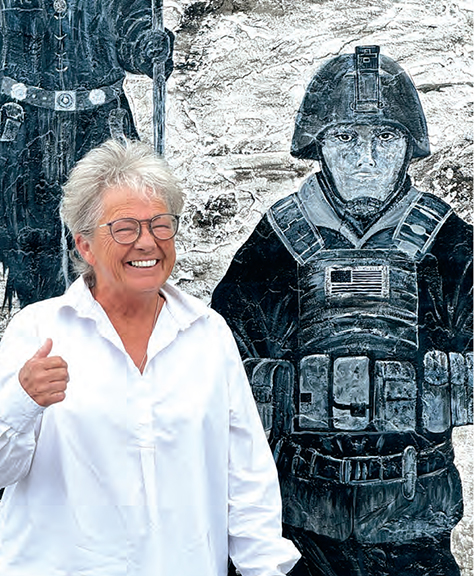
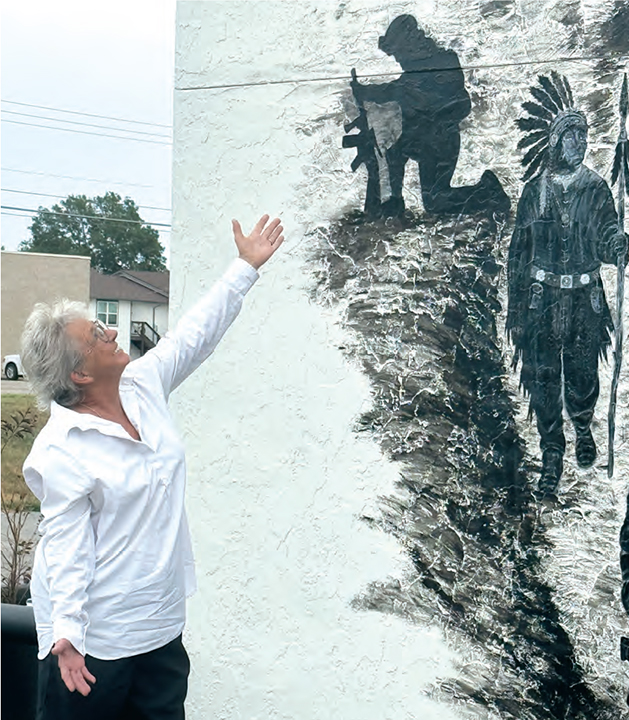
Known for painting tiny, intricate objects like tea bags and eggs, Hendricks built a following through craft shows and a local artists’ website, which led the Skiatook Art Center to invite her in. After she painted a winter mural on the building’s front, the owner asked her to tackle the opposite wall with a tribute to military service. Looking at a painting that hung in his office gave her the insight as to how she might give honor to the warriors of past and present. She initially refused, insisting she only worked on small items. As she was exiting his office, she locked eyes with a portrait of his father on a wall of honor dedicated to his military service. He beckoned her to say yes and she did.
What began as a planned 12-by-16-foot piece grew to 20 by 20 feet. Hendricks spent a month preparing and 20 days painting, often 12 to 16 hours a day. She started from a grid cut from her late father’s roll of drafting paper that was laid out on her ping pong table.
The mural, Tribute to America’s Warriors, portrays the cost of service. No one in it is smiling. It depicts and honors Native Americans, Buffalo Soldiers and Freedom Riders, honoring those who lived on the land first. A chief and a bald eagle watch over the scene. A pair of military boots sit at the bottom of the mural symbolizing all that’s left behind when a service member doesn’t come home and honors all who have fought to keep our land and our country free.
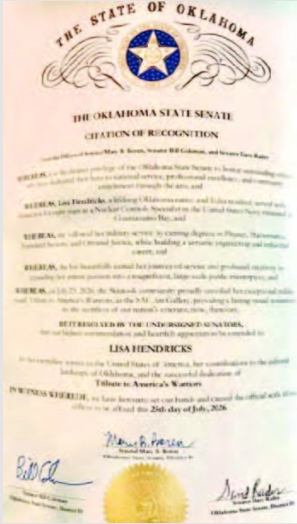
Unveiled on July 25th at the Skiatook Art Center, the mural drew far more attention than Hendricks expected. She received a Citation of Recognition from the Oklahoma State Senate, an honor she calls humbling and surreal and one she says was not just for her but
for everyone represented on the wall. • story by Jill Stephenson, contributing writer