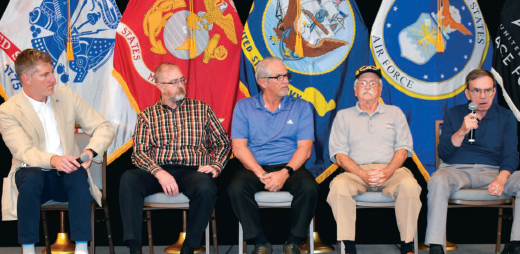

Two well-attended commemorations of Operation Desert Storm’s 35th anniversary occurred in Midwest City, providing informative speakers and a panel of veterans who discussed their deployment to Southwest Asia. The first event, March 27, was organized by Lee McCullum, Fundraising Chief and past Post Commander of VFW Post 7192. Col. (retired) Mark Tarpley and the Air & Space Force Association’s Gerrity Chapter hosted a second commemoration at Rose State College on March 31.
McCullum said, “We wanted to hold it because there’s a good number of Desert Storm veterans in our community. We felt they should be recognized.”
More than 110 veterans, families, and Midwest City Mayor Matt Dukes and State Senator Adam Pugh attended. Guests enjoyed a free barbeque dinner organized by VFW Auxiliary members Sonya McVeigh, Denise Heginbotham, Janet Swenson and Fran Kinchebe.
“Strings of Valor,” a seven-member veteran band, played music. Jay King, a musician, said, “This program has helped me cope with depression and addiction. I’m a better man now, able to help other veterans through music.”
Dukes respects these events. “The value is just remembering the sacrifice that our veterans put forth.”
After dinner, Tarpley, an Air Force Vietnam War and Desert Shield/Storm veteran, provided an overview of America’s participation. He acknowledged United States initially lacked a war plan to counter Iraq’s invasion of Kuwait in August 1990. Stationed at the Pentagon, he explained how the Office of Warfighting Concepts (Checkmate) created an Instant Thunder war plan. It relied on a coordinated mix of fighter, reconnaissance, refueler, and E 3A air battle management aircraft. Tarpey said planners avoided Vietnam War problems with, “You hit them hard, you hit them early and you hit them with all you got.” Ground, air, and naval forces from other Services joined in the buildup. The 43 day air campaign that began January 17, 1991, proved decisive, helping shorten the ground war to 100 hours and reducing casualties. Operation Desert Storm lasted from January 17 – February 28, 1991.
Post Commander Matt Martinez was pleased. “I’m feeling very blessed to have a group of individuals that care enough to know that when there’s a need, or when there’s a time to remember, that we’re at the forefront.”
Afterwards, veterans swapped stories. Air Force Master Sgt. (retired) Brian Wheel deployed near Qatar with the 552nd Air Control Wing from December 5, 1990 to June 16, 1991.
Wheel provided precision approach radar from the base’s air control tower. He explained, “If something happened to the pilot or his plane and he needed to land, but he could not see outside of his plane, listen to my voice.” Wheel would instruct them when to descend and once on the runway, give them directions. “And so many pilots were just so thankful and they were about ready to run out of fuel…” He also guided Bob Hope’s entourage to land for a Christmas show.
Reflecting on his deployment, Wheel said, “It doesn’t matter where you are. It’s what you can make of it. And positive thinking and having buddies with you…helping you out, and you’re helping them out all the time.”
Four days later was Rose State College’s 35th commemoration event. Sixty mostly Desert Storm veterans and Oklahoma State Senator Brenda Stanley attended. After honoring our national symbols, generous amounts of hors d’oeuvres were served.
Tarpley provided a timeline of Desert Shield and Storm. He was followed by Brig. (retired) Gen. Haub, USA, who was Commander, 1st Battalion, 158th Field Artillery, during his unit’s deployment in November 1990 and led offensive land operations into Kuwait, firing 906 rockets at Iraqis.
Col. James Combs, 552nd Air Control Wing Vice Commander, described the E-3 Airborne Warning and Control System airplane’s support to the 43-day air campaign. Brig. Gen. Lindsay Droz, Oklahoma City Air Logistics Complex Commander, explained Tinker AFB’s support.
A panel of Desert Storm veterans who deployed in theater provided insight into combat operations. John Nash, Oklahoma’s Secretary of Military and Veterans Affairs, moderated a talk with Col. Greg Langford, USA, Lt. Col. Jimmy Patterson, USAF, Master Sgt. Michael Joseph, USAF, and Col. Tom Bliss, USAF. • Story for
OK Veteran News Magazine by Lt. Col. Richard Stephens, Jr., USAFR, Ret. website: Rich Travel Niche