Monday, July 13, 2026
Home LAST MONTH'S ISSUE

LAST MONTH'S ISSUE

Oklahoma Veterans United Dedicated to Empowering Veterans

0
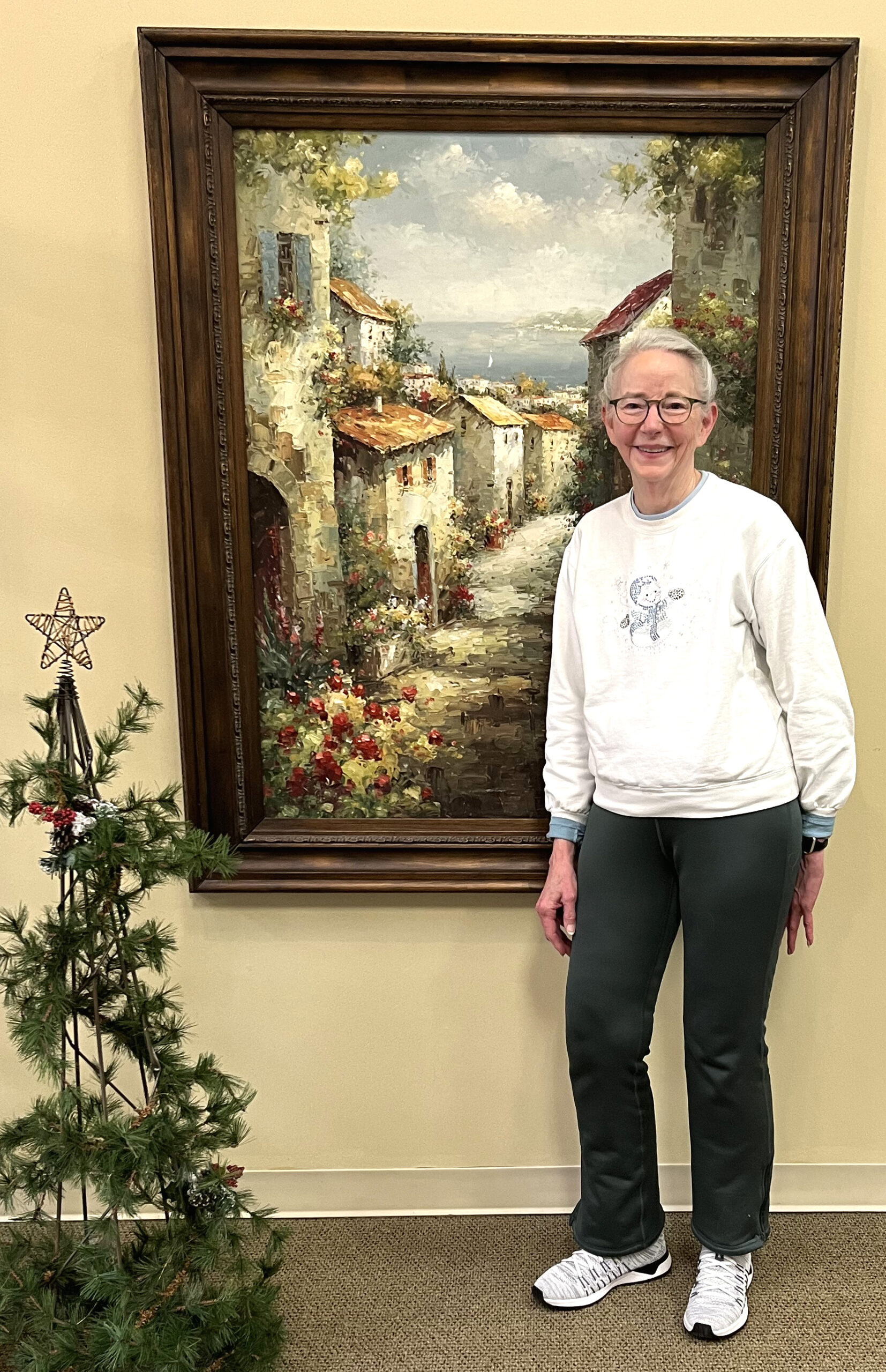
Keshawn, Army Veteran and former Supportive Services for Veteran Families Client.

Oklahoma Veterans United (OKVU) is a 501(c)(3) nonprofit organization dedicated to connecting veterans across Oklahoma with housing services, suicide prevention resources, and employment opportunities. Built on an 80+ year legacy, OKVU officially transitioned from Community Service Council to Oklahoma Veterans United in 2024.

OKVU serves 56 (of the 77 statewide) counties across Northeastern, Central, Western, and Southwestern Oklahoma. Their goal is to empower veterans and honor their service
and sacrifice through compassionate care, personalized support, and advocacy tailored to individual needs. While they cover an extensive range of initiatives, there are two primary areas of impact; the SSVF and SSG FOX SPGP programs.

Supportive Services for Veteran Families (SSVF) is a rapid re-housing program funded by a Department of Veterans Affairs grant.
Using the Housing First model, temporary intervention and short-term assistance is provided to low-income veterans and their families who are homeless or facing eviction.
SSVF Outreach staff conducted 1631 outreach engagements from October 1, 2025 to April 30, 2026. These engagements ranged from individual outreach to homeless veterans on the street, to large veteran focused events across the state. Nearly 40% of outreach engagements targeted rural veterans with limited access to resources.
797 (49%) of all engagements focused on identifying and screening veterans through visits to encampments, street outreach or local partners/drop-in centers. 719 veterans experiencing homelessness or facing eviction secured safe housing through the SSVF program.
The SSG FOX SPGP is a Department of Veterans Affairs funded grant connecting at-risk veterans to upstream suicide prevention tools. These tools include targeted outreach events, warm hand-offs to VA clinical and administrative staff, connection to local community resources, and individualized programs to help reduce the risk of veteran suicide.
While a smaller program, the SSG FOX SPGP initiative had equally impressive outreach efforts to connect to veterans who may be at risk or contemplating suicide. From October 2025 through March 2026 the program highlights include:
• 487 veteran outreach engagements
• Collaboration with 13 organizations and partners in March 2026 alone in support of veterans needing assistance
• 47 new veterans spoke with the team regarding personal concerns
• 52 people actively participated in case management
• 99 referrals were made to local partners including Veterans Health Administration providers and local community organizations based on specific interest and needs
OKVU also has a veteran employer network that was established in 2019. The OKVU Veteran Employer Network proudly has 200+ members representing 100+ employers and distributes an annual state-wide survey to identify and recognize “Champions” who actively recruit, hire, develop, promote, and retain veterans in the workplace. At its inception, a Veteran Employer Champion Survey was established to identify and recognize businesses in Oklahoma who showed their commitment to being a veteran-ready place of work by meeting specific benchmarks.
In 2025, nineteen new employers joined the network and nineteen were awarded the employer championship badge and recognized by the mayors of Tulsa and Oklahoma City.
Veterans most often connect with OKVU by calling the Tulsa and Oklahoma City offices. However, the outreach team meets veterans where they are by connecting with them directly at encampments, veteran events or through referral partners.
OKVU is dedicated to empowering veterans as they navigate the transition to civilian life. By recognizing the strengths and experiences individuals bring, they provide the tools, resources, and opportunities needed to build lasting self-sufficiency and independence – all grounded in empathy, compassion, respect, and dignity.
Per the US Department of Veterans Affairs the following numbers reflect the need for veteran support in the state of Oklahoma:
• 278,538 veterans (as of 2024)
• 18,500 veterans earning below the poverty level (as of 2024)
• 304 homeless veterans (as of 2024)
• 126 veteran deaths by suicide (as of 2022)

OKVU has earned a Platinum Seal of Transparency through
Candid (formerly GuideStar), which reflects their commitment to transparency and accountability. They stand ready to help as many of Oklahoma’s veterans as possible. With many of their staff being veterans themselves, they will do whatever it takes to help a fellow veteran in need.
Federal grants help sustain many of the initiatives OKVU is able to provide, however there are still gaps and barriers that need to be bridged. Private donations help strengthen OKVU’s ability to plan ahead, discern where needs are greatest and to respond to urgent situations.
If you are a veteran in need or know a veteran in need, you
can reach OKVU by using the contact form on their website, calling them at 918-588-8401, 405-724-3360, 580-557-0755 or by sending an email to [email protected].
Tax deductible donations can also be made by following the donation prompts on the website: www.okvetunited.org.
A full list of available services and resources can be found on the website. • Story and photos by Jill Stephenson, Tulsa area staff writer

Abusing the Loan Program

0

By Freddy Graves

It sounds like there was a lot of money to be made from Covid, at least according to investigation reports from the VA’s Office of Inspector General. Unfortunately for certain thieves, however, the OIG was all over them when the scams were revealed. The head thief in one case was a part-time pastor who was nailed on four counts of wire fraud for Paycheck Protection Program (PPP) scams. He devised a scheme to apply for loans that were supposed to be used for payroll and business expenses during the Covid downturns. Not only that, but he approached and then coached church members (one of them a VA employee) on how to apply for the “free money” funds, including pretending they had actual businesses to run.
He then taught them how to apply for loan forgiveness (which was a bonus of the program if funds were actually used to pay employees) so they wouldn’t have to pay the money back. All they had to do, it seems, was to follow his instructions. It helped that he worked for a Small Business Administration-approved lender … and split the money with him.
Part of their downfall came from inflating income figures from a real tax return — which did not indicate that there was any kind of business income at all, not realizing that it would be a simple matter for one government agency to speak to another agency to verify facts. Another mistake was leaving a paper trail of emails wherein he instructed one of his church members on the steps to take to apply for the loans.
When sentenced, the pastor could get 20 years for each count of wire fraud. One coconspirator (who did not own a business) could get 60 years — 20 for each of three counts. The other (who also did not own a business but had a great paper trail
of how-to instruction emails for applying for the fraudulent loans) is cooperating and likely won’t see any jail time.

(c) 2026 King Features Synd., Inc

Honoring the Fallen – PFC, Albert E. Schwab

0
Albert E. Schwab, USMC, posthumous recipient of the Medal of Honor for actions during Battle of Okinawa; photo from official Marine Corps.

1920 – 1945 Tulsa Medal of Honor Recipient
By Jill Stephenson
The story of Albert Earnest Schwab is one of courage forged through hardship and a legacy sustained by family devotion and community honor.
Born on July 17, 1920, in Washington, D.C., Schwab was the oldest of five children in a troubled household. While his father was often absent due to work, his mother, a Chippewa woman, struggled in ways that deeply affected the family. They moved to Tulsa when he was six weeks old and his parents eventually divorced. Despite the challenges of his youth, Schwab found joy and excelled in sports, graduated from Tulsa High School in 1937 and briefly attended the University of Tulsa. He then went to work in the oil industry.
When military deferments were lifted during World War II, Schwab and his brother-in-law enlisted in the Marine Corps. Schwab quickly proved himself to be intelligent and driven and earned a reputation as an overachiever.
PFC Schwab served as a flamethrower operator in Okinawa, Japan. On May 7, 1945, during intense fighting in Okinawa, his unit became pinned down in a valley by machine gun fire coming from a ridge ahead. Facing relentless enemy fire, Schwab climbed the steep cliff toward the gun position. Fully exposed, he reached the emplacement and used his flamethrower to destroy the weapon and its crew. His actions allowed his company to move forward and take control of the ridge. Shortly afterward, a second machine gun opened fire, causing additional casualties and stopping the advance. Before he could refill his fuel supply, he moved forward to confront the new threat. Despite his limited resources, he successfully eliminated the second position.
As Schwab completed the attack, the enemy fired one final burst, causing fatal wounds. His fellow Marines recognized the extraordinary nature of his bravery and gathered witness accounts that would support the highest recognition of valor.
For his gallantry, Schwab was posthumously awarded the Medal of Honor. In
a ceremony in Tulsa on Memorial Day 1946, his medal was presented to his three-year-old son. His sacrifice would continue to be honored in the years that followed, including the naming of Camp Schwab on Okinawa in 1959 and a statue and designated reception area at Tulsa International Airport. His story also reached a wider audience through the writings of famed World War II correspondent Ernie Pyle.
Initially buried in Okinawa, Schwab’s remains were later returned to the United States at the request of his father. He was laid to rest with full military honors at Memorial Park Cemetery in Tulsa in 1949. According to his niece Judy Bryant, given the magnitude of his heroism, the plainness of his grave has long felt inadequate to the family. Bryant has dedicated years to ensuring her uncle receives a more fitting tribute. Inspired by her mother JoAnn, Albert’s sister, she has worked with veterans’ organizations and community supporters to redesign his gravesite so that it more aesthetically reflects his brave and gallant sacrifice. Reflecting what a Marine of his era would have carried, the proposed design includes a Soldier’s Cross and a granite slab engraved with the full wording of his Medal of Honor citation.
Working with Tulsa’s Memorial Cemetery, the effort has taken more than a decade to gain approval and momentum. With support from individuals like John Camp of the Marine Detachment unit, plans are moving forward. The project is has been established to raise the necessary funds. For Bryant, the work is deeply personal but rooted in humility. She has never sought to claim any part of her uncle’s heroism, only to ensure that it is properly remembered. The journey has connected her with veterans and supporters whose shared respect for service has been both humbling and inspiring. Citing it as a tangible way to preserve Schwab’s story for future generations, completing the gravestone project remains a central goal on her life’s bucket list.

Albert E. Schwab’s life was shaped by adversity, but defined by heroism and valor. Today, his legacy endures not only in history books, but will be preserved by the efforts of those who refuse to let his sacrifice fade and will assure he is given the recognition he deserves in his final resting place.
Donations to help with the cost can be made by going to the Albert E. Schwab Detachment of the 857 Marine Corp League website www.mcl857.org and following the DONATE button prompts. Once the page is reached to finalize the donation, there will be a box to add an additional note. Please include
“Medal of Honor Fund” to ensure it is applied accordingly.
Any contributions received over and above what is needed will be directed toward local veteran causes.

Pow Wow to Bring Tribal Vets Together

0

The drums sounded across the Comanche County Fairgrounds in Lawton.
The beat in honor of Native Americans who served this country with pride.
And if Kris Killsfirst, Sr., has any say in it they will keep beating for years to come as a reminder of generations of Native American U.S. Service Members past, present and future.

The seventh annual KCA Veterans Powwow was held in conjunction with the Ft. Sill Armed Forces Parade.

The event started in 2019 as a result of the Smithsonian Institute asking three Oklahoma tribes to help with the unveiling of the National Native American Veteran’s Memorial in Washington, D.C.

“We came together and said ‘what can we do,’” Killsfirst said. “They said “have a celebration and honor our veterans.’ That’s how we came together and started this KCA Powwow.”

Turnout was good for the first event and a partnership with the Oklahoma Department of Veteran’s Affairs office in Muskogee helped veterans in southwest Oklahoma put in 156 benefit claims.

Killsfirst said there were an astounding 86 first-time claimants.
“It was one of the largest events they had ever had,” Killsfirst said. “We reached a lot of rural veterans in Southwest Oklahoma. A lot of them came out because their families said they were dancing for them.
“A lot of our veterans come home and integrate back into society and don’t really claim and get the benefits they rightfully deserve. That’s how we kept going with this.”

Killsfirst said the event brings some broken families together for the first time in decades.
“Pretty soon they couldn’t even remember they were mad at each other,” Killsfirst laughed. “It’s a celebration. There’s no agenda.” There’s traditional food, dancing and family. “We answer a lot of questions. We educate people about who we are and what we do,” Killsfirst said. “Even to our community and neighbors, the folks we went to school with they’ve always heard our drums. They’ve always seen our regalia but they never understood exactly what it meant.”

Killsfirst laments his father’s generation never received the recognition they deserved coming back from Vietnam. He was able to bring his father out to the initial Pow Wows. “Those ones didn’t get this welcome so that’s why it’s so important,” Killsfirst said.

Earlier this year, Killsfirst was inducted into the Oklahoma Military Hall of Honor.
Other honorees included Matthew Dukes, Dr., Sergeant, US Marine Corps, Mark
Baker, Captain, US Army, Peter Plank, Lieutenant Colonel, OK State Guard and Brandi Rector, Sergeant, US Marine Corps.
Killsfirst served from September 1992 to March 2012.
He completed basic training at Fort Leonard Wood, Missouri. He served in Iraq from March 2003 to April 2004, November 2005 to November 2006 and June 2008 to June 2009 with HQs & A Company, 1-4 Attack Reconnaissance Battalion and the 4th Infantry Division.
He served as the team chief for the forward arming refill point.
During his career he also served in Fort Drum, New York with the 10th Mountain Division, Camp Mobile, Korea with 2nd Infantry Division, Fort Sill, Oklahoma with 214th Field Artillery Brigade and K-16 (Seoul Airbase), Korea with the 17th Aviation Brigade.
He retired at Fort Carson, Colorado with the 555th Engineer Brigade.
Now his mission is to help educate.
“One of the biggest things I think is important is we help educate our younger people of where they come from,” Killsfirst said. “They get to hear stories about their grandpas and their grandmas about our history.”
He points out Native Americans were not granted citizenship prior to 1924.
“Yet we deserved in defense of this country for decades before that,” he said. “We’ve only been citizens for 103 years. People don’t know that. It’s allowing our older folks to tell there story once again.” • story by Bobby Anderson, contributing writer


The Wall That Heals Visits Mitch Park

0
Author Eddie R. Beesley, 80, a Marine Vietnam Veteran, right, asked The Wall That Heals installation supervisor and program manager Cathy Miller to point out the name of a friend on the Wall just after it was built for viewing at Mitch Park in Edmond.

Oklahomans and visitors from surrounding states joined thousands of Veterans May 14-17 at the Mitch Park Display in Edmond to experience The Wall That Heals. The three-quarter-scale replica of the Vietnam Veterans Memorial in Washington, D.C., patriotically honors the men and women who gave their lives in Vietnam or later died as a result of their service.
At Mitch Park viewing the Wall installation, the highly decorated Vietnam Veteran and motivational speaker, Eddie R. Beesley, 80, explained he was also an author. The Oklahoman from near Beggs handed this
writer a book filled with his harrowing experiences in the Vietnam
War. The book details his journey of resilience, which inspired his powerful memoir, “Lucky Enough,” published in 2005.
Corporal Beesley enlisted in the U.S. Marine Corps in 1963 at
just 17 years old. In May 1965, he was deployed to Vietnam with
Delta Company, 1st Battalion, 4th Marines, 1st Brigade.
In August 1965, while serving as the point man on a
patrol near Chu Lai, Beesley’s platoon discovered an enemy minefield under construction. While maneuvering to assess
the situation, a squad leader stepped past him; as Beesley stepped back, he triggered a hidden landmine. The blast
killed two Marines and severely wounded four others.
The explosion resulted in the traumatic amputation of both
of Beesley’s legs, making him one of the first above-the-knee double amputees of the war.
Beesley wrote “Lucky Enough” to recount his life journey, his first emotional visit to the Vietnam Veterans Memorial in Washington, D.C., and his resilience in the face of tragedy.
“I am attracted to attend every offering of the Wall as I write about my visits often in my book,” Beesley said. “I pay solemn reverence to the men and women whose names are etched on the walls while paying particular attention to those I served with early in the war.”
Today, he lives with his wife Connie in Edmond, Oklahoma. He is active in the veteran community, serving as the Native American Chairman for the Department of Oklahoma Veterans of Foreign Wars (VFW) in organizing tribal recognition ceremonies for fellow Veterans.
Community members and visitors engaged with the The Wall That
Heals over its four-day run at specific times for the exhibit’s major
events. This included the opening Native American Vietnam Service Recognition Ceremony, a heavily attended Vietnam Veterans Welcome Home Ceremony, and the poignant “Light Up the Night” Oklahoma County MIA Tribute.
That powerful evening tribute honored the more than 100 Missing in Action service members from Oklahoma County during the Vietnam War. The special illumination of the Wall offered a moment of solemn remembrance for those still missing.
A HMONG SGU Recognition Ceremony honored the Hmong Special Guerrilla Units who served alongside U.S. forces during the Vietnam War.
Busloads of public-school students, local youth groups, and civic organizations toured the site during daylight hours. They found the accompanying Mobile Education Center on-site informative in learning about the history of the Vietnam War.
The 375-foot-long synthetic granite structure was equipped with LED lighting, allowing round-the-clock viewing. This meant many Veterans, families, and residents could visit during late-night and early-morning hours for private, quiet reflection away from the daytime crowds.
The Wall That Heals’ 140 panels contain the names of more than 58,000 Vietnam service members, 990 of whom are Oklahomans, ensuring accuracy and consistency with the original Memorial.
Edmond was chosen as one of only 31 host communities nationwide for the 2026 tour. The Mitch Park Display served visitors who otherwise would not be able to travel to the permanent memorial in Washington, D.C. Its mission was Honoring Service. Remembering Sacrifice. Healing Together.
The Edmond VFW Post 4938 coordinated the display with the help of the City of Edmond Parks and Recreation Department. The post recruited volunteers to assemble and dismantle it. They offered a six-day community partnership of public engagement, inviting everyone to take part in this shared act of patriotic remembrance.
Volunteers assisted the steady flow of people with finding specific names among the 58,000 etched into the The Wall That Heals. A large contingent of community volunteers worked around the clock, facilitating name rubbings and guiding visitors through the mobile museum.
Vietnam Veterans have been the focus of a groundswell of recognition over the past 14 years as the U.S. government has executed a sustained, multi-administration effort to provide “overdue recognition” to Vietnam-era Veterans.

• story and photos by Darl DeVault, contributing editor


Dispelling the Myths of Women Veterans Recognition Day

0

Women Veterans Recognition Day is not a separate Veterans Day for women. The day, celebrated yearly on June 12, recognizes, honors and remembers the signing of the Women’s Armed Services Integration Act (pub.L. 80–625, 62 Stat. 356), allowing women the right to permanently serve in the regular armed forces.
Women have served in America’s wars and conflicts throughout our history. They played vital roles in the Revolutionary War, serving as soldiers, raising morale and spying on the enemy. It is known that some even disguised themselves as men to be able to serve. More than 400 women fought in the Union and Confederate armies during the Civil War.
During World War I, about 35,000 women officially served. Women served in lifesaving roles such as nurses, and critical support staff roles such as the Hello Girls, formally known as the Signal Corps Female Telephone Operators Unit. In World War II, 350,000 women served in the U.S. military in occupations such as nursing, military intelligence, cryptography and parachute rigging.
In August 1943, the Women’s Flying Training Detachment (WFTD) and the Women’s Auxiliary Ferrying Squadron (WAFS) merged into a single unit for all women pilots and formed the Women’s Airforce Service Pilots (WASPs). They flew more than 60 million miles in two years. During this time, the 6888th Battalion was formed as the first and only all-Black Women Army Corps (WAC) unit to deploy overseas during WWII. Their nickname was “Six-Triple Eight” and their motto was “No Mail, Low Morale.”
Breaking barriers on June Day 1948 – Before the signing of the Women’s Armed Services Integration Act on June 12, 1948, only women nurses could serve in the regular and reserve forces during peacetime. All other women were sent home after each conflict. The signing of the Act deemed women essential to the war efforts and allowed them to serve in the regular armed forces full time. The Women’s Armed Services Integration Act, coupled with President Truman’s decision to desegregate the military, also permitted African American women to officially serve in the military, five years after the 6888th Battalion accomplished its mission of cleaning two years of mail backlog in three months, twice. When women can, they do.
A day worth recognizing – June 12 proclamations and events around the U.S. each year commemorate the signing of the Women’s Armed Service Integration Act by President Truman in 1948. The date was first recognized as a commemorative date when the New York State Assembly declared June 12, 2008, to be Women Veterans’ Recognition Day.
Women served, women belong – Today, women serve in all military occupational specialties, including logistics, munitions, intelligence, and many combat. Women contribute to the most professional, educated, agile and strongest military the U.S. has ever seen.
Despite their longstanding service, many women Veterans struggle to be recognized, respected and valued as Veterans in civilian life. After all they have done and continue to do, women Veterans deserve the support and respect they have earned through their service. They should feel like they belong at VA.
VA understands that women Veterans face specific challenges and have unique health care needs. Beginning in 1992 with the Veterans Health Care Act, VA has been providing gender-specific care to eligible women Veterans. Since then, we have been expanding those gender-specific services and launching initiatives to make women Veterans aware of their well-deserved benefits. We also continue to support our facilities across the country in fostering a comfortable, welcoming atmosphere for the women Veterans who come through our doors.
Recognize outstanding women – There is so much history about women Veterans to be told, and it’s important that women continue to be recognized for their service and sacrifice. On March 12, 2022, Public Law 117-97 was passed to award the Congressional Gold Medal to the members of the Women’s Army Corps who were assigned to the 6888th Central Postal Directory Battalion, known as the ‘‘Six Triple Eight.’’
This June 12, to all women Veterans out there – Happy Women Veterans Recognition Day from VA and Oklahoma’s Veteran News.
by Missina Schallus, Navy Veteran and communications manager for the VA’s Center for Women Veterans.


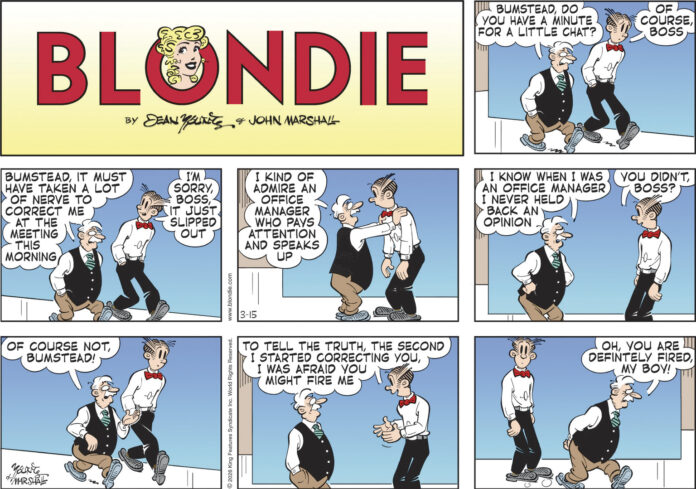
Blondie – 03-01-26

0

Faith Plays Integral Role in Life

0
McGee Depue is a resident of Villagio of Bradford Village Independent Living.

Faith has long played an important role in Crystal McGee DePue’s life in which she lost her father at age 12, and the loss of two husbands.

Born in Tehran, Iran, DePue’s parents, who hailed from Edmond, served as missionaries with the Presbyterian Board of Foreign Missions in that country from the late 1940s until 1954 when they returned to the United States.

The Board of Foreign Missions of the Presbyterian Church in the U.S.A. (PCUSA) was organized in 1837 because of General Assembly (Old School) action. Its creation marked the culmination of a discussion covering a period of years as to whether missionary operations should be carried on by voluntary societies, or by the Church in its organized capacity.

“I had come to know the Lord and I had lost my father as a 12-year-old, and I knew that God had seen me and my brothers and sisters through that,” DePue, a resident of Villagio of Bradford Village Independent Living /Assisted Living, located at 300 Enz Drive in Edmond said. “I (later in life) told my kids, God has promised to be a father to the fatherless and a husband to the widow, and we’re just going to trust that that’s what’s going to happen even though it’s hard.”

DePue, 75, said her family moved to upstate New York upon returning home from Iran in what was supposed to be a year-long sabbatical.

“I moved first to New York City and stayed there for six months,” she said. “Then we moved to upstate New York because we were back supposedly on a furlough. It was just supposed to be a year of being back in the States, visiting family, getting refreshed and ready to go back. But my father was found to have serious health problems, and the Presbyterian Board of Foreign Missions wouldn’t send him back.”

DePue said her father continued doing mission work in upstate New York and at a women’s college in Ohio before moving their family back to Oklahoma where he worked as an accountant.

After graduating high school in Edmond, DePue attended a Presbyterian college in Clarksville, Arkansas before attending the University of Central Oklahoma.

It was at UCO where she met her first husband James “Rudy” McGee through a friend. Within two months of dating they were engaged.

“His name was James Brent, but his college roommate had a poster of Rudolph Valentino and thought he looked like that. So, they called him Rudy,” she said.

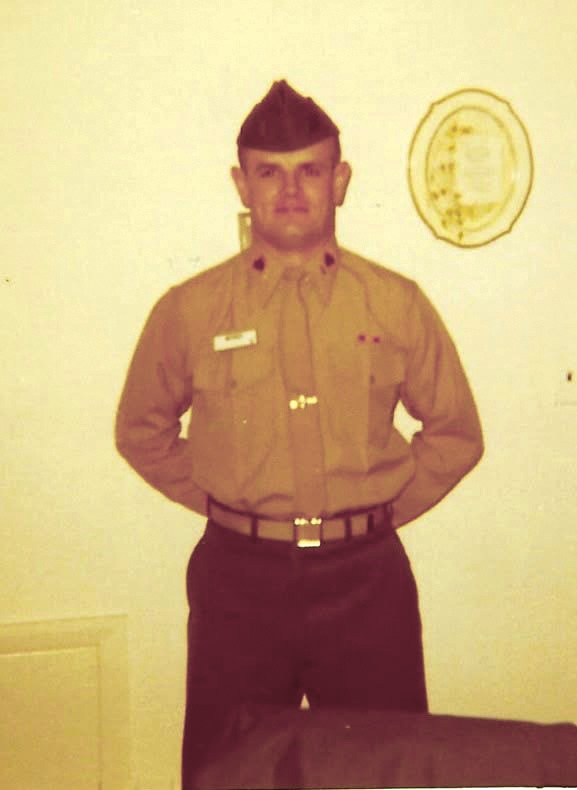
Rudy McGee (pictured) served in the United States Marine Corps, was stationed in Okinawa, Japan. His son Jameson McGee, a retired U.S. Marine Lt. Colonel also served at the same military base in Okinawa as his father.

DePue said Rudy served in the United States Marine Corps and was stationed in Okinawa, Japan. Her son Jameson, a retired U.S. Marine Lt. Col. also served at the same military base in Okinawa, Japan as his father.

After leaving the Marines Rudy became a teacher and taught at several schools in Kansas before landing at his last school in Goddard, Kansas.

In 1985, Rudy was killed by a student in a school shooting along with several others left injured.

“He was shot and killed right after we found out I was pregnant with our fourth child,” DePue said.

She later moved her family back to Edmond to be closer to family.

“We moved back here. I can tell stories of how God provided a house right behind my sister’s house,” she said. “I got Workman’s comp because he was killed on the job. So, that and Social Security allowed me to stay home and have the baby.”’
DePue later worked as a secretary for an oil and gas company before retiring.
Faith continued to tug at DePue’s heart, and she served a year as a missionary in Lyon, France.

“Faith gives meaning to life,” she said. “I don’t know how people make it in this world, particularly now without faith. God has proven himself faithful. As a single parent I had a choice of whether I can do it with God or without God. And I chose God.”

DePue later remarried to the Rev. Dale DePue, who served as the pastor at First United Presbyterian Church in Guthrie, and later served as a State Representative in the Oklahoma Legislature.

DePue said her husband had developed several health issues and moved to Villagio of Bradford Village Assisted Living.

“They took such wonderful care of him, and since it was COVID, I couldn’t go visit him. But when the weather was nice, they would let him come out and we could walk the community,” she said.

DePue later moved into an Independent Living cottage in Villagio of Bradford Village.

She said she enjoys living there.

“They’re very intentional about keeping us active and keeping our minds engaged and keeping us socially engaged,” she said. “It’s a great place to be. I keep telling people it’s where I need to be.” • by Van Mitchell, staff writer

For more information about Villagio of Bradford Village call (405) 348-6945 or visit www.villagioliving.com.

On the Cover: From U-Boat Attacks to Army Wings

0

The Charles Bachlor’s WWII Story

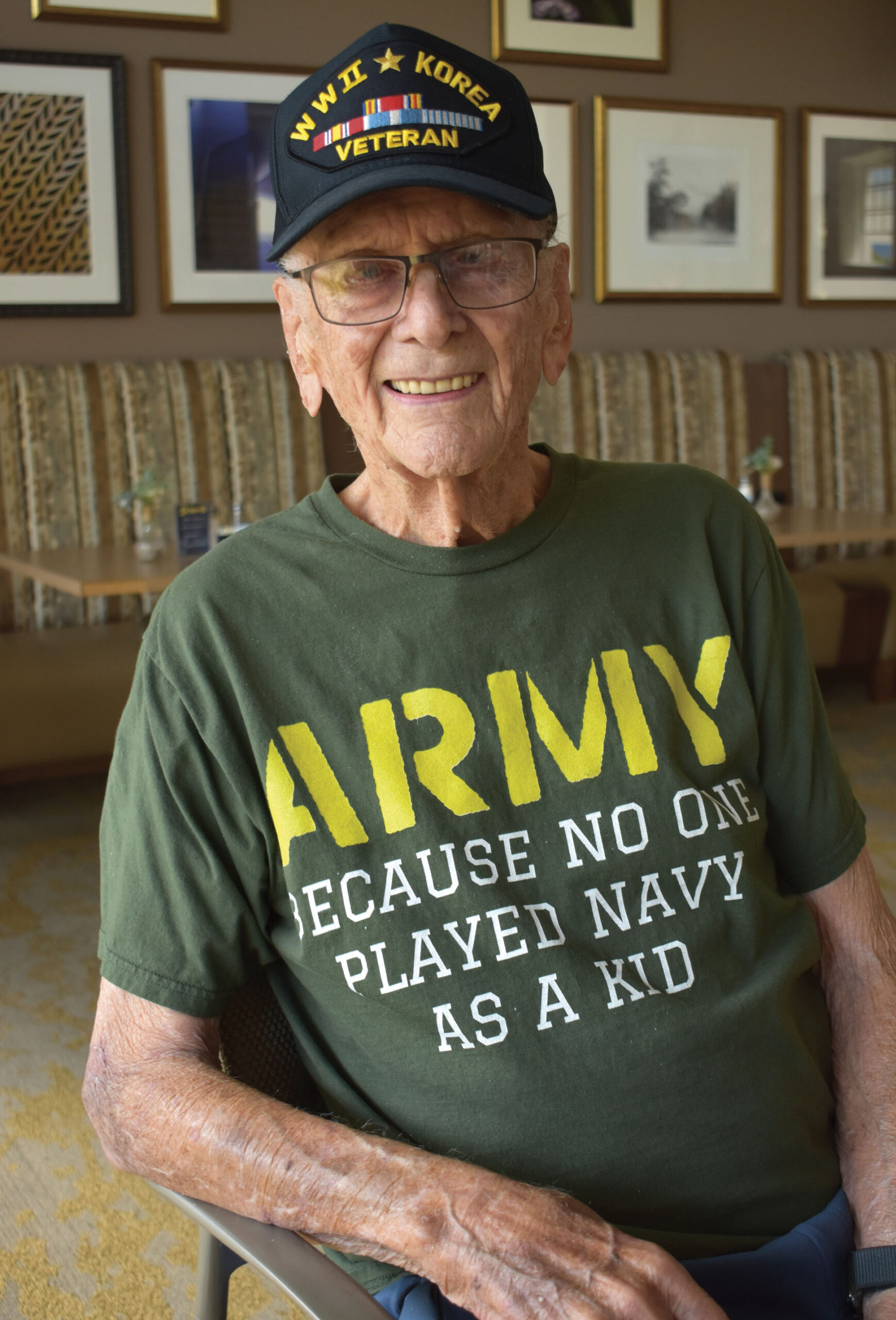
Charles “Ray” Bachlor, born in Tulsa in 1927, spent part of his teenage years in Houma, Louisiana, between 1940 and 1942, attending high school as a sophomore and junior. His family moved frequently. “We followed the oil fields,” he recalled. His father, Roy, managed a supply store for an oil field supply company. Located 57 miles southwest of New Orleans on the Gulf of Mexico, Houma was a quiet oil town-until the war arrived.

Charles (Ray) Bachlor was a WWII Korean and Cold War veteran. He went from Private to Colonel during his 34-year career. Pictured here at 98 years old.

A ‘secret’ war on the Gulf
During WWII, German U-boats prowled the Gulf of Mexico. “Houma soon found itself in the midst of a ‘secret’ war-one in which one or more oil tankers were being torpedoed each week near Wine Island after being loaded with oil,” wrote Bachlor after the war. “The ‘U-boat’ would fire an explosive torpedo to spread the oil and then an incendiary to light it. Merchant seamen would have to dive into the burning oil. Sometimes the sub would surface and machine gun survivors. Those who managed to survive… were picked up by our shrimp boats and brought to the hospitals in Houma and Morgan City.”

“Ellender Hospital in Houma was overwhelmed, and folding cots covered the grounds outside the hospital. The sweet smell of burning flesh permeated the air long before you reached the hospital. Women of the town-including my mother-volunteered to help the overworked hospital staff.”

Kimberly Guise, a curator at the National WWII Museum, confirmed these accounts. Bachlor recorded a grim tally: between 1942 and 1943, 88 tankers sunk and 1,471 dead-Americans killed just offshore.

Back to Tulsa
Bachlor finished high school in Sand Springs in 1943 and briefly attended Tulsa University. He tried to enlist in the Navy but was drafted into the U.S. Army on March 1, 1945, as a private.

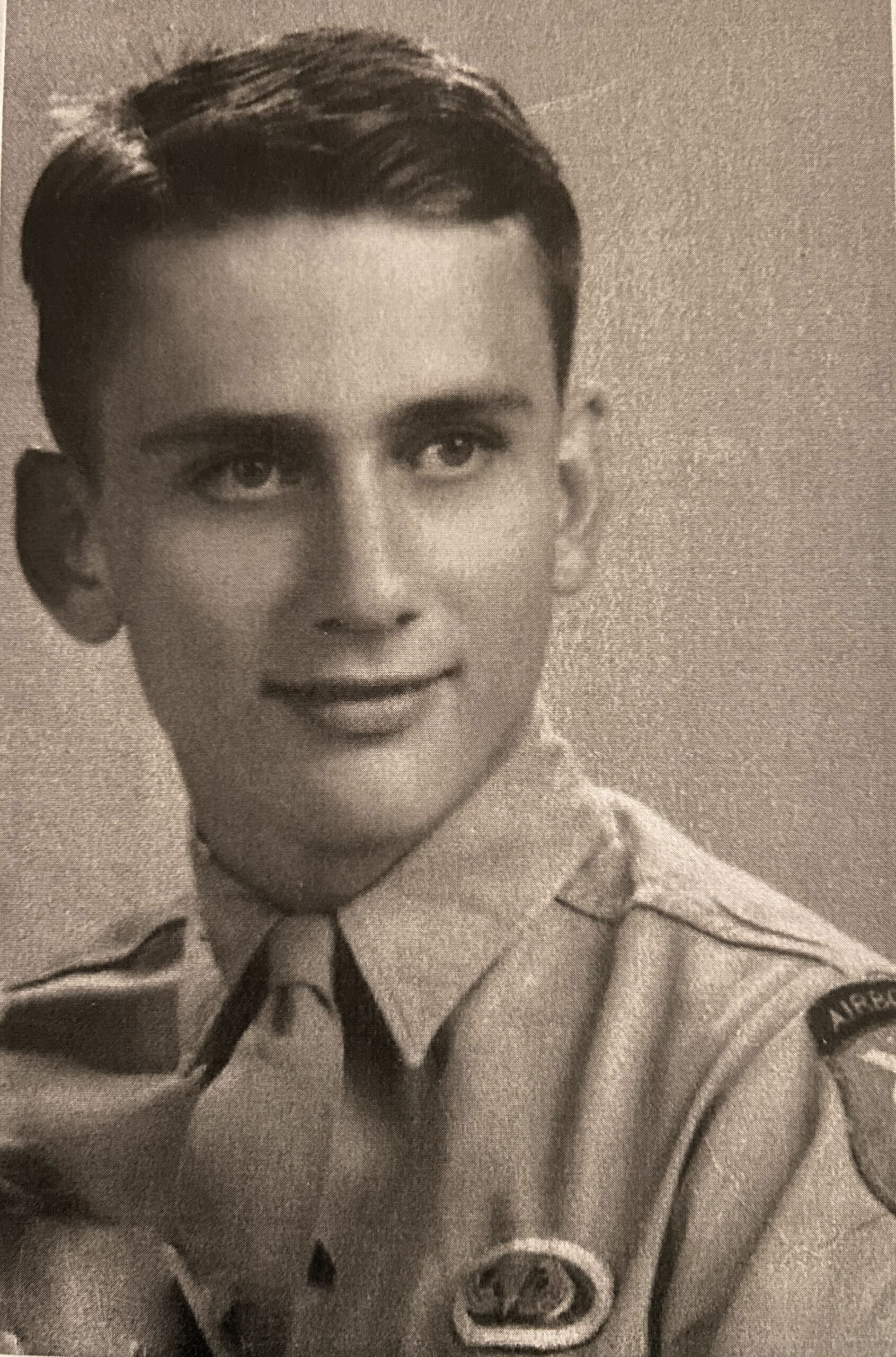
Charles (Ray) Bachlor, shown here at age 19 as a WWII paratrooper in the US Army.

Basic training
He began basic infantry training at Camp Livingston, Louisiana, in March for seven weeks. One day, a paratrooper visited. The man’s appearance and the unique duty of an elite organization intrigued him. “I was afraid of heights so I joined the paratroopers to overcome that fear,” Bachlor admitted.

Paratrooper training
Transferred to Fort Benning, Georgia, he entered paratrooper training. “Our first week was in the sawdust pits where we were doing nothing but PT. Fifty minutes of PT and 10 minutes rest and 50 minutes more… And every day we’d go on long runs.”

The second week brought a new challenge: “We were jumping from a 34-foot tower… the scariest of all, because you dropped 34 feet and then this cable caught you after (falling 19 feet), then you go down a line to a sawdust pit.” All this to overcome a fear of heights!

By the third week, they were packing their own parachutes and, “We’d hang harnesses and learn to guide ourselves, pulling on our shroud lines.” That week, they were also dropped from 250-foot towers.

“Fourth week we jumped every day. And then we made a night jump and then we got our wings…So, we had to make two marches in combat situations and C-47 to came in, picked us up, and we would make a simulated combat jump. And, so then you graduated.”

The war ends
Bachlor trained for a possible airborne assault on Japan. Then, the United States demolished Hiroshima on August 6 and Nagasaki on August 9, 1945, with atomic bombs. National leaders wanted to avoid at least 500,000 American casualties during a land invasion of Japan. “There were a lot of people that were in the military that were happy about dropping the bomb…and I think it was only later that a lot of people had second thoughts about how terrible the bomb was…but in the end run, it saved a lot of lives,” he said. “It shortened the war.”

Japan officially surrendered on September 2, 1945. Bachlor’s orders to join the 13th Parachute Division at Fort Lewis were canceled. Instead, he remained at Fort Benning as a parachute school instructor, earning the rank of Staff Sergeant.

A Long military career
After leaving the Army in 1948, Bachlor earned an Engineering Physics degree, was commissioned as a Second Lieutenant in 1950 and taught infantry basic training at Fort Chaffey, Arkansas, until May 1951. He later worked for the Security Advisory Group-Japan from 1952-1954 and taught at the Command & General Staff College, Ft. McArthur, Calif.

When Colonel Bachlor retired in 1979, he had served 34 years-rising from private to colonel, an achievement few attain. His life story stands as a testament to courage and dedication. He lives in Tulsa. •
story and photos by Lt Col Richard Stephens, Jr., USAFR, Ret.

Stafford Museum: Journey From Wright Flyer to the Moon

0
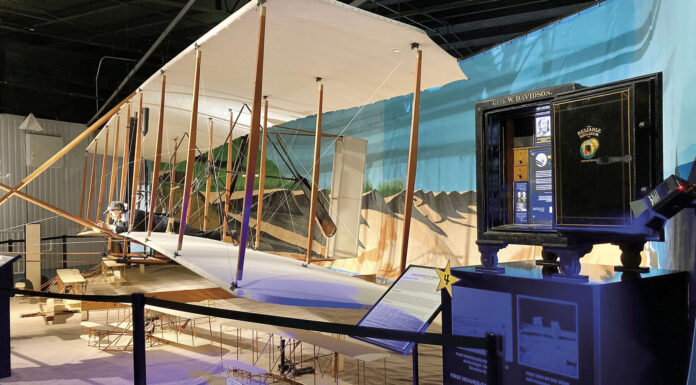
Museum-quality, flyable replica of the Wright Flyer at Weatherford’s Stafford Air and Space Museum.
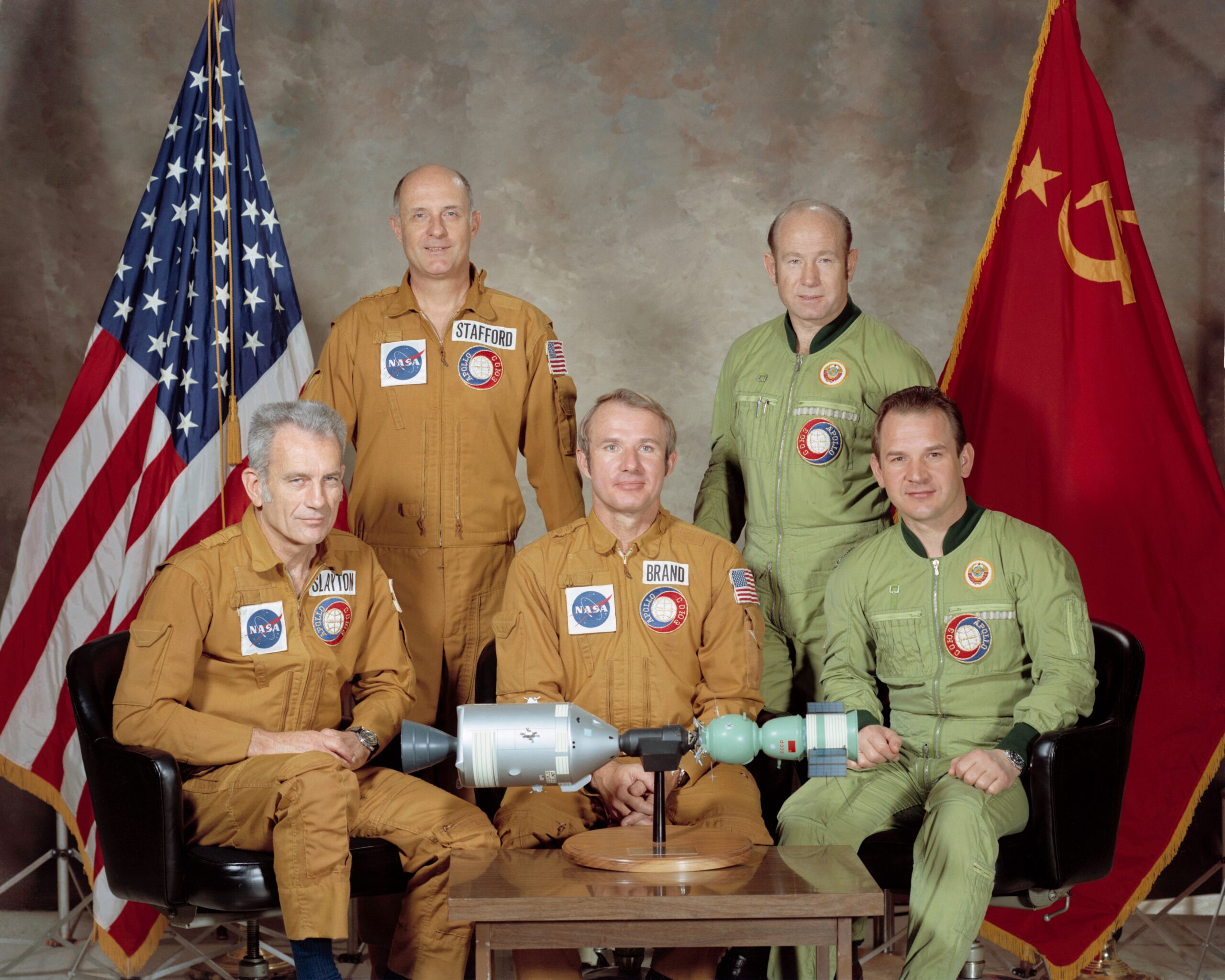
The prime crews of the joint Apollo Soyuz mission 1975. Photo by NASA

Weatherford’s Stafford Air and Space Museum, located at 3000 Logan Road near historic Route 66, offers visitors an extraordinary journey through aviation and space exploration.

From airplanes to space craft
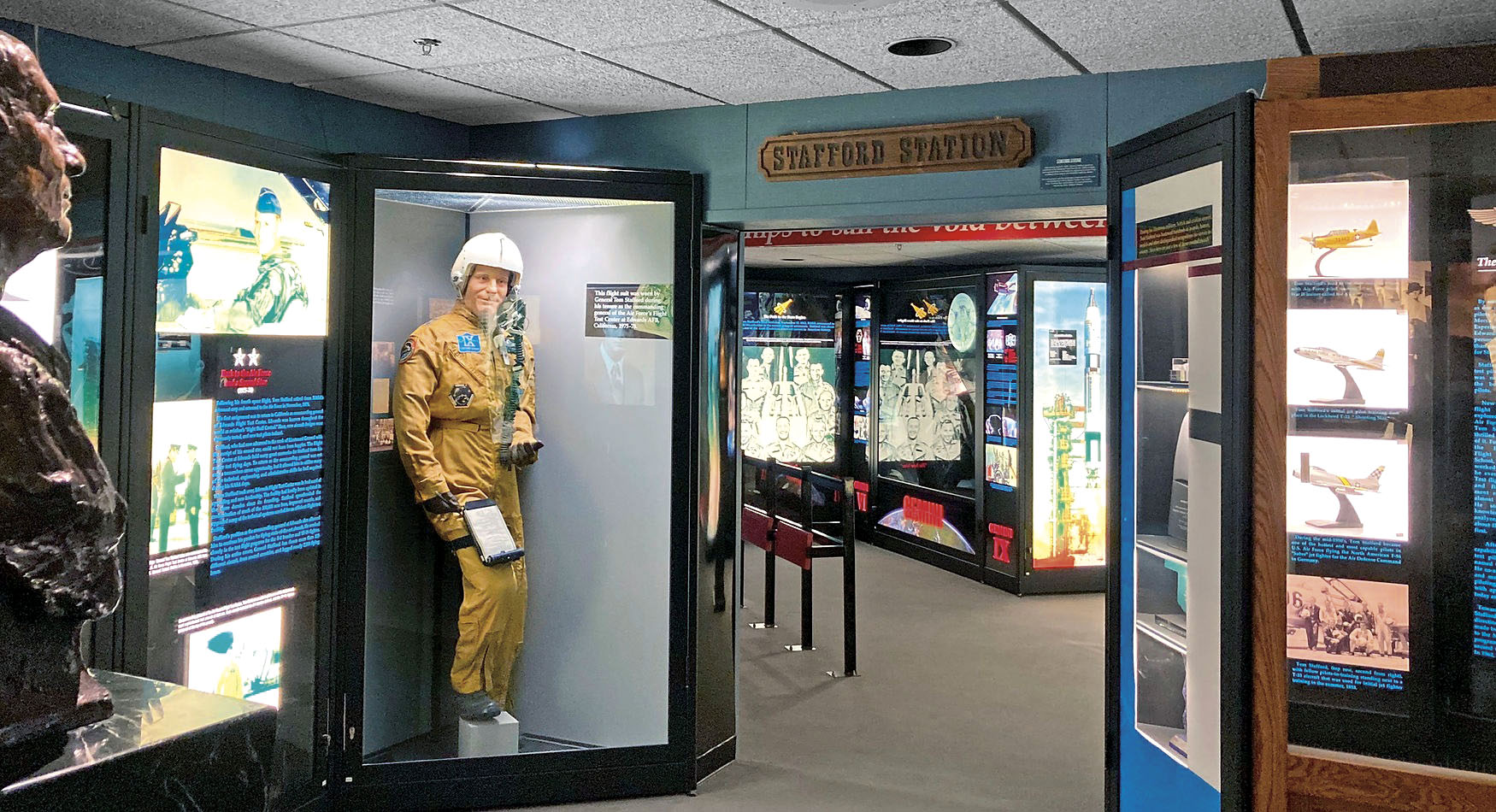
Weatherford’s Stafford Air and Space Museum, located at 3000 Logan Road near historic Route 66, offers visitors an extraordinary journey through aviation and space exploration. Its packed galleries showcase rockets, aircraft, space suits, engines, and other artifacts – many connected to Oklahoma’s celebrated astronaut, Lieutenant General Thomas Stafford. The museum traces the story of flight from the Wright Brothers to the moon landings, with more than 50 American and Soviet technological achievements arranged in rough chronological order. Plan at least two hours to take it all in. Let’s blast off.

Top: Flight suit, awards, and accomplishments of General Stafford in the Stafford Gallery.

The world of controlled, heavier-than-air powered flights started on December 17, 1903, when the Wright Brothers flew the Wright Flyer. A full-scale replica can be seen as well as other early aircraft like an actual Sopwith Pup and replicas of a Bleriot XI, Curtiss Pusher, and Charles Lindbergh’s Spirit of St. Louis. Visitors can use a “Star Tour Guide” handout to learn about each exhibit. Reflecting on the rapid pace of progress, Doug Schones of Canute remarked, “From 1903 to 1969, such a short time (one life time), so much technology.”
Rockets and Engines Take Center Stage
The heart of the museum lies in its space exhibits. Among them is an actual German WWII V-2 rocket, as well as F-1, J-2, and Soviet NK-33 engines. The mighty Saturn V moon rocket required five F-1 Rocketdyne engines, producing 7.6 million pounds of thrust, to send astronauts to the moon. A Titan II rocket, the same type Stafford rode into orbit during his Gemini 6 and 9 missions in 1965 and 1966, respectfully, is also displayed. Interactive exhibits let visitors hear-and almost feel – the immense power of rockets.

Houston’s Johnson Space Center contributed an authentic Mission Control Console used from the Gemini program through the Apollo, Skylab, Apollo-Soyuz, and the early Shuttle eras. Another highlight is the actual Gemini 6A spacecraft that Stafford and Wally Schirra flew during the first-ever rendezvous in space with Gemini 7 on December 15, 1965.

A towering, full-scale replica of the Apollo 11 Lunar Module (LM) “Eagle” is displayed. In 1969, Neil Armstrong and Edwin Aldrin, Jr. piloted a LM like this to become the first humans to walk on the moon. Nearby, Stafford’s Apollo 10 spacesuit – composed of 18,000 parts – offers a tangible link to his historic mission in May 1969.

International Space Station
Space Station fans will enjoy seeing a 1/24th scale model that illustrates the complexity of the orbiting laboratory. Interactive displays explain its components and the multinational crews who have lived and worked aboard. Viewing the model, Angela Correll of Ponca City observed, “This (ISS) is what keeps us connected” because astronauts from many nations share the station. Visitors are encouraged to download the “Spot the Station” smartphone app to track its path overhead.

Cold War and Modern Aircraft
The museum has an impressive collection of fighter airplanes. Outside are four and inside, visitors encounter an F-86 “Sabre,” Soviet MIG-21R “Fishbed,” T-38 “Talon,” F-16 “Fighting Falcon” and 2024’s addition, a F-117A “Nighthawk” stealth fighter. The MIG-21R served as the Soviet Bloc’s front-line fighter during the Cold War. The F-117A, a stealth fighter which Stafford helped develop, flew combat sorties during Operation Desert Storm, Allied Force and Iraqi Freedom, according to the Star Tour Guide.

Honoring Thomas Stafford
General Stafford was born and raised in Weatherford. The museum’s website notes, “His mother came to Oklahoma in a covered wagon and lived to see her only child fly to the moon. His father was a dentist who taught his son to appreciate what he had by working hard for it.” With a lot of hard work and natural abilities, Stafford graduated at the top 10% of his class at the U.S. Naval Academy and later became “Chief of Astronauts at NASA, was appointed Head of Research and Development at the Pentagon, chaired the team that developed the Hubble instrument COSTAR (Corrective Optics Space Telescope Axial Replacement), worked at Area 51, and (was) responsible for Stealth Technology as we know it today.” His career included four historic space missions: Gemini 6A, Gemini 9, Apollo 10, and Apollo-Soyuz, where he commanded Apollo’s final flight. Lieutenant General Stafford lived from September 17, 1930 – March 18, 2024, reaching the age of 93.

Completing the Visit
Open seven days a week, the Stafford Air and Space Museum, blends history, technology, and human achievement into an unforgettable experience. Note. Museum personnel did not respond to requests for an interview. •
story and photos by Lt Col Richard Stephens, Jr., USAFR, Ret.