
Oklahomans and visitors from surrounding states joined thousands of Veterans May 14-17 at the Mitch Park Display in Edmond to experience The Wall That Heals. The three-quarter-scale replica of the Vietnam Veterans Memorial in Washington, D.C., patriotically honors the men and women who gave their lives in Vietnam or later died as a result of their service.
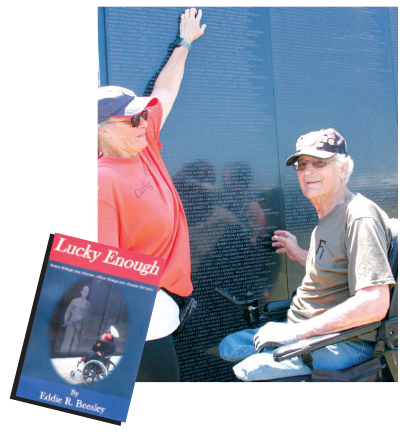
At Mitch Park viewing the Wall installation, the highly decorated Vietnam Veteran and motivational speaker, Eddie R. Beesley, 80, explained he was also an author. The Oklahoman from near Beggs handed this
writer a book filled with his harrowing experiences in the Vietnam
War. The book details his journey of resilience, which inspired his powerful memoir, “Lucky Enough,” published in 2005.
Corporal Beesley enlisted in the U.S. Marine Corps in 1963 at
just 17 years old. In May 1965, he was deployed to Vietnam with
Delta Company, 1st Battalion, 4th Marines, 1st Brigade.
In August 1965, while serving as the point man on a
patrol near Chu Lai, Beesley’s platoon discovered an enemy minefield under construction. While maneuvering to assess
the situation, a squad leader stepped past him; as Beesley stepped back, he triggered a hidden landmine. The blast
killed two Marines and severely wounded four others.
The explosion resulted in the traumatic amputation of both
of Beesley’s legs, making him one of the first above-the-knee double amputees of the war.
Beesley wrote “Lucky Enough” to recount his life journey, his first emotional visit to the Vietnam Veterans Memorial in Washington, D.C., and his resilience in the face of tragedy.
“I am attracted to attend every offering of the Wall as I write about my visits often in my book,” Beesley said. “I pay solemn reverence to the men and women whose names are etched on the walls while paying particular attention to those I served with early in the war.”
Today, he lives with his wife Connie in Edmond, Oklahoma. He is active in the veteran community, serving as the Native American Chairman for the Department of Oklahoma Veterans of Foreign Wars (VFW) in organizing tribal recognition ceremonies for fellow Veterans.
Community members and visitors engaged with the The Wall That
Heals over its four-day run at specific times for the exhibit’s major
events. This included the opening Native American Vietnam Service Recognition Ceremony, a heavily attended Vietnam Veterans Welcome Home Ceremony, and the poignant “Light Up the Night” Oklahoma County MIA Tribute.
That powerful evening tribute honored the more than 100 Missing in Action service members from Oklahoma County during the Vietnam War. The special illumination of the Wall offered a moment of solemn remembrance for those still missing.
A HMONG SGU Recognition Ceremony honored the Hmong Special Guerrilla Units who served alongside U.S. forces during the Vietnam War.
Busloads of public-school students, local youth groups, and civic organizations toured the site during daylight hours. They found the accompanying Mobile Education Center on-site informative in learning about the history of the Vietnam War.
The 375-foot-long synthetic granite structure was equipped with LED lighting, allowing round-the-clock viewing. This meant many Veterans, families, and residents could visit during late-night and early-morning hours for private, quiet reflection away from the daytime crowds.
The Wall That Heals’ 140 panels contain the names of more than 58,000 Vietnam service members, 990 of whom are Oklahomans, ensuring accuracy and consistency with the original Memorial.
Edmond was chosen as one of only 31 host communities nationwide for the 2026 tour. The Mitch Park Display served visitors who otherwise would not be able to travel to the permanent memorial in Washington, D.C. Its mission was Honoring Service. Remembering Sacrifice. Healing Together.
The Edmond VFW Post 4938 coordinated the display with the help of the City of Edmond Parks and Recreation Department. The post recruited volunteers to assemble and dismantle it. They offered a six-day community partnership of public engagement, inviting everyone to take part in this shared act of patriotic remembrance.
Volunteers assisted the steady flow of people with finding specific names among the 58,000 etched into the The Wall That Heals. A large contingent of community volunteers worked around the clock, facilitating name rubbings and guiding visitors through the mobile museum.
Vietnam Veterans have been the focus of a groundswell of recognition over the past 14 years as the U.S. government has executed a sustained, multi-administration effort to provide “overdue recognition” to Vietnam-era Veterans.

• story and photos by Darl DeVault, contributing editor