Enlisting at Seventeen
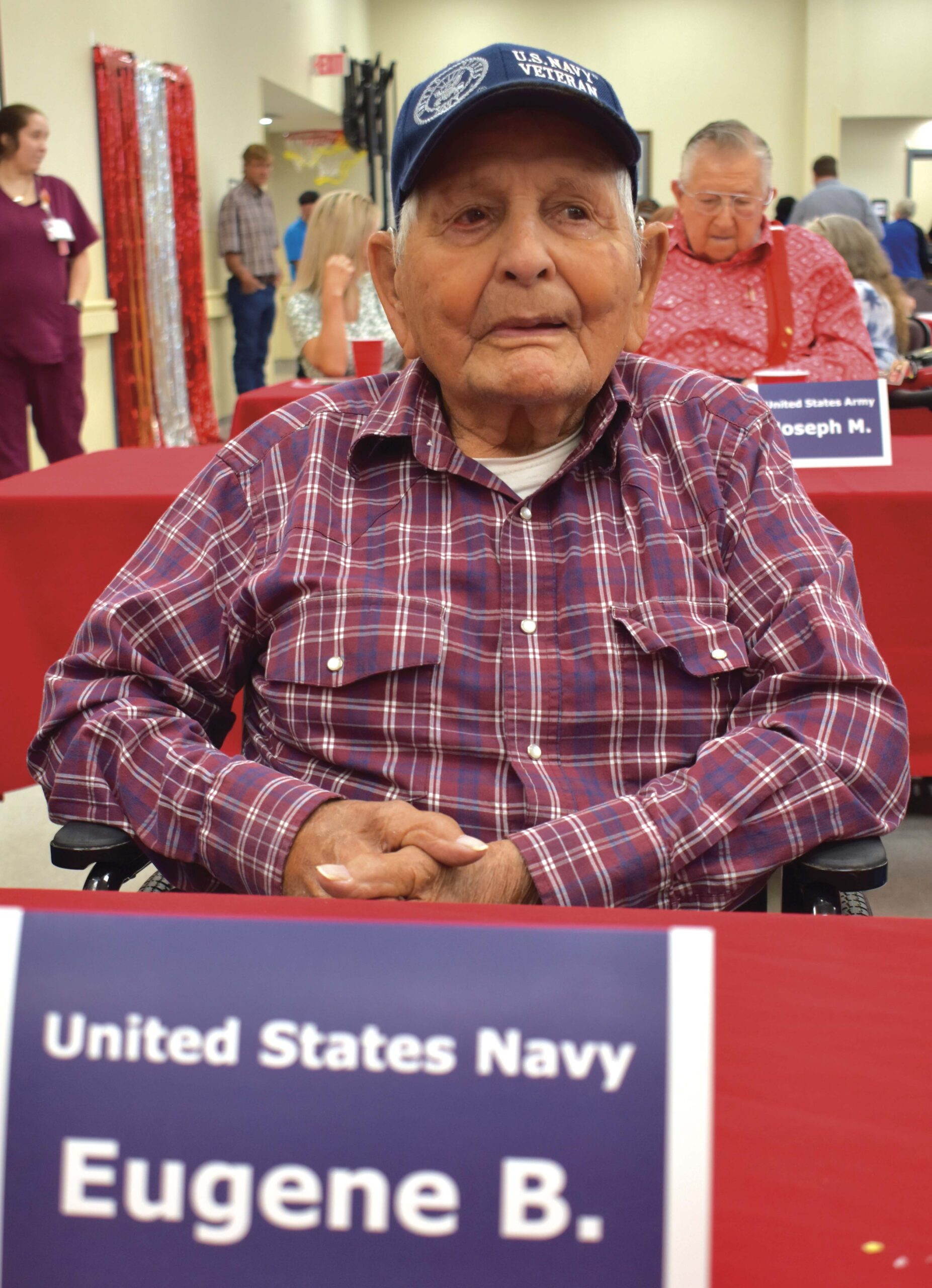
Bargas was in high school when he enlisted in the U.S. Navy at age 17 in Oct. 1944. Two pals, Jimmy Jackson and Paul Cassilas, enlisted with him. Fortunately, all three came home and stayed friends for decades. After finishing training as a Boatswain’s Mate – a “jack-of-all-trades” sailor who performs a variety of duties – at the Great Lakes Naval Training Center on the shore of Lake Michigan,

Sea Duty
Bargas joined the U.S.S. Shenango (CVE-28), a small Navy escort carrier. The 53-foot vessel was manned by about 1,080 officers and enlisted sailors and launched SBD-3 Dauntless dive bombers (nicknamed “slow but deadly”) and Grumman F6F-3 and F6F-5 Hellcats.
His memories of life aboard the Chenango reveal both the routine and danger of carrier duty. “We had planes that they went out and done their job and we’d fold them up (wings) on the carrier, go downstairs, you know, that was it,” Bargas said. After an aircraft’s wing folded, called a “STO-Wing,” an elevator would lower one or two aircraft inside the carrier for safety and to provide more space for take-offs and landings.
Fire on the Flight Deck
He also remembered a day when a pilot’s landing went wrong. “I remember there’s one of them planes coming in and instead of him landing, he made a mistake and he hit the other planes that was already on the deck and they caught on fire. It wasn’t his fault…. It (arresting cable) stopped him, but not quick enough. I guess he didn’t cut the thing off before he was supposed to.” Bargas thinks one or two sailors were killed. The account is confirmed by Wikipedia. “On 9 April (1945), a fighter crashed upon landing and started a raging fire among the strike-loaded aircraft on Chenango’s deck.” The crew put out the flames and kept the ship operational.
Final Battle
That same month, the Chenango joined other Navy ships in the invasion of Japanese-held Okinawa. Wikipedia states, “She gave air cover in the feint landings on the southern tip of the island, then was assigned to neutralize the kamikaze (“divine wind”) bases in Sakashima Gunto.” These were suicide planes flown directly into the decks and superstructures of Allied ships.
Specific strikes by Chenango’s bombers and fighters included dropping 500- and 100-pound bombs on the runways at Nobara Airfield, damaging airfield barracks and control towers, and attacking fuel supplies
and ammunition. They also conducted combat air patrols to intercept Japanese aircraft and protect Allied ships.
According to the National WWII Museum, “The 1945 Allied amphibious invasion of Okinawa lasted from April 1 through the end of June and was the largest and deadliest operation conducted by American forces in the Pacific war.” The Navy’s “loss of life of nearly 5,000 sailors, with another 5,000 wounded, made Okinawa the Navy’s bloodiest battle of the war, greater even than its losses at Pearl Harbor.” Luckily, the Chenango’s crew escaped kamikaze aircraft attacks.
He sailed countless nautical miles. “For the time I was in, I covered a lot of territory.” Bargas said. “I went from one ocean to the other ocean. I went through the Panama Canal. I went to San Francisco and then later on when we came back, we came back through the Panama Canal. One ocean’s higher than the other. I didn’t know that. I couldn’t believe it.” Asked if he ever got seasick, he laughed. “Yes, I was sick for about a week.” Typhoons? He nodded. “We had several of them. The ocean’s rough.”
From War to Civilian Life
After being discharged as a Seaman Second Class on April 1, 1946, Bargas returned home and began building a civilian life. He married Patricia, and later, Joyce, and had six children and three step-children. His daughter, Lanna Daniels, said he first leased a Phillips 66 gas station in Tulsa before opening his own business, Bargas Garage, for twenty years. Nearly eight decades later, Bargas continues to serve his community. He attended the U.S. Navy’s 250th birthday celebration on Oct. 13 and has been asked to be the Grand Marshal in Claremore’s Veterans Day parade Nov. 11th. • Story by Retired Lt. Col. Richard Stephens, Jr., USAFER. See Rich Travel Niche