A Serious Start to an Interview
Stephens. “Sir, is there a story or two you want to share about your service?”

Mauch. “For the younger generation, World War II was terrible. I would like for them to know that. It’s not something you would be anxious to get into…The young people need to know it’s not like video games.”
Stephens. “Please elaborate. Do you mean in general or some of the things you saw?”
Mauch. “You’re constantly hoping you stay alive so you can come home and have the American dream to marry and have a family. And that’s constantly on your mind.”
Stephens. “How did your service or the war change you?
Mauch. “Yes. Physically, I was like 135 pounds. After I got through bootcamp, I’m about 175. I think a little bit stronger (chuckles). Mentally, you were kind of prepared because of the Drill Instructor. He instructed you on how tough you should be.”
Stephens. “What would you say about how you did?”
Mauch. “Well, you experience so many things that if you’re 17 or 18 when you go in, you’re very inexperienced. When you come out, you faced a totally new world of time while you were there.”
Stephens. “Do you mean facing a world of life and death?”
Mauch. “Yes. The value of life. You’re more confident if you’re in the Marine Corps, especially. You’re more confident in your life in the future, I think all the way through life after.”
Stephens. “Anything else you’d like to say?”
Mauch. “Marry a lady that you love, for sure, and that will take good care (of you). Enjoy your family as long as possible.”
William “Bill” Mauch, now 100, saw combat close up as he rode in amphibious assault landing tractors during two of the Pacific’s most grueling battles – Peleliu and Okinawa.
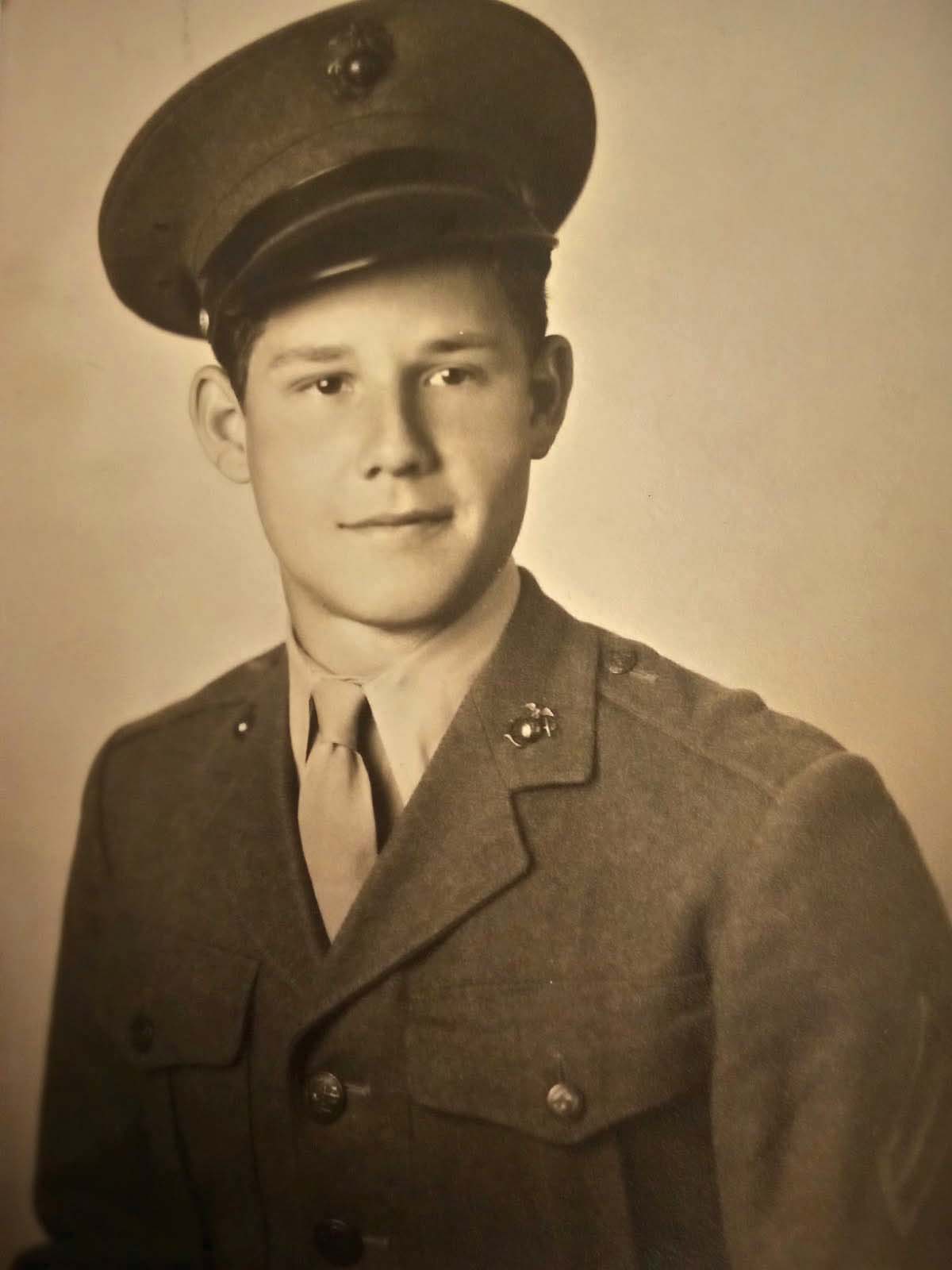
Into the Heat of Peleliu
Between Sept. 16 and Oct. 20, 1944, Mauch was deployed to the island of Peleliu, a small island in the Palau archipelago located some 500 miles east of the Philippines. He arrived just after the initial Sept. 15 landing. He said, “I was in reserve maintaining the radio systems of about a dozen tractors in our company.”
Conditions were brutal. Temperatures soared to 115 degrees daily. “We drank contaminated water (from contaminated petroleum 55-gallon drums) and there was no way to bathe.” Relief came when the Navy supplied water purified through osmosis systems. Mauch said they were often dehydrated and suffered from dysentery and jungle rot in the crotch and armpits. “It was total misery.”
The Invasion of Okinawa
Five months later, Mauch “carried the first wave of troops to shore April 1, 1945”, during the invasion of Okinawa – the final island battle before an anticipated invasion of mainland Japan. Once again, he rode in amphibious tractors formally named as Landing Vehicle, Tracked, LVT4.
Each LVT4, Mauch explained, “would haul about 25 or 30 (personnel) in the rear, and the front was the driver and the radio operator, and then the commander would be also aboard…You could communicate back and forth on the tractor…I was responsible for the radio intercom systems for 12 of those LVT tractors.” He described how the vehicles were designed for transport and protection. “And then on the back was a drop tailgate, I’ll call it, and the troops would come out there and the tractor would protect them more or less while they got out. Then we could haul supplies, ammunition and things like that. Your initial job was to get the troops ashore.”
The Somber Duty of Burial
After the initial invasion of Okinawa, Mauch’s duties took a somber turn. “About the third day that we got a dispatch to pick up a load, and that was about, I’ll say six or seven dead bodies in body bags. We loaded them on our tractor…We’d haul them to the to the designated cemetery area.” The temporary gravesites were later uncovered and the remains returned to the United States.
Living Under Fire
In a Sapulpa Times interview by Micah Coquette, “Lifelong Sapulpan Bill Mauch turns 100, inducted into the Centenarians of Oklahoma Hall of Fame,” Mauch reflected, “’On that island, we were constantly under threat to our lives,’” adding, “’You have rifle fire, you have mortars, you have big guns and bombers every night. You have anti-aircraft shells that burst and can land on your tent. There’s just all these ways you could get killed.’”
Building a Civilian Life
Discharged in Feb. 22, 1946, Mauch returned to Sapulpa. His father took him to an Odd Fellows meeting where he reconnected with his high school mechanical drawing teacher. “He saw me there and he said, ‘Oklahoma Gas & Electric head called for a young man to train as an engineer…I’d like for you to go ahead…So I did and they hired me. And I spent three years as a junior engineer for OG&E.”
Realizing he needed to use his GI Bill, Mauch enrolled at Oklahoma A&M, spending nearly five years earning a degree in architectural engineering. Afterwards, “I went to work in the aircraft industry for Douglas Aircraft in their structural engineering in Tulsa. Later, McDonald Douglas bought them. I worked for them for 33 years.”
Love and Legacy
He married Helen in 1954, and together they celebrated 70 years of marriage before her passing in 2024. The couple raised four children and were blessed with six grandchildren and nine great-grandchildren. Today, William Mauch continues to live in his hometown of Sapulpa. • Story by Retired Lt. Col. Richard Stephens, Jr., USAFER. See Rich Travel Niche