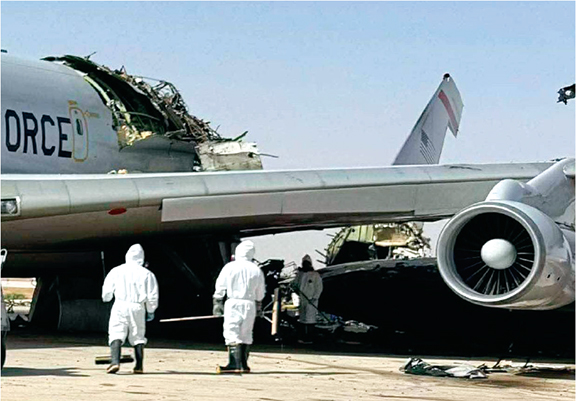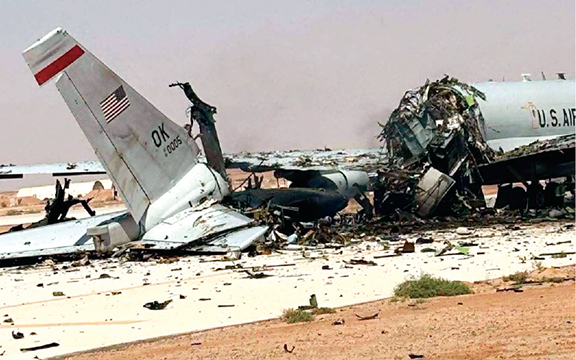

Multiple news outlets reported an E-3 Airborne Warning and Control System (AWACS) aircraft was damaged or destroyed between March 27-29, 2026, at Prince Sultan Air Base, Saudi Arabia. The likely cause was Iranian missiles and/or drones, according to Air and Space Forces Magazine, Microsoft Network (MSN), The Defense News and others. Images confirmed significant structural damage, including to the rear fuselage.

A request was sent to USCENTCOM for information on whether an E-3 was damaged and if any U.S. military or civilians were hurt in the attack but no response was received by presstime. As of April 25, 2026, nothing on the subject is posted on their website. Not providing information like this is routine for operational security reasons to deny enemies useful information.
A March 28 Air and Space Forces (AFA) news release stated, “The attack injured more than 10 service members, two seriously. Among the other planes damaged are aerial refueling tankers… The image appears to show one of the E-3s stationed at the Saudi base, based on runway signage and aircraft markings. Six E-3s had been stationed at Prince Sultan Air Base before the incident, according to open-source flight tracking data.”
A MSN.com report from April 4 said, “The strike also damaged at least two US refueling aircraft and wounded 12 personnel, two seriously…With only 16 operational aircraft and a mission-capable rate of about 56%, the fleet is already under strain. Experts warn the loss will hamper the Air Force’s ability to manage battlefields, deconflict airspace, and deliver coordinated effects in ongoing operations.”
The AWACS aircraft are critical components of the Joint Force Air Component Commander’s arsenal during combat operations like Operation Epic Fury. The Air Force has flown AWACS planes since the late 1970s to provide command and control and intelligence, surveillance, and reconnaissance capabilities. They were used extensively in Operation Desert Storm, the Kosovo war, the wars in Iraq and Afghanistan, and for Operation Inherent Resolve.
“The loss of this E-3 is incredibly problematic, given how crucial these battle managers are to everything from airspace deconfliction, aircraft deconfliction, targeting, and providing other lethal effects that the entire force needs for the battle space,” said Heather Penney for the AFA Magazine. She is a former F-16 pilot and director of studies and research at AFA’s Mitchell Institute for Aerospace Studies. “The value of the E-3 and the battle managers is they see the big picture,” Penney said. “They’re the chessmaster, while [fighter pilots] are the bishops.”
Lee McCullum, a former 552nd Air Control Wing (552 ACW) radio operator for the AWACS and VFW Post 7192 member, said, “I don’t think we planned it right. We did know that Iran was going to hit the neighboring places, states, or whatever. I wish they would move to E3 back somewhere (perhaps) Aviana, Italy.” His hopes and prayers go out to the members and families affected. Veterans of Operation Desert Storm remember Iraq fired numerous SCUD missiles at military installations in Saudi Arabia, including Riyadh. History repeated.
The MSN.com article also stated, “Ukrainian President Volodymyr Zelensky alleged that Russian satellites photographed the Saudi base multiple times in the week before the attack and shared the imagery with Iran. He argued this pattern indicated deliberate targeting preparation, though NBC noted no direct evidence was provided.”
The 552 ACW operates E-3s at Tinker AFB. The wing reports to 15th Air Force headquartered at Shaw Air Force Base, SC. According to an USAF Fact Sheet posted online, the wing consists of four subordinate units: the 552nd Operations Group, the 552nd Maintenance Group, the 552nd Air Control Group, and the 552nd Training Group. “The 552nd Maintenance Group directs logistics support of 27 E-3 AWACS aircraft (several news outlets state there are 16 aircraft in the inventory) valued at $9.2 billion. The
group supports all E-3 sorties enabling aircrews to fly 20,500 hours annually from numerous locations world-wide.”
A USCENTCOM fact sheet dated April 1 states more than 13,000 combat flights have been flown (jet, helicopter, drone, etc.) and 12,300 targets struck and 155 or more Iranian
vessels damaged or sunk.
For more information about Operation Epic Fury, go to www.airandspaceforces.com and major news sources. • Story by Lt. Col. Richard Stephens, Jr., USAFR, Ret. website: Rich Travel Niche