Veterans who receive community care for medical treatment have been required in the past to seek and receive new referrals every 90 to 180 days. Just getting that referral or authorization can cause delays in treatment. Now, with changes at the VA, those referrals won’t be as frequent.
Starting now, in 30 different categories of medical care, referrals and new authorizations will only be required once a year.
Community care can literally be a lifesaver for veterans who live too far from a VA medical facility, whose closest facility doesn’t provide the medical care that’s required or if the VA’s wait times are not acceptable.
Here are a few of the 30 medical categories that are now eligible for the longer authorization: cardiology, oncology, gastroenterology, pain management and pulmonary.
If you’ve been getting community medical care and are subject to the need for frequent reauthorizations, contact the Community Care office at your closest VA medical center to ask how the new rule impacts the schedule you’ll be on going forward. Ask whether the new “year” began when your current authorization period did, or whether a new year begins right now. Get the answer in writing, if you can. Take the steps you need to, to guarantee that your authorization is indeed extended so you don’t discover at the last minute that there’s been a problem and that your file was overlooked.
If you’d like to take advantage of community care, you need to be enrolled in VA health care or be eligible for it.
If you’re getting VA care, tell your VA physician that you’d like to get community care. If they think it’s appropriate, they will start a referral.
Once you find a civilian community care provider that you like, be sure to verify that they’re part of the VA’s network before you get any treatment from them, otherwise VA won’t pay for it.
To learn more about community care or to find a provider in your area, go online to www.va.gov/communitycare. •
By Freddy Groves
(c) 2025 King Features Synd., Inc.
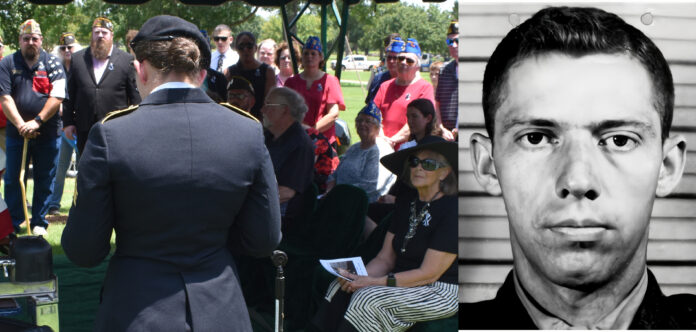
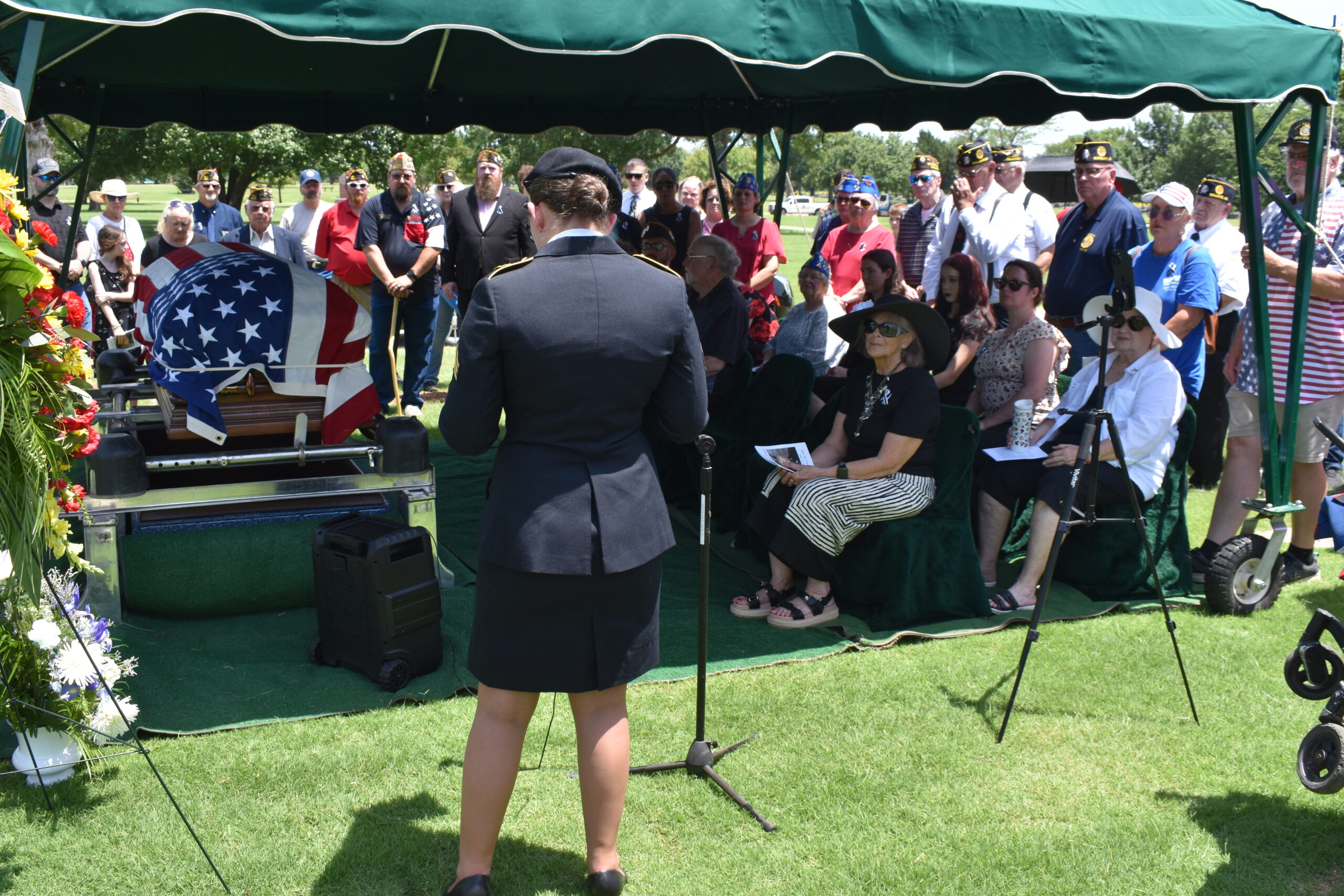
Charli Ford (center), a military historian at the Hamilton VFW Auxiliary 4938, Edmond, eulogized Private Wright at his burial, July 18, 2025
Memorial Service
Private Richard Gordon Wright, U.S. Marine Corps, born June 6, 1921, in Sparks, Oklahoma, was buried with military honors on July 18 at Dignity Memorial Park Cemetery in Oklahoma City. The ceremony began at 2 p.m., with cicadas loudly singing in the hot, still air.
Was that unusual?
Yes. Why?
Wright died on November 20, 1943, 81 years ago during WWII on Betio Island in the Gilbert Islands. His remains were not identified until February 8, 2024, by the Defense POW/MIA Accounting Agency (DPAA) and returned to Oklahoma City on July 11, 2025 – more than eight decades after his death.
As the service drew near, at least 75 people gathered in quiet respect. Members from American Legions (Posts 19, Woodward; 111, Edmond; 88, Norman; 142, Hominy, and others) and Veterans of Foreign Wars (Posts 4938, Edmond; 7977, Skiatook; 3077, Collinsville; 7180, Owasso, and others) came, as did those with no affiliation.
Although no one knew Wright personally, they came to witness the homecoming of a Marine who served his country with honor and gave his life for future generations.
Charli Ford, one of two historians and archivists of military history at the Hamilton VFW Auxiliary 4938 in Edmond (President Amanda Duncan is the other) gave the eulogy and thanked those who made Wright’s repatriation possible, including “the DPAA (Defense POW/MIA Accounting Agency) for their efforts to recover, organize, analyze and identify the remains of the missing. And a special thank you to Mr. (Narsease) Tolen, Richard’s first cousin, for the donation of the DNA while he was still alive. His DNA was used to positively identify Richard.” Her voice carried pride and emotion while she recounted Wright’s early life. Ford ended with, “After today,” Ford said, “Richard’s journey comes to a close… May we never forget Richard’s sacrifice.”
Chaplain Ed Beesley, a Vietnam War veteran and member of Post 4938, described how well Betio Island was fortified by the Japanese against a large-scale amphibious assault by Americans. Beesley continued, “I want you to understand the Marines did it in three days…it was a fierce battle…which would come to be known in the Marine Corps as ‘Bloody Tarawa.’ What struck me, is…our own Oklahoma Marine was a part of the first wave on that beach landing on the 20th November, 1943…My understanding was that Richard’s landing craft was hit by mortar fire…” Wright’s 2nd Marine Regiment, about 150 men, was almost annihilated that day.
The service concluded with a prayer, seven-gun salute provided by VFW District 5, the playing of taps, and a moving flag folding ceremony followed by presenting it to Ed Zink of Weaubleau, Missouri, who represented the family. Zink is a second cousin to Wright. The crowd slowly, quietly slipped away.
Wright’s family
Zink spoke of his family’s connection to Wright. “My mother’s mother (Zink’s grandmother) was the sister to Richard’s mother. They were sisters…George Ann and Sharon are Richard’s nieces and they knew about him. Their brother was named after him. So, they knew he was missing, they just never expected him to come home.”
“I’m honored to be able to represent the family and to acknowledge his military career, as short as it was.” Zink, a Marine, understands sacrifice. He served two tours of duty in Vietnam and one in Thailand.
He praised the research Charlie Ford and VFW Post 4938 performed. “They’ve done a wonderful job. Charlie…has been unbelievable. She’s been on this case for several years. They went above and beyond.”
Identifying veteran remains
Amanda Duncan said, “We do a lot of work with MIAs, POWs. It is something our post and our auxiliary is very passionate about.”
She explained the meticulous process of identifying remains. “When something like this happens, first of all, they (DPAA) look at the service record and where they enlisted out of.” Other clues: where family lives(d) and where the deceased’s military unit was engaged in battle.
In Wright’s case, a relative was located in just a few days, though the full process – DNA testing, approvals, and transport – can take months. Ford described how she reached out to a family member through the Ancestry website after a relative built Wright’s family tree. “I noticed she had him on the tree… trying to see… what relation she was and if we could find somebody to give DNA.”
Private Wright is buried in the same cemetery as his father, Henry Wright, a World War I veteran, and grandfather and grandmother, William and Eva Wright.
There are 1,185 Oklahoma MIA/POW servicemen awaiting repatriation.
• story by Lt Col Richard Stephens, Jr., USAFR, Ret.
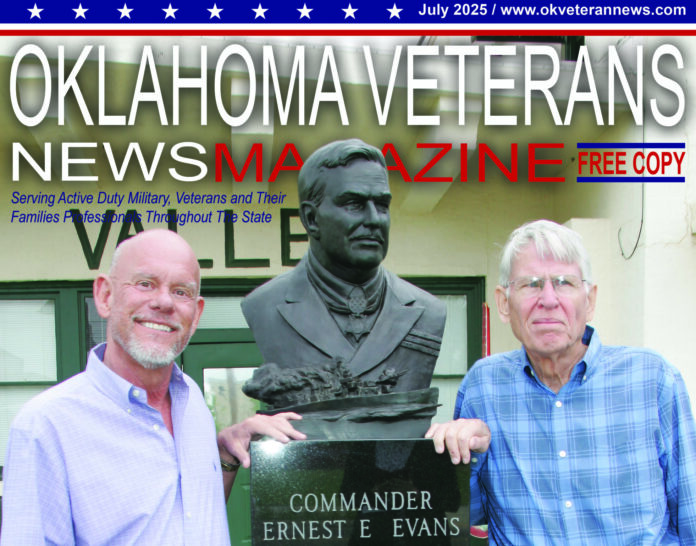
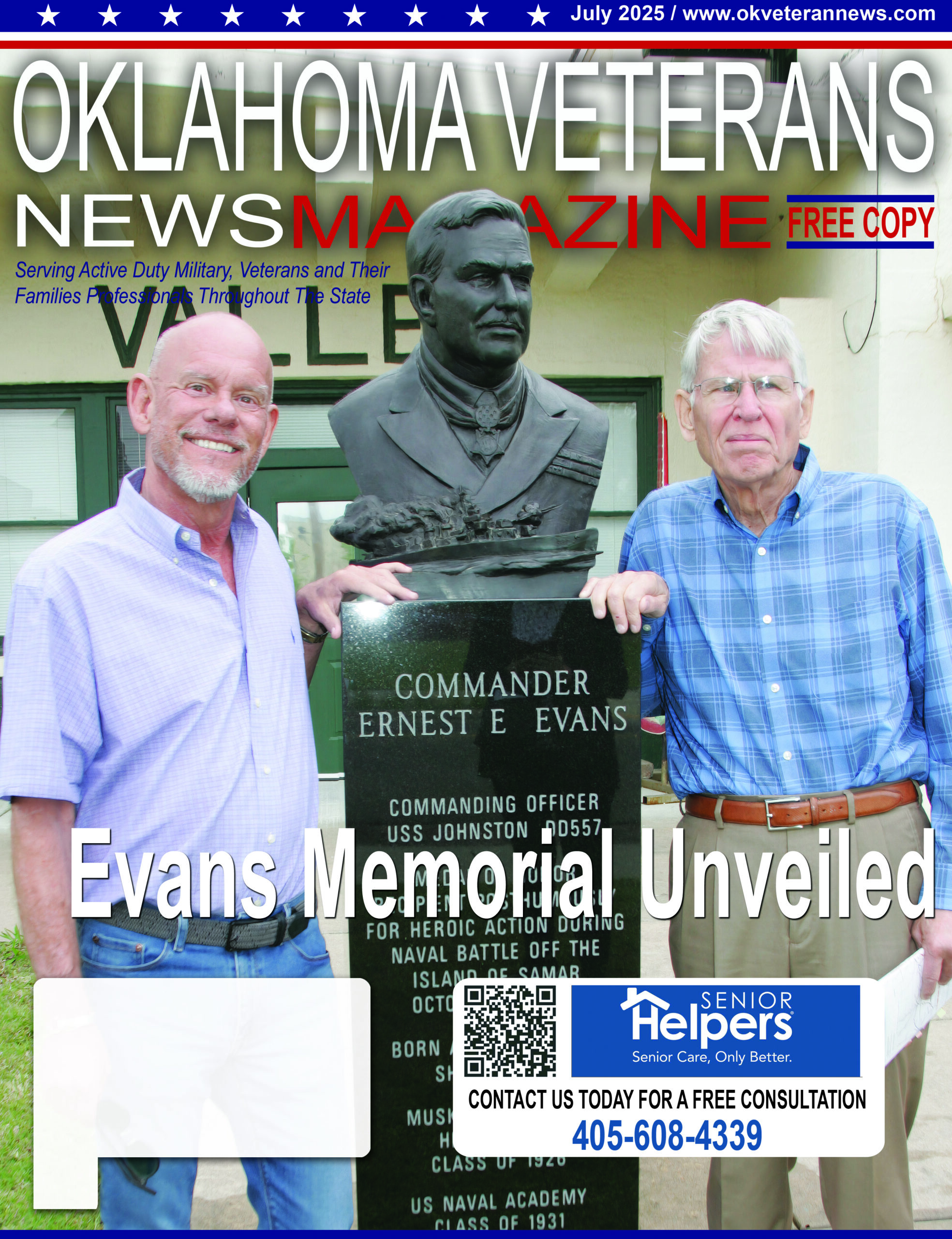
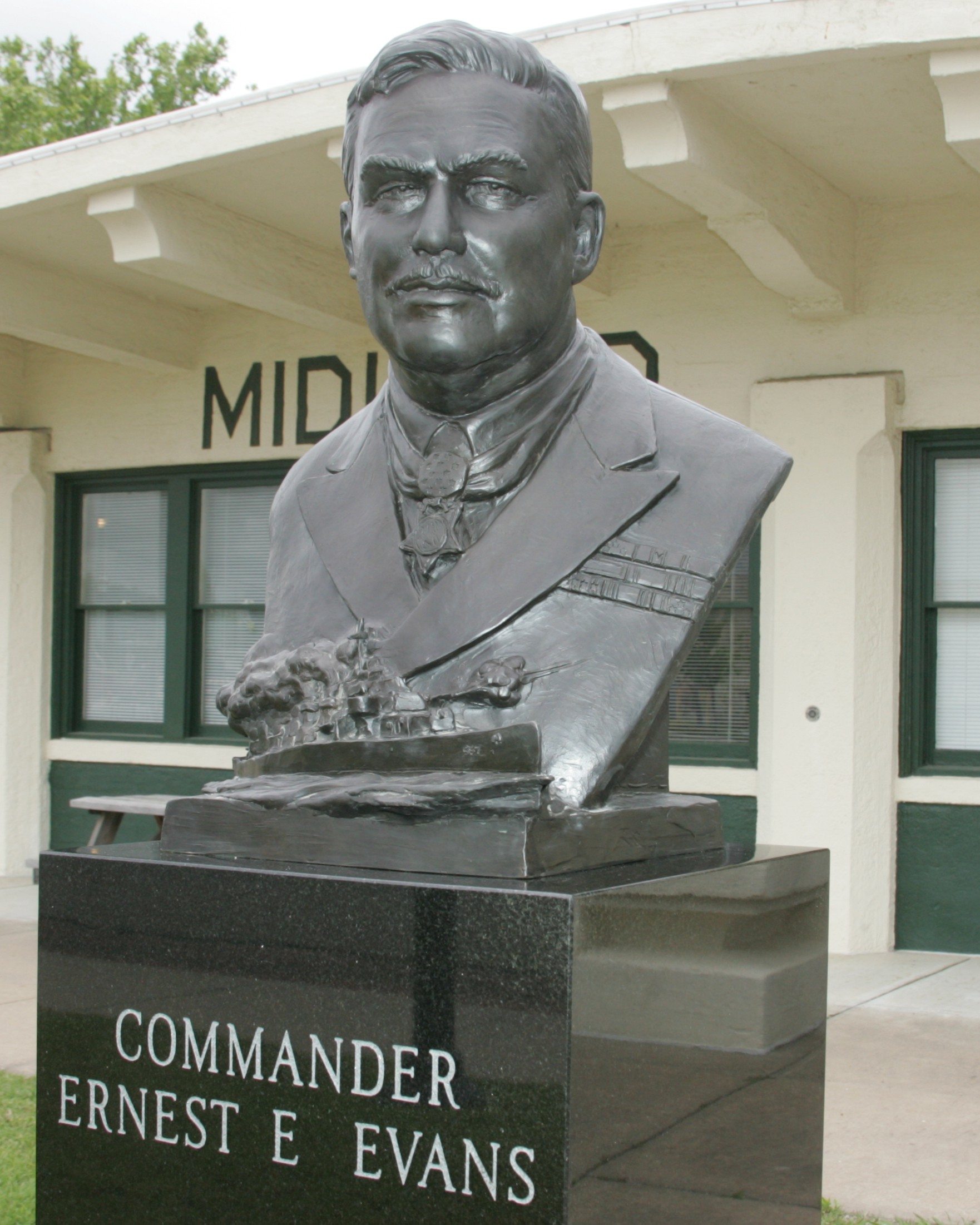
Nationally known artist Paul Moore of Norman donated his sculpting fee in creating this bronze bust of Evans wearing his Navy Medal of Honor. It features Evans’ ship, the USS Johnston, firing her five-inch guns and creating a smoke screen.
Just after dawn on October 25, 1944, the Japanese sent the largest naval battle group ever assembled to destroy 130,000 American soldiers invading Leyte. Their goal was to destroy the American forces just moving inland, five days after the landings, to push them out of the Philippines. This battle and U.S. Navy Commander Ernest E. Evans’ heroic actions had a significant impact on hastening the conclusion of WWII.
Never before that day had one Sailor’s actions diverted the burden of attack from so many American service members so decisively as in the Battle off Samar. That man was Evans, a graduate of Muskogee High School and the U.S. Naval Academy.
“[Leyte Gulf], a key battle in the Pacific War, was almost a disaster for the United States,” said Samuel Cox, retired rear admiral and director of the Naval History and Heritage Command, in an April 2021 article from “The Oklahoman.” “If it hadn’t been for what Ernest Evans did, the battle would have gone much worse.”
The Japanese forces attempting to surprise the overmatched Taffy 3 task force were aggressively introduced to the unwavering courage and self-sacrifice of the U.S Navy’s finest. Three American destroyers, commonly referred to as “tin cans,” because they lacked armor, began the fight for their lives against a far superior force.
Among the attacking fleet, the Japanese super battleship Yamato, the largest battleship ever built with 18-inch rifles, outweighed the entire American defending force. It was a formidable part of a massive force consisting of four battleships, six heavy cruisers, two light cruisers, and 11 destroyers.
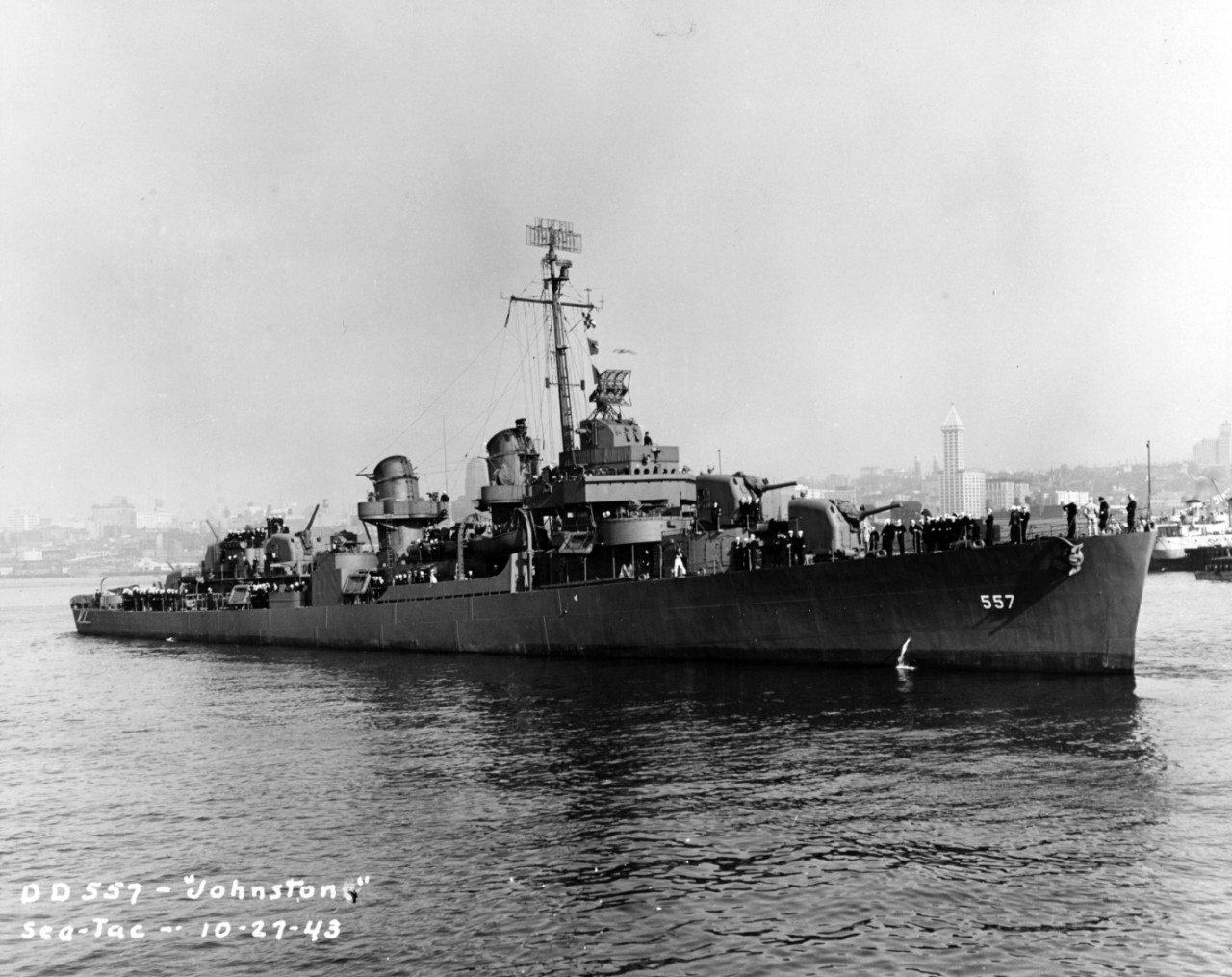
At the helm of the Fletcher-class destroyer USS Johnston, Evans assured himself a place in U.S. Naval history with his courageous initiative in the face of the overwhelming enemy. Before the order to attack was issued, the determined warrior began a lone preemptive retaliatory strike with extreme prejudice.
Evans entered Navy lore forever by laying a smoke screen to protect his fellow ships and navigating his vessel fearlessly into harm’s way to deploy his torpedoes.
The Johnston delivered the immediate first blow, instilling chaos within the Japanese naval ranks. Its 10 torpedoes tore the bow off the Japanese cruiser Kumano in the first few minutes of the three-hour battle. Here was the aggressive Japanese fleet, far outgunning and outnumbering its prey, being attacked and bloodied by the first ship it encountered.
Evans and his only 2,000-ton destroyer were much earlier announced to be the Navy’s readiest-for-battle warship. Evans let his assembled crew know his intentions as he took command at the USS Johnston’s commissioning in October 1943. “This is going to be a fighting ship,” he said. “I intend to go in harm’s way, and anyone who doesn’t want to go along had better get off right now. I will never retreat from an enemy force.”
Evans’s tactical blitzkrieg was everything a ship that size could accomplish in that short a time. But his audacious and successful counterattack against overwhelming forces off Samar was not enough for the brave Oklahoman.
The Johnston rejoined the frigate line of destroyers as they made their torpedo runs at the far superior forces. This action meant the small Taffy 3 task force presented a “larger than real” profile in the water to Japanese Admiral Takeo Kurita on his flagship Yamato. By now in the battle, more than a hundred pilots from the Jeep carriers and land bases nearby were swarming the Japanese fleet.
Although his ship had already fired all its torpedoes, Evans wanted to protect his fellow sailors as much as possible with his ship’s five 5-inch guns. The well-trained crew fired more than 800 rounds in the battle.
The USS Johnston, underway, headed to the Pacific for World War II on October 27, 1943, just after its commissioning
By drawing fire away from the Jeep carriers he was protecting, his ship was taking hits from powerful 14-inch guns. Despite severe damage to his ship and his wounds from Japanese fire destroying the bridge, Evans repeatedly put the Johnston between the enemy and the more vulnerable U.S. ships. This saved the lives of thousands of his fellow sailors.
This second suicide run met with far less success against the enemy. After almost three hours of battle, the Johnston eased over on her side for 25 minutes until finally sinking.
Her early valiant effort meant the Johnston proved decisive. Without air cover, the enemy, confusing the aggression to be a genuine effort made by a more significant force, broke off the attack and headed for Japan.
Fleet Admiral Chester W. Nimitz wrote afterwards that the success of Taffy 3 was “nothing short of special dispensation from the Lord Almighty.”
Evans earned the respect of all Navy personnel forever for his courageous actions, but he lost his life at 36 that day, along with 185 members of his crew. His body was never recovered when the USS Johnston sank after fighting valiantly for three hours.
Evans was posthumously awarded the Medal of Honor and a Purple Heart Medal for sparking the decisive victory in Leyte Gulf. He also shared in the Presidential Unit Citation awarded to Taffy 3 for this action.
On Sept. 28, 1945, shortly after World War II concluded, Evans’ Medal of Honor was presented to his wife, Margaret, in San Pedro, California. The ceremony was attended by his mother, sister, and sons Jerry and Ernest Jr.
Evans is one of only two destroyer captains from World War II to receive the Medal of Honor.
Evans’ exploits have now been interwoven into the Navy’s legacy, as his name has graced one decommissioned warship and a building at the U.S. Naval Academy. Last year, the Navy announced that the USS Ernest E. Evans, a DDG 51 Flight III Arleigh Burke-class guided-missile destroyer, will soon be the second warship named in his honor.
On May 7, Oklahomans demonstrated that their servicemen and women are never forgotten during a solemn ceremony to unveil a bronze bust of Evans. In front of the Three Rivers Museum, a monument was dedicated to Oklahoma’s most celebrated World War II Navy hero in Muskogee, Oklahoma.
Retired U.S. Air Force Lt. Col. Stephen Reagan, who resides in Norman, and his wife, Alice, spearheaded the effort to honor Evans. The campaign to raise funds and acquire the resources to create the monument took almost four years.
“I consider my work to help Muskogee honor Commander Ernest Evans one of the most significant things I have ever done,” Reagan said. “It’s a good feeling to help others. I am very proud to have Alice present, who helped make it a great day for me.”
Nationally acclaimed artist Paul Moore from Norman created a bronze bust of Evans wearing his Navy Medal of Honor. An identical bust, a gift from Reagan and his donors, is displayed at the US Naval Academy Museum.
The bust sits atop a tall square black granite pedestal. Below his image at the front of the bust is a miniature model of the USS Johnston in bronze, firing her five-inch guns and creating a smoke screen.
Patrick Cale, the Mayor of Muskogee and owner of Muskogee Marble & Granite, was the only corporate donor to the project. He provided the pedestal that features Evans’ significant career dates on the front, while the back showcases his Medal of Honor citation.
Reagan and his wife, Alice, volunteer five mornings a week with the Dale K. Graham Veterans Foundation in Norman. It is accredited as a Regional Veterans Service Organization. Its dedicated staff members work tirelessly to help all service veterans and their families receive their full military service benefits. story/photo by Darl Devault, contributing editor
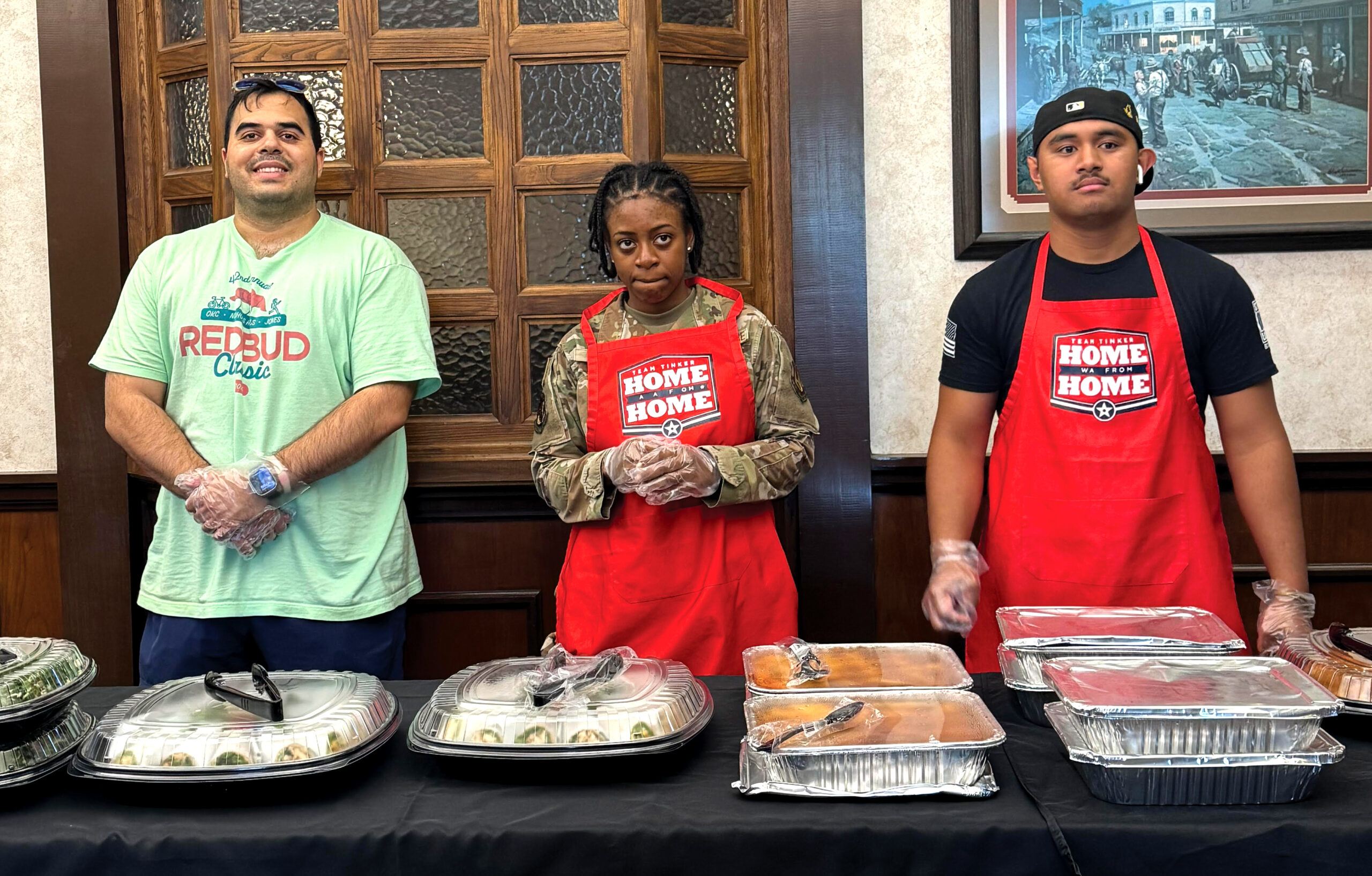
Team Tinker Home Away From Home” provides monthly activities, volunteering opportunities, events, speakers, and professional Life Skills seminars at no cost to service members. At each event service members are provided with a free catered meal.
The Team Tinker Home Away From Home program began out of a tragedy but has turned into a triumph for the young military members stationed at Tinker Air Force Base.
The program was founded by Mike and Pam Kloiber that pairs young service members with civilian host families to help alleviate the anxiety of being alone and far from home, often for the first time.
On an icy Christmas Eve in 2011, two Airmen from the 552nd Air Control Wing were killed in an automobile accident in Oklahoma City. After a conversation with then-552nd ACW Commander Col. Greg Guillot, Mrs. Kloiber had her marching orders and set out to create a program modeled after a similar one at the Air Force Academy.
Over the last 10 years, more than 1,500 first term Airmen and Sailors have taken Kloiber up on her offer and actively participated in the program.
The goal of “Team Tinker Home Away From Home” is to provide all eligible, first-term Service Members with a “home away from home.”
The program strives to match community sponsors with young service men and women, giving them a welcoming, safe, and supportive place to spend time, especially during the holidays.
These community sponsors provide them a welcoming place to relax and offer opportunities to have fun away from the stress and day-to-day requirements of life on Tinker Air Force Base (TAFB). Families offer personal interactions that can develop into strong, long-lasting bonds.
In addition to the host partnership, “Team Tinker Home Away From Home” also provides monthly activities, volunteering opportunities, events, speakers, and professional Life Skills seminars at no cost to service members.
Pam Kloiber said she and her husband are proud of the impact their program has had on service members.
“Mike was the CEO/President of Tinker Federal Credit Union for 33 years,” she said. “Mike and I have always worked as a team, and so when he was working there, I also supported the base in any way I could. I didn’t realize how much of an impact that Home Away From Home would have on me when it first began. The program’s impact and the resiliency, connectivity and family immersion for the service members have exceeded more than I expected.”
Service members can become part of THAFH through several different avenues, Kloiber said.
In addition to being linked with a host family, service members can attend a monthly life skills class through the “Empowerment, Enhancement and Education” initiative.
“ I call all of the servicemembers my kids, and my assigned service members connect with Mike and I every Sunday,” she said. “I’m always trying to find new and innovative ideas to support the service member’s lives. I’m always searching for ways to help empower the service members”
Kloiber writes a program curriculum and each year she has a theme.
For 2025, her theme is Let’s Strive to Thrive, a Year of Empowerment, Enhancement in Education.
“Every month we have professional seminars because I want them to have the opportunity to be exposed and learn life skills,” Kloiber said. “Many of them have never bought a car, particularly service members that live in inner cities like New York City, Brooklyn, and they don’t know how to drive a car. We’ve helped purchase cars for many service members and help them to learn how to drive. I have a class on car buying.”
Kloiber said each month different skills classes are offered.
“Each month we have a speaker talking about various topics pertinent to this age group,” she said.
Kloiber said their program hosts an end-of-the-year party for servicemen and servicewomen called “Thanksmas.”
“We combine Thanksgiving and Christmas together, and we call it Thankmas,” she said. “At all our events we offer a free catered meal. The base leadership, commanders and chiefs all join in to serve the food to service members and they join in the class to show how important it is to better yourself. They take the time to sit and break bread, sit right beside an airman and have a meal. The conversation and connection between the leadership and service members is amazing.”
Kloiber said volunteerism is also an important part of Home Away From Home, following the Air Force’s values of Service Before Self.
“We volunteer in the community several ways,” she said. “We have a connection with Mayor Matt Dukes in Midwest City, and we volunteer with him. He has a neighborhood coalition for senior citizens that need help with various projects around their home. We also laid wreaths for Wreaths Across America, and we volunteered with Hope Therapeutic Horse Ranch. This year we’ve added a volunteer project and it’s Vet Chat, and we will be going in October to Norman’s Veterans facility. We will be having coffee and donuts while spending a Saturday morning with the Veterans in Norman.”
Kloiber said suicide is a factor in the military, but her program has been fortunate to not have experienced any suicides.
“We’ve had a lot of airmen that have reached out because they’re hurting, having some mental health issues and they need support. The families have been wonderful because they know when the service members come over, and they’re consistently visiting with them and doing things with them. They let their service members be there to support them.”
Kloiber said Team Tinker Home Away From Home is more than a program to her. It is her passion.
“It’s a passion now, a connection with young people that I have been able to see growth and development in them,” she said. “They have skills, they have talent, they have ability, but occasionally a few may have a weak self-esteem, and all they just need someone to say, “You’ve got this.”
For more information about Team Tinker Home Away From Home call Kloiber at (405) 503-5041 or visit www.teamtinkerhomeawayfromhome.org Home Away From Home is a 501(c)(3) nonprofit charitable foundation, with no DOD affiliation or governmental status. story/photo by Van Mitchell
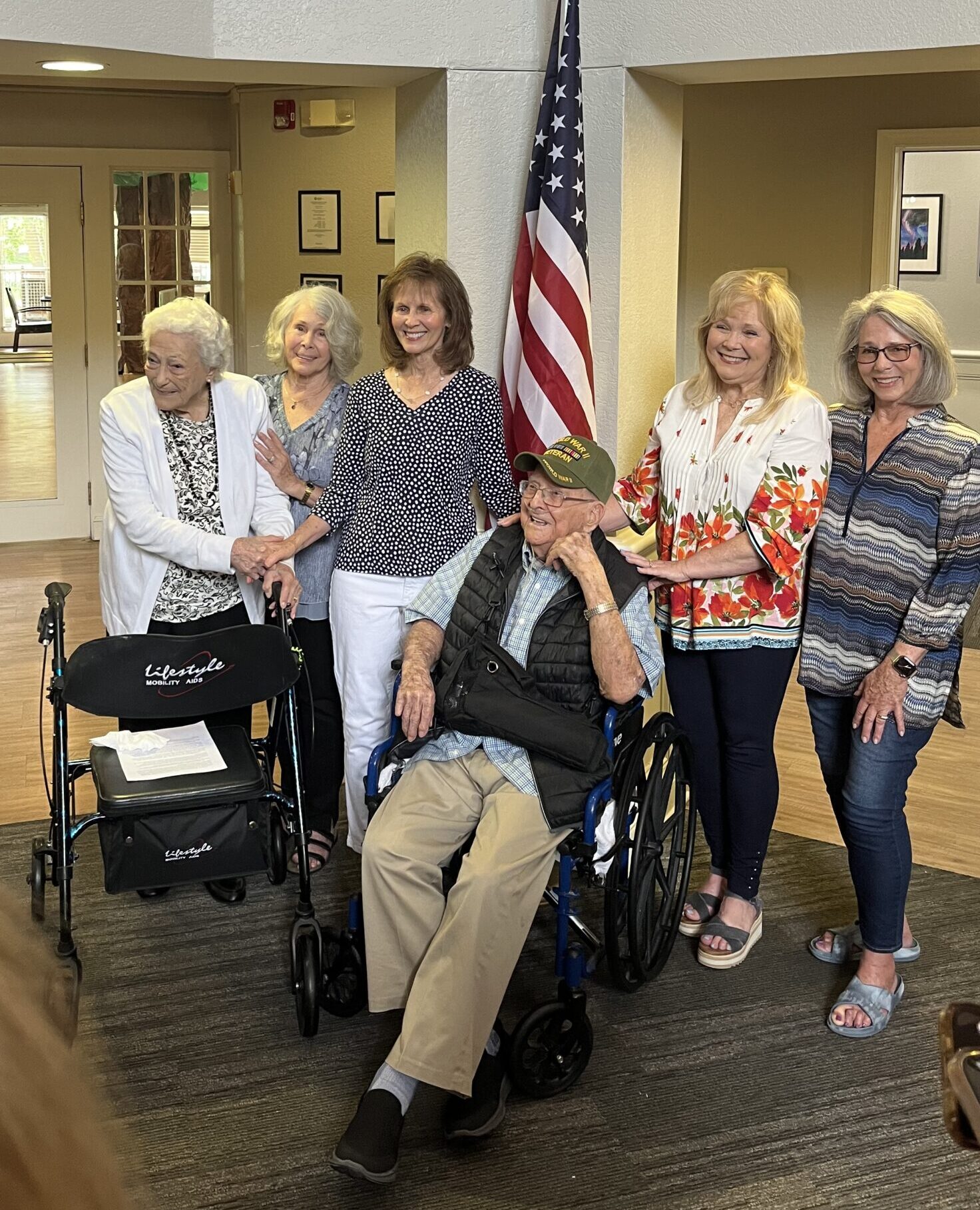
Charlie McGregor, seated, is surrounded by Josie Hill, left, and his four daughters during a military service medal ceremony last month at Villagio of Bradford Village Assisted Living in Edmond.
Josie Hill, a 97-year-old resident of Villagio of Bradford Village Assisted Living at 300 Hadwiger Drive in Edmond calls Charlie McGregor, a 106-year-old resident of the same facility, her hero for helping liberate France, including her hometown of Marseilles from Nazi occupation during World War II.
And, it was Hill’s honor last month to present McGregor, a U.S. Army veteran with his World War II service medals to him that were lost in transition after returning home from the war.
Oklahoma U.S. Senator James Lankford worked with McGregor’s family to help get his war medals finally awarded to him, and have Hill present them to him.
McGregor was presented with the following medals by Hill:
• Good Conduct Medal
• American Defense Service Medal
• American Campaign Medal
• European-African-Middle Eastern Campaign Medal with 1 bronze service star
• World War II Victory Medal
• Honorable Service Lapel Button WWII
• Sharpshooter Badge with Rifle Bar
“I am honored to do this,” Hill said. “I’m sorry, it’s hard for me to hold my tears back since the first day I met you knowing that you knew the country where I came from. Not only the country, but the area where I’m from. I love you Charlie and I present you with all these beautiful thanks that you deserve.”
McGregor thanked Hill, his family, and friends for coming to his medal ceremony.
“I thank you all for coming down. There’s such a big crowd giving me attention. I look at my daughters and my nephew and niece. I’m thankful for each one of you for being here today to give me this honor. Thank you,” he said.
Lankford also sent a letter congratulating McGregor on receiving his service medals.
The letter read, “Dear Sergeant McGregor, congratulations on your receipt of your long-awaited service decorations, particularly your Bronze Service Star. The bravery you displayed across your career makes you a worthy recipient of this great honor. Thank you for wearing the Cloth of Our Nation. Our country owes a debt of gratitude to those who have dedicated their lives to preserving the liberties and freedoms that we all enjoy. On behalf of the great state of Oklahoma and our entire nation, thank you for guaranteeing the safety and security of its people. I have no doubt your story will continue to inspire, uplift and transform the lives of many. I hope you enjoy a wonderful day as you celebrate this great honor. In God we trust, James Lankford, United States Senator for Oklahoma.”
On July 10th, 1941, McGregor, a Kansas native was drafted into the United States Army. He was sent to Virginia to train in the infantry. His wife Mildred stayed with him in Virginia and later went back to Kansas when she discovered she was pregnant.
On May 30th, 1944, he deployed from New York City to the European front of World War II. On June 1, 1944, his first child was born. Due to wartime silence prior to D-Day, he did not receive the information of the birth for several weeks.
McGregor landed in Scotland on June 6, 1944, D-Day. From Scotland, he traveled on a troop train to England, and from there was sent to Marseilles, France.
In the meantime, Hill a young French teenager, had witnessed the invasion of France by the Nazis and suffered from hunger, and many of the traumas suffered by the French people at the hands of the Nazi invasion. She also vividly remembers the liberation of France by the US Army. She did not know Charlie, and he did not know Josie.
McGregor returned to Kansas in November 1945. His Army service medals were somehow lost in confusion at the end of the war. He farmed in Kansas and Oklahoma and had three more children. He and his wife moved from the farm to Bradford Village in 2006, and then to Bradford Village Assisted Living after his wife’s passing.
McGregor served four years, four months, and four days in the war and was stationed in Marseilles, France.
He said that was an eye-opening experience.
“It was an education, that was for sure. I didn’t know anything. I was just a high school student,” he said. “I got promoted several times. I used to be a company clerk, then they made me a platoon corporal, and then they made me a platoon sergeant, then they made me a staff sergeant in charge of the supply room.”
McGregor traveled to Europe with about 18,000 other troops on the Queen Elizabeth ship.
“When they were going to invade France, they sent the Queen Elizabeth to pick up a bunch of us in New York. Picked up 18,000 of us,” he said. “We crossed the ocean in five days. My first child was born while I was overseas. The Red Cross let me know that I had a daughter named Judy. I wouldn’t get to see her for another year-and-a-half.”
After the war, McGregor and his wife returned to her family farm south of Honeywell, Kansas whose property extended across the Oklahoma state line.
McGregor took over his father-in-law’s farming operation after he passed away.
McGregor and his wife raised four daughters, and have 11 grandchildren, 30+ great-grandchildren and one great-great grandson.
McGregor spends each day reading his Bible, and says he always learns something new.
He also recites the same prayer each night.
“God, I’ll see you in the morning, your house or mine,” McGregor said.
McGregor said he has lived a great life, and he is not afraid of death. He said he looks forward to the day when he enters the Kingdom of Heaven.
“From what I read in the Bible, my mouth may fall open and I may not be able to close it for two or three days,” he said. story/photo by Van Mitchell
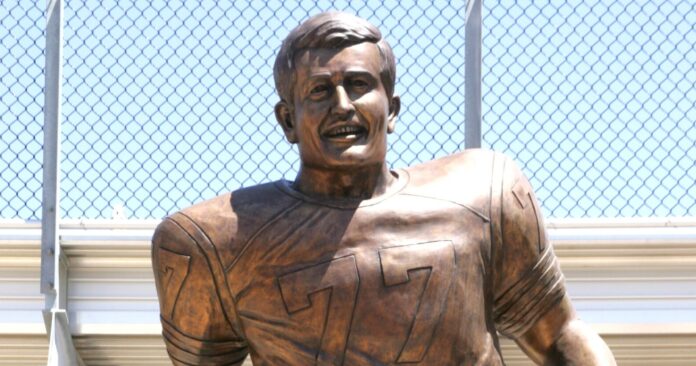
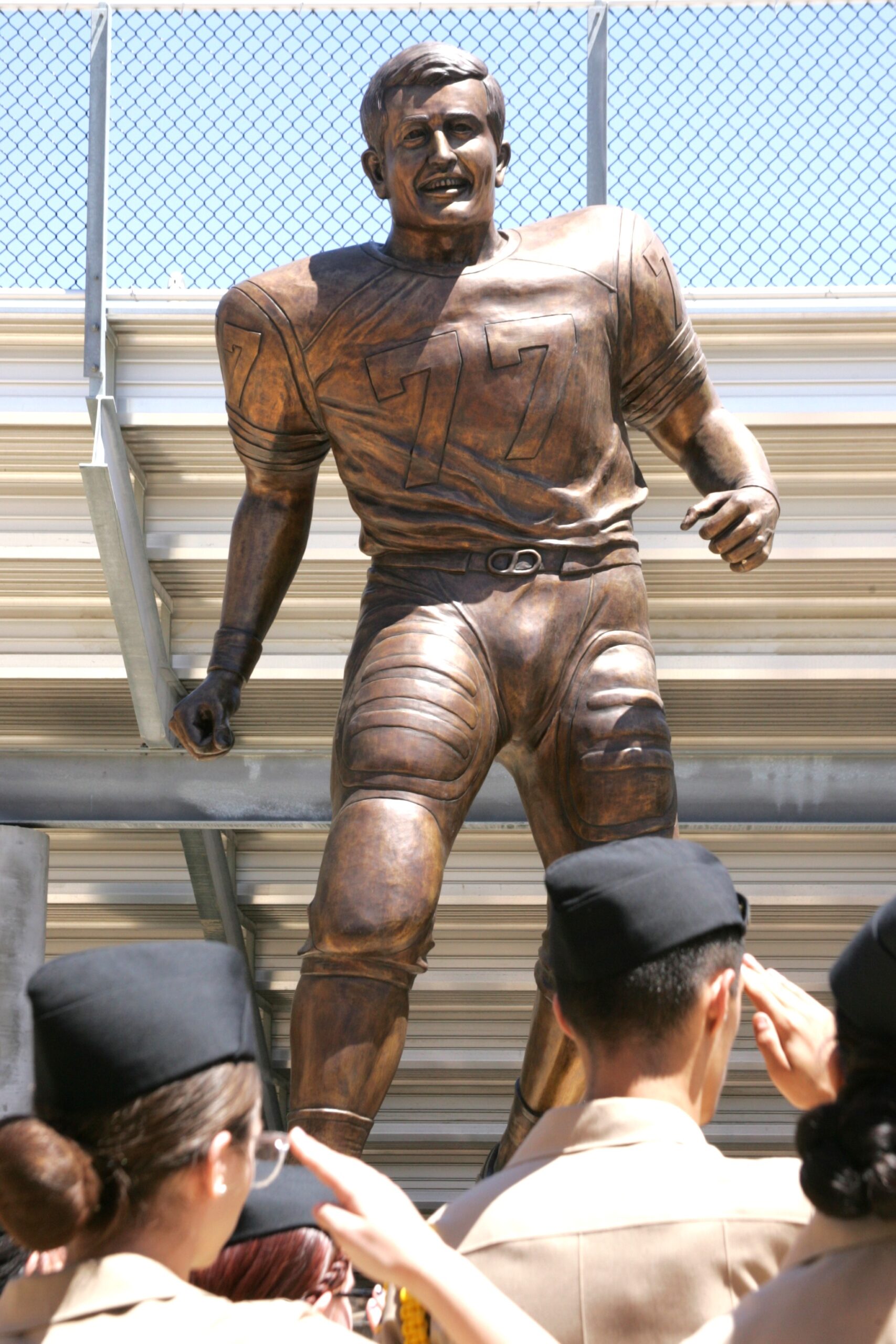
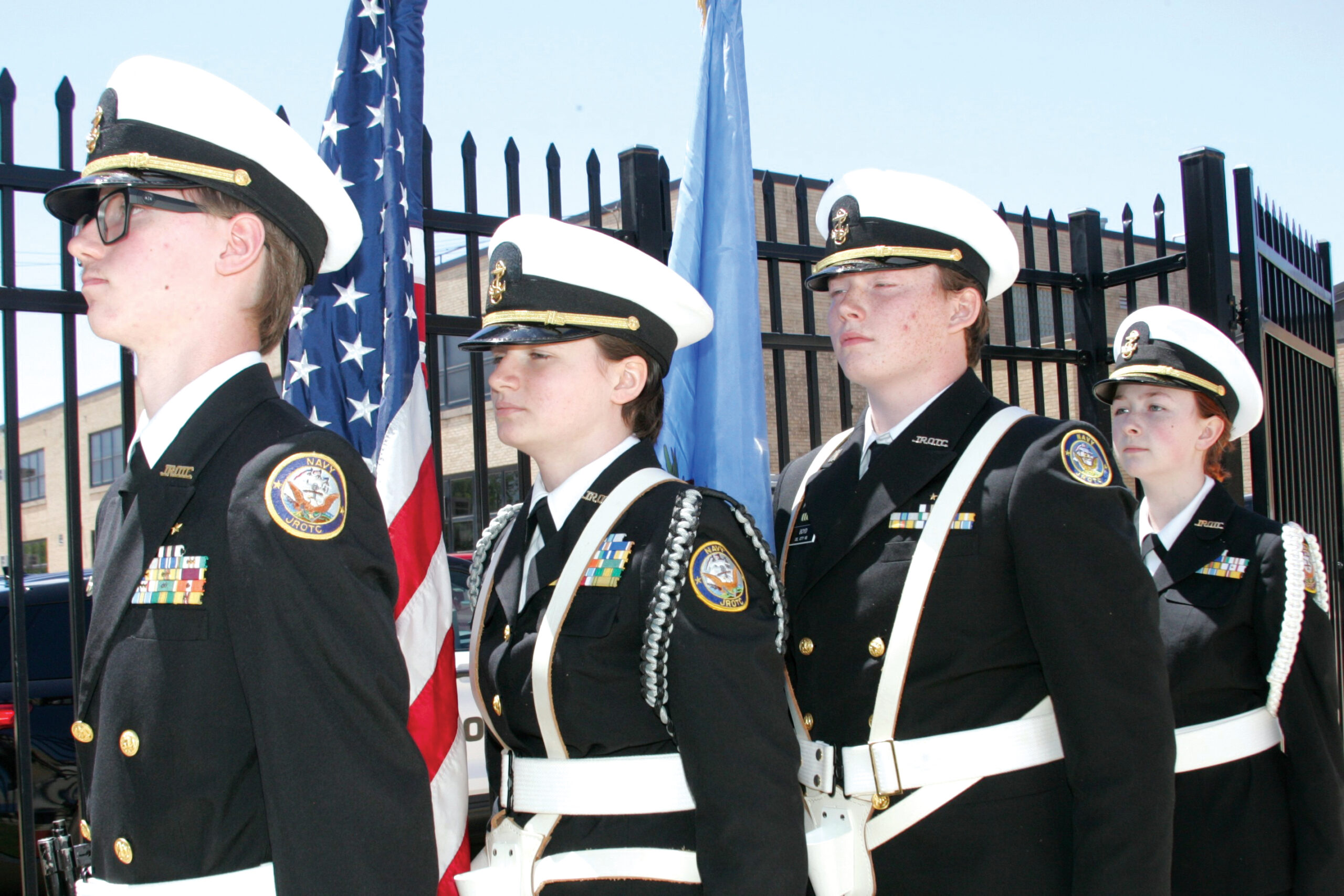
The statue of Robert (Bob) Kalsu stood above the ceremony that day as seven other Del City students were honored for serving their country and being killed in action in Vietnam.From left to right, Del City Junior ROTC Cadets Sebastian Stanton, Eva Black and Beck Boyd present our Nation’s Colors.
State and local dignitaries, accompanied by many veterans and family members of the inductees, led a ‘Del City High School Remembrance and Wall of Honor Induction’ on May 3 at the new Kalsu Plaza, at his namesake DCHS stadium. The significant community presence was a testament to the collective respect and honor for our fallen heroes, showcasing the community’s active role in the ceremony.
When a statue memorializing Army 1st Lt. James Robert (Bob) Kalsu was unveiled March 29, on Vietnam War era Veterans Day last year, his wife Jan remarked he would have asked, “What about the other Del City students who died in Vietnam?”
On May 5 of this year, the other seven DCHS alumni killed in action during the Vietnam War were commemorated on the Robert Kalsu Stadium’s new Wall of Honor. This Wall of Honor, located in the plaza adjacent to his statue, serves as a permanent tribute to these brave soldiers.
A Del City football star, Kalsu, gave up a promising NFL career after starring at OU by showing his patriotism in honoring his commitment to serve in the U.S. Army. He lost his life in service to his country in Vietnam.
Seven of his fellow students now have bronze plaques on the Wall of Honor, each telling a unique and poignant story of their lives and military service. These personal narratives serve as a powerful reminder of the sacrifices made by these brave DCHS students, fostering a sense of connection and empathy from all who will view them.
The United States Marine Corps is represented by 1st Lt. Tom Burton (Class of 1962), Lance Cpls. Jimmy Mullins (Class of 1965), Ricky Sanders (Class of 1966) and Leslie Jones (Class of 1967). The United States Army is represented by Capt. Mike Hope (Class of 1958), Pfcs. Michael Saunders and Gary Parsons (both Class of 1965).
“It is always an honor and humbling experience to attend events honoring our fallen heroes,” said retired USN Rear Admiral Greg Slavonic, former undersecretary of the Navy. “It was especially gratifying to be invited to the recent Dedication/Remembrance Wall of Honor ceremony at Dec City High School. Under the leadership of retired Navy Captain John Keilty, all Del City students who answered the call to serve and were killed in action in Vietnam were honored. These young men walked the halls, played on fields around campus and learned in the classrooms.”
Each inductee was enshrined with a bronze plaque detailing their life and service during the solemn ceremony held that Saturday afternoon. These plaques serve as a lasting testament to the enduring legacy of these fallen heroes, inspiring future generations of DCHS students with their courage and sacrifice while instilling a sense of inspiration and respect.
The Robert Kalsu Legacy Group was co-founded by Mid-Del School Board Member Gina Standridge and Oklahoma State Rep. Andy Fugate, with the support of many other patriotic community leaders. The Legacy Group raised $200K for the statue and plaques. MTM Recognition of Del City cast the statue and plaques, and Willowbrook Construction built the pedestal. The Mid-Del District Maintenance Department installed the new Wall of Honor.
Kalsu graduated from DCHS in 1963, was an All-American at the University of Oklahoma and an All-Rookie Team member for the Buffalo Bills. He became the only active NFL player to die in the Vietnam War.
“I believe the Memorial Plaza at the main gate of the football field is a fitting location for The Wall of Honor,” Slavonic said in an interview. “It will remind students, parents, relatives, friends and anyone coming to an event at the Del City High School Eagles football field how proud the high school is of the sacrifice of these former students who were young and proud to wear the cloth of their nation in time of conflict.”
Additionally, Captain Keilty reached out to the Oklahoma Military Heritage Foundation (OMHF) to establish the OMHF Del City Robert Kalsu Chapter as part of its Hall of Honor.
The “Hall of Honor” will be located at the Del City Community Center. The Hall will honor the 22 Del City citizens who died in military service from World War II to Iraqi Freedom.
“Hopefully, other communities will follow Del City in recognizing their citizen veterans for their sacrifice and service to our country,” Slavonic said. The Del City Veterans of Foreign Wars and American Legion played a crucial role in organizing and conducting the ceremony, partnered with Legacy Group, and Del City Navy Junior ROTC members as the honor guard.
“The day was special for 17 Del City Navy Junior ROTC students who participated in the presentation of our nation’s colors and the reading of the individual citations,” Keilty said in an interview. “A special thanks goes out to all the Del City service organizations and the city of Del City, including the proud members of our VFW, who stood outside the plaza for the whole ceremony to provide a rendering of honors at the end.”
story/photo by Darl Devault, contributing editor
Founded in 1986, by Dr. Jay Don Harris, D-DENT-Dentists for the Disabled and Elderly in Need of Treatment, Inc.-is a recognized 501(c)(3) non-profit organization.
Starting July 1, D-DENT’s new name will be Dentists Donating Smiles to Oklahomans, Inc. Karen Chadwell, Executive Director said.
“We’re very proud of the new name as it is more descriptive of what our services are currently and provides us the opportunity to help more individuals that are in dire need of dental health in the future,” she said.
D-DENT began as a spin-off of Variety Health Center, eventually becoming its own agency after receiving a $100,000 grant from the Oklahoma State Department of Health’s Dental Division.
“D-DENT is a non-profit that provides dental services which are 100% free to the patients,” Chadwell said. “The people we help are seniors, 60 and older, Veterans of any age that do not have VA dental benefits and Intellectually and Developmentally Disabled adults.”
She added “We help people with life-threatening illnesses such as cancer patients, and transplant patients and those that have severe autoimmune diseases. In a lot of those situations, people are unable to get the necessary medical treatment required if their teeth are in bad shape. With the help of our Volunteer Dental Professionals, our patients will receive all the necessary dental treatment needed to receive the medical assistance they not only need but deserve.”
Chadwell said D-DENT has helped over 20,000 people and provided over $30 million in free dental work.
With a network of more than 500 volunteer dentists, hygienists, dental assistants and dental laboratories, D-DENT continues to positively impacts the overall health of many Oklahomans with no access to dental care.
“Our funding comes from grants, fundraising events and donors, both individual and corporate,” she said. “We’re not a clinic and we do not hire dentists. Every bit of the services provided for D-DENT patients are provided by dental professionals from the generosity of their hearts. Should there be the need for crowns, partials or dentures D-DENT pays the bill. Other than that, the dentists provide the X-rays, the exams, the fillings, the extractions, the services needed for as many appointments as the people need until their oral health has been completely restored.”
Chadwell said the services are offered on a one-time basis per patient.
“It is a one pass program. Once patients complete the treatment program, it’s up to them to take care of their teeth from that point forward,” she said.
Chadwell said D-DENT also offers an oral health preventive program.
“D-DENT’s Registered Dental Hygienist, Angela Craig, does oral cancer screenings through our preventative program. In addition, Angela makes routine presentations and consultations in the various senior and IDD organizations throughout the metropolitan OKC area to help people understand the importance of taking care of their teeth, teaching proper brushing technique, providing good oral health guidance, discussions on tobacco cessation, talking about nutrition and its effects on oral health and answering questions regarding their gums or teeth,” she said.
Chadwell said D-DENT offers services at senior facilities and facilities where people with intellectual and developmental disabilities go to day centers, as well as many Veterans events across the state.
“We are out in front of the public at all times trying to help people understand the importance of their oral health,” she said.
She said oral health is a key indicator of overall health, well-being and quality of life.
“Through our Oral Health Education Out reach program, D-DENT provides education and behavioral interventions to seniors and disabled adults in order to share strategies to help improve and maintain a healthy mouth,” Chadwell said. “Because of the many health concerns within this already vulnerable population, oral problems are often overlooked and may be contributors to existing illnesses.”
Samantha Romestan, a Veteran and D-DENT patient, said in a testimonial video she was pleased with D-DENT giving her smile back.
“Before (D-DENT), I was unable to afford services and help from anywhere else. The medications I had to take were destroying my teeth and my bones. I had to find somebody who was willing to take me on as a patient,” she said. “The most rewarding part about the program was the finished product and smile.”
Chadwell said their latest fundraiser will be on July 29 with a golf tournament at Five Iron Golf in Yukon from 5 p.m. to 8:30 p.m. Cost is $100 per person with teams of four. Proceeds will benefit D-DENT’s Veterans programs.
“It’s not a traditional golf tournament. It is going to be at Five Iron’s indoor simulated golf course. The golf course we are playing is Pebble Beach. We will have pizza and auction items. It’s going to be a lot of fun. Spots are still available.”
For more information about D-DENT visit www.d-dentok.org or call 405) 424-8092. story/photo by Van Mitchell
No more long phone waits or trips to the VA medical center. The VA: Health and Benefits App lets you refill prescriptions, message your care team and check benefits anytime, anywhere. With a 4.8 rating in the app store, many Veterans feel it’s an essential tool for managing their VA health care.
Your VA care team at your fingertips
Remember the frustration of trying to reach your provider by phone? They might have been busy, or the call may have been outside regular hours. With the app, you can quickly send a secure message to your VA care team, just like using your favorite social media app.
“It’s great to know I can message my provider and get quick answers,” said Stephen Havard, a Marine Corps Veteran from Texas. “I recently asked my primary care team about a medication, and I had a response by the end of the day.” Veterans are taking advantage of this feature, with over 300,000 secure messages sent each month. Remember, secure messaging is for non-urgent communication only. If you’re in crisis, call 911, 988 (then Press 1) or go to the nearest emergency room. You can also access the Veteran Crisis Line straight from the app.
Kick pharmacy runs to the curb
Gone are the days of waiting in line at the VA medical center’s pharmacy. Refilling medications through the VA: Health and Benefits app is now as easy as ordering takeout. “While sitting in my deer blind, I realized I was low on one of my prescriptions,” said Luke Yanny, a Marine Veteran from Wisconsin. “I opened the app and ordered a refill in just a few taps.” Using the app, you can select the medication you need from your prescriptions, ensuring you order the correct one. Your prescriptions are mailed to your address on file, usually within 5-7 business days, at no cost. With over 250,000 prescriptions refilled monthly through the app, it significantly benefits Veterans everywhere.
Claims and appeals status updates at lightning speed
Remember when checking your claim status was frustrating? It wasn’t very user-friendly, with endless phone loops and navigating various web pages to log in. Now, it’s instant. The app gives real-time updates on claims and appeals, bringing you peace of mind with just a glance at your screen. “The app lets you track your claim from your phone,” said Thomas Turman, a Navy Veteran from Texas. “It’s great not to have to make countless calls for updates.” Veterans have checked their claims over 45 million times through the app—providing 45 million moments of clarity.
Appointments managed with military precision
The app’s appointment feature serves as a personal assistant, helping you view, cancel or track appointments. The app lets you add appointments to your phone’s calendar for easy tracking, ensuring you won’t miss any check-ups. “It’s a lot easier to track appointments,” said Deborah Hall, a Marine Veteran in Alabama. “I recently rescheduled an appointment with my primary care team and added it to my phone’s calendar with just a few taps.” That kind of efficiency would make your drill instructor proud. Once it’s on your calendar, you can easily share it with your caregiver, spouse or family to add to their calendars.
Proof of service in your pocket
The app’s one-touch Proof of Veteran Status feature is like having a digital DD-214. “I’m thankful I can use my Veteran’s discount at different stores,” said Richard McMullen, a Colorado Army National Guard Veteran in Colorado. “Now, it only takes a few seconds to prove my status, and it’s a better option—no paperwork.”
A new battle buddy
Download the VA Health and Benefits app, your new battle buddy for navigating your VA health care and benefits and let it change how you connect with VA. If you find the app helpful, share it with fellow Veterans. Scan this QR CODE or visit www.mobile.va.gov/app/va-health-and-benefits.
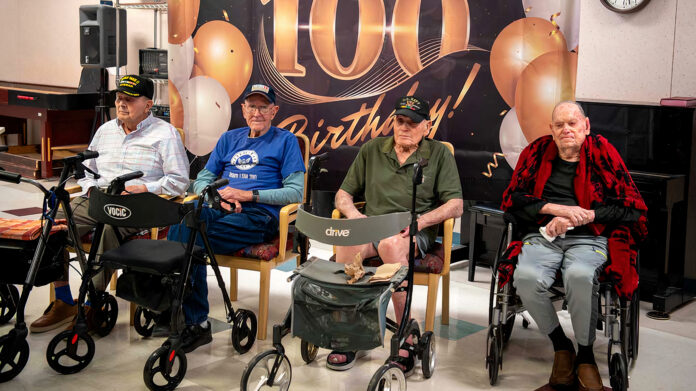
Family members and Veteran caregivers gathered at the Northwest Louisiana Veterans Home in Bossier City, Louisiana, to pay tribute to four World War II-era residents.
All eyes were on Veterans Alfred Procell, 101; Albert Smith, 101; Billie Taylor, 100; and Robert “Bob” Robertson, 100. Between them, the Veterans have 402 years of combined life experience to celebrate.
“These Veterans are truly a living encyclopedia of history, wisdom and experience,” said Kim Lane, associate director of the Overton Brooks VA Medical Center in neighboring Shreveport, where many of the facility’s residence receive their care.
Each Veteran received a framed proclamation and coin signed by VA Secretary Doug Collins to celebrate their life achievements.
Robertson, a Navy Veteran, spent time as an engineer aboard the vessel “Landing Ship Medium 310” in the Pacific during his service.
“If the war hadn’t ended when it did, I probably wouldn’t be sitting here, had they not dropped the bomb on Japan,” Robertson said.
He credits his longevity to never drinking or smoking and some fortunate genetics.
“My dad lived to 103,” Robertson added.
Robertson, Smith and Procell each served in the Navy, while Taylor had a career in the Air Force.
“We’re grateful for the time they have spent with us here at the Veterans Home,” said Wesley Pepitone, administrator of the state-run Veterans home.
by David Hodge, Public Affairs Officer, Overton Brooks VA Medical Center
Harry S. Truman, The 33rd President of the United States
Harry S. Truman The 33rd President of the United States
During his few weeks as vice president, Harry S. Truman scarcely saw President Roosevelt, and received no briefing on the development of the atomic bomb or the unfolding difficulties with Soviet Russia. Suddenly these and a host of other wartime problems became Truman’s when, on April 12, 1945, he became president when Roosevelt died. He told reporters, “I felt like the moon, the stars, and all the planets had fallen on me.”
Truman was born in Lamar, Missouri, on May 8, 1884. He grew up in Independence, and for twelve years prospered as a farmer. He went to France during World War I as a captain in the Field Artillery. Returning, he married Elizabeth (Bess) Virginia Wallace, and opened a haberdashery in Kansas City, which failed.
Active in the Democratic Party, Truman was elected a judge of the Jackson County Court (an administrative position) in 1922. He became a senator in 1934. During World War II he headed the Senate War Investigating Committee, exposing waste and corruption and saving perhaps as much as $15 billion.
As president, Truman made some of the most crucial decisions in history. Soon after V-E Day, the war against Japan had reached its final stage. An urgent plea to Japan to surrender was rejected. Truman, after consultations with his advisers, ordered atomic bombs dropped on the cities of Hiroshima and Nagasaki. Japanese surrender quickly followed. In June 1945 Truman witnessed the signing of the charter of the United Nations.
Soon he presented to Congress a 21-point program, proposing the expansion of Social Security, a full-employment program, a permanent Fair Employment Practices Act, and public housing and slum clearance. The program, Truman wrote, “symbolizes for me my assumption of the office of president in my own right.” It became known as the Fair Deal.
In 1947 the Soviet Union pressured Turkey and, through guerrillas, threatened to take over Greece. Truman asked Congress to aid the two countries, as part of what was soon called the Truman Doctrine. The Marshall Plan, named for his secretary of state, stimulated spectacular economic recovery in war-torn western Europe.
When the Soviets blockaded the western sectors of Berlin in 1948, Truman created a massive airlift to supply Berliners until the Soviets backed down. Meanwhile, he was negotiating a military alliance to protect Western nations, the North Atlantic Treaty Organization (NATO), established in 1949.
In 1948, Truman faced New York Governor Thomas Dewey and a left-leaning third-party challenger, former Vice President Henry Wallace, and defied the predictions of pollsters and analysts to win his own full term as president. After the election, the Trumans moved out of the sagging White House so that it could be gutted and reconstructed. The Truman White House renovations were completed in 1952.
In June 1950, the Communist government of North Korea attacked South Korea. Truman later wrote, “There was no suggestion from anyone that either the United Nations or the United States could back away from it.” A discouraging struggle ensued as U.N. forces held a line above the old boundary of South Korea. Truman limited the fighting, which frustrated Americans—especially his Korea commander General Douglas MacArthur, whom he fired for insubordination.
Having served almost two terms, Truman decided not to run again. Retiring with Bess to Independence, he lived until December 26, 1972. Later, Americans came to appreciate his honesty, sound judgment, and courageous decision making, admiring him far more than his own contemporaries had. Of his presidency, Truman modestly said, “Well I wouldn’t say I was in the ‘great’ class, but I had a great time while trying to be great.”