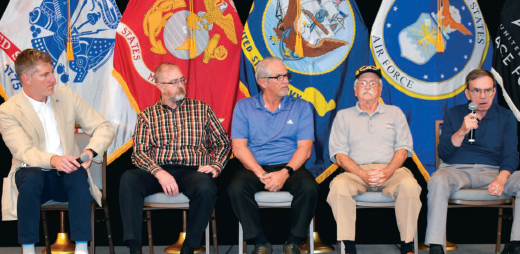
Two well-attended commemorations of Operation Desert Storm’s 35th anniversary occurred in Midwest City, providing informative speakers and a panel of veterans who discussed their deployment to Southwest Asia. The first event, March 27, was organized by Lee McCullum, Fundraising Chief and past Post Commander of VFW Post 7192. Col. (retired) Mark Tarpley and the Air & Space Force Association’s Gerrity Chapter hosted a second commemoration at Rose State College on March 31.
McCullum said, “We wanted to hold it because there’s a good number of Desert Storm veterans in our community. We felt they should be recognized.”
More than 110 veterans, families, and Midwest City Mayor Matt Dukes and State Senator Adam Pugh attended. Guests enjoyed a free barbeque dinner organized by VFW Auxiliary members Sonya McVeigh, Denise Heginbotham, Janet Swenson and Fran Kinchebe.
“Strings of Valor,” a seven-member veteran band, played music. Jay King, a musician, said, “This program has helped me cope with depression and addiction. I’m a better man now, able to help other veterans through music.”
Dukes respects these events. “The value is just remembering the sacrifice that our veterans put forth.”
After dinner, Tarpley, an Air Force Vietnam War and Desert Shield/Storm veteran, provided an overview of America’s participation. He acknowledged United States initially lacked a war plan to counter Iraq’s invasion of Kuwait in August 1990. Stationed at the Pentagon, he explained how the Office of Warfighting Concepts (Checkmate) created an Instant Thunder war plan. It relied on a coordinated mix of fighter, reconnaissance, refueler, and E 3A air battle management aircraft. Tarpey said planners avoided Vietnam War problems with, “You hit them hard, you hit them early and you hit them with all you got.” Ground, air, and naval forces from other Services joined in the buildup. The 43 day air campaign that began January 17, 1991, proved decisive, helping shorten the ground war to 100 hours and reducing casualties. Operation Desert Storm lasted from January 17 – February 28, 1991.
Post Commander Matt Martinez was pleased. “I’m feeling very blessed to have a group of individuals that care enough to know that when there’s a need, or when there’s a time to remember, that we’re at the forefront.”
Afterwards, veterans swapped stories. Air Force Master Sgt. (retired) Brian Wheel deployed near Qatar with the 552nd Air Control Wing from December 5, 1990 to June 16, 1991.
Wheel provided precision approach radar from the base’s air control tower. He explained, “If something happened to the pilot or his plane and he needed to land, but he could not see outside of his plane, listen to my voice.” Wheel would instruct them when to descend and once on the runway, give them directions. “And so many pilots were just so thankful and they were about ready to run out of fuel…” He also guided Bob Hope’s entourage to land for a Christmas show.
Reflecting on his deployment, Wheel said, “It doesn’t matter where you are. It’s what you can make of it. And positive thinking and having buddies with you…helping you out, and you’re helping them out all the time.”
Four days later was Rose State College’s 35th commemoration event. Sixty mostly Desert Storm veterans and Oklahoma State Senator Brenda Stanley attended. After honoring our national symbols, generous amounts of hors d’oeuvres were served.
Tarpley provided a timeline of Desert Shield and Storm. He was followed by Brig. (retired) Gen. Haub, USA, who was Commander, 1st Battalion, 158th Field Artillery, during his unit’s deployment in November 1990 and led offensive land operations into Kuwait, firing 906 rockets at Iraqis.
Col. James Combs, 552nd Air Control Wing Vice Commander, described the E-3 Airborne Warning and Control System airplane’s support to the 43-day air campaign. Brig. Gen. Lindsay Droz, Oklahoma City Air Logistics Complex Commander, explained Tinker AFB’s support.
A panel of Desert Storm veterans who deployed in theater provided insight into combat operations. John Nash, Oklahoma’s Secretary of Military and Veterans Affairs, moderated a talk with Col. Greg Langford, USA, Lt. Col. Jimmy Patterson, USAF, Master Sgt. Michael Joseph, USAF, and Col. Tom Bliss, USAF. • Story for
OK Veteran News Magazine by Lt. Col. Richard Stephens, Jr., USAFR, Ret. website: Rich Travel Niche
Midwest City Remembers 35th Anniversary of Operation Desert Storm

Honoring the Fallen – PFC, Albert E. Schwab

1920 – 1945 Tulsa Medal of Honor Recipient
By Jill Stephenson
The story of Albert Earnest Schwab is one of courage forged through hardship and a legacy sustained by family devotion and community honor.
Born on July 17, 1920, in Washington, D.C., Schwab was the oldest of five children in a troubled household. While his father was often absent due to work, his mother, a Chippewa woman, struggled in ways that deeply affected the family. They moved to Tulsa when he was six weeks old and his parents eventually divorced. Despite the challenges of his youth, Schwab found joy and excelled in sports, graduated from Tulsa High School in 1937 and briefly attended the University of Tulsa. He then went to work in the oil industry.
When military deferments were lifted during World War II, Schwab and his brother-in-law enlisted in the Marine Corps. Schwab quickly proved himself to be intelligent and driven and earned a reputation as an overachiever.
PFC Schwab served as a flamethrower operator in Okinawa, Japan. On May 7, 1945, during intense fighting in Okinawa, his unit became pinned down in a valley by machine gun fire coming from a ridge ahead. Facing relentless enemy fire, Schwab climbed the steep cliff toward the gun position. Fully exposed, he reached the emplacement and used his flamethrower to destroy the weapon and its crew. His actions allowed his company to move forward and take control of the ridge. Shortly afterward, a second machine gun opened fire, causing additional casualties and stopping the advance. Before he could refill his fuel supply, he moved forward to confront the new threat. Despite his limited resources, he successfully eliminated the second position.
As Schwab completed the attack, the enemy fired one final burst, causing fatal wounds. His fellow Marines recognized the extraordinary nature of his bravery and gathered witness accounts that would support the highest recognition of valor.
For his gallantry, Schwab was posthumously awarded the Medal of Honor. In
a ceremony in Tulsa on Memorial Day 1946, his medal was presented to his three-year-old son. His sacrifice would continue to be honored in the years that followed, including the naming of Camp Schwab on Okinawa in 1959 and a statue and designated reception area at Tulsa International Airport. His story also reached a wider audience through the writings of famed World War II correspondent Ernie Pyle.
Initially buried in Okinawa, Schwab’s remains were later returned to the United States at the request of his father. He was laid to rest with full military honors at Memorial Park Cemetery in Tulsa in 1949. According to his niece Judy Bryant, given the magnitude of his heroism, the plainness of his grave has long felt inadequate to the family. Bryant has dedicated years to ensuring her uncle receives a more fitting tribute. Inspired by her mother JoAnn, Albert’s sister, she has worked with veterans’ organizations and community supporters to redesign his gravesite so that it more aesthetically reflects his brave and gallant sacrifice. Reflecting what a Marine of his era would have carried, the proposed design includes a Soldier’s Cross and a granite slab engraved with the full wording of his Medal of Honor citation.
Working with Tulsa’s Memorial Cemetery, the effort has taken more than a decade to gain approval and momentum. With support from individuals like John Camp of the Marine Detachment unit, plans are moving forward. The project is has been established to raise the necessary funds. For Bryant, the work is deeply personal but rooted in humility. She has never sought to claim any part of her uncle’s heroism, only to ensure that it is properly remembered. The journey has connected her with veterans and supporters whose shared respect for service has been both humbling and inspiring. Citing it as a tangible way to preserve Schwab’s story for future generations, completing the gravestone project remains a central goal on her life’s bucket list.
Albert E. Schwab’s life was shaped by adversity, but defined by heroism and valor. Today, his legacy endures not only in history books, but will be preserved by the efforts of those who refuse to let his sacrifice fade and will assure he is given the recognition he deserves in his final resting place.
Donations to help with the cost can be made by going to the Albert E. Schwab Detachment of the 857 Marine Corp League website www.mcl857.org and following the DONATE button prompts. Once the page is reached to finalize the donation, there will be a box to add an additional note. Please include
“Medal of Honor Fund” to ensure it is applied accordingly.
Any contributions received over and above what is needed will be directed toward local veteran causes.
On the Cover: A Tribute to Service A Legacy of Nursing and Community Service
This past May, as the profession celebrated National RN Recognition Day and the 130th anniversary of its national organization during the opening week of National Nurses Month, retired nurse Eileen Kupper-Grubbs was honored at the Oklahoma State Capitol.
Serving on the front lines of healthcare advocacy, she was formally recognized on May 6 by Oklahoma Sen. Lisa Standridge, R-Norman, for her exceptional contributions to the legislative community. Honored through the Oklahoma Nurses Association’s Nurse of the Day Program, her presence at the Capitol underscored the vital connection between clinical practice and state healthcare policy.
“Over my time in office, I have had the privilege of getting to know Eileen and witnessing firsthand the compassion, humility and servant leadership that define her life,” Standridge said in a statement.
“Her dedication to our nation’s veterans is not something she turns on and off-it is who she is. She dedicated her professional nursing career to caring for veterans at
the Veterans Affairs Medical Center. Even in retirement, she continues serving those who served us all through her work as 2nd Vice Commander of Norman American Legion Post 88.”
Kupper-Grubbs has been a member of both The American Legion and The American Legion Auxiliary since 2020.
“I have watched Eileen tirelessly organize events, support veterans and their families and ensure that the sacrifices of our servicemen and women are never forgotten. She leads with a deep love of country and a profound respect for those willing to defend it.”
When asked why she chose to become
a VA nurse, Kupper-Grubbs said, “I am a Veteran, and my father, brother, and one sister were in the Army. Veterans are a precious few who would die for the United States. I wanted to be part of their care.”
“Those words capture the heart of who she is, someone who answered the call to serve long after her uniform was put away,” Standridge said.
“Today, I ask all Oklahomans to join me in recognizing and thanking Nurse Eileen Kupper-Grubbs for a lifetime of selfless service, compassion, and unwavering devotion to our veterans and our community,” Standridge said.
Kupper-Grubbs led a life steeped in military service and nursing. She was a military child whose father served in the Korean War. Her father’s sister, Florence, went to nursing school, where she met Kupper-Grubbs’ later-to-be mother. When her father returned from the war, his sister, Florence, introduced them.
Kupper-Grubbs’ grandmother, Lois, was a private nurse to a family in Illinois. “My mother was a diploma nurse. I am the third of four generations of nurses in my family,” Kupper-Grubbs said. “My sister is an advanced practice registered nurse. My niece, Christine, is an assistant professor and a coordinator in the Bachelor of Science in Nursing program at Oklahoma State University. Her doctoral degree is from the University of Oklahoma.”
Kupper-Grubbs is a U.S. Army Veteran whose post-military career was highly focused on healthcare and now veteran advocacy in retirement. She served for three years as a Military Police (MP) officer. She also received written training in healthcare during her enlistment.
After her service, she graduated from Cameron University in Lawton with an associate’s degree in nursing using the GI bill. She moved to Moore, Oklahoma and attended Central State University to earn a Bachelor of Science in Nursing with a minor in psychology.
She then worked for seven years at Oklahoma City’s major teaching hospital, Oklahoma Memorial Hospital. It has since been renamed OU Health University of Oklahoma Medical Center, which is now Oklahoma’s primary teaching hospital.
Her first nursing job was as a medical/surgical nurse, and she became interested in transplantation.
She and her husband, Eric Grubbs, whom she married in June of 1979, moved
to Ohio when he got a job near The Ohio State University Wexner Medical Center. Kupper-Grubbs served on the transplant floor there, did research and was published in the widely circulated RN magazine.
When Eric and Eileen Kupper-Grubbs moved back to Oklahoma, she became a certified transplant nurse. She transitioned from Oklahoma Memorial to Deaconess Hospital to continue her clinical experience in medical-surgical healthcare. Kupper-Grubbs provided dedicated service to the VA Oklahoma City Healthcare System for 13 years, beginning in October 2012. Board-Certified Medical-Surgical Registered Nurse Kupper-Grubbs served as a care manager within the healthcare system, coordinating complex treatment plans, managing resources, and advocating directly for patient needs. She specialized in acute care, patient stabilization, and post-surgical recovery, alongside fulfilling roles in palliative and ambulatory care settings.
She fulfilled her dedication to nursing as the final chapter of her 41-year nursing career at the OKCVA, retiring in June 2024.
“I am now a volunteer advocate at LifeShare Transplant Donor Services of Oklahoma, Inc. and a donor family member. My nephew, Jeremy, was a kidney and liver donor,” Kupper-Grubbs said. “I have been a docent in the Natural Wonders Gallery at the Sam Noble Museum of Natural History for 17 years. I also volunteer with the Cleveland County Election Board.”
Kupper-Grubbs said, “129 years after my grandfather was born, our family has been in service to others,” she said. “We have had four members in the US Army. My son graduated from the United States Military Academy at West Point in 2006 and is currently serving in Korea. My niece Christine is teaching future nurses in Oklahoma.”
“Life does repeat itself, as you see,” Kupper-Grubbs said. “Nursing is an art, not a science; caring for others after caring for yourself is a calling.”

Story and photos by Darl DeVault, contributing editor
Dispelling the Myths of Women Veterans Recognition Day
Women Veterans Recognition Day is not a separate Veterans Day for women. The day, celebrated yearly on June 12, recognizes, honors and remembers the signing of the Women’s Armed Services Integration Act (pub.L. 80–625, 62 Stat. 356), allowing women the right to permanently serve in the regular armed forces.
Women have served in America’s wars and conflicts throughout our history. They played vital roles in the Revolutionary War, serving as soldiers, raising morale and spying on the enemy. It is known that some even disguised themselves as men to be able to serve. More than 400 women fought in the Union and Confederate armies during the Civil War.
During World War I, about 35,000 women officially served. Women served in lifesaving roles such as nurses, and critical support staff roles such as the Hello Girls, formally known as the Signal Corps Female Telephone Operators Unit. In World War II, 350,000 women served in the U.S. military in occupations such as nursing, military intelligence, cryptography and parachute rigging.
In August 1943, the Women’s Flying Training Detachment (WFTD) and the Women’s Auxiliary Ferrying Squadron (WAFS) merged into a single unit for all women pilots and formed the Women’s Airforce Service Pilots (WASPs). They flew more than 60 million miles in two years. During this time, the 6888th Battalion was formed as the first and only all-Black Women Army Corps (WAC) unit to deploy overseas during WWII. Their nickname was “Six-Triple Eight” and their motto was “No Mail, Low Morale.”
Breaking barriers on June Day 1948 – Before the signing of the Women’s Armed Services Integration Act on June 12, 1948, only women nurses could serve in the regular and reserve forces during peacetime. All other women were sent home after each conflict. The signing of the Act deemed women essential to the war efforts and allowed them to serve in the regular armed forces full time. The Women’s Armed Services Integration Act, coupled with President Truman’s decision to desegregate the military, also permitted African American women to officially serve in the military, five years after the 6888th Battalion accomplished its mission of cleaning two years of mail backlog in three months, twice. When women can, they do.
A day worth recognizing – June 12 proclamations and events around the U.S. each year commemorate the signing of the Women’s Armed Service Integration Act by President Truman in 1948. The date was first recognized as a commemorative date when the New York State Assembly declared June 12, 2008, to be Women Veterans’ Recognition Day.
Women served, women belong – Today, women serve in all military occupational specialties, including logistics, munitions, intelligence, and many combat. Women contribute to the most professional, educated, agile and strongest military the U.S. has ever seen.
Despite their longstanding service, many women Veterans struggle to be recognized, respected and valued as Veterans in civilian life. After all they have done and continue to do, women Veterans deserve the support and respect they have earned through their service. They should feel like they belong at VA.
VA understands that women Veterans face specific challenges and have unique health care needs. Beginning in 1992 with the Veterans Health Care Act, VA has been providing gender-specific care to eligible women Veterans. Since then, we have been expanding those gender-specific services and launching initiatives to make women Veterans aware of their well-deserved benefits. We also continue to support our facilities across the country in fostering a comfortable, welcoming atmosphere for the women Veterans who come through our doors.
Recognize outstanding women – There is so much history about women Veterans to be told, and it’s important that women continue to be recognized for their service and sacrifice. On March 12, 2022, Public Law 117-97 was passed to award the Congressional Gold Medal to the members of the Women’s Army Corps who were assigned to the 6888th Central Postal Directory Battalion, known as the ‘‘Six Triple Eight.’’
This June 12, to all women Veterans out there – Happy Women Veterans Recognition Day from VA and Oklahoma’s Veteran News.
by Missina Schallus, Navy Veteran and communications manager for the VA’s Center for Women Veterans.
“Run to Remember” Sparks Community Pride

Tinker Air Force Base and its “Tinker Strong” philosophy were capably represented by Col. Tamilyn S. Dismukes, Deputy Commander, 72d Air Base Wing, at the 2026 Oklahoma City Memorial Marathon’s three events on Saturday, April 25, in downtown OKC. She draped finishing medals over participants in the 5K run and the Senior and Kids cumulative-mile finishes of their marathons.
“Handing out medals at the Oklahoma City Memorial Marathon finish line was a humbling reminder of Oklahoma’s incredible dedication and passion for community,”
Col. Dismukes said. “Witnessing thousands of participants-including our service members, veterans, retirees, and their families-vividly illustrates the enduring resilience of Oklahomans. This profound shared experience reinforces the unbreakable, supportive partnership between our military and the local community.”
Spanish Cove Retirement Village and Vietnam Veterans were also well represented on April 25. The 75-strong contingent from Spanish Cove in Yukon, Oklahoma, won
a $500 cash prize for having the most participants in the Senior Marathon. The prize money is directly designated to fund and enhance the winning group’s community wellness programs.
The Senior Marathon and Kids Marathon use a “couch-to-marathon” remote compilation structure. Participants aged 60 and older walk or run a total of 25 miles incrementally starting in January (averaging roughly 1.5 miles per week).
On Saturday, April 25, at 8 a.m., the Spanish Cove team, all wearing team
T-shirts, started from outside the Oklahoma City National Memorial & Museum to complete their final 1.2 miles together in downtown OKC.
The course guided the seniors through the streets of downtown Oklahoma City, concluding with celebratory finish medals at Scissortail Park.
The team’s efforts were spearheaded by their Wellness Director, Debbie Miller, who coordinated the training schedules, group registration, and race logistics to foster active aging.
Miller has also assembled many Dragon Boat crews since 2012 to race on the Oklahoma River downtown in RIVERSPORT’s Dragon Boat League. Spanish Cove now fields multiple specialized crews, including the Golden Dragons, Silver Dragons, and even specialized co-ed and all-women’s rosters.
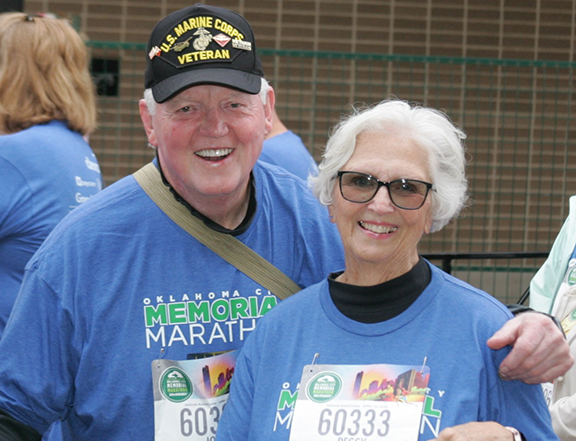
In a heartwarming display of resilience, Vietnam Veteran retired Marine Capt. John Bisbee, who recently gained 100% disabled Veteran status for his Agent Orange exposure at 76, walked for the second year in the Senior Marathon with his wife Peggy.
Bisbee said he saw the event as a way to support the nonprofit Oklahoma City National Memorial & Museum that opened in 2001. It has been serving the community for 25 years in honor of the victims, survivors, rescuers, and all those affected by the devastating April 19, 1995, bombing.
Just by walking its unique cumulative 25-mile training regimen before the race weekend, by completing 1.5 miles each week starting in January, they were ready. On the day of the race, they completed their marathon by walking the final 1.2 miles at the “Run to Remember.”
Bisbee said participating in the Memorial Marathon weekend holds a profound significance. “My wife and I enjoy being a part of all that
the Memorial Marathon represents-our community coming together to remember those killed, those who survived, and those permanently changed by the 1995 Oklahoma City bombing in 1995.”
Their unwavering commitment to the event serves to inspire others, showing that with perseverance and the right mindset, anyone can achieve their goals and positively impact their
community.
The Senior Marathon is an untimed event, allowing runners to savor the experience without pressure or competition. In addition to the race,
the Senior Marathoners had the opportunity to participate in the Health and Fitness Expo at the Oklahoma City Convention Center on Saturday. The Expo, presented by the OKC Convention and Visitors Bureau and OU Health, was located adjacent to the finish line. It offered a platform for Senior Marathoners to interact, show their support, and gain insights into health and fitness.
The Oklahoma City Memorial Marathon is the largest fundraiser for the privately owned and operated Oklahoma City National Memorial & Museum, a National Park Service-affiliated site. Runners received free admission to tour the Museum that day.
Over two days, the event welcomed more than 20,000 runners and walkers from across the United States and several foreign countries. In addition to the Senior Marathon, a 5K and a kids’ marathon, the event featured a half-marathon, a marathon relay (comprising five-member teams) and a wheelchair division.
The Senior Marathon was presented by Mercy, a nonprofit Catholic health system serving Arkansas, Kansas, Missouri, and Oklahoma, as the event’s presenting sponsor.
The fourth year of the Senior Marathon was an outstanding testament to the indomitable spirit of seniors supporting their community and promoting a healthy, active lifestyle. • story and photos by Darl DeVault, contributing editor