Monday, August 10, 2026

Newby-Vance Mobility Serving Veterans And Their Families For More Than 30 Years

0

Newby-Vance Mobility (NVM), located within the John Vance Group in Guthrie, has been trusted for 30 + years to serve individuals and families with special transportation and driving-related needs.
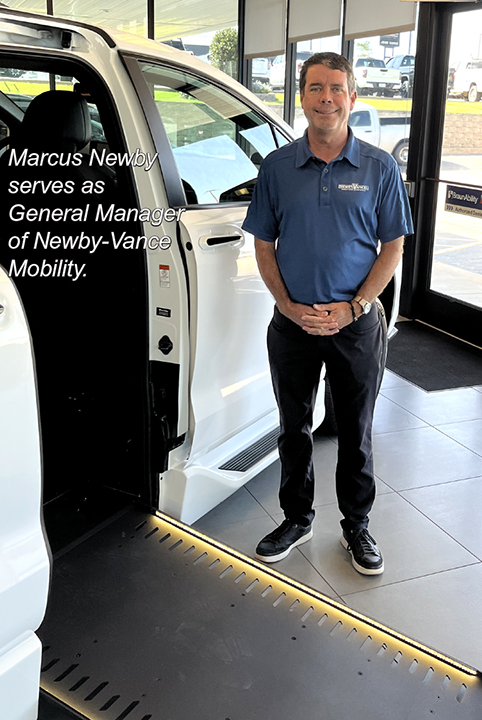
“We are a mobility vehicle and adaptive equipment dealer. We sell, service, rent and warranty wheelchair accessible vehicles and related adaptive mobility equipment, all at a single location,” Marcus Newby, NVM’s General Manager said.
Based on the unique and individual needs of people, there is a wide continuum of specially adapted vehicles and services.
This can range from a simple steering device to an electric scooter lift installed in a vehicle, to a set of hand controls for someone to drive independently.
They also provide fully adapted wheelchair accessible vehicles that allow people in wheelchairs to independently enter and exit the vehicle; options exist for driving from a wheelchair or riding as a passenger in a wheelchair or by transferring to a seat. An evaluation of people’s needs and wants is critically important to identifying the best solutions for any given person or family.
Newby added that his goal as a mobility specialist is to sit down with customers and learn of their unique situations and challenges. From this a plan emerges that can maximize the customer’s ability to be mobile, independently or with assistance; the plan may include a specialized vehicle or a simple item of adaptive equipment. Suddenly, options open in people’s lives in areas of life such as going to school, job maintenance, getting to-from work, going to church and doctor’s appointments, or simply going shopping.
“The overall goal is to assist people and families in maintaining and improving their quality of life with work, friends and family,” he said.
Newby-Vance Mobility opened for business in January 1996.
Their story begins with two landmark federal laws: the Rehabilitation Act of 1973 and the Education of All Handicapped Children Act of 1975. As these laws opened school doors
to students with disabilities, one critical barrier remained: transportation.
Newby said his father Dr. Jim Newby witnessed this firsthand as New Mexico’s State Director of Special Education.
“Jim spent his entire career working with children and youth with special needs in the public-school sector,” Newby said.
Newby said this was a time when families were forced to navigate a fragmented transportation service system: buying vehicles from automobile dealers, then seeking modifications elsewhere with no single point of service or accountability when things went wrong. Jim knew there had to be a better way. The integrated public school system was the model.
“The idea emerged…why can’t I go to an automobile dealership and propose the creation of an inclusive business that provides these special vehicles and services at an auto dealership?” Newby said.
Dr. Newby envisioned a fully integrated model, one that unified vehicle sales, accessibility engineering, and service support under one roof.
In 1995, he shared that vision and proposal with the multi-franchise dealer principal, Mr. John Vance, and together they founded Newby-Vance Mobility in early 1996.
Today, Newby-Vance Mobility is Oklahoma’s largest mobility dealer, now with two locations, the original “north store” in Guthrie, at 5632 S. Division Street, and the newest “south store” in Oklahoma City at 7500 South Shields Avenue.
“So, if you come to Newby-Vance Mobility within the family of John Vance Motors, and you have a unique challenge that necessitates the use a wheelchair, or walker, and you need an accessible vehicle, and/or specially adapted driving equipment, you can come here and be met and treated just like anybody else,” Newby said. “We can help you figure out how your needs can be met, whether it’s a special vehicle, or specialized equipment. Before you spend your hard-earned money, we can tell you whether a particular vehicle, or equipment, is compatible with your needs or not. We can help you get an idea of your needs and help you purchase the vehicle and the equipment, everything all at a single location, just like anybody else that has a need to be mobile, to acquire a user-friendly vehicle. That’s our goal.”
Newby said that Newby-Vance Mobility is a certified dealer/vendor that also specializes in transportation-related services for Veterans through the Veterans Administration (VA).
NVM benefits veterans because they can experience that same level of service and sales at one location.
“We have many veterans with disabilities come to us and they are not aware of the VA or other veteran programs designed to help them with their transportation-related mobility needs. NVM is very well-rehearsed in the programs that the VA offers,” Newby said. “If you are an eligible veteran, the VA may very well assist you with adaptive mobility equipment for your vehicle.”
Newby said that NVM works to educate veterans about mobility equipment they might be eligible for through the VA.
“NVM also works with other veteran advocacy organizations such as the Paralyzed Veterans of America to learn how to go to the VA and exactly what the process is that they go through to apply for these benefits,” he said.
Newby remarked that it is an honor to serve veterans.
“Veterans always have a special place in our heart because of what they’ve done for our country,” he said. “We try to go above and beyond to give Veterans the most streamlined experience they can have of figuring out exactly what they need, and what is available related to vehicle adaptations and, how to go through the process of the VA to determine eligibility.”
Newby said Newby-Vance Mobility works with the VA on the commercial side as well.
“We just delivered seven wheelchair accessible vehicles to the Veterans Administration in Oklahoma City. We’ve sold many of these to the VA hospitals around the state,” he said. “We work with the
VA regional hospital and living centers on the commercial side; we service their wheelchair lifts in many of their wheelchair accessible buses – these busses are used to transport many Veterans to-from the area VA living centers. It is an honor, and a good feeling to work with both the VA Hospitals and VA Regional Living Centers on the commercial side, and the Veterans themselves on the personal side.”
Newby said Newby-Vance Mobility treats veterans and all its customers as family.
“We pride ourselves that…after a purchase is made, that’s when our real job starts, and that’s taking care of these folks for as long as they own that special vehicle or equipment, and keeping them on the road,” he said. • Story and photos by Van Mitchell, staff writer
For more information about Newby-Vance Mobility call
(405)-282-3113 or (405)-778-2013 or visit www.newbyvancemobility.com.

Strength, Service, and Legacy:The Story of a Woman Veteran

0
Priscilla Adams deployed to Iraq in 2004 to supporting special operations with a helicopter squadron.

Priscilla Adams stood before a room full of women veterans being honored on June 13th at the Claremore Veterans Home and reminded them that their stories, sacrifices, and voices matter. For far too long, she said, women veterans have been the ones left out of the conversation.
As the keynote speaker for the event, her own story began long before she put on a uniform. Her father was a Marine and taught her the value of discipline and hard work. He convinced her to join the Navy instead of the Air Force, something she still teases him about. Her mother was tough when it counted, but loved just as fiercely. Through 21 years of service, her husband and her family carried her. She said her husband made countless sacrifices for their family, often taking on the role of both parents when her military and professional responsibilities pulled her away. Her son, now 23, recently graduated from college after earning a football scholarship. Her daughter holds a brown belt in karate and wrestles for her high school team. She says she is a force to be reckoned with.
Adams is candid about what her service actually cost. In 2004, she deployed to Iraq supporting special operations with a helicopter squadron. Her son was only a one-year-old and just learning to walk. She stated that as a 22-year-old, the deployment was hard, frightening, and rewarding all at once. She witnessed combat, sacrifice, and the incredible bond shared by her brothers and sisters in arms who are all willing to do anything for each other. These are experiences that cannot truly be understood by someone who wasn’t there.
Her career wasn’t without its battles closer to home. She described serving
under a commanding officer who had a particular issue with women and would
berate her loud enough for the whole office to hear. At the time she was leading a
team of thirty sailors, a team that went on to pass every inspection and earned Command of the Year. Rather than let the commander’s behavior define her leadership, she chose restraint, and years later, when he asked her to speak at his retirement, she did so with grace. She reflected that true leadership is not about titles or circumstances, it’s about leading from the front, maintaining your integrity, and setting an example no matter what the situation.
Adams speaks with deep respect for the generations of women who served before her, many who did so quietly and without recognition. She sees it as her responsibility to help preserve their stories for the generations to come.
Having earned the rank of Chief Yeoman, when her Navy career ended, she found the transition to civilian life brought its own kind of challenge. The structure and identity the military gave her had to be rebuilt. She found it in a career as an HR Director, where
she says the skills she developed while wearing the uniform translated directly into civilian leadership.Those skills included communication, adaptability and conflict resolution.
Her service didn’t stop there. Today, she works as a Veteran Service Officer for the Veterans of Foreign Wars. She helps veterans and their families navigate the often confusing process of claiming the benefits they’ve earned. She is especially drawn to helping other women veterans. Sadly, she has found that many of them don’t even think of themselves as “veterans” in the same way men do, or they assume someone else needs the help more than them. Her work is incredibly rewarding. She enjoys being able to educate them about the benefits they have not only earned, but also deserve because they answered the call to serve our country.
At one point during her speech she asked the veterans in the room to stand. First those
who served during wartime, then overseas, then those who raised children while serving. Looking around at the women on their feet, she stated, “This is what strength and resilience looks like. This is the legacy of women veterans.”
Adams advised the young women actively serving now to share their story, offer guidance, and never underestimate the difference they can make from leading by example.
In addition to Adams, there were more than a dozen women veterans in attendance,
including two who reside at the Veterans Home. There were door prizes, a potluck luncheon and a full sheet cake for all to enjoy. The event was sponsored by the Claremore VFW Post 2976 Auxiliary and the American Legion Unit 141 Auxiliary. • story
by Jill Stephenson, contributing writer

ON THE COVER: Handling Herbicide Orange Leads to Increased Disability Rating to 60% for Vietnam Vet

0
MSgt William (Bill) Dooley, retired, age 87, sits at Midwest City’s Veterans Park holding his military shadow board

Staff Sergeant Bill Dooley and four team members donned gas masks with respirators, heavy-duty rubber gloves and coveralls to avoid smelling or touching Vietnam War-era Herbicide Orange, aka, Agent Orange, they were removing from 15,000, 55-gallon
drums. Forty-nine years later, his military service-connected disability increased to 70% after he proved his connection to Agent Orange. The PACT Act helped him qualify for the higher rating.

Operation Pacer HO (Herbicide Orange)
Dooley, a logistics specialist with the 2953rd Combat Support Logistics Squadron (CLSS), deployed to the Naval Construction Battalion Center, Gulfport, Mississippi, with 20 other Airmen from Tinker AFB for six weeks between April and June 1977. He left Martha, his wife, and three children behind. CLSS’ from the Air Force Bases at Kelly, San Antonio, and Hill also deployed to remove the defoliant.

Preparation
Dooley remembered squadron leadership saying, “that we’d be taken care of with clothing and appropriate material during getting rid of the herbicide orange…And I’ll say this, they did.” He added, “Before we went, we were all tested for various things in our system”
Medical testing, for heart, for lungs, for any ailments. When we got through with the job, we were tested three different months to see if there was any difference from the beginning.”

On site
Dooley, the third person in the assembly line, served as the tipper and sprayer. After tipping the barrel over, “I sprayed it with diesel fuel with a little foot thing (lever) which would shoot up and clean it.” The Gulfport Sun Herald newspaper reported, “Both the herbicide and fuel will be pumped into railroad tank cars.”
On their last work day, one of the guys attached a white sheet to the railroad car with the wording, “Bye, bye Herbie. And he sat on top of the railroad car,” said Dooley. “It was a good feeling.”

What was Herbicide Orange like?
“Kind of reddish-brown color,” remembered Dooley. It had the consistency of vegetable oil. Were there vapors? Yes. “That’s why we wore a gas mask all the time.” A smell? “It had a horrible smell…musty…and it was on our clothes. They burned our clothes when we
got all through.”

What happened to the defoliant?
Newspaper reports said that once the railcars were filled with defoliant, they were moved to the Port of Gulfport, where hoses transferred the defoliant to the incinerator ship Vulcanus. The ship sailed near Johnston Island in the Pacific Ocean where the liquid was burned. The Environmental Protection Agency approved the entire plan.

Homecoming
Even at home, Dooley said, “You could smell it all the time. It wasn’t a nauseating smell, and it perforated everything you wore. My wife said she could smell me for about several months afterwards, no matter how much I shaved, no matter how much I bathed.”
Tinker’s deployed CLSS members received Air Force Commendation Medals.

Disability
Dooley retired as a Master Sergeant on November 1, 1984, with 21 years of service and a 10% disability rating from the VA for having an enlarged heart. On February 12, 2023, the VA increased it to 40% after evaluating his kidneys, diabetes and heart. Finally, after talking with veterans and reading about the PACT Act (Honoring our Promise to Address
Comprehensive Toxics Act, a law signed in 2022), Dooley, who lives in Del City, requested and received extensive VA tests. Result? His major conditions identified hypertension, coronary artery disease and chronic kidney disease. Those findings increased his overall disability rating to 70% on Dec. 15, 2025.

Advice to veterans
“I looked into the possibility of increasing my disability because of my handling of Agent Orange,” Dooley said. “I hope veterans will read this and if they’re not feeling well, check with the Veterans Administration.”
He encourages veterans to seek testing if they believe their past or current military service has affected their physical or mental health.

Veteran resources
“The PACT Act is a law that expands VA health care and benefits for Veterans exposed to burn pits, Agent Orange, and other toxic substances. This law helps us provide generations of Veterans-and their survivors – with the care and benefits they’ve earned and deserve.” (from the VA website at www.va.gov/resources/the-pact-act-and-your-vabenefits/)

SSgt Bill Dooley poses with his new Commendation Medal in 1978 for disposing of Herbicide Orange at Gulfport, Miss. He was assigned to the 2953rd CLSS, Tinker AFB. Photo by the Dooley
family

HOTTER’N HELL 100 Thrives in Wichita Falls

0
Several riders in this group of the newly formed Prostar cyclists in Oklahoma City have ridden HHH in the past, and many will again this year.

Named USA Today Readers’ Choice for Best Road Cycling Event for 2026, the adventure for seniors is even more inclusive and as close as Wichita Falls, Texas, the weekend of August 27-30, with the 45th-anniversary Hotter’N Hell 100 (HHH).
As the largest century bicycle ride in the nation, the HHH fosters a welcoming community and camaraderie, uniting over 13,000 riders who share a love for cycling and support each other through the challenge.
The inclusiveness allows senior cyclists to explore their new electric bicycles’ capacity for extended fun. Wichita Falls event organizers are happy to provide them equal access, only asking them to be careful.
Long-time HHH organizer Chip Filer notes that while e-bikes are not explicitly mentioned in the official documentation, owners are welcome to participate with the understanding that they must exercise caution, especially at the start and rest stops, to prevent control issues and ensure safety.
“With our aging population, we are open here at Hotter’N Hell to accommodating cyclists who are switching over to e-bikes,” Filer said last year. “Again, we just need them to realize those e-bikes can present control problems if the riders are not vigilant.”
Given the recent hotter-than-usual temperatures in July, participants should prepare for possible extreme heat on August 29, with tips on hydration, sun protection, and contingency plans available on the event website to help you stay safe and comfortable.
The event’s safety and support are
a top priority, with over 100 committee members and more than 1,000 volunteers ensuring a secure experience. This includes medical support and Support and Gear (SAG) assistance on every course and every rest stop.
From the large bicycle consumer show, featuring 50 booths showcasing the latest innovations and major manufacturers, to the myriad of other attractions, including a spaghetti dinner and a pre-ride breakfast buffet, there’s something for everyone.
After putting this on for 45 years, there are too many things going on during the four days to detail it all in an article of this nature.
Visit the HHH website at 2026-HHH-Guide-Pages-VG.pdf for the detailed downloadable Ride Guide, registration deadlines, and planning tips to ensure you’re ready for the event.
Don’t be discouraged by the 100-mile name; the HHH offers inclusive routes like the 10K, 25-mile, 50-mile, and 75-mile options designed to welcome riders of all levels and interests.
All this is just a two-and-a-half-hour drive from OKC. The distance from OKC to the Wichita Falls Multi-Purpose Events Center is 140 miles using I-44 through Lawton. Do not let that distance throw you off; you drive that far just to Durant here within Oklahoma.
Again, for the e-bike crowd, the event offers the most robust set of offerings in America.
Many senior cyclists have found that the surging-in-demand e-bikes are great for allowing them to ride more and farther than
they usually do. “Bicycling Magazine” rates 16 of them for their performance, value and ride quality in its June 2025 issue. Readers can observe how cyclists are turning to cycling more with the help of a little electricity and a significant amount of money.
While more than 10,000 cyclists descend on Wichita Falls, the event offers tent camping close by, where hundreds of people camp out in RVs and tents the night before. The camping facilities are equipped with shower facilities that open Friday night and are open 24 hours until after the event, so riders can shower near the start/finish area before they begin their trip home. This convenient camping option allows you to immerse yourself in the experience fully.
Bicycle clubs from surrounding states often rent buses and stay as far away as Lawton, Okla. or closer-in cities, filling up those accommodations. They get up early Saturday to take their bus into Wichita Falls to stage for the start.
The start of the ride is staged by those riding the most extended distances at the front. For some people, the start is a party where they meet with friends, beginning at 4 a.m. They are soon joined by 10,000+ other riders who have trained to complete their chosen distances. This early start time allows participants to beat the heat and enjoy the ride at their own pace.
All that pent-up human energy is unleashed at 7:05 a.m.
after the National Anthem, U.S. Air Force Flyover and cannon blast. Many say to experience the excitement of starting a major organized ride, the best place to see it is at the HHH.
No matter how far seniors ride, the HHH is about the camaraderie of riding along with thousands of other bicyclists who enjoy a lifelong sport, providing a tremendous health benefit without the overuse injuries of many other endurance sports. • Story and photos by Darl DeVault, contributing editor

No Easy Duty for Floyd Cheatwood

0
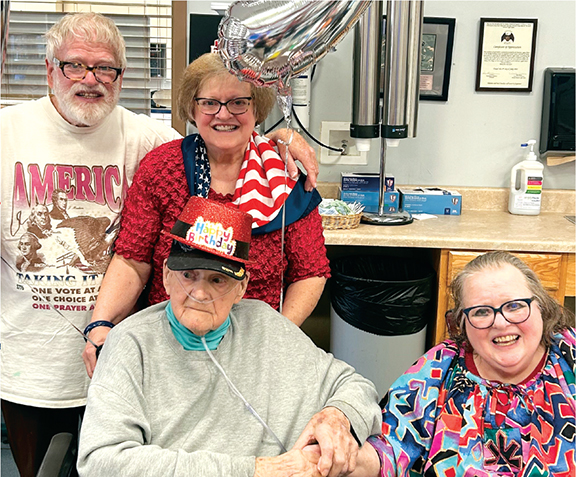
Floyd Cheatwood celebrated his 99th birthday on June 11, 2026, at the Norman Veterans Center. Tommy Cheatwood and Susan Ann Chavez, his son and daughter, stand behind him. Marilyn Cheatwood, his other daughter, sits to his right.

This soldier did not see combat; he dealt with WWII’s aftermath.

He travelled through destroyed towns in France and Germany and saw old people and children picking up rubble to make homes. Guarded German POWs. Met Displaced Persons in camps. Aimed his M-1 Carbine at U.S. Army Military Police. These were some of Private Floyd Cheatwood’s actions in 1946 at age 19 while occupying defeated Germany after WWII.
Eighty years later and 5,125 miles from that, Cheatwood was the center of attention oan June 11, 2026, as 70 family, friends and fellow residents celebrated his 99th birthday at the Norman Veterans Center.
Cheatwood was drafted to active duty Army Air Corps service on August 19, 1945, before WWII ended. After basic military training, he went to several locations in the United States before de-boarding a troop ship in Le Havre, France, in January, 1946. In February, he arrived at his assigned unit, 9th Aviation Engineer Command, Erlangen Army Airfield, Bavaria, Germany.

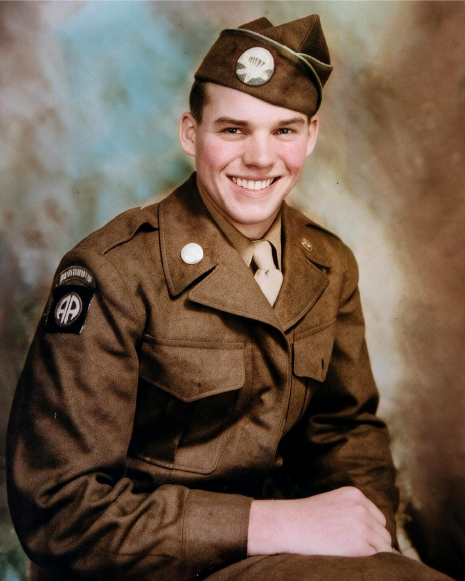
Floyd Cheatwood taken sometime during his service from 1945-1949. Provided by Susan Chavez.

Erlangen Duty
Soldiers slept and worked at Ferris Barracks, a former Wehrmacht post with little war damage. “They rebuilt it before we got there and that was the best barracks I ever stayed in. It had those marble floors and bathtubs.”
Cheatwood’s primary duty was to repair special purpose, heavy-duty bulldozers and other civil engineering construction equipment. He served there through August, 1946, before departing on emergency leave to the United States because his step-mother died.

Additional Duty
“I was in the bed (of a two-and-a-half-ton truck), guarding four prisoners. I was sitting there with a carbine across my lap. The guy that was driving was reckless, turned the corner real quick. I went out in the bed of the truck, and the rifle went over, slid against the cab. I was thinking, ‘Well, I’ve had it now.” You know, a new soldier. They gingerly got out of their seat, all four of them, went over there and picked me up, took me back and set me on the bench, and put the rifle back in my lap,” he said, smiling. “And right then I just thanked the good Lord for what was happening. All they wanted to do was go home. The war was over. They did not want any problems.” He guarded up to 19 Germans at a time.

Military Police Incident
“My sergeant told me to guard the building…not let nobody in the driveway. He said it was some stuff being stolen.” A jeep full of MPs pulled up and Cheatwood told them they could not park there. “One said, ‘Do you think you could get that carbine around before I got this .45 out of the holster?’ And crazy me, I pointed the rifle right at his throat and that was kind of scary. And I said, ‘Buddy, I’ve got a round in the chamber.’ One of them in the back seat said, ‘Well, we can park somewhere else because the kid is just doing what he’s told.’” Cheatwood said, “I thank the Lord that it didn’t come to that because I had the rifle pointing right at his throat. I felt bad about that ever since.” Was a bullet in the rifle’s chamber? No. “I played their bluff.”

Displaced Persons
“I talked to some of those people from Denmark, Sweden,” Cheatwood said. “They was in the next compound compared to our compound. The fence was 20 feet high. They had thousands that had come there from being repatriated, waiting for somebody to put them on the paths to where they could go back home.” This was the Erlangen Displaced Camp which held 822 people who were Holocaust survivors, forced laborers and refugees, according to Arolsen Archives.

It’s the Army or Me
After his step-mother’s funeral, Cheatwood didn’t return to Germany. Instead, he qualified as a paratrooper, rode gliders and worked on heavy equipment at various Army posts. He was honorably discharged as an E-5 Staff Sergeant in August, 1949. As a civilian, he worked for Halliburton, the City of Oklahoma City, and at Transcon.
Cheatwood did not reenlist. Why? He stated, “Fell in love…She said either the Army or me so I became a poor, foolish civilian.” So, he married Helen Jean Spaniel from Seminole in 1948. They were married 48 years before she died. After four years, he married Elva Jean, who died in 2015.
Older brother Ralph fought in WWII, Korea and Vietnam, 31-year career. Younger brother Charles fought in the Korean and Vietnam Wars, 20-year career. Floyd’s family includes one son, Tommy Lynn Cheatwood, and daughters Susan Ann Chavez, who is a retired U.S. Army Reserve nurse, and Marilyn K. Cheatwood. • Story by Lt. Col. Richard Stephens, Jr., USAFR, Ret. website: Rich Travel Niche

OKC Set to Host 2032 American Legion Centennial Convention

0

Oklahoma City has been selected to host the week-long 2032 American Legion National Convention, a centennial celebration projected to bring thousands of veterans to
the metro area, generate
more than $12 million in
local economic impact, and fill approximately 17,000 hotel room nights.
The selection follows a highly competitive bidding process led by Visit Oklahoma City OKC), a division of the Greater Oklahoma City Chamber, with Oklahoma City ultimately chosen over finalist cities Spokane, Washington, and Reno, Nevada.
“This is an extraordinary win for our city,” said Shaun Yates, senior vice president of tourism development for Visit OKC. “What stood out most to the client throughout the site visit was not just our facilities or our proposal, it was our people.”
During a site visit that coincided with a major winter snowstorm, American Legion representatives praised the city’s hospitality, adaptability and tight-knit community collaboration, ultimately solidifying Oklahoma City as the ideal choice for the landmark centennial.
“Serving the State of Oklahoma as the American Legion Commander has had many highlights. One of the biggest being something that will be part of the Oklahoma legacy for generations to come is being the Commander that was able to assist to secure the 2032 National Convention bid,” said Steven Charles Thomas II, department commander for the American Legion Department of Oklahoma.
“I give all the credit to the amazing folks at Visit OKC, the Chamber of Commerce and all the many people within OKC who had a vital role in the site visits and the two amazing representatives Lesley and Mandy who did the in person presentation in Indianapolis to the full selection committee. Their passion for the City, knowledge of its history and strategic planning the City has done to make Oklahoma City a top tier destination is what I believe pushed us to the top. I can’t wait for all my fellow Legionnaires to come here from around the globe and see the beauty and vibrant culture of Oklahoma that we are blessed to call home every day.”
Securing this convention highlights Oklahoma City’s growing reputation as a premier destination for major national events, and the region’s entire business and hospitality community stands ready to welcome these veterans with the world-class service they deserve.