
“I felt like I would be a failure if I got sent home and
didn’t complete basic (training)…I wanted to get the
benefits that the recruiting sergeant had told me about.
I wanna hang in for that. I was focused,” recalled Martha Louise Higgins, using a determined voice.
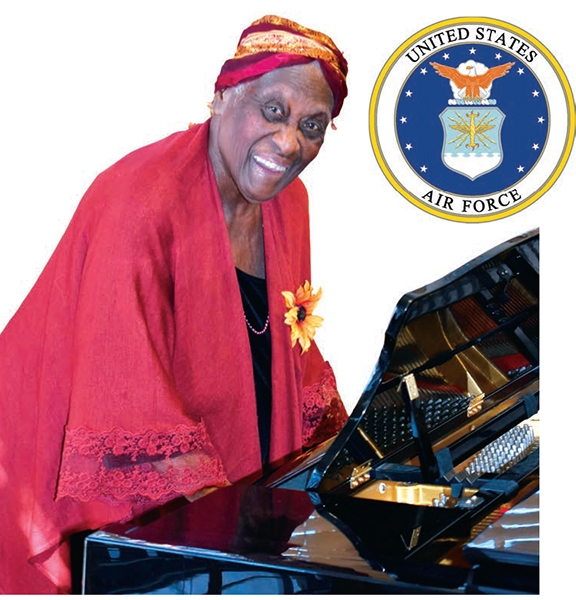
Born on January 15, 1931, in Clearwater, Florida, Higgins, now 95 years old, reflected on her military and civil service employment. Her enlistment occurred during the Korean War when only one-percent of Airmen were women.
Higgins gained knowledge and tenacity from teachers at her segregated elementary school, St. Matthew Baptist Church, and Pinellas High School in Clearwater, Florida. “I think growing up in Florida, they put a lot of confidence in us. That’s why it didn’t bother me going into the military. They had us thinking we could do anything we wanted to do. And we believed that…Because they knew what we were gonna be up against once we came outta high school.”
She graduated from high school in 1949, attended Florida A&M in Tallahassee for one year as a music major, then joined the Air Force.
Basic training
Basic military training was at Kelly Air Force Base (AFB), San Antonio, Texas. She remembered, “We had inspection every morning…we had to be in formation zero five hundred (5:00
a.m.). They didn’t play…You better time yourself… And there,
a lot of girls, they sent them crybabies home,” she said with emphasis. “You went to formation and…when they start roll call, there was a new girl on your right and maybe a new girl on your left…The sergeant would march us to breakfast. And after breakfast you had to go back to your quarters and get set up for inspection…” Lessons in discipline, time management and teamwork shaped her later service.
Preparing Military Pay
After basic training, Higgins transferred to Ent AFB, Colorado (closed in 1976), as a Disbursement Officer in the Finance Office. She explained the importance of pay accuracy. “We had a cutoff date to get our payroll ready because they knew when was payday. So, we couldn’t post anything on the cards (everything was done by hand) until you got it from personnel.”
Enlisted and officers had separate cards, each about 8” by 10,” organized by alphabet and by rank. Higgins remembers managing letters A through H.
She was the only female of the five Airmen in payroll.
She does not remember instances of sexism or prejustice; she just focused on the job. “They were very nice to me…They
just treated me like I was another Airman…You do your job and you’re rewarded for that…I wanted to get an honorable discharge.”
At Ent, she met and married Harvey Higgins of Luther, Oklahoma, on September 12th, 1953. She did not reenlist. Then Harvey, an active duty Airman, got a remote assignment and Martha went home to Clearwater.
Upon his return, and Martha now a military dependent, they were reassigned to Ent AFB, then Lockbourne AFB, Columbus, Ohio (closed in 1984). That’s where Steven and Timothy, two of her three sons, were born. Harvey’s next assignment took them to Incirlik Air Base, Turkey, in October 1964, near Adana.
Overseas Duty
Martha liked working, so she joined civil service as an intelligence coder during the Cold War. She worked in a rundown building. “I had to have a code to get in…And
then I sat at a teletype machine. But I sent out codes all day…They were classified. They cleared me to do that…I couldn’t decipher them…I didn’t know where they were going or who they were going to or what the information (was).”
The Higgins lived on the air base and went to the movies, the NCO Club and recreation center. To reduce their isolation, they drove to the Mediterranean Sea looking for Navy ships and by the American Embassy. “We were looking for the flag. Oh, we saw that flag and we just clap, clap,” she said excitedly, clapping her hands together. “We just clapped for anything that reminded us of home.”
Back in the United States, though, the military’s equality did not exist in civilian society.
Inequality
“I never went to an integrated school, said Higgins. “The first time I experienced integration was when I went into
the military…It (civil rights) was needed because it was so humiliating to us to think we had to get up outta our (bus) seat after we done paid our fare…There was no dignity in that. You going to get up outta your seat to give it to some person who was a different color than you? Now that was wrong.”
Love of Music
Higgins said, “I went back to school under the GI bill
and studied music…I studied music at Mercyhurst in Erie.
It’s a Catholic university.” She also used her musical talent commercially too.
“Oh Lord, Hear my Prayer” and other religious hymns
she wrote have been sold to music producers like Sheet
Music Plus in Minneapolis, Minnesota. Impressed by her vocal abilities, the Columbus Symphony, Columbus, Ohio, and the Erie Philharmonic Orchestra, Erie, Pennsylvania, asked her to sing with the alto section.
Retirement
These days, at the Norman Veterans Center where Higgins lives, she plays the piano for chapel service and for the Knights of Columbus.
She’s proud of her three sons, Steven Higgins, who retired as an Army Lieutenant Colonel, Timothy Higgins, who repairs and installs refrigerators, and David Higgins, a retired Marine Corps Chief Warrant Officer 2.
Higgins uses a walker but remains mobile. “I can do the twist and the electric slide!” she proudly exclaimed.
Would you like to watch Martha Higgins’ video with the “Making History Project” recorded August 8,
2021, by Patrick Russell, visit
https://making-history-project.com/ or scan this
QR CODE. •
story and photos by Lt Col Richard Stephens, Jr., USAFR, Ret.