Wednesday, March 18, 2026

Veteran Gives Back By Training Service Dogs For Veterans

0

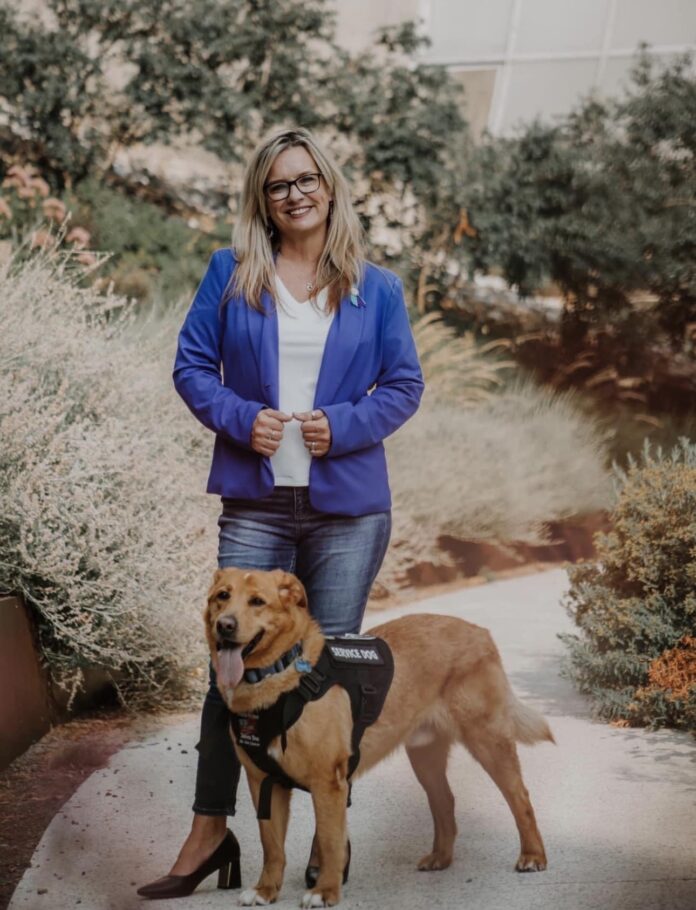
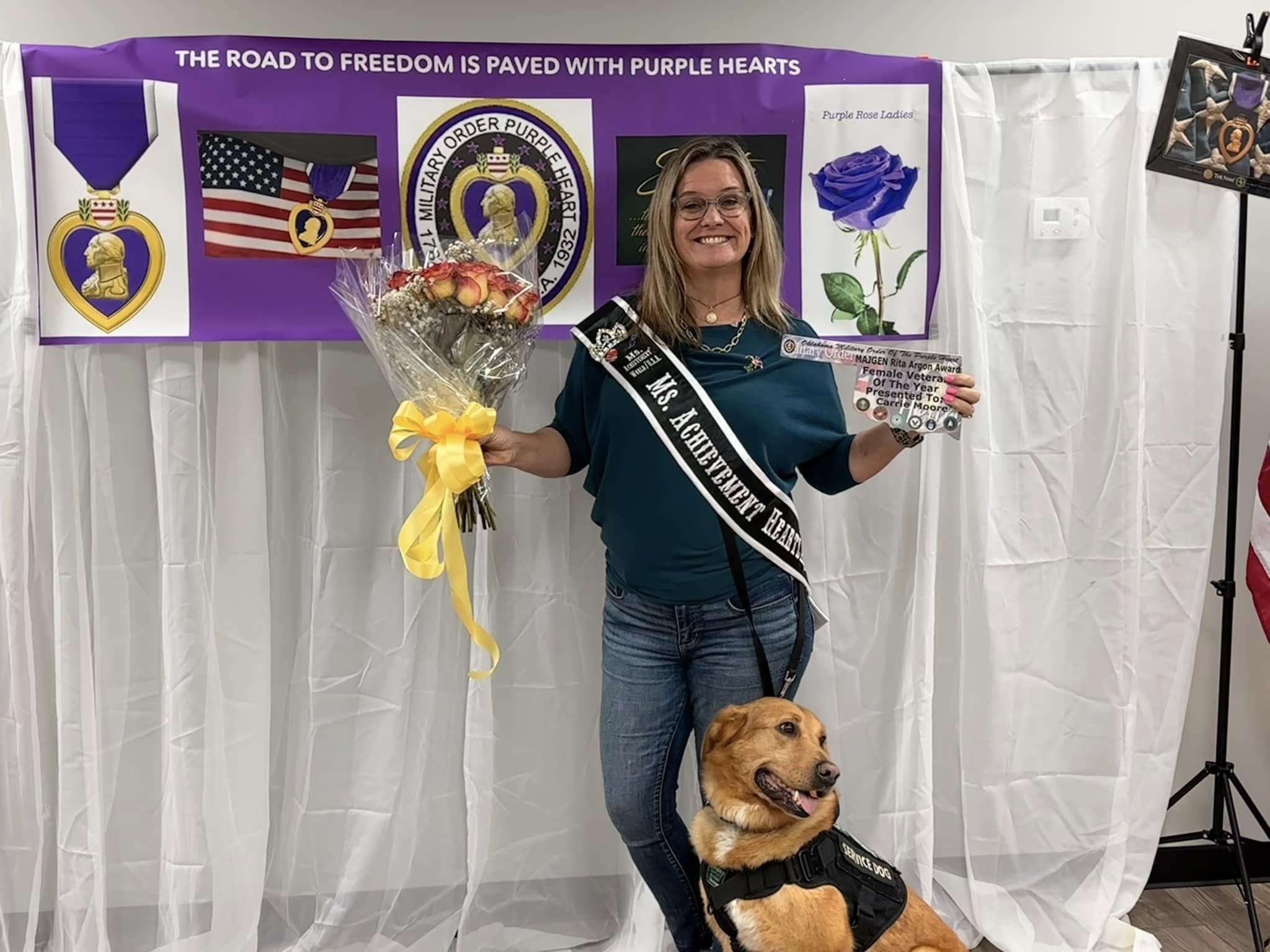
Her experience as a participant in the Ms. Veteran America competition helped spur Carrie Moore into advocacy work for Veterans.

“I ran for Ms. Veteran America, I think it was three years ago, and that kind of threw me into advocacy work,” Moore, a U.S. Navy Veteran said. “The purpose behind Ms. Veteran America is to raise awareness and funds for women veterans that are homeless. We provide suitable housing for them and their children.”

She added, “So, most of the time when women veterans are homeless, they don’t really realize that they can seek assistance if they have children, because they’re afraid their children are going to be taken away from them. We try to help ensure that they’re placed together, and kept together, and get them the help that they need.”

Moore grew up in Eufaula before enlisting in the Navy, where she served for five years.

“I grew up on Lake Eufaula, and being the rebellious teenager that I was, I did not want to do the same thing that my dad (U.S. Army) did. So, the other services were options for me. The Navy just got to me first,” she said.

Moore said directly after the service, she went into contracting after working at the National Security Agency in Fort Meade, Maryland.

“But then, when I had my son, which was in 2004, I wanted to be a stay-at-home mom. So we moved to Texas, and I was a stay-at-home mom for the next 15 years,” she said.

Moore and her husband later moved to Moore to be closer to family.

Moore’s Veteran advocacy efforts also included working as a VSO for the Dale Graham Foundation for about 12 years, writing claims for them, specializing in military sex trauma before working with the American Legion in Moore.

“To be able to give back to veterans just means a lot to me, because we’ve got a lot of making up to do,” she said. “I feel like you make a bigger difference (with Veterans) that way.”

Moore and her husband are also giving back to Veterans through their non-profit, Got Your Six, Service Dogs for Veterans which trains veterans to train their own service dogs.

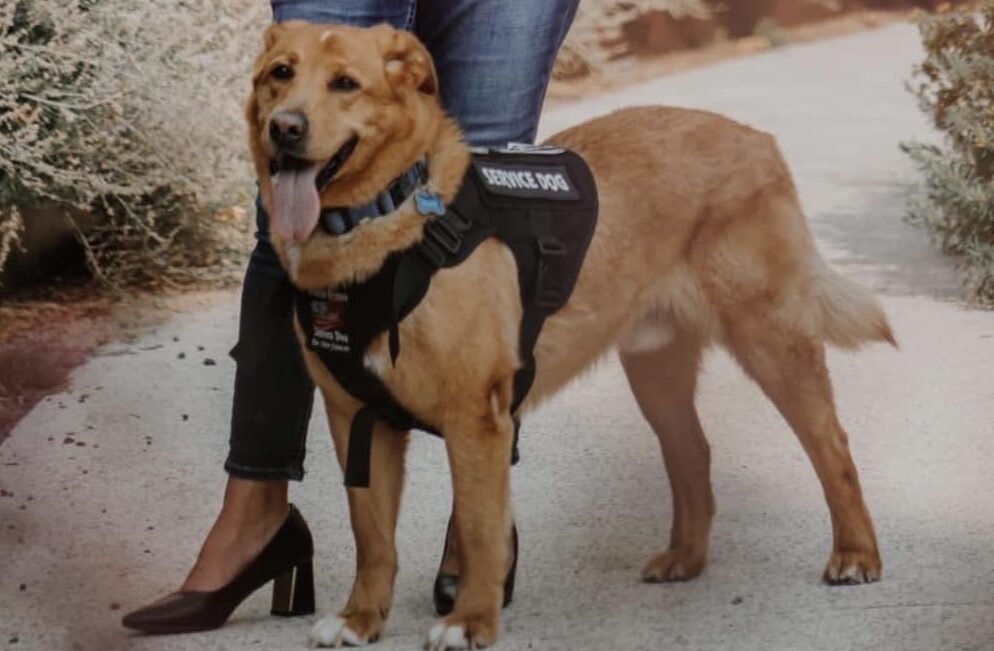
“I had been doing some volunteer work with rescues around the area. I had been fostering dogs and transporting them from one rescue to another,” she said. “We were contacted by an organization that had a dog they had been given to be euthanized. We took the dog on because my husband trains canines for sport. We weren’t worried about taking in this dog, because we knew we could fix whatever issue he had going on. He (Ruger) has been just the best dog ever. If you’re around him for five minutes, you’re in love with him.”

Moore said they had Ruger for about three weeks before they noticed something about him.

“We had him for about three weeks when he started alerting me to a heart condition that I have,” she said. “I have Wolff-Parkinson-White Syndrome, which causes my heart rate to go up to 300 beats a minute.”

Moore said that spurred a desire in learning what it took to get a service dog trained.

“We were unable to find anybody that would train him because we didn’t know his past. They considered it a liability working with a dog that came from the shelter,” she said. “We just went ahead and started training him ourselves.”

Moore believes that service dogs are the most underutilized resource that we have.

“Not many people know about it, and they think that you must spend thousands of dollars or be on a two-year waitlist to get a service dog,” she said. “And that’s not the case. You can train one yourself, and it can be a dog from the shelter. There Are no limitations on breeds, ages. They need to be able to perform a task that you need for your disability to make your life better.”

Moore said Ruger has been a traveling companion to advocate and educate on service dogs.

“I’ve been traveling around with him for two, three years advocating for female veterans, and just trying to get the word out about how this resource can help other veterans,” she said.

Moore said they currently only help Veterans.

“At this point in time, we only help veterans. We train one dog, one veteran,” she said. “We prefer that they bring in a dog that they have at their house, but a lot of times those dogs will not work. They must be environmentally-sound more than anything. So, if that dog doesn’t work, then they can switch to another dog in the house.”

Moore said their training sessions are held each Monday at a church in downtown Moore.

“We train every Monday evening, and we train for about an hour,” she said. “And our point behind it is, we give you homework every week. We show you how to train the dog for something specific, and then we have you go home for that week and practice on that thing. And then we continually add to that.”

Moore said consistency is a key component of training.

“You must do it consistently. The consistent training, doing it daily,” she said. “And a lot of people don’t want to put in the work for it, they think it’s just going to happen.”

Moore said their training services are free to Veterans.

“We have found that many Veterans have a need for service dogs but cannot pay thousands of dollars for one or have years to wait to get one trained from an organization,” she said. “And we believe that teaching a Veteran to train their own will allow them to pay it forward and help someone else which helps the veteran feel worthy and want to stick around. It’s completely free of charge to the veterans. Even if they need a dog, that’s all free of charge.”
For more information contact Moore at (405) 365-5356 or email her at [email protected]. story by Van Mitchell

Warriors of Air & Space above Tinker AFB

0

The free-admission Tinker AFB Air Show returns June 28-29, featuring the U.S. Air Force Thunderbirds, who will amaze Oklahomans with their skill and precision flying daily. This marks their first return to Tinker in six years.

The two days are almost exclusively headlined by U.S. Air Force precision in the sky as elite graduates of the U.S. Air Force Academy’s Basic Freefall Parachuting course demonstrate their team skills. The Air Force Parachute Team Wings of Blue will dazzle the crowd with their signature “Bomb Burst” maneuver at terminal velocity.

The aerial demonstrations will run from 11:30 a.m. to 4 p.m. As the last show each day, the Thunderbirds aerobatic flight demonstration team of F-16s, will treat spectators to their precision flying skills and professionalism for an hour. Watch powerful fighter jets elegantly maneuver in the sky with only a few feet separating each wingtip. It’s a multisensory experience that will leave viewers impressed and inspired. This puts the SHOW in air show.

The Air Force’s premier multi-role fighter jet, the single-seat, supersonic F-16 Fighting Falcon, displays its robust maneuvering capability and showcases the pilot’s elite skills. The demonstration mixes six aircraft performing formation flying and solo routines. The four-ship Diamond formation showcases the precision and training of the pilots and the gracefulness of the F-16. The two solos display the maximum synergy of jet power and the maximum capabilities of elite pilots.

“We want to send an open invitation to the public so they can witness what we do here at Team Tinker,” said Col. Abby Ruscetta, Tinker installation commander. “We want to demonstrate the readiness and strength of American air and space power and the wonder of aviation.”

This open invitation in throwing the gates at Tinker open to the public comes with a caution. Come early to see the air and space power wonder of aviation because when the crowd exceeds a limit, the gates will be closed each day.

Visitors can learn more about Tinker’s missions, the military and how present careers in aviation and aerospace make up Oklahoma’s second-largest industry.

Because admission, parking and shuttles are free, organizers encourage everyone to arrive early. Visitors will want to arrive early enough to park at Building 9001, formerly the old General Motors Plant, off SE 74th Street, because those buses drop them off at the gate area requiring the least walking. The event has been popular, and the gates will close when capacity is reached. Gates open at 8 a.m. daily. All acts are expected to perform each day, but the order of performers may change.

The show will feature dozens of military and civilian aerial performers and various ground display aircraft, such as Tinker’s E-3 Sentry AWACS, the U.S. Navy E-6B Mercury, USAF Thunderbirds, Tora, Tora, Tora – up to Seven Japanese Zero type aircraft, MiG-17F (Russian MiG jets), B-1B Lancer, B-52H Stratofortress, KC-46A Pegasus, KC – 135 Stratotanker, WASP (AT-6, BT-13) and a Red Tail P-51C located next to the Rise above Exhibit.

This year, several aerial acts debut for the first time, including an MV-22 Osprey, Franklin’s Flying Circus air comedy act, and Brittanee Lincoln in the Extra 330 Aerobatic Air Act. The crowd will see and hear historic radial engines powering The Trojan Phlyers Flight Demonstration Team as the world’s only formation aerobatic pair of North AmericanT-28 Trojan Trainers.

Other acts include a Pearl Harbor reenactment by Tora! Tora! Tora! and Randy Ball, a professional demonstration pilot flying a Soviet-era MiG-17, who is returning for the first time since 2014.

The 2025 Tinker Air Show theme is “Warriors of Air and Space,” highlighting the warrior ethos, hard work and contributions of Tinker Air Force Base’s military and civilian members. Visitors will have access to plenty of food and merchandise vendors serving their needs. Complimentary water is provided, so bring an empty bottle to fill at the water stations.
Visitors can explore static displays of modern and historic military aircraft, military recruiting exhibits such as the Air Force’s Tactical Experience, and USAF Honor Guard Drill Team performances.

“Science, Technology, Engineering, and Mathematics (STEM) City” is an aircraft hangar filled with hands-on activities for kids of all ages. This area offers simulators, robotics, drone technology, snap circuits and more. Many of the booths allow visitors to explore potential career opportunities.

“We want to encourage younger generations to get involved in the field of aerospace and encourage them to learn more about the many jobs available,” said Cliff Harden, STEM outreach program manager at Tinker AFB. “There’s everything from becoming a pilot to cyber security, 3D Graphics and imaging to engineering and aircraft maintenance.”

Community partners will provide free activities in STEM City.

Most attractions are free except for a VIP area, Preferred Seating, and the Kidz Zone. The VIP Experience tickets are available for $149 and offer shade tents, preferential seating, cold beverages, and a boxed lunch.

Preferred Seating offers shade seating on the northern end of the flight line, starting at $39. Wristbands for the Tinker Air Show’s Kidz Zone cost $20 and are good all day. The Kidz Zone and play area are located on the north end of the Airshow tarmac, and they include an activity tent with games, inflatables and a rock wall.

As Oklahoma’s largest single-site employer, Tinker AFB personnel are part of the enduring 72-year advantage as the world’s most capable and respected air power source. This open house will demonstrate why the last time an American combatant was killed on the ground by an adversary air force was April 15, 1953.

To learn more, visit www.tinkerairshow.org or tinker.af.mil/tinkerairshow and follow Tinker AFB on social media. story/photo by Darl Devault, contributing editor

Cross of Valor Honors R.D. Lawrence’s WWII Service

0
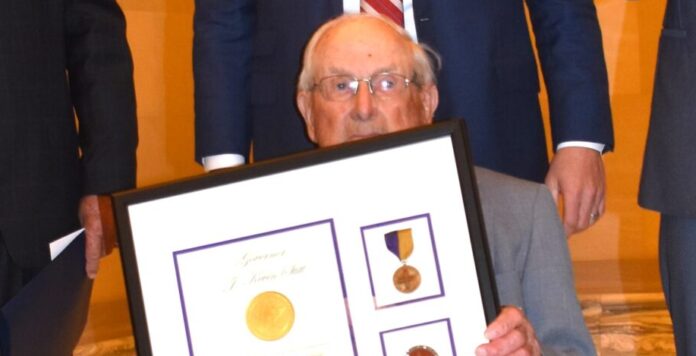
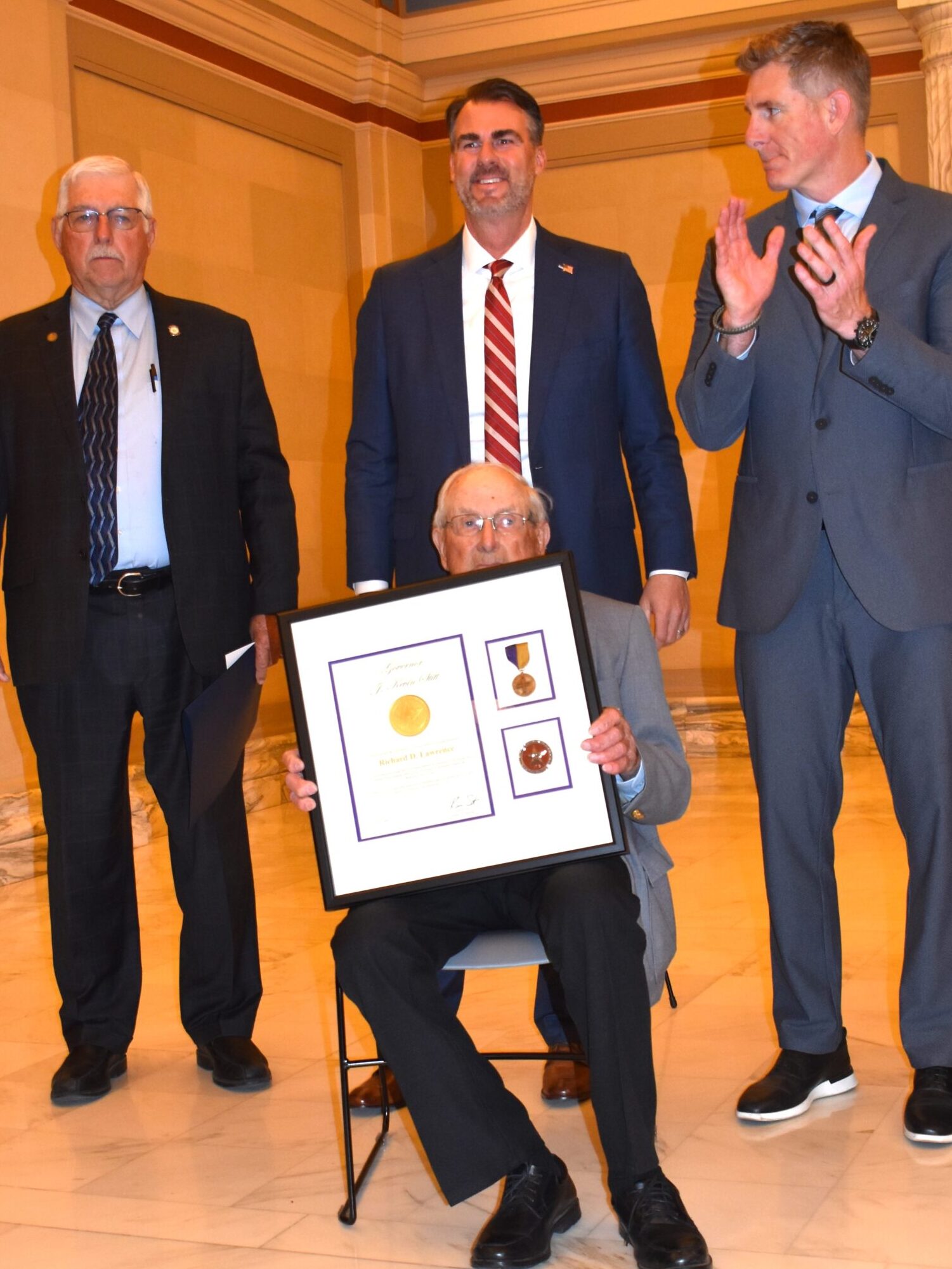
R.D. Lawrence (seated) received Oklahoma’s Cross of Valor from State Senator Roland Peterson (left), Governor Kevin Stitt (center), and Secretary John Nash (right).
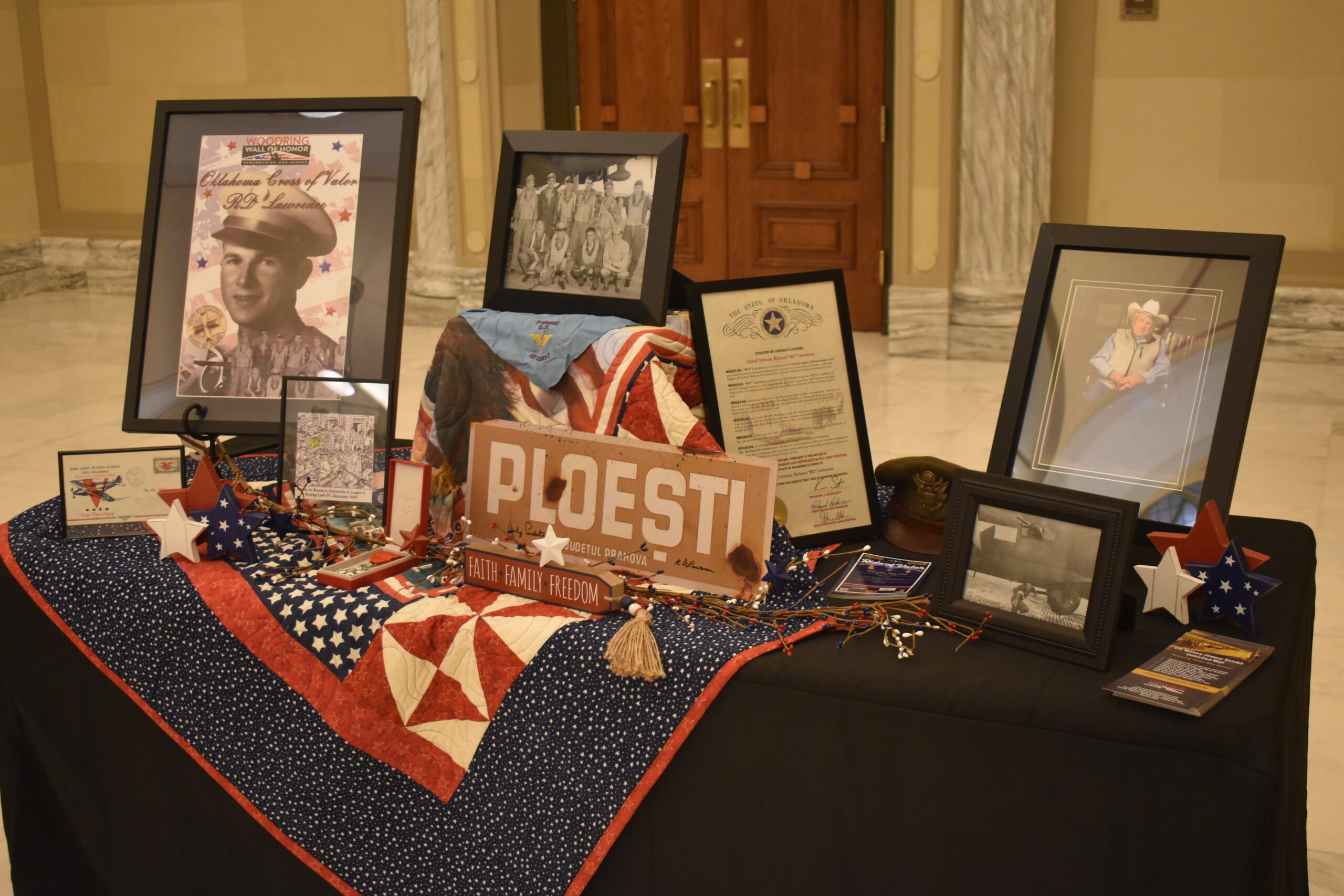
Memorabilia from R.J. Lawrence’s life fills up a table at his medal ceremony at the State Capitol on May 5, 2025. He squats next to the ball turret of the B-17 in one picture.

When your life is in danger, some memories don’t go away, even if they occurred 81 years ago. Like firing twin .50 caliber machine guns at Nazi airplanes from the ball turret underneath a B-17 Flying Fortress.
“I hit a Messerschmidt (fighter) one day. He was gone away from me and of course, when they get by, they turn their belly up – they’re armor-plated on the bottom. I could see some tracers going off from him. I never got him down. He (fighter) was a longways away. He had come through our (bomber) group once and got away but he didn’t come back,” explained Richard D. Lawrence, a 102-year-old WWII veteran.
Lawrence was at Oklahoma’s State Capitol in the Hall of Heros to receive the Oklahoma Cross of Valor from Governor Kevin Stitt. Part of Stitt’s address included the following. “His story is one of grit and courage and unbelievable bravery. He answered the call to serve during a time of war, was taken captive by the enemy and he came home with his honor intact. That strength comes from a love of country, a sense of duty, and unbreakable spirit. In Oklahoma, we believe in honoring our heros and we have a real-life hero with us today.”
Lawrence wasn’t alone – lots of family, friends, State Representatives and Senators, uniformed military and veterans gave him a standing ovation when he was called up to get the Cross of Valor enclosed in a glass case.
Others have formally thanked Lawrence too, including a French Counsel who gave him the French Legion of Honor and the Oklahoma Military Heritage Foundation, who inducted him into the Oklahoma Military Hall of Honor.
Before the ceremony, Alfonso Garza, the Veterans Mental Health Program Administrator with Oklahoma’s Department of Veteran Affairs (ODVA), asked R.D. if he had any advice. His answer? First, take it one day at a time. Second, trust in the Lord with all your heart.
When R.D. got home from the war, he went right to work harvesting crops. No two-week vacation swapping war stories at the bar to relax after the ordeal. In a conversation with Galen Culver of the KFOR television station, he recalled, “I got home on my mother’s birthday, June 15th, 1945, and we started cutting wheat that afternoon.’” He married his high school sweetheart, Joanne, right away too – 11 days later.
They had three children: Richard, Julie and Leanna, who were at the ceremony. Leanna, whose married name is Turney, said, “I had wonderful parents…parents that went to everything we went to (activities).”
The ODVA shared a biography that explains Lawrence’s postwar time of peace. “A proud steward of the land, he continues to live and manage the farm, recently keeping busy clearing fields from the seat of his Polaris”…He served “on the boards of the Farmers’ Cooperative of Wakita, the Wakita School Board, and as a longtime Director of Citizens Bank of Wakita. His dedication to agriculture was honored with the title of Oklahoma Farmer of the Year at the Oklahoma State Fair. A man of faith, he served over 60 years as an Elder at both Fairview Christian Church and Wakita Christian Church. In retirement, RD took up golfing and played daily into his early 90s-always with the same group of friends, and more often than not, he came home the winner.”
James Neal of the Enid News & Eagle sat down with R.D. in 2011 and wrote the following. “Today, he remembers those who didn’t make it home as the true heroes from history’s largest war. Their ranks included Lawrence’s brother, Burke, an aircrewman who was killed while on a training flight shortly after the war’s end…Lawrence said, ‘They were all heroes, I thought, those boys who didn’t make it home.’” story/photos by Richard Stephens, Jr., Lt. Col, USAF Retired

Portion of Citation of Appreciation from the Oklahoma State Legislature to Technical Sergeant Richard D. Lawrence.
———————————————–
Whereas, on June 7, 1944, while on a mission to destroy marshalling yards in Budapest, Hungary, R.D. Lawrence’s plane took a direct hit, and he was forced to parachute out. He was captured a week later and held as a prisoner of war in Stalag Luft IV Prison Camp in Gross Tychow, Pomerania (now Tychowo, Poland) and later forced on a 500-mile death march. On May 2, 1945, he was liberated by the British soldiers and returned to Enid just in time for harvest.

Stephen Evangelista Appointed Deputy Commissioner for Operations at the Social Security Administration

0

The Social Security Administration (SSA) today announced the appointment of Stephen Evangelista as the Deputy Commissioner for the Office of Operations. In this role, he will oversee SSA’s nationwide network of offices that provide frontline and support services to millions of customers each year. This includes oversight of more than 1,200 field offices serving communities across the country, as well as 23 teleservice centers assisting the public on the phone.

Stephen Evangelista has over 25 years of experience in executive leadership roles at SSA. He has held various leadership positions within the agency, most recently serving as the Assistant Deputy Commissioner for Policy in the Office of Law and Policy. His record of achievement includes developing and implementing an enterprise strategy to unify SSA’s more than 3,000 data matching agreements, resulting in improved program administration.

“Stephen’s proven track record of leadership and his dedication to public service make him an excellent choice for this critical role,” said Lee Dudek, Acting Commissioner of Social Security. “His deep knowledge of the agency’s programs will be an asset as we continue to improve customer service while safeguarding Americans’ hard-earned benefits.”

Stephen Evangelista succeeds Doris Diaz, who had been serving as the agency’s Acting Deputy Commissioner for the Office of Operations since January 2025. Under her leadership, SSA implemented several customer-focused improvements, including expediting over $14.8 billion in retroactive payments to more than 2.2 million individuals under the Social Security Fairness Act.

“I am grateful to Doris for her outstanding leadership of the Office of Operations,” added Dudek. “She delivered transformational improvements in the agency’s operations, and millions of Americans’ lives are better because of her service.”

For more information, please visit the SSA’s Communications Corner at www.ssa.gov/news.

WEEKEND RIDE (OR DRIVE): Take a Hike! To Skydance Bridge, Oklahoma City

0
Taking Flight Light as a Feather sculpture – Nick Thomas

With over 90 miles of trails weaving through the area, Oklahoma City’s numerous parks are a haven for walkers, joggers, and hikers alike. While the green urban spaces invite exploration of the hidden gems and points of interest throughout the city, one must-see landmark for visitors – day or night – is the iconic Skydance Bridge.

Arriving late in the afternoon, we parked on SW Second Street before heading south on foot through Scissortail Park, named after Oklahoma’s state bird – the scissor-tailed flycatcher. Our destination was the 380-foot-long pedestrian Skydance Bridge that spans I-40 and connects the north (40-acre) and south (30-acre) portions of the park. Opened in 2012, the state bird also inspired the bridge’s design with its striking V-shaped steel sculpture towering nearly 200 feet above the walkway, resembling the flycatcher’s distinctive forked tail feathers.

Skydance Bridge in the evening – Nick Thomas

After admiring the bridge, we continued through the park and surrounding area waiting for sunset since the bridge is especially stunning when lit by LED lights during the evening. But there was no shortage of dazzling sights to fill the remaining daylight hours, including a walk around a lake with surrounding trees teeming with colorful chirping birds. Rental pedal boats, canoes, and kayaks glided slowly over the water as their occupants absorbed the relaxing view dominated by Oklahoma City’s tallest building. The sleek 50-story Devon Tower, also completed in 2012, is a skyline scene stealer with its reflective glass exterior. The Vast Restaurant occupies the top two floors offering both meals “sourced from local producers” and spectacular views of the city.

Skydance Bridge by day – Nick Thomas

Myriad Botanical Gardens, just a couple of blocks north of the park off Reno Street, was intriguing. Since originally conceived by city leaders in the late 1960s, the 17-acre plot most recently underwent an $11 million renovation in 2022 and features immaculate landscaping, a children’s garden, a restaurant area, fountains, sculptures, and the dazzling Crystal Bridge Tropical Conservatory encased in a shell of over 3,000 translucent acrylic panels housing an impressive exotic plant collection.

The “Taking Flight: Light as a Feather” art piece, installed 2 years ago at the north end of Scissortail Park, was a delightful surprise find. The 6-ton 31-foot-tall metal sculpture is the artist’s vision of a delicately curved feather gently floating earthward. Stunning any time – and especially at night when fiber optic lights illuminate its intricate details – the sculpture truly comes to life just prior to sunset when we happened to walk past. As the sun hung in the darkening sky behind the sculpture, its dying rays filtered through the figure highlighting the steel bars comprising the feather’s ribs, offering an inspiring picture-perfect moment we were lucky to experience.

For many visitors, however, the star of Scissortail Park will be the illuminated Skydance Bridge straddling the busy Interstate below. The remotely controlled lights, programmable for holidays and special events, displayed a vibrant deep blue glow during our visit, dramatically highlighting the structure’s sweeping design. But the color varies from night to night. When viewed from the bridge’s south end and set against the backdrop of city lights, it was the perfect conclusion to our 2-mile urban nature walk around Oklahoma City.

story and photos by Nick Thomas teaches at Auburn University at Montgomery in Alabama and has written features, columns, and interviews for many newspapers and magazines. His hiking column describes short trails, hikes, and walks from around the country that seniors might enjoy while traveling. See www.ItsAWonderfulHike.com.

Strengthening Veteran Services: James Bynum Shares Key Updates on Oklahoma’s Commitment

0
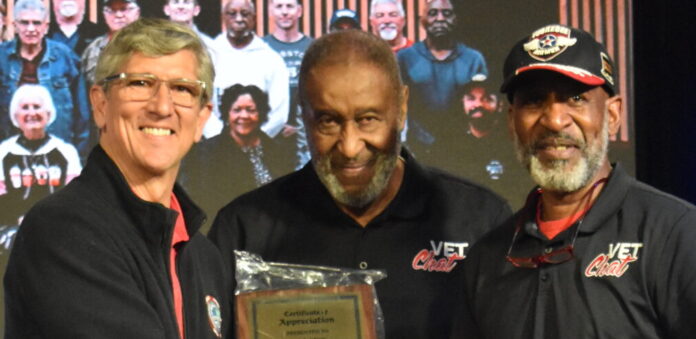
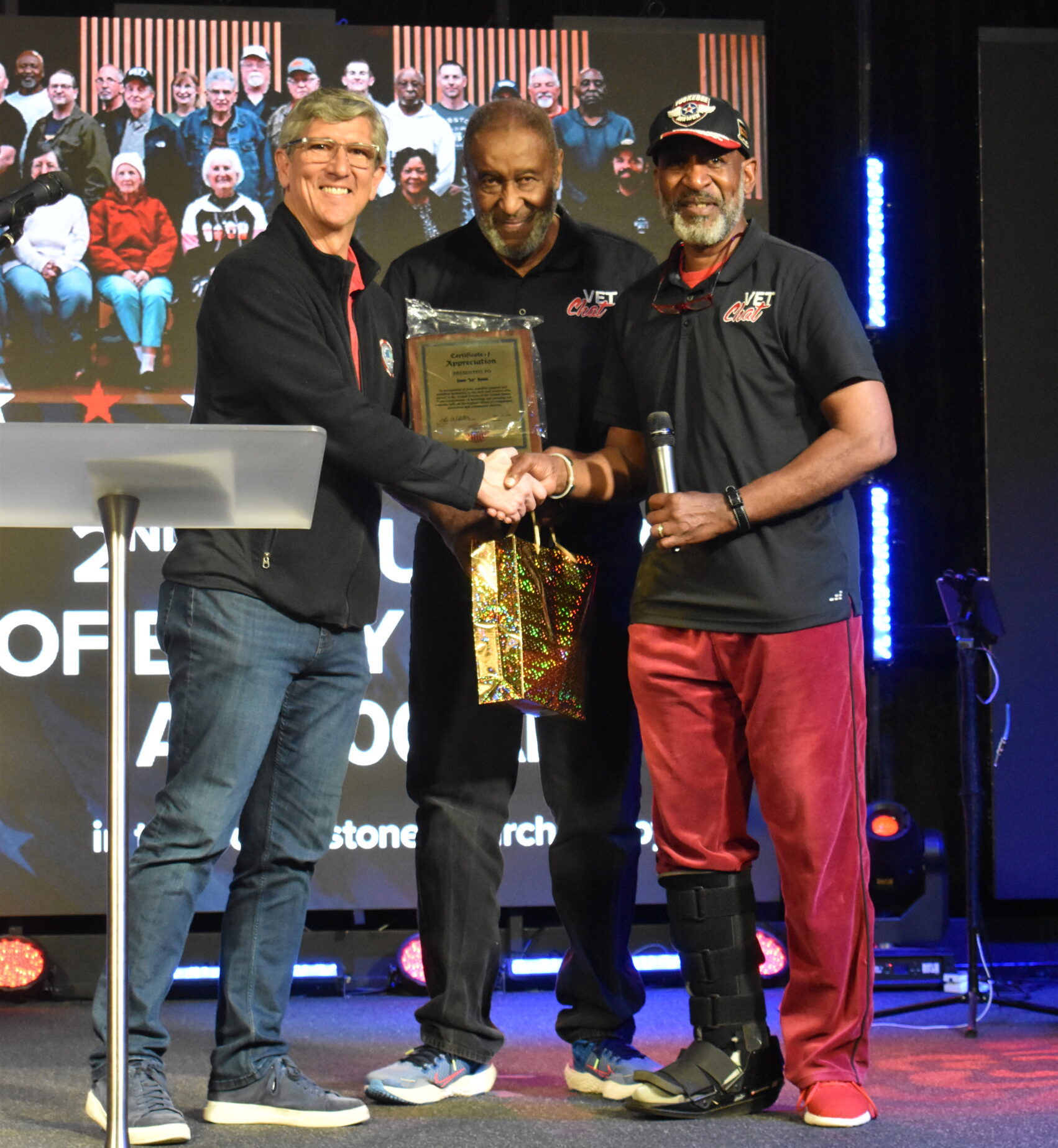
Leo Webster (center) and James McQuillar of VetChat (right) give gifts to OVDA Director James Bynum after he talked with veterans on April 12, 2025.

VetChat hosted Rear Admiral James Bynum, Executive Director of ODVA, at Cornerstone Church in Midwest City on April 12, where he addressed 110 veterans and discussed the agency’s current and future roles. Bynum, a retired Navy fighter pilot with a 36-year career, emphasized his commitment to enhancing veteran services by improving mentorship programs, increasing the quality of Veterans Service Officers, and leveraging technology for secure, convenient access to benefits. He detailed plans to bolster communication through quarterly advisory forums, regular newsletters, and an expanded media presence, as well as partnerships with private organizations to aid with job placements. During the Q&A session, veterans raised concerns ranging from lost medical records to reduced benefits. Bynum said ODVA is exploring CMS certification for veteran care facilities and will open a new Veterans Home in Sallisaw in 2025.
VetChat, a non-profit organization that promotes veteran fellowship, hosted Rear Admiral James Bynum, Executive Director of the Oklahoma Department of Veterans Affairs (ODVA) at the Cornerstone Church in Midwest City, April 12th. Bynum discussed current and future roles of the agency and answered questions from the 110 veterans in attendance.
Bynum built a 36-year career in the U.S. Navy as a fighter pilot (primarily F-18s), retiring in 2021. His last military assignment was as Deputy and Director, Warfare Development, on the Office of the Chief of Naval Operations staff. He also commanded “the Royal Maces of Strike Fighter Squadron 27…and Carrier Air Wing 3 as part of the Harry S. Truman Strike Group…” according to ODVA’s website. Bynum started his talk by saying he was glad to have been asked to lead ODVA. “I needed a mission, be part of a team and have some outcome,” he said. The director talked directly and honestly with veterans.
He emphasized how ODVA will get better to serve veterans and their families with the services and benefits they offer. “We can’t be professional if we don’t know how we need to improve or if we don’t know where we’re falling short, if we’re aiming totally at the wrong target. So, we have to have that input…Whether that’s veteran services, whether that’s help with finding a job, whether that’s help with finding other services…But our job is to be that connective tissue…That’s finding some discreet things to get accomplished, put ‘em on a calendar, make a plan, assign roles and responsibilities and drive to them. And then come check our homework. See how we did.”
Ways for the ODVA to provide information include scheduling quarterly Veterans Advisory Forums, advertising on television and radio (started in May) and publishing a regular newsletter. Areas to improve service include providing mentorship and more qualified Veterans Service Officers (VSOs). “We all want the best that someone has to offer,” Bynum said. “I owe every veteran that…You’re not going to get an apprentice VSO, you’re going to get journeyman or above with access to masters (highly qualified ability) if you need it.”
Bynum wants ODVA to utilize technology better by having personal identifiable information available in a veteran’s registry securely held behind electronic firewalls. He stated, “We can do that business with you online at your convenience, on your time…I got to meet you where you are.” The Director acknowledged ODVA doesn’t have the people to meet with every veteran individually or in groups. No mention was made whether the drive towards technology-powered tools would result in fewer ODVA employees, face-to-face or telephone service.
Partnering with private and public organizations, such as Major Talent for job finding can help veterans (https://majortalent.com/). Bynum said, “They have a nationwide architecture to acquaint your resume with the folks that fund them, free to the veteran. They’ll write your resume, they’ll give you the lesson, they’ll give you mock interviews, computer-based training on how to do an interview.”
Currently, Veterans Homes must be certified by the Federal Department of Veterans Affairs (VA). Bynum said ODVA is exploring “other ways to provide care and operate Veteran Affairs homes, perhaps through Centers for Medicare & Medicaid Services (CMS) certification. So, with Medicare Advantage waivers, veterans can now get in-home care, and…because we have…full suite of skilled nursing available, and that’s speech therapy, occupational therapy, physical therapy…if we get that CMS certification to do rehabilitation work for short stays…,” veterans will benefit. ODVA is asking three facilities to look into getting CMS certification.
A new Veterans Home in Sallisaw, Sequoyah County, will open in 2025. It is built and staff are being hired. Senator Kelly Hines (R) and Representative Nicole Miller (R) submitted State Bill 520 to create a State of Oklahoma Veterans Foundation allowing it to receive donations to promote veteran activities. It was signed into law by Governor Stitt on April 23, 2025.
Ten veterans asked questions ranging from what to do about the VA losing medical records to what the OVDA could do to help small businesses to reductions in benefits (tinnitus, sleep apnea).
According to Bynum, Oklahoma has about 300,000 veterans. More information about the ODVA is at https://oklahoma.gov/veterans.html.
Other attendees included the following from ODVA: Dr. Sidney Ellington, Vice Chairman of the Veterans Commission, Lisa Acevedo, Director of Veteran Services & Legislative Liaison, Pitta Zulker, Women Veterans Program Coordinator, and Al Garza, Mental Health & Suicide Prevention Administrator, and State Senator Brenda Stanley (R), Midwest City Mayor Matt Dukes and Vietnam War Ace Colonel Charles Bellevue.
story/photos by Richard Stephens, Jr.

IN THE NAVY – IN THE NEWS

0
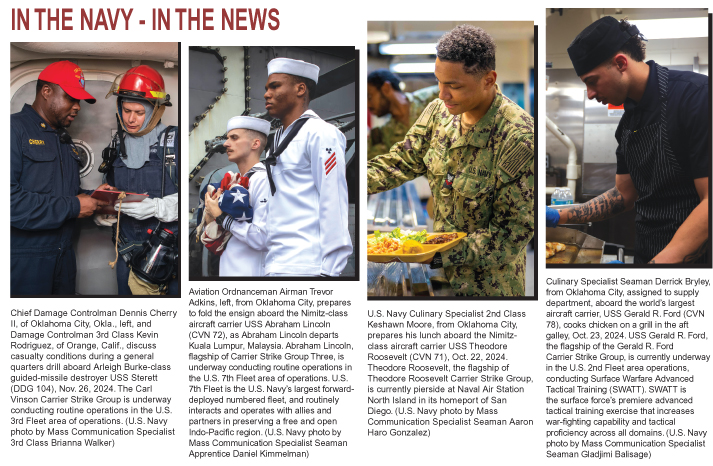
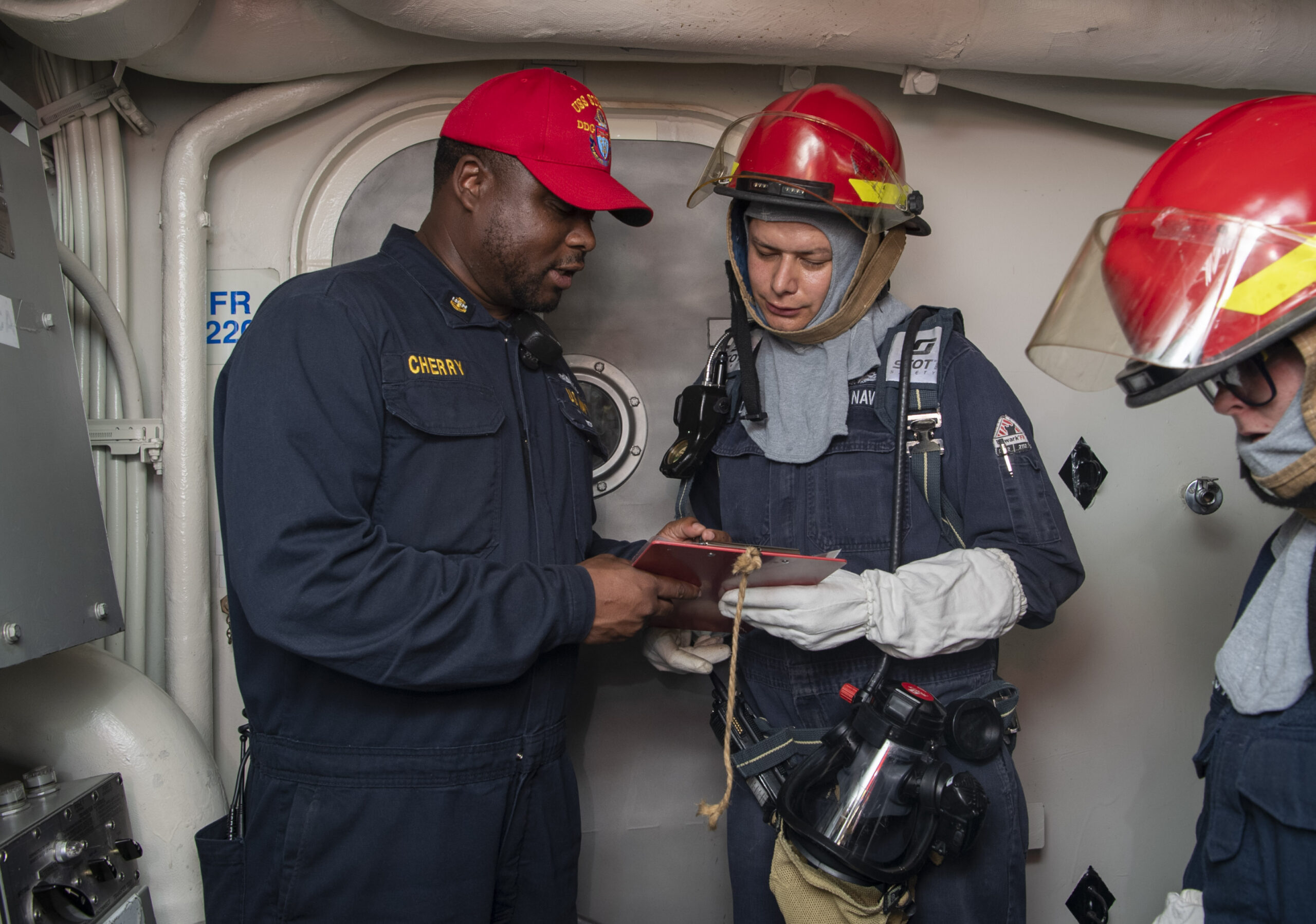
PACIFIC OCEAN (Nov. 26, 2024) – Chief Damage Controlman Dennis Cherry II, of Oklahoma City, Okla., left, and Damage Controlman 3rd Class Kevin Rodriguez, of Orange, Calif., discuss casualty conditions during a general quarters drill aboard Arleigh Burke-class guided-missile destroyer USS Sterett (DDG 104), Nov. 26, 2024. The Carl Vinson Carrier Strike Group is underway conducting routine operations in the U.S. 3rd Fleet area of operations. (U.S. Navy photo by Mass Communication Specialist 3rd Class Brianna Walker)

PACIFIC OCEAN (Nov. 26, 2024) – Chief Damage Controlman Dennis Cherry II, of Oklahoma City, Okla., left, and Damage Controlman 3rd Class Kevin Rodriguez, of Orange, Calif., discuss casualty conditions during a general quarters drill aboard Arleigh Burke-class guided-missile destroyer USS Sterett (DDG 104), Nov. 26, 2024. The Carl Vinson Carrier Strike Group is underway conducting routine operations in the U.S. 3rd Fleet area of operations. (U.S. Navy photo by Mass Communication Specialist 3rd Class Brianna Walker)
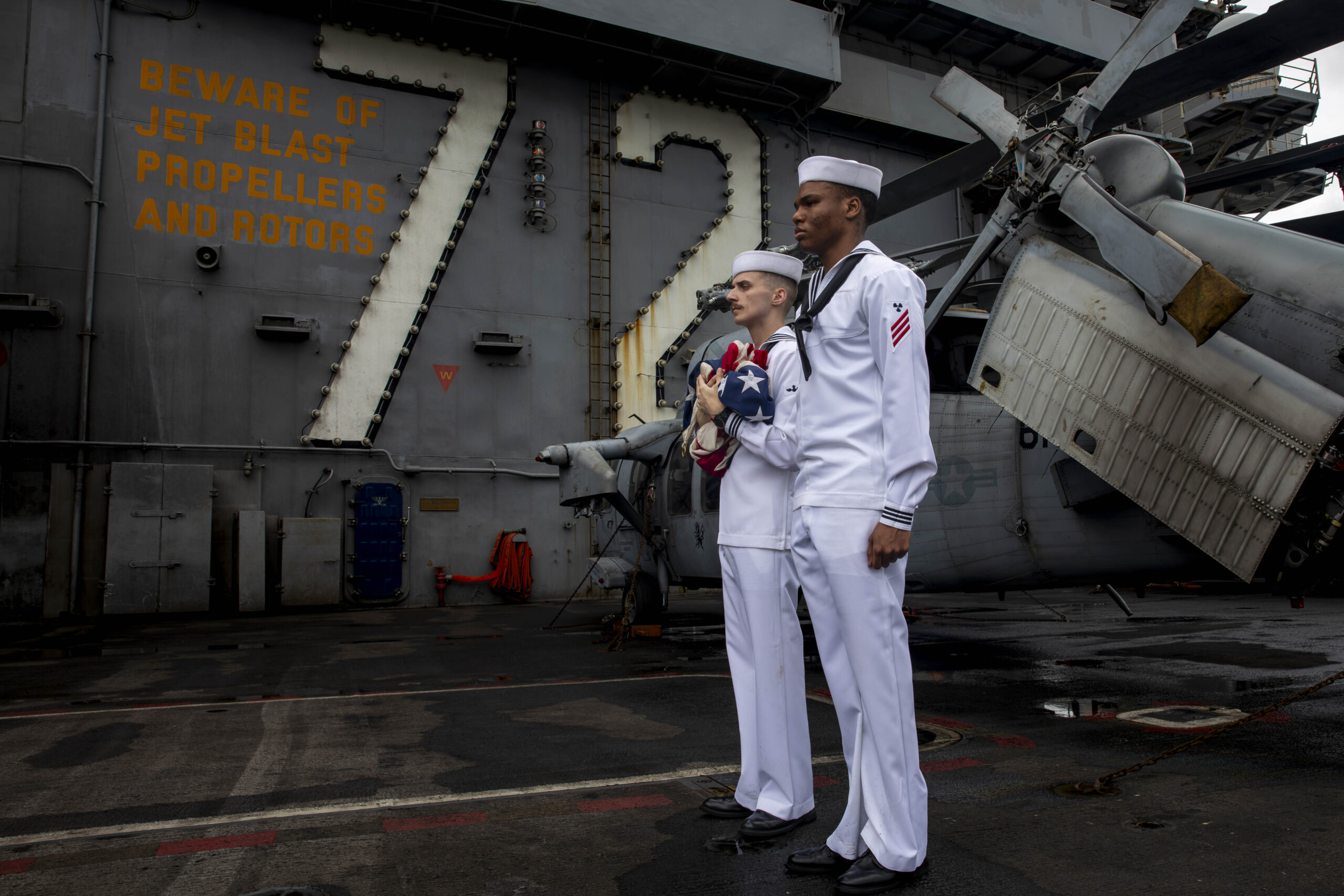
241127-N-NH911-1081 MALACCA STRAIT (Nov. 27, 2024) Machinist’s Mate Fireman Jordan Moore, right, from Willingboro, N.J., and Aviation Ordnanceman Airman Trevor Adkins, from Oklahoma City, prepare to fold the ensign aboard the Nimitz-class aircraft carrier USS Abraham Lincoln (CVN 72), as Abraham Lincoln departs Kuala Lumpur, Malaysia. Abraham Lincoln, flagship of Carrier Strike Group Three, is underway conducting routine operations in the U.S. 7th Fleet area of operations. U.S. 7th Fleet is the U.S. Navy’s largest forward-deployed numbered fleet, and routinely interacts and operates with allies and partners in preserving a free and open Indo-Pacific region. (U.S. Navy photo by Mass Communication Specialist Seaman Apprentice Daniel Kimmelman)
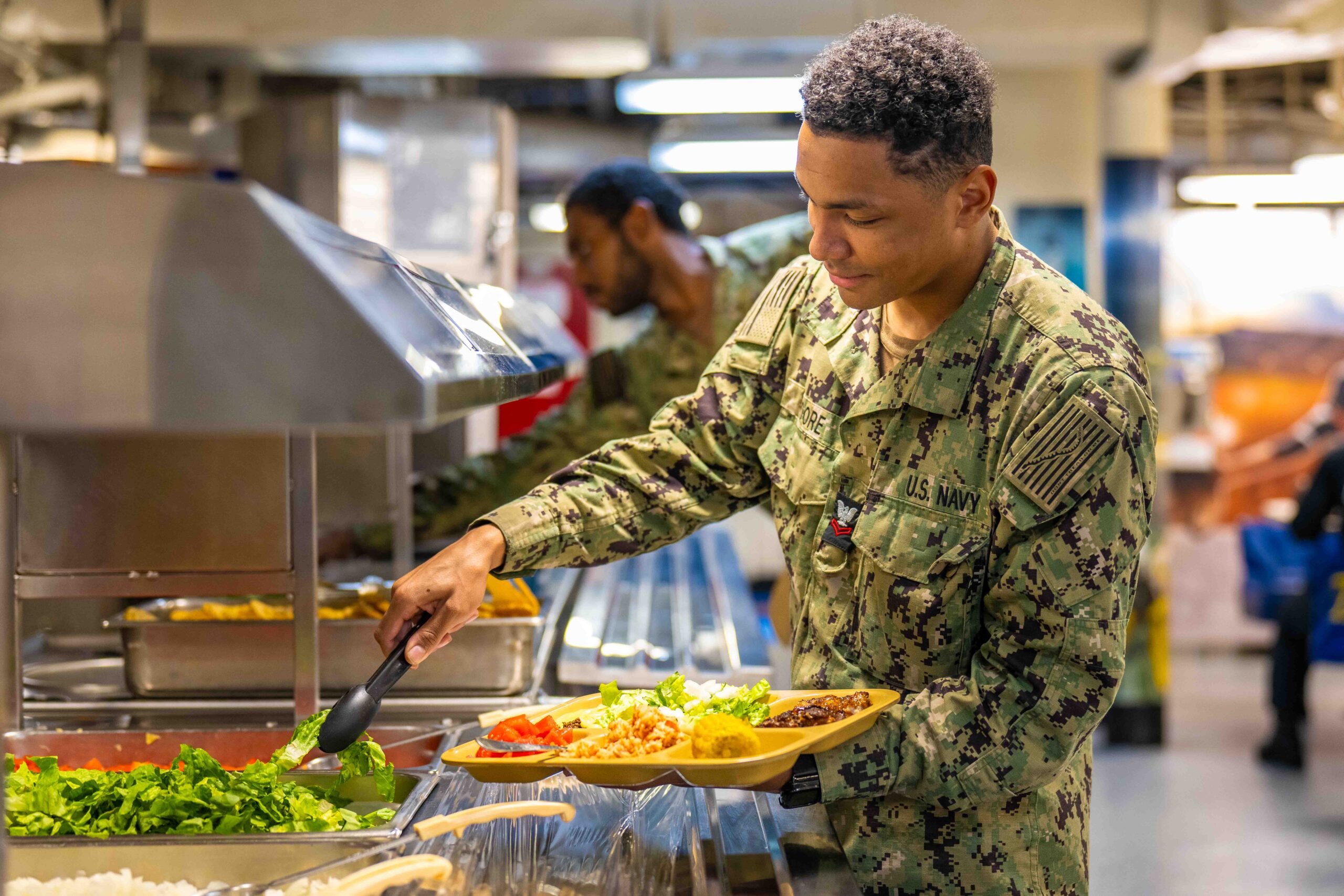
SAN DIEGO (Oct. 22, 2024) U.S. Navy Culinary Specialist 2nd Class Keshawn Moore, from Oklahoma City, prepares his lunch aboard the Nimitz-class aircraft carrier USS Theodore Roosevelt (CVN 71), Oct. 22, 2024. Theodore Roosevelt, the flagship of Theodore Roosevelt Carrier Strike Group, is currently pierside at Naval Air Station North Island in its homeport of San Diego. (U.S. Navy photo by Mass Communication Specialist Seaman Aaron Haro Gonzalez)
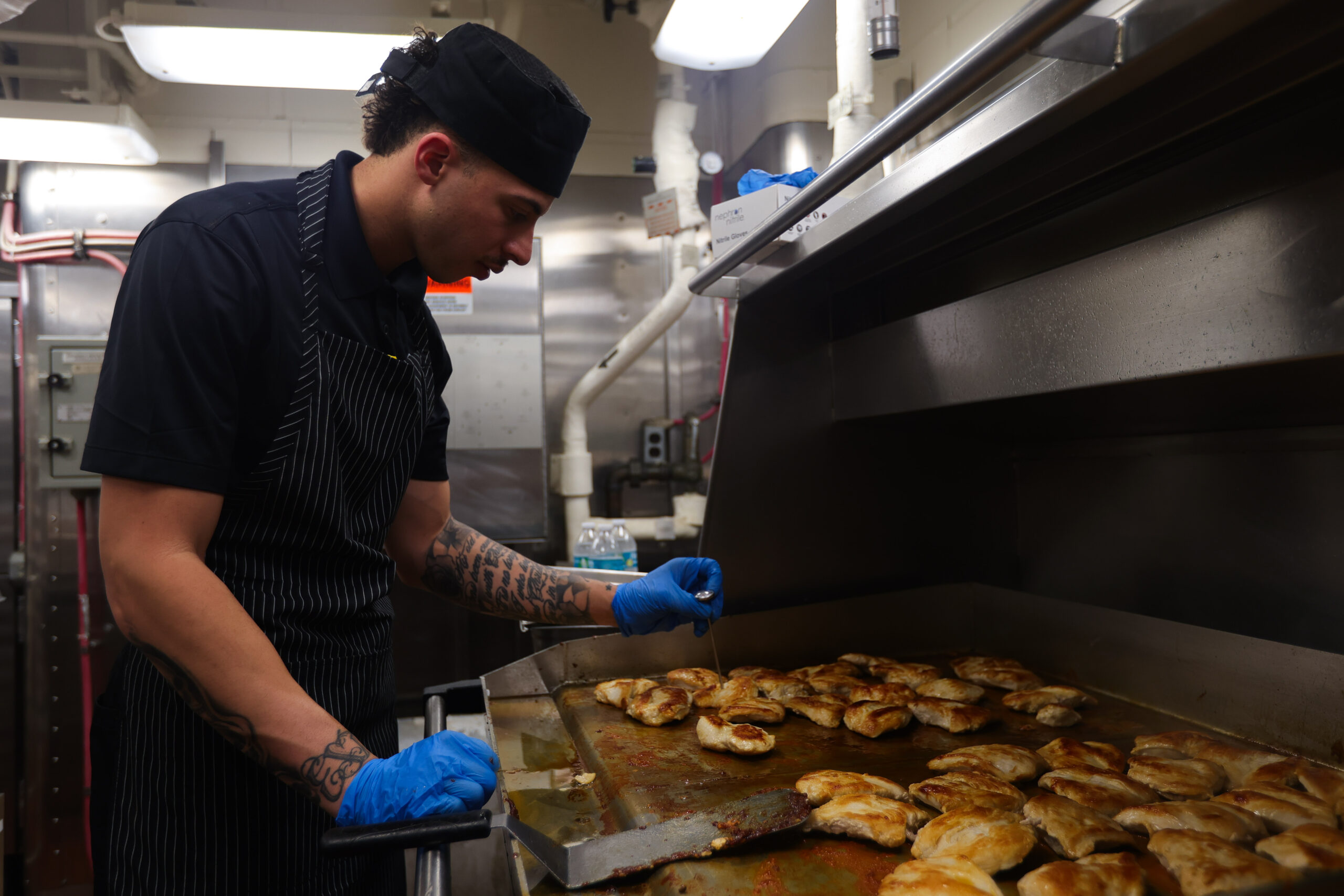
ATLANTIC OCEAN (October 23, 2024) Culinary Specialist Seaman Derrick Bryley, from Oklahoma City, assigned to supply department, aboard the worldÕs largest aircraft carrier, USS Gerald R. Ford (CVN 78), cooks chicken on a grill in the aft galley, Oct. 23, 2024. USS Gerald R. Ford, the flagship of the Gerald R. Ford Carrier Strike Group, is currently underway in the U.S. 2nd Fleet area operations, conducting Surface Warfare Advanced Tactical Training (SWATT). SWATT is the surface forceÕs premiere advanced tactical training exercise that increases war-fighting capability and tactical proficiency across all domains. (U.S. Navy photo by Mass Communication Specialist Seaman Gladjimi Balisage)

Family Day and VetsFest Brings Thousands

0

While drilling reservists enjoyed fun and food at Tinker AFB, veteran friendly businesses explained their services to customers in Piedmont on May 3rd.

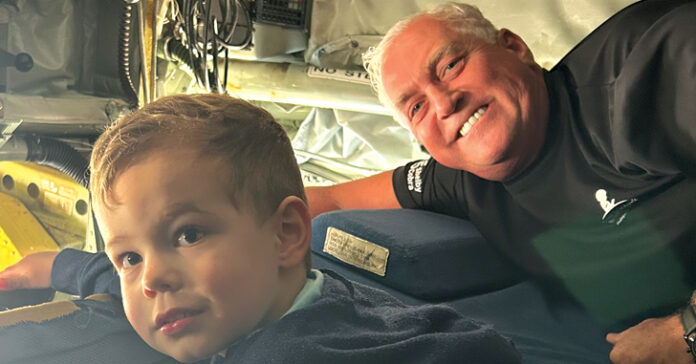
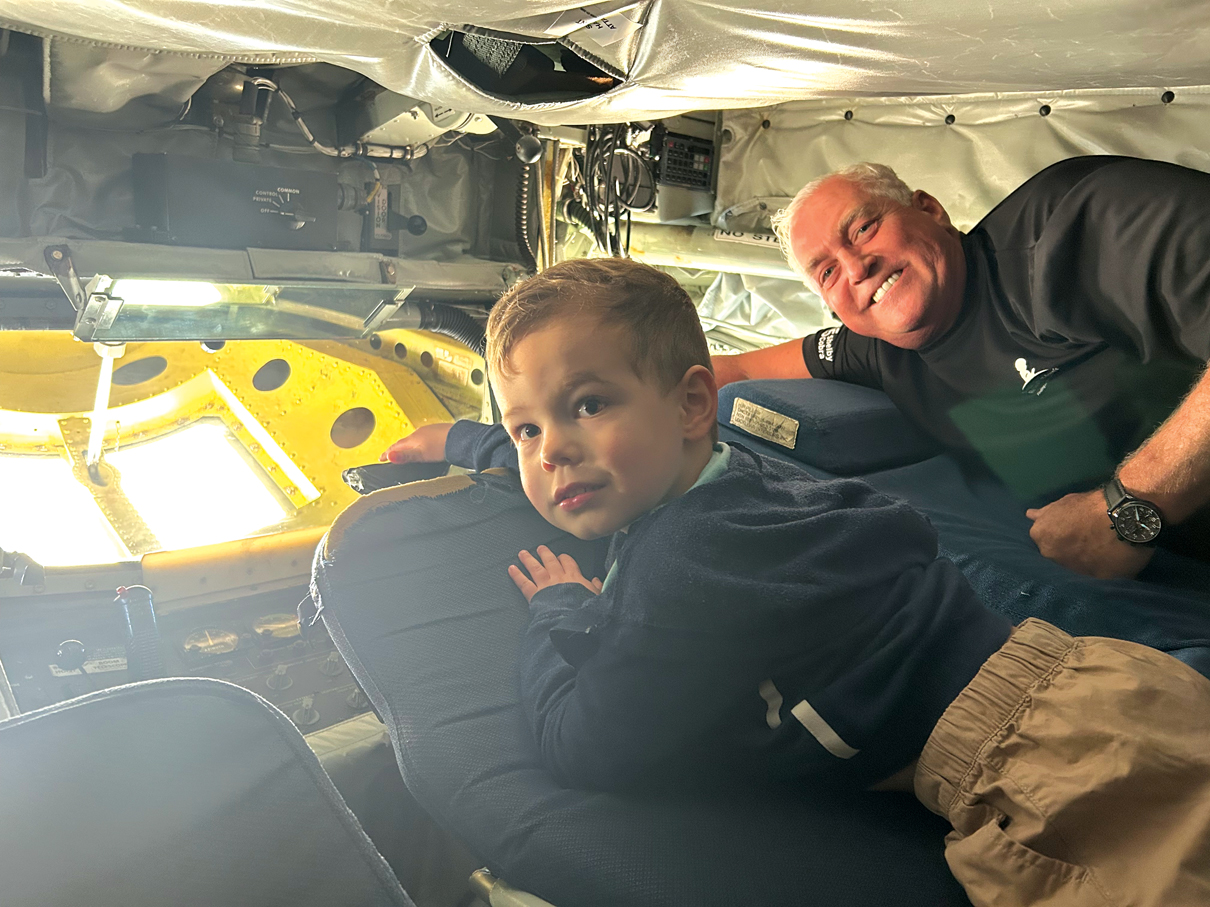
Mike (right) and his grandson, Myatt (left), checkout the boom operator’s position in a KC-135 during the 507 ARW’s Family Day,
May 3, 2025.

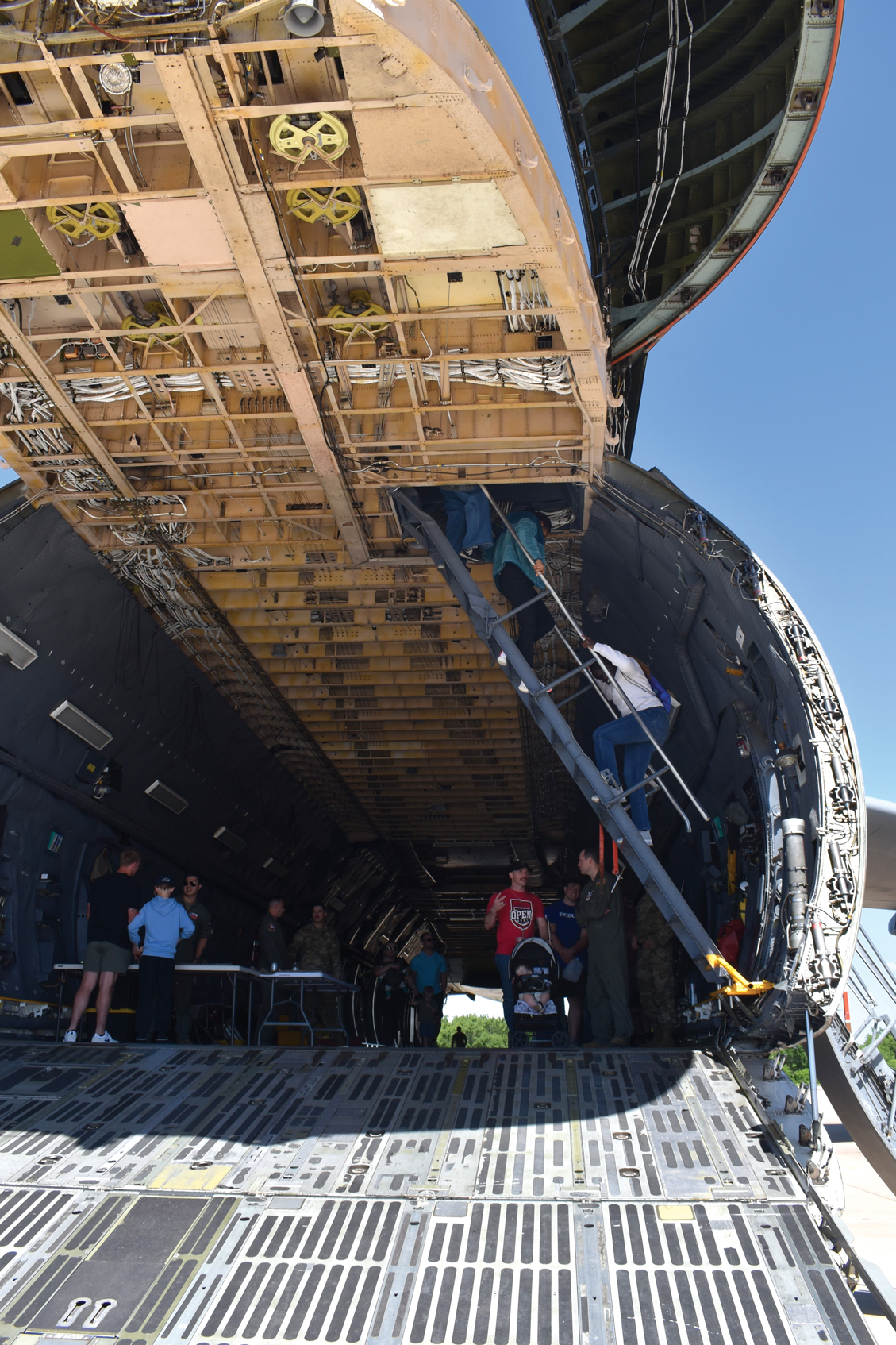
Reservists and family of the 507th Air Refueling Wing, an Air Force Reserve Command, unit equipped KC-135 unit, enjoyed their annual Family Day in Hanger 1030. They ate hamburgers, played on air-inflated slides and bounce houses, looked at classic cars and of course, showed off their refueling tankers. Other static display aircraft on hand: a C-5 and C-17 cargo airplane and a T-1, T-6 and T-38 trainer.
What is Family Day? Event planner 1Lt Kennedy Humprey, 465th Aircraft Refueling Squadron, shared that it is “To show our families what we do as military members.” 1Lt Nick Pratt, also with the 465th, added, “Show appreciation to the families because it’s all for them.” Humprey said he expected 1,000 people to attend.
Reservists like what they do. “I like working on the planes that refuel our fighter and other combat mission aircraft, plus I enjoy exploring the world,” said MSgt Trevor Hardesty, a member of the Aircraft Maintenance Squadron. MSgt Lindsey Newton, the Engineering Squadron’s First Sergeant, said she likes serving in the 507th “because the people (reservists) are like family.”

Hundreds of people walked through a C-5 during Family Day at the 507 ARW in 2025.

Twenty-nine organizations manned tables offering services and products, such as 72d Air Base Wing’s Military Family Readiness Center and Sexual Assault Prevention and Response Program, DoD’s Integrated Prevention & Resilience Office, VFW Post 8706 (Moore), and Big Brothers, Big Sisters. “I come because I want to help families with resources,” said Crystal Garcia with the Employee Assistance Program at Tinker AFB.
Gerardo Guzman, a 30-year retired Army Sergeant First Class, came because his son is a member of the wing. “My wife and I were proud for my son…” joining the Air Force Reserves.
According to the 507 ARW website (https://www.507arw.afrc.af.mil/About-Us/), “The wing operates and maintains eight KC-135R Stratotanker aircraft providing world-wide aerial refueling to U.S. and NATO aircraft in times of peace, war and national emergency” and “…consists of three subordinate groups and 11 squadrons while employing more than 1,200 men and women.”
Meanwhile, in Piedmont, the 4th Annual VetsFest 2025 was in full swing (with guitars, drums and keyboards) at the Piedmont Veterans Event Center. The Piedmont Area Veterans Association (PAVA)

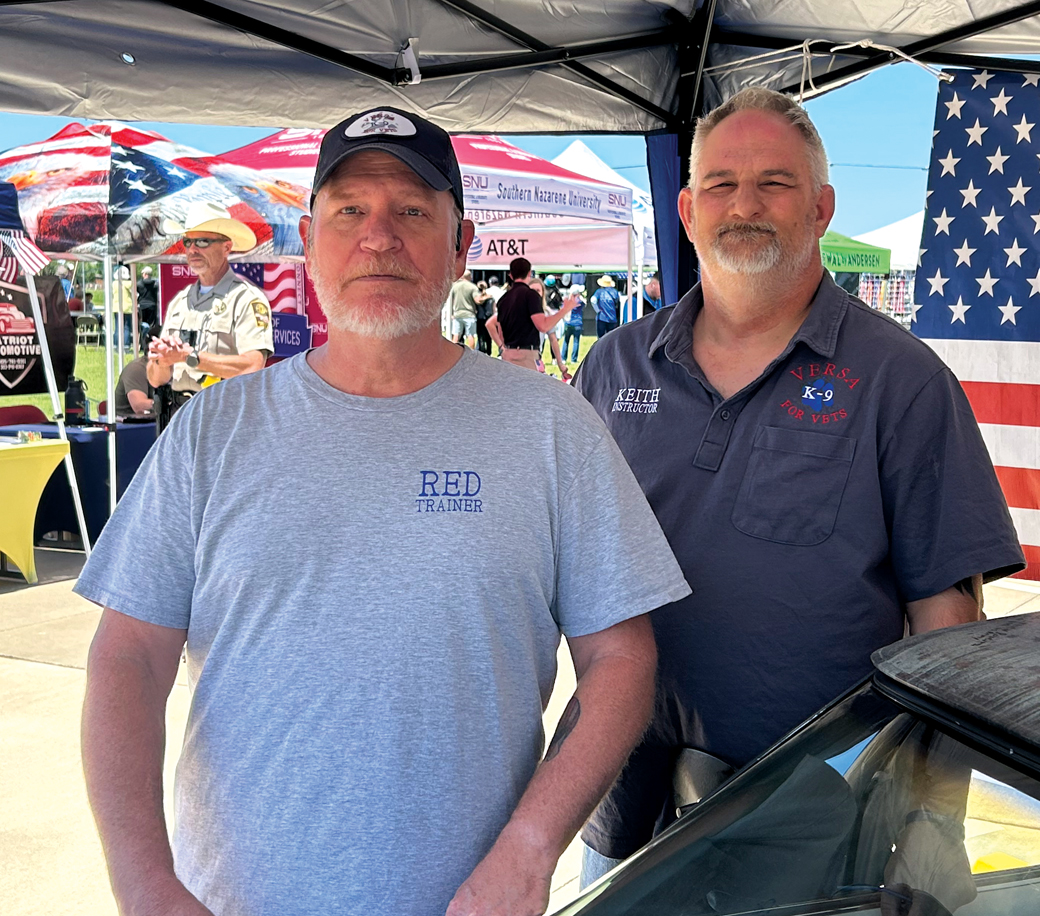
Red Avery (left) and Keith Newman (right), run Versa K-9 For Vets. ‘We train veterans to train their own service dogs.

( https://pavavets.org ), hosted the event. The Caroline Grace and J. Rod Wald bands played country music while Atlantis Aquarius entertained with psychedelic 60s style rock and roll for 300 people that attended. Grace joined the Atlantis Aquarius’ six band members to provide more vocals.
Twenty-five veteran-owned and veteran-connected businesses (colleges with veteran student services, etc.) came from throughout Oklahoma. Patriot Automotive of Piedmont is owned and operated by Jeremy Hays and John Leahr. Hays was a five-year U.S. Navy medical corpsman and Leahr is a 15-year drilling reservist with the 160th Oklahoma National Guard (U.S. Army). Hays said they wanted a booth to “let people know we are here to serve our community. You bring it in and we’ll fix it,” meaning vehicles of all makes, models and ages.
Ella Jefferson-Speed, founder and CEO of Soul Survivor Supportive Living Foundation, came to bring awareness to the organization. She is a 10-year U.S. Army veteran. She uses her experience to help “women with societal barriers like disability, homelessness, justice involved (jailed) and sobriety services.” The Soul Survivor handout says it’s a “501©3 that is dedicated to providing a safe, secure, and loving drug-free temporary home-solution for Veteran Women…” She estimated serving 25 women in 4 years.
Josh Cain was the lead event planner and is a PAVA board member. He said, “PAVA has done a lot of traditional things, for instance, (having) veterans affairs representatives, but beyond that, we are dynamically active in unique ways.” Holding VetsFest is one unique way. It allows them “to support veteran owned businesses and to celebrate veterans.” He said the event was a success because the overwhelming number of vendors were happy with the number of customers who engaged with them. Referring to event sponsors Ascent Midstream Partners, F&M Bank, Edward Jones and Express Employment International, Cain said, “I can’t say enough good things about how these guys care.” story/photos by Richard Stephens, Jr., Lt. Col, USAF Retired

Nancy Davis Reagan: Wife of 40th President, Actress and Advocate

0
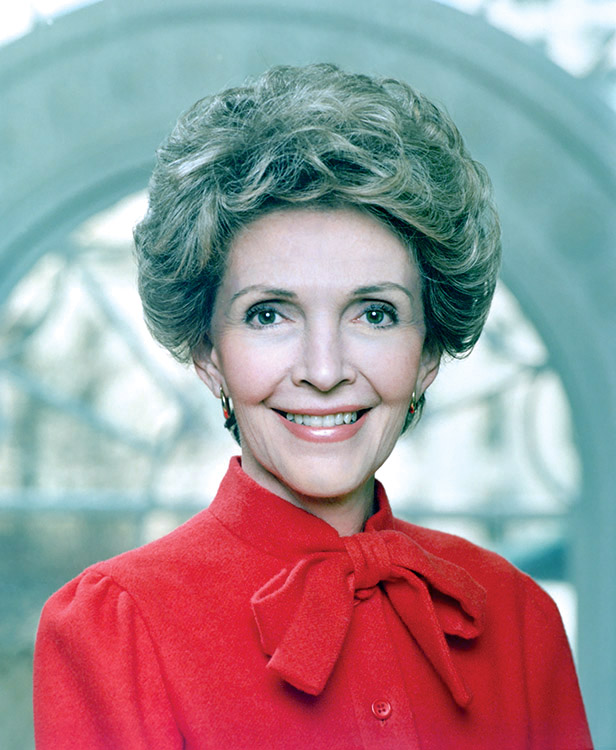
2/1/1983 Official Portrait of Nancy Reagan
Portrait of Nancy Reagan

Originally a Broadway actress, Nancy Davis Reagan served as First Lady from 1981 to 1989. She served alongside her husband, President Ronald Reagan, and is remembered for her passionate advocacy for decreasing drug and alcohol abuse.

“My life really began when I married my husband,” says Nancy Reagan, who in the 1950’s happily gave up an acting career for a permanent role as the wife of Ronald Reagan and mother to their children. Her story actually begins in New York City, her birthplace. She was born on July 6, 1921.

When the future First Lady was six, her mother, Edith–a stage actress–married Dr. Loyal Davis, a neurosurgeon. Dr. Davis adopted Nancy, and she grew up in Chicago. It was a happy time: summer camp, tennis, swimming, dancing. She received her formal education at Girls’ Latin School and at Smith College in Massachusetts, where she majored in theater.

Soon after graduation she became a professional actress. She toured with a road company, then landed a role on Broadway in the hit musical Lute Song. More parts followed. One performance drew an offer from Hollywood. Billed as Nancy Davis, she performed in 11 films from 1949 to 1956. Her first screen role was in Shadow on the Wall. Other releases included The Next Voice Your Hear and East Side, West Side. In her last movie, Hellcats of the Navy, she played opposite her husband.

She had met Ronald Reagan in 1951, when he was president of the Screen Actors Guild. The following year they were married in a simple ceremony in Los Angeles in the Little Brown Church in the Valley. Mrs. Reagan soon retired from making movies so she “could be the wife I wanted to be…A woman’s real happiness and real fulfillment come from within the home with her husband and children,” she says. President and Mrs. Reagan have a daughter, Patricia Ann, and a son, Ronald Prescott.

While her husband was Governor of California from 1967 to 1975, she worked with numerous charitable groups. She spent many hours visiting veterans, the elderly, and the emotionally and physically handicapped. These people continued to interest her as First Lady. She gave her support to the Foster Grandparent Program, the subject of her 1982 book, To Love A Child. Increasingly, she concentrated on the fight against drug and alcohol abuse among young people. She visited prevention and rehabilitation centers, and in 1985 she held a conference at the White House for First Ladies of 17 countries to focus international attention on this problem.

Mrs. Reagan shared her lifelong interest in the arts with the nation by using the Executive Mansion as a showcase for talented young performers in the PBS television series “In Performance at the White House.” In her first year in the mansion she directed a major renovation of the second- and third-floor quarters.

While living in retirement in California, Nancy continued to work on her campaign to teach children to “just say no” to drugs. In her book My Turn, published in 1989, she gave her own account of her life in the White House. Through the joys and sorrows of those days, including the assassination attempt on her husband, Nancy Reagan held fast to her belief in love, honesty, and selflessness. “The ideals have endured because they are right and are no less right today than yesterday.”

Nancy Reagan died at home in Los Angeles on March 6, 2016. She is buried alongside her husband at the Ronald Reagan Presidential Library in Simi Valley, California.

The biographies of the First Ladies on WhiteHouse.gov are from “The First Ladies of the United States of America,” by Allida Black. Copyright 2009 by the White House Historical Association.

Presidents Remembered: Ronald Reagan The 40th President of the United States

0

Ronald Reagan, originally an American actor and politician, became the 40th President of the United States serving from 1981 to 1989. His term saw a restoration of prosperity at home, with the goal of achieving “peace through strength” abroad.

At the end of his two terms in office, Ronald Reagan viewed with satisfaction the achievements of his innovative program known as the Reagan Revolution, which aimed to reinvigorate the American people and reduce their reliance upon Government. He felt he had fulfilled his campaign pledge of 1980 to restore “the great, confident roar of American progress and growth and optimism.”

On February 6, 1911, Ronald Wilson Reagan was born to Nelle and John Reagan in Tampico, Illinois. He attended high school in nearby Dixon and then worked his way through Eureka College. There, he studied economics and sociology, played on the football team, and acted in school plays. Upon graduation, he became a radio sports announcer. A screen test in 1937 won him a contract in Hollywood. During the next two decades he appeared in 53 films.

From his first marriage to actress Jane Wyman, he had two children, Maureen and Michael. Maureen passed away in 2001. In 1952 he married Nancy Davis, who was also an actress, and they had two children, Patricia Ann and Ronald Prescott.

As president of the Screen Actors Guild, Reagan became embroiled in disputes over the issue of Communism in the film industry; his political views shifted from liberal to conservative. He toured the country as a television host, becoming a spokesman for conservatism. In 1966 he was elected Governor of California by a margin of a million votes; he was re-elected in 1970.

Ronald Reagan won the Republican Presidential nomination in 1980 and chose as his running mate former Texas Congressman and United Nations Ambassador George Bush. Voters troubled by inflation and by the year-long confinement of Americans in Iran swept the Republican ticket into office. Reagan won 489 electoral votes to 49 for President Jimmy Carter.

On January 20, 1981, Reagan took office. Only 69 days later he was shot by a would-be assassin, but quickly recovered and returned to duty. His grace and wit during the dangerous incident caused his popularity to soar.

Dealing skillfully with Congress, Reagan obtained legislation to stimulate economic growth, curb inflation, increase employment, and strengthen national defense. He embarked upon a course of cutting taxes and Government expenditures, refusing to deviate from it when the strengthening of defense forces led to a large deficit.

A renewal of national self-confidence by 1984 helped Reagan and Bush win a second term with an unprecedented number of electoral votes. Their victory turned away Democratic challengers Walter F. Mondale and Geraldine Ferraro.

In 1986 Reagan obtained an overhaul of the income tax code, which eliminated many deductions and exempted millions of people with low incomes. At the end of his administration, the Nation was enjoying its longest recorded period of peacetime prosperity without recession or depression.

In foreign policy, Reagan sought to achieve “peace through strength.” During his two terms he increased defense spending 35 percent, but sought to improve relations with the Soviet Union. In dramatic meetings with Soviet leader Mikhail Gorbachev, he negotiated a treaty that would eliminate intermediate-range nuclear missiles. Reagan declared war against international terrorism, sending American bombers against Libya after evidence came out that Libya was involved in an attack on American soldiers in a West Berlin nightclub.

By ordering naval escorts in the Persian Gulf, he maintained the free flow of oil during the Iran-Iraq war. In keeping with the Reagan Doctrine, he gave support to anti-Communist insurgencies in Central America, Asia, and Africa.

Overall, the Reagan years saw a restoration of prosperity, and the goal of peace through strength seemed to be within grasp.

Social

0FansLike
0FollowersFollow
0SubscribersSubscribe