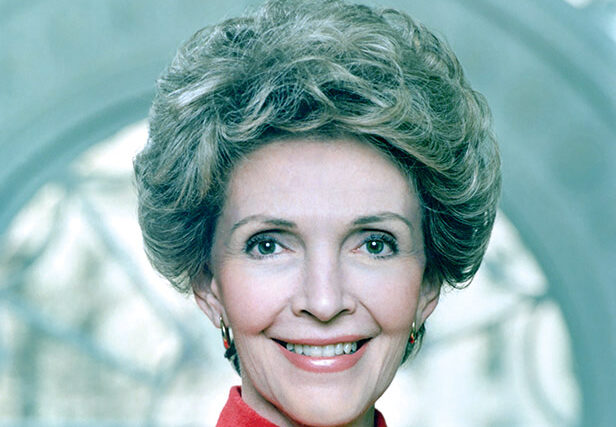
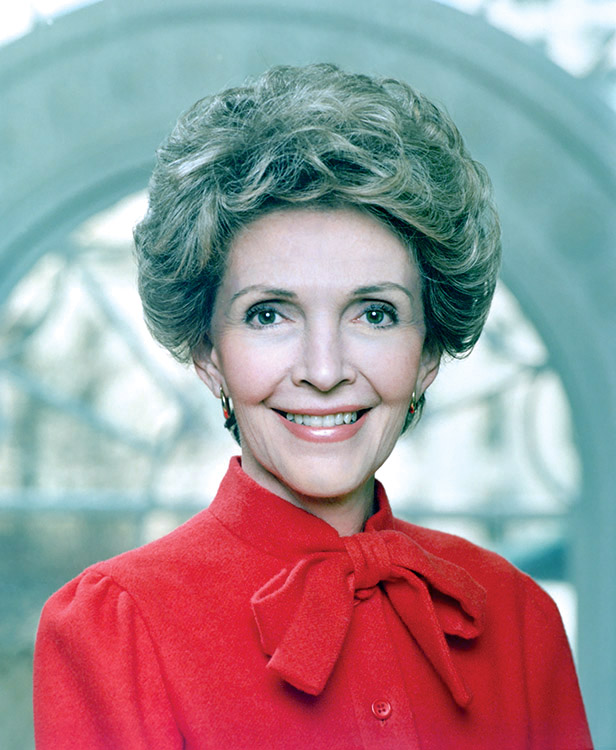
Originally a Broadway actress, Nancy Davis Reagan served as First Lady from 1981 to 1989. She served alongside her husband, President Ronald Reagan, and is remembered for her passionate advocacy for decreasing drug and alcohol abuse.
“My life really began when I married my husband,” says Nancy Reagan, who in the 1950’s happily gave up an acting career for a permanent role as the wife of Ronald Reagan and mother to their children. Her story actually begins in New York City, her birthplace. She was born on July 6, 1921.
When the future First Lady was six, her mother, Edith–a stage actress–married Dr. Loyal Davis, a neurosurgeon. Dr. Davis adopted Nancy, and she grew up in Chicago. It was a happy time: summer camp, tennis, swimming, dancing. She received her formal education at Girls’ Latin School and at Smith College in Massachusetts, where she majored in theater.
Soon after graduation she became a professional actress. She toured with a road company, then landed a role on Broadway in the hit musical Lute Song. More parts followed. One performance drew an offer from Hollywood. Billed as Nancy Davis, she performed in 11 films from 1949 to 1956. Her first screen role was in Shadow on the Wall. Other releases included The Next Voice Your Hear and East Side, West Side. In her last movie, Hellcats of the Navy, she played opposite her husband.
She had met Ronald Reagan in 1951, when he was president of the Screen Actors Guild. The following year they were married in a simple ceremony in Los Angeles in the Little Brown Church in the Valley. Mrs. Reagan soon retired from making movies so she “could be the wife I wanted to be…A woman’s real happiness and real fulfillment come from within the home with her husband and children,” she says. President and Mrs. Reagan have a daughter, Patricia Ann, and a son, Ronald Prescott.
While her husband was Governor of California from 1967 to 1975, she worked with numerous charitable groups. She spent many hours visiting veterans, the elderly, and the emotionally and physically handicapped. These people continued to interest her as First Lady. She gave her support to the Foster Grandparent Program, the subject of her 1982 book, To Love A Child. Increasingly, she concentrated on the fight against drug and alcohol abuse among young people. She visited prevention and rehabilitation centers, and in 1985 she held a conference at the White House for First Ladies of 17 countries to focus international attention on this problem.
Mrs. Reagan shared her lifelong interest in the arts with the nation by using the Executive Mansion as a showcase for talented young performers in the PBS television series “In Performance at the White House.” In her first year in the mansion she directed a major renovation of the second- and third-floor quarters.
While living in retirement in California, Nancy continued to work on her campaign to teach children to “just say no” to drugs. In her book My Turn, published in 1989, she gave her own account of her life in the White House. Through the joys and sorrows of those days, including the assassination attempt on her husband, Nancy Reagan held fast to her belief in love, honesty, and selflessness. “The ideals have endured because they are right and are no less right today than yesterday.”
Nancy Reagan died at home in Los Angeles on March 6, 2016. She is buried alongside her husband at the Ronald Reagan Presidential Library in Simi Valley, California.
The biographies of the First Ladies on WhiteHouse.gov are from “The First Ladies of the United States of America,” by Allida Black. Copyright 2009 by the White House Historical Association.
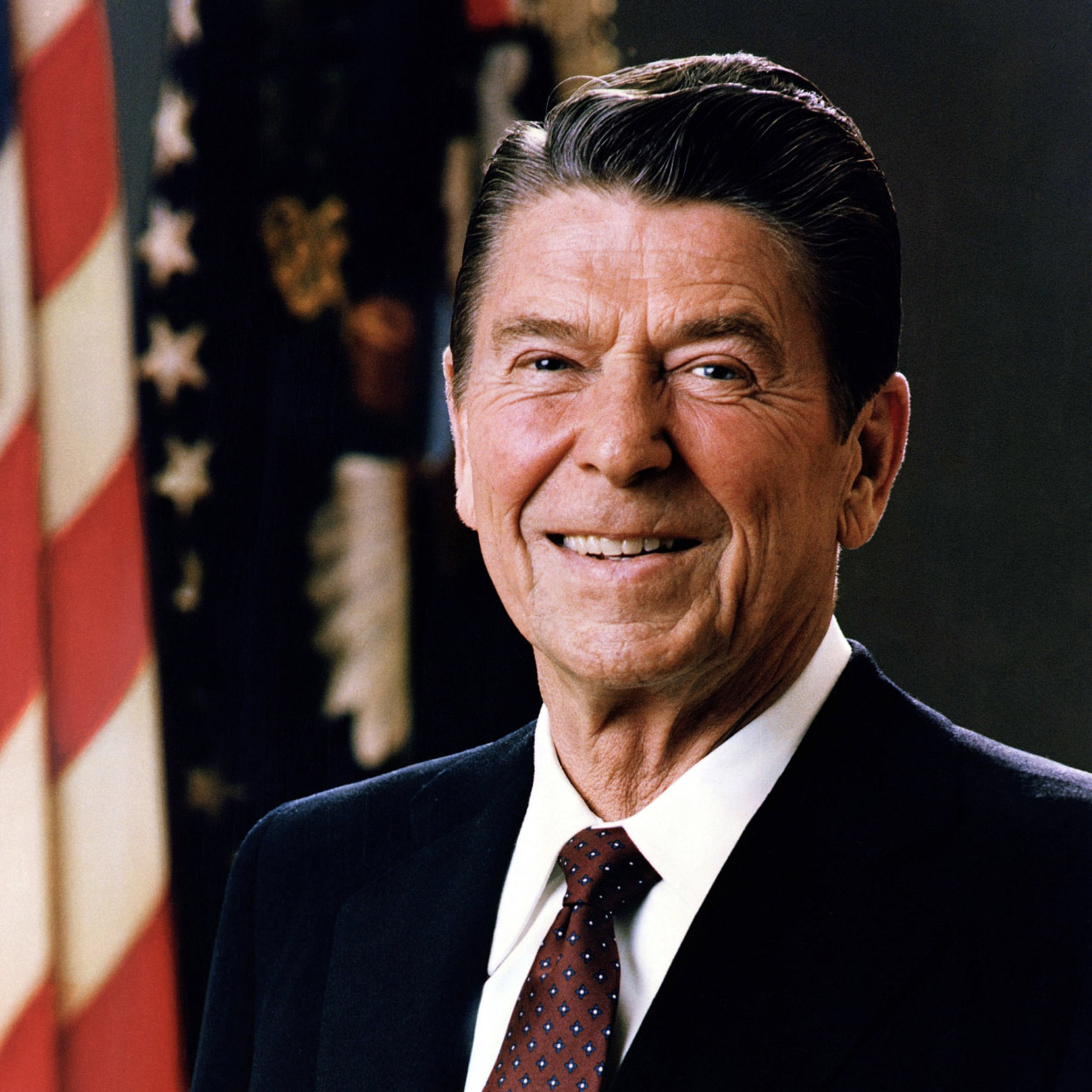
Ronald Reagan, originally an American actor and politician, became the 40th President of the United States serving from 1981 to 1989. His term saw a restoration of prosperity at home, with the goal of achieving “peace through strength” abroad.
At the end of his two terms in office, Ronald Reagan viewed with satisfaction the achievements of his innovative program known as the Reagan Revolution, which aimed to reinvigorate the American people and reduce their reliance upon Government. He felt he had fulfilled his campaign pledge of 1980 to restore “the great, confident roar of American progress and growth and optimism.”
On February 6, 1911, Ronald Wilson Reagan was born to Nelle and John Reagan in Tampico, Illinois. He attended high school in nearby Dixon and then worked his way through Eureka College. There, he studied economics and sociology, played on the football team, and acted in school plays. Upon graduation, he became a radio sports announcer. A screen test in 1937 won him a contract in Hollywood. During the next two decades he appeared in 53 films.
From his first marriage to actress Jane Wyman, he had two children, Maureen and Michael. Maureen passed away in 2001. In 1952 he married Nancy Davis, who was also an actress, and they had two children, Patricia Ann and Ronald Prescott.
As president of the Screen Actors Guild, Reagan became embroiled in disputes over the issue of Communism in the film industry; his political views shifted from liberal to conservative. He toured the country as a television host, becoming a spokesman for conservatism. In 1966 he was elected Governor of California by a margin of a million votes; he was re-elected in 1970.
Ronald Reagan won the Republican Presidential nomination in 1980 and chose as his running mate former Texas Congressman and United Nations Ambassador George Bush. Voters troubled by inflation and by the year-long confinement of Americans in Iran swept the Republican ticket into office. Reagan won 489 electoral votes to 49 for President Jimmy Carter.
On January 20, 1981, Reagan took office. Only 69 days later he was shot by a would-be assassin, but quickly recovered and returned to duty. His grace and wit during the dangerous incident caused his popularity to soar.
Dealing skillfully with Congress, Reagan obtained legislation to stimulate economic growth, curb inflation, increase employment, and strengthen national defense. He embarked upon a course of cutting taxes and Government expenditures, refusing to deviate from it when the strengthening of defense forces led to a large deficit.
A renewal of national self-confidence by 1984 helped Reagan and Bush win a second term with an unprecedented number of electoral votes. Their victory turned away Democratic challengers Walter F. Mondale and Geraldine Ferraro.
In 1986 Reagan obtained an overhaul of the income tax code, which eliminated many deductions and exempted millions of people with low incomes. At the end of his administration, the Nation was enjoying its longest recorded period of peacetime prosperity without recession or depression.
In foreign policy, Reagan sought to achieve “peace through strength.” During his two terms he increased defense spending 35 percent, but sought to improve relations with the Soviet Union. In dramatic meetings with Soviet leader Mikhail Gorbachev, he negotiated a treaty that would eliminate intermediate-range nuclear missiles. Reagan declared war against international terrorism, sending American bombers against Libya after evidence came out that Libya was involved in an attack on American soldiers in a West Berlin nightclub.
By ordering naval escorts in the Persian Gulf, he maintained the free flow of oil during the Iran-Iraq war. In keeping with the Reagan Doctrine, he gave support to anti-Communist insurgencies in Central America, Asia, and Africa.
Overall, the Reagan years saw a restoration of prosperity, and the goal of peace through strength seemed to be within grasp.
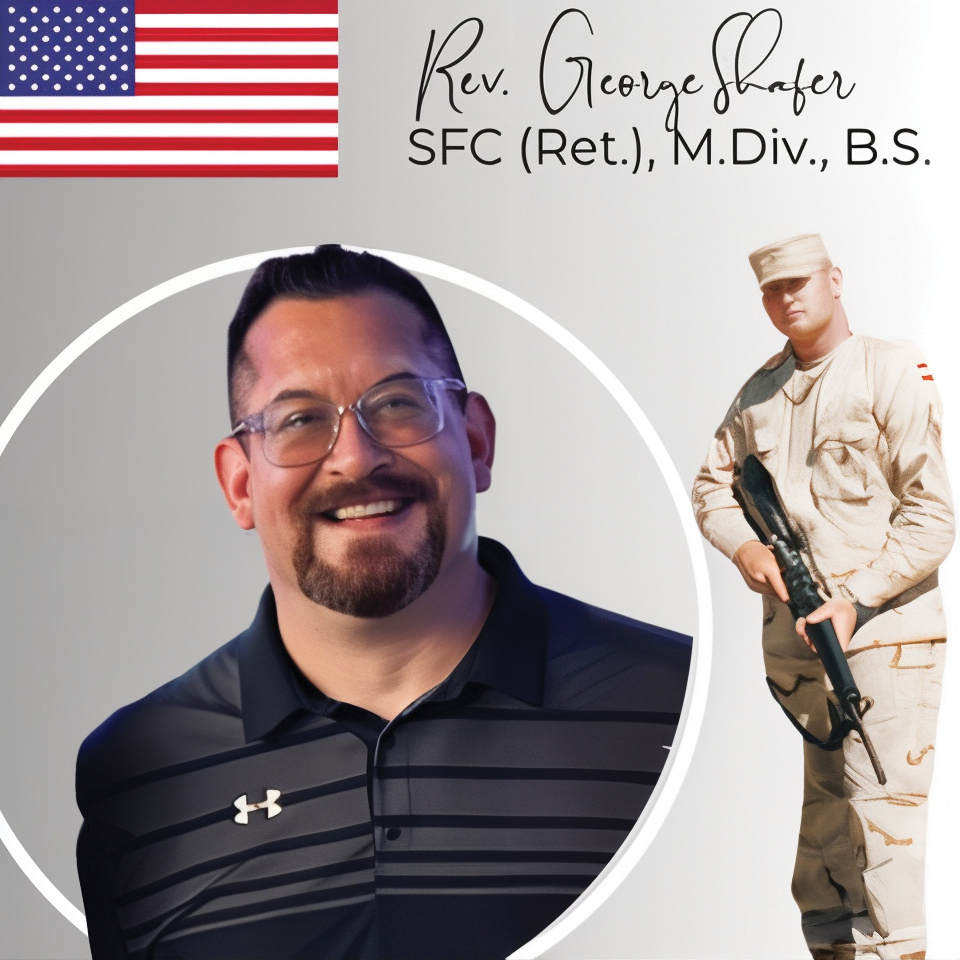
Rev. George F. Shafer, SFC (Ret.), M.Div., B.S., Chaplain (TAL Post 58)
What an honor and a privilege to be part of the inaugural Chaplain’s Corner segment. My name is SFC (Ret.) George Shafer, and I am the Chaplain for The American Legion LeBron Post 58 in Guthrie, OK.
I recently graduated seminary with a capstone thesis about online ministry and American Veterans. During the research phase of development, I felt as though the Lord directed me to Matthew chapter 8 verses 5-18 which states: “When he had entered Capernaum, a centurion came forward to him, appealing to him, ‘Lord, my servant is lying paralyzed at home, suffering terribly.’ And he said to him, ‘I will come and heal him.’ But the centurion replied, ‘Lord, I am not worthy to have you come under my roof, but only say the word, and my servant will be healed. For I too am a man under authority, with soldiers under me. And I say to one, ‘Go,’ and he goes, and to another, ‘Come,’ and he comes, and to my servant, ‘Do this,’ and he does it.’ When Jesus heard this, he marveled and said to those who followed him, ‘Truly, I tell you, with no one in Israel have I found such faith. I tell you, many will come from east and west and recline at table with Abraham, Isaac, and Jacob in the kingdom of heaven, while the sons of the kingdom will be thrown into the outer darkness. In that place there will be weeping and gnashing of teeth.’ And to the centurion Jesus said, ‘Go; let it be done for you as you have believed.’ And the servant was healed at that very moment.”
Matthew 8:5-13 (ESV)
This passage is fascinating for several reasons. First, the geographical context of Capernaum at this time being “an important fishing village and commercial center…As a major city on the trade route, it had a Roman battalion, and one of the centurions approached Jesus.” Osborne and Arnold also believe that the centurion would have been either Syrian or Roman, and notes that the relationship between Romans/Syrian and the Jews was highly contentious.
Furthermore, this passage is the only one in Matthew’s gospel that “Jesus marvels at anything.” Jesus marveled at the faith of the centurion! But this passage gets even better; especially when we view this interaction within the scope of evangelism and missions. Osborne notes that “the miracle happened as much for the centurion as for his slave, and that in this, salvation has come not just to Israel but for the nations, so that the universal mission is found here in embryo.”
Did you catch that? Whereas we understand that the first Gentile conversion occurs in Acts under the command of God to Peter after his vision, here we find the Son of God himself carefully cultivating and preparing the way for Gentile inclusion… through a soldier.
If you are reading this and are struggling with your faith; perhaps the transition from soldier to civilian has been too much. Maybe you’re like me and your time in the military left you with scars, both visible and invisible. But I want you to know that He sees you. He hears you. He knows you and He completely understands you. The Gentile ministry that Jesus began with the Centurion over two thousand years ago in an embryonic state was not still-born but rather is alive and well in the pursuit of YOU.
I pray this message has encouraged you in your faith. If you have not yet considered the path of a faith-driven life, I would encourage you to stop by your local veteran service organization (The American Legion, Veterans of Foreign Wars, etc.) and speak to the local chaplain. May the Lord bless you and keep you, and may His face shine upon you in all you do today! by Rev. George F. Shafer, SFC (Ret.), M.Div., B.S., Chaplain (TAL Post 58)
Edwards followed his heart to help the others during and after Vietnam War.
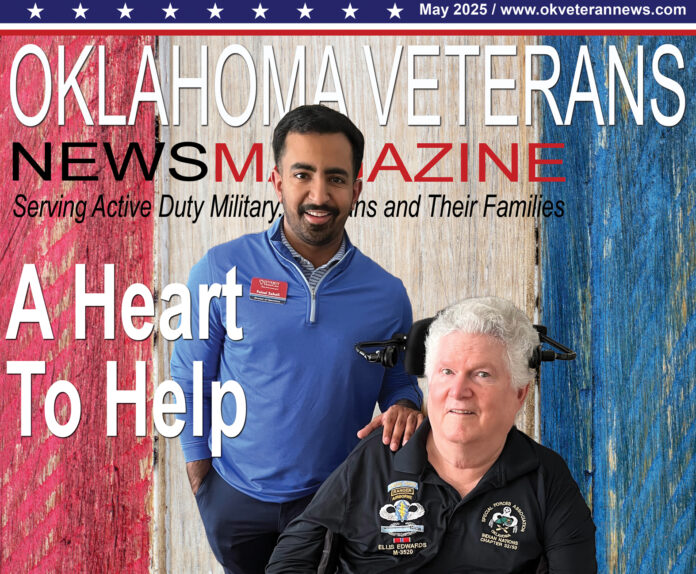
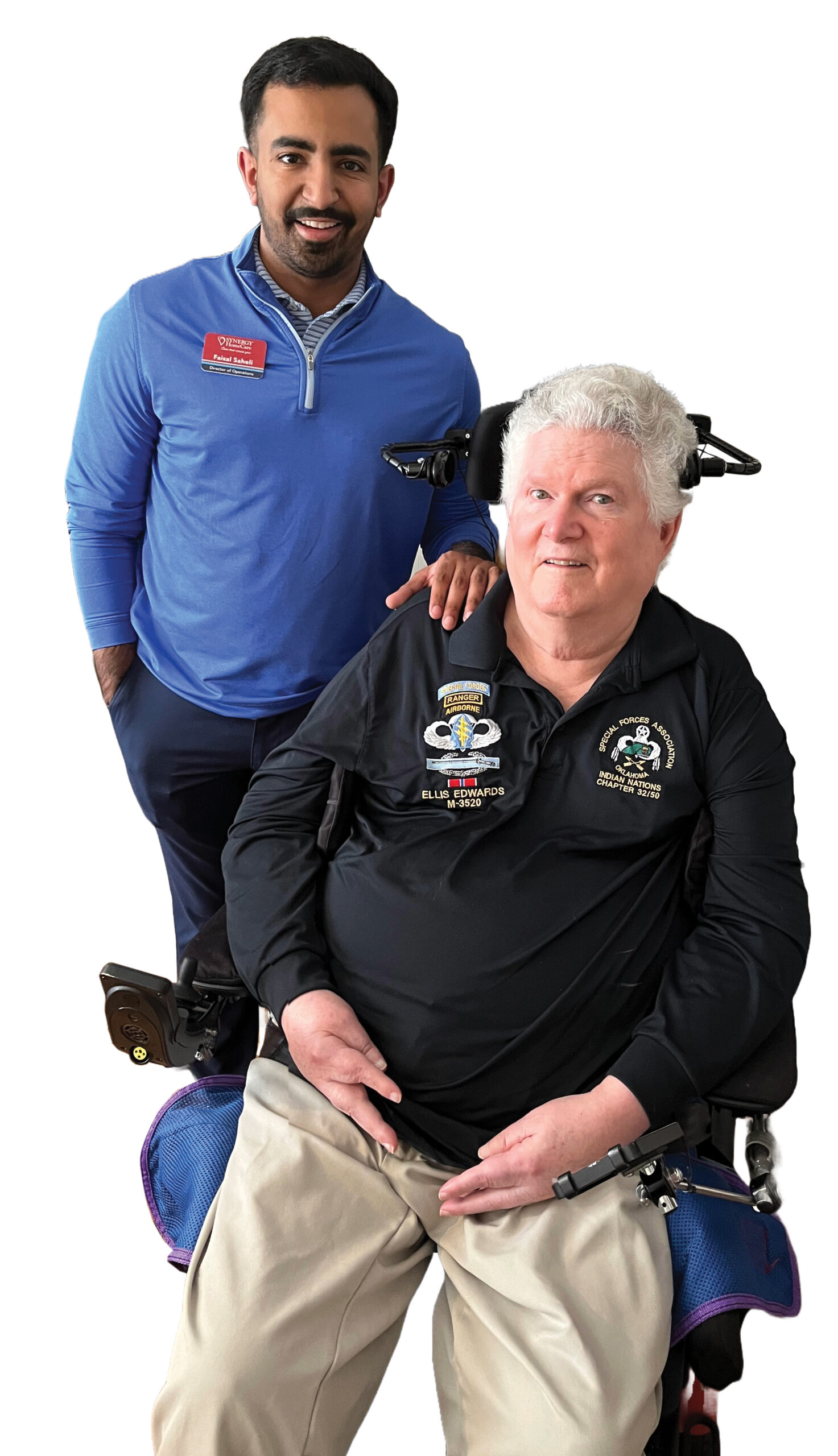
On The Cover: Ellis Edwards, a Bronze Star recipient receives in-home care from SYNERGY HomeCare located in Oklahoma City. Pictured with Edwards is Faisal Saheli, SYNERGY HomeCare Director of Operations.
Ellis Edwards has been a Veteran Home Care client of SYNERGY HomeCare since May 2019.
He and his wife have been very grateful for the extra help they’ve been able to receive and have grown to view their caregivers as an extension of family.
His wife, Thao, said “SYNERGY is doing a great job to accommodate Ellis’ needs. They are a good company, especially to our veterans. Our caregivers are always there to help him, and it’s been such a relief for us.” The entire team is grateful to be able to serve the Edwards family and are honored to recognize his incredible service to our nation.”
Edwards might not see himself as a hero, but there are others that might dis agree with the Bronze Star Medal and Combat Infantry Badge recipient and a member of the Oklahoma Military Hall of Fame.
Edwards, 77, has made a difference in peoples’ lives both during and after the Vietnam War.
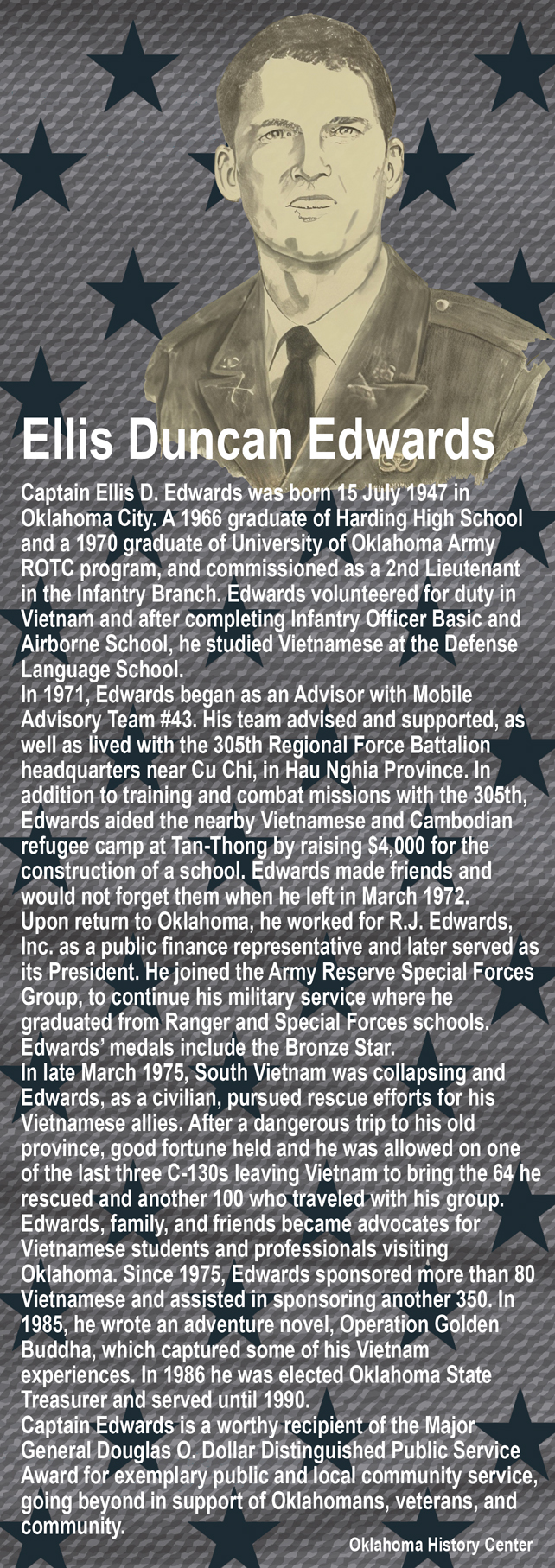
He rescued 64 American allies when the Republic of Vietnam was falling to the North Vietnamese. In 1970, he was a second lieutenant in the infantry. He volunteered for the Republic of Vietnam for duty in Vietnam. He was promoted to Captain because of that rescue mission.
As an advisor, Edwards was aware of the instability of the South Vietnamese government. He promised his comrades that, in the event a communist takeover was imminent, he would return and help them escape. Edwards took this commitment seriously.
“I knew that I could do something,” Edwards said. “That was my Christian duty.”
Following his return from Vietnam and his release from his active duty, Edwards joined Operational Detachment 212, Company A, 2nd Battalion, 12th Special Forces Group (Airborne) in Oklahoma City.
While working as a financial bond advisor, completing a master’s degree and serving in the Special Forces Reserve, Edwards closely monitored the Vietnam War, remaining in touch with his friends.
On January 3, 1975, Edwards suffered a serious injury on a night parachute jump with the Special Forces Unit, fracturing vertebrae in his back. The injuries eventually caused his retirement from the Army.
In March of 1975, South Vietnam was quickly collapsing. The North Vietnamese had started their push to destroy the remaining South Vietnamese military, and vast areas were falling into the Communists’ hands. Many soldiers abandoned their posts and fled in panic. The highways were clogged with columns of tanks, armored personnel carriers, artillery pieces and trucks loaded with soldiers.
Remembering his promises, Edwards planned an emergency return to the war zone to rescue as many as he could.
At his own expense, Edwards flew first to New Orleans where he obtained an expedited passport, flying on to Washington D.C. where he received a visa from the South Vietnamese embassy, then flying to Saigon.
Edwards returned at the very moment that Communist forces were overrunning the country, exposing him to great personal danger.
The South was within weeks of capture and the whole country was in a state of pandemonium.
Further complicating matters, Edwards was in pain throughout his mission. He said his back injury required him to wear a brace, and he was constantly in need of unavailable physical therapy.
Despite his pain, Edwards diligently set about contacting those in harm’s way. Most of Edwards former counterparts were located on the Cambodian border in a province there, where heavy fighting was taking place.
Edwards found and hired a taxi driver who originally agreed to take him to that area.
As they traveled through the countryside, however, there were Communist roadblocks, which barely managed to evade.
When the driver refused to go any further, Edwards produced his only weapon, a pistol and told the shaken man that he had no choice but to continue.
They reached the area where Edwards found his former unit and the individuals whom he had advised. From both that province and Saigon, Edwards rounded up 64 people seeking to escape.
When it was time for Edwards to return to Saigon, however, the taxi had gone. Having no other transportation, Edwards was left with the unbelievable option of taking a public bus through enemy-held territory.
He said was lucky that the Communists caught a Republic of Vietnam officer who was riding a bus shortly behind him and hanged him.
Back in Saigon, Edwards then had to address the problem of how to get the refugees out of the country.
In a misguided effort to keep South Vietnam from collapsing, the US government initially refused to evacuate Vietnamese nationals, and the American ambassador attempted to prevent Vietnamese citizens from leaving.
Edwards was required to not only deal with the Vietnamese onslaught, but he was also hampered by non-cooperation from the American embassy.
Ever determined, Edwards resorted to unconventional tactics to accomplish his plan. He first found a South Vietnamese air force pilot who accepted $25,000 to fly the refugees to Thailand.
At the last minute, however, the US government changed its policy, and Edwards was able to convince the Air Force to devote an airplane to his refugees. Although he never recovered the $25,000 paid to the pilot, he now believes that expenditure was worth it.
Before leaving on one of the last military flights out of Vietnam, Edwards helped all those he could.
Among them were six Vietnamese women, each of whom Edwards “married” before the fall of South Vietnam.
Edwards managed to talk his way into the American embassy where, in the chaos, he found the empty office of an American general who had already been evacuated. He used his fortress to gain access to people who can help him get the refugees out. At one point, he even posed as a congressional staffer.
While in Saigon, Edwards was attacked on the street by an unknown assailant. The incident involved gunfire, and Edwards was shot by the assailant.
Once the refugees reached US soil, Edwards did not abandon them.
In fact, he sponsored more than 200 refugees in Oklahoma, finding them places to live, obtaining jobs, enrolling children in school, acquiring household furnishings, obtaining driver training licenses and automobiles.
The refugees who came to Oklahoma have successfully been part of the state. They have businesses and professions.
In 1998, Ellis and his wife Thao Edwards invited a young teenage girl who had been raised under the Communist regime in Vietnam to live in their home and attend Bishop McGuinness High School in Oklahoma City.
The girl’s mother was unable to support her, and she asked Edwards for help. After a successful semester at McGuinness, Edwards managed to get the girl accepted into the Oklahoma School of Science and Math. Upon high school graduation, she received a full scholarship to Mount Holyoke University, which she finished in three and a half years with double majors.
The summer of 2010, Edwards invited a Vietnamese college student to stay at his house, helping him with acquiring tuition for about a year. The young man went on to St. Bernard’s Seminary and School of Theology. He was ordained June 30, 2018.
“I’ve helped a lot of people, and I gave them (help with a new life in the United States),” he said.
Edwards also helped raise funds from private sources to build a much-needed grade school in Vietnam. He personally ramrodded the project to completion only to hear that the Communists demolished it after his departure.
Thao Edwards said her husband of almost 49 years has a heart of gold. “He’s extraordinary. He can do the things that normal people don’t do,” she said. story by Van Mitchell
Jeff Burch, a Morrison resident, was specially trained to see things coming that the average civilian might not be prepared to face.
Jeff Burch is a Morrison resident and disabled veteran who proudly served his country overseas. During his time in the Army, he was specially trained to see things coming that the average civilian might not be prepared to face. But late last year, he had no way of predicting an emergency situation that left him hospitalized.
He woke up in intense pain with no spinal fluid and no memory of the previous hours. Those hours, he says, are unforgettable for his family, as they rushed him to the Stillwater Medical Emergency Room.
“The process of coming into the hospital itself was traumatic for my wife, as well as my son. The staff at the emergency room were comforting. They tried everything at their disposal to figure out what was going on,” Burch said.
With no clear answers, Burch was admitted to the hospital. His insurance is through Veterans Affairs, so his family feared he may be transferred to another facility before they understood the reason for his condition.
Cooperation enabled Burch to stay put.
“The line of communication from Stillwater Medical to the Oklahoma City VA was completely wide open,” Burch said. “They helped my wife and my family get the paperwork all started, which is key.”
Burch had suffered a stroke and needed time to heal. His military training wasn’t entirely useless to him in hospital. He recognized how the structures he was so familiar with in the military seemed present among the staff caring for him. They each had a clear mission, rank and responsibility. Doctors, nurses, medical technicians, staff in the Central Business Office, all came together to provide care in his time of need. Care that he said he considers heroic.
“All the way from the nurse in the ER room to the top floor of your care, it takes a special kind of person to deal with a sick person. Most people that are sick are in a bad mood. But everyone I interacted with showed nothing but pure compassion, pure understanding. It’s almost as if they knew what I needed before I needed it,” Burch said.
Burch is quick to reject the label of hero for his service. To him, he was just doing the job he signed up for with the help of veterans who came before him and the allies who trained beside him. Others might disagree.
Mirriam-Webster defines a hero as a person admired for achievements and noble qualities. Admiration is certainly what Burch expressed for his care team.
“To summarize my experience as far as the care that I received at Stillwater Medical, it was extraordinary, humbling,” Burch said. “They didn’t have to take that above and beyond, but they did, and it shows. It really shows.”
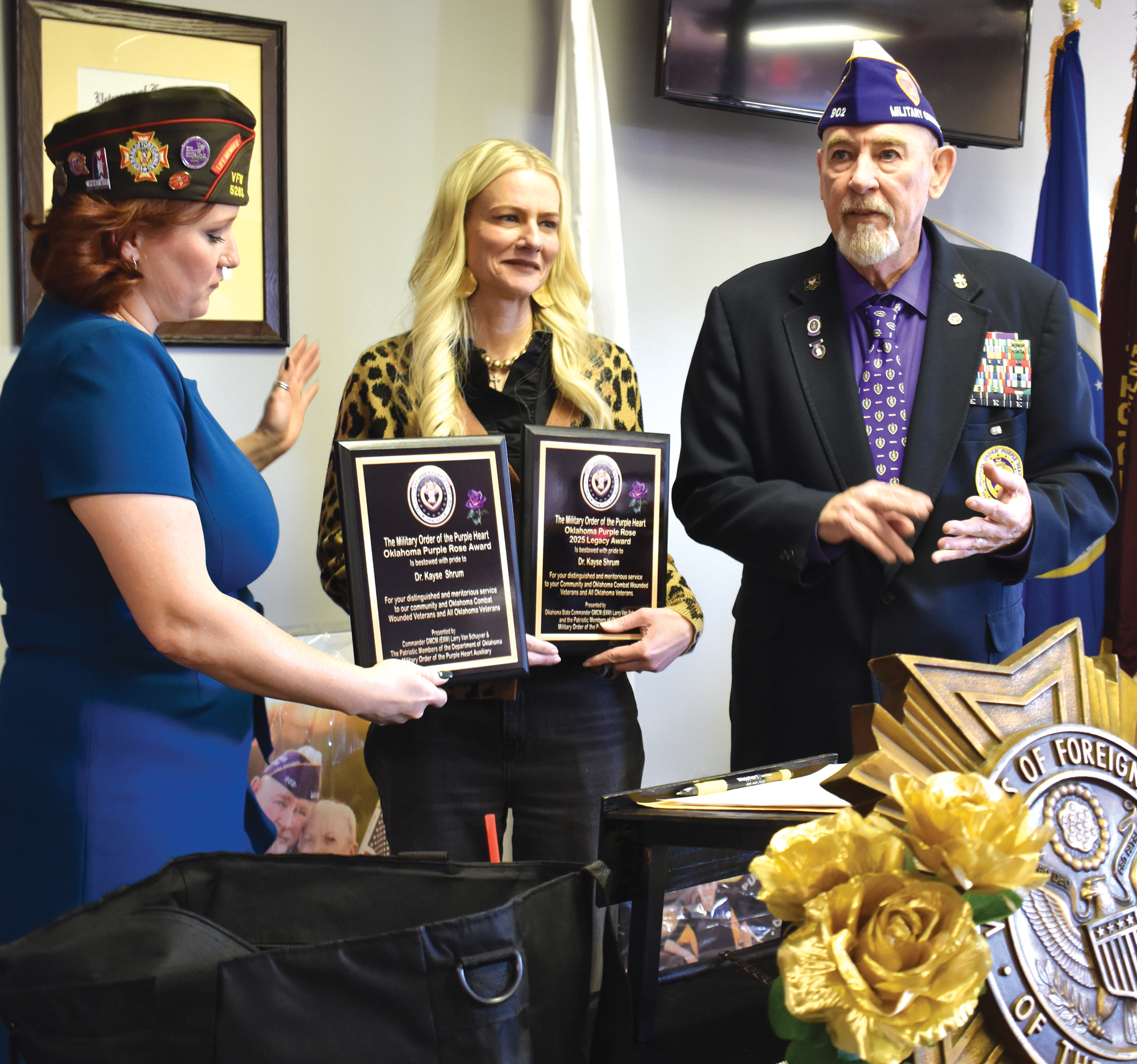
Dr. Kayse Shrum (center), President of Oklahoma State Univ. 2021-2025, received the Oklahoma Purple Rose and Legacy awards from Larry Van Schuyver (right).
It was standing room only at VFW Post 4938, Edmond, on March 1 as retired Navy Master Chief Larry Van Schuyver, Oklahoma’s State Commander of the Military Order of the Purple Heart (MOPH) and other members recognized about 42 individuals and groups who volunteered in 2024 and 2025 to make a difference to Oklahoma veterans, including combat wounded veterans. The annual ceremony was a tribute to those who improve veteran’s lives in many ways.
After receiving a plaque, recipients told the 90-person crowd what they do for veterans of all Services. It was quite evident, through tears and quivering voices, how deeply each person felt about their mission to honor veterans. The name of the award and its recipient are in bold font. Remarks by several recipients, edited for brevity, are provided below.
Master Chief Larry Van Schuyver (left) State Comdr of the Military Order of the Purple Heart, congratulates Jesse Sanchez for receiving the Purple Heart Joe Barlett Memorial Award.
Spirit of Oklahoma Award
Lt. Col. Peter Plank said, “What a nice recognition for what we’ve done over 20 years with the World War II…We formed a Liberty Jump Team, parachute team, 20 plus years ago. And we jump in Normandy, France, Holland, and we do a veteran program in Belgium every year. And we took some Battle of the Bulge veterans back to the battlefields. They fought the villages, they liberated, and one of them…101-year-old Chock Charleston was a Sherman tank driver and we took him back to the villages that he went through and it took him to the Luxembourg American Cemetery and brought closure.”
Purple Heart Business of the Year
Jessie Newell of Shawnee is a photographer and owns Bird Nest Baby Photography. “I photograph war veterans to honor their service with or without their families…I’ve photographed over a thousand veterans…So, my very first veteran was named Dewey Muirhead…So, he comes out and he brings about 20 family members and I photographed them all…Dewey told me what D-Day was like, how terrifying it was to lay on Omaha Beach in the middle of thousands of wounded and dead soldiers, hearing young men yelling out for their mothers, because all of them were between 16 and probably 20 years old or somewhere around there.” She concluded, “It’s a blessing that I would never walk away from.”
Outstanding Mayor of the Year
Matthew Dukes, the Mayor of Midwest City, bested 64 nominees to earn the award. Accepting the plaque, he smiled and told the crowd, “I’m very honored…All I did was make Midwest City a Purple Heart City. I appreciate the recognition and – shock – to Midwest City. We’re on the map now. I appreciate this very much.” Mayor Dukes is a retired Chief Master Sergeant of the Oklahoma Air National Guard.
Purple Heart Veteran of the Year
Don Nichols, Muskogee Adjutant of the Military Order of the Purple Heart (and a Purple Heart recipient), and volunteers came from Muskogee and Tahlequah. He said of them, “They worked to save the (Jack C. Montgonery) VA Hospital in Muskogee…We went out and got together 80,000 signatures and kept them from moving the hospital, and it was that group that did it… We built a National Purple Heart Monument in Tahlequah, Oklahoma (It was dedicated May 25, 2024)…We’re proud of it…We are just in the process of recognizing the 14 historical black towns in the state of Oklahoma as Purple Heart Cities.”
Service Before Self Award
Sixteen members of the (mostly) motorcycle riding group Flag Poles Honoring our Veterans attended. One spokesman said Kevin Blake, the group’s founder, started in March 2020 and added, “Since then, the group has installed 670 flag poles for veterans…Most of us are just patriots (not veterans)…We will raise the flag with the pledge of allegiance, say a prayer over it…We do the 13 folds of the flag and read the meaning of the 13 folds…And then we’ll have a veteran present the flag to the recipient. It’s a moving experience.”
Distinguished Service Organization of the Year
Vet Chat at Cornerstone Church, Midwest City, has been connecting veterans with local agencies, organizations, and civic groups for advice and assistance since 2018. About 15 members attended the ceremony. Leo Webster, the Executive Director, thanked his volunteers. “You stepped into the life of veterans in need, offering them support, understanding the compassion that they may never have found anywhere else…Let’s be relentless in our pursuit of saving lives and ensuring that no veteran feels alone, abandoned.”
General Pete Costilow Volunteers of the Year
Fat Guys Club. This dedicated group donates countless hours providing cooking demonstrations at the Norman Veterans Center, donating clothing for a special care school in OKC, cooking for children receiving Christmas gifts with the Mafias Motorcycle Club, cooking and delivering Thanksgiving and Christmas dinners to needy families, and grilling food on Father’s Day and Valentines Day for veterans at San Marcos Mexican Restaurant, OKC.
Hall of Honor Supporter.
Plaques went to Oklahoma Representative Andy Fugate, Stacy Reddig, Debra Wimpee, and John Meek of the Navy Enlisted Reserve Association-Oklahoma. After Pugate received his plaque, he said, “I’m grateful for the recognition. I’ll stand up for you every day.” Additionally, Dr. Kayse Shrum, Former President of OSU 2021-2025, received the Purple Heart Legacy and Oklahoma Purple Rose Awards.
Lady Purple Rose Award
Melissa Morrison, Heather Rutherford, Sarah Wheatley, Cloris Webster and Rolanna Whitlock received these awards. As he gave them, Schuyver said, …”the Purple Rose to us is the highest form of honor we give those that are members of our family.”
At the end of the ceremony, Jessie Newell of Bird Nest Photography stood up and praised Master Chief Van Schuyver – and guests agreed with thunderous rounds of applause. “As amazing as his military service is, it’s his service after retirement that blows my mind…If he’s not repairing a home, he’s out in a widow’s flower bed, or he’s trying to make money to pay a widow’s bills.” Besides leading the Oklahoma Chapter of the OMHF, she noted his efforts to collect canned goods to fill up VFW pantry shelves.
After the meeting ended, most attendees stayed and donated money to the Fat Guys Club in order to enjoy a good company while eating a hamburger or hot dog. It was evident these volunteers don’t provide hundreds, even thousands, of hours a year to receive plaques – they want to support Oklahoma’s veterans who need and appreciate help and they find a variety of ways to do it. Volunteerism is alive and well in our great state. That’s a good feeling. story by Richard Stephens
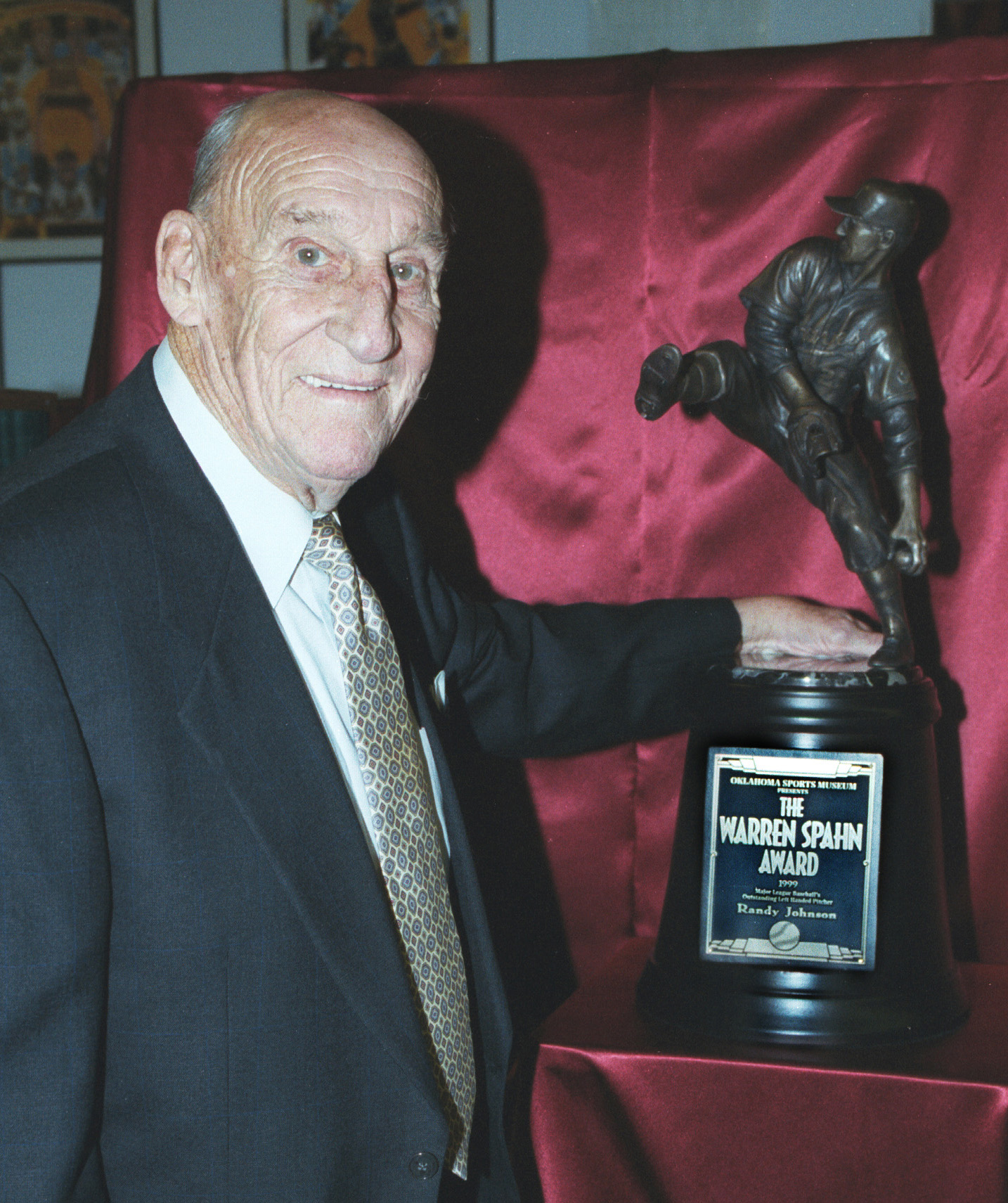
Warren Spahn with the first Warren Spahn Award won by Randy Johnson in 1999.
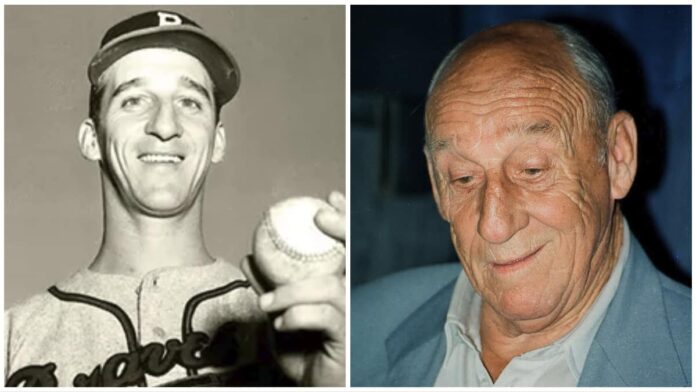
National Baseball Hall of Fame pitcher Warren Edward Spahn accomplished something few Major League Baseball pitchers have—he led the major leagues in wins for the years spanning his lengthy career. What makes this even more remarkable is Spahn’s major-league career was interrupted for three and a half years while he distinguished himself as a U.S. Army combat engineer in Europe in World War II.
“People say that my absence from the big leagues in World War II may have cost me a chance to win 400 games,” Spahn said in an interview in 1998. “But I don’t know about that. I matured a lot in those years in the Army. I believe I was better equipped to handle major league hitters at 25 than I was at 22. Also, I pitched until I was 44. Perhaps I wouldn’t have been able to do that otherwise.”
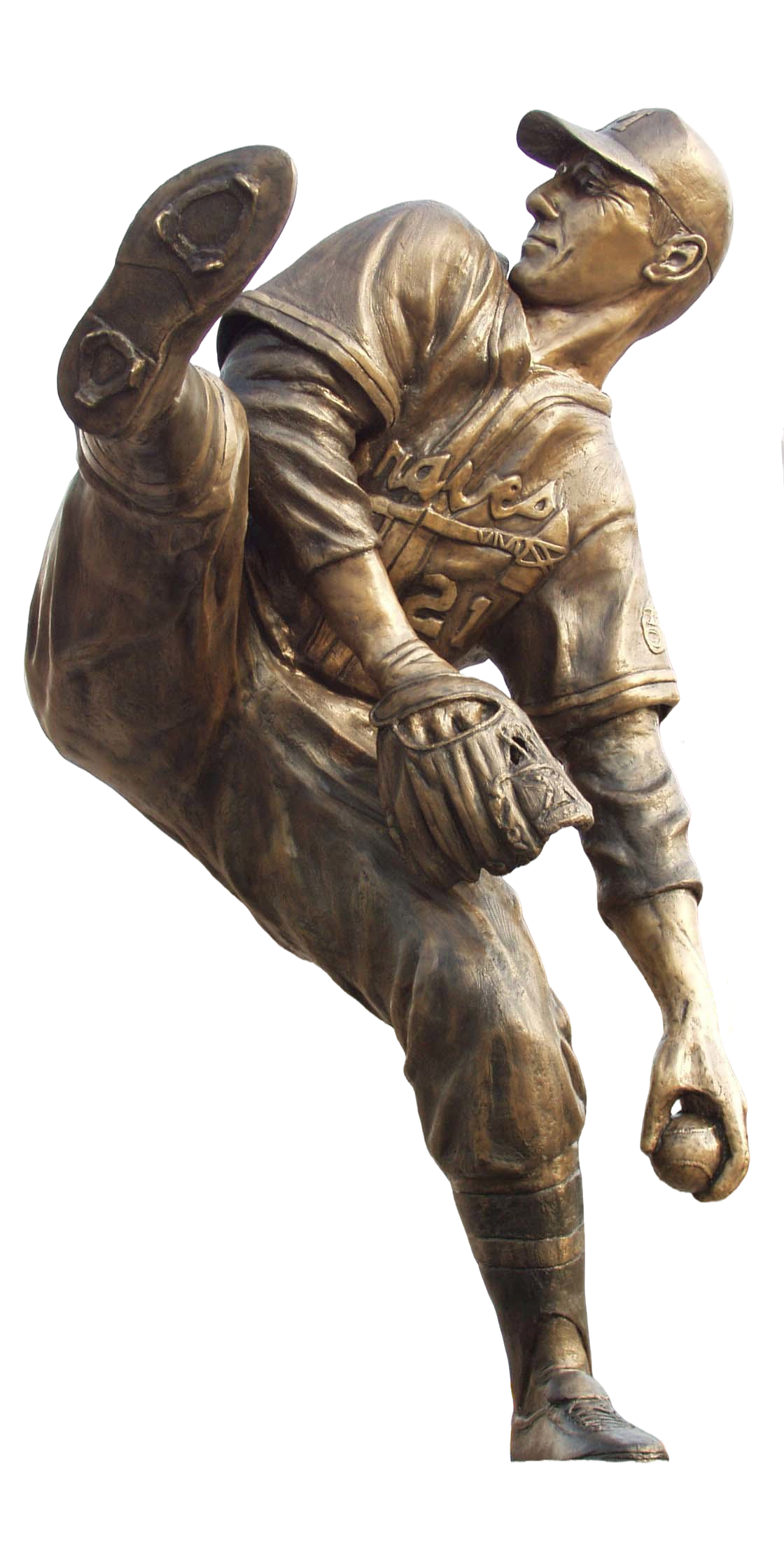
This Warren Spahn Statue was unveiled at Atlanta Braves’ Turner Field in August 2003.
He had a stellar career after switching from first base to pitching at a high school in Buffalo, New York. Propelled by his almost unhittable fastball, his team won the local high school championship in his junior and senior years. He attracted the attention of scouts by throwing a no-hitter as a senior. He signed with the Boston Braves in 1940 before graduation.
The rookie reported to the Braves’ Class D club and had a good year. His teammates nicknamed him “Spahnie.”
He worked his way up through Class D, C, and B-ball, growing and throwing stronger every year. After a season in A ball in Hartford, Conn., his 17 wins and less than 2.0 earned run average (ERA) warranted a call-up to the Braves. He arrived at the end of the 1942 season at six foot and 175 pounds. He pitched 15 innings as a major leaguer and notched seven strikeouts.
U.S. Army Combat Engineers celebrate their 250th Anniversary in 2025
By 1942, World War II was increasingly depleting major-league rosters, and Spahn was a healthy 21-year-old. After the season ended, he joined the Army from his home in Buffalo. After basic training, he was sent to Oklahoma, where he met his future bride, LoRene Southard.
He trained as an Army combat engineer at Camp Gruber, near Muskogee, for seven months in 1944. Camp Gruber was started after the Japanese attack on Pearl Harbor, and its 2,250 buildings were finished in four months. Thousands of soldiers trained at Camp Gruber during World War II, and its extensive facilities included a 1,600-bed hospital.
In the summer of 1944, he was shipped to Europe. Already promoted to staff sergeant, his leadership ability was apparent. Upon arrival in Belgium, Spahn’s 276th Engineer Combat Battalion was soon helping the First Army push back the bulge in what came to be called the Battle of the Bulge.
Spahn’s engineers were put to work clearing roads of the wreckage of German Tiger tanks and other vehicles. The troops were assigned to guard vital bridges and clear roads of snow and mines. They also cleared airstrips and constructed gun and radar pits for anti-aircraft artillery.
On Jan. 26, 1945, the battalion constructed its first bridge under fire. Five days later, the first combat casualty was suffered in a mine explosion when an engineer engaged in destroying mines was killed. The unit earned its first battle star for The Battle of the Ardennes.
After crossing the Roer River, the engineers were put to work maintaining the roads used to approach the Rhine River. They supported infantry by building footbridges across rivers.
Three months later, in Germany, Spahn’s unit helped repair the only remaining bridge spanning the Rhine River, the vital Ludendorff Bridge at Remagen. Although they had heavily damaged it, the Germans had failed to destroy the bridge with explosives when they withdrew across the Rhine.
Determined to use the river as a natural barrier to the Allies’ advance, the Germans attempted daily to destroy it with artillery and bombs, but their efforts were unsuccessful.
Repairing the initial demolition damage and the daily damage to the old railway bridge was extremely dangerous for the combat engineers. They were also vulnerable when a layer of roadway was added over the railroad tracks. This maintenance assignment proved to be the most dangerous one in the European theater of operations during the war.
Casualties were heavy as the engineers of the 276th worked to repair the bridge and provide a second lane for two-way traffic. Spahn earned a Purple Heart for what he says was only a scratch on his foot when he was caught on the bridge during a bombing attack.
Although it allowed the Allies to pour five divisions of troops into the first foothold east of the Rhine for 10 days, the bridge had taken a beating. On March 17, 1945, while 200 men from the battalion were working on the bridge, it collapsed due to structural damage and overload. Many Americans were killed, including 22 engineers from the 276th.
Readers can watch a video wherein Spahn recounts the last hour before the bride fell: Warren Spahn, Former MLB Pitcher, Shares His Remagen Bridge Experiences
The 276th received a Presidential Unit Citation for their maintenance efforts on the bridge. The unit also received its second battle star for participating in the Battle of the Rhineland.
In recognition of his leadership under fire, Spahn received a battlefield commission to second lieutenant. He finished his combat career helping his unit earn its final battle star in the push deep into Germany in the Battle of Central Germany.
Accepting his promotion to officer required him to stay in the Army nearly a year after the war’s end. Spahn was first transferred to the Army of the Occupation. The 276th was disbanded to provide reinforcements for the Pacific and was deactivated.
His battlefield promotion was one of the few for a major leaguer during the war. “I did not know it at the time, but that promotion cost me dearly when the war was over,” Spahn said. While other major leaguers were home from the war and playing again, Spahn built hospitals in Nuremberg, West Germany, with the Corps of Engineers.
Finally returning to pitch for the Boston Braves, Spahn married LoRene and eventually made Hartshorne, Oklahoma, their home. He went on to become the winningest left-handed pitcher ever in the majors. “Every pitch had a thought behind it,” Spahn said. “I am well remembered for saying, ‘Hitting is timing. Pitching is upsetting timing’.”
As a 17-time All-Star with 363 wins and the 1957 Cy Young Award winner in 21 seasons in 1965, he was inducted into the Baseball Hall of Fame in 1973. At 44, he transitioned into coaching and management, retiring from baseball in 1982.
He was honored in 1999 with the creation of a namesake award to celebrate the winningest left-handed pitcher in the majors each year. Every year, the best lefty in the majors traveled to Guthrie, Oklahoma, where they received the Warren Spahn Award trophy.
Spahn died in November 2003, at 82, a few months after attending the unveiling of a nine-foot bronze statue sculpted by Oklahoman Shan Gray at the Atlanta Braves’ Turner Field. Readers can find an identical statue outside the Chickasaw Bricktown Ballpark in Downtown Oklahoma City. Story and photos by Darl DeVault, contributing editor
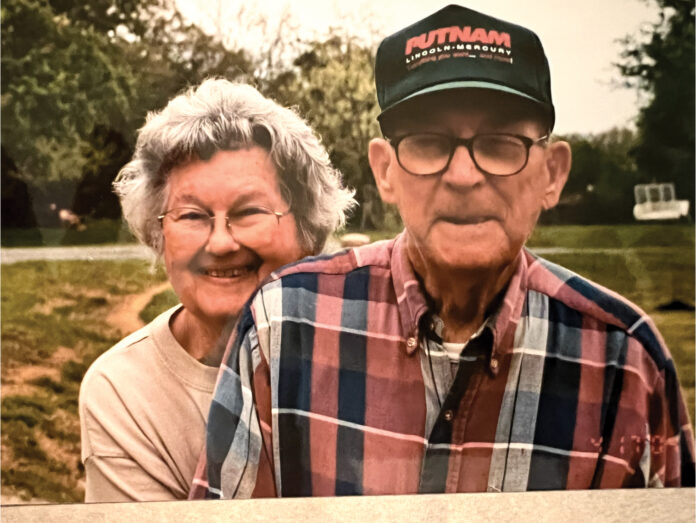
Angeline Sivic with her husband John Sivic circa. 1990’s.
Angeline Sivic, 99, is a part of World War II history, where she served as a Rosy Riveter working on airplanes in Wichita, Kansas.
Sivic, who turns 100 years old on April 14, was born on a small farm, seven miles north of Hartshorne.
After graduating from Hartshorne High School, Sivic, who resides in Iris Memory Care in Nichols Hills, followed a cousin to Wichita, who was already working at the Boeing airplane plant.
“I went up there and got a job, right out of school,” she said. “I liked it alright.”
Rosie the Riveter was the star of a campaign aimed at recruiting female workers for defense industries during World War II, and she became perhaps the most iconic image of working women.
American women entered the workforce in unprecedented numbers during the war, as widespread male enlistment left gaping holes in the industrial labor force. Between 1940 and 1945, the female percentage of the U.S. workforce increased from 27 percent to nearly 37 percent, and by 1945 nearly one out of every four married women worked outside the home.
While women during World War II worked in a variety of positions previously closed to them, the aviation industry saw the greatest increase in female workers.
More than 310,000 women worked in the U.S. aircraft industry in 1943, making up 65 percent of the industry’s total workforce (compared to just 1 percent in the pre-war years). The munitions industry also heavily recruited women workers, as illustrated by the U.S. government’s Rosie the Riveter persuasion campaign.
Based in small part on a real-life munitions worker, but primarily a fictitious character, the strong, bandanna-clad Rosie became one of the most successful recruitment tools in American history, and the most iconic image of working women in the World War II era.
Sivic married her husband John on Oct. 30, 1946, after he returned from the war. They had 4 children (3 girls, 1 boy), 6 grandchildren, 9 great-grandchildren, and 1 great-great grandchild.
Sivic laughed when she was asked what she felt about turning 100.
“I am getting old,” she said.
Jana Determan, Sivic’s daughter, said her mother grew up on the family farm and loved cooking and gardening.
“She enjoyed canning what food came from her farm,” Determan said.
Sivic said both her parents came to the United States from Europe and eventually settled on the family farm.
She said her father worked in the coal mines along with other family members.
“That’s what they did, coal mining,” Determan said. “What they did was underground.” Determan said growing up her family ate together at home.
“Every meal, we ate at home. We didn’t go out to eat. They didn’t go on vacation. They were just home on the farm, their whole life,” she said.
Determan said growing up on a farm developed her mother into a strong-willed and hard-working person.
“She was the strong-willed person in the family. She’s the one that pretty much ran it (life on the family farm),” she said.
Determan said she is proud of her mother’s work achievements as Rosie the Riveter during World War II.
“I think it’s the greatest generation (World War II military/civilian workforce) and there’s a reason for that,” she said. story by Van Mitchell