Tuesday, March 10, 2026

FOCUS ON HEALTH HEROES: Senior Embraces Being Road Scholar

0
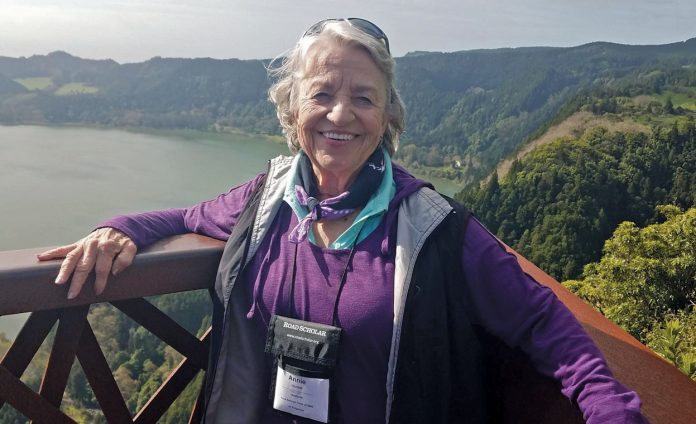
At 78, Annie Shurtleff still enjoys solo travel both domestic and abroad.

At 78, Annie Shurtleff still has a penchant for learning and experiencing new things.
In fact, over the last 23 years she’s turned into quite the road scholar.
“I’ve always been a very curious person,” the Tulsa native said, unfolding a story that began at age 55 and has chapters from all over the world.
After taking an early retirement from a 25-year career in customer service for Shell Oil, Shurtleff experienced wanderlust.
She liked to travel and always satisfied that itch by working at national parks beginning in 1996.
“I kind of put (travel) on the back burner for about 10 years, working at Yellowstone and other parks,” she said. “When I decided to slow down I started looking at the Road Scholar program more.”
Not-for-profit Road Scholar is the world’s largest and most innovative creator of experiential learning opportunities. The company has guided generations of lifelong learners on transformative learning adventures from San Francisco to Siberia, and nearly everywhere in between.
It’s comprised of a diverse community of knowledge seekers and explorers, united in the belief that lifelong learning is a vital part of overall well-being.
The belief is in living life to the fullest at every age – by experiencing the world, and not just looking at it. That goal is accomplished by meeting new people, touching history where it happened and, delving deep into the cultures and landscapes explored.
Alongside renowned experts, participants experience in-depth and behind-the-scenes learning opportunities by land and by sea on travel adventures designed for boomers and beyond.
Road Scholar offers thousands of learning adventures in more than 100 countries and throughout the United States. At any given time, nearly 2,000 Road Scholars – like Shurtleff – are experiencing the world on our learning adventures.
“I like to travel and I like the outdoors,” Shurtleff said.
She has gone on more than 50 excursions with Road Scholar and admits she’s been just about everywhere offered in the continental United States.
She’s even gone overseas with other companies and says oftentimes it’s the journey and not necessarily the destination that gives her the most memories.
“Usually, when people think of travel they think international,” she said. “I’m really an advocate for domestic trips.”
Shurtleff said she’s always stuck to the same formula when it comes to deciding on where to go. She starts with her available dates to travel. From there she looks over her interests, which for her are the outdoors and historical things.
Then she chooses a location offered.
“So sometimes it’s kind of a surprise to me that I end up someplace I really like,” she says.
Places like Chattanooga, Tennessee and Mobile Bay, Alabama are some of the communities she’s fallen in love with.
She admits she’s a small-town girl who loves the outdoors when she travels.
Natchez, Mississippi, and Channel Islands National Park in California have special places in her heart.
“Once you’re there, the one thing I really like is they take care of everything from the time you get to the hotel,” she said. “There’s transportation whether trolley or public transit or private vans so you don’t have to worry about a thing and they’re so comprehensive in their catalog”.
“They tell you literally down to how many steps you’ll have to take.”
Shurtleff said when she travels with Road Scholar she normally signs up willing to accept a roommate to save a little bit of money.
“I’ve made some good friends and I’ve always had good experiences, she said. “I’ve made some new friends that way and we still communicate.”
When she’s not traveling with Road Scholar you may still see Shurtleff in Colorado where she volunteers for YMCA of the Rockies. She volunteers at Snow Mountain Ranch by Winter Park for her room and board.
She teaches pickleball or serves as the lobby hostess.
“I love to meet and great people,” she said. “It’s been the most rewarding thing I’ve ever done because you’re dealing with a cross-section of humanity and you’re helping people with special needs and helping families reunite.”
And when she’s not doing that she’s boarding a plane, a train or a bus looking for her next adventure.
“I’m a real minimalist now,” she laughed. “It’s pretty much have bag will travel for me.”


 

SNL: CENTENARIANS OF OK

0

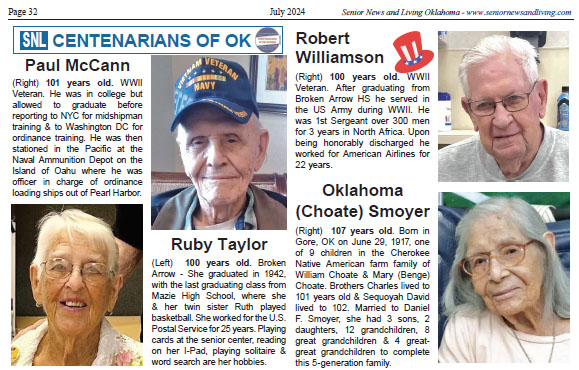
Paul McCann

(Right) 101 years old. WWII Veteran. He was in college but allowed to graduate before reporting to NYC for midshipman training & to Washington DC for ordinance training. He was then stationed in the Pacific at the Naval Ammunition Depot on the Island of Oahu where he was officer in charge of ordinance loading ships out of Pearl Harbor.

Ruby Taylor

(Left) 100 years old. Broken Arrow – She graduated in 1942, with the last graduating class from Mazie High School, where she & her twin sister Ruth played basketball. She worked for the U.S. Postal Service for 25 years. Playing cards at the senior center, reading on her I-Pad, playing solitaire & word search are her hobbies.

Robert Williamson

(Right) 100 years old. WWII Veteran. After graduating from Broken Arrow HS he served in the US Army during WWII. He was 1st Sergeant over 300 men for 3 years in North Africa. Upon being honorably discharged he worked for American Airlines for 22 years.

Oklahoma (Choate) Smoyer

(Right) 107 years old. Born in Gore, OK on June 29, 1917, one of 9 children in the Cherokee Native American farm family of William Choate & Mary (Benge) Choate. Brothers Charles lived to 101 years old & Sequoyah David lived to 102. Married to Daniel F. Smoyer, she had 3 sons, 2 daughters, 12 grandchildren, 8 great grandchildren & 4 great-great grandchildren to complete this 5-generation family.


OKC Native Continues a 124-Year Tradition of Service Under Sea

0
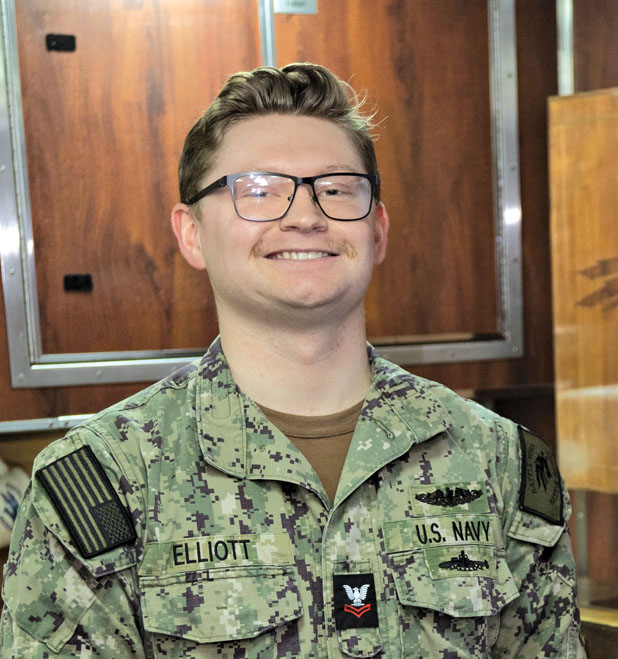
Petty Officer 2nd Class Zane Elliott, native of Oklahoma City.

Petty Officer 2nd Class Zane Elliott, a native of Oklahoma City, Oklahoma, is one of the sailors serving aboard USS Nevada, continuing the U.S. Navy’s 124-year tradition of service under the sea to help ensure Americans’ safety.
Elliott graduated from Moore High School in 2019.
The skills and values needed to succeed in the Navy are similar to those found in Oklahoma City.
“My parents always instilled in me the importance of having a good work ethic,” said Elliott. “They would always tell me to outwork my coworkers and to work the hardest that I can. That lesson is important here because the Navy needs sailors working hard to succeed.”
Elliott joined the Navy four years ago. Today, Elliott serves as a fire control technician.
“My uncle was in the Air Force and I saw that he was living a comfortable lifestyle,” said Elliott. “He lived in a big house and bought a new truck almost every two years. So, I tried to originally join the Air Force but they wouldn’t offer me a sign-on bonus. However, my best friend joined the Navy about a year before me. He gave me his recruiter’s number and the rest is history.”
Known as America’s “Apex Predators,” the Navy’s submarine force operates a large fleet of technically advanced vessels. These submarines are capable of conducting rapid defensive and offensive operations around the world, in furtherance of U.S. national security. A major component of that maritime security is homeported at Naval Base Kitsap, in Washington.
There are three basic types of submarines: fast-attack submarines (SSN), ballistic-missile submarines (SSBN) and guided-missile submarines (SSGN).
Fast-attack submarines are designed to hunt down and destroy enemy submarines and surface ships; strike targets ashore with cruise missiles; carry and deliver Navy SEALs; conduct intelligence, surveillance, and reconnaissance missions; and engage in mine warfare. The Virginia-class SSN is the most advanced submarine in the world today. It combines stealth and payload capability to meet combatant commanders’ demands in this era of strategic competition.
The Navy’s ballistic-missile submarines, often referred to as “boomers,” serve as a strategic deterrent by providing an undetectable platform for submarine-launched ballistic missiles. SSBNs are designed specifically for stealth, extended patrols and the precise delivery of missiles. The Columbia-class SSBN will be the largest, most capable and most advanced submarine produced by the U.S. – replacing the current Ohio-class ballistic-missile submarines to ensure continuous sea-based strategic deterrence into the 2080s.
Guided-missile submarines provide the Navy with unprecedented strike and special operation mission capabilities from a stealthy, clandestine platform. Each SSGN is capable of carrying 154 Tomahawk cruise missiles, plus a complement of heavyweight torpedoes to be fired through four torpedo tubes.
Strategic deterrence is the nation’s ultimate insurance program, according to Navy officials. As a member of the submarine force, Elliott is part of a rich 124-year history of the U.S. Navy’s most versatile weapons platform, capable of taking the fight to the enemy in the defense of America and its allies.
The Pacific Submarine Force maximizes the Navy’s strengths of knowledge, stealth, agility, firepower and endurance.
“The men and women of the Pacific Submarine Force are among our best and brightest Americans,” said Rear Adm. Richard Seif, Commander, Submarine Force U.S. Pacific Fleet. “The pace of activity across the force is eye-watering, and our ability to remain on-scene, unseen, is only possible due to their hard work and critical thinking. We are lethal, far-reaching, and incredibly capable, and we deter aggression through our demonstrated advantage in the undersea domain.”
With 90% of global commerce traveling by sea and access to the internet relying on the security of undersea fiber optic cables, Navy officials continue to emphasize that the prosperity of the United States is directly linked to recruiting and retaining talented people from across the rich fabric of America.
Elliott serves a Navy that operates far forward, around the world and around the clock, promoting the nation’s prosperity and security.
“We will earn and reinforce the trust and confidence of the American people every day,” said Adm. Lisa Franchetti, chief of naval operations. “Together we will deliver the Navy the nation needs.”
Elliott has many opportunities to achieve accomplishments during military service.
“I am most proud of being named Blue Jacket of the Year for USS Nevada because, to me, that meant I was the hardest working sailor on the boat,” said Elliott. “I am also proud of leading the charge for qualifying 50 sailors in submarines. I am proud of that because that is what we work toward in the submarine community. It took me a long time to earn my dolphins but it feels good that now I can help other sailors earn theirs.”
Elliott can take pride in serving America through military service.
“The Navy has been a great stepping stone in my life,” said Elliott. “I have been able to get qualifications and certifications that I wouldn’t be able to afford or would have gotten otherwise. Now when I get out, I will also be able to go to college while being paid.”
Elliott is grateful to others for helping make a Navy career possible.
“I want to thank Ensign Curtis Labrone for getting me to join the Navy,” added Elliott. “I also want to thank Fire Control Technician 2nd Class Dillon Porter and Fire Control Technician 1st Class Greg Moore for mentoring me. Lastly, I want to thank Chief Fire Control Technician Kevin Behnken for being a great leader.”


VillagesOKC, Leadership has Role in ‘Aging Our Way’ Plan

0
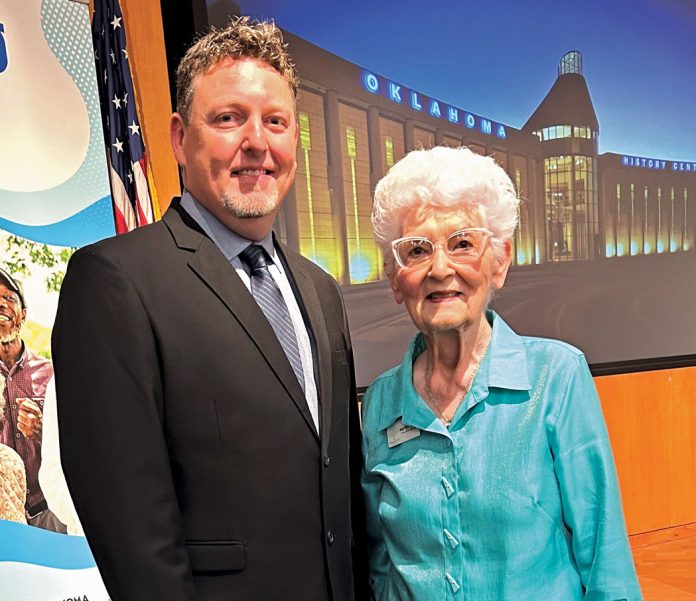
Jeromy Buchanan, Executive Director of Community Living, Aging and Protective Services at the Oklahoma Department of Human Services, with Marilyn Olson, Executive Director of VillagesOKC.

Marilyn Olson, VillagesOKC’s excecutive director, joined other stakeholders in the June 25 unveiling of the Oklahoma Multisector Plan on Aging, which has been dubbed “Aging Our Way.” The event at the Oklahoma History Center included a partner from Guidehouse consulting, Oklahoma Human Services leadership and Aging Our Way Ambassadors.
The Aging Our Way plan is an approach that engages public, private, and other organizations to work together to improve the lives of older Oklahomans – specifically those 60 and older. The goal is to give every senior the confidence to live life on their terms and to provide them with the resources needed to lead a healthy lifestyle.
In his remarks, Jeromy Buchanan, Executive Director of Community Living, Aging and Protective Services at Oklahoma Department of Human Services, who directed the plan’s development, said the plan is intended to be a roadmap for Oklahoma to be a wonderful place for people to age well.
“While today is a celebration of the plan’s completion and the work done to-date, it is really just the beginning,” Buchanan said. “Now that we have the plan, it’s up to all of us to put it to action. I encourage you to get involved or stay involved. Take a close look at the full plan on our website, Oklahoma.gov/aging.”
The official unveiling included remarks by the Honorable Lance Robertson, Guidehouse partner and VillagesOKC board member. Robertson is the former US Department of Health & Human Services Assistant Secretary for Aging. Guidehouse oversaw development of the Aging Our Way plan. He was joined by Olson and Deborah Shropshire, Director, Oklahoma Department of Human Services. Speaker introductions were managed by Joncia Johnson, Aging Initiatives Programs Director- Aging Our Way OK.
“It’s been our pleasure at Guidehouse to support Oklahoma Human Services in the development of the Aging Our Way Oklahoma plan,” Robertson said. “Our team at Guidehouse is committed to supporting state agencies around the country in navigating the challenges of long-term services and improving quality and outcomes for older adults.”
Information gathering for the plan began a year ago and included Listening Sessions and a Statewide Survey conducted in May and July of 2023.
Olson represented the grassroots sector of 50+ adults embracing change from the ground up. She served on the Advisory Committee representing private sector organizations and nonprofits and two Advisory Committee subcommittees providing subject matter expertise for each of the plan’s 10 focus areas. She is an Aging Our Way Ambassador and will be promoting the plan in her role with VillagesOKC.
“The Aging Our Way plan perfectly aligns with the VillagesOKC mission, and I’ve been proud to be involved,” Olson said. “Everyday at VillagesOKC we are actively connecting with individuals, businesses and organizations who offer trusted solutions empowering each individual age with vitality and purpose. Aging well is both a personal responsibility, and also a community responsibility. We are fortunate here in great State of Oklahoma to have a wealth of community resources from which to draw.”
Shropshire said, “It’s hard to believe this day is here. For more than a year, Jeromy and the Community Living, Aging and Protective Services team has been focused on building this Aging Our Way plan. And, as he mentioned, today is not the end, but the beginning. At Oklahoma Human Services, our goal is to be here when Oklahomans need support. And. that includes looking ahead to identify potential areas of need in the future.

For more information about VillagesOKC visit https://villagesokc.org


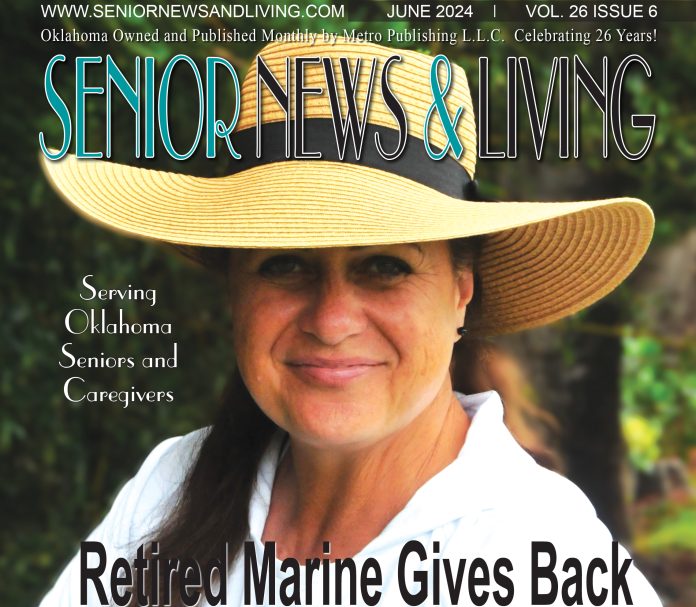
Retired Marine Gives Back

0

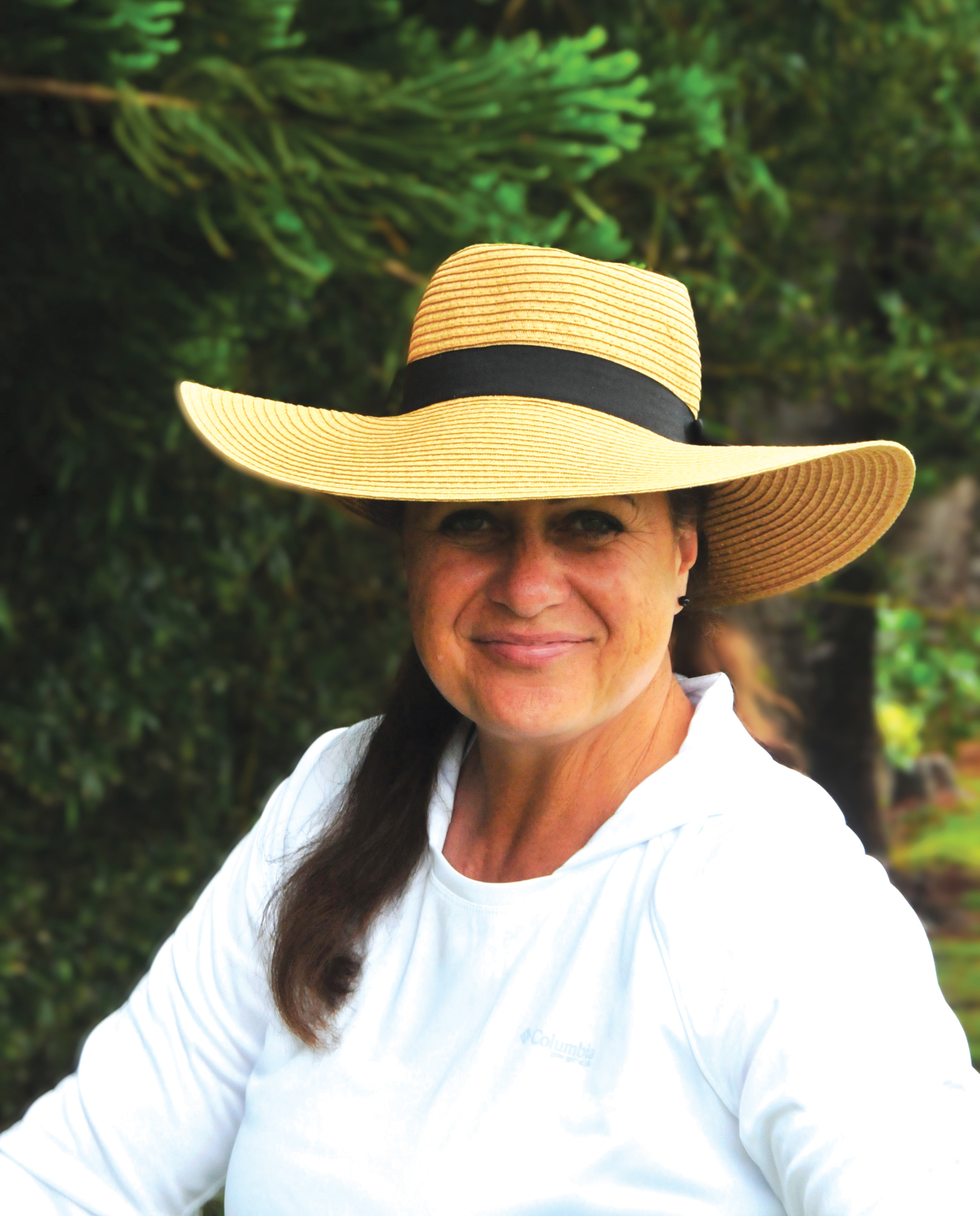
Angela Maness

Currently training to become a certified Post Veteran Service Officer at American Legion Post in Norman.

Story by Van Mitchell, Staff Writer

(Retired) U.S. Marine Corps SgtMaj Angela Maness joined the Marine Corps in 1987

(Retired) U.S. Marine Corps SgtMaj Angela Maness joined the Marine Corps in 1987, graduating as the platoon honor recruit from Parris Island, S.C.
Her journey includes duty stations across the globe, from Camp Lejeune to Okinawa, Japan, and multiple combat deployments to Iraq and Afghanistan.
Recognized for her outstanding service, Maness holds multiple personal awards including the Meritorious Service Medal (2 stars), Navy & Marine Corps Commendation Medal (3 stars) and more.
Maness is currently training to become a certified Post Veteran Service Officer through the American Legion Post in Norman.
“I’ve been a member of the American Legion for five or six years, but when I came up here in 2020 because of COVID, I saw the Norman (American Legion) Post and decided to check it out,” she said.
Maness walked through the front door of the Norman American Legion and saw they had just two service officers, and only was credentialled.
Accredited American Legion service officers are specially trained to provide expert assistance, free of charge, to veterans and their families. While the majority of a service officer’s work involves application for VA disability benefits, these compassionate professionals also provide information, referrals and resources on education, employment and business, death benefits and other important topics.
The American Legion was chartered by Congress in 1919 as a patriotic veteran’s organization. Focusing on service to veterans, servicemembers and communities, the Legion evolved from a group of war-weary veterans of World War I into one of the most influential nonprofit groups in the United States. Membership swiftly grew to over 1 million, and local posts sprang up across the country. Today, membership stands at nearly 2 million in more than 13,000 posts worldwide. The posts are organized into 55 departments: one each for the 50 states, along with the District of Columbia, Puerto Rico, France, Mexico and the Philippines.
Maness is engaged to her fiancé Sal Cenicacelaya, a US Marine Veteran who served from 1983-1989 as a 0311 Infantryman.
The duo was asked by Master Chief Petty Officer Larry Van Schuyver, the State Commander of the Department of Oklahoma Military Order of the Purple Heart, to become Ambassadors to the MOPH.
“He invited Sal and I to become Ambassadors to the MOPH and we gladly accepted about six months ago,” Maness said. “He later informed us that we were also nominated for volunteer “Veteran of the Year” and female “Veteran of the Year.” Master Chief has informed us that we will receive the plaque and official recognition sometime early August 2024 when they have their organizational meeting.”
Maness is also working to become a certified motorcycle rider instructor.
“I’m taking this course to become certified as a coach here in the state of Oklahoma,” she said. “It’s a rider’s coach course teaching the coaches themselves how to prepare the class for the basic rider course, and we’re in the advanced portion of it. It takes a lot of my time, but it’s worth it to me.”
Maness and her fiancé help give back as members of the Flag Poles Honors our Veterans (FPHOV) which erects flagpoles for veterans around the state of Oklahoma.
“It’s just so much fun,” she said. “If you’ve never had the privilege to witness what these outstanding Patriots do every Sunday, you’re missing out.”
FPHOV installs 5-10 flag poles around the state of Oklahoma and arrive at each home with a parade of motorcycles.
“The majority of the “Red, White and Blue Team” are civilians who just happen to own motorcycles and have a deep appreciation for Veterans who have sacrificed for this country. The best part – it’s all free for the veteran,” Maness said.
“Maness continued “Every Sunday they go out and they pick a town or region in Oklahoma, and they all ride to the veteran’s home. They show up on 10, 12 Harley’s making loud noise through the neighborhood, so it wakes everybody up and they park in front of the home. They go and place the flagpole. It’s an amazing process to watch. It’s about the ceremony that they perform, about the prayer service that they actually do right there in the Veterans front yard.”
Maness said the flag pole ceremony becomes a community affair.
“All the neighbors usually come out to watch and ask questions,” she said. “They are usually very excited to be part of the process and some actually participate in helping us dig the hole and perform the dedication. We always explain why we are here, why we are honoring this veteran, his service, his family, and his dedication to this country. Then, we recite the 13-folds of the flag and we hand it to him while the cement dries and we ask him to fly the flag the very next day. At this point, there is usually not a dry eye – so we get back on our bikes and make our way to the next home. It is an honor to give back in this fashion and I hope to continue as much as my schedule will allow.”
Maness comes from a military family. She and several of her siblings followed suit and joined the military. Her father was a Marine for 27 years, and her mother was in the United States Navy.
Maness said her parents both met while serving at Pearl Harbor in Hawaii in 1960.
“There are five kids in my family. One has already passed. Of the four left, three of us have served in the Armed Forces (two Marines and one Army) while the other is a military supporter who works with Marines as a government employee,” she said. “This is just something that my family takes pride in doing – serving our country in some fashion.”


VIPcare opens new Edmond location: Now accepting new patients

0
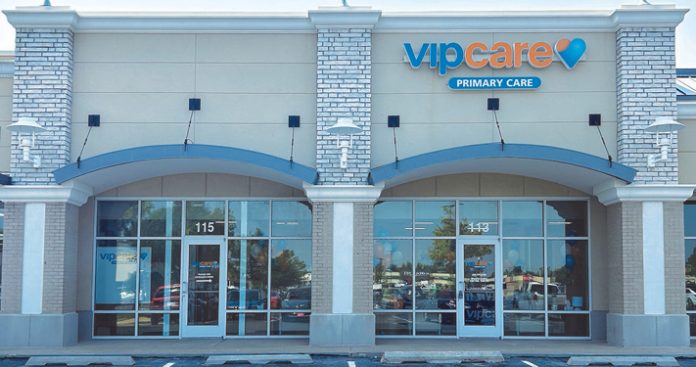
Now open in new offices at 3325 S. Blvd. Suite 113, Edmond
Joseph Jamison, M.D.
Board Certified Family Medicine

Dr. Joseph Jamison is a board-certified primary care physician specializing in Family Medicine. He earned his bachelor’s degree from Rice University and attended medical school at Texas A&M College of Medicine. He completed his residency at the University of Oklahoma and served as the Chief Resident in Family Medicine.

Dr. Jamison was initially drawn to a career in medicine because it offered him an opportunity to practice in a challenging field. As a provider, he enjoys interacting with patients and believes in taking the necessary time to truly listen to their concerns so he can help them feel their very best and stay healthy. In his free time, he enjoys history, genealogy, reading, traveling, hiking, and kayaking.

“I like that the VIPcare model allows doctors to not only address patients’ active problems, but also to help patients avoid problems. The focus on prevention helps patients have a better quality of life. As a physician, I really enjoy having the opportunity to help patients live a healthier life.” Dr. Jamison

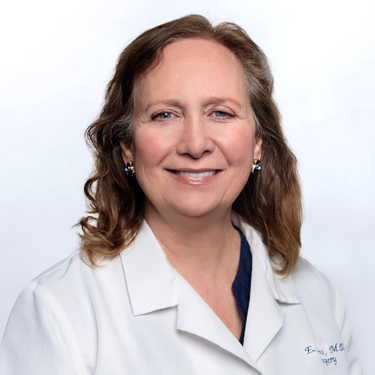
Ernestine Shires, M.D.
Internal Medicine
Board Certified General and Peripheral Vascular Surgery

Dr. Shires is a dually trained board-certified/eligible physician, specializing in Internal Medicine. She earned her medical degree and completed residencies at the University of Oklahoma College of Medicine.

Dr. Shires has been an Oklahoma practicing physician for over 35 years. She has been a member of several medical organizations, received numerous accolades from the medical community, and has served on hospital and clinic boards throughout her years of practice.

Dr. Shires considers it a great honor to have earned the trust of so many patients throughout her years, and she is dedicated to creating individualized healthcare plans while utilizing the latest global evidence-based medical information

“I spend every minute of the appointment listening to my patients and gathering information that I may better serve them. Because they deserve quality with their longevity.” Dr. Shires

Now open in new offices at 3325 S. Blvd. Suite 113, Edmond.
Call for more information 405-400-0322.

Edmond has a new primary health clinic for seniors over 65! VIPcare has recently moved into a state of the art clinic located in the same shopping center as Natural Grocers off 33rd and Blvd.

VIPcare’s goal is to always provide a better healthcare experience for their patients: Less time in the waiting room, more time with the doctor, and more time to care

By focusing on a senior care model and increasing access to high-quality care, VIPcare’s model is at the forefront of the future of healthcare, as opposed to the current system the healthcare organization refers to as “sick care.”  Patients are encouraged to see the doctor often instead of only when they are sick, contributing to their success in patient outcomes.

VIPcare’s goal is to always provide a better healthcare experience for their patients: Less time in the waiting room, more time with the doctor, and more time to care.

VIPcare promises to be there when their patients need them the most with same-day, urgent care appointments, 24/7 on-call provider, and transportation assistance.

VIPcare is committed to delivering compassionate and preventive healthcare, specializing in primary care for individuals 65 and older. They accept most Medicare Advantage plans and work personally with insurance plans to ensure families receive the coverage they need and deserve.

VIPcare advocates better healthcare as opposed to ‘sick care. Because their doctors only see an average of 12 to 15 patients a day instead of the industry standard of 25 to 35, they’re able to spend more time with patients, sometimes up to an hour. This allows for a different mindset and a different way of providing care.


A Special Connection: 99-Year-old Loves to Fly Her American Flag

0
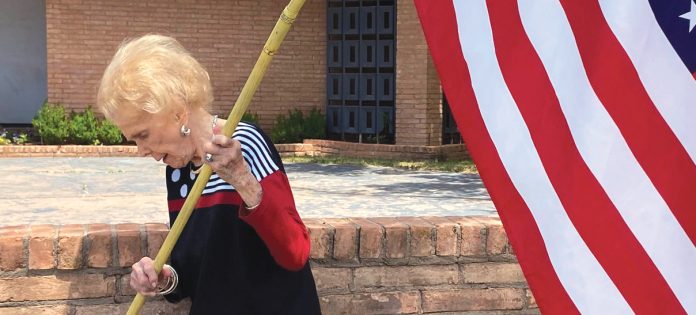
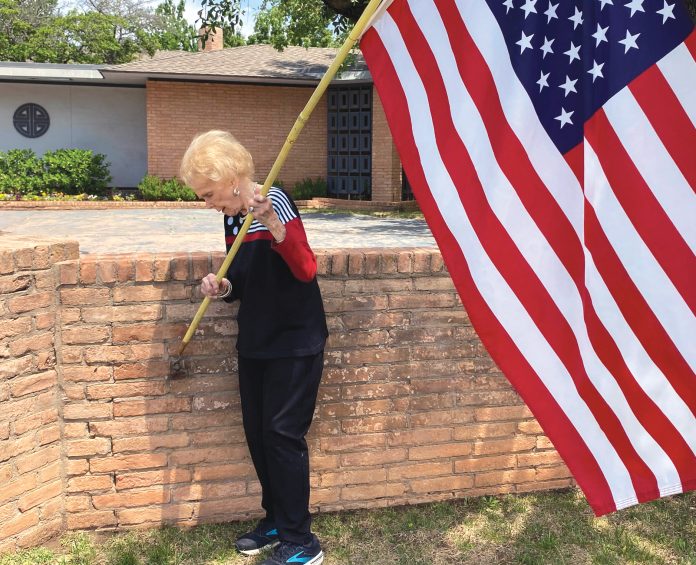
ABOVE: Patty Kelly Stevens puts out her U.S. flag outside her home in celebration of Armed Forces Day in mid-May.

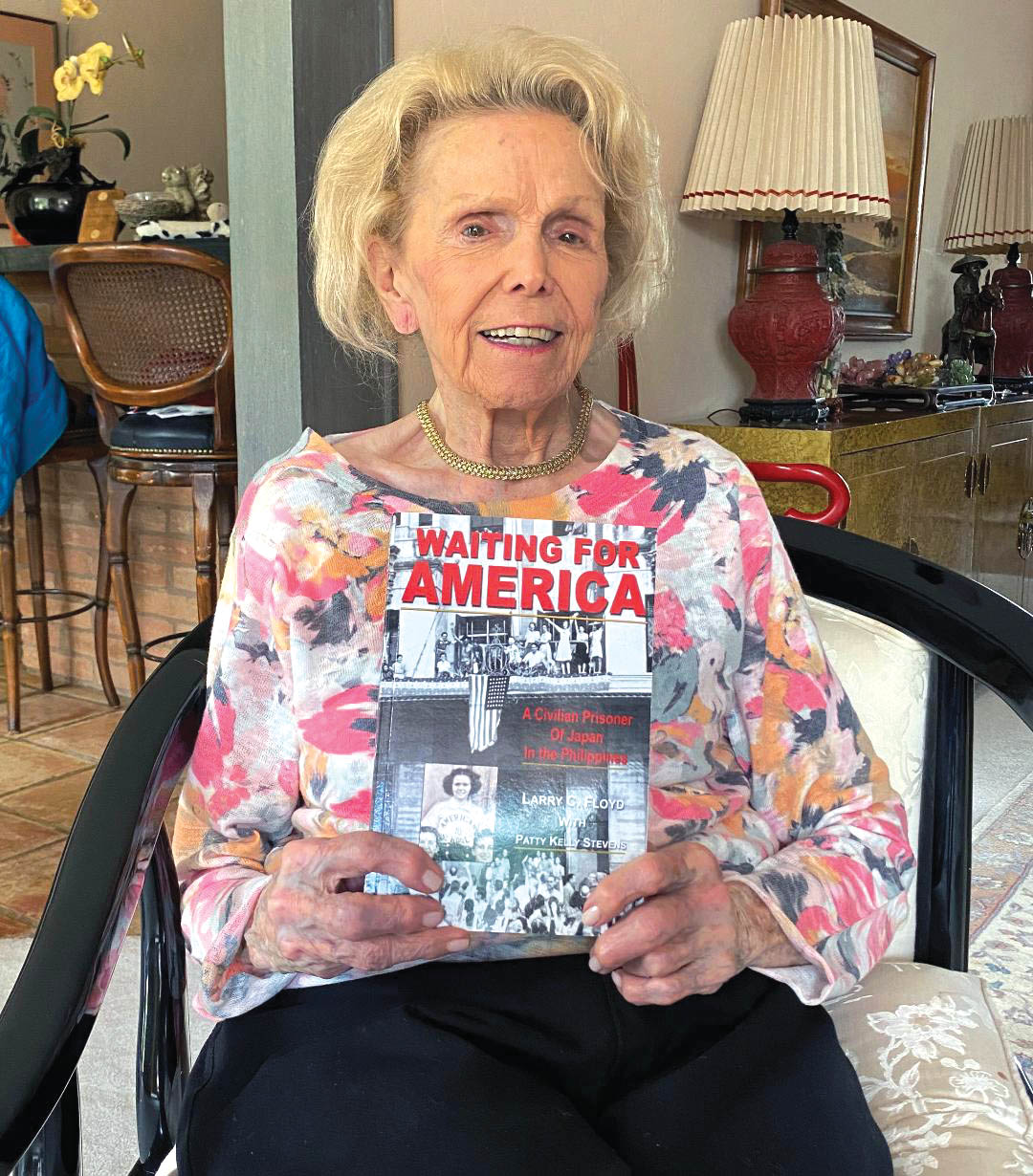
Patty Kelly Stevens displays her new book.
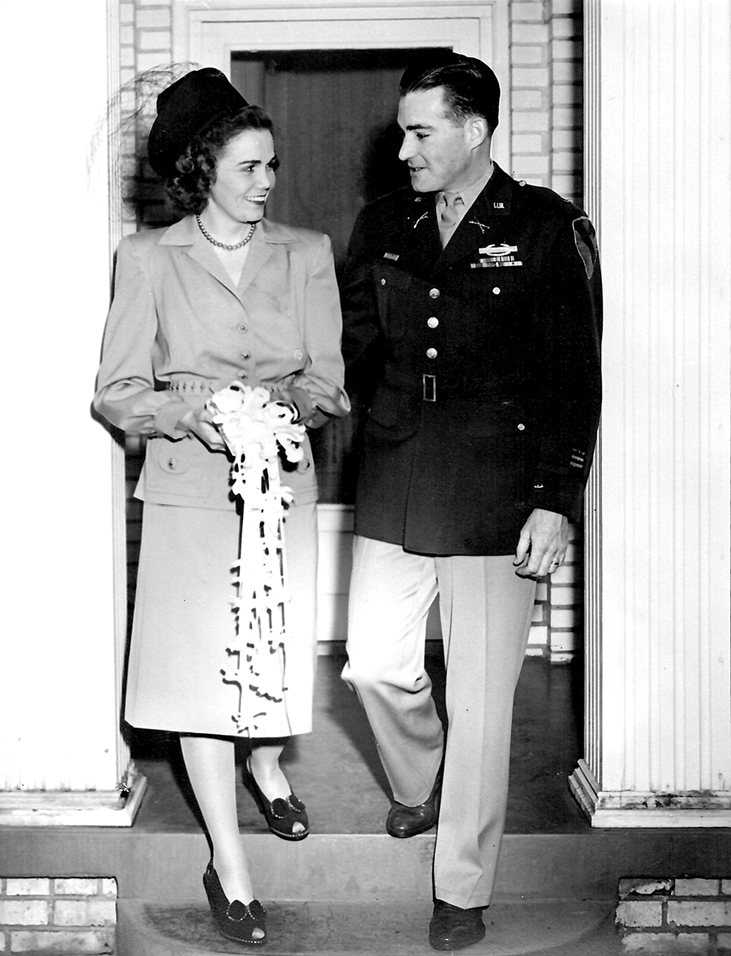
After a wartime courtship in the Philppines, Patty and Paul Kelly wed in Oklahoma City in February 1946, one year and a day after her liberation from Los Baños Internment Camp.

Longtime Oklahoma City resident Patty Kelly Stevens faithfully displays the U.S. flag outside her Nichols Hills home for most holidays. But Flag Day, June 14, is extra special to the 99-year-old American patriot, who at an early age lived through shattering experiences that bonded her with her country’s flag.
Watching recent televised reports of students protesting on U.S. college campuses and taking down the American flag has shocked and upset her. “Yeah, that flag means a lot to me,” she says. “For me, it’s mostly about freedom.” As for those protesting students taking down U.S. flags and replacing them with other flags: “They need to ship ‘em out.”
Her impatience with the protesters’ lack of respect for the U.S. flag is better understood in context with her experiences in 1941 as a 17-year-old American high school senior in the Philippine Islands. Abruptly arrested by Japanese soldiers when World War II began, she was classified as an “enemy alien” and sent to the infamous Santo Tomás Internment Camp in Manila. After three years at Santo Tomás with thousands of other American civilian prisoners and suffering badly from malnutrition, she and her mother volunteered to transfer to another internment camp, Los Baños, thirty miles south of Manila.
Patty and her mother had hoped for better conditions at the new camp, but by January 1945 they and the Los Baños camp’s 2,150 other prisoners were on the verge of starvation and a possible mass execution. To their surprise and delight, the captives awakened one morning to find their Japanese guards gone. Thinking the Japanese soldiers had fled from approaching American troops, the prisoners began a celebration.
“We broke into the guards’ food warehouses-we called them bodegas-and started eating like kings and queens,” Patty recalled. “Then someone asked if anyone had an American flag to put up. I was shocked when my mother pulled out the large American flag that had been presented to my father by Philippine Governor-General Leonard Wood around 1921. It had been a family heirloom since way before the war. I didn’t even know my mother had smuggled it into our camp and was hiding it.”
As someone played a recording of the “Star Spangled Banner” over the camp’s loudspeakers, the captives sang along while saluting the raised 48-star flag, many weeping openly. They renamed their former prison “Camp Freedom.”
The gorging and celebrating went on for several days-until the Japanese guards unexpectedly returned one night. “They were furious when they found out someone had put up an American flag,” Patty said.
Fortunately for Patty and her mother, their flag had been taken down as a precaution and hidden before the Japanese returned. “The guards searched our barracks three or four times trying to find it,” Patty recalled. “I remember sitting outside the barracks when they searched and getting so upset. My mother kept telling me, ‘Don’t get all worked up, Patty, don’t get all worked up. They won’t find it.’ They would have killed us if they found that American flag.”
She never learned where her mother had hidden the flag. With conditions worsening in the camp, in the early morning hours of February 23, 1945, Patty and the prisoners were stunned to see a company of U.S. paratroopers from the 511th Parachute Infantry Regiment drifting down just outside their camp. The troopers had been ordered by Gen. Douglas MacArthur to rescue the suffering civilians in a special operation. MacArthur and other officials worried the captives would be executed by their Japanese guards in the closing months of the war.
“God, those parachutes falling were a wonderful sight,” Patty says nearly 80 years later. “I’ll never forget it. Whenever I’m a little down or depressed, I just think about that sight.”
The famous airborne rescue of these 2,150 civilians behind enemy lines at Los Baños was described in 1993 by Chairman, Joint Chiefs of Staff Colin Powell as “the textbook airborne operation for all ages and all armies.” The complex operation was the subject of a 2004 documentary, Rescue at Dawn-The Los Baños Raid, which aired as recently as last summer on the television network History (formerly The History Channel).
Barely 20 years old when freed by U.S. troops, Patty was soon to meet her future husband, Paul J. Kelly, a 22-year-old first lieutenant from Oklahoma City who had dropped out of the University of Oklahoma to join the war effort. Paul was serving with the First Cavalry Division, which had liberated Santo Tomás Internment Camp in early February 1945 and was stationed in Manila in the closing months of the war. After a whirlwind courtship following the war, the two were wed in Oklahoma City on February 24, 1946, one year and a day after Patty’s liberation from Los Baños.
Long after the war, Paul Kelly founded Guaranty Bank and Trust in Oklahoma City. The couple had two children who grew up in the city, Paul Jr. and Carole. At her husband’s funeral in 1971, Patty had his coffin covered with the U.S. flag that had flown at “Camp Freedom” in January 1945.
With the storied flag nearing 100 years old in 2018, Patty and Paul Jr. found a permanent home for the flag at the U.S. Airborne and Special Operations Museum in Fayetteville, N. Carolina. Patty and her family delivered the flag to the museum where it was honored in a ceremony around a special display in the museum’s front lobby.
Reciting the flag’s proud history, museum director Jim Bartlinski said at the ceremony, “We have an obligation to care for that flag until the end of time.”
Still active and regularly driving herself to an exercise class in north Oklahoma City, Patty finally decided to put in book format the story of her family’s famous flag, her early fraught years as a Japanese prisoner, and her dramatic rescue by U.S. airborne troops. She worked with a local historian and author to complete Waiting for America: A Civilian Prisoner of Japan in the Philippines, published in late February.
As one of the last living witnesses to these historic events, she has recounted parts of her story at several local book signings and is excited about several more planned around the state. And she gets a special thrill displaying her American flag outside her home.
“Armed Forces Day, Memorial Day, Flag Day, the Fourth of July-these are all holidays I take special pride in flying my Stars and Stripes,” Patty says. “Those few of us still around who lived through those hard war years have a special connection with that flag. I wish more Americans did. But most have never lost their freedom for more than three years and been denied the right to fly that flag.”


OMRF Donors See Their Generosity in Action

0
OMRF research technician Duane Goins, second from left, explains to donors the regenerative abilities of certain sea life species on May 21, 2024.

More than 100 Oklahoma Medical Research Foundation donors now have a better understanding of the scientific discoveries their gifts make possible.
This week’s annual gathering of OMRF’s Loyal Donors Society included tours of the foundation’s Multiple Sclerosis Center of Excellence and demonstrations of current research projects ranging from Alzheimer’s to cell regeneration to blood clotting.
OMRF’s loyal donors are those who’ve contributed for at least five straight years. Using that criteria, the foundation currently has 989 loyal donors, including 111 who met the five-year threshold for the first time this past year.
Combined, they have given nearly $80 million. The longest active streak belongs to the Oklahoma Association of Mothers Clubs, whose contributions date to 1956 – a decade after OMRF’s founding.
“Thanks to your generosity, our scientists make a worldwide impact on human health,” Vice President of Research Courtney Griffin, Ph.D., told the group. “We take great pride in being Oklahoma’s medical research foundation,”
Tuesday’s event was the first visit to OMRF for Peggy and Richard Geib, who’ve been giving to OMRF since 2019. “I can tell that everyone here is passionate about what they do,” said Peggy Geib, “and that they feel like they’re making a difference.”
The Geibs make an annual year-end contribution to the foundation, and they also make memorial gifts to OMRF following the death of a friend or relative. “Flowers are fine, but to us, the memorials are more meaningful,” Richard Geib said.
Sylvia Zimmerman, a donor since 2005, described the event as “an eye opener. I love that OMRF focuses not only the cause of illness, but also on the treatment of it.”
Robert Tilghman enjoyed learning about cardiovascular health and OMRF’s cardiovascular biology research at the event. “I love the dedication of the scientists here and the constant effort to explore every avenue to solve a problem,” said Tilghman, who’s donated to OMRF for 12 straight years.
The consistent generosity of donors like those who attended Tuesday’s event has fueled OMRF’s research since its founding in 1946, said Vice President of Philanthropy & Community Relations Penny Voss.
“These donors are essential to our mission, which aims to help people lead longer, healthier lives,” Voss said. “If we can show our appreciation while giving them a better understanding of the research they make possible, this event is a success.”


Hard Insurance Market: Why and What to Expect

0
Glen Mulready, Oklahoma Insurance Commissioner.

Early American poet Anne Bradstreet once wrote, “If we had no winter, the spring would not be so pleasant: if we did not sometimes taste of adversity, prosperity would not be so welcome.” This quote applies to almost every aspect of life, including insurance markets. Unfortunately, we’re experiencing a winter, or the effects of a hard insurance market. However, just like with winter, fairer weather will eventually return. Let’s look at what a hard market means, what’s happened historically, and what the next few years will look like.
What is a hard market?
A hard insurance market is a period marked by rising rates and coverage becoming more difficult to obtain, in contrast to a soft market, where conditions are favorable to stable or falling prices and plenty of coverage options. Multiple factors influence market conditions, including the economy, the number of natural disasters across the country, and regulatory pressures, to name a few. Often, it takes years before we see the effects of these types of events, which is what is happening right now. The economic impacts of the COVID-19 pandemic are still being felt, including inflation and high interest rates, and we’ve seen an increasing number of natural disasters over the past few years, all culminating in the current market conditions.
Have there been hard markets before?
Hard markets are a part of the property and casualty insurance cycle – meaning this is not the first time we’ve been here. According to the Insurance Information Institute (III), during the last three hard markets, inflation-adjusted net premiums written grew 7.7% annually (1975 to 1978), 10.0% (1984 to 1987) and 6.3% (2001 to 2004). When markets toughen, insurance companies raise rates to remain financially solvent, or able to pay claims. However, competition creates pressure for insurers to offer lower rates. This, along with reduced economic challenges and periods of fewer claims, helps to bring those rates down and soften the market.
What can we expect over the next few years?
Hard markets do stabilize, and prices remain flat or come down. Because of severe weather events and other impacts on the insurance industry, the road to a softer market won’t be an easy one traveled overnight. We may see the current market for the next few years, at least. It will take time for the insurance industry to react to any positive changes occurring right now. What’s important is that consumers have plenty of options when it comes to insurance and that the market remains robust.
The insurance industry is marked by periods of hard and soft markets. One thing that will remain constant, though, is the Oklahoma Insurance Department’s dedication to the people of our state. Consumers can find helpful resources about insurance and what they can do to weather the hard market on our website at https://www.oid.ok.gov/. If you have questions about your insurance coverage or need to file a complaint, you can reach us at 800-522-0071.


TINSELTOWN TALKS: Paula Poundstone Loves to Work an Audience

0
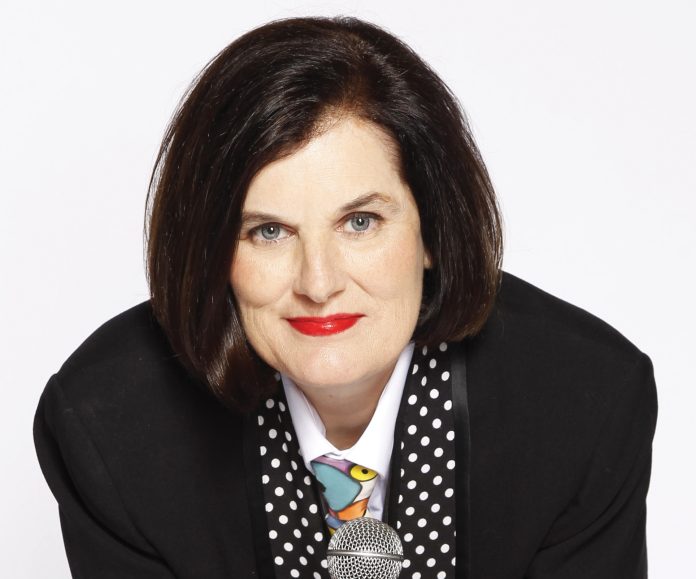
Paula Poundstone selects audience members to engage in her stand-up routines. Photo provided by Michael Schwartz.

As Paula Poundstone continues her 2024 U.S. tour, audiences can be assured of an evening of hilarity as the comedian launches into a string of humorous stories typical of most observational stand-up comics. But at some point into her routine, the sharp-witted Poundstone will seamlessly morph into her trademark banter with audience members – a part of the show fans have come to expect and adore. It’s a style that evolved out of necessity.
“I’ve been doing stand-up for over 40 years, but have a terrible memory,” said Poundstone by phone from Florida recently, while preparing for an evening event. “I started out doing the five-minute open mic thing and spent years trying to memorize an act. Then I just began talking with the audience. My first thought was that it might be a liability, but one night I realized it was kind of the heart and soul of the whole show. Now it’s my favorite part of the evening.”
How she selects audience members to engage varies from venue to venue as the blinding house lights will often obscure distant individual faces. Sometimes she’ll spot a guest arriving late, or perhaps someone getting up to leave temporarily, while others grab her attention by yelling out answers to her rhetorical questions – and Poundstone pounces.
“I’ll often start with the time-honored question of asking what they do for a living,” she explained. “In this way, little biographies of audience members come up and I use that to set my sails! Their profession might remind me of a piece of material I have stored away in my mind and I’ll run with it.”
A memorable interaction occurred in 2006 during a show recorded for the Bravo cable network. About a half-hour into her performance, Poundstone began questioning an engaged couple who revealed the woman worked for an insurance company and the man was in banking. A seemingly innocuous inquiry about who proposed to whom brought a response from the gentleman, “What kind of a question is that?” prompting immediate gasps from the audience – an opening for the comedian to fire off her frequently heard laugh-inducing response to the crowd’s reaction: “I’ll handle it!”
And she did, brilliantly, with lightning-fast improvisational skills during a sidesplitting 6-minute interaction with the pair.
“People still come up to me and ask about that one and to this day I wonder whatever happened to the couple and if they did get married,” said Poundstone. “And every now and then, someone will ask me if it’s all planned – that the people somehow know they will be picked. That always makes me laugh and my response is how would that even be possible? It would require a lot of effort and I wouldn’t even know how to begin. This is why my shows are never exactly the same wherever I go.”
Like many entertainers with a busy tour schedule, Poundstone has little time for sightseeing (see www.paulapoundstone.com for cities and tour dates).
“I don’t get a chance to look around much since the touring only allows me to fly in for a show and then I’m off again,” she says. “But I still think it’s the best job in the world.”
Nick Thomas teaches at Auburn University at Montgomery in Alabama and writes features, columns, and interviews for newspapers and magazines around the country. See https://www.getnickt.org.


Social

0FansLike
0FollowersFollow
0SubscribersSubscribe