Brightmusic Chamber Ensemble will celebrate the contribution of notable women composers, from Clara Schumann to contemporaries such as Libby Larsen, in its 2019-2020 season. This year the ensemble marks its 17th as Oklahoma City’s premier classical chamber music presenter. The five-concert regular season will also include works by Brahms, Dvorák, Mozart, Haydn and Tchaikovsky. In June the ensemble will again present a four-concert summer chamber music festival.
The ensemble will be joined by two guest artists: pianist Stephen Buck in Concert 3 and French horn player Adam Unsworth in Concert 4. Buck is Visiting Professor of Music at the Conservatory of Music at the State University of New York, and Unsworth is Professor of Horn at the University of Michigan.
Concert 1 – “Melodic Masters” September 24, presents a lyrical evening with Germaine Tailleferre’s piano trio, Josef Suk’s Piano Quartet in A minor, and Johannes Brahms String Sextet No. 1.
Concert 2 – “From Café to Concert Hall” November 12, will include Clara Schumann’s masterpiece, her Piano Trio in G minor; Paul Schoenfield’s ever-popular Café Music, a trio for violin, cello and piano; and Antonín Dvorák’s Piano Trio No. 4, the “Dumky,” one of his best-loved works.
Concert 3 – “Rustic Gardens” January 21, features Libby Larsen’s Barn Dances, Carl Maria von Weber’s Clarinet Quintet, W. A. Mozart’s Quartet No. 1, and Arnold Schoenberg’s Chamber Symphony No. 1 (arr. by Anton Webern). Joining ensemble musicians will be guest pianist Stephen Buck.
Concert 4 – “The Virtuoso French Horn” March 3, will showcase the versatility and elegance of the French horn, ranging from works by Joseph Haydn and Mozart to contemporary Catherine Likhuta, with guest artist Adam Unsworth.
Concert 5 – “Musical Panorama” April 14, concludes the regular season with works by Pytor Ilyich Tchaikovsky, his popular Souvenir de Florence, Sir Malcolm Arnold’s Suite Bourgeoise for Flute, Oboe and Piano and Joan Tower’s Island Prelude for Oboe and String Quartet. Capping the evening will be “In Box” by Oklahoma City’s Edward Knight, an off-kilter look at the daily communications flooding the inbox.
In June the Brightmusic Chamber Ensemble will present Summer Festival IX at St. Paul’s Cathedral. Dates and programs will be announced in January.
Season Membership Passes are available on our website or at the door for $100 for all regular season concerts and the four festival concerts. Single admission prices are $20 at the door. Children admitted free. Active-duty military and students are free with ID.
Brightmusic Chamber Ensemble, Oklahoma City’s own chamber ensemble, presents fine classical chamber music in the beautiful and acoustically-rich St. Paul’s Cathedral at NW 7th and N. Robinson near downtown Oklahoma City. Free parking is available just south of the cathedral. For more information about the ensemble and upcoming concerts, visit www.brightmusic.org
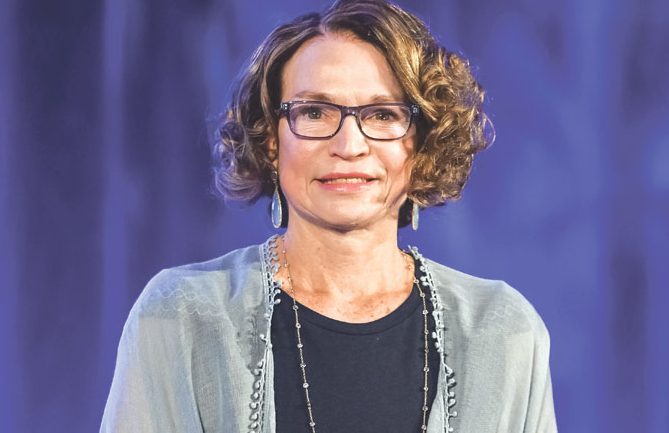
JoLaine R. Draugalis, Ph.D., dean of the University of Oklahoma College of Pharmacy.
JoLaine R. Draugalis, Ph.D., dean of the University of Oklahoma College of Pharmacy, has been honored with a Lifetime Achievement Award from the American Association of Colleges of Pharmacy.
The award recognizes individuals who have made a significant contribution to the American Association of Colleges of Pharmacy and to pharmacy education over a minimum of 25 years. Draugalis has been active in the education and research missions of the OU Health Sciences Center, in addition to statewide and national service and outreach. She has been named a David Ross Boyd Professor and holds the Phil C. and Fern Ashby Endowed Dean’s Chair at the OU College of Pharmacy.
“I have participated in every AACP annual meeting since 1985, after completing two years of graduate school. I love the organization,” Draugalis said. “This award represents many years of interactions and collaborations with pharmacy students, graduate students and faculty colleagues.”
Draugalis began her tenure as the dean of the OU College of Pharmacy in 2007 and has guided it in many areas of growth and achievement, including its 125th anniversary celebration in 2018. She oversees a college with more than 300 students and trainees and about 200 employees.
Draugalis has been active as a researcher, conducting studies in pharmacy education program design, administration and evaluation; educational applications in pharmacoeconomics and outcomes research; and the scholarship of teaching and learning. She has been the author of 125 peer-reviewed publications, book chapters and monographs. From 2004-2005, she served as president of the American Association of Colleges of Pharmacy.
In the 12 years she has led the OU College of Pharmacy, faculty members have substantially increased their research publications, state and federal grant funding, and national and international presentations. U.S. News & World Report has ranked the OU College of Pharmacy among the top 25 programs in the country. In 2014, the college received the AACP Lawrence C. Weaver Transformative Community Service Award for its commitment to addressing unmet community needs.
In 2010, the college embarked on an annual campus flu clinic campaign, administering 2,309 vaccinations that year. The program has grown to more than 5,780 vaccinations given in 2018.
The OU College of Pharmacy also operates the Oklahoma Center for Poison and Drug Information, which is open 24 hours a day, 365 days a year, to provide information to Oklahoma residents and healthcare professionals concerning the prevention and management of potential toxic exposures.
In the first six months of 2019, the Oklahoma Insurance Department recovered double the amount of money for policyholders compared to all of last year. More than $5.1 million in claims disputes have been settled with the Department’s help.
“These recovery amounts make a real impact on peoples’ lives, and Oklahomans should expect their insurance companies to keep the promises made to them” Oklahoma Insurance Commissioner Glen Mulready said. “Today’s numbers show our Department’s continued commitment to protect insurance consumers.”
OID’s Consumer Assistance/Claims Division processes and assist consumers seeking help with their insurance companies. The division opened 3,061 files from January to June of this year. They’ve also answered 7,110 phone calls. The money recovered from January to June of this year totaled $5,129,962.81. Last year, the recovery amount for the entire year was $3,549,619.17.
Policyholders who have an issue with their claim can file a “Request for Assistance” for the following types of insurance: auto, home, commercial, life and health, service warranty, title or workers’ compensation. To learn more about the complaint process, go to oid.ok.gov or call the Consumer Assistance Division at 800-522-0071.
The Oklahoma Insurance Department, an agency of the State of Oklahoma, is responsible for the education and protection of the insurance-buying public and for oversight of the insurance industry in the state.
On July 8, Joe Rackley was named the 2019 Cooperative Agricultural Pest Survey Recognition Award recipient for his contributions and outstanding efforts in support of the Oklahoma CAPS Program.
Rackley, a field inspector for the Oklahoma Department of Agriculture, Food and Forestry, voluntary took on the added role of State Survey Coordinator while the vacancy was being filled.
“Joe’s primary responsibility is to be a nursery field inspector,” said Blaine Powell, Oklahoma State Plant Health Director. “But, he has done an excellent job maintaining both duties despite the heavy work load.”
Rackley worked to draft and summit work plans which ensured Oklahoma’s participation in survey activity for the 2019 CAPS Program. With Rackley’s knowledge and understanding of the CAPS Program, he was able to smoothly facilitate program duties, Powell said.
Rackley has delivered multiple program presentations at various meetings across the state, and he worked with Agreement Specialists to resolve problems and discuss options for potential survey issues. He also completed activities for the 2018 season by entering all data and writing final reports. “Joe is extremely goal oriented and has a keen eye for details, ensuring all aspects of work and financial plans are written correctly and closely monitors field work for accuracy,” Powell said.
CAPS pest detection program supports the USDA Animal and Plant Health Inspection Service as it works to safeguard U.S. agricultural and environmental resources. The CAPS Recognition Award is designed to recognize individuals or groups for specific achievements and accomplishments resulting from work done in support of Pest Detection activities in the previous calendar year, and more information can be found at http://caps.ceris.purdue.edu/caps-recognition.
Presbyterian Health Foundation (PHF) is awarding $3.9 million in research dollars to Oklahoma Medical Research Foundation and University of Oklahoma Health Sciences Center, funding a total of 64 new grants during its June grant cycle in the areas of cancer, diabetes, heart, aging, and pediatrics.
Since revitalizing funding of medical research in Oklahoma, PHF has granted more than $20 million to the two research powerhouses, and the foundation doesn’t see its funding focus slowing any time soon.
“We are committed to funding the best, cutting-edge science to secure life-enhancing treatments for people in Oklahoma, across the country, and world,” said PHF’s President Tom R. Gray, III. “Getting scientists together who can combine their know-how in a collaborative way plays a critical role in achieving meaningful results. We’re excited about the many grants that were presented to us this round, in particular the team science awards.”
PHF team science grants are intended to foster innovative, collaborative approaches to research projects involving multiple researchers. These grants focus on collaborative relationships with at least two or more investigators on each project, combining and integrating basic, clinical, community-based and translational research endeavors.
A collaborative project funded at OMRF will continue its investigation on therapies for amyotrophic lateral sclerosis (ALS), also known as Lou Gehrig’s disease. Scientists Holly Van Remmen, Ph.D., and Rheal Towner, Ph.D. will work in concert to test a new compound designed to ameliorate the effects of the disease. “The PHF funding will allow us to test the preliminary hypothesis that OKN-007, an anti-inflammatory compound with neuroprotective effects, can have a beneficial effect on the initiation and progression of ALS,” said Holly Van Remmen, Ph.D., chair of OMRF’s Aging and Metabolism Research Program. “The data we obtain from this study will be used to help us secure further funding to move this drug forward to a clinical trial for ALS.”
One particular team of scientists at OUHSC will focus its efforts on pancreatic cancer, one of the deadliest forms of cancer affecting people today. The team, including Courtney Houchen, M.D., Min Li, Ph.D., and CV Rao, Ph.D., is exploring how to improve treatment methods with this diagnosis.
Pancreatic cancer is particularly deadly because the way it grows is not highly responsive to available chemotherapies. In addition, patients often struggle with complications like cachexia, a muscle-wasting condition that affects at least 80 percent of people with pancreatic cancer. Because cachexia takes such a toll on patients, many cannot withstand surgery and they respond poorly to chemotherapy and radiation.
“Pancreatic cancer is a very tough disease, and novel therapies like treating cachexia are the only way we’re going to make progress because the traditional approach of trying to destroy the tumor isn’t enough,” Houchen said.
“We’ve seen an encouraging uptick in collaborative proposals over the last few years, indicating to us that the teamwork amongst Oklahoma’s researchers in stronger than ever,” said Gray. “We are confident these continued efforts will translate into better quality of life for us all.”
The National Committee for Quality Assurance (NCQA) recently announced that fifteen INTEGRIS Family Care Clinics earned Patient-Centered Medical Home (PCMH) Recognition renewal.
The clinics received the initial recognition in 2016 for using evidence-based, patient-centered processes that focus on highly coordinated care and long-term, participative relationships.
The facilities receiving the PCMH Certificate of Recognition renewal are listed below:
INTEGRIS Family Care Baptist
INTEGRIS Family Care Central
INTEGRIS Family Care Norman
INTEGRIS Family Care Yukon
INTEGRIS Family Care Coffee Creek
INTEGRIS Family Care Edmond East
INTEGRIS Family Care Edmond Renaissance
INTEGRIS Family Care Memorial West
INTEGRIS Family Care Northwest
INTEGRIS Family Care Southwest
INTEGRIS Family Care Lake Pointe
INTEGRIS Family Care Moore
INTEGRIS Family Care Surrey Hills
INTEGRIS Family Care South
INTEGRIS Family Care Mustang
The NCQA Patient-Centered Medical Home is a model of primary care that combines teamwork and information technology to improve care, improve patients’ experience of care and reduce costs. Medical homes foster ongoing partnerships between patients and their personal clinicians, instead of approaching care as the sum of episodic office visits. Each patient’s care is overseen by clinician-led care teams that coordinate treatment across the health care system. Research shows that medical homes can lead to higher quality and lower costs and can improve patient and provider reported experiences of care.
To date, sixteen INTEGRIS Family Care Clinics have achieved this distinction. INTEGRIS Family Care South Penn has a different renewal cycle.
Benefits include vehicle discounts, equipment service and access to mobility specialists
The Oklahoma Assisted Living Association (OKALA) is pleased to offer benefits to members through a collaboration with United Access. As the second largest provider of customized accessible vehicles and equipment in the nation, United Access provides vehicle sales for wheelchair vans, trucks and SUVs, as well as wheelchair and scooter lifts, hand controls, power transfer seats and more.
“With United Access our members will have the advantage of working with a local dealership and local mobility specialists who know, live and work in our community,” said Melissa Holland, Executive Director OKALA. “Being able to meet in person with United Access will not only be convenient and comfortable, but also critical to their developing a deep understanding of our members’ businesses and specific accessible vehicle needs, as well as knowing the local resources necessary to keeping your vehicles operating at peak performance.”
Incentives offered by United Access will enable OKALA members to receive the maximum possible value on their vehicles by working with dedicated mobility specialists. In addition to special discounts on vehicle acquisition, OKALA members will receive mobility equipment servicing and access to nationwide remarketing experts for selling vehicles, among other benefits. Dealer sales, service and financing and leasing also are available for retail and commercial wheelchair vans in Oklahoma.
Specific benefits and discounts include:
*Local, dedicated mobility specialists
*Up to 5 percent savings on vehicle acquisition costs
*Free annual mobility equipment service
*Factory ordering, manufacturer and volume incentives
*Access to nationwide remarketing experts for buying and selling vehicles
“United Access is dedicated to giving people the power of freedom and independence by providing the safest and most trusted accessible driving solutions and we are pleased to be able to offer these special benefits to OKALA members across the state,” said Jim Thurmond, commercial sales manager for United Access. “Our vehicles provide an affordable transportation solution for independent living and senior living communities for non-emergency medical transport and ambulette paratransit.”
All United Access’ wheelchair accessible vans comply with National Mobility Equipment Dealers Association (NMEDA) and Americans with Disabilities Act (ADA) standards and include top quality vehicles from trusted companies including BraunAbility, Vantage Mobility International (VMI), Bruno, Harmar lifts, and ElDorado. Selections include wheelchair vans with side- or rear-entry ramps, as well as full-size vans with lifts. Rentals also are available.
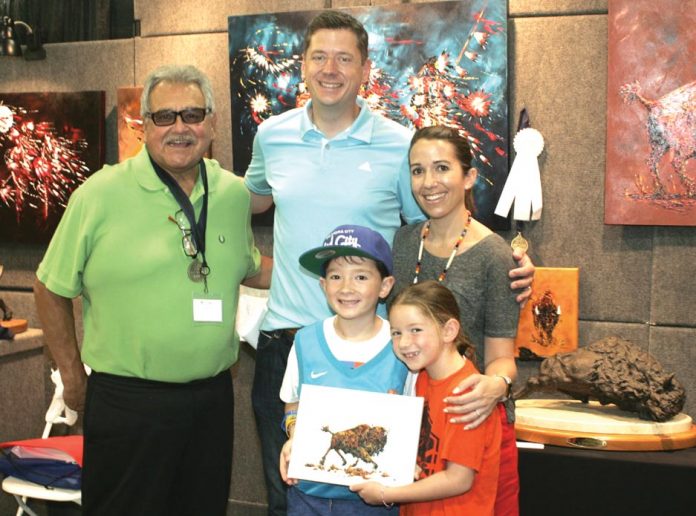
Osage Nation member Clancy Gray (left) invited fellow Osage Mayor Holt and his family to stop by his booth at 2019 Red Earth Festival after they were in the event’s parade on Saturday morning.
Story and photos by Darl DeVault
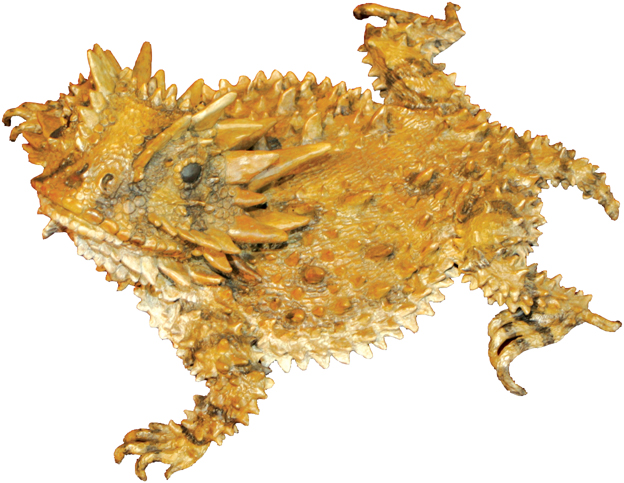
LEFT: Osage Nation member Clancy Gray sculpted this 10-times life size or heroic-sized bronze sculpture of Scout in clay. Osage Nation member John Free Jr. cast it in bronze in his Bronze Horse Foundry in Pawhuska, Okla. Free then applied the colorful patina that allows the horned toad to come to life.
Retired and just now decompressing from a 39-year career teaching high school art in the Greater Tulsa area, Osage Nation member Clancy Gray says creating his own Native American art is truly rewarding at age 70.
Making that transition to full-time fine art modern master translated into more sales of his jewelry, paintings and sculptures the first weekend in June at the 33rd Red Earth Festival.
At the three-day event in downtown Oklahoma City at the Cox Convention Center Gray sold several of his important works and had his best show ever. Gray said the extra attention lavished upon his art by the board of directors of Red Earth naming him 2019 ‘Red Earth Honored One’ sparked a successful sales weekend.
“Being the Honored One this year afforded me so many privileges that it just seemed natural that more people wanted to buy my work,” Gray said. “We set it up with the t, who is also an Osage Nation member, mayor to stop by the booth after he and his family were a part of the parade Saturday morning. I showed his family around the booth and we talked for about 10 minutes. I was excited when he came back by my booth after looking around for an hour and bought a painting of a bison his son really liked.”
That Honored One status, after Gray has exhibited at the Festival for 32 of its 33 years, put his art out front, in an expanded double-size booth nearest to the entrance to the juried art show.
Gray said that even though he was halfway across the state from his Broken Arrow home, his two sons, his brother and sister and many friends coming by or helping made him feel more at home than ever at Red Earth. The Honored One recognition is for a Native master visual artist whose support of Indian art has been substantial throughout his life.
Gray entered four items in the juried art portion of the show and collected two ribbons for top three placings. And again, in the truly rewarding vein, one of his first-place sculptures from three Red Earths back sold on Saturday.
Owners of one of Oklahoma City’s prominent CPA firms, T.C. Burgin, stopped by the booth and purchased Scout, a heroic size bronze horned toad, for the new office building they will open in the fall.
Osage Nation member and bronze casting legend John Free Jr. cast several of the horned toads at his Bronze Horse Foundry in Pawhuska, Okla. Free is famous for capturing the artist’s real goal in their work by applying some of the most skilled patinas in the crucible industry.
Gray said Free’s ability to create a life-like patina to the bronze sculpture brings his horned toad Scout to life. He explains Scout’s name in that the horned toad represents what Native Americans would often use to help locate their game while hunting. During a hunt, if they were not finding their prey, they would pick up a horned toad and say a prayer. When the hunter put the horned toad down, and it scurried off, that was the direction they would start in to continue their hunt.
“It is a privilege to get to work with John Free and his group at the Bronze Horse Foundry.” Gray said. “I always say that sculpting success is a two-part process, the artist who first creates it in clay and the foundry master who duplicates it in bronze for them.”
Gray’s traditional and contemporary influenced jewelry reflects Gray’s fondness for vivid color, texture, and asymmetrical design. The silver jewelry is often the most collected of his work, and leads to the most commissions. This nationally collected master silversmith has won many awards in exhibitions and museum shows.
Gray’s paintings sold well at Red Earth as well. His building up depth from the canvas in the impasto style has elevated his status in the Native American art world. He uses a palette knife to apply vivid acrylics, giving the paintings intensity that allows light to animate the focus of his work. This signature style allows Gray to create a modern ruggedness. He says he works to celebrate the light’s colorful and reflective sparkle built up in focused areas.
By creating a ceramic glaze depth with skillful repetitious palette strokes of the water-based acrylic paint, his paintings are dynamic and unique. Those high-gloss highlights have a richness of color that captures the eye, whether portrait or figures, still life, or landscape.
In retirement Gray says he now has more time to reflect on the achievements of his art students. He taught in Tulsa at McLain High School for 17 years and East Central High School for 18 years. He finished his teaching career at Edison High School after three years.
The insightful artist and teacher insisted his students master the basics of composition and design. He then encouraged them to create original works, rather than just copying ideas or pictures they saw. Gray has guided the beginnings of many art careers. More than 5,000 students graduated from his 39-year influence at those three schools.
“I tried to model strong basic skills, so as they learned those skills it would take them anywhere they wanted to go as artists.” Gray said. “Our schools supported them so the best and brightest could go on to win many art competitions in the state and nationally.”
Gray also made the students’ academic progress an important part of their art educations. The result was a highly productive teacher who helped many students receive college scholarships and awards
“We had student artists earn important scholarships, and become award-winners in art competitions and students whose work is now shown in galleries,” Gray said. “We had high expectations, we really wanted them to grow as much as possible as artists along the way.”
Gray says his passion for teaching and creating a nurturing educational setting for all his students was a given. After his double major in art and physical education, Gray went on to earn a master’s degree in education at the University of Central Oklahoma.
During his long career he also coached boys and girls soccer, boys baseball, girls softball, boys and girls cross-country and boys and girls swimming.
Gray says that one of the best features of retirement is the satisfaction of seeing how his many students’ talents evolve. He enjoys following his former students’ progress as they adapt to create great art in their growing careers.
He says that spark of excellence often stimulates him to keep up with his own art career. No longer constrained to a teacher’s schedule, he has found that requests to put on exhibits have come more often now.
“Being named 2019 Honored One at Red Earth has been one of the highlights of my recent retirement,” Gray said. “I had not danced in 35 years and was proud to dance in step as part of the procession at the beginning of the dance contests in my role as this year’s Honored One.”
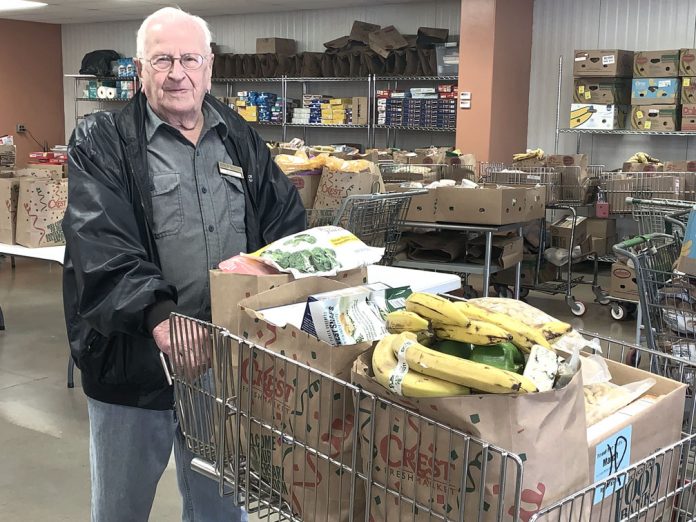
RSVP Volunteer Linus Affolder at Britvil Food Pantry
Story and photos by Taprina Milburn, Communications Coordinator for RSVP of Central Oklahoma
When Linus Affolder, 89, lost his wife, Carolyn, of 47 years in 2013, he said the grief was like going through a dark tunnel.
“I could be sitting on the patio and break down. Things would just trigger the tears,” the Oklahoma City resident explained. “I wanted her back. She was my foundation and strength; my right-hand person.”
Carolyn had been sick with leukemia for many years and as the disease progressed, the couple traveled to Houston’s MD Anderson Cancer Center almost every weekend for treatments. During those years, the Affolders had to step away from all of the volunteer activities they did individually and as a couple to concentrate on Carolyn’s health.
The loss was overwhelming when Carolyn died, Linus said, and he tried to manage the grief and loneliness on his own for as long as he could.
“A lady from church who had lost a son told me about a grief program at Christ the King Catholic Church that helped her, and so I started going. It was a four-month program and we met on Thursdays and learned about the phases of grief and shared our stories with one another. One of the things that stood out for me was the suggestion that getting back to volunteering could help in my grieving.”
So, Linus picked up where he left off years ago as a volunteer with Britvil Food Pantry in north Oklahoma City, an opportunity he found through the Retired and Senior Volunteer Program (RSVP) of Central Oklahoma, a program that matches seniors 55 and older with volunteer opportunities in the community.
“That was the starting point for me to get back out and be around people,” he said. “It revitalized me because I have people that I look forward to seeing and a weekly obligation to help others.”
There are no components of our life that grief doesn’t affect, said RSVP of Central Oklahoma board member and Licensed Professional Counselor Marla Mercer-Cole, who has a private counseling practice and leads grief groups through Mercer Adams Funeral Service.
“Grief affects us emotionally, physically, and spiritually,” she said. “There is a huge paradigm shift when we lose a loved one, especially a spouse. It leaves you shaken. You don’t feel of much value any longer and don’t know what your purpose is moving forward. I encourage the people in the groups that I lead that although we will always miss that person, we do begin to adapt physically and emotionally.”
She said that volunteering often helps with that process and has on many occasions referred her senior clients or members of her grief groups to contact RSVP of Central Oklahoma or other organizations to find out about volunteer opportunities.
“We have the capacity to be enlarged as humans to have compassion and empathy because of what we’ve been through,” she said. “Doing something altruistically for someone helps others but also gives you a break from the heaviness of grief. It helps with connections and making friends and reminds us that if we are still here, we have a purpose.”
She also encourages grievers to surround themselves with positivity and look for things for which to be grateful. Research shows that gratitude changes brain chemistry and complaining and negativity does, too, she said.
And last, read as much as you can about grief because knowledge is power, and if you are ready, join a grief group.
“Some people who are grieving worry that something is wrong with them until they are in a grief group and hear others who share some of the same things you are going through,” she said.
Today, Linus is involved with several volunteer opportunities each week and joins friends at three church-sponsored senior luncheons each month.
“Pushing myself is what I have to do,” he explains, “but I feel a difference when I get out with people and my friend base is enlarging.”
To learn more about ways to volunteer in your community, call the Retired and Senior Volunteer Program (RSVP) of Central Oklahoma, at 405.605.3110 or visit rsvpokc.org.
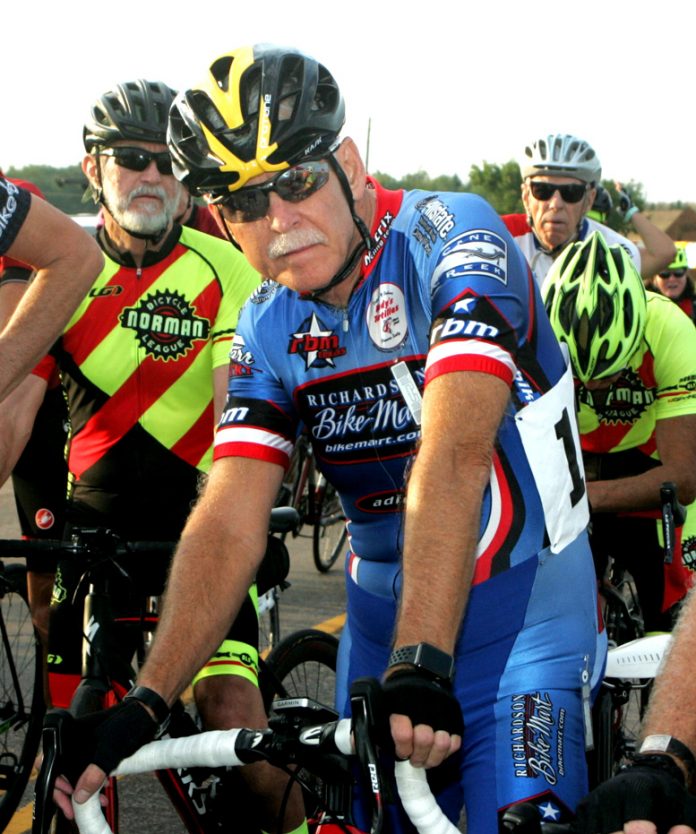
Oklahoma Senior Games cycling competitors gathered Sunday, September 16 last year at the Lake Stanley Draper Marina to stage for their either one lap or two lap races starting north around the lake. Many of the 55 cyclists who started racing at 8 a.m. in a mass start travelled from out of state to qualify for the 2019 National Senior Games in Albuquerque, New Mexico.
“Oklahoma offers many of these Texas riders racing today another chance to qualify for nationals,” said Kathleen Fitzgerald, OSG state director. “It is surprising at first, how far they will travel to qualify for nationals, until you talk to them and realize these are really competitive older folks who want to stay fit year-round as cyclists.”
The 22K and 44K road races drew the most contestants last year at Draper, while the 5K and 10K time trial events that started at noon and 1 p.m. saw many of the same road racers participate.
The 22K course, one clockwise lap around Draper, saw the group stay together. They finished almost together on the long downhill that sweeps from the south to the finish near the road that leads into the marina. Many of the racers continued for another lap around Draper to contest the 44K category.
The 40 and over bicycle racers were hoping to place first through fourth place at last year’s games so they could qualify for the 2019 National Senior Games in New Mexico. Those games just took place June 14-25.
Many of the same racers, trying to qualify for Nationals, lined up again at noon or 1 p.m. to start an individual 5K or 10K time trail on an out and back loop north on the lake road. The cyclists, many riding specialty time trial bikes, began their race against the clock in one-minute intervals. Starting order was from youngest to oldest starting with males and ending with females.
The events observed U.S.A Cycling rules and went off without any wrecks or mishaps throughout the day.
In the time trial events, riders were not allowed to draft (take pace behind another rider) closer than 25 meters ahead, or two meters to the side. If anyone had broken this rule, they would have received a time penalty.
Both road race distances and the two time trail distances offered dual opportunity for qualifying for nationals. Qualifying in any event at the 2018 event earned the athletes the right to compete in either or both their respective events at Nationals.
2019’s events for 40+ cyclists will take place Saturday, September 21 at the lake with a similar schedule as last year. Entry Deadline is September 7 this year and staging will again be at the marina at 8301 SE 104th. Street.
Divisions will be contested in recumbent, Paralympic Upright, Paralympic Handbike, Paralympic Tandem and Paralympic Tricycle if enough racers enter those categories,
Racers 40+ can go online to okseniorgames.com for more information or call (405) 821-1500.
In a recent article published by the Harvard Medical School’s Harvard Health online, bicycling is described as providing important physical benefits. First, it is an aerobic workout, which for seniors is the heart of any health plan, pun intended. Cycling, therefore, is good for their heart, brain and blood vessels.
Cycling is easy on joints, Dr. Safran Norton says in the article. He says that unlike walking, cycling is good for anyone with joint paint or age-related stiffness.
Bicyclists use their largest muscle group, the legs, which helps them build muscle while toning other muscles needed to keep them balanced and steer the bicycle.
These benefits carry over into everyday activities while helping cyclists build bone density, says Dr. Norton.
Greater Fort Lauderdale, Florida will host the 2021 National Senior Games, the largest multi-sport championship event in the world for adults 50 and over. More than 10,000 qualified athletes, accompanied by an estimated 15,000 visitors, are expected to compete in 20 medal sports in 2021.
The National Senior Games, begun in 1987, has 54 affiliated qualifying member games in North America promoting wellness and active, healthy lifestyles for older adults.