SSM Health St. Anthony Hospital – Oklahoma City was awarded an ‘A’ from The Leapfrog Group’s Fall 2018 Hospital Safety Grade. The designation recognizes SSM Health St. Anthony Hospital, including SSM Health Bone & Joint Hospital at St. Anthony, for their efforts in protecting patients from harm and meeting the highest safety standards in the United States.
The Leapfrog Group is a national organization committed to improving health care quality and safety for consumers and purchasers. The Safety Grade assigns an A, B, C, D or F grade to hospitals across the country based on their performance in preventing medical errors, infections and other harms among patients in their care.
“At SSM Health St. Anthony Hospital and SSM Health Bone & Joint Hospital at St. Anthony, we take great pride in providing exceptional patient care. Safety is our number one priority for each patient that walks through our doors. Our employees go above and beyond every day, committed to the best safety practices, ensuring our patients receive the best care possible,” said Tammy Powell, President, SSM Health St. Anthony Hospital.
“Leapfrog’s Hospital Safety Grades recognize hospitals like SSM Health St. Anthony Hospital that focus on advancing patient safety. This ranking provides an important resource for patients, and a benchmark for hospitals, to determine how care at one hospital compares to others in a region,” said Leah Binder, president and CEO of The Leapfrog Group. “Hospitals that earn an A Hospital Safety Grade deserve to be recognized for their efforts in preventing medical harm and errors.”
Developed under the guidance of a National Expert Panel, the Leapfrog Hospital Safety Grade uses 28 measures of publicly available hospital safety data to assign grades to more than 2,600 U.S. hospitals twice per year. The Hospital Safety Grade’s methodology is peer-reviewed and fully transparent, and the results are free to the public.
SSM Health St. Anthony Hospital was one of 855 across the United States awarded an A in the Fall 2018 update of grades. To see full grade details of SSM Health St. Anthony Hospital, and to access patient tips for staying safe in the hospital, visit www.hospitalsafetygrade.org and follow The Leapfrog Group on Twitter and Facebook.
Founded in 2000 by large employers and other purchasers, The Leapfrog Group is a national nonprofit organization driving a movement for giant leaps forward in the quality and safety of American health care. The flagship Leapfrog Hospital Survey collects and transparently reports hospital performance, empowering purchasers to find the highest-value care and giving consumers the lifesaving information they need to make informed decisions. The Leapfrog Hospital Safety Grade, Leapfrog’s other main initiative, assigns letter grades to hospitals based on their record of patient safety, helping consumers protect themselves and their families from errors, injuries, accidents, and infections.
By Jose M Olivero, Social Security Public Affairs Specialist in Oklahoma
In the digital age, frauds and scams are an unfortunate part of doing business online. During the holiday season, Social Security has traditionally seen a spike in phishing scams, and we want to protect you as best we can. Always be cautious and to avoid providing sensitive information such as your Social Security Number (SSN) or bank account information to unknown individuals over the phone or internet. If you receive a call and aren’t expecting one, you must be extra careful. You can always get the caller’s information, hang up, and — if you do need more clarification — contact the official phone number of the business or agency that the caller claims to represent. Never reveal personal data to a stranger who called you. Please take note; there’s a scam going around right now. You might receive a call from someone claiming to be from Social Security or another agency. Calls can even display the 1-800-772-1213, Social Security’s national customer service number, as the incoming number on your caller ID. In some cases, the caller states that Social Security does not have all of your personal information, such as your Social Security number (SSN), on file. Other callers claim Social Security needs additional information. if they do not confirm your information. Reports have come from people across the country. These calls are not from Social Security.
Callers sometimes state that your Social Security number is at risk. The caller then asks you to provide a phone number to resolve the issue. You should avoid engaging with the caller or calling the number provided, as the caller might attempt to acquire personal information.
In only a few special situations, such as when you have business pending with us, a Social Security employee may request the person confirm personal information over the phone.
Social Security employees will never threaten you or promise a Social Security benefit approval or increase in exchange for information. In those cases, the call is fraudulent, and you should just hang up. If you receive these calls, please report the information to the Office of the Inspector General at 1-800-269-0271 or online at oig.ssa.gov/report.
Remember, only call official phone numbers and use secured websites of the agencies and businesses you know are correct. Protecting your information is an important part of Social Security’s mission to secure today and tomorrow.
What are the cheapest cell phone plans available to seniors today? I’m 78-years-old and want it primarily for emergency purposes. Infrequent Caller
Dear Infrequent,
While unlimited high-speed data, video streaming and mobile hot spot are now standard for most cell phone plans today, there are still a number of low-cost wireless plans designed with seniors in mind.
These plans offer limited talk time and text, which is ideal for seniors who want to stay connected without spending much money each month. Here are some super cheap plans to consider.
Cheapest Plans
Prepaid plans are the best deal for seniors who only want a cell phone for emergency purposes or occasional calls. The very cheapest prepaid plan available today is T-Mobile’s Pay As You Go plan, which includes any combination of 30 minutes or 30 text messages for only $3 per month. After that, additional minutes and texts cost 10 cents each.
Phone prices start at $75, but if you have a compatible device, you can use it rather than buying a new one. You will, however, need to pay for a $10 SIM Starter Kit fee, whether you bring your own phone or buy a new one. Visit T-Mobile.com or call 844-361-2792 for more information.
Two other companies that offer low-cost prepaid deals are TracFone and AT&T.
TracFone (TracFone.com, 800-867-7183) has a 30 minute talk/text plan for $10 per month, or an even cheaper a 60 minute talk/text plan for $20 for three months, which averages out to only $6.66 per month.
And AT&T (ATT.com, 800-331-0500) has two low-cost prepaid plans including the 25 cent per minute call plan, and a $2 daily plan that charges only when you place or receive a call or send a text that day. The fees are deducted from the prepaid balance on your account. But to use AT&T Prepaid, you must prepay into your account either $10 per month, $25 for three months or $100 per year.
Best Emergency Phone
If you’re interested in a senior-friendly cell phone that provides top-notched emergency assistance, consider the Jitterbug Flip (GreatCall.com, 800-918-8543).
This is a nifty flip phone that has big buttons, enhanced sound, a simplified menu, and a 5Star urgent response button that connects you to a trained agent that will know your locations, and will be able to assist you whether you need emergency services, directions, roadside assistance or a locksmith, or to contact family. GreatCall’s service runs on Verizon’s network.
The Flip phone costs $100, with monthly service plans that start at $15 for 200 minutes. Or, you can get the 5Star service with 50 minutes of monthly talk time for $25.
Free Phones
If your income is low enough, another option you should check into is the federal Lifeline program, which provides free or low-cost cell phones and plans through numerous wireless providers.
To qualify, your annual household income must at or below 135 percent of the Federal Poverty Guidelines – which is $16,389 for one person, or $22,221 for two. Or, you must be receiving Medicaid, food stamps/SNAP, SSI, public housing assistance, veterans pension or survivor’s pension benefit, or live on federally recognized Tribal lands.
To find out if you’re eligible, or to locate wireless companies in your area that participates in the program, visit LifelineSupport.org or call 800-234-9473.
Send your senior questions to: Savvy Senior, P.O. Box 5443, Norman, OK 73070, or visit SavvySenior.org. Jim Miller is a contributor to the NBC Today show and author of “The Savvy Senior” book.
Date/ Day/ Location/ Time/ Registration #/ Instructor
Nov 13/ Tuesday/ Okla. City/ 9 am – 3;30 pm/ 691-4091/ Palinsky Rose State – 6191 Tinker Diagonal – room 203
Nov 14/ Wednesday/ Warr Acres/ 8:30 am – 3 pm/ 789-9892/ Kruck Warr Acres Community Center – 4301 N. Ann Arbor Ave.
Nov 15/ Thursday/ Norman/ 9 am – 3:30 pm/ 307-3177/ Palinsky Norman Regional Hospital – 901 N. Porter Ave.
Nov 17/ Saturday/ Shawnee/ 9 am – 3:30 pm/ 818-2916/ Brase Gordon Cooper Tech Center – One John C. Burton Blvd.
Dec 6/ Thursday/ Okla. City/ 9 am – 3:30 pm/ 951-2277/ Varacchi Integris 3rd Age Life Center – 5100 N. Brookline, Suite 100
Dec 8/ Saturday/ Midwest City/ 9 am – 3 pm/ 473-9239/ Williams First Christian Church – 11950 E. Reno Ave. (Activity Room
Dec 11/ Tuesday/ Okla. City/ 8;30 am – 3 pm/ 521-3756/ Palinsky Office of Disability Concerns – 1111 N. Lee Ave, Suite 500
Dec 14/ Friday/ Okla. City/ 9 am – 3 pm/ 951-2277/ Edwards S.W. Medical center – 4200 S. Douglas , Suite B-10
Dec 14/ Friday/ Okla. City/ 9 am – 3:30 pm/ 951-2277/ Edwards S.W. Medical Center – 4200 S. Douglas, Suite B-10
The prices for the classes are: $15 for AARP members and $20 for Non-AARP. Call John Palinsky, zone coordinator for the Oklahoma City area at 405-691-4091 or send mail to: [email protected]
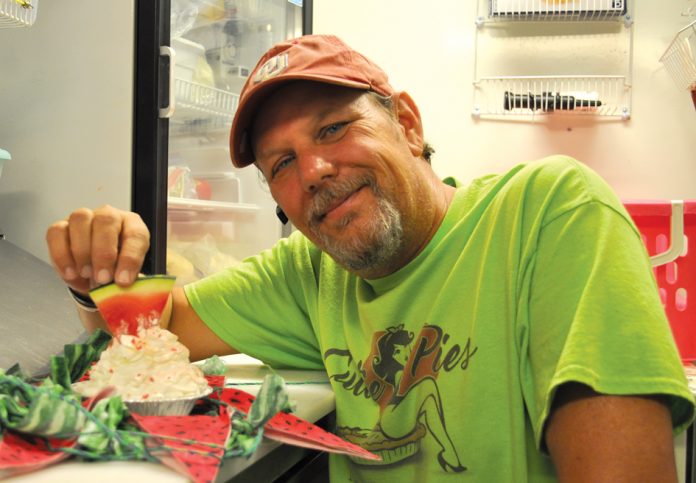
Mike and Belinda Winslow, owners of Cutie Pies Concessions, took first place for their watermelon pie at the State Fair of Oklahoma.
by Bobby Anderson, Staff Writer
This fall has been pretty sweet for Belinda Winslow and husband Mike.
In September, she received the blessed news that her 27-year-old daughter was finally cancer free.
October saw her Watermelon Pie creation clean up in the awards category at the Oklahoma State Fair. The pie, an old recipe from her childhood, earned the FAIRest of Them All award as the best overall food creation. The fruity, creamy treat also was named the top overall sweet offering at the fair, dubbed Sweetest of the Sweet.
“We’ve had a good year this year,” Belinda Winslow smiled.
Going up against eclectic creations like deep fried coffee, Frosted Flakes chicken on a stick and Kit-Kat fries, Winslow’s watermelon pie blew away judges at the Great TASTE of a Fair competition which immediately precedes the September fair.
The event, staged to whet appetites and drum up publicity for the fair, was Winslow’s coming out party for her mobile food truck business.
Based out of Moore, the Winslows opened their trailer for business in March 2015 after scores of friends and family kept insisting they bring the watermelon pie to every gathering.
Winslow said some of those invites may have just been for the pie, but it was clear she had something on her hands that people really liked.
“It was a recipe my mom came across and she just loved it and we started making it,” Winslow said. “It just stuck.”
So did the idea of opening her own business. Her and her husband, who runs a full-time paint contracting business, began drawing up a business plan months earlier.
Cost projections outpaced savings for opening a traditional brick-and-mortar business.
“The food truck was the first thing we could think of,” Winslow admitted.
A business on four wheels came with its drawbacks.
Running a business in a trailer meant more prep work. Winslow typically makes her runs to Sam’s Club, Wal-Mart and the Chef Store the Tuesday before an event. Six to seven hours the following day are spent doing prep work, including cutting up some 20 to 25 watermelons by hand.
“It’s hard work, very hard work,” Winslow said of the business. “It’s not something you could just do on a part-time basis. It’s a full-time job.”
“You’ve got to pack it up, move it and have it ready on time.”
The concept also came with advantages.
Being on wheels means that Cutie Pies can be at almost any venue in the state with enough advance notice.
This month the trailer will pull up to Norman and the University of Oklahoma Day of the Dead Celebration. The following day Cutie Pies will be at Integris Baptist with 100 pies for a private event hosted by the radiology department.
Twelves days later you can find watermelon pie at the Luther Pecan Festival.
Outside of the State Fair, Winslow said one of the company’s best events is always the The Old Chicken Farm Vintage Barn Sale in Jones.
It’s a good thing Cutie Pies gets around because it will take you awhile to work through the menu. Watermelon pie may be the star but there’s a talented ensemble cast of banana cream cheesecake, root beer float pie, cherry limeade pie and cotton candy pie.
If sweet isn’t your thing they have savory covered, too, with Winslow’s chicken and corn frito pie.
The twist on the original frito pie includes santa fe chicken layered on Fritos doused in queso cheddar cheese mixed with feta, cilantro and a special chili lime mayo.
Wash it all down with a variety of lemonades – including watermelon, of course.
“This our first year to actually make money,” Winslow said.
And that’s despite a trying year.
Winslow’s daughter battled stage IV ovarian cancer before doctors announced she was cancer-free three days after her last surgery.
Through it all, Winslow has been her daughter’s caregiver, keeping her out of the truck for most events. That’s meant Mike pulling double duty.
“He’s been our savior. He’s saved both of our businesses,” Winslow said of her partner of 20 years.
But it all paid off this fall.
“It was kind of Heaven-sent because (my daughter) finished chemo and we had the fair,” Winslow said. “Right after the fair she had her surgery.”
“But she was still out there.”
All three of Winslow’s kids help in the business including a 21-year-old daughter and a 38-year-old son.
Her two granddaughters pitch in, too.
“They come stay with us every other weekend,” Winslow said. “They love to work on the truck and they hope we have leftovers, which doesn’t happen very often.”
So what’s next? Can she top Watermelon pie?
“I have somethings in the works for next year but I can’t tell you,” Winslow laughed.
You can find out where Cutie Pies Concessions will be next through their Facebook page.
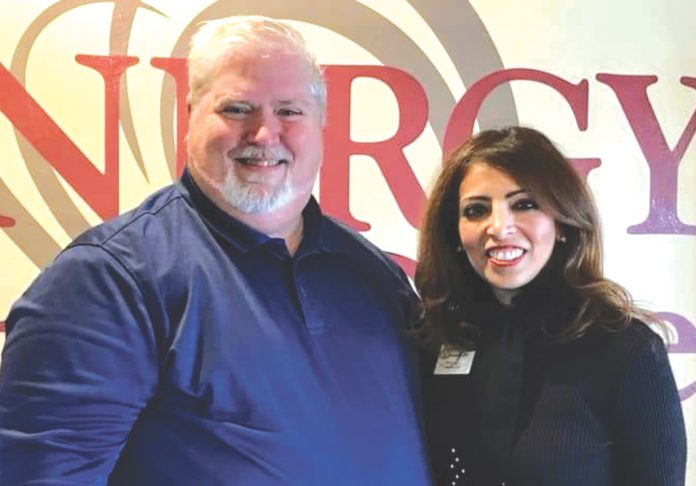
Weama Kassem, CEO and President of SYNERGY HomeCare with Jeff Aynes who recently joined the SYNERGY Home Care Team as their Director of Sales and Marketing.
Expanding and strengthening their team and service
SYNERGY HomeCare proudly opened their doors over 5 years ago in Edmond, Oklahoma. Weama Kassem, CEO and President of SYNERGY HomeCare, has always dreamt of having a business that centered around caring for others; specifically, our aging community. Weama has been fortunate enough to attract a team of professionals with the same heartfelt drive and talent. The people Weama has assembled have accomplished some incredible things by always putting their clients’ needs and happiness first. The SYNERGY HomeCare team always refers to each other as “SYNERGY Family” and they work together to create an atmosphere of care and respect for each other and for their clients and families.
Weama opened her second office in December 2016 in Norman, Oklahoma. This enabled the company to reach and connect a larger clientele and reaching beyond Edmond and Oklahoma City. One of the most essential guidelines in opening the new location has been to duplicate their high standard of care. SYNERGY HomeCare does not use contracted caregivers, all are employees who must completed in-house training, along with continued monthly and quarterly training programs. This ensures the caregivers are not only qualified, but it strengthens the support and bonds within the company itself. Each caregiver is a Certified Nursing Assistant and/or a Certified Home Health Aide. They are each insured and bonded by SYNERGY HomeCare and strive to provide excellent care and support to both clients and their families.
SYNERGY HomeCare is very pleased to announce that Jeff Aynes has joined the SYNERGY Home Care Team as our Director of Sales and Marketing. Jeff has been a strong advocate for health care in Oklahoma for many years and will make a great leader on our team. Jeff is a father of two beautiful ladies and grandfather of two beautiful girls. He went to the University of Central Oklahoma and Oklahoma State University where he studied Marketing, Public Relations, and Broadcasting. Jeff is a Past President of Marketing Plus for Healthcare and currently serves as Secretary. He is currently serving as President of the Northside Marketing Alliance, as well as, Secretary. He has served in the community for many years as a member of the Shriner’s, Scottish Rite, Eastern Star, Amaranth, and Masons where he is a Past Master. He has been volunteering with Muscular Dystrophy, Cerebral Palsy Association, and Make Promises Happen Camp for over 25 years. His passion outside of Sales and Marketing is music. He has owned Jammin’ Jeff Entertainment for over 25 years and has performed over 1,800 events. Jeff joins the SYNERGY staff from AllianceHealth Midwest where he served as Director of Marketing for the Behavioral Health Program. Prior to going to AHM, Jeff served for over 5 years at Absolute Senior Care of Oklahoma City and A Premier Senior Home Care of Tulsa as their Director. We are beyond thrilled and honored that Jeff has chosen to join our team and know he is truly a valuable asset that will provide wonderful support to our growing company.
Together, Weama and Jeff, will be able to provide assistance to our aging community, education to our referral partners, knowledge to our team of growing caregivers, and a bright and smiling face to see each time you encounter them. Serving people is what SYNERGY HomeCare does every day and it is truly the drive and passion of both Weama and Jeff. With over 100 caregivers and five years in business, the SYNERGY HomeCare team stands ready to answer specific questions about care.
Whether you are a senior living on your own, with an aging spouse, or you have an aging parent – there are some key things to keep in mind when selecting a home care company. First, is the home care company licensed in the state? Companies are reviewed annually to determine their eligibility, and this is a perfectly normal question to ask a potential company. Ask to see a copy of their business license. Second, ask if the caregivers are employed by the company instead of being contract labor employees. It may seem beneficial to contract our work, but actually you can face many liability and scheduling issues down the road. Ask the provider to include client AND their family members in developing the plan of care. SYNERGY HomeCare has full-time RNS on staff to specifically build a plan of care for each new client and they spend the time you need to sort out every little detail. Lastly, ask for a list of references so you can check in on who you are considering to employ! We are all use to providing references when applying for a job. SYNERGY HomeCare is happy to answer questions like these anytime.
SYNERGY HomeCare is a group of Oklahomans that you can trust. Weama, Jeff, and the whole team are honored to provide care to this amazing community and welcome your call anytime, day or night!
SYNERGY HomeCare is located at 13720 N Bryant Ave. Edmond, OK 73013 405-254-3046
www.synergyhomecareedmond.com
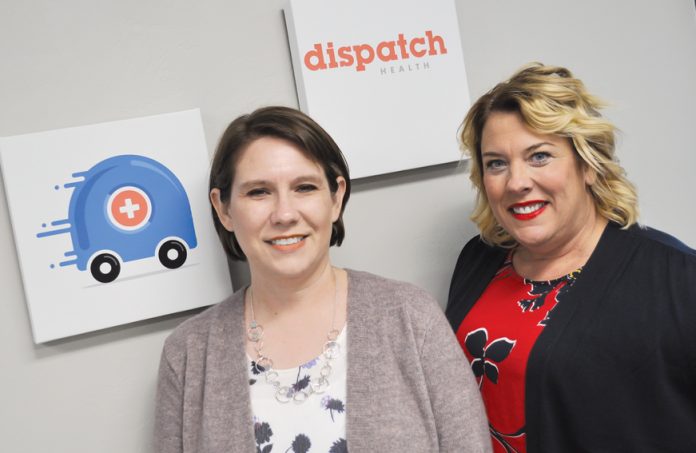
Amy Evans and Tiffany Traxler are helping bring an exciting new health care delivery option right to your door with Dispatch Health.
story and photo by Bobby Anderson, Staff Writer
A cough. A sniffle.
You feel something coming on. But what next?
You can call your doctor and hopefully get an appointment sometime in the next couple weeks.
Or you can get in your car and head to the local urgent care clinic and wait with 20 or 30 others doing the same thing.
What if there was a better way?
That’s what Dr. Mark Prather thought in 2013 when he came up with a unique service model that would eventually become DispatchHealth.
“Really anything you can think of you would get in your car and go to urgent care for but more,” Dispatch Community Engagement Manager Tiffany Traxler said, explaining the service that has recently expanded into the metro.
DispatchHealth is bringing back the house call with a modern technology twist. DispatchHealth gives patients ways to access convenient, high-quality acute care in the comfort of their home at the time of need.
DispatchHealth is redefining the healthcare landscape as an extension of a patient’s healthcare team and offering solutions for simple to complex medical problems all from the comfort of your home.
The concept dates back to 2013 when Prather was running the emergency department in Denver for Centura Health.
“They asked Dr. Prather if he could come up with a system that could be delivered safely in the home for patients who go to the emergency room with urgent needs but not emergent,” Traxler explained. “He knew the need and he knew how to make things mobile.”
“He started going out on calls.”
Working with the ambulance service through the 911 system, Prather helped more than 400 patients in 18 months in the comfort of their own homes.
The total cost savings to the health system was more than $1 million.
But saving patients the time, expense and hassle of an ER visit was priceless.
The model has spread like wildfire to Colorado Springs, Richmond, Phoenix, Las Vegas, Houston, Oklahoma City, Tacoma, Dallas and Springfield.
Blue Cross and Blue Shield – one of Oklahoma’s largest insurers – quickly saw the value.
“Blue Cross and Blue Shield saw what we were doing and the impact we were making,” Traxler said. “For the 65-and-under patient if you have Blue Cross and Blue Shield it’s an urgent care co-pay. For 65 and up all Medicare, Medicaid and Medicare Advantage plans … we bill as an urgent care.”
For some that can mean an urgent care visit in their home for less than $50.
Services include testing such as: blood tests on-site, strep test, flu swab, urinalysis, urine cultures, stool culture, test for blood in stool, pregnancy test, lactate, 12-lead EKG, PT/INR, rapid infectious disease testing and more.
Dispatch also provides medications such as: anti-inflammatories, IV antibiotics, IV fluids, prednisone, lasix, antiemetics, flu medications, laxatives, stool softeners, heartburn prevention, glucose gel, anesthetics, migraine cocktail, antihistamines and more.
IVs can be placed and fluids begun all in your home.
Breathing treatments can also be administered.
AVOID THE BUG
Last year’s influenza outbreak was one of the worst in nearly a decade and the severity of the outbreak was extreme. In fact, The Center for Disease Control and Prevention (CDC) recorded over 20,000 positive flu tests per week at the height of the outbreak.
While most seek treatment at an emergency room (ER) or urgent care clinic, when leaving one’s home the virus can be immediately exposed to others and cause further spread of the flu. Also, ERs and clinics can easily become overwhelmed with a high number of sick patients during flu season, leading to overcrowding, lengthy wait times and even physician burnout.
Adults can infect others one day before their flu symptoms even develop and can pass on the virus up to a full week after becoming sick.
“Flu comes on very, very quickly. If it’s 2 p.m. and you realize you don’t feel well you’re not going to get into your (doctor’s office),” DispatchHealth Market Director Amy Evans said. “With flu if you can get those anti-virals within that first day or two it cuts down on the length of flu.”
“When you’re talking about the elderly population and people with compromised immune systems that 12 hours means something.” To request on-demand urgent care brought to you call 405-213-0190
A group of senior friends published a new book that takes a look at the undercurrent behind today’s political climate.
by Bobby Anderson, Staff Writer
A sociologist, a psychologist and a benedictine nun walk into a room.
Sounds like the beginnings of a good joke.
But for John Karlin, PhD, those are just a few of the cast of characters that helped create his new book: Fear, Religion, Politics: Well I’ll Be Darn!
Karlin spent the last year of his life writing this book that takes a look at the intertwining of three things deeply personal to Americans.
“It was incredible in the sense that how much insight humans have but not realize it,” Karlin said. “In researching this I kept seeing these little lights in other people’s works.”
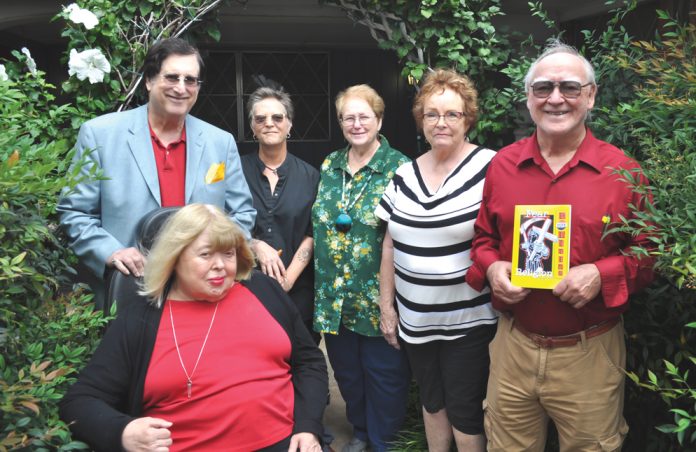
Karlin was aided by Dr. Melvyn Preisz, Rhonda Bell, Judy Martin, Marsha McMillin, Gerry Lantagne and others in developing his second book. Each brought their own unique talents.
Preisz is a local clinical psychologist who befriended Karlin years ago.
“I agree with Dr. Karlin’s timely and insightful assessments of this unprecedented crisis,” Preisz said. “From my own psychological viewpoint, these enemies of our individual freedoms collude to divide and conquer the good within us, and to continue to attack our personal conscience from a buffet of lies.”
Karlin stresses he has no political motives with this book.
His wish for what readers walk away with is simple.
“Simply an understanding of those undercurrents, a complete, full, intense understanding of … what’s actually happening underneath the surface,” Karlin said. “I just expose those undercurrents, that was my whole concern. I write from a sociological perspective.”
“I’m not the only one who has picked up on this. What I found is pieces of those themes in many, many other works.”
Karlin cites some 120 references in his work, that he says was a labor love performed with dear friends.
“Our intent was to give seniors out there a message that you can do stuff like this. You’re never too old,” the 72-year-old Karlin said. ”Don’t just sit, you’re capable of doing stuff.”
More than 20 years of Karlin’s life have been spent in teaching, largely at Northwestern Oklahoma State in Alva, Oklahoma City University and Phillips University.
While teaching sociology and criminal justice at OCU, Karlin begin his friendship with Preisz.
Preisz introduced him to Lantagne, who introduced Martin, a former Benedictine nun and things began falling into place.
“It was just friends introducing friends,” Karlin said. “It was basically happenstance then realized ‘Gosh, look at all this talent.”
The motives were simple.
“I just didn’t like the way things were going in this country especially politically and socially in terms of the turmoil and discontent,” Karlin said. “I thought there had to be something underneath that. As a sociologist you always know that what’s on the surface isn’t always the whole story.”
“Sometimes in our culture there are some very deep undercurrents that help explain.”
Karlin recalled attending Louisiana State University for his doctorate. A conversation with an old fisherman came to mind.
The fisherman pointed to the Mississippi River and told Karlin to watch it closely.
“It’s just real slow, old man river kind of thing but underneath that is just incredible turmoil,” Karlin said. “The Mississippi in spots is almost a mile deep and a lot of people don’t realize that because the undercurrent is cutting it.”
“There are literally complete trees down there. That’s the way culture and society can be.”
That got Karlin thinking about what’s underneath today’s politics and headlines.
“What’s under that is not good,” he said.
Karlin’s book flows through three sequences with the first being our innate fear of death and how we view our own mortality.
“And how that came to actually produce the phenomena we call religion in society,” Karlin said. “Any religion, it doesn’t matter what it is, came from the fear of death because religion was a way to escape that tension and fear.”
The second sequence evaluated Christianity and the life of Jesus Christ.
“I looked at what (Jesus Christ) was actually trying to accomplish in his own time and he was trying to accomplish something,” Karlin said. “You’ll find that as somewhat of a shocker.”
The third sequence takes things into the political realm.
“That’s where the dream goes awry because a big chunk of our Christian community want to blend religion and politics to the point where they are no longer distinguishable and that’s not good,” Karlin said.
“That’s what has created most of the problems you see in society today. Basically, it’s the drive towards theocracy.”
Karlin’s book is now available on Amazon. He will do a benefit book signing for the Peace House at the Peace Festival at the Civic Center Music Hall November 10 from 10 a.m. to 4 p.m.
The Peace House will get $5 for every book sold.
Mike Isaac, RN, went from breaking down doors as a police officer to opening new ones as a nurse at the JD McCarty Center for Children with Developmental Disabilities in Norman.
by Bobby Anderson, Staff Writer
To say Mike Isaac’s resume is extensive would be an understatement.
EMT, police officer, detective, SWAT team member – all of it has combined into Isaac’s RN Nurse Manager role at JD McCarty Center for Children with Developmental Disabilities in Norman.
And for the past six years now, Isaac has been a nurse. But his past is almost as interesting as his present.
Fellow nurse manager Suanne Livingston likes working alongside Isaac and is constantly amazed by his background.
“He’s very organized and he’s very respected,” Livingston said. “He does a great job with staff. When he was a staff nurse he was a great staff nurse. I kind of defer to him as far as how he handles things employee-wise because he’s a little more hard-nosed than I am.”
“I learn a lot from him and I kind of watch and learn how he handles situations.”
Isaac worked in emergency rooms at night to help put him through college. He applied for PA school and quickly found it wasn’t a career track he wanted to pursue.
He spent some time in medical research and a couple other jobs before signing on with the Norman Police Department as an EMT for the ambulance service.
He attended the prerequisite police academy and later pursued his master’s degree. The only problem was working those 24-hour EMT shifts really took a toll on his studies.
So he decided to become a police officer instead.
“I said I would just transfer over and I did,” Isaac said. “I did really well and got promoted quickly and did a bunch of really good stuff but I got really interested in things involving mental health.”
A detective and eventually a supervisor, Isaac helped craft Norman’s policy on dealing with mental health subjects. His plans were carried over into department’s across the nation during his 27 years with Norman PD.
Isaac’s reputation earned him a spot helping craft officer-involved shooting policy.
“They weren’t getting the help they needed post-shooting,” Isaac said. “There were a lot of trauma victims involved with homicide and rape – two of the things I was assigned to – that weren’t getting follow-up care to prevent and treat post traumatic stress.”
Working with the FBI’s Behavioral Science unit in Quantico, Va., he helped craft policy to protect all involved.
“You didn’t take their gun right after a shooting. You took it as evidence but you replaced it,” Isaac said. “You didn’t put them on a desk job and treat them like they were unable to do work. Basically we wrote it so they would get a return to work slip.”
The process helped officers work through the ensuing mental and physical issues while protecting their personal health information. Inservice training was given and officers qualified again at the shooting range before easing back into their duties while riding with a supervisor.
“That was actually taken to Quantico for the national FBI academy that all law enforcement agencies around the world send people to.
“Our policy is still given out there.”
A friend mentioned he would be a perfect fit for nursing school.
“They sold me on this BADNAP program,” Isaac said of Oklahoma City Community College’s accelerated nursing program. “It was a great program. I wouldn’t do it again but it was a great way to get in and get employed and get out. I had a couple jobs before I even graduated.”
EMT, policeman, mental health advocate – you would think it all prepared him for nursing school.
“It did, but the pace was a great equalizer. It was just so fast. I don’t know how some of those people did it,” Isaac said. “I don’t know how some of those people did it, single heads of households with children to take to soccer games and other things.
“They were my heroes throughout. It was a great experience.”
Day and night, Isaac completed his ADN in eight months.
“It was tough but it was good. They don’t cut any corners,” Isaac said.
Assessment, investigation, report writing and observation – all skills Isaac honed in his former life have prepared him for a nursing career.
Nursing care plans are still vital. Different disciplines are heavily involved such as dietary and physical therapy.
He laughs when he admits his experience as Norman’s chief hostage negotiator still comes in handy.
But most days he doesn’t need it.
“The opportunity to see mostly the direct care staff grow in professionalism and responsibility so they can take ownership,” Isaac said of his greatest reward. “I always tell them when I interview it’s not a nursing home for kids.”
Jerri Wilson of Loco is being recognized as a significant woman in Oklahoma agriculture.
by Bryan Painter
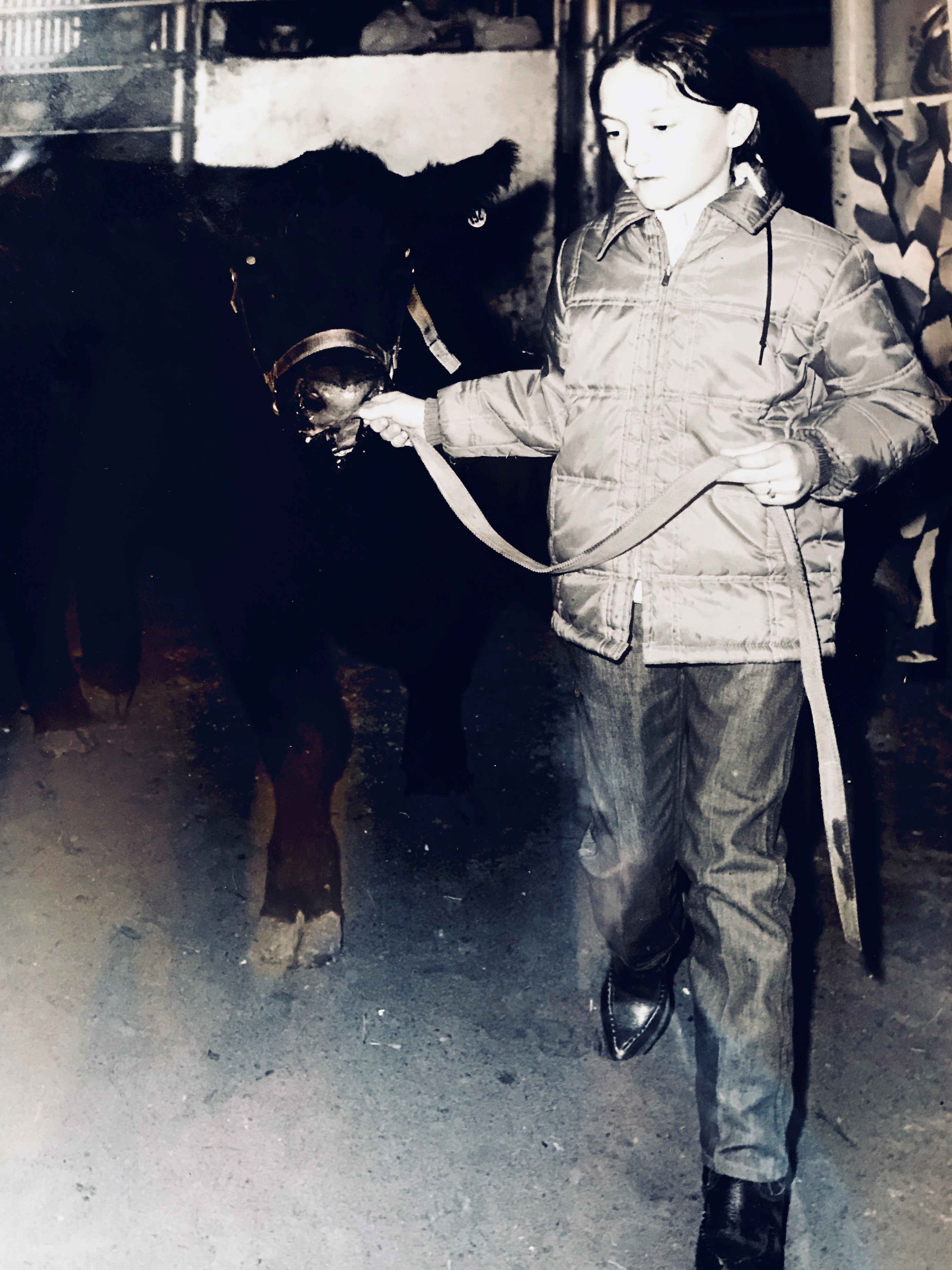
Jerri Wilson at 10 years old showing her home-raised Angus show steer.
LOCO – Cattle and horses over people.
Jerri Wilson, raised near Duncan in southern Oklahoma, made that choice about the time she was still shedding baby teeth.
Horseback at every opportunity, Wilson would carry her lunch around in her saddle bags. Why?
“If it was even mentioned about going to town,” she said, “I became scarce out in the pastures.”
She was born to Billie and (Ed) John E Jackson, Jr. and grew up on the commercial Angus cow-calf ranch in southern Stephens and northern Jefferson counties. Ed Jackson purchased the ranch the year Wilson was born, 1959, and expanded it to 23,000 acres.
Billie and Ed had four daughters. Their names started with J so it was called the 4J ranch.
Wilson was the youngest and grew up following her father around taking care of the cattle.
“The others did not take up much to cattle and the country life,” she said. “I was quite the tomboy, staying out with the cattle all day.”
Wilson’s love for taking care of cattle and the land was not a secret. Everyone could see it.
“Our ranch was far from school,” she said. “I was the first one on and the last one off the school bus for two hours each way and spent many hours looking at cattle and pastures along the way.”
Add those round-trips up from grade school through high school and that’s a lot of miles.
Not long after the bus came to a stop near their house, Wilson was out on her paint pony riding through the cattle and across pastures.
“At branding and shipping time,” she said, “myself, and the other kids on the ranch were in the mix of helping. I thank all of the adults from back then for allowing us to be there because it was what shaped my future.”
More responsibility
As she got older, Wilson’s responsibilities grew. She worked cattle, took care of the cattle and horses, and doctored the sick ones.
Wilson also began showing cattle at the county and state level.
“I really think that was the point that I knew I would always have cattle in my blood,” she said. “At that time, everyone would show home-raised steers. I remember running down to the barn and feeding in the dark before getting on the bus.”
At 13, she showed heifers, but they had to be registered.
“I was fortunate that our neighbor, Mr. Phil Lowery, raised registered Herefords for years,” she said. “I had been riding my pony up the road to help him gather his cattle and I told him I needed to buy one of his heifers to show. He said, ‘Pick one out.’”
Lowery gave her a heifer every year through high school as payment for helping him with his cattle.
“His operation was much different than our commercial herd,’’ Wilson said. “I would ride around in his pickup with him and listen to all the pedigrees.”
Lowery kept little breeding books, with a rubber band around them, on his dusty dash. Wilson studied those little books.
“I built my first herd with those registered Herefords and still have a little Hereford patch for sentimental reasons,” Wilson said.
One of her other passions was livestock judging and grass identification. She went to numerous contests and loved all the aspects of learning.
4-H was a big part of her life, and the horses she took to 4-H and Quarter Horse events were not only for showing.
“They were also my cow horses back on the ranch,” Wilson said.
In high school, she started going to the state high school rodeos. That’s where she met her future husband Bob Wilson. The two married after high school, in June, 1977.
“For a couple of years we lived in Elk City,” she said. “Bob worked there during the oil and gas boom and of course I dragged a few cows along with us.”
As her Dad was getting older, he had heart problems, so Bob and Jerri returned to Ed’s ranch where they lived and worked.
The Wilsons had three daughters, Kristy, Kerri and Kayla.
When Jerri Wilson’s father passed away, the family dispersed the ranch and cattle.
Wilson, 30 years old at the time, and Bob, began their own ranching operation near Loco. They put together enough acreage to get a start, so they bought four loads of commercial Angus bred heifers.
“The timing was not great,” Wilson said. “The cattle market was on a low, so Bob began driving a Peterbilt with a flatbed.”
Bob hauled nationwide for a local wire plant which allowed “us to let the cows pay for themselves.”
“As soon as that was done, he stopped,” she said.
While he was gone, Wilson was feeding cattle and taking care of their first grandson.
“By now our two youngest daughters were beginning to show cattle and loved it,” Wilson said. “It had changed dramatically from my days. Hair products and clipping were much different. There was a lot of learning to do.
“Along the way I bought a couple of Simmental heifers for them to show and liked the way they performed and their temperaments.”
So, from artificial breeding the heifers, and purchasing some purebred and percentage bulls, they started breeding Simmental into their cow herd.
“Now we have a SimAngus cow base and have been breeding them to registered Angus bulls,” she said.
A dusty memory
During the fall of 2010, it seemed the Oklahoma skies had started to dry up.
Rains became a dusty memory.
“We had some really tough years during the drought,” she said. “From 2010 to 2013 we culled our cow herd by a third because there was no pond water. We had some wells dug for them but it is very hard to get water in this area.”
Plus, in February 2011, Bob broke his wrist in a shop accident.
“Then in August, him and his horse parted ways on a large crack in the ground from the drought and he broke his hip,” Wilson said. “It was a very tough year for him.”
A hired hand helped for about three years before moving back to Nebraska. Challenging decisions had to be made.
“At the time, there was not enough water so the calves were taken off at 400 pounds and we sent them to a feedlot which is not what we normally do,” she said. “Normally our calves are left on the cows till they are 500 to 600 pounds.
“In the end it improved our cowherd into productive beautiful cows that I am very proud of. We have been selling a lot of our heifers for breeding or as bred heifers. Steers and heifers not for breeding are sold through National Livestock at the Oklahoma City stockyards or sold at home.”
Over the years, Jerri and Bob have purchased more land and have doubled their size from what they started with, “which has been gratifying to improve those areas.” They have done a lot of clearing brush, sprigging Bermuda and weed spraying to improve the grass for cattle, while yet always being mindful of the wildlife.
They are also mindful of the future. In addition to three children, they have six grandchildren.
“So who knows, maybe some of them will continue in a ranching lifestyle,” Wilson said. “In the cattle business it’s a lot of long days and hard work but it is a lifestyle that I love and have a passion for.”