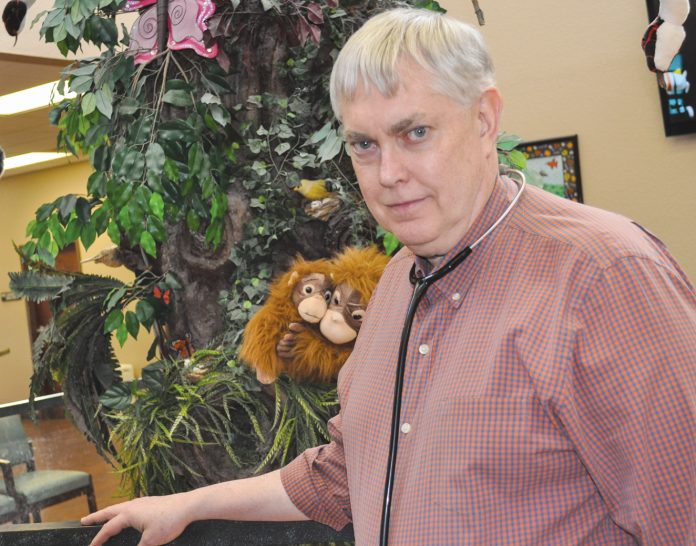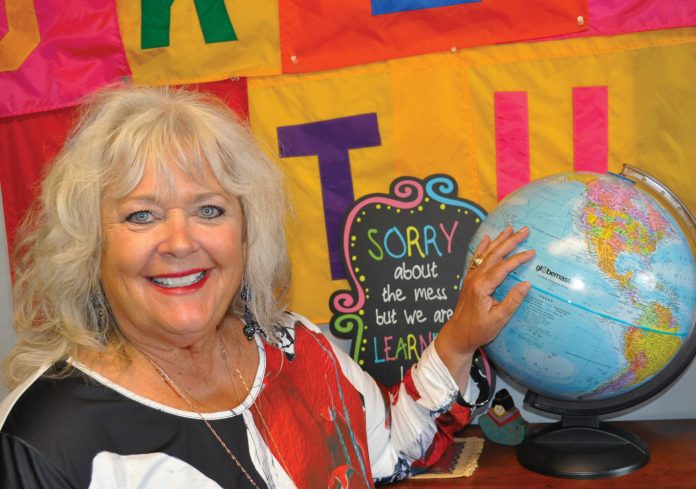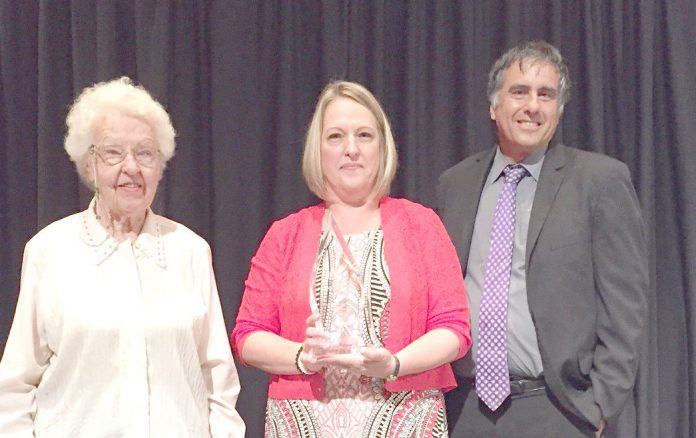
Amy Chlouber, Sunbeam Family Services Early Childhood Mental Health Coordinator, LPC-S, was recently honored with the 2017 C.V. Ramana Award. The award recognizes Chlouber for her outstanding contributions to children’s mental health in Oklahoma.
The C.V. Ramana Award was established to honor individuals who have played exceptional roles in enhancing awareness of children’s needs and the development of education and services to meet those needs.
Amy leads Sunbeam’s Infant Mental Health efforts with enhanced and expanded Infant Mental Health services across the organization’s four core programs: early childhood, foster care, counseling and senior services. She and her team also provide training for child welfare professionals and the District Courts of Oklahoma County as well as community presentations that create awareness about the mental health needs of infants and very young children who experience stress and trauma.
“Amy leads this initiative with her vision and passion for the youngest and most vulnerable in our community. She is the Russell Westbrook of Infant Mental Health. Talented. Passionate. Resourceful. Focused,” said Sunbeam Family Services CEO Jim Priest. “I don’t know how well she shoots free throws, but I know she consistently scores a triple double in the arena of Infant Mental Health.”
Amy is an Endorsed Infant Mental Health Mentor-Clinical/IMH-E ® (IV-C) who has worked in the mental health field for more than 20 years, specializing in infant and early childhood mental health in public, private and non-profit organizations. She has provided home and office-based therapy services and support to biological, kinship, foster and adoptive families. Amy developed and served as Clinical Director of a private mental health agency satellite office where she provided consultation and training to child welfare professionals and foster families as well as content expertise in juvenile court. She served on the Board of Directors of Canadian County CASA and provided training to CASA volunteers for many years. Amy was one of the original therapists chosen to participate in Oklahoma’s Early Childhood Mental Health Consultation pilot in licensed child care facilities. She served as the Mental Health and Disabilities Coordinator for Early Head Start through Sunbeam Family Services where she provided consultation and training for direct care and administrative staff and was instrumental in the design of the mental health program of OKC Educare. Amy left Sunbeam to work at the state level for seven years providing leadership and oversight of the Oklahoma Infant and Early Childhood Mental Health Strategic Plan. She has served on numerous local, state and national early childhood work groups. Amy is on the Board of Directors of the Oklahoma Association for Infant Mental Health (OK-AIMH) and is currently President-elect. She returned to Sunbeam in 2015 as the Early Childhood Services Manager.

Mental Health Coordinator Receives Ramana Award

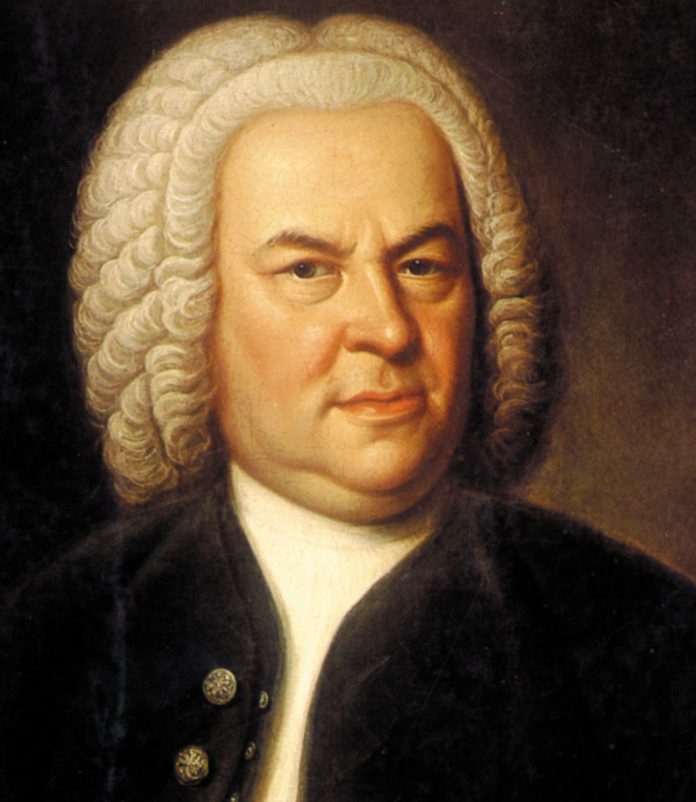
Bach and Brahms: The Sequel!
The Brightmusic Chamber Ensemble presents “Bach and Brahms II” in its sixth annual spring chamber music festival at St. Paul’s Cathedral in downtown Oklahoma City.
The four-concert festival will present some of the best-loved works by two of the world’s greatest composers, including two of Bach’s Brandenburg Concertos and works for organ, a cello suite, a cantata, and the powerfully moving Chaconne from Bach’s Partita No. 2 in D minor, described by violinist Joshua Bell as “not just one of the greatest pieces of music ever written, but one of the greatest achievements of any man in history. “ Also on the program will be works by Brahms: sonatas, organ and chamber works and lieder featuring Philadelphia baritone Randall Scarlata.
Fourteen Brightmusic musicians will be appearing during the Festival. See the attached sheet for a complete list.
All concerts will begin at 7:30 pm, except for the 4:00 pm Sunday concert, at St. Paul’s Cathedral, 127 NW 7th Street (at Robinson). A pass for all four concerts is available at the door or on our website at www.brightmusic.org/concerts for $50 each (a savings of $30 over individual concert tickets of $20). Students and active-duty military personnel are admitted free with ID. Also, any who would like to attend but feel they cannot due to financial hardship as a result of recent layoffs in the energy sector are invited to join us as guests of the musicians by simply advising the person at the front desk that they are guests of the musicians and no questions will be asked. More information about the festival is available on Brightmusic’s website at http://www.brightmusic.org.
American Nurses Association Urges Congress to Reject American Health Care Act
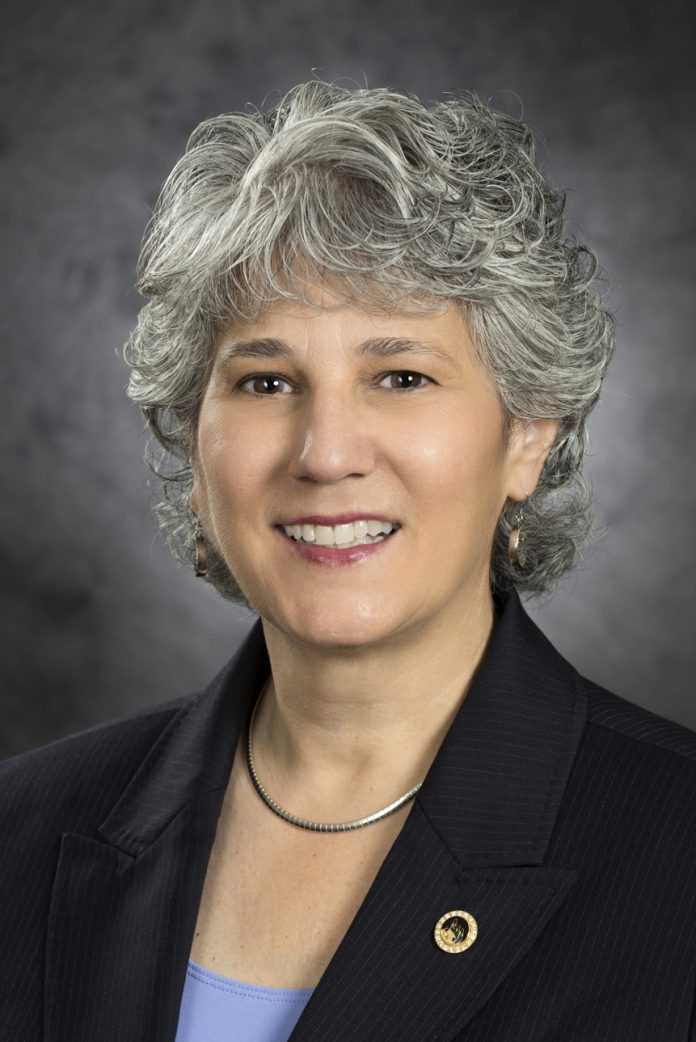
The American Nurses Association (ANA) today announced its continued opposition to the pending American Health Care Act (AHCA) and urges Congress to reject this flawed legislation. ANA, which represents the interests of more than 3.6 million registered nurses, has expressed serious concerns throughout negotiations about the critical impact the AHCA would have on the 24 million people who stand to lose insurance coverage if AHCA becomes law.
“This bill is an extreme departure from ANA’s priorities,” said ANA President Pamela F. Cipriano, PhD, RN, NEA-BC, FAAN. “AHCA would cut Medicaid funding by $880 billion over 10 years, dramatically increase premiums on seniors, restrict millions of women from access to health care, weaken the sustainability of Medicare, and repeal income-based subsidies that have made it possible for millions of families to buy health insurance.”
Under AHCA, states would have the option to waive essential health benefit protections which prevent insurance companies from charging Americans with pre-existing conditions significantly more for coverage. Even worse, insurers could decline coverage for substance abuse treatment, maternity care, and preventive services. “As the nation’s most trusted profession and largest group of health care professionals, nurses understand the importance of health coverage,” Cipriano continued. “ANA urges Congress to not deny peoples’ right to health care and quality of life by standing with the American people in opposing AHCA in its current form. ANA will continue to work with Congress to help improve health care delivery, coverage, and affordability for all Americans.”
Non-profit giving away money
Central Oklahoma Chapter of Hearing Loss Association of America has received scholarship applications and is now in the process of determining which two applicants will receive $1,000 each for the fall semester of college next year. This is the second year that the Central Oklahoma Chapter of HLAA has given scholarships to local students. The summer season sees activities slow down but one would not know it from the schedule. This is a time of fun and planning for HLAA Central Oklahoma Chapter. May and June the chapter holds “fun” nights instead of regular chapter meetings. Several local members are preparing to attend the national convention in Salt Lake City this June. In August we have an ice cream social where new chapter officers will be introduced and our scholarships will be awarded. All events are open to the public and there is no charge for attendance. Visit our website for more information. WWW. OKCHearingLoss.org.
Caregivers Learn Self-Care Strategies at Annual Conference
The 19th Annual Caregiver Survival Skills Conference is scheduled for 9 a.m.-2:45 p.m. Friday, June 9 at Church of the Servant Community Hall, 14343 N. MacArthur Blvd.
The theme for this year’s conference is United in Caregiving: You Are Not Alone. The conference affirms for caregivers that being responsible for another person is challenging and many caregivers feel unprepared, overwhelmed or stressed. The Annual Caregiver Survival Skills Conference will bring expert speakers together to equip conference-goers with important skills and resources they can implement immediately.
Jerry Shiles, estate planning and elder law attorney with Parman and Easterday, will be one of the event speakers. He is the co-author of two books, Estate Planning Basics: A Crash Course in Safeguarding Your Legacy and Guiding Those Left Behind in Oklahoma: Settling the Affairs of Your Loved One. He is a speaker on estate planning and elder law on television, radio, newspapers and for community groups. He is one of 21 certified elder law attorneys in the state of Oklahoma, a member of the American Academy of Estate Planning Attorneys and National Academy of Elder Law Attorneys.
Other speakers include Andrea Sneed, Sunbeam Family Services Respite Services Coordinator; and keynote speaker Meredith Shafer, executive director of the Wegener Foundation, an organization that supports programs that serve at-risk children and youth. She is also a wife, mother and author of My Pink Champagne Life and Mad Cow: A PTSD Love Story.
The Annual Caregiver Survival Skills Conference is sponsored by Sunbeam Family Services, Concordia Life Care Community, Home Instead Senior Care and Mercy Hospital. In addition to the speakers, the conference will provide complimentary breakfast and lunch as well as a resource fair. The registration and resource fair will open at 8:30 a.m. There is a suggested donation of $10 to attend the conference; please make checks payable to Mercy Community Outreach. Registration deadline is June 1. For more information or to register, call 405.936.5821. Please leave a message with your name and phone number, and your call will be returned for confirmation.
ASK VICKI: Q. I never really thought about “conversational intimacy” and the role it plays in a relationship.
Q. I never really thought about “conversational intimacy” and the role it plays in a relationship. It is much harder than people think and sad to think I lost my marriage because of it. I wanted to make others aware of the knowledge I gained and to encourage you to do it before it is too late.
A. My name is Jim and I was married for 16 years. My wife and I both worked full time and we were raising two children. We were busy like all married couples with children’s activities and managing a home.
My wife would occasionally tell me that we needed “to talk” and I would get very busy hoping she would forget. She didn’t. These “talks” always made me anxious. She wanted to discuss a problem or issue related to our marriage or “my behavior.” I would attempt to talk, she would get frustrated and I would completely forget the English language. She could “out talk” me.
We went to counseling and my wife would vent her frustrations to the counselor, often crying saying how alone she felt. I would sit there and pat her on the back, which interesting enough made her dislike me even more. That’s when I learned about “conversational intimacy.” (which I was lacking).
The counselor had us sit facing each other and make eye . (Also hard to do). It was really grueling and strangely informative. I realized that my wife and I had no trouble with physical intimacy (that is until she began to really dislike me) but I’m not sure we ever really had conversational intimacy to begin with. Of course we “talked” during dating and engagement and I’m sure after we married but intimate conversations were rare.
We practiced in the counselor’s office but at home we struggled. My wife had developed some resentments towards me for my lack of concern for her desire to talk, apparently building for several years. I learned that resentments can’t easily be discarded.
She was upset that it took so long for me to “get it.” When she told me that she wanted a divorce I was devastated. I had no idea I had caused so much damage by not making myself available, listening, validating her feelings and trying to find solutions. Having physical intimacy was way more enjoyable and didn’t really require much talking. I made myself very available.
As I sit here in my apartment, alone, after taking my children back to my ex-wife’s house (previously my house too), I have become wiser. I learned how important it is to occasionally have deep conversations, to really get to know the person that I have grown to love.
new drug and you find it does help your symptoms. But when you are told it will cost $475 after your samples are gone, what is the point.
I was personally given a prescription for a skin cream, with a coupon because the doctor told me it might be expensive. When I went to pick up the prescription the pharmacy tech had a strange look on his face when he told me the small tube of cream was $1042 after the coupon!!
Be cautious. Pay attention to the side affects listed for these drugs. If you can make behavioral or life changes, try that first. Your health and your money are at risk.
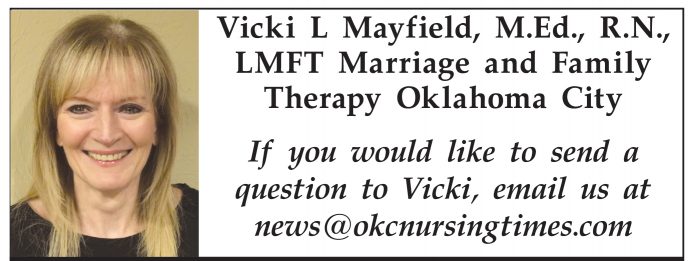
Vicki L Mayfield, M.Ed., R.N., LMFT Marriage and Family Therapy Oklahoma City
If you would like to send a question to Vicki, email us at [email protected]
May AARP Drivers Safety Classes
Date/ Day/ Location/ Time/ Registration #/ Instructor
Jun 1/ Thursday/ Okla. City/ 9:30 am – 4 pm/ 951-2277/ Palinsky
Integris 3rd Age Life Center – 5100 N. Brookline, Suite 100
Jun 3/ Saturday/ Chandler/ 9 am – 3:30 pm/ 258-5002/ Brase
Thompson Insurance – 121 W. 10th St.
Jun 9/ Friday/ Okla. City/ 9 am – 3:30 pm/ 951-2277/ Edwards
SW Medical Center – 4200 S. Douglas, Suite B-10
Jun 16/ Friday/ Okla. City/ 9 am – 3:30 pm/ 942-4339/ Palinsky
Will Rogers Senior Center – 3501 Pat Murphy Dr.
Jun 17/ Saturday/ Moore/ 9 am – 3:30 pm/ 799-3130/ Palinsky
Brand Center – 501 E. Main St.
Jun 23/ Friday/ Okla. City/ 9 am – 3:30 pm/ 691-4091/ Palinsky
Mercy Hospital – 4300 W. Memorial Rd, Rm A/B
Jun 28/ Wednesday/ Okla. City/ 9 am – 3:30 pm/522-6697/ Palinsky
Department of Disability Concerns – 1111 N. Lee Ave., Suite 50
Jul 6/ Thursday/ Okla. City/ 9 am – 3:30 pm/ 951-2277/ Varacchi
Integris 3rd Age Life Center – 5100 N. Brookline, Suite 100
Jul 11/ Tuesday/ Midwest City/ 9 am – 3:30 pm/ 691-4091/ Palinsky
Rose State Learning Center – 6191 Tinker Diagonal
Jul 11/ Tuesday/ Yukon/ 9 am – 3:30 pm/ 350-7680/ Kruck
Dale Robertson Center – 1200 Lakeshore Dr.
The prices for the classes are: $15 for AARP members and $20 for Non-AARP. Call John Palinsky, zone coordinator for the Oklahoma City area at 405-691-4091 or send mail to: [email protected]
Right Place, Right Time

by Bobby Anderson, Staff Writer
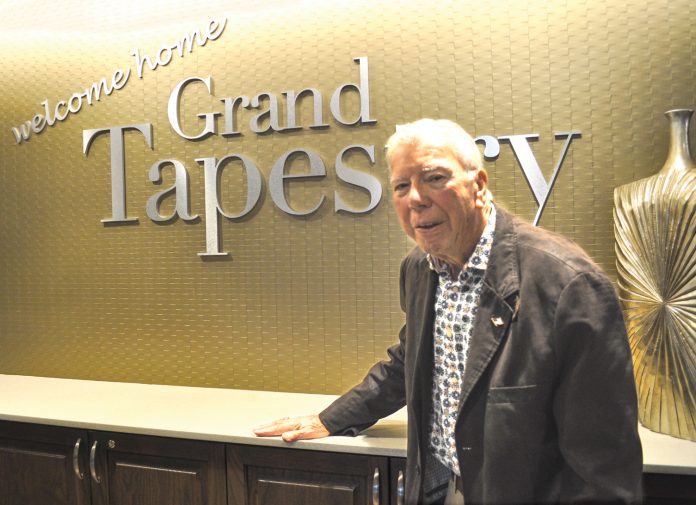
Throughout Glenn Boyer’s life he’s had a knack for being in the right place at the right time.
Even after retirement – living life the way he wants to – little has changed.
“I’ve been blessed with a lot of things,” Boyer said. “Most of these things I didn’t choose, they chose me.”
Being a man of firsts, Boyer has filled his life with love, laughter and a passion for his profession.
His home for the past year, Grand Tapestry at Quail Springs, has helped him continue living life the way he wants.
“It’s great,” Boyer said of his Northwest Oklahoma City apartment. “You meet a lot of people here. I don’t want three meals a day or babysitting. I want to do what I want to do. You choose what you want and you do it.”
By 7:30 each morning you’ll find Boyer in the workout room or he might be taking a few laps in the heated salt water exercise pool.
Some days he’ll invite his men’s bible study over for a catered four-course meal.
In the evenings you might see him in the billiards room teaching a friend’s granddaughter how to play pool.
“Things like that just make it home,” Boyer said.
Being one of the inaugural Grand Tapestry residents is just another in a long line of firsts for Boyer.
In college, he was a shooting guard for Wichita State University’s basketball team. He’s a member of the first Shocker postseason tournament team.
An ROTC cadet, Boyer was drafted out of college and sent to Ft. Bliss
“Little did I know from then on it would be my career,” he said.
The math major was assigned to the computer, missile and radar fields. He spent two years of his four years in the service on a missile site.
He applied for a job as a coach and teacher on the outskirts of Kansas City. The offer was $4,000 a year.
At the same time, Bendix Corporation offered him $12,000 a year as a computer programmer – a first for him.
“That was in 1961 when there were very few computers,” Boyer said. “I’ve been in the field ever since.”
He came to Oklahoma City in 1969.
In 1972 he started Applied Computer Systems, a business he still runs today with son Glenn Jr. at 3509 N. Classen Blvd.
Boyer enjoyed 65 years with his wife before she passed.
“I didn’t know what I wanted but I knew I didn’t want to live by myself in my house,” said Boyer, who lived at Ski Island for 44 years.
His daughter brought him to Grand Tapestry.
It’s a story told time and again.
“I just gave it a try and it turned out to be a good fit,” said retired psychiatrist Liliana Schechter. “It’s very cozy, very nice and we all help each other.”
She definitely didn’t expect to meet a fellow resident whose mother was also from Poland.
Schechter’s Polish mother survived the Auschwitz concentration camp and the Holocaust.
The conversation between the instant friends just flowed.
“We go to the synagogue (together),” Schechter said. “It was truly a miracle.”
Gwyn Walters watches the sun rise each day from her third floor apartment.
“Most of us would say the people,” Walters said of what drew her to become a founding member. “And we have some really fun things to do. The educational offerings have been great, too.”
From listening to University of Oklahoma Football Coach Bud Wilkinson’s story told by his own son, Jay, to learning more about current topics, Walters has been able to experience it all in the comfort of her home.
She enjoys greeting visitors each day.
“I think this place is great,” Walters said. “It’s comfortable. That’s one of the big things I feel here is comfortable and safe.”
“I didn’t feel this safe in my own house.”
A new and vibrant place to call home, Grand Tapestry at Quail Springs is tailored to active adults age 55 and better, centrally located in the Quail Springs area of Oklahoma City.
Here, residents like Boyer chase their passions, enjoy their hobbies and seek out new adventures.
The architecture and interiors were designed to create comfort and convenience in a caring, maintenance-free setting. From the theatre offering an exclusive cinematic experience with reclining lounge chairs, to an outdoor kitchen equipped with grills, a fire pit and water feature, to the raised-bed garden, Grand Tapestry offers a social environment for everyone.
Residents also take advantage of concierge-style services and enjoy the community beyond Grand Tapestry at a variety of dining, shopping and entertainment options within steps of the front door.
Epidemic proportions

Seniors needed in vaccine debate
story and photos by Bobby Anderson, Staff Writer
Whooping cough, polio, measles and rubella.
Anyone over the age of 50 remembers hearing horror stories about the diseases that plagued previous generations.
For the much of the current generation the above are simply footnotes in history with no real meaning.
But that may be changing.
From January 1 to March 25, 2017, 28 people from 10 states (California, Colorado, Florida, Michigan, Nebraska, New Jersey, New York, Pennsylvania, Utah, and Washington) were reported to have measles.
Those numbers are alarming for Norman Pediatrician Dr. Thomas Kuhls, so alarming that for the first time in his life he’s entered politics.
“I’ve never done anything political in my life. I don’t think I even ran for student council in middle school,” Kuhls laughed.
Then two things happened. Kuhls read that an immunization bill by Sen. Ervin Yen would not be heard in the 2016 session.
“Senator Yen’s bill would strengthen immunizations because rates are dropping,” Kuhls said. “More importantly, at the end of the legislative year when the anti-vaccine bill was passed by an overwhelming majority and went to the Governor.” Thank God Gov. Fallin vetoed it but what scared me was when the Republicans tried to override their own governor and came just 13 votes short.
“It was clear the majority of those legislators … even with my ignorance I knew there weren’t that many people that didn’t have their kids vaccinated. It had to do more with misinformation and misunderstanding and not really truly understanding vaccines.”
That’s why Kuhls is supporting the non-profit political action group Vaccinate Oklahoma.
Kuhls taught vaccines at the University of Oklahoma for years. His background is in immunology and pediatric infectious diseases.
Kuhls still has his smallpox scar.
“In my generation and in my parents’ they all knew the importance of vaccines because many of those era have seen polio,” Kuhls said. “Back in my era vaccines were always important.”
WHAT’S AT STAKE
“I think people don’t realize what’s at stake,” Kuhls said. “Our personal exemption rate is increasing yearly in this state. Other states when their rates go up have had outbreaks of diseases like in California.”
“When the population isn’t immunized it sets us up for a disaster, an outbreak.”
Before the middle of the last century, diseases like whooping cough, polio, measles, Haemophilus influenzae, and rubella struck hundreds of thousands of infants, children and adults in the U.S.. Thousands died every year from them. As vaccines were developed and became widely used, rates of these diseases declined until today most of them are nearly gone from our country.
Statistics from the CDC paint an interesting picture.
*Nearly everyone in the U.S. got measles before there was a vaccine, and hundreds died from it each year. Today, most doctors have never seen a case of measles.
*More than 15,000 Americans died from diphtheria in 1921, before there was a vaccine. Only two cases of diphtheria have been reported to CDC between 2004 and 2014.
*An epidemic of rubella (German measles) in 1964-65 infected 12½ million Americans, killed 2,000 babies, and caused 11,000 miscarriages. Since 2012, 15 cases of rubella were reported to CDC.
Kuhls says the United States has very low rates of vaccine-preventable diseases, but this isn’t true everywhere in the world.
Only one disease — smallpox — has been totally erased from the planet. Polio is close to being eliminated, but still exists in several countries.
More than 350,000 cases of measles were reported from around the world in 2011, with outbreaks in the Pacific, Asia, Africa, and Europe.
In that same year, 90% of measles cases in the U.S. were associated with cases imported from another country. Only the fact that most Americans are vaccinated against measles prevented these clusters of cases from becoming epidemics.
Kuhls said one of the major drivers of non-compliance is public schools making it easier for parents to sign exemption forms rather than instructing parents to have their children vaccinated.
“I think anybody my age understands the importance of vaccines and have watched diseases go away,” Kuhls said. “Your readers need to tell their grandkids these diseases are real and they’ve lived through them and they are the vaccines that made them go away.”
“It’s the grandparents that have seen that and have been through that.”
Generation Builder

Senior educates generations
by Bobby Anderson,
Staff Writer
The sounds of children’s playful voices float through Southwinds Montessori Preschool in Norman.
Inside, the classrooms are a flurry of activity with 45 smiling faces whirring around from activity to activity.
In the background, Carol Zerboni smiles a big, beautiful proud smile.
It’s been that way more than 40 years now for Zerboni, who operates the private Montessori school along Highway 9.
And she laughs at the time when running a school and teaching children was the farthest thing from her mind.
“I just wanted a paycheck – a little extra money to have to spend,” Zerboni said of looking for a job as a young art major at the University of Oklahoma.
“I asked if they needed an art teacher and she hired me immediately.”
“I didn’t have a clue what Montessori was. Being Italian, I thought for sure I’d figure it out.”
When Zerboni figured out the Montessori philosophy hailed from Italy she was intrigued.
When she found out what it could do for young children she was hooked.
“I watched and looked at the materials and equipment and the way they were learning and it was different than anything I’d ever seen,” Zerboni said. “The materials were just incredible – beautiful. There was a purpose for everything.”
She switched her major to elementary education and then went on to Oklahoma City University to complete her Montessori training.
The textbook definition of Montessori discusses an emphasis on independence, freedom within limits, and respect for a child’s natural psychological, physical, and social development.
For Zerboni – and literally millions of children through the years – it just seems natural.
THE MONTESSORI CONCEPT
The education system originated in Italy with Dr. Maria Montessori, the second female doctor in the country’s history.
With compulsory education beginning at age seven, the streets of Rome were filled with young children with plenty of time on their hands.
With the idea that children learned 80 percent of their knowledge from birth to four, the pediatrician set up the first Montessori, Casa dei Bambini.
The program was a success, so much so that Prime Minister Benito Mussolini appointed her chairwoman of education for the country.
But during World War II she called the dictator “a fascist pig” and was booted from the country.
“She was so ahead of her time and really bright and really understood the child,” Zerboni said of her icon.
Landing in India, Montessori continued her curriculum development, carrying it all the way through high school.
To this day, Zerboni still gets questioned about what Montessori is all about.
“I tell them it’s a method of education where the teacher’s role is totally different,” Zerboni said. “It’s not teacher-driven. Your job as a teacher is to create the environment to be inviting so that the kids can go in it and move. They need to move and they need to have meaningful work … and for them to make their own choices and create independence.”
That’s why the halls at Southwinds are often a flurry of activity. To some it may seem like a classroom run amuck.
But spend a few moments observing and you’ll see children discovering the world around them through all five senses.
And they’re enjoying it as the same time.
Zerboni will tell you Montessori school kids read earlier than those in traditional school. Phonic sounds are taught at age three but it’s not done with them sitting in a hard-plastic chair for six hours a day.
“Freedom of movement is one of the biggest things that’s different from public school,” Zerboni said. “I really think sticking children that are young in desks is really not fair to the child. It is unnatural. They can’t sit. They’re not absorbing anything at all.”
Absorption is key to knowledge. Children aren’t just taught things in Montessori they experience them and store them with emotion and memory that will carry the information with them for the rest of their days.
Zerboni things a lot of that is missing in today’s schools.
“I think what we’re losing out on is we’re waiting too long to get our kids involved in Math, Reading, Science and all the basics,” she said. “They’re ready for it. They get it.”
Zerboni took her 40 years of experience and passion and poured them into her own line of instructional books.
Zeb Books was born nearly a decade ago – named after the family pet. “I’ve done the thinking about this and about what works and what doesn’t,” Zerboni said. “I’m not sure I have the only way but I know my way works because I’ve got kids reading up a storm.”
“That’s one reason people send their kids here.” And the fact that they’re having fun while learning doesn’t hurt either.