Thursday, March 12, 2026

Sept/Oct AARP Drivers Safety Classes

0

Date/ Day/ Location/ Time/ Registration #/ Instructor
Sept 1/ Thursday/ Okla. City/ 9:30 am – 4 pm/ 951-2277/ Edwards
Integris 3rd Age Life Center – 5100 N. Brookline, Suite 100
Sept 7/ Wednesday/ Norman/ 9 am – 3:30 pm/ 307-3176/ Palinsky
Fowler Toyota – 4050 Interstate Drive
Sept 9/ Friday/ Okla. City/ 9 am – 3:30 pm/ 951-2277/ Edwards
SW Medical Center – 4200 S. Douglas, Suite B-10
Sept 10/ Saturday/ Moore/ 9 am – 3:30 pm/ 799-3130/ Palinsky
Brand Senior Center – 501 E. Main
Sept 13/ Tuesday/ Midwest City/ 9 am – 3:30 pm/ 691-4091/ Palinsky
Rose State – 6191 Hudiberg Drive
Sept 14/ Wednesday/ Okla. City/ 9 am – 3:30 pm/ 522-6697/ Palinsky
Office of Disability Concerns – 2401 NW 23rd, Ste 90
Sept 16/ Friday/ Okla. City/ 9 am – 3:30 pm/ 752-3600/478-4587/ Reffner
Mercy Hospital – 4300 W. Memorial Rd.
Sept 20/ Tuesday/ Warr Acres/ 9 am – 3:30 pm/ 789-9892/ Palinsky
Warr Acres Community Center – 4301 Ann Arbor
Sept 24/ Saturday/ Shawnee/ 9 am – 3:30 pm/ 818-2916/ Brase
Gordon Cooper Tech. Center – Sky Lab 1 Room-1 John C. Burton Blvd.
Oct 1/ Saturday/ Newcatsle/ 9 am – 3:30 pm/ 392-4466/ Palinsky
1st Baptist Church of Newcastle – 1650 N. Main
Oct 6/ Thursday/ Okla. City/ 9:30 am – 4 pm/ 951-2277/ Palinsky
Integris 3rd Age Center – 5100 N. Brookline suite 100
Oct 14/ Friday/ Okla. City/ 9 am – 3:30 pm/ 951-2277/ Edwards
S.W. Medical Center -4200 S. Douglas, Suite B-10
The prices for the classes are: $15 for AARP members and $20 for Non-AARP. Call John Palinsky, zone coordinator for the Oklahoma City area at 405-691-4091 or send mail to: [email protected]

New OMRF grant will study immune cell linked to asthma

0
Oklahoma Medical Research Foundation Scientist Xiao-Hong Sun, Ph.D.

The National Institute of Allergy and Infectious Diseases has awarded Oklahoma Medical Research Foundation scientist Xiao-Hong Sun, Ph.D., a five-year, $2.76 million grant to investigate a recently discovered immune cell involved in asthma.
The role of the new cell, called an innate lymphoid cell, is to protect the body from parasitic infection. However, when too much of this cell type is present, it seems to result in asthma.
“These cells were previously thought to be made only in bone marrow,” said Sun, who holds the Lew and Myra Ward Chair in Biomedical Research at OMRF. “We discovered that they are also made in the thymus, which brings up some interesting connections to asthma.”
The thymus, which sits on top of the heart, is a major site for the creation of T cells, a type of specialized white blood cell that plays a central role in immunity. During childhood and through puberty, the thymus generates a lifetime supply of T cells—enough to carry through adulthood. When the supply of T cells is adequate, the thymus has done its job and begins to shrink.
Sun postulates that innate lymphoid cells are also present in the thymus and might explain why children have higher rates of asthma than adults.
“Since kids have a very active thymus when they’re born and up to puberty, they’re more likely to have a large number of innate lymphoid cells coming from the thymus along with the T cells,” said Sun. “This is also the stage of life where many kids tend to develop asthma. People often say they ‘grow out” of asthma as they get older, so maybe it’s linked to this later decrease in thymus function. That’s what we hope to find out with this grant.”
According to the Centers for Disease Control and Prevention, 7.7 percent of people in the United States suffer from asthma. The highest rates of asthma occur in the 5-14 age group at 10.3 percent and decline over time, reaching a low point of 6.9 percent in Americans over the age of 65.
“We don’t yet know the significance of this finding, but if we determine this hypothesis to be true, it would have great clinical relevance,” she said. “Perhaps the thymus is where we need to look for ways to control asthma in children. That’s what we hope to learn.”
The grant will also allow Sun and her lab to further investigate whether the innate lymphoid cells produced in the thymus differ from the ones made in the bone marrow.
Sun said their discovery of innate lymphoid cells in the thymus came about by accident through study of a particular mouse model in their lab—a model they’ve used for more than two decades to study T cell development.
“This research builds on our experience and what we have been working on the past 25 years, so it puts us in a unique position to do this work,” she said. “I am very excited to see how this cell is controlled and hope we can learn what happens in the thymus and how it might be linked to asthma. It really fits really well with the overall research of this lab and comes back to what started this lab in the first place.”

Owasso Couple Charged with Exploiting World War II Veteran

0

An Owasso couple is charged with exploitation of an elderly person for fraudulently taking over an 89-year-old man’s financial affairs. Former insurance agents Sterling Messer, 78, and Billie Messer, 60, cashed $15,189 worth of checks from the victim’s bank account. The victim said the Messers also pressured him into giving their church $22,000. “The suspects violated each and every element of their professional and ethical duties,” said Oklahoma Insurance Commissioner John D. Doak. “We will not tolerate any action that violates a consumer’s trust. I commend our investigators for their hard work on this case.”
The Oklahoma Insurance Department’s Anti-Fraud Unit began investigating the Messers after receiving a complaint from the victim’s longtime friend. She was concerned about the Messers selling the victim, who was 86 at the time, a $92,500 annuity with a 10-year-term requirement. Then, they sold him a $59,273 policy with a 7-year-term requirement. The victim’s friend said he was unaware of the term requirements of the annuities. She also said the victim had hearing loss due to an ear injury sustained during World War II.
During the investigation, detectives learned the Messers convinced the victim to sign paperwork naming them successor trustees to his trust. The couple had also acquired durable power of attorney over the victim and amended his will to make themselves personal representatives of his estate. Combined, the moves gave the Messers control of the victim’s personal, business and financial affairs.
Sterling Messer’s insurance license was revoked on Aug. 20, 2015 for “using fraudulent, coercive or dishonest practices and by demonstrating incompetence, untrustworthiness and financial irresponsibility in the conduct of business.” Billie Messer’s insurance license was revoked on Dec. 14, 2015.

SPECIAL TO SNL: Hearing Loss Association Scholarships Awarded

0

By Ron Hendricks

wo Oklahomans were awarded $500 scholarships during the Hearing Loss Association of America Central Oklahoma Chapter’s 25th anniversary celebration. Ashton Darling and Shaun Bainter are the recipients.
Ashton Darling is attending Oklahoma State University in Stillwater to pursue a second degree, in Business Administration. Ashton was diagnosed at 18 months as being deaf/hard of hearing. The Doctor told her family that “…she wouldn’t be able to have a life like a normal kid…” but she has proved him wrong! Ashton is currently employed at the university in the accounts receivable department. Ashton moved to Oklahoma from Kansas. Shaun Bainter, a recent graduate from Putnam City High School, will begin his higher education at Oklahoma State University OKC. After he completes the curriculum at OSUOKC, Shaun plans to attend the University of Oklahoma. Shaun said, “I was born with a hearing loss and even in elementary school was a mentor to other students with hearing loss. I was raised to see my hearing loss as a gift, not a disability and that I would do great things with it.” Shaun’s goal is to become an audiologist.
Hearing Loss Association of America was founded in 1979 with the goal of helping people with a hearing loss live successfully in a hearing world. The Central Oklahoma Chapter is celebrating being a part of HLAA for 25 years. Hearing loss is virtually an invisible physical ailment but 60% of returning veterans complain of hearing loss. About 38 million Americans have hearing loss. Your Central Oklahoma Chapter of HLAA fosters public programs aimed at alleviating misconceptions of hearing loss; encourages social enrichment, and educational opportunities for the community and those with hearing loss; and even offers a place to inspect and try out listening devices in the Hearing Helper’s Room. There are 3 convenient meeting times and locations to answer your questions and help with concerns. The public is invited to all meetings and there is no admission charge to attend or belong to HLAACOC. Visit the website www. OKCHearingLoss.org for more information.

SAVVY SENIOR: Meal Service Delivery Options for Seniors Who Don’t Cook

0

Dear Savvy Senior, What types of healthy meal delivery options can you recommend for seniors who live at home, but don’t cook and don’t get out much. Since mom passed away, my dad’s diet is terrible and I worry about his health. Long-Distance Daughter

Dear Long-Distance,
There are various healthy meal service delivery options available to non-cooking seniors who live at home, but what’s available to your dad will depend on his location and budget. Here are several to check into.
Senior Meal Programs
A good place to start is to find out if there’s a senior home delivery meal program in your dad’s area. Meals on Wheels is the largest program that most people are familiar with, but many communities offer senior meal delivery programs sponsored by other organizations that go by different names.
To find services available in your dad’s area, visit MealsOnWheelsAmerica.org, which offers a comprehensive directory on their website, or call the area aging agency near your dad. Contact the Eldercare Locator at 800-677-1116 to get the number.
Most home delivered meal programs across the U.S. deliver hot meals daily or several times a week, usually around the lunch hour, to seniors over age 60 who have problems preparing meals for themselves, as well as those with disabilities. Weekend meals, usually frozen, may also be available, along with special diets (diabetic, low-sodium, kosher, etc.). Most of these programs typically charge a small fee (usually between $2 and $6) or request a donation, while some may be free to low-income seniors.
Online Meal Delivery
Another option that’s a bit more expensive is to purchase your dad’s meals online and have them delivered to his home. There are a number of companies that offer this type of service like Magic Kitchen (magickitchen.com), Home Bistro (homebistro.com), Personal Chef To Go (personalcheftogo.com), Good Measure Meals (goodmeasuremeals.com), and many others.
These companies offer a wide variety of tasty meal choices, and will usually post the nutrition information for their meals right on their website. Most companies will also cater to a host of dietary and medical needs, such as low-sodium and low-carb meals, diabetic meals, gluten-free, dairy-free, and vegetarian options.
Most of the food arrives frozen, but a few companies ship food fresh. Prices generally start at around $10 to $13 per meal, plus shipping, however most companies provide discounts or free shipping when you order meals in bulk.
Grocery Stores and Restaurants
Depending on where your dad lives, he may also be able to get home delivered meals from local grocery stores or restaurants. Some grocery stores offer a selection of pre-cooked meals and foods, including roasted chicken, mashed potatoes, and fresh soups and salads. Contact the grocery stores in your dad’s area to inquire about this option. Or check with some of his favorite restaurants to see if they offer home delivery.
Personal Chefs
Another option for non-cooking seniors with a bigger budget is to hire a personal chef from time to time. A personal chef can provide your dad with a do-it-all service that will help plan his meals, do the grocery shopping and prepare him several weeks worth (or more) of tasty meals in his home, which he can freeze and eat whenever he wants. Or, they can prepare it in their own kitchen and deliver it. Chef’s fees range between $200 and $300 plus groceries. He may be able to save money by sharing meals with you or another family member, or a friend or neighbor.
To find a personal chef in your dad’s area, check the listings at the American Personal & Private Chef Association (personalchef.com) or the United States Personal Chef Association (hireachef.com).

Send your senior questions to: Savvy Senior, P.O. Box 5443, Norman, OK 73070, or visit SavvySenior.org. Jim Miller is a contributor to the NBC Today show and author of “The Savvy Senior” book.

Piedmont horse and rider on top of the Ford Youth World in Ranch Riding

0
Ann Elizabeth Tebow of Piedmont is shown with her American Quarter Horse Vinny at the Built Ford Tough AQHYA World Championship Show at State Fair Park.

Ann Elizabeth Tebow gazed into the stall at her American Quarter Horse Vinny.
It was still a few hours before Tebow, 18, was scheduled to show the 8-year-old gray gelding in ranch riding prelims on Monday during the Built Ford Tough American Quarter Horse Youth Association (AQHYA) World Championship Show at State Fair Park in Oklahoma City.
“I looked at him in the stall earlier today and I thought, ‘I want to do this for you, I want to do good so that you know that you deserve it,’ because he does. He works really hard for me,” said the recent Piedmont High School graduate.
Vinny, whose registered name is “FS Vintage Sidekick,” and Tebow are an example of the teamwork between rider and horse displayed at horse shows and other equestrian events throughout Oklahoma.
“People don’t realize how they have their own personalities,” she said of horses. “They’re just like people because everyone’s different and they each have their own little quirks. It took us a long time to get on the same page.”
Not only did they make it to the same page but on Tuesday evening Tebow and Vinny won the 2016 world championship in ranch riding.
“That’s what makes this so much more special is because we did get through those hard times,” Tebow said Wednesday. “It shows that if you work hard and keep going you can accomplish anything and your dreams can come true. Everything we went through together just made it that much sweeter.”
The Built Ford Tough AQHYA World Championship Show is the pinnacle event for American Quarter Horse exhibitors ages 18 and under around the world, who must qualify for the event by earning a predetermined number of points to compete in each of the classes representing halter, English and western disciplines.
The Built Ford Tough AQHYA World Championship Show, which continues through Saturday (August 13) has an economic impact on the Oklahoma City area of more than $10.3 million. The show features more than 2,180 entries from the United States, Australia, Canada, Ireland and the United Kingdom with exhibitors competing for 35 world championships.
Within all those entries are 761 exhibitors and 1,096 horses. That’s a lot of teamwork between horses and riders – and a lot of personalities.
Tebow, the 2015-2016 AQHYA National President, has shown Vinny, owned by her mother Vicki Tebow, for a just a few years now and they didn’t click right away.
Some friendships – including many that last for a long time – take time to develop.
“The problem is that we have similar personalities,” she said. “We’re both curious and like to think a lot about things. He’s really curious so when we get in the show pen sometimes he’s like ‘Oh what’s over here?’ and I’m like ‘Vinny, we’ve got to pay attention right now, we’re supposed to be working.’”
There were times Tebow thought briefly about giving up. Instead, they persevered and got to know each other.
“He’s too smart for his own good, which` is really cool in a horse,” said Tebow, who in the fall will attend Texas A&M University, studying biomedical sciences and competing on the equestrian team. “I’ve heard the great ones have the most personality and so you’ve kind of got to learn how to deal with that. We were constantly trying to outthink him, but I’ve just had to learn that you have to let Vinny do his thing and you’re kind of along for the ride.”
A year ago during the Ford Youth World they “got on the same page” and that resulted in them making the 2015 finals of the ranch riding. They began to find success together.
“The ranch riding class was developed to showcase the ranching heritage of the American Quarter Horse,” said Sarah Davisson of the AQHA. “It includes different maneuvers a horse would use on a ranch on any given day. They have to do a certain pattern in the arena and be scored on the different elements of that pattern.”
This week, Tebow and Vinny again qualified for the ranch riding finals and finished on top with the world championship in ranch riding.
However, she points out that success in the arena is just one part of this special team.
“Now when I ride other horses it makes me appreciate him for all the things that he has taught me,” she said.
Tebow will take those lessons learned with her to Texas A&M where she will compete on the equestrian team.
Davisson of the AQHA, said Tebow, “definitely embodies a great youth.” This summer, the Oklahoma teen was with Team USA for the American Quarter Horse Youth World Cup in Australia.
“Not only does she show and compete on the world level,” Davisson said, “her leadership skills are amazing. She’s also a great role model to the youth coming up in the Association.”
Sometimes that is conveyed verbally and other times through actions. Take for example, Tebow’s reaction a couple of minutes after the ranch riding prelimins as their score was announced. Still horseback, Tebow, with tears welling in her eyes, leaned forward in the saddle, hugged Vinny’s neck with both arms then patted his neck with her right hand.
“It was just like more a sigh of relief that, ‘OK I did you right, I didn’t’ get in your way, I didn’t let you down,’” she said. “I really wanted that for Vinny.”
Partners helping make the Built Ford Tough AQHYA World Championship Show possible are Ford, Bank of America, B&W Trailer Hitches, Farnam, John Deere, Justin Boots, Markel, Merial, Montana Silversmiths, Nutrena, Professional’s Choice, Cripple Creek, SmartPak and Wrangler, along with event sponsors, including Noble Outfitters, Metro Golf Cars, Oklahoma State Fair Park, Oklahoma City Convention and Visitors Bureau, and the Four Sixes Ranch.

Six shoots straight with MWC seniors

0
Twenty-seven year Midwest City Police veteran Mike Six and coordinator Fredia Cox are invaluable at the Midwest City Senior Center.

Story and photo by Mike Lee, Staff Writer

Depending on the day you come, you may find Mike Six behind a broom at the Midwest City Senior Center.
You might also see him behind the wheel driving seniors where they need to go or simply pulling up and cooling off their car on a hot day.
Then again he might be calling out bingo numbers or laying a spinner down during a daily game of dominoes.
But whatever he’s doing you’ll find the 27-year Midwest City Police Department veteran with a smile on his face
“This is the best job I’ve ever had,” said Six the center’s assistant coordinator under Fredia Cox.
After 27 years on the force, Six retired and decided to try a few things. He spent a year teaching before kicking around some different jobs.
He came back on with the city and shortly the job at the senior center opened up.
“I snagged it up quick as I could,” he said. “These are great people. I tell people all the time it’s the best job I’ve ever had. It’s not a six-figure job for sure but it’s not the money what I like, it’s the people.”
Cox estimates nearly 6,000 seniors each month are served at the Midwest City facility.
All of them know Mike, or just Six.
“He’s vital,” Cox said simply of her assistant, who also handles all the building’s maintenance.
It’s the time he spends at the facility that Six counts as his most important contribution.
“I guess in general you want to be available for them,” Six said. “That’s what I do. The senior center is part of the city of Midwest City. It’s a facility we’ve made that really belongs to the seniors. What we try to do is give them a destination, a place to come a reason to get up in the morning.”
A lot of counseling goes on within these walls, but there’s no couches or co-pays involved. The kind of counseling Six and Cox deliver is a smile, a cup of coffee and a willingness to listen.
“We visit with them. It’s really a quality of life issue for them,” Six said.
The center schedules three dances a week for the seniors plus many other activities.
Six and Cox both serve as resources for seniors. If someone is having a problem in an area of life their combined 70 years of experience in the community is there to help.
The Midwest City Senior Center offers programs, classes, events and activities for citizens, age 55 and older, who have a common interest in fellowships, leisure pursuits and mutual respect for one another.
The center is managed by Cox under the direction of the Midwest City Parks and Recreation Department. All programs and activities offered at the center are supervised by Cox and Six.
The center encourages ideas, input and involvement from senior citizens. It keep them going and it keeps Six going.
“Kind of like with the police department it does make you feel good when someone comes to you and identifies you as someone who might be able to help them,” Six said. “When you do help them it really does make you feel good.”
Six’s roots run deep in Midwest City after spending his career policing the streets. He was part of the department’s various community policing projects which focused on community relations as well as tackling the city’s gang problems.
“We were real visible and we made sure (the criminals) were real visible,” Six said. “People were living like prisoners in their homes. We cleaned up the neighborhoods and had people barbecuing in their front yards. We made a big difference.”
Funny, but nearly three decades later he still is. “You can’t be there to supervise. You can’t be there just to monitor,” Six said. “You have to be involved.”
The Midwest City Senior Center offers several weekly classes and activities including:
-Bible Study
Bible study class is Wednesdays from 10 – 11 a.m. in the Mistletoe Room.
-Gospel Music
Gospel music is Fridays from 10 – 11:15 a.m. in the Grand Room.
– Oil Painting Classes
Oil painting classes are offered Wednesdays and Fridays from noon – 4 p.m. in the Mistletoe Room. Participants are responsible for providing their supplies for the class. Please call 405-737-7611 for a list of supplies.
-Quilting
Quilters meet Tuesdays and Thursdays from 9 a.m. – 2 p.m. in the Dogwood Room.
-Woodcarving
Woodcarving classes are offered every Tuesday from 1 – 4 p.m. in the Mistletoe Room. Participants are responsible for bringing supplies for class. Please call for a list of supplies.
“The main thing at the senior center, plain and simple, it addresses quality of life,” Six said. “That’s the only way I know how to put it. I’ve adopted some of them and I think they’ve adopted me.”

Peace of Mind

0
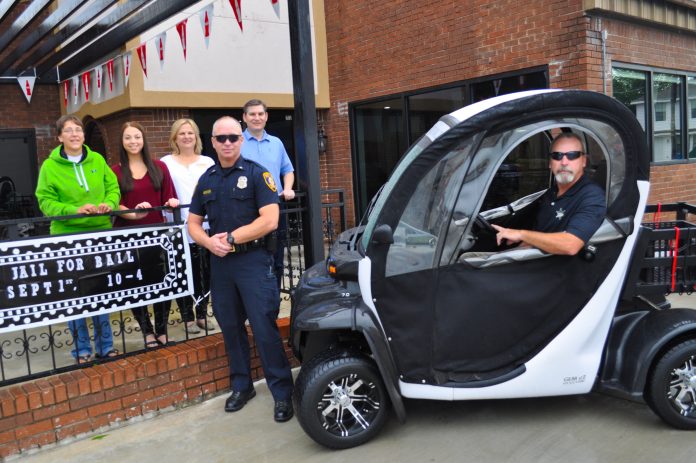
Norman Police Department Lieutenant Jamie Shattuck, Dan Schemm, executive director Visit Norman, Allison Stampley with Bernstein Law Firm and Harold and Lucy Mahoney, owners of Home Instead Senior Care are all volunteering their time to help raise funds to keep Norman seniors safe.

Home Instead helping families keep seniors safe

story and photo by Bobby Anderson, Staff Writer

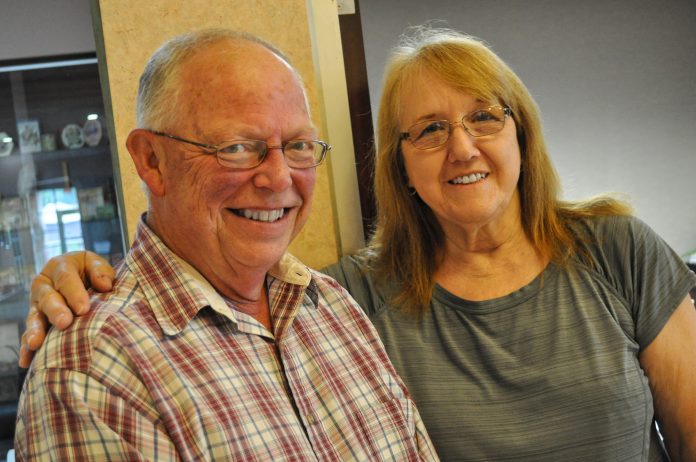
It’s at the core of what Harold and Lucy Mahoney provide every day as owners of Home Instead Senior Care in Norman.
So it’s just natural for the husband and wife to throw their support behind an upcoming fundraiser designed to help families quickly find their loved ones in the event of an emergency.
A Stroll Down Main Street on September 1 in Norman will feature an antique car show, discounts, giveaways and a Jail and Bail event. Several downtown executives and community officials have already volunteered to be “arrested” for the fundraiser.
The money will go to help the Norman Police Department and Sunbeam Family Services offer reduced-cost technology that can save a person’s life.
“The reason Home Instead is passionate to get funding for the Care Trak device is that it is a strong resource for families, Police and Fire Departments,” said Home Instead Community Relations Director CJ Judd.
Care Trak is a program that issues bracelets which emit a radio frequency to help Norman Police officers electronically locate at-risk people who have wandered off or gone missing. Care Trak has been used nationally since 1986, and with it thousands of missing persons have been located.
Care Trak bracelets look similar to a watch, can be worn on a wrist or ankle and are meant to be worn 24 hours a day. They are waterproof and include a thick band which can only be removed by a caregiver.
In the event your loved one goes missing, you can call the Norman Police Department to report the missing person and tell the dispatcher that he or she is wearing a Care Trak Bracelet.
In 1986 Care Trak created telemetry tracking of high-risk people with Alzheimer disease and special needs kids primarily with Autism. Since starting more than 24 years ago the company has earned a 100 percent rescue rate and has become the oldest, most respected name in Telemetry based people locating worldwide.
Hundreds of Sheriffs, Police, Fire Departments, SAR Teams and more use Care Trak to quickly locate at risk individuals with Alzheimer’s disease, dementia and special needs kids primarily with Autism and Down syndrome.
Thousands of lost individuals were rescued by trained emergency responders in an average of less than 30 minutes. Everyone reported missing who was wearing a Care Trak wrist transmitter was located.
The assurance that a loved one will be brought to safety was the appeal to Harold and Lucy Mahoney.
Lifelong Arkansas residents, family has always been important to the Mahoneys, who raised two boys before settling down in Norman.
Harold grew up working with his five brothers in the family body shop and wrecker service their father started.
A quarter century before the Mahoneys ever thought of owning a personal care service they took care of Lucy’s grandmother.
From meals to medicine to baths, the Mahoneys took care of every need.
“We loved it and we loved caring for her,” Lucy said with a smile remembering the care that ranged from meals to baths to trips to the doctor. “We made her wish come true to be able to stay at home.”
After her grandmother passed Lucy entered the medical profession for 25 years.
“It’s just a passion that I have to take care of people,” Lucy said. “I was with a client the other day and she made me think of my grandmother. She was lonely and she needed someone to talk to. It was wonderful to know that I had made her smile and she was happy to have me there and that’s why Home Instead is so personal to me.”
Keeping the integrity of a client’s life is what it’s all about, Lucy says.
“I was with a client yesterday and she said ‘I just want to be able to stay in my home,’” Lucy recalled. “She was happy in her home, even though her life had changed. I told her we were there to help her and take her where she needs to go.”
Professional in-home care allows your family members to age in place. They can continue to live safely and independently in the home they’ve known for much of their lives. In-home caregiving offers peace of mind – and it does so very affordably.
Unlike the high, fixed costs associated with assisted living facilities or nursing homes, the price of in-home care stays flexible to meet your needs. You can keep control of your budget by scheduling as few or as many hours of care as you need.
Proceeds raised during the Downtown Norman event will help Sunbeam Family Services offer Care Trak on a sliding scale based on income.
Scholarship applications and payment plans are available and there are no membership fees associated with Care Trak.
For more information about the event you can call Home Instead at 405-310-2756.
It’s peace of mind the Mahoneys think is well worth their time and energy.

Coffee shop to benefit community

0
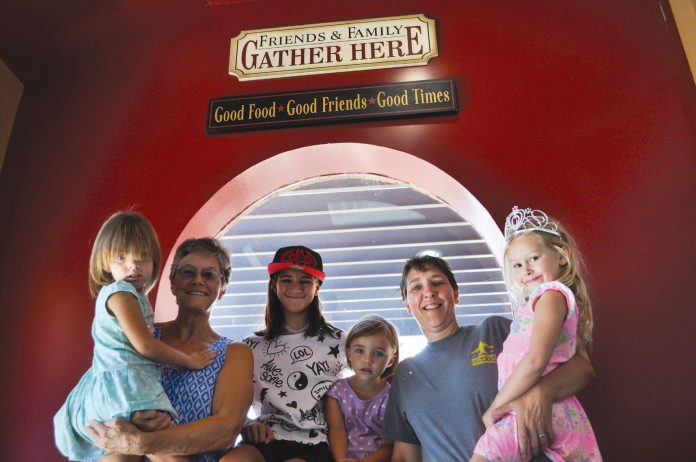
Bridget Hefner, her mother, daughters and even granddaughters are opening up Norman’s newest gathering place, The Screen Door.

by Bobby Anderson
Staff Writer

For nearly 20 years Bridget Hefner worked as an aircraft mechanic at Tinker Air Force Base.
So when retirement came around she thought it was time to finally pursue her dreams.
The money she earned she decided to pour into what has become a labor of love and Norman’s newest gathering place.
August 8 will be the official opening of The Screen Door, an event center and coffee shop that Hefner hopes fascinates the community as it has her for the past few months.
Hefner, her mother Patricia Whaley, daughters and even her grandchildren have been painting and prepping for months now.
The search for a building was a long one with plenty of properties getting checked off the list.
“It just happened the building itself happened to have everything,” Hefner said of the building at 408 W. Main. “I looked at buildings that didn’t have restrooms, buildings that didn’t have air conditioning and buildings that didn’t have the fire system in it. This building was perfect.”
The former Coneys and More location has a patio that looks down Main Street onto a thriving business district.
Inside is a spacious, steampunk-themed cafe with seating ranging from tables and stools to cushy leather oversized chairs.
Hefner eventually would like to free herself up enough where she can offer seminars revolving around dreams and philosophy.
For now, poetry slams and musicians have been scheduled.
The space is available for free for those who just want to meet up, Hefner said.
“The point of it is to bring the community together and make things more social,” said Hefner, a Navy veteran. “It’s a place where people can gather, meet or just hang out.”
Sandwiches, salads, soups and desserts will be offered with the menu ranging from meat to gluten free and vegan. Coffees, teas and frozen fruit smoothies are also on the menu.
The Screen Door is open seven days a week from 5 a.m. to 10 p.m. Free WIFI will be available for those who want to drop by and surf the web for an hour or two over coffee.
“Hopefully there will be different types of groups and meetings will come in,” Hefner said.
Hefner put out the word well before she left Tinker. Once she rented the building she began canvassing the neighborhoods.
“I’ve been going house to house just to let people know we’re here,” Hefner said. “I thought it would be a little more personable.”
Hefner welcomes feedback. A large chalkboard will even allow patrons to put up their comments, sayings or thoughts for the day.
The sky is the limit for The Screen Door which plans on hosting wine tastings, murder mysteries, Mad Hatter tea parties and a 1920s dance in addition to whatever else guests can think up.
The location is directly across from Republic Bank. It’s within walking distance of the Cleveland County Courthouse, Norman High School and Norman’s original downtown.
A portion of the 5,800 square-foot building will be available for private use as well for $50 per hour.
The idea has been ruminating in Hefner’s head for two years now. She wanted a space she could invite others into as well as a space people would feel welcome.
Making a difference daily is the theme for the new venture. In keeping with that, all of The Screen Door’s paper products are eco-friendly and biodegradable.
“I’m hoping our product will be good enough quality that word of mouth will get out,” Hefner said.
Every week discounts will be offered to different groups of people like firefighters, police officers, medical professionals or teachers. A different charity each week will also be able to receive some of the proceeds of the sales.
Right now Hefner’s mom and her oldest daughter are her best employees. But she has hired a sous chef from Packard’s kitchen to put together a menu ranging from strawberry jam muffins with streusel to roasted vegetable and goat cheese grits.
The Screen Door’s Facebook page is one of the best places to get information about what’s coming up but the business also has a website at www.screendoorok.com where you can find out more information.

Easter Seals pioneering adult day health

0
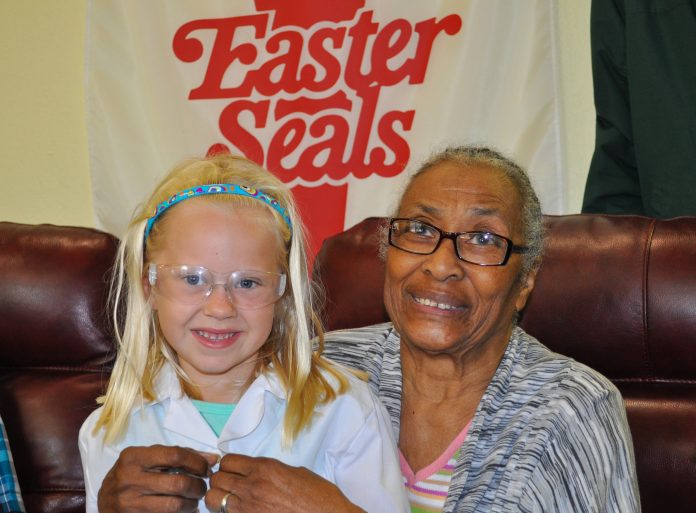
Seniors are enjoying spending their days around children at Easter Seals’ unique Adult Day Center in Oklahoma City.

by Bobby Anderson, Staff Writer

What do eight-year-old kids and 80-year-old seniors have in common?
Turns out quite a lot.
Thanks to a unique Easter Seals program that combines adult day health participants with children both groups are having brighter days.
“It benefits both of them,” says Tony Lippe, Easter Seal’s assistant program director of adult day health. “It helps the children grow up not to be be afraid of older people and those who have a walker or a wheelchair. Children just lighten (the seniors) up.”
The Adult Day Health Center provides special care for adults who are unable to care for themselves for extended periods of time in a protective group setting enabling them to maintain or improve their ability to remain independent. The program utilizes music therapy, horticulture, arts and crafts, current events and other programs to help clients maintain a high level of functioning.
With Easter Seals, you are not alone caring for your family member or friend with frail health or disability. Services are medically-based and offer various levels of care based on the individual needs. A medical professional on staff meets with you to determine the level of care required.
Easter Seals Adult Day Center meets your loved one’s physical, social and emotional needs in a safe, home-like setting.
The program uses individual plans of care to provide a variety of health, social, recreational and therapeutic activities. In addition, the center provides supervision, support services and, in some cases, personal care. The program is open to eligible applicants ages 18 and up.
Attached to the day health center is a children’s center.
Brittney Ellis serves as the assistant director of programs for the Easter Seals Early Learning and Inclusion Academy.
She says the program is one of only two in the state.
“Everything for a kid is routine so the more we brought them over the more comfortable they became,” Ellis said. “They would start to get really excited about seeing them. We started out just coming over and doing morning exercise but we wanted to delve deeper.”
Soon the groups started joining together for art activities. Just recently there was an intergenerational talent show.
“Everything we do we do it together now,” Ellis said. “The (seniors) are very helpful. Over the last few months we really kind of rely on each other to get things done.”
Connie Henderson serves as the activity coordinator for the Adult Day Center and says the relationship is one that seems to work for everybody.
For the seniors, activities are planned with their individual needs in mind.
“I believe it’s my purpose, it’s what I tell my department,” Henderson said. “It’s a purpose because every individual is unique. I believe when you create a program you have to create it to that individual. What I like about Easter Seals is we offer small groups every day and they select where they want to go to.”
And seeing the children becomes a highlight of the day.
“I know for a lot of participants it does a lot for their conditions to just be around the children,” Ellis said. “Our overall goal is to be the leading organization for intergenerational (services). We want to lead the charge. There is so much research about the positives for (the seniors) and (for the children.)”
Easter Seals Oklahoma Adult Day Health Center is designated as a “Center of Excellence.”
It’s a distinction not easily earned.
The role of a Center of Excellence is often one of mentor, according to Jed Johnson, Assistant Vice President Adult & Senior Services, Easter Seals America.
“These centers serve as resources for fellow Easter Seals affiliates who are involved in the start-up of a new adult day services site, in the acquisition of a center, or in the performance improvement of an existing program,” Johnson said.
Adult Day Health Center Hours of Operation are Monday through Friday, 7:30 a.m. to 5:30 p.m. You can call (405) 239-2525 for more information.
Private pay or financial Assistance is available through the Department of Human Services,Veterans Administration and Medicaid Advantage Waiver Program.
“What we’re trying to do is keep them in their homes and that’s what adult days does,” Lippe said. “It’s a home-like setting. When the kids come in, it’s like when their grandchild came to visit them at home. It’s the same.”
Together the groups participated in a food drive benefitting the Regional Food Bank of Oklahoma where donations were collected and dropped off at the charity.
“From my (perspective) it’s just automatic joy once they come into the room,” Ellis said. “I think they get a sense of the simplicity of being a child again and the laughter. Some of the participants physically can not participate but to just hear the children play brings joy all over them.”
Ellis doesn’t believe either group is really all that different from the other. Each require some attention, structure and an opportunity to flourish.

Social

0FansLike
0FollowersFollow
0SubscribersSubscribe