Arrest warrants have been issued for a general contractor and a subcontractor charged with fraudulently padding an insurance claim. An investigation by the Oklahoma Insurance Department’s Anti-Fraud Unit found that Lisa Loven, 50, and Jeffrey Scott, 41, filed fake invoices with the insurance company for equipment that wasn’t used.
“Anyone who thinks insurance fraud is a victimless crime is dead wrong,” said Oklahoma Insurance Commissioner John D. Doak. “Insurance fraud leads to higher premiums for everyone. I will do everything in my power to prevent these crimes from happening and to make sure the perpetrators are punished.”
The Anti-Fraud Unit began investigating Loven in May after receiving complaints she was acting as an unlicensed public adjuster. One complaint involved an Edmond church that had received roof damage during a hailstorm on May 29, 2012. Investigators found Loven had submitted a typed invoice for $14,923 to pay for a rented crane to remove the church steeple.
When investigators contacted the owner of the crane rental company, he said he had never worked on the church and that his invoices are handwritten. The owner said he provided a handwritten estimate to subcontractor Jeff Scott of Edmond Roofing. After speaking with an independent adjuster hired by the insurance company, investigators learned that a crane was not used on the church repairs and the steeple was not removed.
Investigators believe Loven and Scott worked together to submit false documents to the insurance company for personal benefit. The Oklahoma County District Attorney has charged them with one count each of conspiracy to commit a felony and false claim for insurance.
General Contractor & Subcontractor Charged with Forging Claims
Sayre Residents Describe Pain of Hospital Closure
The Oklahoma Hospital Association (OHA) today unveiled a new video, “Losing Rural Hospitals,” as part of its makeOKbetter initiative to broaden health care coverage under Insure Oklahoma.
The video illustrates the impact a hospital closing has on a rural community. It features residents of Sayre, Oklahoma. Sayre Memorial Hospital shut its doors in February, costing the city jobs, sales tax revenue and local hospital care.
“It makes a tremendous difference if you have a stroke or heart attack to get somewhere very quickly,” said A.L. Whinery, retired Sayre businessman.
The closure of the hospital is also affecting the city’s image and economy. “I think we’re going to lose a lot of residents, a lot of people are going to move out,” said Francie Bauldridge, Sayre hair stylist and business owner. “You can’t have a viable community without a hospital.”
According to iVantage Analytics, 42 of 76 rural hospitals in Oklahoma are at risk of closing.
“Sayre’s story is too close to becoming a reality for more than 40 other communities in Oklahoma,” said OHA president Craig Jones. “We must act now to take back federal funds to help sustain these rural hospitals and towns.”
With only two months left in the legislative session, OHA is calling on Oklahomans to contact their legislators and tell them to protect rural health care, communities and jobs by taking back federal dollars for Insure Oklahoma as a part of the state’s budget deal. Building on Insure Oklahoma would bring $9.9 billion to Oklahoma and allow more than 230,000 Oklahomans to have medical insurance.
To learn more, visit makeokbetter.org. Follow the movement on Facebook at www.facebook.com/makeOKbetter or Twitter at twitter.com/makeOKbetter.
155 Fallen Officers to be Engraved on State’s Memorial
The names of one hundred and fifty five (155) law enforcement officers who have died in the line of duty in Oklahoma will soon be engraved on the Oklahoma Law Enforcement Memorial. The deaths date back to 1872.
“These officers have not been forgotten, we just have not had the space or money to engrave them on the memorial until now”, says Dennis Lippe, Chairman of the organization that oversees the memorial. Most of their stories have been on the memorial’s web site for several years. The newest granite stone to be added to the memorial was ordered in January 2014 to accommodate the names of the officers. The stone was not delivered until October. About the same time the stone was installed the memorial organization was looking at expanding the original memorial plaza to include the six stones that have been added outside of the plaza over the years since the memorial was dedicated on May 15, 1969. This is when contractors, who were to bid on the expansion project, discovered the plaza was starting to sink. The Oklahoma Law Enforcement Memorial organization is making efforts to raise the almost $60,000 needed to just make the repairs. The memorial is totally supported by donations even though it sits on state property on the west grounds of the Oklahoma Department of Public Safety Headquarters.
Oklahoma’s was the first state law enforcement memorial built in the United States.
Forty-eight (48) of the new names are those of officers of the US Marshal Service. Almost half of all the US Marshal Service officers who have died in the line of duty in the United States died in Oklahoma both before and after statehood.
The new names will be dedicated during the 48th Annual Oklahoma Law Enforcement Officer’s Memorial Service to be conducted on Friday, May 20th.
Those officers being added are:
M. H. Adams, US Marshal Service, 1873;
Alexander A. Anderson, Grady County Sheriff’s Office, 1925;
Robert W. Arnold, Osage County Sheriff’s Office, 1924;
John M. Beard , US Marshal Service, 1894;
Seth Beardsley, US Marshal Service, 1873;
Black Sut Beck, US Marshal Service, 1872;
Sam Beck, US Marshal Service, 1872;
William Beck, US Marshal Service, 1872;
Richard D. Bell, Haileyville Police Department, 1909;
William R. Benningfield, Oklahoma Department of Corrections, 1941;
William T. Bentz, US Marshal Service, 1872;
Joe Big Knife, US Indian Police, 1895;
Jim Billy, US Marshal Service, 1890;
Ed Bohanon, US Indian Police, 1895;
John R. Boston, US Indian Police, 1881;
A. J. Boyd, Langston Police Department, 1900;
George W. Bradley, Caney Police Department, 1920;
Benjamin F. Brashears, Panama City Police Department, 1919;
Howard O. Brewer, Oklahoma County Sheriff’s Office, 1926;
Leander Brown, US Indian Police, 1882;
Robert B. Bryant, Depew Police Department , 1911;
Charles L. Bullock, Delaware Police Department, 1917;
William H. Butler, Bartlesville Police Department, 1915;
(First Name Unknown) Campbell, US Marshal Service, 1886;
James J. Campbell, US Marshal Service, 1891;
Felix Chapman, Okmulgee Police Department, 1908;
Charles F. Christian, Oklahoma Department of Corrections, 1935;
Henry D. Cobb, Bartlesville Police Department, 1935;
Reuben D. Coleman, Grayson County, Texas, Sheriff’s Office, 1881;
D. B. Cook, Ardmore Police Department, 1908;
David S. Cox, Hughes County Sheriff’s Office, 1908;
Andrew Creason, Rock Island Railroad Police, 1903;
Billy Cully, Seminole Lighthorse, 1906;
Tom Dancer, Maud Police Department, 1906;
Kenneth L. Denton, Oklahoma Department of Corrections, 1989;
L. P. Dixon, US Marshal Service, 1907;
George M. Doolittle, Lampasas County, Texas, Sheriff’s Office, 1879;
James Doss, El Reno Police Department, 1895;
Morris T. Dunn, Fannin County, Texas, Sheriff’s Office, 1888;
Jerry D. Emerson, Logan County Sheriff’s Office, 1903;
Charles I. Epperson, Boynton Police Department, 1925;
Fred Evans, Mannford Police Department, 1911;
Frank Faulkner, US Marshal Service, 1894;
James E. Fields, Osage County Sheriff’s Office, 1961;
Walter C. Floyd, Roff Police Department, 1923;
Robert S. Garrett, Hastings Police Department, 1909;
John Garritson, Delaware Police Department, 1917;
Franklin W. Goss, Chouteau Police Department, 1957;
James A. Hands, Sapulpa Police Department, 1918;
William T. Harden, US Marshal Service, 1890;
Henry L. Harper, Harmon County Sheriff’s Office, 1919;
West Harris, US Marshal Service, 1894;
Bill Harrison, US Marshal Service, 1894;
Joseph P. Heinrichs, US Marshal Service, 1899;
Jesse Hendrickson, Grant County Sheriff’s Office, 1893;
Isaac L. Hicks, Bartlesville Police Department, 1903;
William Hicks, US Marshal Service, 1872;
Ben J Higbee, Coyle Police Department, 1904;
Otto Holler, El Dorado Police Department, 1924;
Fred Hollingsworth, Washita County Sheriff’s Office, 1915;
Tom Hood, Sequoyah County Sheriff’s Office, 1933;
Luther Houston, US Marshal Service, 1902;
L. C. Hughes, Mill Creek Police Department, 1904;
William H. Humble , Kiowa County Sheriff’s Office, 1930;
William D. Hutchins, Claremore Police Department, 1918;
Henry H. Jackson, US Bureau of Prohibition, DO J, 1932;
Aron W. Johnson, US Marshal Service, 1896;
Berry Jones, Okfuskee County Sheriff’s Office, 1920;
Harrison Jones, Jackson Township Police Department, 1911;
William F. Jones, Fredrick Police Department, 1934;
Joseph M. Jordan, US Marshal Service, 1897;
Lincoln Keeney, US Marshal Service , 1894;
William Kirby, Jay Police Department, 1974;
T. John Kirk, Marble City Police Department, 1911;
William Kirksey, US Marshal Service, 1885;
James Knight, Cherokee Junction Police Department, 1901;
William Leech, US Marshal Service, 1884;
Webb H. Lester, Guthrie Police Department , 1894;
Anderson Lewis, Pittsburg County Sheriff’s Office, 1905;
Johnson Lewis, Tishomingo County Sheriff’s Office, 1893;
James R. Lindsey, Pottawatomie County Sheriff’s Office, 1926;
John C. Lunsford, Beggs Police Department, 1910;
Thomas R. Madden, US Marshal Service, 1896;
John T. Martin, Carnegie Police Department, 1960;
William Mayes, Federal Prohibition Unit, IRS, 1919;
William R. Mayfield, OK Department of Corrections, 1926;
William W. McCall, US Marshal Service, 1895;
Claude H. McDonald, Rock Island Railroad Police, 1911;
Henry McGill, Tishomingo County Sheriff’s Office, 1883;
Herbert McIntosh, Jr., McAlester Police Department, 1984;
Mose McIntosh, US Marshal Service , 1888;
John McWeir, US Marshal Service, 1883;
Henry Miller, US Marshal Service, 1886;
Nimrod J. Miller, Burnett County, Texas, Sheriff’s Office, 1881;
Benjamin F. Milligan, Cimarron County Sheriff’s Office, 1909;
Lem E. Mitchell, Pontotoc County Sheriff’s Office, 1914;
James H. Murphy, Fairfax Police Department, 1912;
Howard E. Murray, Pittsburg County Sheriff’s Office, 1910;
Charles M. Nichols, Marshall County Sheriff’s Office, 1921;
Joe Nix, US Marshal Service, 1894;
Richard E. Oliver, Canute Police Department, 1983;
Slack Palmer, Pawnee County Sheriff’s Office, 1911;
James E. Parish, Bennington Police Department, 1912;
Henry Peckenpaugh, US Marshal Service, 1899;
John B. Pemberton, US Marshal Service, 1892;
Steve Pen-su-wau, US Marshal Service, 1891;
William Pitts, US Marshal Service, 1890;
John Poorbear, Fort Gibson Police Department, 1890;
Josiah Poorboy, US Marshal Service, 1891;
Harry L. Potter, Beaver County Sheriff’s Office, 1971;
Richard H. Pratt, Gore Police Department, 1927;
Marion Prickett, US Marshal Service , 1890;
Bud Pursley, US Marshal Service, 1884;
Ezekiel M. Putnam, Allen Police Department, 1909;
Robert Reed, US Marshal Service, 1889;
William T. Reynolds, Chandler Police Department, 1926;
William W. Roberts, Comanche County, Texas, Sheriff’s Office, 1948;
Ralph Robinson, Rock Island Railroad Police, 1926;
William Roland, Shidler Police Department, 1927;
Wendell R. Rowan, Wright City Police Department, 1980;
Running Eagle, Pawnee Tribal Police Department, 1891;
Running Over Water, Ponca Tribal Police Department, 1908;
Sherman Russell, US Marshal Service, 1893 ;
John H. Scott, Quinton Police Department, 1918;
George W. Selvidge, US Marshal Service, 1872;
David Sizemore, US Marshal Service, 1890;
Donald W. Smiley, Texhoma Police Department, 1983;
Warren N. Smith, Bokchito Police Department, 1951;
James D. Snider, Osage County Sheriff’s Office, 1921;
Charles C. Starr, Braggs Police Department, 1916;
George C. Starr, Rogers County Sheriff’s Office, 1912;
Charles H. Stricker, Commerce Police Department, 1919;
Jeff Surratt, San Bois County Sheriff’s Office, 1900;
J. H. Swinford, Kiefer Police Department, 1909;
Homer Teaff, Muskogee County Sheriff’s Office, 1922;
William C. Temple, Anadarko Police Department, 1910;
Oscar M. Terry, Creek County Sheriff’s Office, 1913;
Albert Turner, Wilburton Police Department , 1909;
William C. Turner, Oklahoma Department of Corrections, 1935;
Thomas E. Tyus, Creek County Sheriff’s Office, 1911;
John Wall, Tatums Police Department, 1923;
James Ward, US Marshal Service, 1872;
James Ward, Tulsa County Sheriff’s Office, 1919;
Charles T. Warner, US Marshal Service, 1935;
Thomas Whitehead, US Marshal Service, 1891;
Adam Wilkins, Choctaw Tribal Police, 1920;
William O. Wilkins, Choctaw County Sheriff’s Office, 1924;
Jim Williams, US Marshal Service, 1889;
William Williams, Bismark Police Department, 1916;
Sore Lip Willie, US Marshal Service, 1889;
Charles B. Wilson, US Marshal Service, 1884;
J. C. Wilson, Weleetka Police Department, 1932;
Riley Woods, US Marshal Service, 1872;
Pleasant Yargee, Tulsa County Sheriff’s Office, 1909;
Thomas Young, US Marshal Service, 1882.
For more information on these officers or any of the almost eight hundred (800) law enforcement officers who have died in Oklahoma go to www.oklemem.com
In the movies

Senior finds new life behind silver screen
by Bobby Anderson, Staff Writer
After several health issues including a heart attack, stroke and a multiple sclerosis diagnosis, Martin Evans’ doctors term him a “walking miracle.”
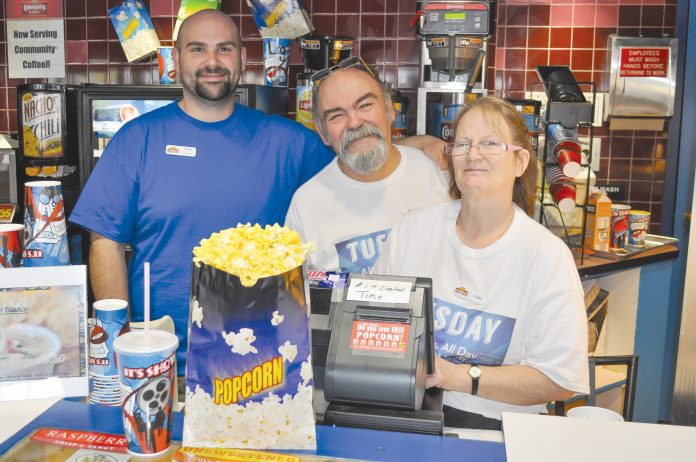
So at age 63 it shouldn’t come to anyone’s surprise that the man with a background in food service, construction and ministry has combined all three and opened up Norman’s newest discount theatre.
Three months and bucket fulls of sweat equity later, Evans wouldn’t trade the experience for the world and movie goers continue to line up day after day for a unique entertainment experience.
“It’s a family-oriented business,” Evans says. “Our prices are reflective of value.”
The theatre features $1 tickets on Tuesdays. All other days shows before 4 p.m. are $2. After 4 p.m. the price goes to $3.
The value continues at the concession stand where you can get a large popcorn, large drink and candy for less than $10. Soda refills are just a quarter.
Evans admits he couldn’t do it without his wife of nearly 35 years, Pam.
Three sons and a daughter – nearly half of the Evans family – plus a nephew all work at the theatre.
Evans has nine children.
“Everyone of them rolled up their sleeves when it was still building in progress and my brother-in-law came out for a couple months and did most of the painting for us,” Evans said. “(Having a family business) most days it’s great. Some days we’re on opposite ends of the building so we don’t scream at each other.”
Evans has a long history in customer service.
He managed Sambo’s restaurants years ago as well as a string of fast-food restaurants in California and Southern Oregon.
A few years back, son Josh opened a theatre with partners in Waterbury, Connecticut. Hurricane Sandy struck and three months later a major nor’easter all but deflated Josh’s chances at operating a successful movie theatre.
“Things kept piling up so they closed it but he always wanted to get back in,” Evans said.
So it was no surprise that Josh came to his parents for a serious talk.
“He said he really wanted to do something with us,” Martin said. “He told us we weren’t going to make a living on Social Security and he wanted to get us in a position where we could make a living and not have to work.”
There’s been plenty of work lately, but Evans has a vision of duplicating his theatre success in other markets.
“I’m 63 and for the first time in my life I was able to go to a car lot and buy a brand new car,” Evans said. “A week later I went back and bought another one for the company.”
The public has responded.
“We’re having a ball. We love it and we love the community,” Evans said. “I can’t think of a better place to live and start your business than Norman.”
Before the front doors were even unlocked Christmas Eve 2015 more than 5,000 people had liked the theatre’s Facebook page.
A crowdfunding campaign yielded nearly $30,000 with people purchasing discount admission cards and on-screen advertising.
Schools from as far away as Paul’s Valley are bringing 200 students at a time for reward days.
Movies like Goonies, Back to the Future, Gone with the Wind, Sound of Music, Singing in the Rain, Indiana Jones and Jaws are back up on the big screen for those who
“A lot of kids will get to see a movie that they’ve maybe seen on TV but not on the big screen,” Evans said. “We cater to the kids and cater to the families. We see everything from grandparents bringing their kids for their first movie experience to large families on a tight budget. We’re starting to see more college kids.
“Really we’re widespread but we have a lot of seniors.”
The Red Hat ladies come once a week to enjoy the newly-renovated digs. Upgraded sound, seating and carpet await theatre goers with a new 3D experience coming later this summer.
A family of five can come to the theatre and spend less than $50 including tickets and food.
Evans even offers a special line of all-beef hot dogs.
The nacho dog has cheese, chips and jalapenos. The namesake Marty Dog weighs in with white queso, bacon, guacamole and pico de gallo.
Fresh-baked pizza and boneless wings make an appearance after noon.
Evans credits a very aggressive film booker in getting the theatre its releases.
“It’s the same process. We have a booker who negotiates the film and the studio tells us the special things we have to do,” Evans said.
When you walk into Evans Theatres you can tell it’s a different type of theatre.
Pam Evans knows why.
“We believe everyone that walks through that door is family – family that we like,” Pam says with a chuckle.
Evans Theatres Robinson Crossing 6 is located at 1300 N Interstate Drive in Norman and opens at opens at 10:00 AM.
Caring business model
Diverse excellence sets the standard for Newby Vance Mobility Sale

by Jason Chandler, Staff Writer
It is the business model of Newby Vance Mobility Sales in Guthrie that is unique in meeting the needs of persons living with a disability, said Jim Seeger-Newby, of Newby Vance Mobility Sales. Newby Vance Mobility Sales is the only Ford, General Motors, Chrysler dealership franchise in the United States, Newby said.
“It’s also a full-fledged comprehensive mobility dealer,” Newby said.
The business model is designed to allow people who have a family member with a special transportation need to come to a single location, Newby said. Their individual vehicle needs will be identified at the same time their mobility needs are evaluated.
“It allows people to be treated like anyone else and not have to go to a car dealership and purchase a vehicle and then have to take their vehicle to a handicapped store to have it adapted,” he said. “That is not a very user-friendly way to have their needs met.”
The Newby Vance Mobility Sales business model allows people to bring their vehicle here for its service work and body shop work to be taken care of at a single location.
“That is the strength of our business model,” he said. “So what we offer is a comprehensive mobility/automotive business model that allows people to have their entire set of automotive, transportation mobility needs met in a single location.”
The business was founded 20 years ago and with a lot of hard work became one of the largest 15 mobility dealers in the United States. He runs the business with his son, Marcus Newby. Its success is not only due to its business model but also by the way Newby Vance Mobility Sales treats customers with individualized service. Newby Vance Mobility Sales dwells on the relationships it cultivates with every customer.
“Once you do business with us, unless you move away or unless I move away, we’re probably going to know each other for the rest of our lives,” Newby said. “Because you’re going to be contacting us and bringing your vehicle in for special service, special care when the equipment or adaptions require special service or repair.”
Customers bring their needs back to where they have a trusted relationship at Newby Vance Mobility Sales. Relationships have been developed with more than 7,000 customers, Newby said. So reoccurring business is common.
Although Newby Vance Mobility Sales is located at an automobile dealership, it is important for customers and potential customers to function on a scheduled basis. The company serves clients from all across the state.
People go to typical car dealership stores sometimes on a whim, but 95 percent of Newby Vance Mobility Sales meeting with customers is on a scheduled basis, he said.
“When you come, one of the things we help you do is to identify what your short-term or long-term needs are,” Newby continued. “And that takes time to do. It’s not much fun to try to do that when you have people walking in and out on an unscheduled basis.”
The location is west of the 153 exit on Interstate 35, making it an easy to find business in central Oklahoma at the northern edge of the Oklahoma City metroplex.
“We’re right on the I-35 artery, and so it’s real easy to get to us no matter what direction you’re coming from,” Newby said. “You don’t have to suffer if you will congested city street driving to get to us. We’re a little bit farther for some people but it’s actually an easier drive for the majority of people who come to us.”
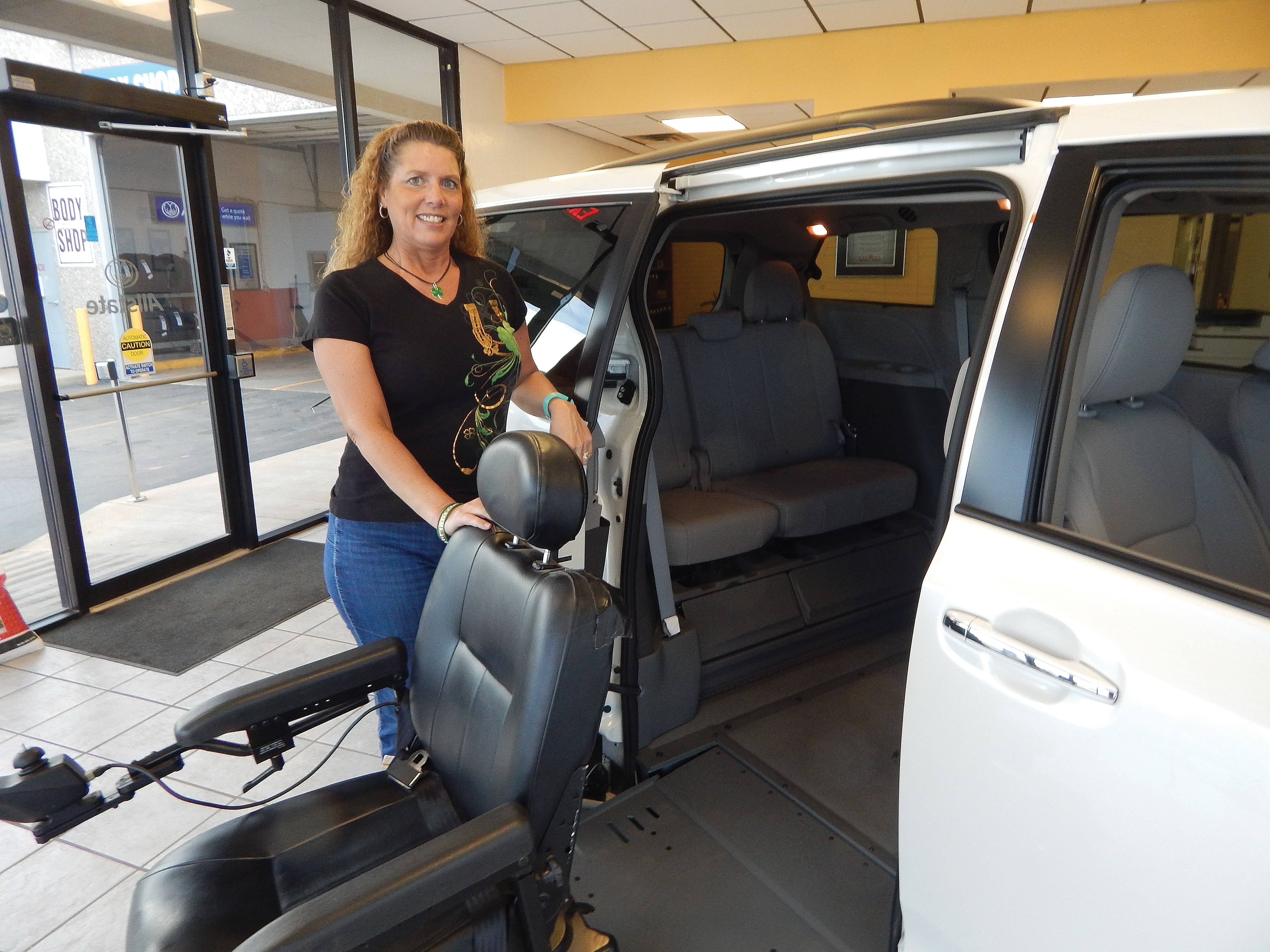
The BraunAbility manufactures a conversion that is installed on several different mini vans. This conversion lowers the floor of a vehicle to provide adequate head room for those people entering the vehicle in a wheel chair.
“The conversion also consists of a ramp that can operate electrically or manually,” he said
A person can literally push a button for the ramp to deploy and bring the person into the vehicle while they are in their chair. The flexibility of the product allows a person to drive from a wheelchair, ride in their wheelchair or transfer from their wheelchair.
“Not all people need a special mini van. It’s very individualized,” he said. “It’s what a person’s needs are and how you can help them determine what is in their best interest.”
Leading renaissance

by Bobby Anderson
Staff Writer
Gloria Ceballos, RN, PhD has worked in just about every nursing area you can imagine. From the operating room to home care to the classroom, Ceballos’ 40 years in nursing has taken her to places she never thought possible.
Now, as the Chief Nursing Office of AllianceHealth Midwest, Ceballos is lending that experience to growing local nurses who want to work for their hometown hospital.
Ceballos has helped transition the former Midwest Regional Hospital to the new AllianceHealth Midwest name.
“It has been a great ride with committing to quality of care here at Alliance Midwest,” Ceballos said. “We’ve seen a lot of change this year, changing our name and recruiting new nurses. We’ve recruited over 25 brand new nurses where for a while this hospital was hiring just one or two new nurses.”
Growing nurses is a passion for Ceballos.
She made sure AllianceHealth Midwest awarded eight $5,000 scholarships to students in the medical field last year. Four went to high school students and the rest went to college students already in a medical program.
Ceballos assigned mentors from the hospital to help them along.
“The scholarship doesn’t tie them to us – we hope it does,” Ceballos said. “It’s more mentoring through their schooling. In the end, they could choose to work for us if they wanted to.”
By being one of the largest employers in the area, AllianceHealth Midwest is able to be a strong supporter of employment opportunities within the community. AllianceHealth employs more than 1,500 individuals, equaling to more than $70 million a year paid in salaries and benefits.
What was established in 1962 as a community hospital is now a 255-bed acute care facility. AllianceHealth Midwest was the first metro hospital to meet the requirements to be recognized as a Certified Level III Trauma Center by the Oklahoma State Department of Health.
“There are nurses that want to stay here in the community and if we encourage them they will stay,” Ceballos said. “Oklahoma needs every single nurse it can keep. Nursing is a career you can take worldwide, really. We want to keep the nurses that want to stay close to home and to their families and not have to leave.”
Formerly, Ceballos worked as a consultant in Florida. Ironically, it was that job that brought her to Midwest City.
She came to help with finding solutions but found a great opportunity in front of her.
“I saw the effort this team put in. They convinced me to come,” Ceballos said. “Most people don’t get to see their organizations from the inside before they’re hired. I got to see that and test it.”
With healthcare rapidly moving to a pay-for-performance model, Ceballos says communication of that fact to employees is critical.
Under Ceballos quality scores have improved.
“We are incrementally improving and sustaining, which is very important,” Ceballos said. “Nationally, hospitals are struggling with their satisfaction scores. Patients are not well when they come to us. Our goal is for them to understand why they are hospitalized and what they need to know before they leave.
“We want to make sure if they need us again they are sure to come back.
“I want the nurses to embrace the new healthcare environment because it’s here to stay.”
With the increasing importance of scores derived from the Hospital Consumer Assessment of Healthcare Providers and Systems (HCAHPS), Ceballos says it’s important that nurses understand how the assessment works.
The HCAHPS survey contains 21 patient perspectives on care and patient rating items that encompass nine key topics: communication with doctors, communication with nurses, responsiveness of hospital staff, pain management, communication about medicines, discharge information, cleanliness of the hospital environment, quietness of the hospital environment, and transition of care.
The survey also includes four screener questions and seven demographic items, which are used for adjusting the mix of patients across hospitals and for analytical purposes. The survey is 32 questions in length.
“Those questions are being correlated with patients coming back in the hospital,” Ceballos said. “Patients who answered poorly in some of these questions nationally are correlating maybe with readmissions, not taking their medications or not following up with their doctors. The patients still have to make the decisions but when they leave the hospital we should have given them the opportunity to have those questions answered.”
And one by one, Ceballos is answering any questions people might have about whether AllianceHealth Midwest is the right place for them.
Helping those in need – Senior women host Celebration of Hope

by Bobby Anderson, Staff Writer
With 200 ladies strong, the Salvation Army Central Oklahoma Women’s Auxiliary helps the Army make a tremendous difference for those in need in our community.
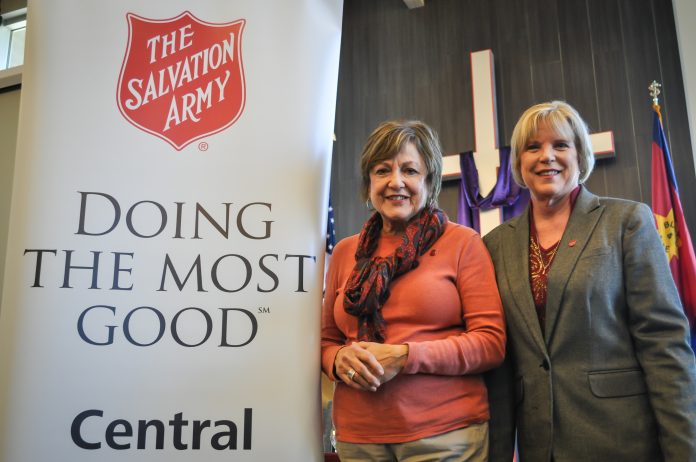
It’s an honor that June McCoy and Beth Everett remember every time they volunteer their time and services to an organization that assists some 139,000 Oklahomans each year.
And in order to help so many the auxiliary each year holds a Celebration of Hope.
“This Celebration of Hope is the ladies auxiliary’s big fundraiser,” McCoy, 70, explained. “This is where we get our money to be able to donate.”
The Salvation Army Central Oklahoma Women’s Auxiliary is hosting the 29th Annual Celebration of Hope on Wednesday, April 6, 2016 with a silent auction beginning at 10 a.m. followed by a luncheon and program at 11:30 a.m. at Church of the Servant, 14343 N MacArthur in Oklahoma City.
Tickets for the event are $45 and can be purchased by contacting Jill Walker at 405-627-1334. All reservations must be made by March 25, 2016.
This year the event will focus on lives that have been transformed by The Salvation Army’s ministry with a personal testimony of one man’s redemptive journey from homelessness back to self-sufficiency.
“That’s our theme this year, transforming lives,” Everett, 67, said. “One of the new programs that’s taken our heart is called Night Watch. This is a program where the Army takes one of their disaster trucks on a Thursday night and goes under the bridges.”
“We’re just an arm.”
The event will also celebrate 10 years of the Women’s Auxiliary Buck$ 4 Bikes program which raises funds to provide bicycles to children who are on The Salvation Army’s Angel Tree at Christmas.
“Because of the generosity of this community we have the incredible opportunity to provide tools that allow individuals to better their lives,” said Major Charlotte Gargis, associate area commander for The Salvation Army Central Oklahoma. “We thank God for the privilege of providing hope, healing and restoration to those hurting in Central Oklahoma.”
The program will also feature ventriloquist Darci Farmer and KFOR NewsChannel 4 Anchor Marianne Rafferty as emcee.
The Salvation Army Women’s Auxiliary is comprised of women who have dedicated their time and talents to help transform lives through The Salvation Army’s programs and services. The Celebration of Hope event began 29 years ago to raise funds to purchase Christmas gifts for Forgotten Angels, children on the Angel Tree who were not adopted, but has grown to help fund many more programs.
All funds raised through this year’s event will benefit the ongoing programs and services at The Salvation Army Central Oklahoma including the shelter program, Client Choice Food Pantry, senior programs, summer camp scholarships and The Salvation Army Boys & Girls Club.
The Salvation Army, an international movement, is an evangelical part of the universal Christian church. Its message is based on the Bible.
Its ministry is motivated by the love of God. Its mission is to preach the gospel of Jesus Christ and to meet human needs in His name without discrimination.
Nearly 139,000 Oklahomans receive assistance from The Salvation Army Central Oklahoma each year through the broadest array of social services that range from providing food for the hungry, relief for disaster victims, assistance for the disabled, outreach to the elderly and ill, clothing and shelter to the homeless and opportunities for underprivileged children.
Nearly 82 cents of every dollar raised is used to support those services.
For more information, go to www.salvationarmyokcac.org. The Salvation Army Central Oklahoma Area Command is a proud partner agency of the United Way of Central Oklahoma.
McCoy came to the Celebration of Hope three years ago and was instantly hooked.
“Once I came in and looked around, listened to their programs I said ‘This is the most wonderful group. I want to spend some time helping this group,’” said McCoy, a violinist who will also perform during the event. “I think the rewards of seeing what this group does for the whole metro area and reaches so many people is different than some of the other things I volunteer for.
“I think our group here is very diversified. They come from every walk of things that they’ve done in their lives. It’s a wide variety of most interesting ladies that want to give their time to the Salvation Army.
Everett says those ladies who would like to learn more about volunteering can call 405-246-1100.
From the Angel Tree to the food pantry there’s something for everyone.
Senior CPA helps take the sting out of tax time
by Bobby Anderson, Staff Writer
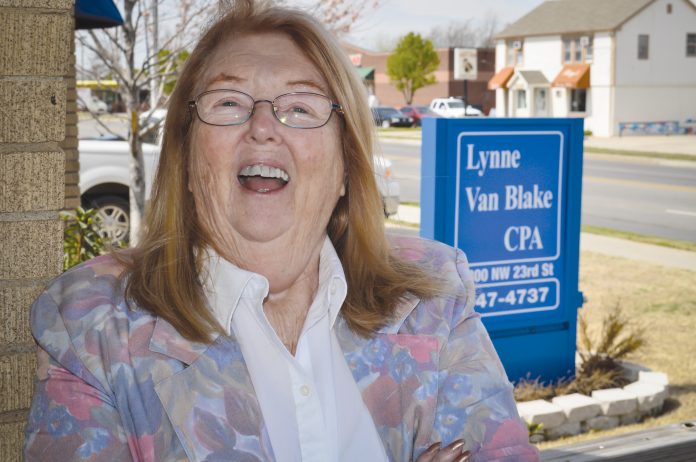
Only a few days remain before the April 15 filing deadline and there are a few items Oklahoma City Certified Public Accountant Lynne Van Blake says seniors need to look out for.
“Seniors need to be aware that they may need to file a tax return if they have income from other than Social Security,” Van Blake said. “Filing a return does not mean they will owe taxes.”
Founded in 1984, Van Blakes, is a family-owned CPA firm providing year-round accounting, tax preparation, incorporation, and other financial consulting, as well as planning services and advice—helping clients achieve their financial goals while maintaining legal and statutory compliance.
As the clock ticks down, Van Blake says it’s important that seniors pay attention to changes that will affect them.
“Seniors older than 70 may earn unlimited amounts without affecting their Social Security income,” Van Blake said. “Under age 70, a portion of their Social Security is reduced if their wages or net self employment are above certain limits. Seniors over age 70 may owe taxes on their earnings.
Van Blakes seeks to assist individuals, families, and businesses with tax preparation and accounting services that ensure they are fairly represented to tax agencies and financial institutions, while also developing long-term relationships built on cooperation and trust.
Van Blake said seniors need to pay particular attention to the special limits they have access to when it comes to padding their retirement accounts.
Seniors age 55 and older are able to add an additional $1,000 to bring total contributions to IRA’s to $6,500. These contributions can be left to heirs as part of an inheritance.
Contributions to a Roth IRA do not require minimum distributions at age 70 1/2. That, too, can be a tax planning tool.
The IRS offers this advice to seniors:
– If you do not itemize your deductions, you can get a higher standard deduction amount if you and/or your spouse are 65 years old or older. You can get an even higher standard deduction amount if either you or your spouse is blind.
– You must file using Form 1040 or Form 1040A to receive the Credit for the Elderly or Disabled. You cannot get the Credit for the Elderly or Disabled if you file using Form 1040EZ. Be sure to apply for the Credit if you qualify.
– IRS-sponsored volunteer tax assistance programs offer free tax help to seniors and to low- to moderate-income people who cannot prepare their own tax returns.
– Also see Publications 524 (Credit for the Elderly or Disabled); and 554 (Tax Guide for Seniors).
Van Blake also warns people to be cautious with their information.
Aggressive and threatening phone calls by criminals impersonating IRS agents remain a major threat to taxpayers, but now the IRS is receiving new reports of scammers calling under the guise of verifying tax return information over the phone.
The latest variation being seen in the last few weeks tries to play off the current tax season. Scam artists call saying they have your tax return, and they just need to verify a few details to process your return. The scam tries to get you to give up personal information such as a Social Security number or personal financial information, such as bank numbers or credit cards.
“These schemes continue to adapt and evolve in an attempt to catch people off guard just as they are preparing their tax returns,” said IRS Commissioner John Koskinen. “Don’t be fooled. The IRS won’t be calling you out of the blue asking you to verify your personal tax information or aggressively threatening you to make an immediate payment.”
The IRS reminds taxpayers to guard against all sorts of con games that continually change. The IRS, the states and the tax industry came together in 2015 and launched a public awareness campaign called Taxes. Security. Together. to help educate taxpayers about the need to maintain security online and to recognize and avoid “phishing” and other schemes.
The IRS continues to hear reports of phone scams as well as e-mail phishing schemes across the country.
“These schemes touch people in every part of the country and in every walk of life. It’s a growing list of people who’ve encountered these. I’ve even gotten these calls myself,” Koskinen said.
This January, the Treasury Inspector General for Tax Administration (TIGTA) announced they have received reports of roughly 896,000 phone scam contacts since October 2013 and have become aware of over 5,000 victims who have collectively paid over $26.5 million as a result of the scam. Just this year, the IRS has seen a 400 percent increase in phishing schemes.
Budget Crisis Threatens Health and Safety of Vulnerable Oklahomans
For more than 20 years, many frail, elderly and disabled Oklahomans with limited means have relied on the ADvantage Waiver Program to receive at-home care. Without a line item in the next state budget, funding for these services may be cut, putting the lives of these Medicaid beneficiaries in jeopardy.
The ADvantage Waiver Program enables more than 23,000 Oklahomans to retain their independence and stay at home as long as possible, instead of being institutionalized. Under the program, qualified Oklahomans receive assistance that includes:
· Picking up groceries and medicine
· Assisting with bathing and grooming
· Providing housekeeping to maintain a clean, safe environment
· Giving respite care for other caregivers
“The ADvantage Program has been a vital part of my life, and I truly believe I would not have lived without it,” said Sarah Hadyn Smith of Norman. “It has given me a life worth living in a difficult time of serious illness.”
Funding cuts to the ADvantage Waiver Program could be devastating. Frail and elderly Oklahomans would be forced into institutions at greatly increased cost. More than 10,000 employees will struggle to deliver quality care and Oklahoma businesses will leave the program. In addition, these employees may have their wages cut or lose their jobs and turn to other state services.
“Many of our members do not have family to care for them and just need a little extra help to remain in their home. Under this program, providers deliver needed care at a much more affordable rate than nursing homes,” said Steve Goforth, president and founder of Tulsa-based Oxford HealthCare and legislative officer for the Home and Community Based Services Council (HCBSC).
“Preserving the ADvantage Waiver Program is the financially conservative and responsible choice. It prevents overuse of the emergency room and unnecessary institutionalization,” said Lola Edwards, president of HCBSC. “Cuts will create serious health and safety risks to the most vulnerable Oklahomans and cost the state more in the long run.”
The Council will hand-deliver over 500 member letters of support to legislators at the capitol on March 30.
HCBSC is asking the Oklahoma Legislature to sustain current funding to the ADvantage Waiver Program through a line item in the state budget.
About the Home and Community Based Services Council-
The Council is comprised of 10 provider agencies delivering services to Oklahoma’s elderly and disabled in 38 communities. The agencies represent 80 percent of all services delivered in the ADvantage Waiver Program and State Plan Personal Care Program.
Give 3 Smiles a Day

by Vickie Jenkins
There is something exciting taking place in Bethany, OK. It is the new opening of Bethany Behavioral Health! “Today is the first day that we’re open to see patients,” says Rob Lake, CEO. “It took a lot of people to make this work and it’s nice to see everything come together so well. This is the old Deaconess Hospital so it has come a long way. The whole place has been renovated and everything is brand new, along with the latest equipment. New business, new facility, new everything,” Lake said.
Bethany Behavioral Health is a 57-bed psychiatric hospital meaning more mental health crisis beds for the Oklahoma City metro. “Of course, as our patients grow in number, our facility will grow also. Our program will help adults over the age of 55 with major mental illness disorders,” Lake states. “We will have in-patient only. There will be a 5-day stay for adults and an 11-day stay for geriatrics. That number will change as we fill to capacity and I know we are going to grow in time. The patient will receive treatment for their individual needs and there will be an assessment before discharging them. We have the highest quality of care here,” Lake adds.
Lake attended school at Texas Tech University, where he got his Bachelors and his Masters. Beginning his career in the medical field in 1987, he spent 20 years as CEO of different hospitals in different states. “This is the 7th hospital that I have been at,” Lake says. “I’ve been at hospitals in Texas, Arkansas, New Mexico and several cities in Oklahoma. Traveling to different states gives me the chance to join in on a progressive and innovated opportunity to motivate companies for healthcare. With this being a new healthcare facility, it gave me the chance to hire all new people. Recruiting all new people was fun, yet challenging. Right now, we have 45 employees. We have high quality employees and they were all hand-picked. I am very proud of each one of them. Our main concern here at Bethany Behavior Health is to help the patients with their problems. We will focus on the patients and the quality of medical care as we see them. Right now, we have the chance to make this the best hospital it can be. Everyone needs to work as a team, doing their very best and we can make it happen. I think this is what makes everything run so smoothly,” Lake said.
Some warning signs that could indicate a senior should seek help are: anxiety/agitation, confusion/disorganization, depression, fear/paranoia, fluctuations in weight, hallucinations/delusions, memory loss, mood swings, sleep disturbances, social withdrawal, suicide thoughts and wandering.
“Do you see any challenges that you might face as time goes on?” I ask Lake. “Well, like any new facility, I’m sure we’ll face a few problems but nothing that we can’t handle. I know I have the best employees and I see how well things have gone so far. I look forward to the future and watching how much Bethany Behavioral Health is going to grow. I like my job and I like the way it makes me feel, even if I do face some challenges ahead, I can do it,” Lake commented.
When not working, Lake stays active in many ways. Triathlons, golf, tennis and cycling. “Exercise is very important to me,” says Lake. “My wife is an occupational therapist and she stays active too. We have 2 sons, Cody, 24, and Kyle, 23. Both boys will graduate in May of this year. We are so proud of both of them.” Lake comments.
“Do you have any words of wisdom that you pass along to others?” I ask Lake. “Yes, I do. I always tell my employees to make sure to give 3 smiles a day. 1. Make a patient smile. That is why we are here. 2. Make a physician smile. That is how we get our patients here. 3. Make the staff smile. This is your hospital. Make it what you want it to be; the best!”
Bethany Behavior Health is located at 7600 N.W. 23rd (formerly Deaconess Hospital) Their goal is to increase functioning and improve the quality of life. For any questions, call 844-243-1331 or 405-792-5360.