Tuesday, October 27, 2026

Essential Legal Documents All Seniors Should Have

0

Dear Savvy Senior, What kinds of legal documents are suggested for end-of-life plans? I would like to get my affairs in order before it’s too late. Getting Old


Dear Getting,
Every adult – especially seniors – should have at least four essential legal documents to protect them and their family. These documents will make sure your wishes regarding your estate are legal and clear, and will help minimize any conflicts and confusion with your family and your health care providers if you become seriously illness or when you die. Here are the key documents you need, along with some tips to help you create them.
A Will: This document lets you spell out your wishes of how you’d like your property and assets distributed after you die, whether it’s to family, friends or a charity. It also allows you to designate an executor to ensure your wishes are carried out, and allows you to name guardians if you have minor or dependent children.
In addition to a will, if you own real estate or have considerable assets, another option you may want to consider is a “revocable living trust.” This functions like a will but allows your estate to avoid the time and expense of probate (the public legal process that examines your estate after you die) and helps ensure your estate’s privacy.
Durable Power of Attorney: This allows you to designate someone you trust to make financial, tax and legal decisions on your behalf if you lose your decision-making capacity.
Advanced Health Care Directive: This includes two documents that spell out your wishes regarding your end-of-life medical treatment. The two documents are a “living will” which tells your doctor what kind of care you want to receive if you become incapacitated, and a “health care power of attorney” which names a person you authorize to make medical decisions on your behalf if you become unable to.
Do-It-Yourself
If you have a simple estate and an uncomplicated family situation, there are several good do-it-yourself guides that can help you create all these documents for very little money.
For creating a will, a top resource is the Quicken WillMaker Plus 2015 software (available at nolo.com) that costs $50, works with Windows personal computers and is valid in every state except Louisiana. If you use a Mac, nolo.com offers an online will maker for $35.
Or, if you only need to create an advance directive you can do it for free at caringinfo.org (or call 800-658-8898), where you can get state-specific forms with instructions. Or for only $5, an even better tool is the Five Wishes document (agingwithdignity.org, 888-594-7437), which is valid in 42 states and will help you create a customized advance directive.
Get Help
If, however, you want or need assistance or if you have a complicated financial situation, blended family or have considerable assets, you should hire an attorney. An experienced lawyer can make sure you cover all your bases – especially when writing a will or living trust – which can help avoid family confusion and squabbles after you’re gone.
Costs will vary depending on where you reside, but you can expect to pay somewhere between $200 and $1,000 for a will, or $1,200 to $5,000 for a living trust.
The American College of Trust and Estate Counsel (actec.org) and the National Academy of Elder Law Attorneys (naela.org) websites are good resources that have directories to help you find someone in your area.
If money is tight, check with your state’s bar association (see findlegalhelp.org) to find low-cost legal help in your area. Or call the Eldercare Locater at 800-677-1116 for a referral.
Send your senior questions to: Savvy Senior, P.O. Box 5443, Norman, OK 73070, or visit SavvySenior.org. Jim Miller is a contributor to the NBC Today show and author of “The Savvy Senior” book.

Greg Schwem – Upon my death, please continue to ‘like’ me

0

By Greg Schwem


Upon my death, please continue to ‘like’ me


My immediate family huddled on a couch in the funeral home’s parlor room. My wife and I held hands while my daughters stifled urges to check their cell phones. A box of tissues sat on the coffee table. None were needed. Not yet.
A kind looking man emerged from a small office. “Greetings, Mr. and Mrs. Schwem. Girls. I’m Herb Blansky, social media grief coordinator for Blansky & Sons. We specialize in assisting families with the social media accounts of a family member who has passed on. You specifically had questions about Facebook?”
I reached for a tissue. The mere thought of who would handle my eight-year collection of backyard barbecue photos, Kim Kardashian memes and ABSOLUTELY ADORABLE videos of dogs wearing sweaters after jumping into laundry baskets produced a lump in my throat. My wife gripped my hand tighter.
“As you know, Facebook recently added a legacy feature, authorizing someone to take over the account once its owner has passed.” Shifting his eyes between my wife and daughters he added, “Someone you trust. At Blansky & Sons, we can assist you with this process.”
“Like, don’t you just click one button at the bottom of your page?” my eldest asked. “Why are we here?”
“Because I haven’t decided who my legacy contact should be,” I said. “Mr. Blansky, do you have a suggestion.”
“Well, it should be somebody familiar with the nuances of posting, responding, wall updates, friend acceptance, group messaging, commenting, ‘liking,’ and the Facebook mobile app.”
“That counts me out,” my wife said.
“She never got into Facebook,” I informed Blansky.
“Girls, how about you?” Blansky asked, looking at my daughters. “Keep in mind it’s a big responsibility.”
“We’re no longer on Facebook,” my youngest said. “We use Instagram.”
“Yeah, we wouldn’t be caught dead using Facebook,” her sister replied. “Wait, that didn’t come out right. Sorry, Dad.”
“What do we do?” I asked Blansky.
“This is an unusual situation,” he replied. “Have you considered a Facebook power of attorney?”
“I’m not mentally incapacitated,” I said defensively. “I just want my Facebook account to live on when I’m gone. I enjoy steak every Sunday and I ALWAYS post a photo before I consume it. Is it wrong to have somebody continue posting photos of my favorite meals? In my memory?”
“Yes,” my daughters said in unison.
“Not at all,” Blansky said.
“And what if I pass before the next presidential election,” I said, reaching for another tissue, “who is going to post disparaging comments about GOP candidates?”
“All valid questions,” he said. “Obviously, Mr. Schwem, your Facebook account is very important to you. Have you considered having a ‘Celebration of Life’ for it?”
“Excuse me?”
Sliding a brochure across the table, he said, “This is where Blansky & Sons can help.” “You invite people to our funeral home, and they spend time reading all your Facebook posts and looking at all the photos and videos you’ve uploaded. They can comment and ‘like’ until they feel a sense of closure.”
“What’s that going to cost?” my wife said.
“Right now we’re having a prepay special of $5,475, including four hours of free Wi-Fi and up to a dozen iPads placed around the premises.”
“And then?”
“At the ceremony’s completion, an iPad of your choosing will be lovingly wrapped and handed to whomever you choose as your legacy contact. And we do sell iPads. Mr. Schwem, a man of your stature looks like you’d be most comfortable with our top of the line ‘Steve Jobs original.’ Note the cherry trim and the 128GB memory.”
“I think we have some decisions to make,” I said.
“I understand. Just remember, these prices won’t last forever,” Blansky said.
We rose to leave as Blansky produced a business card from his pocket.
“Call me any time,” he said. “And remember, at Blansky & Sons we’re here for your posthumous Twitter, LinkedIn, Tumblr and blogging needs as well.”

‘Really?” I said. “I think we’re going to need a few more appointments.”

(Greg Schwem is a corporate stand-up comedian and author of “Text Me If You’re Breathing: Observations, Frustrations and Life Lessons From a Low-Tech Dad,” available at http://bit.ly/gregschwem. Visit Greg on the web at www.gregschwem.com.)

Problem Solving Skills for Families in Nursing and Assisted Living Facilities

0

There are times when family members, who have a loved one in a nursing facility or an assisted living center, are uncertain about how to advocate on behalf of the resident. Advocacy is basically problem-solving. Learning the basics of the problem-solving process and steps to take along the way will benefit both the resident and family member.
Stage 1 is defining the problem. What exactly is the issue, be able to describe the problem with as much detail as possible. Include the five “W’s” – who, what, where, when, why in your description.  What information do you have from direct observation, discussion with a loved one or a staff member? Keep written notes which are dated to document your personal observations and discussions so you can refer to them as needed. Use objective, factual language to address the concern.
In Stage 2 determine what your goal is. What does the resident want to happen? What is an acceptable resolution? What outcome will benefit the resident? Make sure the goal is realistic and benefits the resident. Identify what action steps you could take to try to solve the problem at this point. Determine if there is a designated person on staff to handle concerns such as the administrator, the director of nurses or the social services director. Think through the “pros” and cons” in analyzing your approach to address a concern. Once you have taken action and addressed the issue, follow-up with the staff person you spoke to by sending a note summarizing the discussion and include any specific steps the facility said it would take to resolve the issue. Lastly, evaluate the outcome of your efforts. What was the result of your action? Is the problem resolved, partially resolved or not yet resolved? If the problem is only partially resolved or not resolved at all, repeat the above steps to re-address a second time.
If you are still not successful, identify where you could turn for assistance by contacting the local ombudsman or the state survey agency.
If your own attempts are not successful and you would like assistance with advocacy you may contact the Long-Term Care Ombudsman Program at Areawide Aging Agency (405)942-8500; search our website at www.areawideaging.org or visit us on Facebook.

Oklahoma Assisted Living Group Works to Improve Lives of Seniors

0

The Oklahoma Assisted Living Association (OKALA) joined 35 of its state peers this week in Washington, DC in a meeting hosted by the Assisted Living Federation of America to discuss strategic relationships that promote excellence in senior living throughout Oklahoma and the nation.
The group engaged in fruitful dialogue focused on credentialing, standards, and public policy in the senior living industry that enhance levels of care while creating consistent, meaningful regulatory and legislative reform. Oklahoma and its state partners agreed that some of their most pressing issues include addressing the increasing acuity of residents in senior living communities and current life safety codes. OKALA also looks forward to serving in a leadership role within the state to help unite senior advocacy groups on the state level.
“This meeting between ALFA and its state partners really shows the spirit of partnership and collaboration that will lead us all too even greater success,” said Oklahoma Assisted Living Association Executive Director, Melissa Holland.
Many seniors and their families turn to assisted living to have the necessary supports they need to continue caring for their loved ones. While providing excellent quality of care, it is quality of life that has made assisted living such a popular option. Seniors who were isolated in their own homes, without friends or purpose of life, thrive after moving into an assisted living community.
A 2013 poll shows that 94% of assisted living residents say they are satisfied or very satisfied with the overall quality of life in their community. Today, 99% of senior living residents say they feel safe or very safe in their community.
“There was strong recognition among the group that the senior living industry has changed since ALFA was founded 25 years ago,” ALFA President and CEO James Balda said. “The senior living industry is successful when we’re successful together. This meeting helped us all move the discussion forward so that our new efforts in branding, credentialing and standards can be well integrated with the efforts we’ve seen by our state partners.”
Assisted living is home for our residents and typically 50% less expensive than a skilled nursing facility. Over 80% of senior living residents pay from their own private resources. There are many assisted living options available at various price points including large or small, urban or rural, high-rise or single level.

The Oklahoma Assisted Living Association (OKALA) is dedicated to the preservation of dignity and choice for older Oklahomans and to the quality of their care in the senior living setting. For over 18 years OKALA has been providing educational opportunities including an administrator certification course; representation with state department of health; and legislative advocacy for Assisted Living communities and those who provide services to them. For more information visit www.okala.org or on facebook.

‘Magna Carta: Enduring Legacy’ Exhibit Slated for March 23 – April 5

0

In commemoration of the 800th anniversary of one of the most enduring symbols of liberty and the rule of law, the Oklahoma State Capitol will host the “Magna Carta: Enduring Legacy 1215-2015” exhibit from March 23 to April 5.
The event will be free and open to the public. The exhibit will be displayed in the Supreme Court Hallway on the second floor of the State Capitol.
The exhibit tells the story of the Magna Carta, which is widely regarded as one of the most important legal documents in the history of democracy.
“Bringing the incredible story of the Magna Carta to the halls of the people of Oklahoma’s government presents a unique opportunity to celebrate the document that makes our form of government possible,” Oklahoma Secretary of State Chris Benge said. “We are thrilled to host this exhibit so Oklahomans can learn about and appreciate the foundations of democracy as we know it today.”
The Magna Carta stands at the heart of English and American law and has influenced the legal systems of many other democratic nations.
King John of England was forced to sign the Magna Carta in 1215. The document greatly reduced the power wielded by the King of England and allowed for the creation of a powerful Parliament. It thus became the basis for English citizens’ rights.
The Magna Carta is therefore considered to be the founding document of English liberties and hence of American liberties. Because of the Magna Carta, the divine right of kings was superseded by government of and by the people and legal principles such as habeas corpus.
“There’s a direct link between the Magna Carta and our state government,” Benge said.
The Library of Congress and the American Bar Association developed the traveling educational exhibit to raise awareness about the Magna Carta’s enduring legacy. The traveling exhibit, displayed on freestanding banners with images of priceless Magna Carta-related items, complements the Magna Carta: Muse and Mentor exhibition previously on display at the Library of Congress.
The traveling exhibit is brought at no cost to the state through partnerships with the Library of Congress, American Bar Association and the Federalist Society. The state’s hosts are the Oklahoma Legislature, Secretary of State Chris Benge, the Oklahoma Arts Council, and the state Office of Management and Enterprise Services.

March & April AARP Drivers Safety Classes Offered

0

March & April AARP Drivers Safety Classes Offered

Date/ Day/ Location/ Time/ Registration #/ Instructor

Mar 20/ Friday/ Okla. City/ 9 am – 3:30 pm/ 681-3266/ Palinsky, Woodson Park Senior Center – 3401 S. May Ave
Mar 21/ Saturday/ Moore/ 9 am – 3:30 PM/ 799-3130/ Palinsky, Brand Senior Center – 501 E. Main
Apr 1/ Wednesday/ Warr Acres/ 9 am – 3:30 pm/ 789-9892/ Palinsky, Warr Acres Community Center – 4301 N. Ann Arbor
Apr 2/ Thursday/ Okla. City/ 9:30 am – 4 pm/ 951-2277/ Edwards, Intergis 3rd Age Center – 5100 N. Brookline
Apr 10/ Friday/ Okla. City/ 9 am – 3:30 pm/ 951-2277/ Edwards,  S.W. Medical Center – 4200 S. Douglas, Suite B-10
Apr 11/ Saturday/ Okla. City/ 9 am – 3:30 pm/ 682-7859/ Palinsky, Okla. City Community College – 6500 S. Land
Apr 11/ Saturday/ Shawnee/ 9 am – 3:30 pm/ 818-2912/ Brase, Gordon Cooper Tech. Center -Sky Lab 1 Room – 1 John C. Burton Blvd.
Apr 14/ Tuesday/ Norman/ 9 am – 3:30 pm/ 360-5300/ Palinsky, 1st Baptist Church Family Life Center – 300 W. Commanche
Apr 25/ Saturday/ Chandler/ 9 am – 3:30 pm/ 258-5002/ Brase, Thompson Insurance – 121 W. 10th St.
The prices for the classes are:  $15 for AARP members and $20 for Non-AARP. Call John Palinsky, zone coordinator for the Oklahoma City area at 405-691-4091 or send mail to: [email protected]

OCU Hosts Exercise Pioneer Dr.

0
Dr. Kenneth H. Cooper

Oklahoma City University will host preventive medicine pioneer Dr. Kenneth H. Cooper for a presentation, open to the public, at 3 p.m. March 26 in the Kerr McGee Auditorium in Meinders School of Business. Following his presentation, the university will bestow Cooper with an honorary Doctor of Science degree.
Cooper, the founder and chairman of Cooper Aerobics in Dallas and an Oklahoma native, is credited with starting the international fitness movement following the release of his best-selling book, “Aerobics,” in 1968. This year marks the 45th anniversary of Cooper Aerobics inspiring millions of people to live healthier, longer lives.
He has lectured in more than 50 countries and is most famous in Brazil, having trained the 1970 Brazilian soccer team to a World Cup victory. As a result, jogging is translated as “coopering” in Portuguese.
Cooper’s efforts have also impacted the American diet. His collaboration with PepsiCo to eliminate trans fats from its Frito-Lay snack line encouraged other companies to follow suit.
Cooper was born in Oklahoma City in 1931. During his 13 years of service in the U.S. Army and Air Force, he served as a flight surgeon and director of the Aerospace Medical Laboratory. He developed the 12-minute and 1.5-mile fitness tests and the Aerobics Point System still used today by branches of the military, schools and organizations worldwide.
In 1970 Cooper resigned from the military and founded Cooper Aerobics Center in Dallas with the mission to explore the relationship between cardiovascular fitness and health and longevity. With the popularity of his book “Aerobics,” which has been translated into 41 languages and Braille, he also coined the term “aerobics” and submitted the official definition to the Oxford English Dictionary. He has authored 18 additional books, which combined have sold more than 30 million copies.
Cooper’s mission is for people of all ages to Get Cooperized™. As a leading pioneer of preventive medicine, he is challenging the world to follow his “8 Healthy Steps” to live better: maintain a healthy weight; eat healthy most of the time; exercise most days of the week; take the right supplements for you; stop smoking; control alcohol; manage stress; and get a regular, comprehensive physical exam. Founder and Chairman of Cooper Aerobics, Dr. Kenneth Cooper continues to lead the organization alongside his son, Dr. Tyler Cooper, president and CEO.

Local Artist Creates Special Crucifixes for St. Anthony Healthplex Facilities

0

Don Narcomey, local artist, is currently working on the fourth installment of crucifixes he makes for the St. Anthony Healthplex facilities.
Each facility has 12 emergency rooms, with each one containing a custom built niche to house and light his beautiful crucifixes.
Narcomey is a talented artist using a variety of woods and other materials for his works and uses special care when searching for the right pieces. “For the Christ figure, I go out into the woods or rummage through torn out shrubbery and search for branches that have a “pose” that suggests a Christ figure.”  Finding the perfect material for his work is just the start, as he later returns to his studio to cut, grind, and carve these figures to take on a life of their own.
Narcomey’s newest creations will be displayed at the new St. Anthony Healthplex North location located on North Western Avenue.  St. Anthony Healthplex North officially opened its doors the last week of February.

SENIOR TALK – What’s your favorite thing about spring? Featherstone Plaza Retirement and Assisted Living

0

What’s your favorite thing about spring? Featherstone Plaza Retirement and Assisted Living

The birds singing and things are trying to grow and just the whole atmosphere. Betty Young

I guess the best part is the beginning when we’ve been sitting in winter so long and we’re tired of it. It just makes you feel good. Hassie Milner

To me it’s the Talimena Scenic Drive and seeing all the trees in bloom. Bill Brown

I just love things growing whether it’s flowers or whatever. James Smith

Nurses give extra TLC to the babies in the NICU at Deaconess Hospital

0
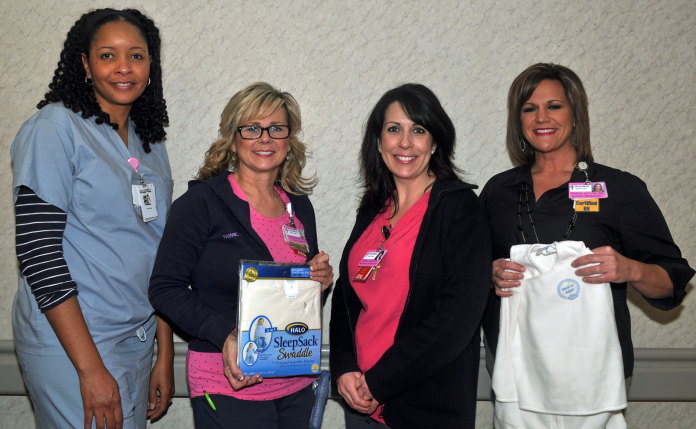
Nurses in the NICU show the Sleep Sack Swaddle that is given to each baby born in the nursery at Deaconess Hospital.

by Vickie Jenkins

The Birth Center at Deaconess hospital features eighteen elegantly appointed single-room maternity suites that allow mothers to share the birth experience with family in a beautiful, home-like atmosphere by staying in the same room for labor, delivery, recovery and postpartum care.  Nine-bed level-II NICU provides excellent care for babies who need additional medical attention. The NICU is staffed by registered nurses and board-certified neonatologists.  One-on-one nurse to patient ratio throughout the entire labor and delivery process.
Deaconess Hospital in Oklahoma City is known for their outstanding doctors and nurses. Picture: From L-R: Tanya Bogan, RN,  Yvonne Silberman RNC-OB,  Jonna Criscuoli, RN and Supervisor Trisha Brown, RNC-OB show the Sleep Sack Swaddle that each newborn receives at Deaconess.  The Sleep Sack is a Safe Sleep Initiative that was introduced February 14, 2014.
Here are some Safe Sleep Swaddle Tips to ensure a safe sleep for your baby. Always place baby to sleep on his or her back at naptime and night time.  Use a crib that meets current safety standards with a firm mattress that fits snugly and is covered with only a tight-fitting crib sheet.  Remove all blankets, comforters and toys from your baby’s sleep area (this includes loose blankets, bumpers, pillows and positioners).  The American Academy of Pediatrics suggests using a wearable blanket instead of loose blankets to keep your baby warm.  Offer a pacifier when putting baby to sleep. If breastfeeding, introduce pacifier after one month or after breastfeeding has been established.  Breastfeed, if possible, but when finished, put your baby back to sleep in his or her separate safe sleep area alongside your bed.  Room share, but don’t bed share.  Bed sharing can put a child at risk of suffocation.  Never  put your baby to sleep on any soft surface (adult beds, sofas, chairs, water beds, quilts, sheep skins etc.)  Never dress your baby too warmly for sleep.  Never allow anyone to smoke around your baby.
Deaconess Hospital is proud of their new Hugs and Kisses Security System as of January 2015.  The Hugs system offers the reliability that you and your staff can depend on every day to keep your infants safe.  The Hugs tag attaches in seconds and is automatically enrolled in the software.
Protection can start right in the delivery room.  The Hugs system requires no manual checks of infant tags or other devices to make sure they’re working. The Hugs system software -continually monitors the status of all devices, and will generate an alarm if something goes wrong.  There is an automatic mother/infant matching.  With the Kisses® option, the Hugs system automatically confirms that the right baby is with the right mother. There are no buttons to push and no numbers to match.
Deaconess Hospital offers Certified Lactation Consultants that round on all post-partum and NICU mothers.  Here you will find Neonatologists and Neonatal Nurse Practitioners on call 24/7 for high risk deliveries.