
SNL CROSSWORD CORNER – ANSWERS

Across
1 Kilauea flow
5 Clear dishes from
8 Jammies
11 Hosp. figures
14 Longest, as odds
16 Like many Berbers
18 *Occasion to pin back one’s coif?
19 Like village roads
20 Mediterranean country
22 Mixed martial artist Rousey
23 Girl of the fam
26 *Catchy part of a virtuous song?
29 Shortly
32 Arboreal marsupial
33 “You betcha”
34 Garage door opener brand
35 Org. that includes the TSA
38 *People born during the Era of Good Feelings?
42 Digs in the mud
43 Battery measures
44 Biblical mount
45 Bernie in his mittens, Keanu playing with puppies, etc.
46 “Yeah, that’s old news”
47 *Evening spent downloading the latest OS?
52 Manhattan option
53 Mind
54 Qualifying events
57 Calm
60 Social climbers, and what the answers to the starred clues literally have
64 Brings in
65 “You can guess the rest”
66 Put away
67 Keystone bumbler
68 Mauna __
69 Monumental
Down
1 “Geaux Tigers!” sch.
2 High point of a trip to Europe?
3 YouTube clip, for short
4 Mine, in MontrŽal
5 Capital in the Levant
6 Many an election night graphic, for short
7 Direct
8 LAX setting
9 Yak
10 Limited autonomy, so to speak
11 Pipe cleaner
12 Internet stranger
13 Quarterback maneuver
15 The Colorado fourteeners, e.g.: Abbr.
17 Hana Airport greeting
21 Compares
23 Facial cavity
24 Unsuitable
25 Watched from the sidelines
27 Left
28 Locks
30 Letters in ancient history
31 “Tell me if this is too personal, but … “
34 Understands
35 Currency of Serbia and Jordan
36 White with frost
37 Biting
39 Large volume
40 Singer Campbell
41 Draw
45 Two socks, hopefully
46 Mississippi source
47 Linguistic practices
48 Violinist/singer Haden
49 Light rail stop
50 Slop
51 Aware of
55 Cell service letters
56 Appease fully
58 Citigroup’s Jane Fraser, e.g.
59 Super vision?
61 Set component
62 Tetra- minus one
63 __ bunt

Savvy Senior – Tips on Caring for an Aging Parent

Dear Savvy Senior,
Where can I turn to for caregiving help? I help take care of my 80-year-old father and work too, and it’s wearing me out. Worn Out Wendy
Dear Wendy,
Taking care of an aging parent over a period of time – especially when juggling work and other family obligations – can be exhausting. But help and resources are available. Here’s what you should know.
Identify Your Needs: To help you determine and prioritize the kinds of help you need, a good first step is to make a detailed list of everything you do as your dad’s caregiver and the amount of time each task takes. Identify the times when you need help the most and which tasks others might be able to do for you.
Then list the types of care needed, such as simple companionship or doing active chores, like shopping or running errands. Once you determine this, here are some tips and places you can reach out to for help.
Care Helpers: If you have siblings or other loved ones close by, start by asking them if they could come and help with specific tasks. And see if friends, neighbors or faith group members could help too.
You also need to check into local resources that may be available. Many communities offer a range of free or subsidized services that help seniors and caregivers with basic needs such as home delivered meals, transportation, senior companion services and respite services, which offers short-term care so you can take an occasional break. Call your nearby Area Aging Agency (800-677-1116) for referrals to services or visit https://www.areawideaging.org/.
There are also a bevy of online services you can use to help you save time on certain chores. For example, online grocery shopping and home deliveries, and online pharmacy medication refills and deliveries. You can also order meal-kits or pre-made meals online through numerous meal service delivery companies and arrange needed transportation with ride sharing services like Lyft or Uber.
Or, if you can afford it, you may want to consider hiring someone a few hours a week to help with things like cooking, housekeeping or even personal care. Costs can run anywhere from $12 up to $25 per hour. https://www.care.com/ or https://www.carelinx.com/ are two good websites to help you find someone, or you can work with a local home care agency.
Financial Aids: If you’re handling your dad’s financial chores, make things easier by arranging for direct deposit for his income sources, and set up automatic payments for his utilities and other routine bills. You may also want to set up your dad’s online banking service, so you can pay bills and monitor his account anytime. Or, if you need help, consider hiring a bill paying service like SilverBills https://silverbills.com/, which charges a flat fee of $150 per month.
BenefitsCheckup.org is another excellent tool to look for financial assistance programs that may help your dad, particularly if he’s lower income.
Technology Solutions: To help you keep tabs on your dad when you are away at work or if he lives alone, there are affordable technology devices that can help. For example, there are medical alert systems and smart speakers that help with communication and allow him to call for help if needed. Home video cameras with two-way speakers that allow you to monitor and talk to him when you’re away. Electronic pill boxes that can notify you if he has taken his medications. And to help you coordinate his care with other members of his care team there are websites like https://lotsahelpinghands.com/.
Other Resources: There are also a number of other organizations you can draw on for additional information like the Family Care Alliance (Caregiver.org), which provides a state-by-state listing of caregiving programs and services; the Alzheimer’s Association https://www.alz.org/help-support/caregiving that provides information unique to the challenges of dementia caregivers; and the U.S. Department of Veterans Affairs https://caregiver.va.gov/, which offers caregiver support services to veterans and spouses.
Send your senior questions to: Savvy Senior, P.O. Box 5443, Norman, OK 73070, or visit SavvySenior.org. Jim Miller is a contributor to the NBC Today show and author of “The Savvy Senior” book.
OMRF scientist awarded $3.4 million to investigate immune cells

Fifty years ago, immunologists were just beginning to understand a newly discovered type of white blood cell that would come to be known as the T cell. Decades of research have since shown these protective cells to be so crucial, we couldn’t survive without them.
Fast-forward to today, and research stands at a similar infancy with a closely related immune cell called innate lymphoid cells, or ILCs, says Oklahoma Medical Research Foundation scientist Xiao-Hong Sun, Ph.D.
The National Institutes of Health recently awarded Sun a $3.4 million grant to continue unraveling mysteries about these cells, including whether they may offer clues about the differences in immune reactions between children and adults.
“It’s far too soon to say whether we will someday discover ILCs play a role as profound as T cells,” said Sun, who holds the Lew and Myra Ward Chair in Biomedical Research at OMRF. “But I hope this research will begin to answer that question.”
Sun joined OMRF in 1999 and studied T cells until pivoting her research to ILCs when scientists discovered them about a decade ago.
Initially, researchers believed ILCs originated only in bone marrow. In 2019, Sun discovered the thymus, a gland near the heart, can also produce them. The thymus trains the immune system to distinguish friendly cells from invaders. It tends to shrink and become less active as we age.
“Our previous discovery was important because it may shed light on why immune reactions differ between children and adults,” Sun said. “Childhood onset of asthma and food allergies are just two examples. This new study may help explain the underlying causes and suggest new therapeutic approaches.”
“It took a half-century of painstaking work by scientists around the world to get to our current understanding of T cells,” said OMRF Executive Vice President & Chief Medical Officer Judith James, M.D., Ph.D. “That’s often how science works. Dr. Sun is applying similar approaches to understand ILCs in an accelerated way. I’m excited to see where her research leads.”
Sun’s grant, No. 1R01AI178947-01, was awarded by the National Institute of Allergy and Infectious Diseases, part of the NIH. Oklahoma City’s Presbyterian Health Foundation provided funding for Sun to collect preliminary data for this research.
OKC Indian Clinic Raises Over $150,000 for hearing 19th Annual Red Feather Gala
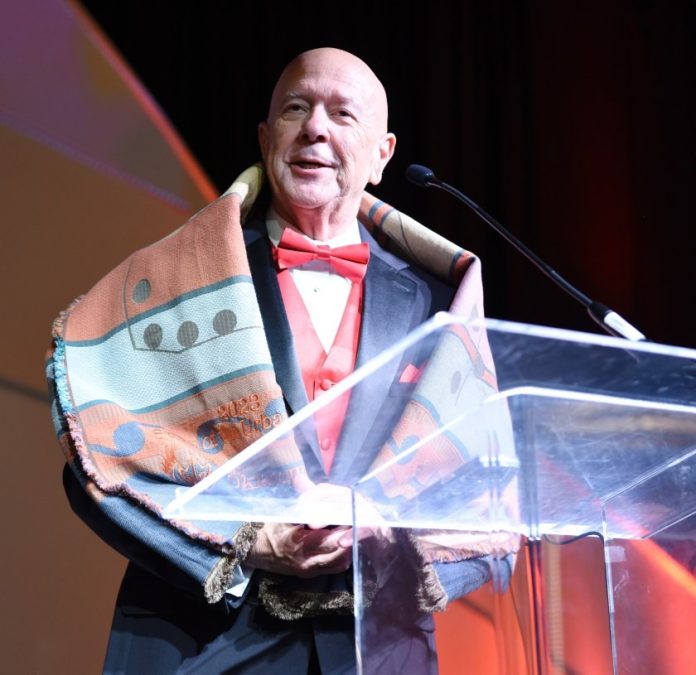
Oklahoma City Indian Clinic (OKCIC), celebrates the Red Feather Galaeach year during Native American Heritage month. This year’s occasion raised over $150,000 and will provide 30 pairs of hearing aids for patients in need.
Held at the Omni Hotel in downtown Oklahoma City, this year’s Red Feather Gala was emceed by Ali Meyer and Joleen Chaney, news anchors from KFOR. They successfully united nearly
600 supporters, including tribal representatives from various parts of Oklahoma, to contribute to OKCIC’s charitable mission. To support the cause, attendees had the opportunity to make donations through a silent and live auction and Native art.
An outstanding moment of the evening was when RADM (Ret.) Kevin Meeks received the 2023
Spirit of the Urban Indian honor. RADM Meeks was honored for his lifelong commitment to improving the well-being of Native Americans in Oklahoma. As a proud citizen of Chickasaw Nation, he currently serves as Deputy Secretary of Health. Throughout his career, he has played a pivotal role in the enhancement of health care services for American Indians.
“I am very honored to receive the Spirit of the Urban Indian Honor,” said RADM Meeks. “I’m so proud of Oklahoma City Indian Clinic’s accomplishments. They have created outstanding and nurtured outstanding partnerships with area tribes and the Indian Health Service. OKCIC is a great example for other urban Indian programs to emulate.”
The gala provided attendees with an opportunity to immerse themselves in Native American culture through a captivating dance performance by the Central Plains Dancers. Additionally, guests could make memories at the photo booth, while enjoying a night of dancing with live music and karaoke.
Silver from USS Oklahoma on Display at OK History Center
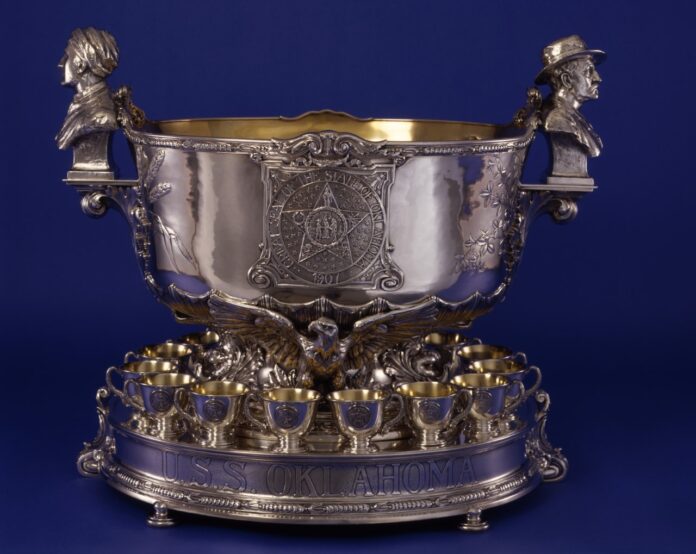
The Oklahoma History Center Museum will have pieces of silver service from the USS Oklahoma on display starting Monday, November 27, to commemorate the anniversary of the attack on Pearl Harbor. The complete set consists of 55 pieces. Only select pieces will be available for public view.
On December 7, 1941, the USS Oklahoma was one of eight battleships docked at the Pearl Harbor Naval Base in Honolulu, Hawaii, when it came under attack by the Imperial Japanese Navy Air Service. The USS Oklahoma suffered 429 casualties, and the battleship capsized due to multiple torpedo strikes.
The tradition of creating presentation silver sets for American warships of the “first rank” began with the USS Maine in the late 1890s. Continuing this tradition, the Oklahoma Legislature appropriated $7,500 in 1913 to create a silver service to express the state’s pride in having a new battleship named for the state. It was designed by Walter Dean of Oklahoma City and executed by Gorham Silversmiths of New York. The USS Oklahoma was christened on March 23, 1914, and the service was presented to the ship at that time. The service was used on the battleship from 1914 until 1941 but was removed before the attack on Pearl Harbor on December 7, 1941, and stored at the Puget Sound Shipyard in Bremerton, Washington. In 1946 after World War II, the Oklahoma Historical Society appointed a committee to find the silver service and return it to the state. In 1947 the U.S. Navy loaned the silver service to the Oklahoma Historical Society. After thorough polishing and repair, it went on public display.
The Oklahoma History Center is located at 800 Nazih Zuhdi Dr. in Oklahoma City. It is open to the public Monday through Saturday from 10 a.m.-5 p.m. Please call 405-522-0765 or visit https://www.okhistory.org/historycenter/ for admission costs and group rates.
The Cultural Reintegration of Veterans: Easing Civilian Life after Combat

By Thomas Shevlin, Recovery + Resiliency Director — Mission 22
Duty. Discipline. Teamwork. Loyalty. Sacrifice. Military culture inculcates these values into its members, and they are long cherished even after active personnel return to civilian life. Indeed, most Veterans from all branches of service continue to adhere to these values for the rest of their days.
These values make Veterans excellent citizens, neighbors, employees, and friends. Yet, the challenges of combat can also make it difficult for Veterans to reintegrate into their communities, as the effects of military service — which can be positive as well as negative — last a lifetime.
The good news is that caregivers, retirement communities, and other community members can help their Veterans thrive in civilian life. Below, I explain how.
Develop cultural competence
The first thing Americans can do is understand the unique perspective Veterans derive from their military experience. The military has its own subculture, so when civilian employers and communities inform themselves about its tenets, they build their cultural competency.
Namely, Veterans have encountered distinct life events during their service. For instance, deployment often requires long separations from their significant others and family members. They may also have faced combat, and some may have been responsible for keeping their team alive during hostilities. In consequence, many Veterans may be accustomed to wielding a level of authority that is rare in civilian contexts.
When Veterans’ unique experiences are not just acknowledged and included, but also respected, it has a positive impact by helping Veterans feel understood. This is a solid foundation upon which to build connections with others.
That’s why caregivers, staff at retirement communities, and other community members should take the time to learn about the military histories of each Veteran, which starts with knowing their military branch, rank, and deployments. It should also include any significant events that transpired during their service. Retirement communities should also offer workshops or training programs to help staff understand Veterans.
Create inclusive communities
Veterans often feel isolated and struggle to find ways to participate in civilian communities. As such, the best way caregivers, staff, and other community members can include Veterans is by listening actively to them and offering them both acceptance and empathy.
Toward that end, retirement communities should give staff opportunities to learn about and practice these essential communication skills. Over time, if Veterans see their experiences are valued, they will start to open up and contribute more and more.
Retirement communities should also consider creating support networks specifically for them. These groups foster a sense of camaraderie, making Veterans feel more comfortable and embedded in their new communities.
Normalize asking for help
While many Veterans suffer from mental health issues, they may fear seeking treatment due to the stigma that sometimes surrounds these challenges. That’s why retirement communities should not only provide mental health services, but also encourage help-seeking behavior.
In addition, navigating the healthcare system often presents difficulties of its own. The more communities can make their processes simple, clear, and intuitive, the more likely everyone — not just Veterans — will be able to avail themselves of these services effectively, meaning patient outcomes are likely to improve overall.
In general, caregivers and staff should be knowledgeable about the resources available, both within the retirement community and through external organizations. This includes access to healthcare services, mental health support, and any benefits they may be entitled to as veterans.
Everyone benefits by including Veterans
Civilian communities and employers should value the richness of Veterans’ experiences, the depth of their values, and the nature of their challenges. When they do, everyone benefits, and the whole community thrives.
— Thomas Shevlin, Recovery + Resiliency Director at Mission 22, is a former infantry machine gunner who served in the Marine Corps. He went through two deployments, one in combat. After serving four years, he became a personal trainer and obtained his Kinesiology degree. Having competed in bodybuilding and powerlifting, he has taken the knowledge of physical application and educational application to formulate a structure that is most advantageous for health and fitness goals. Still having a passion for the military, as well as that of health and fitness, he wanted to incorporate the two together in order to help veterans in need.
A Tribute to Veterans – Scroll of Honor
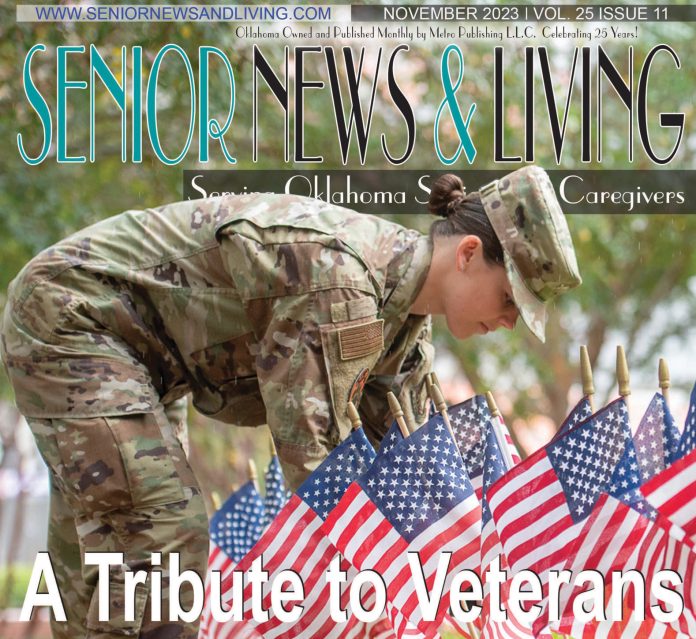
History of Veterans Day
World War I – known at the time as “The Great War” – officially ended when the Treaty of Versailles was signed on June 28, 1919, in the Palace of Versailles outside the town of Versailles, France. However, fighting ceased seven months earlier when an armistice, or temporary cessation of hostilities, between the Allied nations and Germany went into effect on the eleventh hour of the eleventh day of the eleventh month. For that reason, November 11, 1918, is generally regarded as the end of “the war to end all wars.”
Veterans Day continues to be observed on November 11, regardless of what day of the week on which it falls. The restoration of the observance of Veterans Day to November 11 not only preserves the historical significance of the date, but helps focus attention on the important purpose of Veterans Day: A celebration to honor America’s veterans for their patriotism, love of country, and willingness to serve and sacrifice for the common good.
Veterans Day Timeline – 1919
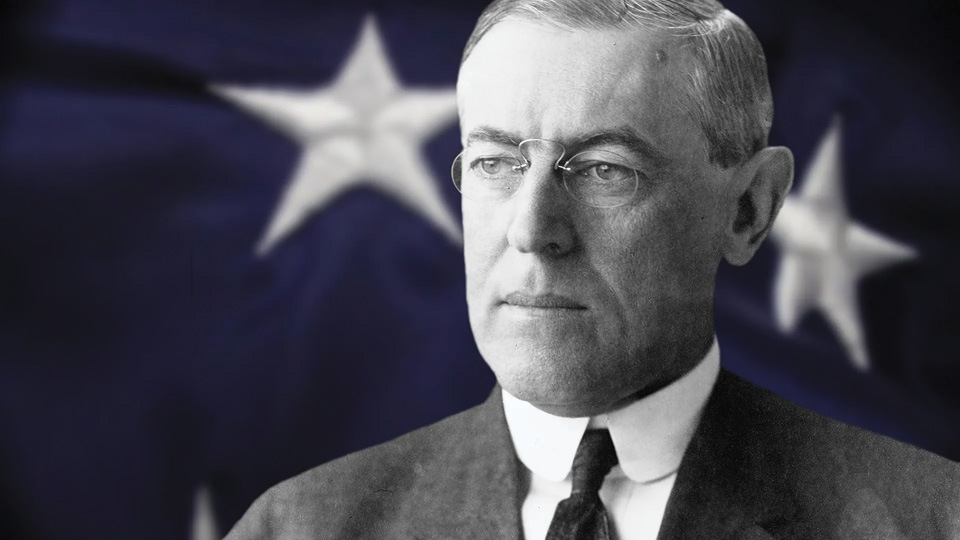
In November 1919, President Wilson proclaimed November 11 as the first commemoration of Armistice Day with the following words: “To us in America, the reflections of Armistice Day will be filled with solemn pride in the heroism of those who died in the country’s service and with gratitude for the victory, both because of the thing from which it has freed us and because of the opportunity it has given America to show her sympathy with peace and justice in the councils of the nations…”
The original concept for the celebration was for a day observed with parades and public meetings and a brief suspension of business beginning at 11:00 a.m.
Veterans Day Timeline – 1926
The United States Congress officially recognized the end of World War I when it passed a concurrent resolution on June 4, 1926, with these words:
The United States Congress officially recognized the end of World War I when it passed a concurrent resolution on June 4, 1926, with these words:
Whereas the 11th of November 1918, marked the cessation of the most destructive, sanguinary, and far reaching war in human annals and the resumption by the people of the United States of peaceful relations with other nations, which we hope may never again be severed, and Whereas it is fitting that the recurring anniversary of this date should be commemorated with thanksgiving and prayer and exercises designed to perpetuate peace through good will and mutual understanding between nations; and
Whereas the legislatures of twenty-seven of our States have already declared November 11 to be a legal holiday: Therefore be it Resolved by the Senate (the House of Representatives concurring), that the President of the United States is requested to issue a proclamation calling upon the officials to display the flag of the United States on all Government buildings on November 11 and inviting the people of the United States to observe the day in schools and churches, or other suitable places, with appropriate ceremonies of friendly relations with all other peoples.
Veterans Day Timeline – 1938
An Act (52 Stat. 351; 5 U. S. Code, Sec. 87a) approved May 13, 1938, made the 11th of November in each year a legal holiday—a day to be dedicated to the cause of world peace and to be thereafter celebrated and known as “Armistice Day.” Armistice Day was primarily a day set aside to honor Veterans of World War I.
Veterans Day Timeline – 1954
In 1954, after World War II had required the greatest mobilization of soldiers, sailors, Marines and airmen in the Nation’s history; after American forces had fought aggression in Korea, the 83rd Congress, at the urging of the Veterans service organizations, amended the Act of 1938 by striking out the word “Armistice” and inserting in its place the word “Veterans.” With the approval of this legislation (Public Law 380) on June 1, 1954, November 11th became a day to honor American Veterans of all wars.
Later that same year, on October 8th, President Dwight D. Eisenhower issued the first “Veterans Day Proclamation” (PDF) which stated: “In order to insure proper and widespread observance of this anniversary, all Veterans, all Veterans’ organizations, and the entire citizenry will wish to join hands in the common purpose. Toward this end, I am designating the Administrator of Veterans’ Affairs as Chairman of a Veterans Day National Committee, which shall include such other persons as the Chairman may select, and which will coordinate at the national level necessary planning for the observance. I am also requesting the heads of all departments and agencies of the Executive branch of the Government to assist the National Committee in every way possible.”
Veterans Day Timeline – 1958
In 1958, the White House advised VA’s General Counsel that the 1954 designation of the VA Administrator as Chairman of the Veterans Day National Committee applied to all subsequent VA Administrators. Since March 1989 when VA was elevated to a cabinet level department, the Secretary of Veterans Affairs has served as the committee’s chairman.
Veterans Day Timeline – 1968
The Uniform Holiday Bill (Public Law 90-363 (82 Stat. 250)) was signed on June 28, 1968, and was intended to ensure three-day weekends for Federal employees by celebrating four national holidays on Mondays: Washington’s Birthday, Memorial Day, Veterans Day, and Columbus Day. It was thought that these extended weekends would encourage travel, recreational and cultural activities and stimulate greater industrial and commercial production. Many states did not agree with this decision and continued to celebrate the holidays on their original dates.
Veterans Day Timeline – 1971
The first Veterans Day under the new law was observed with much confusion on October 25, 1971. It was quite apparent that the commemoration of this day was a matter of historic and patriotic significance to a great number of our citizens, and so on September 20th, 1975, President Gerald R. Ford signed Public Law 94-97 (89 Stat. 479), which returned the annual observance of Veterans Day to its original date of November 11, beginning in 1978. This action supported the desires of the overwhelming majority of state legislatures, all major veterans service organizations and the American people.
To view the “Veterans Day Proclamation” (PDF) visit:
https://tile.loc.gov/storage-services/service/ll/fedreg/fr019/fr019198/fr019198.pdf

14th Annual The Santa Market Craft Show
Story and photos by Darl DeVault, contributing editor

The Santa Market Craft Show, December 1-2, in the Pavilion Building at the OKC Fairgrounds, is Oklahoma City’s premiere free, two-day showcase for one-of-a-kind, Christmas-themed creations benefiting the Alzheimer’s Association of Oklahoma.
As one of Oklahoma’s most extensive free-admission, nonprofit arts and crafts shows, the 192 carefully chosen, creative vendors will sell their products during the 14th annual festive shopping experience. The show offers free parking, a silent auction, and more. The hours are 9 a.m. to 4 p.m., Friday and Saturday. Handcrafted items are available for all of the shoppers’ seasonal gift needs at an event that raised $44,000 last year for Alzheimer’s work.
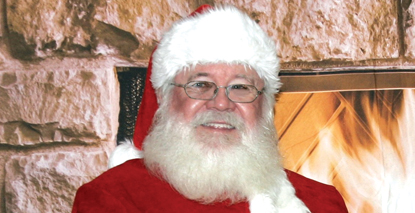
Visitors are encouraged to bring their children to get free photos taken all day with Santa at Oklahoma City’s most prestigious Christmas market each year.
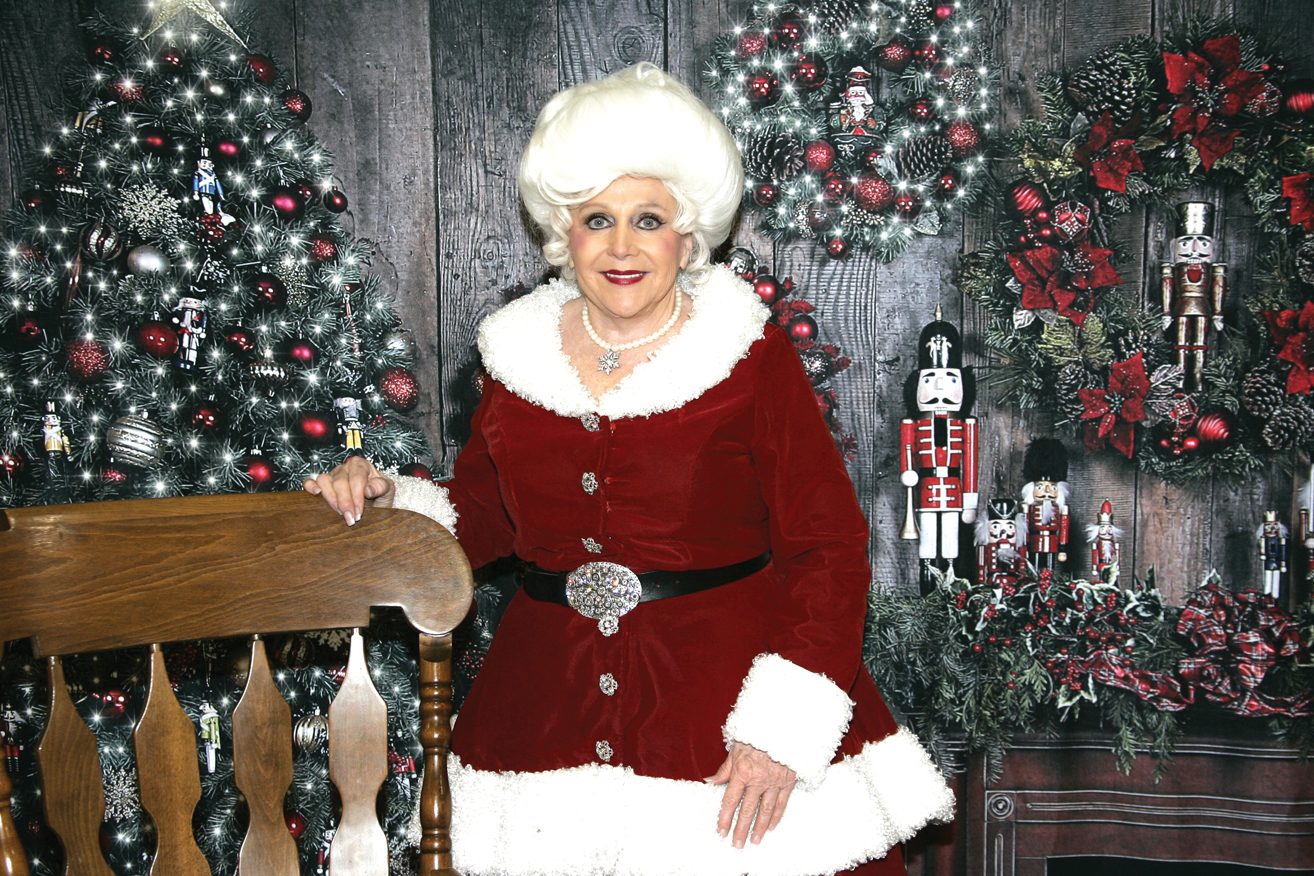
“We work on this show all year,” organizer Molly Nye said. “It is a true labor of love and helps all of us by doing something positive to combat Alzheimer’s. If anyone would like to be involved by volunteering, donating an item or service for the auction, or an item for the Alzheimer’s booth, please contact Joan Clarke at 405-314-1033. Be sure to get your free picture with Santa, Del Humphreys and visit with the lovely Mrs. Claus, Linda Turner. I also have it on good authority that The Grinch himself will be there this year.”
Shoppers are treated to home decor, homemade arts and crafts, boutique and holiday items, jewelry, children’s clothes, books and food goodies. The first 1,000 visitors receive free shopping bags sponsored by local businesses.
Joan Clarke, Molly Nye and Megan Nye began the event in 2010, after Joan’s husband died of Alzheimer’s in 2007, to support the charity addressing one of America’s most challenging diseases.
“Molly and I had been selling items at craft shows for years, and we decided to start our own event. We booked a small room in a hotel and started with 17 vendors,” Clarke said. “By the time our third year began, we realized how much work putting on a quality show involves, so we decided to make it a fundraiser. Molly immediately suggested Alzheimer’s since Joan lost her husband and Megan lost her father to the terrible disease.”
All funds raised through The Santa Market further the care, support and research efforts of the Alzheimer’s Association, a nonprofit 501(c)3 organization. All donations are tax-deductible as allowed by law.
“Our excellent vendors make this show what it is each year. We are one big family; everyone helps promote the show, advertise, and find new vendors. They donate to our cause, monetarily and with their products, even though it’s voluntary,” Clarke said. “They help with set up, clean up and everything in between. We have three vendors that have been with us all 14 years. Countless more have been with us for 5, 8, or even 10 years. One vendor named it ‘The Greatest Show on Earth,’ and it truly is.”
The organizers limit the number of crafters assigned spaces. Clarke says It is not about turning away new vendors but only allowing a limited number of each type of vendor. They wish they could take everyone, but having a variety makes for a better shopping experience, and the vendors have a much better chance of success.
Clarke says some vendors see the event as an opportunity to make sure their favorite charity receives as much as possible from their craft world and them personally. By writing personal checks to the Alzheimer’s Association when The Santa Market rolls around, these vendors do their part to help. They also donate products and gift certificates to the Alzheimer’s auction and the Alzheimer’s booth.
The Santa Market promoted the show at the annual Walk to End Alzheimer’s that occurred on October 28 in downtown OKC. This year, the event saw 1,431 people walk in 290 teams at Scissortail Park to help raise awareness and funds for care, support and research. The event exceeded its $625,000 in donations goal.
Clarke and her family have walked every year since 2003.
National presenting sponsor Edward Jones helps to make the walks the world’s largest event to fight Alzheimer’s. The Santa Market was one of three Impact Sponsors this year and fielded a team for the walk.
This year, the US Food and Drug Administration approved LEQEMBI, a prescription medicine treatment for people with mild cognitive impairment (MCI) or mild dementia due to Alzheimer’s disease. This newly approved drug in the US targets amyloid proteins and reduces existing amyloid brain plaque.
In a large, 18-month study, treatment with LEQEMBI was proven to slow the progression of early Alzheimer’s disease. It helped people remember, solve problems, and complete daily activities for longer.
The organizers say the successful 13 years of The Santa Market Craft Show could only be done with the help of quality vendors, loyal customers, volunteers, sponsors, and donors. They call it The Santa Market Family and hope everyone will attend to make it a success again this year. This year, Steve Eldridge, Senior News & Living and Oklahoma Nursing Times publisher, is a Diamond Sponsor. For more info, see: www.thesantamarket.org.

WWII Infantryman Celebrates Another Veterans Day
Story and photos by Darl DeVault, contributing editor

Born on a cotton farm near Bessie, Oklahoma, Ivan Evans Jr. married his Dill High School sweetheart Erma J. Sallee and was drafted right after graduation to become a decorated infantryman in the U.S. Army during the last year of WWII in Europe.
After only 16 weeks of U.S. Army basic training in Texas, he sailed as a replacement soldier to rainy, fierce fighting in early November in the rugged forested terrain of the French Vosges Mountains. The mountains served as a seemingly impregnable fortress for German troops determined to hold the last barrier between the Allies and the Rhine.
Trained quickly to be a replacement soldier in the infantry because seven out of ten infantry soldiers suffered casualties in WWII, Evans became a light machine gunner.
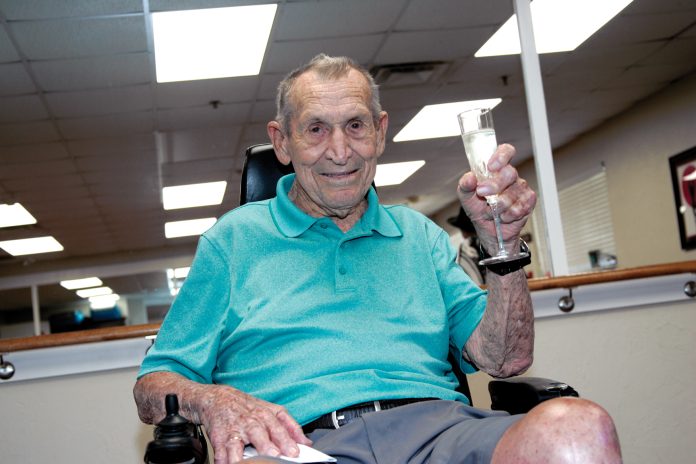
Evans, now 98 and a 23-year resident of Spanish Cove Retirement Center in Yukon, saw more action in his almost year on the front lines in Europe than many in the whole war. He is proud that his fellow Spanish Cove residents celebrate and honor American veterans for “their patriotism, love of country, and willingness to serve and sacrifice for the common good.”
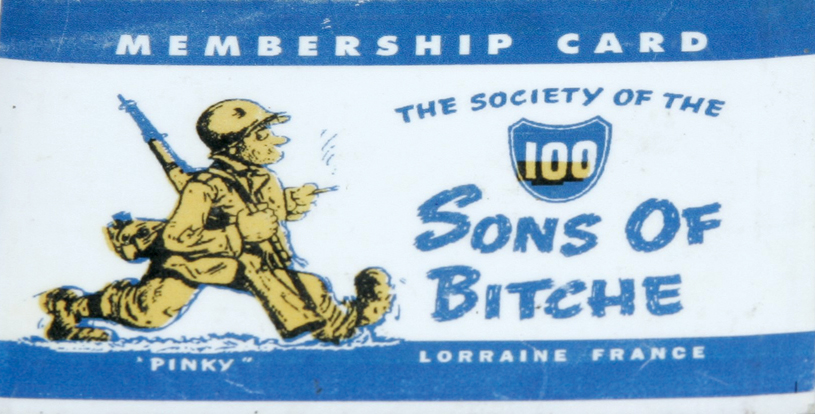
He paid careful attention in his abbreviated training, earning a Bronze Star for gallantry and a Purple Heart as his proud 100th Infantry Division conquered more enemy territory with fewer casualties than any other division in the war.
“About my Purple Heart, a German did that—nothing I could do about it,” Evans said in a recent interview about the fierce fighting taking the Maginot Line.
The only time Evans was not at his light machine gun on the front lines attacking was the seven weeks in a Mobile Army Surgical Hospital unit and recovery from being shot in the arm.
He explains his complete recovery was based on luck as he was moving through triage waiting for surgery when it was the only neurosurgeon on duty’s turn. So, Evans received the most skilled surgery available to repair the damaged nerves in his arm and ensure he was pain-free and capable for the rest of his life.
His full recovery meant soon he was back in the line, earning more respect from his fellow soldiers in his platoon.
Evans has now seen 77 Veterans Days honoring his patriotism and service. He is still quick to tell people his survival on fire-swept terrain in WWII was based on mere seconds and inches. He escaped death several times in the world’s largest and most violent armed conflict. Sixteen million American men and women served in uniform during the war. More than 400,000 lost their lives.
His 31-lb Browning 30 caliber light machine gun was a “crew-served weapon.” Evans was the gunner serving with an assistant gunner who carried the tripod and loaded the weapon and two ammo carriers.
Evans spoke about how the 45 caliber M1911 Colt semi-automatic pistol he was issued as a light machine gunner was not enough protection when the fighting got in close. He received permission to carry a M1 carbine rifle.
“My Bronze Star medal was my act of bravery, disarming a German and capturing him in hand-to-hand combat when he attacked me in a bayonet charge while I was in my foxhole,” Evans said. “In the middle of a pitched battle and heavy shelling, I recognized the form of a German soldier appear before me and reached back to grab my carbine lying behind me. So when he thrust his rifle with bayonet affixed at the center of my body, I was turned reaching back, and he just missed me by sliding his weapon across my chest.
I stopped reaching for my carbine and grabbed his rifle before he could pull it back to stab at me again. The force of his forward motion gave me just enough leverage to catch him off balance and turn him as I struck a blow that stripped him of his rifle. In the ensuing hand-to-hand combat, I got control and captured him as my friend in our foxhole did the same to another German. We were both awarded Bronze Star medals for gallantry in capturing these two enemy soldiers.”
Evans returned to wait for the next attack after marching them to the rear to turn in as prisoners. He fought across France and into Germany as part of the 398 Infantry Regiment to the war’s end.
Deep into one of the coldest winters in recent European history, it was often a severe struggle to dig foxholes with smallish entrenching tools through snow and a foot of frozen ground before reaching softer earth.
Evans says once he narrowly escaped death by leaving his foxhole.
“The heavy shelling had just stopped, and the guy in the foxhole with me said the cooks promised to bring up a hot meal,” Evans said. “The guy said I’m going to go get that meal. I said I’m not because the Germans will likely begin shelling again soon. I’m going to stay right here and eat my K ration.”
So the soldier got up and left.
“I don’t remember what made me decide to leave that foxhole after he left,” Evans said. “Soon, I was walking about 75 yards back to get behind our fortified area of the line when I heard a big explosion behind me. I realized it was close to my foxhole, so I ran back, only to find our foxhole was a big shell crater. I had to be reissued all my gear and a new machine gun.”
“And that’s how God took care of me because I wasn’t planning to get out of that foxhole,” Evans said. “I was going to stay there and eat my K ration. God and a promise of a hot meal saved us that day.”
Evans humbly says his performance was typical in the well-disciplined, effective fighting force of the 100th Division taking the battle to the enemy. He said he was proud when it was life and death and surviving as a unit; they all pulled together.
The chaotic fighting to take the strongly fortified Forts Freudenberg. and Schiesseck of the Maginot Line northwest of Bitche, France, from December 17th- 21st, 1944, was some of the fiercest fighting in the war. While farther north, the much-heralded Battle of the Bulge was receiving the lion’s share of the world’s attention.
Evans often moved over open terrain in the leading elements to set up his machine gun to fire on pill boxes under direct enemy observation. These brave men were subjected to artillery, mortar and sniper fire while keeping the assault moving forward.
The 100 Division fought on after liberating Bitche. They fought to cross the Rhine River into Germany, and then battles in crossing the rivers Neckar and Jagst. They attacked Heilbronn to pursue the enemy forces until April 21 near Stuttgart and became a unit in the Army of Occupation of Germany after VE Day restored freedom to Europe. Evans served the reestablished freedom near Stuttgart for seven months after the war.
Evans then returned to his wife in Oklahoma. Together, they attended Oklahoma A&M in Stillwater, now OSU. Evans earned a bachelor’s degree in education, while his wife earned a degree in business education with honors and later a master’s degree in the same subject.
They both taught high school students for the rest of their careers. Evans retired from a 40-year education career as a coach, teacher, and high school principal.
Married almost 69 years, Evans and his wife, who died in 2013, had one son, two grandsons, and three great-grandchildren.
“I wouldn’t be here talking to you if God hadn’t got me through,” Evans said. “I’ve lived a good life. If God were to tell me he’d give me a new life, I wouldn’t take it. I wouldn’t change a thing. I can’t explain how important freedom is; sometimes people do not realize how fortunate they are to have the freedoms they have.”