
Wednesday, June 24, 2026

TRAVEL / ENTERTAINMENT: Local Theater productions offer an entertainment escape

0

Photography and Text by Terry “Travels with Terry” Zinn [email protected]

While physical travel is still hindered with virus road blocks, traveling to local theater productions can offer a safe way to escape self imposed restrictions. While Masks and proof of vaccination is needed at the venues, with your K95 or KM95 masks, makes the outing relatively safe. And yes it is a hassle to wear a mask while watching plays and musicals, but it is a sign of our times and should provide a measure of security.
Long time and award winning Lyric Theater of Oklahoma has always offered high quality productions of musicals and in recent years, plays. This season resumes with shows that were postponed because of the virus. Back and rescheduled is: Distant Thunder at the First Americans Museum, starting March 23, 2022; Head over Heels at the Plaza Theater starting April 20; Matilda at the Civic Center starting June 21;then Rogers and Hammerstein’s Carousel at the Music Hall, starting July 5; and ending the summer season with Kinky Boots at the Civic Center Music Hall, starting July 19.
Two extra shows, Rocky Horror Show, and A Christmas Carol, are fall season favorites.
Oklahomans are familiar with Lyric Theater, and long time friends will remember their starting days on the Oklahoma City University Campus, where local talent was nurtured and given a profession venue for the their craft. In recent years Lyric has cast its main leads from tryouts in New York City, bringing Broadway talent to Oklahoma. As popular as ever, single tickets are not impossible to obtain but season subscriptions are needed for securing the best seats and not missing a show in the season.
Lyric Theater describes “Distant Thunder” the musical as: Darrell Waters, a brash young attorney, returns to his childhood home in Montana to broker a deal between a large energy company and the Blackfeet Nation. In the process, he is forced to confront his reclusive father about their painful past. Through a childhood sweetheart, Dorothy Dark Eyes, he rediscovers his identity and feels his perspective shift: his clever business deal will destroy her language school, further erode Blackfeet culture and taint their land. Darrell must grapple with the paradigm of being Native American in America.
The production will be staged at the brand new Native American Center, across the Oklahoma River from the boat house district. First Americans Museum celebrates the shared American history through the collective stories of 39 distinct tribal nations in Oklahoma today. The 175,000 sq ft museum is located at 659 First Americans Boulevard in Oklahoma City. Driving and Parking information along with Ticket Information can be found at: https://lyrictheatreokc.com/venues/first-americans-museum/. It is a world premiere.
Head Over Heals; a New Musical is A fearlessly fresh, new musical mash-up of posh and punk!
Matilda is a Family Friendly Musical.The inspiring story of an extraordinary little girl who, gifted with a vivid imagination and a sharp wit, dares to prove that you can change your destiny despite all odds.
Kinky Boots is an exhilarating Tony Award-winner tells the true story about a struggling shoe factory that will lift your spirits to high-heeled heights!
Carousel is a familiar staple of Musical Theater and this production teams up with Ballet Oklahoma which promises a most artistic rendition of the famous Ballet of the second act.
While Lyric is the premiere Oklahoma theater company you might be surprised to explore the theatrical productions at colleges UCO, OCU, OU, and Guthrie’s Pollard Theater and reinvented City Rep, and Carpenter Square in their brand new venue. Theater abounds in Oklahoma and is there for your enjoyment, when we all can use a little escape these days.

Mr. Terry Zinn – Travel Editor
Past President: International Food Wine and Travel Writers Association
3110 N.W. 15 Street – Oklahoma City, OK 73107
https://realtraveladventures.com/?s=terry+zinn
https://realtraveladventures.com/?s=zinn
http://new.okveterannews.com/?s=TERRY+ZINN
www.martinitravels.com

Seamless care: SSM Midwest implements Epic

0
Joy Mathews, RN manager - CCU/PCU and Debbie Pender, RN, chief nursing officer/VP patient care services at SSM Midwest review the recent implementation of Epic at the Midwest City hospital.

by James Coburn – Staff Writer

A patient-friendly hallmark in the health care industry has arrived at SSM Health St. Anthony Hospital – Midwest, said Debbie Pender, RN, chief nursing officer/VP patient care services. SSM Midwest went live with Epic on December 11.
SSM Midwest has brought on board Epic, a leading-edge electronic health records system to streamline all areas of operation.
SSM has utilized the Epic technology platform since 2011 to seamlessly coordinate care without a paper trail.
Epic technology allows patients to have convenient digital access to their health information. Documentation of the patient medical record is stored in the easy to access hospital computer system.
Epic is one of the most preferred platforms to document health records in the nation. The patient’s entire encounter with SSM Midwest is secured, confidential, and easily accessible.
“Different departments can see that medical record,” Pender said. “So, it really helps facilitate quality of care through ensuring continuity of the communication from department to department, even from the in-patient to the out-patient phase when physicians have Epic in their medical offices as well. So, that medical record goes wherever the patient goes in any hospital that has Epic.”
Any patient discharged from SSM Midwest who somehow ends up in another hospital system using Epic will have their SSM record available to that hospital whether in Oklahoma or out of state. That whole record of care will go with that patient as a requirement of the Affordable Care Act. Hospitals for reimbursement purposes must come on board with an electronic medical record allowing portability of health care records from organization to organization.
“A patient’s medical history and all the medications that they take travels with that patient which is very important for safe care,” Pender continued. “There are some safeguards built within Epic that improve our patients’ safety here.”
The electronic medical record has been shown to prevent mistakes being made across the United States. Many elderly adults are known to take multiple medications. A lot of times they forget their medicine list, or they could have several doctors who have prescribed medicines as specialists. To avoid confusion, nurses can see all of a primary care physician’s record from the computer. Physicians using Epic can update a patient’s current medication list. Emergency rooms can easily access Epic records from a physician’s office. The continuation of care is simplified.
“We are very excited to upgrade the technology at SSM Health St. Anthony Hospital – Midwest with Epic,” said Dr. Kevin L. Lewis, President, SSM Health St. Anthony Hospital – Midwest & Regional President of SSM Health Medical Group Oklahoma. “We are committed to Midwest City and providing our patients with exceptional health care services.”
Epic allows for safe IV infusions with medication administration with warnings implemented if guidelines are not followed properly.
“There’s a lot of surveillance ability within Epic that tells us if a patient is having a stroke, if a patient perhaps has sepsis, and a lot of reports that we can get out of Epic that tell us about a patient’s care experience from a quality/safety perspective,” Pender said.
Several of the SSM Midwest nurses have stated that the Epic implementation was the best go-live event they’ve ever experienced. Nurses commented that SSM was well prepared in bringing Epic to SSM Midwest.
“We are enjoying Epic here at Midwest, since it is so user friendly,” said Joy Mathews, RN manager – CCU/PCU. “Documenting on one computer eliminates the need for paper, which is convenient in caring for our critically ill patients in the CCU. Additionally, it will be a huge tool for recruiting high quality nurses to our staff.”
Pender serves as a team builder as the chief nursing officer at SSM Midwest. She has been CNO of SSM Midwest since June, after SSM purchased the hospital from Community Health Systems in April. Her goal has been to enhance the leadership structure from a for-profit hospital to a not-for-profit.
A lot of SSM Midwest nurses have used Epic in previous health care organizations they have worked in. This was helpful in the transition.
“I have not met one person who thinks Epic was a bad thing,” Pender said. “Now it’s change, so they have to learn new work flows and the functionality within Epic, but everybody loves Epic.”
She said it’s nice to see seamless documentation utilized from department to department, all for the betterment of patient care.
“The care isn’t just in a silo wherever you are in the hospital. A physician can see every piece of the record,” Pender said. “It’s been very positive.”
The data analytics made available by Epic is phenomenal when evaluating best practices.
Safe and effective care is what patients deserve from any bedside nurse, Pender said.

Honey Springs Battlefield to Host “The First Indian Home Guard” Presentation

0

Honey Springs Battlefield is excited to announce a special presentation, “The First Indian Home Guard,” to be held at the battlefield’s Visitor Center on Saturday, February 26, at 1 p.m. Dr. Jane Johansson, professor in the Department of History and Political Science at Rogers State University and editor of the book “Albert C. Ellithorpe, the First Indian Home Guards, and the Civil War on the Trans-Mississippi Frontier,” will speak about the regiment’s unique history in relation to the Civil War in Indian Territory and the Battle of Honey Springs.
“Recruited in Kansas refugee camps in the spring of 1862, the First Indian Home Guard was a unique Civil War regiment,” said Johansson. “Comprised of whites, refugee Muscogee Creeks and Seminoles, and African Creeks, the regiment served in a variety of military operations from 1862–1865. Notable actions that the unit engaged in included Locust Grove, Fort Wayne, Cane Hill, Prairie Grove, Honey Springs and many smaller encounters. This presentation will explore the regiment’s background, its composition, notable personalities, military actions, relations with the federal government and the postwar era,” Johansson continued.
Johansson is a native Oklahoman and graduate of Oklahoma Baptist University (OBU). After completing her bachelor’s degree at OBU, Johansson attended the University of North Texas where she earned a master’s degree in library science and a doctorate in United States history. She has written three books about the Civil War west of the Mississippi River, and co-edited two volumes of the papers of Will Rogers. Her most recent book, “Albert C. Ellithorpe, the First Indian Home Guards, and the Civil War on the Trans-Mississippi Frontier,” was honored with the Founders Award given by the American Civil War Museum in recognition of “excellence in the editing of primary source documents.” Johansson especially enjoys traveling to historic sites and visiting used bookstores with her husband, Richmond, an English professor at Northwestern Oklahoma State University.
After the presentation, visitors will have the opportunity to tour the Visitor Center’s exhibits, view the new “Battle of Honey Springs” film, buy newly stocked items from the gift shop, and tour the largest Civil War battlefield in Oklahoma.
For more information regarding the presentation and Honey Springs Battlefield, please email [email protected] or [email protected], or call 918-617-7125.
Honey Springs Battlefield is located east of U.S. Highway 69 between Oktaha and Rentiesville. The Visitor Center is located on a hill within close proximity to the Oklahoma Blues Hall of Fame in Rentiesville. Take the second left after reaching the Oklahoma Blues Hall of Fame Museum (driving from the west).

Greg Schwem: The one-day workweek. Because, why not?

0
While some workers wish for a four-day workweek, Greg Schwem proposes a one-day workweek would be even better.

by Greg Schwem

Aw, heck, let’s just work one day a week.
I mean, we’re all overstressed, burned out, mentally exhausted and up in arms that receiving paychecks requires us to do something other than attend spin classes whenever we feel like it. Never mind that our parents, their parents, and their parents’ parents clocked in at 9 a.m. and left at 5 p.m. Monday through Friday. True, there was no such thing as Zoom to haunt their weekend plans; but there also wasn’t a “Bring Your Dog to Work” day at my dad’s office.
We demand a shorter work week. We want Dolly Parton to sing, “Workin’ 9 to noon, ’cause three hours should be plenty; Boss, my brain is fried, although I’m still in my 20s…”
Bosses and even politicians appear to be learning the new lyrics, or at least humming the tune. Last July, Rep. Mark Takano (D-CA) introduced a bill amending the Fair Labor Standards Act of 1938, reducing the standard work week from 40 to 32 hours. The bill is currently languishing in the House and the chances of it remaining there will only intensify if Congress decides to take Fridays off.
Meanwhile, a nonprofit pilot program, 4 Day Week Global, is encouraging companies to sign up and participate in shortened weeks. The website contains a petition, seeking 100,000 signatures from employees who favor working less, even naming specific companies and the number of employees who have already signed. When I checked, the petition had received 114 signatures from Amazon workers, a figure I found shockingly low considering the guy who kept dropping packages at my door the week prior to Christmas appeared to be working about 100 hours a week.
The site points to companies like crowdfunding platform Kickstarter and fintech startup Bolt, which have switched to four-day workweeks. It also posts studies with phrases like “productivity increase” and “laser focused employees” as proof that a three-day weekend is an idea whose time has come.
So, why stop there?
If workers are “laser focused” working four days a week, imagine how sharp they would be if they worked three days? Or two? Or even one? Let’s try it. I hereby present to you a company that requires employees only produce eight hours of weekly work. I’ll call it Slack.
Wait, that company already exists. My bad. Let’s call it Slacker. That’s a movie but not yet a Fortune 500 company.
Before my company is besieged with applications from enterprising workers who want to change the world providing it doesn’t conflict with thrice weekly Pilates sessions, please be aware that working for Slacker does have some drawbacks.
During your one day of employment, you cannot break for lunch.
Red Bull and other energy drinks are forbidden. If you need a “jolt” before starting your weekly eight-hour shift, you’re probably not going to fit in at Slacker.
Don’t even think about asking for paid vacation.
You will be required to work in an office, which will not contain clocks of any type. I don’t need Slacker employees, on their way to the parking lot to begin their six-day weekends, saying, “Man, I thought 5 o’clock would NEVER get here.”
Calling in sick is allowed, but sick days must be made up in full. That’s right, if you’re sick one day, you must work TWO days the following week. If that makes me a tyrant of a boss, just remember there are plenty of jobs available at Kickstarter, where your workload will quadruple!

I will pay you an honest wage, but don’t expect a 401(k) or profit-sharing plan of any type. You’ll have plenty of free time to become a Bitcoin millionaire.
Finally, I will not offer a health care plan, but I will provide gym memberships. Slacker employees are expected to use their off time to stay in shape. I don’t need any workforce members unexpectedly dropping dead on their off days.
From boredom.
Kids be warned; the Great Elf Retirement may soon be upon us.
(Greg Schwem is a corporate stand-up comedian and author of two books: “Text Me If You’re Breathing: Observations, Frustrations and Life Lessons From a Low-Tech Dad” and the recently released “The Road To Success Goes Through the Salad Bar: A Pile of BS From a Corporate Comedian,” available at Amazon.com. Visit Greg on the web at www.gregschwem.com.
You’ve enjoyed reading, and laughing at, Greg Schwem’s monthly humor columns in Senior Living News. But did you know Greg is also a nationally touring stand-up comedian? And he loves to make audiences laugh about the joys, and frustrations, of growing older. Watch the clip and, if you’d like Greg to perform at your senior center or senior event, contact him through his website at www.gregschwem.com)

TINSELTOWN TALKS: Lana Wood still questions sister Natalie’s death

0
Cover of Lana Wood’s book alongside photo of Lana - provided by publicist.
Sean Connery and Lana Wood as Plenty O’Tool in Diamonds Are Forever. Publicity photo for United Artists.

By Nick Thomas

The movie world was shocked when the body of 43-year-old Natalie Wood was found floating lifeless in the ocean off Catalina Island on the morning of November 29, 1981. Forty years later, sister Lana still can’t accept that the incident was nothing more than a tragic accident.
Natalie’s watery demise remains one of Hollywood’s enduring mysteries recently resurrected in Lana’s “Little Sister: My Investigation into the Mysterious Death of Natalie Wood” published last November, 40 years after the beloved actress’s death (see www.amazon.com/Lana-Wood/e/B001KDRGZ8?).
Despite a morbid fear of drowning, Natalie would often go boating with husband Robert Wagner but, according to Lana, remained especially terrified of “dark ocean water.”
“How did she end up in the sea at nighttime?” asked Lana from her home in Los Angeles. “The circumstances remain a question for many people. I wanted to present the facts about her death in this new book, including the police and coroner’s reports, as well as a new witness who heard screams that night.”
Natalie and Wagner, along with fellow actor Christopher Walken, had embarked on a weekend cruise aboard Wagner’s motor yacht skippered for the trip by Dennis Davern. Although the group had been drinking and the couple apparently argued, Lana doesn’t believe her sister merely fell overboard or that she tumbled into the water while attempting a nighttime launch of a dingy attached to the boat to leave after the argument.
While no one on board at the time has ever been charged with involvement in Natalie’s death, speculation on how Natalie got into the water the night before her body was discovered continues to haunt her sister.
“I wrote another book (in 2011) that looked at Natalie’s life and happier times,” recalled Lana. “But the new book wasn’t as easy to write because I’d get emotional and have to walk away from it periodically.”
Both sisters were close, having been thrust into acting by their mother. But each took a different career path with Natalie working mostly in film to reach true superstar fame while Lana embraced the television route and enjoyed modest success in films such as the perky Bond girl Plenty O’Toole in “Diamonds Are Forever.” And while Lana may have lived in her famous sister’s shadow, she appears to have been comfortable in that shade.
“Natalie loved being a movie star,” said Lana. “Any time she left home, she would put on her make-up, do her hair, and dress impeccably because she never wanted to disappoint when out in public. While I enjoyed working, I didn’t want to be scrutinized everywhere I went or be constantly photographed. I didn’t seek that fame.”
She is, however, still convinced there’s more to the story of her sister’s death.
“I don’t know if the truth will ever come out,” she says. “I hope my book will keep people probing for answers and keep Natalie’s memory alive.”
Nick Thomas teaches at Auburn University at Montgomery, in Alabama, and has written features, columns, and interviews for numerous magazines and newspapers. See www.tinseltowntalks.com.

Protecting the Vulnerable from Financial Exploitation

0

Every year many elderly and vulnerable adults become victims of financial exploitation. Financial exploitation is defined as illegal or improper use, control, or withholding of property, income, or resources.
Many people fall victim to financial exploitation at the hands of both strangers and family. This crime is a felony under Oklahoma law. Penalties include jail time, thousands of dollars in fines, and restitution.
Signs of financial exploitation can include, but are not limited to the following:
• Unusual bank activity • Change of statement delivery address • Unpaid bills • Unexplained withdrawals or transfers • Large purchases that don’t fit the persons income level
How to protect against financial exploitation: • Estate planning • Choose a Power of Attorney ahead of time • Consult an Elder Law Attorney If you or someone you know are experiencing financial exploitation contact Adult Protective Services (APS). 800-522-3511 or okhotline.org
The Long-Term Care Ombudsman Program is in place to advocate for elderly Oklahomans who reside in Long Term Care facilities. As our aging population grows, so does the need to make sure our loved ones are being cared for. If you have question or concerns regarding Resident’s Rights in a long term care facility there are several ways to contact an Areawide Aging Agency Ombudsman. Call 405-942-8500 to speak to an Ombudsman Supervisor, visit the agency website at www.areawideaging.org, or find us on Facebook.

SAVVY SENIOR: Approaching 65? Here’s What to Know About Enrolling in Medicare

0

Dear Savvy Senior, Can you give me a brief rundown of Medicare’s enrollment choices along with when and how to sign-up? Approaching 65

Dear Approaching,
The rules and timetables for Medicare enrollment can be confusing to many new retirees, so it’s smart to plan ahead. Here’s a simplified rundown of what to know.
First a quick review. Remember that original Medicare has two parts: Part A, which provides hospital coverage and is free for most people, and Part B which covers doctor’s visits and other medical services, and costs $170.10 per month for most enrollees in 2021.
When to Enroll
Everyone is eligible for Medicare at age 65, even if your full Social Security retirement age is 66 or later.
You can enroll any time during the “initial enrollment period,” which is a seven-month period that includes the three months before, the month of, and the three months after your 65th birthday. It’s best to enroll three months before your birth month to ensure your coverage starts when you turn 65.
If you happen to miss the seven-month sign-up window for Medicare Part B, you’ll have to wait until the next “general enrollment period” which runs from Jan. 1 to March 31 with benefits beginning the following July 1. You’ll also incur a 10 percent penalty for each year you wait beyond your initial enrollment period, which will be tacked on to your monthly Part B premium. You can sign up for premium-free Part A, at any time with no penalty.
Working Exceptions
Special rules apply if you’re eligible for Medicare and still on the job. If you have health insurance coverage through your employer or your spouse’s employer, and the company has 20 or more employees, you have a “special enrollment period” in which you can sign up. This means that you can delay enrolling in Medicare Part B and are not subject to the 10 percent late-enrollment penalty as long as you sign up within eight months of losing that coverage.
Drug Coverage
Be aware that original Medicare does not cover prescription medications, so if you don’t have credible drug coverage from an employer or union, you’ll need to buy a Part D drug plan from a private insurance company (see Medicare.gov/plan-compare) during your initial enrollment if you want coverage. If you don’t, you’ll incur a premium penalty – 1 percent of the average national premium ($33 in 2022) for every month you don’t have coverage – if you enroll later.
Supplemental Coverage
If you choose original Medicare, it’s also a good idea to get a Medigap (Medicare supplemental) policy within six months after enrolling in Part B to help pay for things that aren’t covered by Medicare like copayments, coinsurance and deductibles. See Medicare.gov/medigap-supplemental-insurance-plans to shop and compare policies.
All-In-One Plans
Instead of getting original Medicare, plus a Part D drug plan and a Medigap policy, you could sign up for a Medicare Advantage plan instead (see Medicare.gov/plan-compare) that covers everything in one plan. Nearly half of all new Medicare enrollees are signing up for Advantage plans.
These plans, which are also sold by insurance companies, are generally available through HMOs and PPOs and often have cheaper premiums, but their deductibles and co-pays are usually higher. Many of these plans also provide coverage for extra services not offered by original Medicare like dental, hearing and vision coverage along with gym/fitness memberships, and most plans include prescription drug coverage too.
How to Enroll
If you’re already receiving your Social Security benefits before 65, you will automatically be enrolled in Part A and Part B, and you’ll receive your Medicare card about three months before your 65th birthday. It will include instructions to return it if you have work coverage that qualifies you for late enrollment.
If you’re not receiving Social Security, you’ll need to enroll either online at SSA.gov/medicare or over the phone at 800-772-1213.
If you need help, get a copy of “Get It Together: Organize Your Records So Your Family Won’t Have To” at Nolo.com for $17.50 for the downloadable versions, or $20 for a printed copy.
Send your senior questions to: Savvy Senior, P.O. Box 5443, Norman, OK 73070, or visit SavvySenior.org. Jim Miller is a contributor to the NBC Today show and author of “The Savvy Senior” book.

SITUATION UPDATE: COVID-19

0

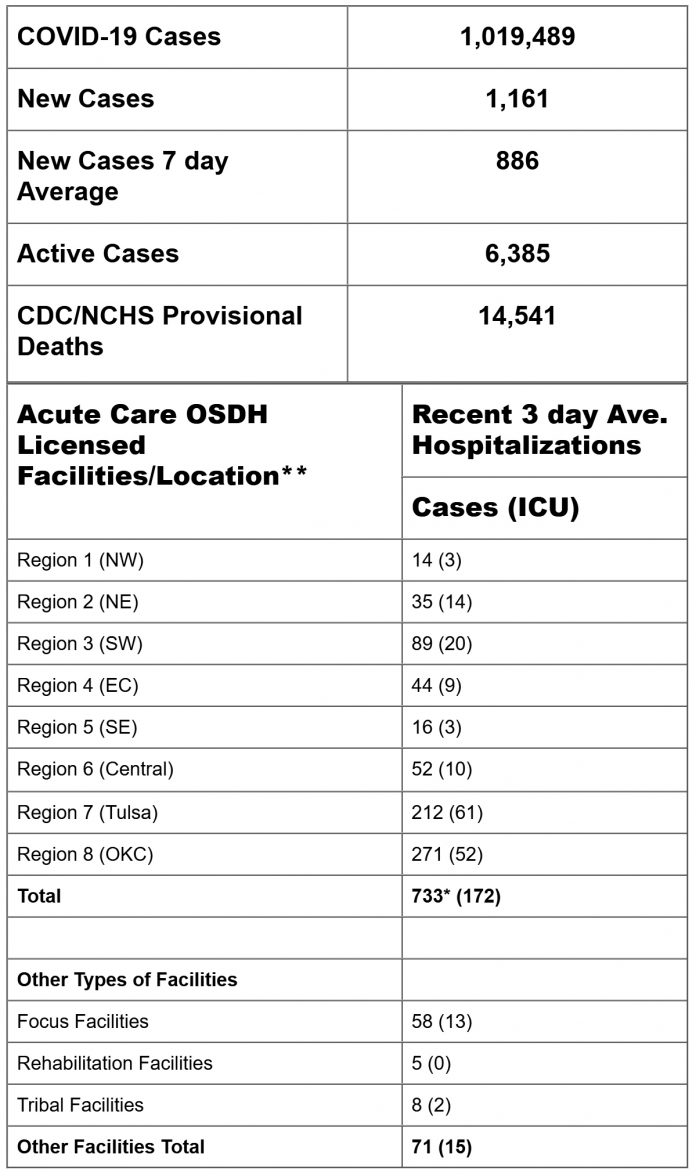
COVID-19 Oklahoma Test Results

*As of 2022-01-27 at 7:00 a.m.

OU Health to Participate in National Study of ‘Long COVID’

0

OU Health is projected to receive more than $1 million to participate in a National Institutes of Health (NIH) initiative to better understand the long-term effects of COVID-19 infection. Enrollment in the study begins soon, and researchers will follow participants for up to four years.
The NIH launched the RECOVER (Researching COVID to Enhance Recovery) Initiative to learn why some people have prolonged symptoms (often referred to as “long COVID”) or develop new or returning symptoms after the acute phase of infection from SARS-CoV-2, the virus that causes COVID-19. The most common symptoms include pain, headaches, fatigue, “brain fog,” shortness of breath, anxiety, depression, fever, chronic cough and sleep problems.
“This is a unique opportunity to be part of a nationwide study that investigates the impact of post-acute sequelae from SARS-CoV-2 infection (PASC), which includes long COVID. In other viral infections, you rarely see long-term symptoms at the rate we have seen with COVID-19. If we can understand the biological underpinning of these symptoms, that may help us to better treat people who continue to have problems for weeks or months after the infection is over,” said Timothy VanWagoner, Ph.D., co-principal investigator of the study for OU Health.
VanWagoner is deputy director of the Oklahoma Clinical and Translational Science Institute (OCTSI) at the OU Health Sciences Center. The OCTSI unites universities, nonprofit organizations, American Indian communities, public agencies and primary care providers in research addressing the health outcomes of Oklahomans. OCTSI’s existing infrastructure will be used to enroll patients from across the state, including those in rural and medically underserved areas. OU Health is among more than 30 academic healthcare institutions across the nation enrolling patients in the study.
OU Health will enroll approximately 80 adults in three different study categories. One group will include individuals with a past COVID-19 infection who continue to have symptoms. Another group will be comprised of people with a recent COVID-19 infection who may or may not continue to have symptoms. To serve as study controls, the final group will feature people who have never had COVID-19. Participants will be asked to undergo laboratory tests and other analyses, depending on the category.
Current data show that 10% to 30% of people who have had a serious COVID-19 infection will continue to experience symptoms for at least one month. Researchers don’t know why symptoms persist long after the infection or why some people have little to no symptoms.
“The RECOVER study is important because researchers around the country will be sharing their findings in real time in an effort to find answers as quickly as possible,” said Judith James, M.D., Ph.D., co-principal investigator of the study for OU Health and director of the OCTSI. “We hope to discover factors that put people at higher risk for ‘long COVID’, as well as protective factors. That information will be critical for preventing and treating the long-term effects of the virus.”
The current study will focus solely on adults; however, a study in children and adolescents will be forthcoming.
For more information about enrolling in the OU Health study, call (405) 271-3490 or email [email protected].

Reps. Bice, Lucas visit OMRF

0
U.S. Rep. Frank Lucas (OK-03) visited the Oklahoma Medical Research Foundation for an update on work at the Oklahoma City-based nonprofit biomedical research institute. From left, OMRF President Andrew S. Weyrich, Ph.D., Rep. Lucas.


U.S. Rep. Stephanie Bice (OK-05) visited the Oklahoma Medical Research Foundation for an update on work at the Oklahoma City-based nonprofit biomedical research institute. From left, OMRF President Andrew S. Weyrich, Ph.D., Rep. Bice, and OMRF Vice President of Clinical Affairs Judith James, M.D., Ph.D.

The Oklahoma Medical Research Foundation this week welcomed U.S. Reps. Stephanie Bice (OK-05) and Frank Lucas (OK-03) for updates on work at the Oklahoma City-based nonprofit biomedical research institute.
Bice and Lucas met with OMRF President Andrew S. Weyrich, Ph.D., and scientists from three of the foundation’s research programs.
Bice received a briefing on Covid-19 research from OMRF Vice President of Clinical Affairs Judith James, M.D., Ph.D., who leads a team of scientists studying the body’s immune response to Covid-19 and whether the virus may trigger autoimmune conditions such as lupus and rheumatoid arthritis. James is also the lead investigator on a nationwide National Institutes of Health-funded trial to assess how to elicit a stronger immune response to the Covid-19 vaccine in people with certain autoimmune diseases who did not respond well to an original vaccine regimen.
“Federal funding for biomedical research is vital,” said Bice, a member of the House Science, Space and Technology Committee. “I’m proud that OMRF is part of my district. The cutting-edge work scientists are doing here is inspiring and impacts not just Oklahomans, but all Americans.”
Lucas met with OMRF researchers Michael Beckstead, Ph.D., who is studying the role of the naturally occurring brain chemical dopamine in opioid addiction, and Courtney Griffin, Ph.D., whose work on blood vessels shows promise for restoring vision in those who have lost eyesight due to diabetes or premature birth.
A champion of ensuring rural students get access to quality science, technology, engineering and math education to bolster their career opportunities, Lucas applauded OMRF’s efforts to train the next generation of scientists through in-state recruitment as well as in the foundation’s Fleming Scholar Program and Langston University Biomedical Research Scholars Program.
“Basic research like what scientists are doing at OMRF is fundamental to advances in human health, but it requires a strong STEM workforce,” said Lucas, the ranking member of the House Science, Space, and Technology Committee. “OMRF plays an important role in making careers in STEM a reality for Oklahomans.”
OMRF, which is celebrating its 75th anniversary, has nearly 500 staff members and scientists in more than 50 labs studying cancer, heart disease, autoimmune disorders, and diseases of aging. The foundation’s discoveries have yielded hundreds of patents and three life-saving drugs available in hospitals and clinics worldwide. Most recently, Adakveo became the first targeted therapy approved in the U.S. for sickle cell disease, which affects an estimated 100,000 Americans.
“The Oklahoma congressional delegation’s commitment to biomedical research is steadfast and admirable,” said Weyrich. “Their decades of support for OMRF’s scientists and our mission of making discoveries that make a difference has changed and saved lives.”