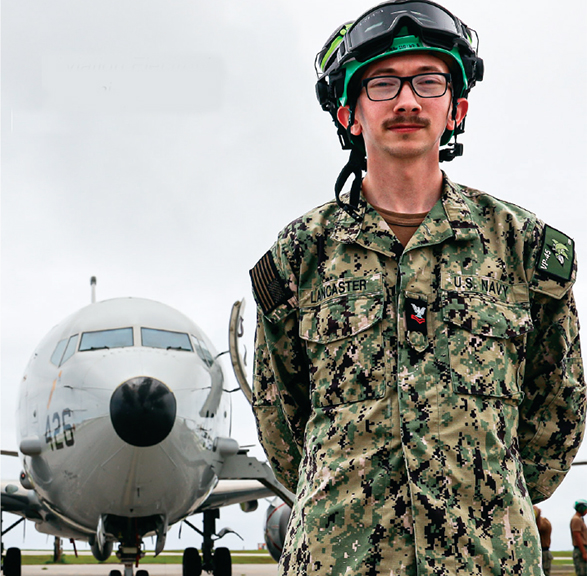
Airman Jensen Jones graduated from Southmoore High School. Photo by Mass Communication Specialist 1st Class Justin Johndro.
Airman Jensen Jones, a native of Oklahoma City, learned skills and values in the Heratland that would be foundational to their success in the Navy.
“Growing up, I learned the importance of patience and trying to understand the perspective of others,” Jones said.
Jones graduated from Southmoore High School in 2024.
Jones joined the Navy one year ago.
“I joined the Navy because I wanted to do something with meaning,” Jones said. “When I was in Boy Scouts, we got to spend the night aboard the retired aircraft carrier, USS Lexington, and I really enjoyed it.”
Today, Jones serves as a naval air crewman (avionics) assigned to Fleet Air Reconnaissance Squadron Seven (VQ-7) in Oklahoma City. Jones supports the nation’s nuclear deterrence mission at Strategic Communications Wing One (STRATCOMMWING ONE). Its “Take Charge and Move Out” (TACAMO) mission provides airborne communication links to nuclear missile units of U.S. Strategic Command.
The TACAMO mission originated in 1961 when a Marine Corps aircraft was used to test the feasibility of an airborne Very Low Frequency (VLF) communications system. Once the test was successful, funding for the program was granted, and it has continued to grow ever since.
The U.S. Navy’s presence on an Air Force base in a landlocked state may seem strange, but the position is strategic, allowing squadrons to quickly deploy around the world in support of the TACAMO mission.
The U.S. Navy is celebrating its 250th birthday this year.
According to Navy officials, “America is a maritime nation and for 250 years, America’s Warfighting Navy has sailed the globe in defense of freedom.”
With 90% of global commerce traveling by sea and access to the internet relying on the security of undersea fiber optic cables, Navy officials continue to emphasize that the prosperity of the United States is directly linked to recruiting and retaining talented people from across the rich fabric of America.
Jones has many opportunities to achieve accomplishments during military service.
“I’m proud that I graduated in the top 10% of my class for Navy training school,” Jones said. “I’m also proud that I earned two promotions while in boot camp.”
Jones serves a Navy that operates far forward, around the world and around the clock, promoting the nation’s prosperity and security.
“It’s an honor doing a job that actually makes a difference,” Jones said. “I am proud to be able to protect the freedom of all Americans.”
Jones is grateful to others for helping make a Navy career possible.
“I want to thank all my family for their support,” Jones added. “I especially would like to thank my parents, Jeff and Kristi Jones, for their continued support and for all they taught me growing up, which made me the person I am today.” •
By Alvin Plexico, Navy Office of Community Outreach
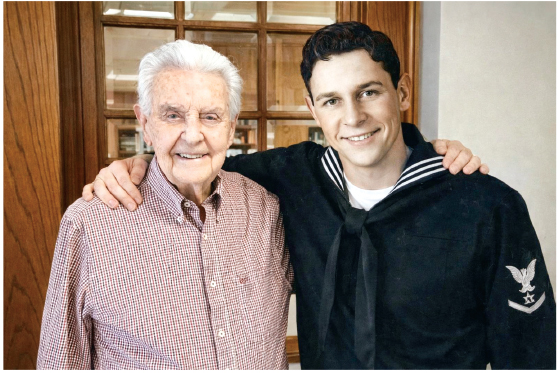
James and Beverly Ferguson were married for 70 years and had a son, William, and daughter, Gayle.This photo was taken in 1944 when Corporal James Ferguson served the Army Air Corps in Bari, Italy.
Some Americans serve their country for a chapter of their lives. Jim Ferguson wrote a book’s worth. His record spans three years of active duty during World War II and one year during the Korean War, 17 years in the Air Force Reserve, and 31 years as an Air Force civilian engineer at Tinker Air Force Base – four decades devoted to national defense.
Ferguson’s journey began after graduating from Siloam Springs High School, Arkansas. At age 18, he enlisted in the U.S. Army Signal Corps Reserve on October 22, 1942. He immediately attended radio technician school in Little Rock as a civilian civil servant before being activated by the Army Air Corps on March 10, 1943.
After completing basic infantry training at Camp Pinedale, California, Ferguson was assigned as a Classification Specialist and deployed overseas.
Duty at Bari, Italy
When he arrived on May 23, 1944, front-line fighting had moved north. He recalled, “Sunken ships littered the harbor…The noise and flak from the British guns are loud and heavy.”
Assigned to the 420th Signal Company, 15th Air Force, Ferguson used a typewriter and spreadsheets to take aim at manpower shortages by comparing authorized manpower to assigned strength and reporting shortages to headquarters.
The work required visiting combat units. “On a typical day, I would get on a B-17 and fly out to one of our units and get information for my reports to be this worksheet that shows how many positions we’ve got that’s vacant so that the system can send in the replacements…”
SS Charles Henderson blows up in Bari Harbor
On April 9, 1945, “In one of the greatest munitions disasters of World War II, the Charles Henderson was unloaded at Exit 14…when it was destroyed in a high-level explosion,” according to the Puglia Reporter newspaper in Italy. “This detonation caused by [handling] 500 loaded bombs loaded with Composition B, killed 542 people and injured 1,800 others…The buildings along the waterfront were destroyed by 2,000 feet, the ships were badly damaged at 2,100 feet.’”
The blast left a lasting impression and later, PTSD. Ferguson remembered, “you could still see debris that…the gravity hasn’t brought back to the ground…Our building was severely damaged with all windows and doors destroyed…I went up on the roof and found a piece of the ship that I could not lift that had been blown from the harbor to the roof of our building.”
Given rest and recreation leave, Ferguson visited Capri, Rome – where he met Pope Pius XII – and Switzerland.
He received a Bronze Star for Italy’s Rome-Arno Campaign and was discharged on Jan 28, 1946.
Korean Conflict
Service called again. “I spent one year on active duty and was discharged as a Technical Sergeant on 23 August 1951…During this period, I was commissioned as a 2nd Lieutenant in the US Air Force Reserve as an electronic engineer.” He continued in the Air Force Reserve as an engineer, attaining the rank of Major before retiring on 1 February 1969.
Family
Ferguson met his future wife, Beverly Murry, at a church activity in Siloam Springs in 1946. Both attended John Brown University, where he earned a Bachelor of Engineering degree using the new GI Bill.
After the Korean War, Ferguson resumed his friendship with Beverly and they married on Feb 16, 1952. He said, smiling, “She told me later that she would’ve married me a lot sooner if I’d asked sooner, but I wasn’t too smart…Beverly had said, ‘I was ready to get married long before you asked.’ The best 70 years of my life.”
They raised two children: Bill Ferguson, who married Elette and live in Mount Vernon, Washington, and Gayle Davis, who lives in Oklahoma City with her husband, Michael.
Electronic Engineer
In 1951, Ferguson began his civilian Air Force career with the Airways and Air Communications Service, renamed the 38th Cyberspace Engineering Installation Group. The Group provided communications and navigational aids. His work included preparing “site concurrence letters and engineering documents…at different bases around the country…” His team identified locations for airfield infrastructure like air navigation systems and control towers and equipment to support them during the Cold War.
Ferguson’s attention to detail and ability to work with people led to promotion as a Supervisory Electronics Engineer and eventually, GS-14 General Manager. He earned a Meritorious Civilian Service Award, among the Air Force’s highest civilian honors. He retired Dec 30, 1982.
Reflections about life
Looking back on war, Ferguson remains thoughtful and direct. “I don’t know why adults go to war. The outcome is always the same: somebody wins, somebody loses. A lot of people are killed. I still remember the burial grounds with the crosses, you know, driving by them in Italy.”
His advice for living a good life? “I’d say the golden rule would be pretty good.” His son, Bill, added, “You always told me, Dad, ‘Do more than what’s expected…Don’t just do the minimum.’”
After Beverly died four years ago at age 90, Ferguson reflected on loss and companionship. “I’m just much, much happier when I’m around people and that was a thing I didn’t recognize until I experienced living alone after my wife passed…The loss of a spouse was the worst experience I’ve ever had, you know…’”
Longtime friend Bill Dooley summed up friendship simply: “He’s a wonderful guy and I’m happy he’s my friend.”
Ferguson is 101 years old and lives in Midwest City. •
story and photos by Lt Col Richard Stephens, Jr., USAFR, Ret.
Gary Owens is a familiar face locally with his television commercials as owner of Galleria Furniture.
Gary Owens, right, is the owner of Belmont Cove with locations in Yukon and Oklahoma City. Pictured on the left is Claudia Escamilla, leasing manager at Belmont Cove North.
But Owens is also in the construction business where he and his son Justin have built Belmont Cove into one of the premiere 50+ independent living communities, with one located in Yukon at 1650 S Czech Hall Road, and the newest one in Oklahoma City, at 14604 Parkway Center.
Gary and his son, Justin, are owners and builders at Belmont Cove. Gary started construction in 1978, then added his son, Justin Owens and now grandson, Dawson Owens has been added, making this a great family-oriented team, all local to the area.
“We do probably 40% of the work ourselves, which allows us to pass the cost saving onto our residents, with about a 20% savings over the competitors’ pricing,” Gary Owens said.
“We have a great full time construction crew, thanks to our leaders and building superintendents. Jake Sellers has been with us for 25 years, Edgar Escamilla
25 years, and Carlos Escamilla 25 years.
We have great office staff as well, with Carolyn Kulbeth assisting clients at the Yukon location and Claudia Escamiila taking care of the clients at the OKC North location.”
Gary Owens said each location features maintenance free luxury high-quality homes with hardwood flooring, stainless steel appliances, and granite countertops.
He said their units come with a fire suppression system, security alarm, and a 1-car garage with door opener. These also come with a covered patio in the small yard with a stockade fence.
“Our Yukon location boasts easy access to I-40, dining and shopping areas and medical facilities. This community features walking paths, pet-friendly homes, and a clubhouse with a pool as well as regular scheduled activities. Each unit has 1,076 square feet of quality living space, hardwood flooring, stainless steel appliances, granite, ceramic tile, and so much more,” Owens said.
Owens said each Belmont Cove North unit has 1,200 square feet of quality living space, fully furnished or unfurnished, with all the amenities of the Yukon location.
He said coming soon is a 7,000 square foot clubhouse and pool. The clubhouse will have an indoor pickleball court with 4 regulation sized courts in a heated and cool environment.
Owens said Phase 1 is now complete and leasing for units is open. The full development will hold 320 units when each phase is complete.
“Coming soon will be our location in Moore with all the same amenities as the first two locations. There will be a clubhouse with pickleball, a pool, walking trails, and so much more, making this a great place to live,” Owens said.
Owens first got into senior independent living construction in the 1990s.
“We built one of these in the ‘90s in Mustang,” he said. “And a guy called me one day and said, “Would you sell it? “ And I did. I sold it to him, and I have regretted it ever since.”
Fast forward about a decade later, Owens was looking for affordable senior living for his mother-in-law.
“My father-in-law was my building superintendent and he passed away. And so, I was looking for a place for my mother-in-law to move into,” he said. “And we couldn’t find anything new that she could really afford. And so, I thought, well, I ought to just build some of these and help myself and help the senior citizens. So, we did.”
Owens said they started Belmont Cove about 9 years ago in the original Yukon location.
For more information call (405)-805-COVE or visit www.belmontcove.com. • By Van Mitchell, staff writer
BrightStar Care expands its imprint in Oklahoma serving veterans across the state.
When Jarod Cannicott acquired two BrightStar Care territories in the Oklahoma City metro in 2021, his goal was simple: build a home-care organization that families can trust when they are in crisis.
By 2025, that same focus led him to expand across Oklahoma City and acquire the BrightStar Care location in Tulsa – a longtime office that had served the community for 17 years but was not consistently delivering care to the standard he expects.
“When we acquired the Tulsa location, the care experience wasn’t meeting our standard,” Cannicott said. “Fixing that required a full overhaul of staffing, training, and clinical oversight – and we’ve done that work.”
Today, Cannicott operates five BrightStar Care locations as one integrated agency, with the scale to serve clients across Oklahoma.
“We serve clients statewide,” he said. “We have clients as far west as Elk City, as far north as Ponca City, as far east as Grove, and then south down to Ardmore.”
That reach is backed by a statewide caregiver bench – about 250 caregivers across Oklahoma – and a model designed for speed and reliability when families need help fast.
“In many personal care situations, we can start the same day,” Cannicott said. “And families get a live answer 24/7 from our own staff – not a call center.”
A higher standard, with nurses built into the operation.
BrightStar Care is known nationally as an in-home care provider, and Cannicott believes the brand’s biggest differentiator is how strongly it leads with clinical oversight and skilled care.
“Nurses aren’t an afterthought here,” he said. “Our company is nurse-led. We have registered nurses deeply involved in how we deliver care – including roles that most people wouldn’t expect, like scheduling and community liaison work – so oversight is baked into the operation.”
Cannicott points to Joint Commission accreditation as one-way BrightStar holds itself accountable to that standard.
The Joint Commission is a nationally recognized organization that accredits health care providers based on quality and safety standards, including many leading hospitals and health systems.
“We use that framework to keep our practices tight,” Cannicott said. “It’s about consistency and safety for families.” That emphasis shows up in operational details as well. For example, Cannicott’s teams reassess clients every 90 days, more frequently than the industry norm, because care needs can change quickly.
“Families deserve a plan that stays current,” he said. “And reliability matters – the best care plan fails if shifts aren’t covered. Our systems are built for coverage.”
Like many home care agencies, BrightStar provides private-pay personal care with CNAs and caregivers.
Cannicott says the difference is the breadth of skilled and higher-acuity care his Oklahoma team delivers – services many agencies cannot safely provide.
“We do private pay personal care, but we also do higher-acuity work,” he said. “That includes private-pay skilled nursing, catastrophic workers’ compensation cases, skilled care for Veterans in the home for complex conditions like ALS, home infusions, and therapy.”
Those services can be the difference between a patient staying safely at home or cycling back through the hospital.
“For a lot of families, the question isn’t ‘Do we want home care?’” Cannicott said. “It’s ‘How do we keep mom or dad safe at home, and who can actually manage what’s happening medically?’ That’s where skilled support matters.”
Serving Veterans and supporting the spouse Cannicott said it is a distinct honor for his caregivers and nurses to serve Veterans and their families.
In Tulsa and across Oklahoma, BrightStar works with the Veteran community through the Homemaker and Home Health Aide program, providing CNAs and caregivers to help with activities of daily living.
But he believes the most important story for many Veteran households is what happens when care needs become complex – and the spouse or family caregiver is carrying an unsustainable load.
“We work with the Veteran community through the Homemaker Home Health Aide program,” he said. “And we also provide skilled care with Veterans in the home with help from the VA.
One example is ALS – they’re currently taking care of ALS patients at home, and those families need a much higher level of support.”
In progressive conditions like ALS, Cannicott says, the spouse is often under immense strain.
“We serve the Veteran by supporting the spouse,” he said. “Respite and professional help can keep the household intact.”
Cannicott says the Tulsa acquisition was not about adding dots on a map – it was about delivering consistent experience statewide, including Tulsa.
“We wanted to bring the same level of service across the entire state and bring that level to Tulsa,” he said. “That work took real effort, but now we’re seeing results.”
One family’s review reflects what the team aims to deliver – a partnership that helps people remain at home as long as safely possible.
“Working with our nurse, we were able to keep my parents at their home of 57 years for as long as we possibly could,” a recent reviewer wrote.
For Cannicott, the mission is straightforward: scale through quality, responsiveness, and clinical oversight.
“We’re proud of what we’ve built,” he said. “And we’re focused on doing it even better.”
Need help in Oklahoma?
BrightStar Care answers calls live 24/7. For Tulsa care needs – including same-day starts for many personal care situations, and skilled support for complex cases – call (918)-392-9949. For Oklahoma City, call (405)-896-9600 or scan this QR code. • story by Van Mitchell, staff writer
Known as The Big Guy, the statue represents all Oklahoma veterans. It is part of the Oklahoma Veterans Memorial, State Capitol Park.
A Soldier Who Never Leaves His Post. Oklahoma’s Capitol Memorial to Those Who Served and Sacrificed
Soldier Represents All Veterans
Is “The Big Guy,” deep in thought? Does he wear the Thousand-Yard Stare – a distant or vacant look in the eyes of individuals who have experienced intense and often traumatic events? You decide.
Either way, the 8 ½ feet statue of a Vietnam soldier on a 3 1/2 foot pedestal that faces the State Capitol stops visitors at the Oklahoma Veterans Memorial. The memorial is located in the State Capitol Park on Lincoln Boulevard on the north side of the Oklahoma Supreme Court. Walking through the area saddened me because the names of thousands of Oklahomans killed in action are listed throughout.
Other memorials
Behind The Big Guy stand four bas relief bronze panels mounted on rose granite walls. Each panel depicts scenes from four major wars fought since Oklahoma became a state: World War I, World War II, the Korean War and the Vietnam War. The names of Oklahomans killed in action are engraved on the back of the walls and were added in the mid-1990s with additional names from Operation Desert Storm to the present added in 2014.
A memorial to the U.S.S. Oklahoma, a battleship sunk at Pearl Harbor on December 7, 1941, lists the names of 429 sailors and Marines who died.
A place that remembers every war
A memorial to the U.S.S. Oklahoma, the battleship sunk at Pearl Harbor on December 7, 1941, is there with the names of the 429 sailors and Marines who died. It was added on December 7, 1999.
Flags of each branch of the Armed Forces, the MIA-POW flag, the Oklahoma State flag and United States flag are posted behind The Big Guy, next to the “Eternal Flame.” The flame is meant to remind Oklahomans that “we will never forget.”
How the memorial came to be The State of Oklahoma donated the land for the memorial and people from around the country donated money to pay for it.
“After fundraising for the memorial stalled, Governor George Nigh appointed 44 leaders from across the state to the Veterans Memorial Task Force in April 1986” reported The Oklahoman on Nov. 10, 1986. The leaders got the job done: a well-attended ceremony dedicated The Big Guy, four blank rose granite walls and the grounds on 11 November 1986 – almost 40 years ago. Ceremonies included a speech by Governor Nigh and a flyby of F-4 Phantom II fighters.
On November 11, 1987, phase two was completed when bas-relief panels created by Jay O’Melia were dedicated.
A veteran’s vision
Vietnam War veteran Sergeant Mike Mullings was the driving force for the memorial. A medic from Bethany, Mullings was permanently injured while jumping from a helicopter under fire in Vietnam. After he died in 2017, an inscription was added to the base of the Vietnam soldier, “In Remembrance of SGT J. “Mike” Mullings…He was truly a “Big Guy.”
This is the bas relief of World War I, created by Jay O’Melia. Memorials to WWII and the Korean and Vietnam Wars are next to it.
The Sculpturers
Jay O’Meilia of Tulsa (died in 2022), a WWII and Korean War veteran, and Bill Sowell of Pawhuska (died in 2013), an Army veteran, designed, sculpted and cast The Big Guy from 1984-1986.
They chose 18-year-old Harrison Shackleford, an Osage Indian from Pawhuska, as the model for the Vietnam-era infantryman. “We wanted the sculpture of the soldier to be authentic in terms of age, dress and military equipment,” O’Meilia said in the same Oklahoman article, “especially since many of those who served in Vietnam were only 18 or 19 years old.”
Their design was chosen from 44 entries in a sculpture competition in 1984 that included six Vietnam veteran judges.
According to the Oklahoma Historical Society, “Artist Jay Philip O’Meilia, born in Tulsa, Oklahoma, on July 17, 1927, achieved recognition in Oklahoma and elsewhere as a sports painter in the 1950s. A graduate of Tulsa Central High School, he served in the U.S. Navy as an artist during World War II and in Korea.” His work has been exhibited “at the Corcoran Gallery in Washington, D.C., …the National Cowboy and Western History Museum and the Gilcrease Museum in Tulsa.”
Sowell studied at Texas Tech University in Lubbock, Texas. His works appear in Oklahoma and New Mexico.
Over 476,000 Oklahomans have served our state and nation in uniform – The Big Guy stands watch for all of them.
The memorial is worth a visit with friends or with a veteran’s group. If you want to hold an event there, call Capitol Event Reservations, 405-521-2121, or see the Oklahoma Management & Enterprise Services Upcoming Events website at Upcoming Events website at Upcoming Events .
Tech SGT Marshal D. Roberts, Oklahoma Air National Guard.
Tech SGT Marshal D. Roberts, 28 of Owasso, was serving with the Oklahoma Air National Guard when he was killed on March 11, 2020. At the time, he was the first Oklahoma Air Guardsman KIA since September 11, 2001. Roberts was a member of the 219th Engineering Installation Squadron, 138th Fighter Wing, headquartered in Tulsa.
Roberts met his wife Kristie while they were serving together. They married after four years and sadly he was killed less than two years later. Roberts had a daughter from a previous relationship. He is remembered as a loving husband, devoted father and a brother in arms that many still salute with pride and admiration.
From his obituary: The United States Air Force has set out definitions of courage and spirit that all Airmen should aspire to achieve. Courage is defined as the mental or moral strength to venture, persevere, and withstand danger, fear, or difficulty. Spirit is defined as an intense energy that empowers one to act when called to action. Marshal embodied these definitions – he placed God and others before himself always, even up until his last breath. Marshal will always be remembered for the love and sacrifice he made on behalf of his country and fellow wingmen.
Tech SGT Marshal D. Roberts, Marshal Roberts Hwy and post office memorial signage.
A portion of Highway 20 between Claremore and Owasso is dedicated in his name. The post office in Owasso was named in his honor in 2023. Because Roberts was killed at the beginning of COVID, his funeral and any public ceremonies were limited. Kristie and Robert’s mother spoke at the dedication and said it was the first time they spoke about him publicly since his funeral. Kristie described Marshal as a humble man who would blush at the thought of a building or highway being named after him. However, there is no question about the importance of having permanent structures like this for the public to honor his service and sacrifice.
Because of COVID, Robert’s funeral was delayed two months, causing additional emotional strain on the family. Kristie stated they never spoke about him being killed in action, but did speak about military honors and wanting them when the day came that they were called home to be with the Lord. She said it was difficult to put off honoring him. COL Mason, Commander of the base at the time, made sure that he was appropriately honored. His funeral was held at the Claremore Expo center where he received full honors with the missing man formation flown by 138th FW F-16s and a nine-round volley salute performed by the 138th FW Honor Guard.
Roberts loved watching movies. He had funny sayings and would randomly break out in Disney movie songs and make people laugh. They would play the animal game during long car rides when his daughter was with them. They would describe the animal without saying its name and they had to guess what it was. He loved going to the zoo or the aquarium to learn about new animals. These activities were engaging and educational and kept them off their phones while driving. Attending church as a family was very important to him. Christmas was his favorite holiday.
Roberts is laid to rest at Floral Haven cemetery in Broken Arrow. His grave marker is a bronze soldier’s cross and includes a bench for people to sit, pray and reflect. It sits next to a water feature where geese are frequent visitors. Kristie shared that when she and Marshal would see geese they would always count them together because they mate for life.
I asked Kristie what she wanted people to remember most about Marshal. She said,
“That he wore his nation’s cloth and served in the U.S. Armed Forces. He didn’t feel worthy of people thanking him for his service and didn’t feel as though he’d done anything worthy of being thanked. Deploying was his way of doing what he felt was worthy of this.
His love for his daughter was also incredibly important. He gave his all to be the most amazing dad he could be. Kristie still prays for God to watch over her. She is now in her 20th year of service and currently in residency training at the University of Oklahoma-Tulsa. They were required to fill out a goal sheet in the Air Force. Medical school was one of hers. Marshal wanted to support her to get through her schooling. He was with her when she got in. Accomplishing this has helped her through her grief journey. •
I became a believer in the Gospel at the age of 19 in the mid 70’s while serving in the Air Force. Those who guided me through my born-again experience encouraged me to get baptized and start going to church. They were good people, however over time my discipleship experience seemed to be based primarily on what not to do. No adult beverages, no movies, no dancing, no more fun. Some things made sense, some didn’t. Over time, what felt like a self-righteous lifestyle left me spiritually unfulfilled for years. Now, I refer to myself an out of Egypt believer, who wandered in a desert place for over 40 years.
In 2018 all that changed. I got connected with a spiritually vibrant Christian community, focused on spirit filled worship, the Word of God, a rhythm of prayer, and personal discipleship. Over time I developed a daily plan for both prayer and reading scripture. I call it, “The 2:24 Discipleship Challenge.” It is not based on a scripture passage. Two hours and twenty-four minutes is 10% of a 24-hour day. It is a recognition of spending prioritized time intentionally focused on my relationship with God.
How does the challenge look? It is making my Heavenly Father first in my life. He is the first one I want to talk to and the first one I want to listen to each day. I start with worship music, creating a focus on praise. In a brief prayer, I praise and acknowledge Him then close with this statement, “Bless me as I prayerfully meditate in the Spirit of worship through your word, starting in the book of Psalms in Jesus name.” I read a Psalm a day because I want to learn to pray like David. I continue praying with ongoing intentional requests and acknowledgement of God’s work and will in my life. I close again, asking for God’s wisdom, as I read from Proverbs daily, the one that corresponds to the day of the month. Our knowledge and experience is most effective when used in light of Gods wisdom.
The third part of my prayer is a focus for each day. Sunday, I pray for the mission of my local and the global Church. Monday, for family members by name. Tuesday, for close friends who attend my local church community by name. Wednesday, I pray for our giving and the ministries of my local church by name. Thursday, I pray for friends, acquaintances, and co-workers by name. Friday, I pray for those I meet in passing who I feel a connection to or who may have a special need. Saturdays I pray for whatever/whoever is on my heart, a special need or person.
Next, I enjoy a light breakfast and continue reading scripture. I read daily from the New Testament. In addition, I read through the scriptures from beginning to end using a Chronological Bible. I start that every second January. It simply makes the stories of the Old Testament, the Gospels, Acts and the Epistles come alive as the events historically happened in chronological order.
During the day, I stay engaged with my Heavenly Father by listening to worship music whenever I drive and pray spontaneously when the opportunity or need arises. The 2:24 Intentional Discipleship Challenge has changed my life. My intentionality has prepared me for His spontaneity which I find during my daily walk as I engage with those He puts in my path. I challenge you to create your own Intentional Discipleship practice. • Steven Sibley- Retired E7/Disabled Veteran, Publisher OK Veteran News
(Ret.) Sergeant First Class Jim Davidson served over 30 years in Oklahoma National Guard. He also had careers in education and ministry.
Jim Davidson dreamed of joining the United State Naval Reserves, but his eyesight kept him from fulfilling that goal.
Instead, the Pittsburg County native found a home in the Oklahoma Army National Guard for over 30 years of service.
“My dad was a coal miner,” he said. “I was one of six kids and thought I had the best growing up years of anybody. My brother was two years older than me and was my hero. He joined the Naval Reserve when he was 17, and I thought they had the coolest uniforms. So, my ambition was to join the Naval Reserve as soon as I got old enough. I went up on my 17th birthday. I went up to sign up, and they were giving me my physical.”
Davidson, a resident at Villagio of Bradford Village Independent Living /Assisted Living, located at 300 Enz Drive in Edmond said when he went in for a vision test, an optometrist gave him disappointing news.
“When I walked in for the vision test, the doctor happened to be my optometrist,” Davidson said. “He said, ‘There’s no need for me even going any further. You can’t pass the Navy’s vision test.’ And I was so disappointed. He said, ‘Go next door and join the National Guard. They’ll take anybody.’ Well, in 1955, that was true.”
Davidson, (Ret.) Sergeant First Class said a cousin who was in the National Guard invited him to go on a National Guard drill.
“Before I left that night (after the drill), they had signed me up. And that started my military career,” he said. “I am a retired military. I receive an annuity, though I am not officially a Veteran due to insufficient consecutive active-duty service days. And there are probably not a whole lot of people like that. But I stayed in the Guard off and on from 1955 until 1996.”
Davidson served in the 45th Infantry of Oklahoma National Guard nicknamed the Thunderbirds. He served a variety of roles in service.
“The main thing they drilled into me was what an honor it was to be a Thunderbird,” he said. “I did a little of everything. We were an infantry unit to start with. And when I retired, we were MPs.”
During his time in the Army National Guard, Davidson worked for Maj. Jimmy Burnett, who was the Unit Administrator of the National Guard Unit Company L in Hartshorne.
“All the years I was in the Guard, I worked for Maj. Burnett in one capacity or other, except for the last four years and he retired before I did,” he said. “He was a fine man to work for.”
Davidson said he only served overseas twice during his military career, and both times were in Panama.
“The only time I left the country, we went to Panama during the time that they were getting ready to retire, Mr. (Manuel) Noriega,” he said. “I was not sure what our duties were, but we got there and we discovered that we were what they called relieving active-duty soldiers. We were doing guard duty around the Panama Canal zone so the active-duty guys could do their business, preparing Mr. Noriega for retirement.”
In 1960, Davidson graduated from East Central University in Ada and then began his teaching career.
“At that time in Oklahoma it helped a great deal if a teacher had a secondary job and the National Guard was always my secondary job,” he said.
Davidson taught in Kansas and Oklahoma before becoming an elementary school principal in McAlester.
My calling, I think, in the education business was to be a grade school principal because I loved the kids and I recall my years in grade school, I was afraid of everybody,” he said. “And I felt my job was to make kids realize that the teachers and the school staff were there to make their life better.”
Davidson retired from education at age 51, followed by a brief foray into selling insurance.
He later started a second career as a child development specialist at the McAlester Army Ammunition Plant.
“They had a daycare center. I did not know the Army was in the daycare business. So, I went to work there,” he said. “I tell people I went to work for civil service, and I got a $10,000 a year raise because that’s what the difference in the pay I was getting as a grade school principal.”
Davidson worked at the daycare department for three years before transitioning to an employee relations position at the plant before retiring from that post.
Davidson added another job to his resume as a church pastor in Pittsburg County.
“All the churches in Pittsburg County were familiar with me because I went around speaking in different churches with the Gideons,” he said.
Davidson said he began pastoring when a small church in Pittsburg County could not afford a full-time pastor anymore.
“They were looking for a pastor for that little church,” he said. “They wanted to know if I’d come down and help them and fill in on Sundays. It developed into a full-time thing because I stayed there for 12 years.”
After retiring from that, Davidson and his wife of 63 years Mary bought a motor home and started traveling before deciding to move to Edmond to be closer to one of their two sons.
“Our son had a pastor friend who lived here (Villagio of Bradford Village), and he liked it, so we came over and visited him, and that is why it appealed to us. The people are super friendly. As retirement communities go, we are one of the smaller ones, and so that gives us more of a community feel.”
Davidson didn’t abandon his ministerial hat completely after he was selected by an advisory committee as the Villagio of Bradford Village community chaplain.
“We have an advisory committee here made up of the residents and we came home (from seeing family in Michigan) and they said, “By the way, we elected you chaplain.” I said, “Only if you get me a badge.” And so that is where the badge came from. I’ve been the volunteer chaplain here ever since.”
Davidson said what he enjoys most as community chaplain is helping send Christmas cards to Veterans.
“The residents donate Christmas cards signed a lot of times with a little message in it, and we collect them and we distribute them to all seven Veteran centers in Oklahoma,” he said. “And this year there were 1,051 cards that we delivered to the Veterans homes. It makes me feel good because I have friends who were at the Veteran’s home and many of them never have any company. They’re just all but forgotten. It’s just good to show somebody that somebody still cares.” • story by Van Mitchell, staff writer