The Oklahoma History Center (OHC) agrees with the fact that all individuals, children and adults alike, deserve a safe, dignified and clean restroom experience. Assistance with this need is common for adults who are aging or have disabilities and other conditions. Because of this, the OHC has recently installed a universal adult changing table in its Family Restroom, located on the first floor, to accommodate individuals with a range of disabilities and medical issues such as muscular dystrophy, Parkinson’s disease, paraplegia, cerebral palsy or those recovering from a stroke. Having access to such a table will provide a clean and safe environment, eliminating the unhygienic option of placing a loved one on a bathroom floor.
“We want to provide this amenity to families so they can extend their stays and won’t have to go out to their cars, or go home early, when a family member is in need,” said Dan Provo, director of the OHC.
In an interview earlier this year, disability advocate Audra Beasley was quoted as saying, “If we’re not planning for all, we’re not planning. We need to be asking ourselves what we are doing as great citizens of this state to hold the door for those coming in behind us, to build on the work of those before us. We need restroom access for all!”
The Oklahoma History Center is a division of the Oklahoma Historical Society and is an affiliate of the Smithsonian Institution, National Archives and is an accredited member of the American Alliance of Museums. The mission of the Oklahoma Historical Society is to collect, preserve and share the history and culture of the state of Oklahoma and its people. Founded in 1893 by members of the Territorial Press Association, the OHS maintains museums, historic sites and affiliates across the state. Through its research archives, exhibits, educational programs and publications the OHS chronicles the rich history of Oklahoma. For more information about the OHS, please visit www.okhistory.org.
Oklahoma City’s Cattle Baron’s Ball celebrates 20 years of saving lives with a night of food, fun and fundraising – Friday September 23rd at the National Western Heritage Museum. This year’s event is being led by dedicated volunteer, Mary Blankenship Pointer, Vice President at Frontier State Bank.
Cattle Baron’s Ball is the signature philanthropy gala of the American Cancer Society.
This year’s western-themed “party with a purpose” features A-List entertainer and OKC local, Ty England. As well as games, food and beverage, live and silent auctions.
All proceeds benefit the American Cancer Society and the Chad Richison Hope Lodge Oklahoma.
The Chad Richison Hope Lodge is a centrally located home-away-from-home for patients and their families opening this fall. It offers cancer patients and their caregivers free lodging while they travel to receive life-saving care from any of the area’s premier medical centers.
The $16.5 million facility is named in recognition of ACS’s capstone donor, Paycom Founder and CEO, Chad Richison. Mr. Richison is also this year’s Cattle Baron’s Ball honoree and will be recognized the night of the event.
Richison donated $5 million to fund Oklahoma’s first Hope Lodge. “This is a personal cause for many, including myself, and helps ensure anyone traveling for treatment will have one less item to worry about,” said Richison.
Cancer is the second-leading cause of death in Oklahoma. Each day, 49 Oklahomans are diagnosed with cancer. The American Cancer Society is working every day to free the worldfrom the pain and suffering of cancer through research, prevention, patient services, and advocacy.
To learn more or donate visit www.cattlebaronsballokc.org. For more information, please contact Rachel Stratton at 281-352-6471. Engage with @ACSOklahoma and follow us on Facebook, Instagram, and Twitter.
“Do you mind if I touch you?” I asked my wife one evening after dinner.
“Not at all,” she replied with a soft giggle.
“You’re sure?”
“Yes, I’m sure.” But the giggle had disappeared.
“There will be no negative ramifications or consequences if I place my hand anywhere on your body?” I asked, extending my hand toward her waist.
She slapped it away. “WHAT is going on?”
I recounted the story that played out on a recent business trip to New Orleans. After saying goodbye to a college friend who happened to be in town, I decided to have a nightcap at one of the dozens of bars dotting Bourbon Street. There was nothing special about the establishment; it featured two levels, the lower containing dozens of patrons in various stages of inebriation. I opted for the top floor.
I found a lone couple sitting at the bar. “Perfect,” I thought. “Maybe a chance to engage in some quiet conversation.” Chatting up strangers at bars is a pastime I sorely missed during quarantine. For starters, I am a standup comedian by trade and some of my best ideas, which later become comedic bits, germinate during bar conversations. Not all comedians write material this way, but it works for me.
More importantly, people in general fascinate me. I talk for a living, but I’m also an excellent listener. To me, there is nothing worse than seeing a bar full of customers engrossed in their phones, oblivious to their surroundings. Everybody has a story to tell if given a chance.
The bartender seemed to be taking an inordinately long time mixing the woman’s drink. I turned to her companion. “What’s she having?”
The bartender replied instead, naming some oddly titled New Orleans drink that I have since forgotten. I do know it wasn’t a Hurricane.
‘Well, it looks amazing,” I said to the man. Placing my hand on top of his shoulder, I added, “I think I’ll have one too. I’ve still got an hour before curfew.”
Without laughing or even smiling, he turned to me.
“Don’t ever touch me again.”
I should note, he added an unprintable word between ‘ever” and “touch.”
Then he took his hand, and not so gently shoved the side of my head. Without bothering to ask me if I liked being touched.
While his companion stared sullenly at her now completed drink, the man got off his stool and began to pace. I didn’t know if he had been overserved, for doing so would have required making eye contact. What if he didn’t like being stared at either?
The bartender, sensing a situation, intervened. Turning to me, he said, “Sir, why don’t you head downstairs?”
I took the hint.
“That sounds horrible,” my wife said. “Did he think you were hitting on him?”
“I put my hand on top of his shoulder. I didn’t try to kiss him,” I said.
“Can’t you just keep your hands off people?” she inquired. “What if he had a gun?”
How sad, I thought, that a simple gesture of friendship or inquisitiveness could end with gun violence.
“I won’t be touching anybody’s possessions either,” I said.
“Why not?”
Two days after returning from New Orleans, I was sitting in a traffic jam while heading to Chicago for a meeting. The Honda CRV, creeping in front of me, contained a decal to the left of its license tag stating, “Don’t Touch My Car.”
What frightened me wasn’t the command but the two-stick figure artwork accompanying it. One figure was crouched on its knees, its head being held down by the second figure, whose free hand contained an upraised stick. The message? Touch this particular Honda and get beaten over the head. Maybe it was the owner’s way of saying, “No Tailgating.” Or maybe the owner just returned from New Orleans. Regardless, I changed lanes.
I pondered the fact that I now fear the consequences of exhibiting a friendly gesture or inadvertently bumping a cheap vehicle. Our nation’s anger is manifesting itself in strange ways, in strange locations. Now, two years after quarantine forced everybody inside, I’m still not comfortable venturing outside, for who knows? I too might become angry at the slightest provocation.
I guess I’ll just stay indoors and watch TV. Oh, look, another Jan. 6 committee hearing is about to get underway.
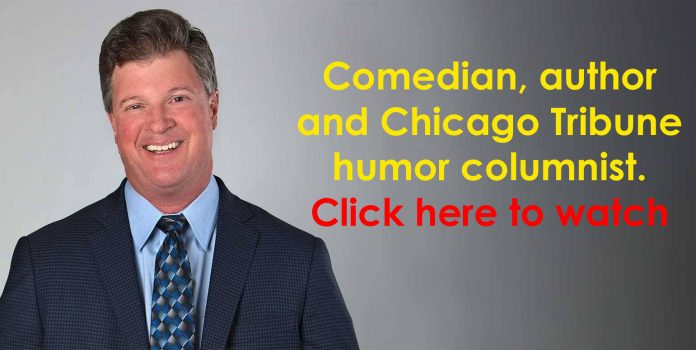
(Greg Schwem is a corporate stand-up comedian and author of two books: “Text Me If You’re Breathing: Observations, Frustrations and Life Lessons From a Low-Tech Dad” and the recently released “The Road To Success Goes Through the Salad Bar: A Pile of BS From a Corporate Comedian,” available at Amazon.com. Visit Greg on the web at www.gregschwem.com.
You’ve enjoyed reading, and laughing at, Greg Schwem’s monthly humor columns in Senior Living News. But did you know Greg is also a nationally touring stand-up comedian? And he loves to make audiences laugh about the joys, and frustrations, of growing older. Watch the clip and, if you’d like Greg to perform at your senior center or senior event, contact him through his website at www.gregschwem.com)
By Ron Hendricks, Hearing Loss Association of America Central Oklahoma Chapter
Hearing Loss Association of America Central Oklahoma Chapter (HLAA COC) is not all serious stuff. We have fun too. Our summer bingo party brought out a large crown for Bingo, Prizes and Pizza and August is cold. At least the ice cream at the Annual Ice Cream Social is cold. The social is the traditional kick-off of the new season of monthly Educational Seminars held by HLAA COC. Seminars have speakers of interest to the hearing loss community – subjects like technology, research, training, tips & tricks. All helpful to those with hearing loss and those who love ‘em. Speakers/programs for the fall include Shelley Gladden, Oklahoma Able Tech discussing technology, October we host Dr. Sarah Newman delving into research being done by Hearts for Hearing. In November Dr. Kopke with the Hough Ear Institute will talk about their research in hair regrowth that will possibly restore hearing. December, ‘ya-all come for the annual Christmas Party. The Ice Cream Social is also the time when we introduce the scholarship winners who are; Boyd Robertson, Josie Burns, Charles Brady IV.
HLAA COC’s educational seminars are captioned so you can see the conversation as well as hear it. Now there is also a hearing loop system to be used with the telecoil in your hearing aid AND we zoom the meeting too. Seminars are held monthly on the third Thursday, 11:30-1PM. The public is invited as there is no entry fee.
We have a lot of activities but our main mission here is to “Open the world of communication to people with hearing loss by providing information, education, support, and advocacy.” for more information visit our website, www.OklahomaHearingLoss.org.
Mercy has earned the 2022 Excellence in Patient Experience Award as the top large health system in the country for patient experience, a distinction made by NRC Health, a leader in building personalized health care solutions and data-driven insights.
NRC Health’s 2022 Excellence in Patient Experience Award recognizes health systems and hospitals that have demonstrated their commitment to improving patients’ care experiences.
“This award is all about the patient experience and that is central to everything we do,” said Dr. John Mohart, president of Mercy communities, who leads operations for all Mercy hospitals. “Our medical team always puts health and safety first, but the patient experience goes far beyond clinical care. Whether it’s our food service team, housekeepers or volunteers, it takes every Mercy co-worker to make patients a priority and give them the best experience possible.”
Award winners are selected based on the real-time “would recommend” ratings from patients. One winner is honored in each of the following eight categories of facilities: small, medium and large health systems; small, medium and large hospitals; pediatric facilities; and medical groups. Mercy was selected as the top large health system based on patient feedback collected from April 1, 2021, through March 31, 2022, amid the ongoing COVID-19 pandemic.
“It is incredibly gratifying to be able to honor another esteemed group of organizations this year who deliver exceptional patient care day in and day out,” said Helen Hrdy, chief growth officer at NRC Health. “Human understanding is at the core of what we do, and to see it come to life is rewarding beyond words. Congratulations to Mercy for this recognition. Their work is inspiring!”
A complete list of winners is available at nrchealth.com/awards/excellence-in-patient-experience-award/. The NRC award follows the recently announced collaboration between Mercy and Mayo Clinic to transform patient care and find diseases earlier and the recently announced availability of an innovative blood test at Mercy to detect more than 50 types of cancer in early stages.
“This honor from NRC Health means every aspect of a patient’s care at Mercy is important, beginning when they schedule an appointment and through the follow-up care long after the clinic, virtual or hospital visit,” said Dr. Jeff Ciaramita, Mercy’s chief physician executive.
As of the end of the day, Friday, August 12, 2022, OU Health and UnitedHealthcare (UHC) have come to a resolution. The two organizations had been negotiating their contract since November of 2021.
The agreement between OU Health and UHC for hospital and clinic facilities and services terminated on May 1, 2022, but have now been reinstated. UHC has agreed to retroactively process the out-of-network claims that would now be considered in-network. OU Health Partners, the health system’s physician and provider group, was under a separate contract, which was in effect through the end of 2022. Under the new agreement, the provider’s contract was extended through July 31, 2024. OU Health and UHC also agreed to re-engage transplant services to the same level as prior to May 1, 2022.
“With so many of our services not available anywhere else in the state, we are so pleased to be able to continue to care for our UHC-insured patients, so they can continue to receive services like cancer treatment or comprehensive children’s care,” said Richard Lofgren, M.D., OU Health president and CEO.
“Throughout this time, our focus and commitment to patient care and being an institution that champions the health of our state hasn’t changed,” Lofgren said. “We are extremely pleased to be able to reinstate and continue our partnership with UHC, and together, we will make a difference in the lives of Oklahomans.”
Make your way to the Moon (Modern Living Building) for free health screenings, activities, and entertainment at the 45th annual Senior Day. We hope you enjoy this fun-filled day planned especially for senior adults. Seniors (ages 55 & older) receive FREE outside gate admission!
PJ Acker poses with Brayden holding the oil painting she created of the young man and his father.
Story and photo by Darl DeVault, Contributing Editor
The family commissioned PJ Acker to create this 11 x 14-inch oil painting so Brayden could have an image of him and his father together.
Faced with a challenge many artists would not be able to pull off, PJ Acker recently used her easily demonstrable talent and social grace to create an oil painting a young boy will cherish forever. In capturing the boy’s likeness while adding the photorealistic painting of his deceased father, she provided the family with a comparative study for the ages.
Working in her newly named Treehouse Studio, located upstairs of the Paseo Arts and Creativity Center (PACC) building, Acker was recently touched by a special commission.
Her narrative of what happened next is so direct it is largely unedited: “He doesn’t have a photo of his Daddy and him together,” A young woman named Leah whispered to me. She and her son, Brayden, were visiting my studio during a recent First Friday Art Gallery Walk. Brayden, 11 or 12 years old, seemed captivated by the process of the pencil sketch I was doing of another visitor. When I asked if he’d like his portrait sketched, he was shy but seemed very eager, nodding yes.
While Brayden was occupied with looking over the sketch I’d completed for him, Leah whispered to me, “If I supply a photo of his dad, could you paint a portrait of them together?”
I’ve done similar portraits for others, so I told her I’d love to try. Soon, our plan was made. As we visited, I discreetly snapped several photos of Brayden with my phone.
Over the following weeks, I chose from photos Leah emailed and developed a composition. After emailing a rough draft for her approval, I got to work. While it usually takes about two months to finish a portrait from start to finish, this project touched my heart and had my full attention. I completed the painting in three weeks. These kinds of projects make the years of study and practice pay off.
I form a connection with my portrait subjects while studying their faces and the tiny nuances of expression. I become energized, excited and eager to commit to canvas what I see and feel.
In one of our communications, Leah confessed to me she’d cried more than a few tears while watching the painting as it developed. While it’s common for me to feel connected to my subject during the hours of trying to capture its essence onto canvas, a process called ‘chasing the likeness,’ this one felt special to me.
Arriving to pick up his painting, Brayden entered my studio closely following his mother. His eyes immediately landed on the 11 by 14-inch portrait in oil on the center table.
He stared motionlessly at it from the doorway. When he didn’t move or speak for minutes that seemed an eternity, I silently sought out his mother’s eyes. She gently moved him toward the table. I lifted the painting into his hands. Remaining silent, his eyes never left the painting.
“He’s overwhelmed,” his mother told me, smiling.
We took a couple of photos together, Brayden, his painting and myself, before they left.
Ten minutes later, I received a text from Leah, “He hasn’t let go of the painting. He’s crying quietly in the backseat.”
Being a mother and grandmother herself, Acker understood a mother’s desire to give her son a link to his father.
Capturing common similarities of expression while portraying an ease of comfort between the two required a certain intuitiveness. Employing the power of photorealism while imagining “what would be” required imagination. Blending disparate images with different settings and lighting conditions required technical ability. Doing these things simultaneously defines the challenge and artform of this type of portraiture.
Sketching her first portraits in pencil and crayon, Acker recalls from her childhood, “I’ve always been fascinated with faces, with watching and studying people.”
Holding true to this, she chose nursing as her first vocation. Seven years later, she taught herself the skills needed to work as a technical typist at the School of Aerospace and Mechanical Engineering at the University of Oklahoma. With a promotion to a position with the Oklahoma Department of Human Services Training Department, she worked with and scheduled mandatory workshops for social workers throughout Oklahoma.
After retiring, her passion for creating art reignited. Doggedly pursuing whichever technique or medium that called to her at the time, Acker acquired her education in art attending workshops across the country, as well as seminars and art courses locally at Rose State College and OCCC. Workshops with Philippe Faraut, a world-renowned sculptor, and Betty Pat Gatliff, past Forensic Reconstructive Sculptor for the State of Oklahoma, encouraged her love of portraiture and figurative art. She has created works in oil, acrylic, oil pastel, soft pastel, charcoal, watercolor, soft clay, and oil-based clay for bronze work.
For the last 25 years, Acker has worked as a professional artist in Oklahoma and has been a member of the Oklahoma Art Guild, Oklahoma Sculpture Society, Oklahoma Pastel Society and the Portrait Society of America. She cites John Singer Sargent, John Howard Sanden, Berthe Morisot and Philippe Faraut as her primary influences.
Her artistic passion continues to grow and develop as it chooses from her Treehouse studio. She blogs about works-in-progress and accepts commissions through her website www.pjackerart.com.
Visitors are welcome during her usual studio hours: Tue – Sat 10:30 a.m. – 4 p.m. and 6 – 9 p.m. every month on Paseo’s First Friday Gallery Walk.
“What I paint or sculpt now is often more informed by what I feel than by what I see,” Acker said in an interview. “Capturing the essence of a person on canvas or clay has always been magical to me. Creating is the anchor that reminds me of who I am, from whom I come, and I’m happy to be able to share.”
The Paseo Arts Association hosts the PACC as a 501(c)(3) non-profit organization working since 1981 to develop the historic Paseo into a thriving arts district.
Oklahoma City’s only authentic arts district is known for its eclectic galleries attached to art studios, high-quality restaurants, bars, and many types of merchants. The walkable cultural area surrounding a curving street features Spanish Revival architecture with trees providing shade during its well-attended Arts Festival each May. The three-day event Memorial Day Weekend – May 28-30 this year usually adds 100 artist’s booths to what the 80 district resident artists offer.
Oklahoma Medical Research Foundation scientist Benjamin Miller, Ph.D.
The National Institutes of Health has awarded the Oklahoma Medical Research Foundation $3 million to continue the study of the anti-aging abilities of a diabetes drug.
The five-year grant will allow OMRF physiologist Benjamin Miller, Ph.D., to continue his investigation of the ability of metformin, the world’s most prescribed diabetes drug, to slow the biological process of aging.
Aging is a leading risk factor for many diseases, but people can lessen the impacts of aging with appropriate diet and exercise. Because many people find dietary changes and exercise challenging, there are ongoing searches for medications that may mimic those effects.
“We know exercise slows the aging process, but this drug could be an alternative for otherwise healthy people who don’t get much movement,” Miller said.
The study will observe metformin’s impact on animal models with different fitness levels. Investigators designed the study after surprising results that also led to an ongoing OMRF clinical trial of metformin in humans.
“Our studies have shown that there may be people who benefit from the metformin treatment and others who do not,” Miller said. “Our goal is to help determine who may benefit and better target the treatment to slow the onset of chronic diseases.”
Finding the right context for anti-aging metformin treatment is critical as this use for the drug grows, Miller said. This study will help identify groups who may see the greatest positive impact and who should skip this treatment to avoid adverse effects.
Miller is continuing to recruit participants for the ongoing clinical trial. The study is now focused on participants aged 40-75 who have higher-than-normal blood sugar, a body mass index above 30, or are not physically active. Participants must also not be taking glucose-lowering agents.
Volunteers will first undergo a health screening. If enrolled, participants’ visits during the 12-week study may include blood tests, muscle biopsies, bone density scans and insulin sensitivity tests.
To participate or for more information, visit www.omrf.org/metformin or contact Oklahoma Shared Clinical and Translational Resources at 405-271-3480 or [email protected].
Funding for the research is provided by the National Institute on Aging, a part of the NIH. Grant No. R01AG074502-01A1 will support the new study, and R01AG064951 continues to fund the clinical trial.