Scholarship applications are being sought for the 2022 Oklahoma Chapter Hearing Loss Association scholarships. Oklahomans with hearing loss who plan to attend higher education in the fall of 2022 are encouraged to apply. The application deadline is April 4, 2022. This will be the 7th year scholarships have been offered. The local chapter has given away $16,000 to Oklahoma students and this year there will be 3 awards of $1,500 each. The Scholarship Application and Rules are available on our website: oklahomahearingloss.org
The Hearing Loss Association of America Central Oklahoma Chapter is a 501(c)3 tax exempt organization. Our chapter is run entirely by volunteers. There are no paid positions. [HLAA hopes to open the world of communication to people who have a hearing loss by providing information, education, support, and advocacy.]
INTEGRIS Hospice and Palliative Care Services is hosting a free Grief Support Group facilitated by Chaplain Kelly Russell.
The next series will be on Thursdays from 6:30 – 8 p.m., from March 3 through April 7, 2022. The meetings will be held in the INTEGRIS Health Hospice Administration Building, located at 5710 N.W. 130th Street in Oklahoma City.
If you have lost a loved one, grief is a normal and natural response. Sharing your grief with others and listening to the experiences of others can help you to be heard and know you are not alone in your grief. The program is free of charge, but space is limited. To enroll, please call 405-609-4578 or register online.
To register online, click here: Grief Support Group | INTEGRIS Health (coursestorm.com)
To learn more about our grief support program, click here: https://integrisok.com/locations/hospice-and-home-care/integris-hospice-in-okc/grief-recovery-resources
Recently a friend who had relocated from her two-story house of many years to a one- bedroom apartment commented, “I realize I just called this home.” In her case, she had closed her mother’s home of many years with all those old treasures from times past. Two homes to close in less than eight months was significant. Additionally, her husband in a memory care facility, could now be moved closer to her new home.
Perhaps all these factors played into the sense of home. She’s managed to grapple with the idea of home. Where is it? What makes a space or place home? Poetry has become her means of exploring and making sense of finding home.We’ve heard “Home is where you heart is.” Or, it might also be said: “Home is where your stuff is.” Years ago chairing an accreditation in Japan, I asked my team mates where home was for them
A very blond Cathy, who looked like someone from the California beaches said, “I guess this is home since I’ve lived in Taiwan longer than any other place.” Does length of time mean a place is now home? We comment about a church home or feeling at home in certain places. Perhaps having family nearby, or readily accessible, provides a sense of home. Quite possibly returning to where we grew up, or lived in different parts of our lives, gives us a sense of homecoming.
We celebrate homecoming during the fall, often around football games. We reconnect with friends from years ago. In so doing, we return to roots established at some point in time. Reunions provide us with a sense of connecting with home whether where we grew up or just plain being with others significant to us – family, friends or both. Where is home after all? Maybe it’s what we make it no matter the location.
Martha (Marty) Coffin Evans, Ed.D. is a freelance writer with MACE Associates, LLC. She can be reached at [email protected].
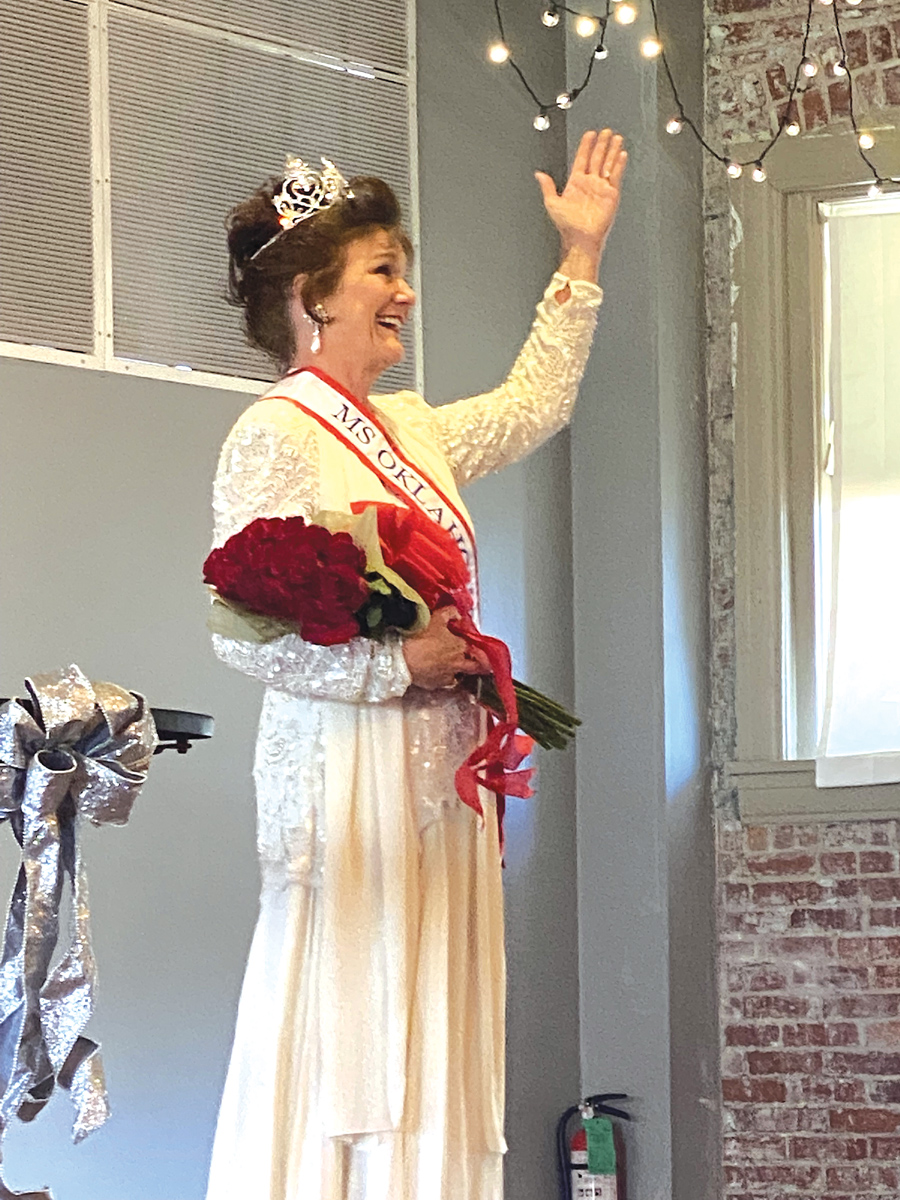
In her evening gown, Roxanne Parks, Ms. Oklahoma Senior America 2022, was full of smiles at her coronation held recently in Guthrie.
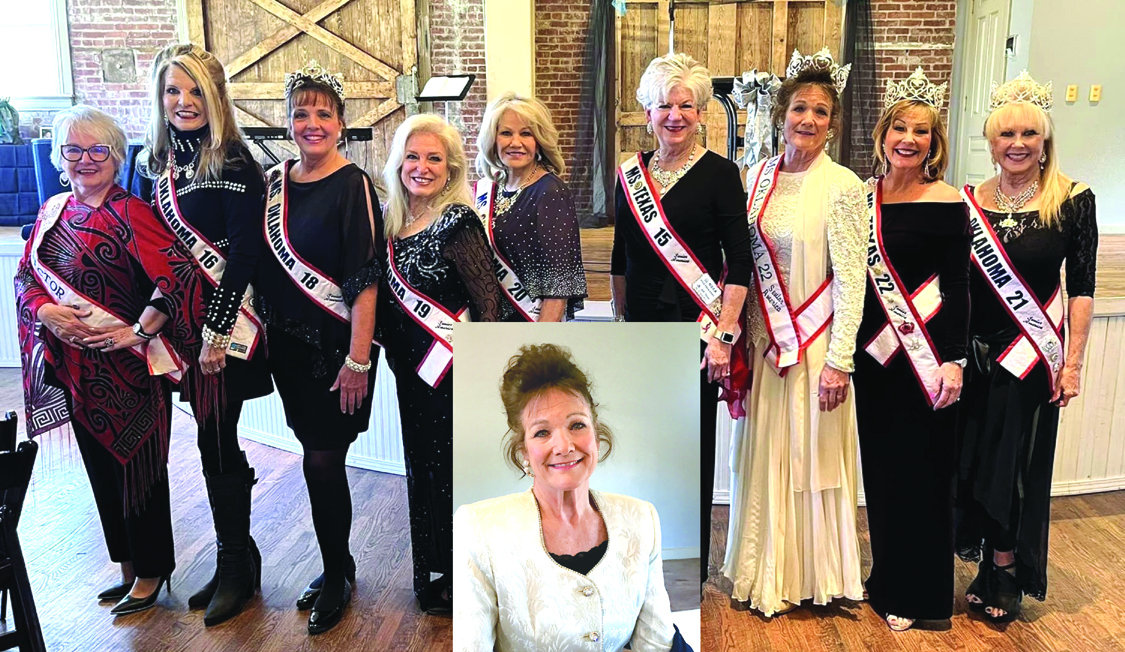
Among those who celebrated the coronation of Roxanne Parks, Ms. Oklahoma Senior America (MOSA) Queen 2022, from left to right were Carol Kallenberger, Oklahoma MOSA state administrator; Dove Morgan-Schmidt, MOSA Queen 2016 and current director; Kay Manning, MOSA Queen 2018; Deborah Wedel, MOSA Queen 2019 and current director; Susan Frazier, MOSA Queen 2020; Jill Bean, Ms. Texas State Queen 2015, national officer; Roxanne Parks, MOSA Queen 2022; Kimberly Gheti, Ms. Texas Senior America Queen 2022; and Kathryn Gordon, MOSA Queen 2021.
story and photo by James Coburn, Staff Writer
A glowing celebration was held in Guthrie at the recent coronation of Roxanne Parks, Ms. Oklahoma Senior America (MOSA) Queen 2022.
Parks was crowned by MOSA Queen 2021 Kathryn Gordon.
Several former MOSA queens were among the scores of guests who honored Parks at the Old Santa Fe Depot in Guthrie on Saturday, Jan. 22.
“To reign in life means we are filled with confidence in God and in our assignment,” Parks said. “It is that we are able to have peace in chaos. We’re able to have power and peace, regardless of the circumstances. We are able to be free of the grips of sin…”
MOSA is considered the senior version of the Miss America Pageant, said Dove Morgan-Schmidt, MOSA Queen 2016.
At the coronation, Parks presented three requirements of the national pageant. This includes her talent, philosophy of life, and her evening gown presentations.
She shared her original spoken and inspirational work highlighting her YouVersion Bible Plan that has close to 400,000 subscribers, as well as her latest book, “Breathe: 101 Life-Giving Devotionals.”
Parks said every person is created with a purpose in life.
“Each of us are uniquely gifted to serve and to bless others,” she said in her philosophy of life presentation. “I don’t want to miss out on one thing that God has in store for me to accomplish this year on earth. I want to live bold; I want to give bold and, in a world where depression and anxiety abound, I want to be that life-giving breath of fresh air.”
The Ms. Senior America Pageant is the world’s first and foremost pageant to emphasize and give honor to women who have reached the “Age of Elegance.” It is a search for the gracious lady who best exemplifies the dignity, maturity and inner beauty of all senior Americans, according to the mission statement. The Ms. Senior America philosophy is based on the belief that seniors are the foundation of America, and our most valuable treasure. It is upon their knowledge, experience and resources that the younger generation has the opportunity to build a better society.
An Edmond resident, Parks will represent the state of Oklahoma and its senior community along with state queens from 31 other states this September at the national pageant to be held at the Hershey Lodge and Resort in Hershey, Pa., said Carol Kallenberger, Oklahoma MOSA state administrator.
Parks is a certified life coach at Roxanneparks.com. She has served as president of a large marketing company, and is the founder, president, and CEO at Winter Summit Ministries, Inc. She studied at the University of Oklahoma’s Mewbourne School of Petroleum and Geological Engineering.
She and her husband Brian Parks have been married for 36 years. She is the mother of three adult children and a proud grandmother. Parks believes that families are the foundation of our society. Parks is also corporate chaplain. She appears at conferences and conventions throughout the US. Parks appeared inspired and enthusiastic in her talent presentation as she accompanied herself on the piano. Parks said she gathers her peace of mind with faith in God, and not to news or events.
“There has never been one like you before. There will never be one like you again. And since today is the first day of the rest of our lives, and life is not a dress rehearsal, let’s make today the best day of the rest of our lives,” Parks said. “Even though there are very many noises and choices in our head in the battlefield of our mind, we hear the voice of ourselves as loud as it speaks to you. And then, there is the voice of the enemy who likes to raise doubt and discouragement in our heart. And then, there is the voice of the other — your mother or your neighbor — your boss. And then, there is the voice of truth. Oh, we have ears, but do we hear. Oh, we have eyes, but do we see? The same God that fashioned you and me, assigned us with a thumbprint. He invited us to live a full life. Since today is the first day of the rest of your life, let’s choose today and the rest of your life to be the very best of your life.”
For more information about Ms. Senior America, please visit http://senioramerica.org.
“This is a sisterhood,” said MOSA Queen 2021 Kathryn Gordon. “And, if you’re sitting there thinking, ‘Maybe I might try it,’ just step out of your comfort, take a chance, believe in yourself. It’s a wonderful experience — it will help you grow into being the person that maybe you were supposed to be. And I challenge you to challenge yourself to take a chance and become a part of our 2023 pageant for Ms. Oklahoma Senior America.”
Belmont Cove sits on prime real estate in Yukon, Oklahoma. Our convenient location boasts easy access to I-40, dining and shopping districts, and a medical center. Our retirement village has walking paths and a community center and pool, which are currently under construction.
Each unit has 1100 Sq. Ft. of quality living space, hard wood flooring, stainless steel appliances, granite, ceramic tile, and so much more.
Owners Gary and Justin Owens bring more than 20 years of experience to thisvibrant & independent retirement community.
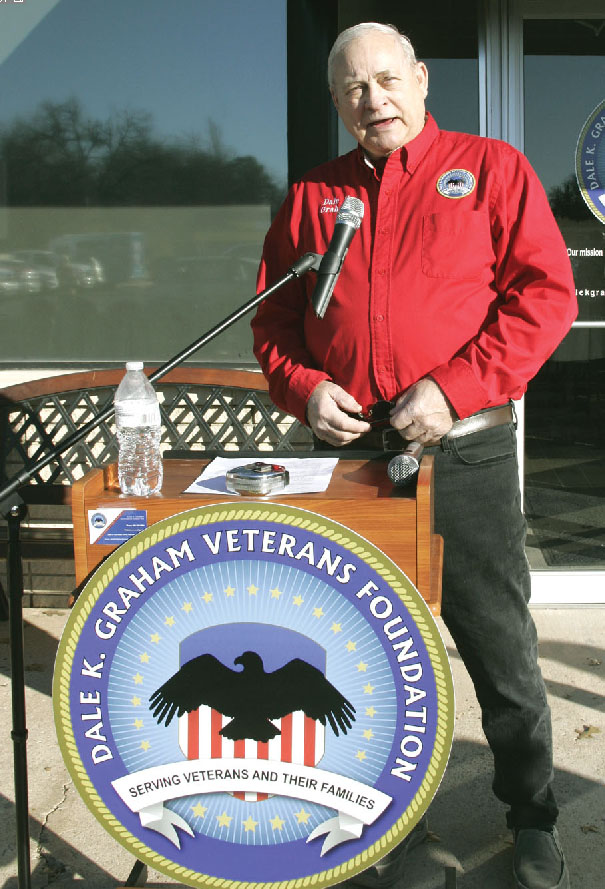
U.S. Marine Corp Veteran Dale Graham welcomes the crowd during the ribbon-cutting ceremony on January 25 at his namesake nonprofit Dale K Graham Veterans Foundation’s new location in Norman.
U.S. Marine Corp Veteran Dale Graham welcomes the crowd during the ribbon-cutting ceremony on January 25 at his namesake nonprofit Dale K Graham Veterans Foundation’s new location in Norman.
Story by Darl Devault, Contributing Editor
In Dale Graham’s short remarks during the ribbon-cutting ceremony on January 25 for the new larger location in Norman for the nonprofit Dale K Graham Veterans Foundation, he made everyone welcome. Speaking at the front doors at 1233 W Lindsey St., the Vietnam Veteran and retired U.S. Marine Corps Lance Corporal, 74, shared his pride in how far the group’s mission has grown.
“When I first started out helping veterans sign up for their benefits in my garage 30 years ago, I knew a lot of satisfaction in helping other veterans,” Graham said. “Now I know a lot of these great people gathered here today who have helped thousands in that same mission. We are all proud to welcome you to this new location.”
The foundation is named after Graham, who has dedicated his life to encouraging and helping veterans file their benefits claims. They serve more than 300 veterans each week with a 96 percent success rate for claims filed in 2019.
The main speaker, Sen. Adam Pugh, R-Edmond, told the crowd of 120 he is prefilling a bill aiding veterans for the new legislative session beginning in February. It will further emphasize that Oklahoma is a welcoming state for veterans, retired and separated from the service.
Pugh’s effort this session is Senate Bill 401, a carryover measure from last year, to exempt military retirement from state income taxes. He said this would keep Oklahoma keep in line with the surrounding states.
“According to our research at the legislature, Oklahoma has more per capita veterans than any state in the country,” said Pugh, a former U.S. Air Force Officer of almost eight years. “The legislature needs to do more in making sure our resources like this new Dale Graham Veteran Graham Foundation center are an example of how Oklahoma can be seen as the number one state for veterans.”
Pugh served as an AWACs command and control officer worldwide as an air battle manager as a captain. Before election to the Senate in 2016, he was an executive at Delaware Resource Group. There he oversaw the local aerospace company’s B-1 Bomber program, an extensive program with millions of dollars attached to it, he said.
Those gathered — veterans and their families, volunteers, veteran’s rights advocates, and Norman and Cleveland County officials, then saw Norman Chamber of Commerce dignitaries welcome the new facility and perform a ribbon-cutting ceremony. After the ceremony, 25 veterans waiting to be helped were invited into the new facility for their appointments with volunteers. On January 27, more than 50 veterans were helped. At the intake event on February 1, 150 veterans are expected to receive services.
The new location on west Lindsey is twice the size of the previous office on Interstate Drive in northwest Norman. The new office provides volunteers a training room and the veterans a computer lab where they can get online and scan their documents to complete their claims. The new computer lab has gone from 40 computer workstations in the previous office to more than 80.
Additionally, there is office space for private meetings. The new office means there is room for the volunteers to give the veterans more privacy as they assist them. This has allowed the Graham Foundation to increase the number of veterans they can help each day.
The Graham Foundation has assisted more than 25,000 veterans across all 77 counties in Oklahoma, 50 states, and eight foreign countries in filing claims with the U.S. Department of Veterans Affairs.
Many volunteers help veterans fill out forms and submit medical or other documentation supporting their request for service connection to a disability or an increased rating on a pre-existing service-related disability.
Jonathan Foti, Graham Foundation CEO, spoke as master of ceremonies, saying their mission had outgrown their previous office because there are now about 330,000 veterans in Oklahoma.
The Graham Foundation’s seven full-time employees and nearly 100 volunteers help veterans apply for service-connected benefits. To do this, the volunteers have to go through continuing training programs. This ensures they keep current with Dept of Veterans Affairs policies as they change. In addition, the volunteers who are certified Veteran Services Officers have additional training requirements to maintain their certifications.
Most of their volunteers and staff recently attended the Joint Service Officer Training Symposium training from the Muskogee VA Regional Office and the Oklahoma Department of Veterans Affairs. The two-day event was held in Norman at the Oklahoma National Guard Training Center.
The Graham Foundation had teamed with numerous other nonprofits and service organizations to provide veterans with additional services, support, and counseling. This means veterans are better able to get the services they need. The VA application process is a dynamic environment that continually changes as rules, laws and federal policy change.
Retired U.S. Air Force Colonel Chuck DeBellevue, president of the Graham Foundation Board, said, “Our supporters and volunteers have helped many veterans who never sought help in the past. While only a few World War II veterans still visit us, most of the veterans seen by the Graham Foundation are from the Vietnam War era, with visits from Iraq and Afghanistan War veterans on the increase.
This move will allow us to assist more veterans in more ways. You had to show up in person to receive our services in the past. Now you can get an appointment online and be seen virtually. Jon Foti, our CEO, has continually improved the processes and our efficiency. We are all proud to be a part of this effort to help those who served this great country.”
Veterans register online to start the process and are then contacted to schedule an appointment. Details about the next intake session can be found at Dale K. Graham Veterans Foundation | Our mission is to serve military veterans and their families. (dalekgrahamveteransfoundation.org)
The Oklahoma State Department of Health (OSDH) is working to make sure Oklahomans have widely available access to N95 masks in the state.
In partnership with the Oklahoma Pharmacists Association and pharmacy partners around the state, the OSDH will be distributing N95 masks around the state to local pharmacies through a distribution system that will provide Oklahomans the opportunity to go to their local pharmacies to receive N95 masks, free of charge.
Through the OSDH and Federal Government distributions, local, independent pharmacies and pharmacies that are a part of the Federal Retail Providers program will have N95 masks available to Oklahomans throughout the state.
“With the highly transmissible omicron variant we know that the quality of the mask someone chooses to wear matters,” said Michael DeRemer, director of emergency preparedness and response service for the OSDH. “We want to make sure all Oklahomans have access to the best mask possible to protect themselves and others from this virus, no matter where they live and at no-cost.”
The first shipment of masks was sent to select pharmacies on Thursday, Jan. 27 with the next shipment, to additional pharmacies, occurring on Monday, Jan. 31.
In total, the OSDH will be distributing a total of just over 500,000 N95 masks across the state
Steve Sibley is a native Oklahoman and Native American. He is also a retired, disabled veteran of both the Air Force and Army, and holds an MBA in Healthcare Administration.
By Steven Sibley, Medicare Broker
Whether it’s annual enrollment in the fall, open enrollment during the first three months of the year or you’re turning 65, when it’s time to decide about your Medicare plan, where will you go for advice? Joe Namath, Jimmy Walker, or William Shatner? Well, if you’re boldly taking this journey where you’ve never gone before, you may think Captain Kirk would be the right choice. You can also try online at Medicare.gov. But do you really trust that a website can clearly guide you through all your options and answer all your questions? What about an 800 number, where you can speak to someone you don’t know, who doesn’t know you, or who you’ll likely never speak to again? Do any of these seem like great options that will lead to a great decision about your healthcare plan? Also ask yourself, will they be there to support you after your decision?
The truth is your best decision is to develop an ongoing relationship with a Medicare plan agent. First, you’ll want to know if the agent is captive, representing just one company or if they’re a broker, representing numerous companies and options on your behalf. Medicare Plan agents are licensed life and health agents who are required to complete specialized Medicare plan training every year, including certifications from each Medicare plan provider they’re appointed with. They are knowledgeable in all types of Medicare options, including Original Medicare Parts A & B, Medicare Part C Advantage Plans, Part D drug plans and supplements. They can explain how Medicare Savings Plans work for lower income clients and how Medicare Plans and Medicaid work together to provide even more benefits for those who qualify. They can also help veterans understand how Medicare Plans can enhance their VA and Tricare for Life benefits, giving them even more benefits, wellness options and even get their Part B premium reduced.
We’ve found that many people without an agent are unsure of how all the parts of their plan work, how to access all their benefits, or if there is a more affordable plan that will meet their health and wellness needs. If you don’t have an agent, perhaps because you used a website or an 800 number to enroll in a plan, you are not alone, and we can help. At Sibley Insures we’ll guide you through your healthcare plan options and benefits. We’ll show you how to access all the benefits to help meet your health and wellness needs.
We are located here in Oklahoma and our staff is uniquely qualified to serve seniors and retirees in the health insurance industry. We are fully licensed, trained, and appointed with the most recognized Medicare plans in Ok, TX, KS, NM, & AZ. Our staff’s education and experience include a Bachelor of Science degree in Health Studies with an emphasis in gerontology, including 25 years as a hands-on healthcare provider and another holds an MBA with an emphasis in Healthcare Administration, along with 20 years in the Financial Services industry. We believe in one-on-one, ongoing relationships with our clients, plus we’re always available to advise and advocate for them and even those who are not our clients but request our help. If you have questions about your current or new Medicare plan, or know someone turning 65 this year, reach out to us at 405-850-1569. Plus, see our ad below.
For more information, please contact me at: 405-850-1569 or visit: [email protected]
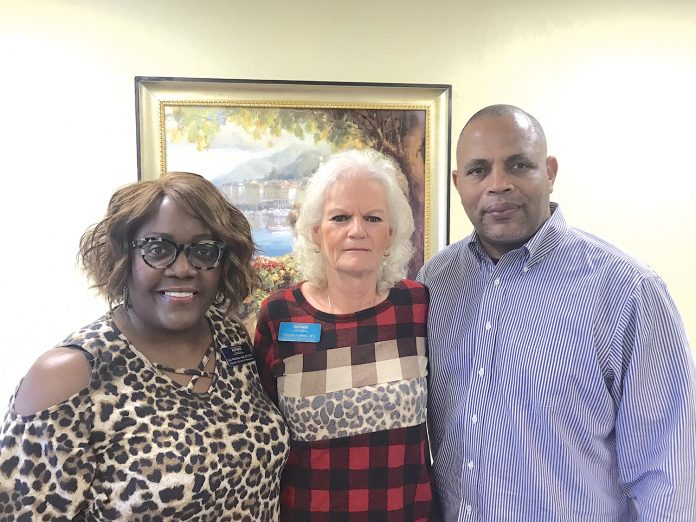
From left, Lisa Wariboko-Alali, RN, owner of All Faith Home Care has nothing but compassion for her clients and praise for her staff which includes, Brenda Guthrie, RN, DON; and Michael G., spokesman.
by James Coburn, Staff Writer
Lisa Wariboko-Alali, RN, aspired to make a difference in patient’s lives and become a good employer. All Faith Home Care gave her the opportunity to serve the family of mankind as the owner of the company she founded.
Alali earned a Bachelor of Science degree from the University of Oklahoma and has been a nurse for 30 years. She began her career working in the post-coronary care unit at Southwest Medical Center before making the transition to home health.
She needed a more flexible schedule when she married and started raising a family. Home health met her needs.
“I fell in love with home health and found my niche,” she said of the business she opened in 1996. “It’s totally enriched my life. I think it’s been my calling. My mother was in the health care profession. As a little girl I watched her care for my sick dad. I watched her care for other families by sacrificing her time. And I think that really inspired me to be a nurse and caregiver.”
Home health is not only a business, but a ministry for Alali as well. Advantage waiver case management was added over a year ago, a program to help seniors stay at home and funded by the Oklahoma Health Care Authority.
The staff is what makes All Faith Home Care a success, she said.
“I love my staff so much. They are totally committed,” Alali said. “Some of my staff have been here for 15 years, some for 10 years. They are compassionate and caring.”
All Faith Home Care is also a blessing for families in need of knowing their families are secure.
“That’s so rewarding. It helps us to keep going, especially during this time of the COVID pandemic and nursing shortage. It’s a very challenging time to be in health care right now.”
All Faith Home Care wears personal protective equipment to enhance patient care during the pandemic, said Brenda Guthrie, RN, director of Clinical Services, who has been with the company for 10 years.
“With several COVID patients we make sure we go above and beyond what they need. So, it is a calling,” Guthrie said.
She aspired to become a physician when thinking of a career. Guthrie passed all her tests but could not afford medical school. She chose nursing school and has kept going since 1979.
“I get attached to all of my patients and I can’t imagine not seeing them. I took care of Lisa’s mom, and I took care of my husband while he was dying. I will hold someone’s hand if that’s what they want at the end,” Guthrie said.
Guthrie began her nursing career in an intensive care unit for trauma. She went on to be an ER nurse and did flight nursing. Guthrie also has the distinction of having served as the health services administrator for the state of Delaware Prison System. She managed the hospital there for eight years.
“Then I came back to Oklahoma to take care of my parents and here I am,” Guthrie explained.
Alali understands that her staff has family issues, too, and is given the flexibility to take care of that, Guthrie said.
All Faith Home Care will travel beyond its 50-mile service range whenever a doctor notifies them that nobody else will accept a patient, Guthrie said.
Most Medicaid insurers only provide 36 home health visits a year, Michael said. Currently more than 20 clients have exceeded the 36 visits. But All Faith Home Care did not discharge them. Alali ensures that her clients, some in a rural area, will continue being cared for beyond 36 visits.
“When the poor people don’t have anymore visits, we don’t cast them out,” he said.
Guthrie said their clients are their families and will not be deserted when All Faith Home Care will not be paid to see them.
“Time after time we’ve had patients that would not have lived if All Faith Home Care had not stepped in and provided the services,” Alali said. “There’s been several occasions when Brenda has gotten a call from a patient and has ended up saving that patient’s life.”
On many occasions Brenda will be in a home and do CPR on a patient.
“I just don’t know how to describe it, but I know it’s a divine assignment for her. She has left the office on the way to see a patient and she’ll come up on an accident and she’s there just at the right time to save someone’s life,” she said. “And other times, it’s been a family member and not a patient, and she’s gotten there just in time to save their life. That’s the ultimate calling.”
Guthrie said they have walked into homes with an empty refrigerator.
“All I have to do is call Lisa, and she’s calling Michael or one of the nurses and we’re out buying groceries, and we’re getting them set up with food banks,” she said.