Monday, December 29, 2025

Covid-19 employee testing keeps OMRF running strong

0
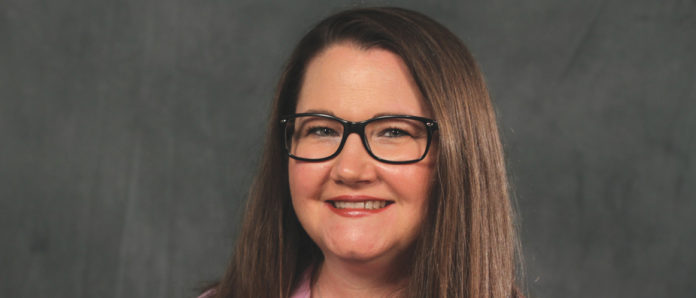
OMRF Vice President of Human Resources looks on as OMRF scientist Antonina Araszkiewicz tuns in a saliva sample for Covid-19 screening. Since starting the weekly in-house testing program developed by its researchers, OMRF has had no instances of onsite spread of the virus among employees.

Once a week, after she brushes her teeth and gets ready to leave for work at the Oklahoma Medical Research Foundation, Cindy Carter sets a 30-minute timer on her phone.
When Carter’s phone buzzes on her drive, it reminds her of the task that now kicks off her week: submitting a saliva sample for OMRF’s weekly employee Covid-19 testing program.
Before leaving her car, Carter opens her testing kit, which OMRF provides to staff members each week. Inside is a cup, a barcoded sample tube, pipette, alcohol wipe and biohazard bag.
“I don’t want to take off my mask indoors, so before I go in, I spit into the cup, put the sample in the tube and throw the waste away in a biohazard receptacle,” said Carter, a lab manager for OMRF’s Cardiovascular Biology Research Program.
Carter then enters OMRF’s Research Tower, where a human resources staffer sits behind plexiglass, ready to collect samples.
“They scan a barcode on my employee badge, then a barcode on the tube,” explained Carter, who joined OMRF in 1996. “Only human resources has those codes. It couldn’t be easier or faster.”
Each Wednesday morning, having collected samples from the 300-plus employees who are onsite each week, foundation technicians analyze the samples. The OMRF-developed process can run 186 samples at a time and examines each sample five times for accuracy. And because of the “specificity” of the test, it can detect amounts of the virus much smaller than those picked up by many commercially available tests.
The lab relays any positive results by Wednesday evening to OMRF Vice President of Human Resources Courtney Greenwood, who contacts those individuals. “If you haven’t heard from me by Thursday morning, you know you’re in the clear,” said Greenwood.
When it came to adding testing to OMRF’s existing pandemic protocols of mask-wearing and physical distancing, Greenwood said OMRF leadership agreed the test had to be fast, free of nose swabs, and affordable for the foundation.
OMRF scientist Joel Guthridge, Ph.D., and his team answered the call, using existing equipment, technology and staff to develop the saliva-based PCR test at a fraction of commercial costs.
“It’s pennies on the dollar comparatively,” said Guthridge. “Our goal is to help people be healthier. We had to achieve that mission on our own turf so that we could forge ahead with our other research.”
More than 4,000 samples have been run since the testing program started in October. To date, they’ve identified 17 employees who were positive for the virus. In the same timeframe, there have been no instances of onsite spread of the virus among employees.
“This testing program has really proven effective at keeping our workforce safe and avoiding outbreaks,” said Greenwood. “It’s helped us maintain our laboratory operations, and we plan to continue the program as long as the virus remains a threat in the community.”
For Carter, OMRF’s weekly testing program, along with a host of other onsite safety protocols, have provided comfort during unsettling times.
I’ve felt really good about coming into work during even the worst stretches of the pandemic,” said Carter. “Having worked here as long as I have, I’m not surprised they went above and beyond to protect us.”

Savvy Senior: Do I Need to Sign-Up for Medicare If I’m Still Working?

0

Dear Savvy Senior,

I will turn 65 in a few months and plan to keep working for several more years. I have good health insurance from my employer now. Do I have to sign up for Medicare when I reach 65?

Looking Ahead

Dear Looking,
Whether you need to enroll in Medicare at 65 if you continue to work and have health insurance through your job depends on how large your employer is. The same rules apply if your health insurance comes from your spouse’s job.
But first, let’s review the basics. Remember that original Medicare has two parts: Part A, which provides hospital coverage and is free for most people. And Part B, which covers doctor’s bills, lab tests and outpatient care. Part B also has a monthly premium, which is $148.50 for most beneficiaries in 2021, but is higher for individuals earning above $88,000.
If you’re already receiving Social Security, you’ll automatically be enrolled in parts A and B when you turn 65, and you’ll receive your Medicare card in the mail. It will include instructions to return it if you have work coverage that qualifies you for late enrollment. If you aren’t yet receiving Social Security, you will have to apply, which you can do online at SSA.gov/medicare.
If you plan to continue working past the age of 65 and have health insurance from your job, your first step is to ask your benefits manager or human resources department how your employer insurance works with Medicare. In most cases, you should at least take Medicare Part A because it’s free. (Note: If you’re funding a health savings account you may not want to take Part A because you can’t make contributions after you enroll). But to decide whether to take Part B or not will depend on the size of your employer.
Small Employer
If your current employer has fewer than 20 employees, Medicare will be your primary insurer and you should enroll in Medicare Part B during your initial enrollment period. This is a seven-month period that includes the three months before, the month of, and the three months after your 65th birthday.
If you miss the seven-month sign-up window, you’ll have to wait until the next general enrollment period, which runs from Jan. 1 to March 31 with benefits beginning the following July 1. You’ll also incur a 10 percent penalty for each year you wait beyond your initial enrollment period, which will be tacked on to your monthly Part B premium.
Large Employer
If your employer has 20 or more employees, your employer’s group health plan will be your primary insurer as long as you remain an active employee. If this is the case, you don’t need to enroll in Part B when you turn 65 if you’re satisfied with the coverage you are getting through your job. But if you do decide to enroll in Medicare, it will supplement your employer insurance by paying secondary on all of your claims.
Once your employment or group health coverage ends, you will then have eight months to sign up for Part B without a penalty. This is known as the Special Enrollment Period.
Check Drug Coverage
You also need to verify your prescription drug coverage. Call your benefits manager or insurance company to find out if your employer’s prescription drug coverage is considered “creditable.” If it is, you don’t need to enroll in a Medicare Part D prescription drug plan. If it isn’t, you should purchase a plan (see Medicare.gov/plan-compare) during your initial enrollment period or you’ll incur a premium penalty (1 percent of the average national premium for every month you don’t have coverage) if you enroll later.
If you have more questions or need help, contact your State Health Insurance Assistance Program (see ShiptaCenter.org), which offers free Medicare counseling. Or call the Medicare Rights Center helpline at 800-333-4114.
Send your senior questions to: Savvy Senior, P.O. Box 5443, Norman, OK 73070, or visit SavvySenior.org. Jim Miller is a contributor to the NBC Today show and author of “The Savvy Senior” book.

INTEGRIS Health Pharmacy Manager Receives Medallion

0

Steven Howell, the Pharmacy Manager at INTEGRIS Baptist Medical Center, receives a token of appreciation from Alex Azar the former Secretary of the United States Department of Health and Human Services.
Howell was given this medallion for his role in discovering extra doses of the Pfizer vaccine. In early shipments of the vaccine, the FDA had originally approved the use of five doses per vial. But when examining the doses sent to INTEGRIS Health, Howell discovered that you could actually get six doses from each vial. He quickly informed his brother-in-law, U.S. Marine Colonel Gregory McCarthy, who happens to be on the White House Coronavirus Task Force. McCarthy relayed the information up the chain of command and after further review, the FDA granted permission for hospitals around the country to use the sixth dose. “In essence, we received 20-percent more doses than we originally thought,” said Howell. “We were able to vaccinate that many more people and none of the vaccine went to waste.”
Howell may downplay his involvement in this potentially life-saving discovery, but he fully understands the importance of expanding the use of such a scarce commodity. “It’s exciting to be a part of something so monumental,” admits Howell.
We applaud you, Steven, for your daily contributions to INTEGRIS Health and the citizens of Oklahoma, and we commend you for your service to the entire country.

Enid Family Care Clinics Earn Recognition

0

The National Committee for Quality Assurance (NCQA) recently announced that five INTEGRIS Family Care Clinics in Enid have earned Patient-Centered Medical Home (PCMH) Recognition renewal.
The clinics received the initial recognition for using evidence-based, patient-centered processes that focus on highly coordinated care and long-term, participative relationships. The facilities receiving the PCMH Certificate of Recognition renewal are listed below:
INTEGRIS Family First
INTEGRIS Christopher A. Shearer, D.O.
INTEGRIS Dustin Baylor, M.D.
INTEGRIS N.W. Family Medicine Clinic
INTEGRIS Family Care Services of Enid
The NCQA Patient-Centered Medical Home is a model of primary care that combines teamwork and information technology to improve care, improve patients’ experience of care and reduce costs. Medical homes foster ongoing partnerships between patients and their personal clinicians, instead of approaching care as the sum of episodic office visits. Each patient’s care is overseen by clinician-led care teams that coordinate treatment across the health care system. Research shows that medical homes can lead to higher quality and lower costs and can improve patient and provider reported experiences of care.

AHCA/NCAL Issues Statement Regarding COVID-19 Vaccine Rollout In Long Term Care

0

The American Health Care Association and National Center for Assisted Living (AHCA/NCAL), representing more than 14,000 nursing homes and assisted living communities across the country that provide care to approximately five million people each year, released the following statement regarding the pace of the COVID-19 vaccination rollout.
The following statement is attributable to Mark Parkinson, president and CEO of AHCA/NCAL:
“With record-breaking cases in nursing homes right now due to soaring community spread, no one could wish for a swifter delivery of the vaccine than those living and working in long term care facilities. While we must be efficient in order to save the lives of our most vulnerable, we must also be thoughtful and targeted in our approach.
“Since the creation of the pharmacy partnership program for long term care, we knew that this rollout would take time: to approve the vaccines for use; to have enough supply for each state to activate the program; to encourage states to prioritize our population; to distribute and ship the vaccine to the pharmacies; to prepare the clinics for our residents who have complex conditions; to gather consent among residents or their health care representatives; and to educate staff, residents and family members about the need to take the vaccine. The plan from the beginning was to vaccinate long term care residents and staff with the first dose over three to four weeks, beginning the last two weeks of December. Therefore, we are in the midst of the pharmacy partnership program really getting underway, and we believe this program is operating in accordance with its intended timeline.
“As of right now, we are not aware of widespread issues or delays with this vaccine rollout, and if there were, we would be among the first to sound the alarm. We continue to assist a minority of member providers who come to us looking for assistance or clarity, but the majority of providers tell us that their clinics have been scheduled or have already occurred and that overall, the program is running smoothly.
“As with any effort of this scale, there will be issues, and vaccine hesitancy is our primary focus at this moment. Uptake among residents and staff is varying widely, but in general, staff seem to be mirroring the general public’s reaction: excitement mixed with hesitation about the vaccines’ development and safety. We launched the #GetVaccinated campaign to encourage all long term care residents, families and staff members to consent to the vaccine as well as provide credible information to help inform their decision. We call on public health officials, social media companies, and members of the media to combat misinformation about the vaccine to aid in this effort.
“And pardon the pun, but we get more than one shot at this. We remain hopeful that uptake for the vaccine will improve as this pharmacy partnership program continues to unfold in the coming weeks and months in the subsequent clinics.
“This is a monumental effort to vaccinate millions of our nation’s vulnerable seniors and their caregivers, and we are confident and grateful that everyone involved is working as hard and as fast as they can while still ensuring we get this right.”

Greg Schwem: The Diet Coke button doesn’t work in my office

0
Greg Schwem is a corporate stand-up comedian and author.

by Greg Schwem

Greg Schwem has dreamed about having a “Diet Coke” button on his desk.

The hardware store employee approached, noting the confusion on my face. It’s a look that just happens naturally the moment I enter any store that smells of lumber.
“What can I help you find today?” he said.
“The ‘Diet Coke’ button,” I said.
“Excuse me?”
I repeated my request, glancing at my watch while doing so. Whenever I’m in a hardware store, my goal is to be out in less than five minutes. I never do this when I’m in, say, an electronics store. Then again, I enjoy being around flat screen televisions. Drill bits and tile grout, not so much.
“We sell Diet Coke at the registers,” the employee said. “But that’s it. Are you referring to something you wear on your lapel?”
“No, I want the button that sits on your desk. You press it and somebody walks in with a Diet Coke,” I said. “I read Donald Trump had one installed on the Oval Office desk, but President Biden got rid of it when he was sworn in. And it didn’t even require an executive order.”
“We don’t sell a Diet Coke button,” the relieved employee said. “Have you tried contacting Coca-Cola? Maybe they have one.”
“I sent an email,” I said. “Still waiting for a response. Look, it doesn’t have to be Diet Coke, specifically. Do you sell other buttons for a home office that produce objects instantly when pressed? What about a ‘potato chips’ button? A ‘warm pair of socks’ button? A ‘Bud Light’ button?”
“You want a Bud Light button in your office?” the employee said.
“I’d program it so it only worked after 5:30 p.m.,” I replied.
“Sir, we have a full line of doorbells in aisle 15. Wouldn’t something like that work?” asked the employee, now glancing at HIS watch.
“I suppose so,” I said.
“Great. Happy to be of service,” the employee said. “Now if you’ll excuse me, I’m needed in plumbing.”
Trudging to the other side of the store, I found an “entry alert kit” featuring a device that promised to emit a buzzing sound. I brought it home, secured it near my keyboard and pressed the button. My dog, not recognizing this new sound, freaked out, nonetheless.
“Why is she barking?” my wife yelled from upstairs.
“She’ll be fine,” I yelled back. “She just needs to get used to the new sound.”
“What new sound?” said my wife, now standing at the entrance to my office.
“This one,” I said, pressing the button again. The dog responded accordingly.
“Why are you buzzing?” she asked, after consoling our now breathless pooch.
“It’s my Diet Coke buzzer,” I said. “Like the one President Trump used. You’re familiar with it?”
“Familiar enough to know that I’m not getting you a Diet Coke every time you press that thing,” she said. “Did you really think that was going to happen?”
“It doesn’t have to be you,” I said. “It could be anyone who happens to hear it. What about our daughters? They’ve been spending a lot of time in the house since COVID-19. They can get it.”
“When did everybody in this house suddenly become your servants?” she said.
“So, I should return the buzzer?”
“No, I think I’ll get one. Maybe I’ll get a few, all with different sounds. One is the signal that I’m not cooking dinner tonight, another is that the faucet is still dripping — I’ll return it when you finally fix it — another for…”
“OK, I get it. But can you just bring me a Diet Coke one time? Just so I can experience what might have been?”
Before she could answer, I pressed the button.
My wife exited the room, returning with my favorite beverage.
For a brief moment, I felt very presidential.
(Greg Schwem is a corporate stand-up comedian and author of two books: “Text Me If You’re Breathing: Observations, Frustrations and Life Lessons From a Low-Tech Dad” and the recently released “The Road To Success Goes Through the Salad Bar: A Pile of BS From a Corporate Comedian,” available at Amazon.com. Visit Greg on the web at www.gregschwem.com.
You’ve enjoyed reading, and laughing at, Greg Schwem’s monthly humor columns in Senior Living News. But did you know Greg is also a nationally touring stand-up comedian? And he loves to make audiences laugh about the joys, and frustrations, of growing older. Watch the clip and, if you’d like Greg to perform at your senior center or senior event, contact him through his website at www.gregschwem.com)

SITUATION UPDATE: COVID-19

0

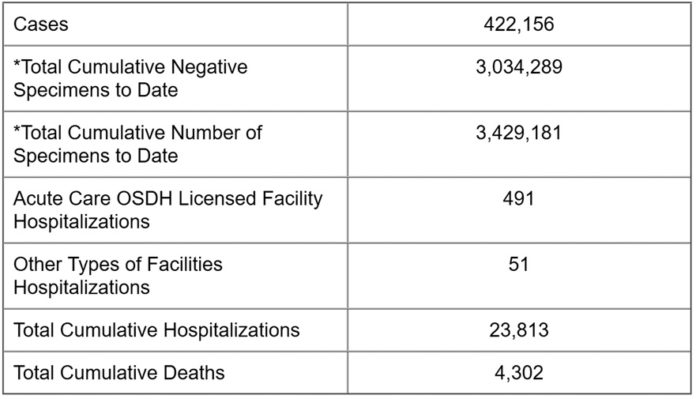
* As of this advisory, there are 381,430 cases of COVID-19 in Oklahoma.
* 2,626 is today’s 7-day rolling average for the number of new cases reported.
* There are 35 additional deaths identified to report.
*One in Bryan County, one female in the 50-64 age group.
*Two in Caddo County, one female in the 50-64 age group, one male in the 65 and older age group.
*One in Carter County, one female in the 50-64 age group.
*One in Cleveland County, one male in the 65 or older age group.
*Three in Creek County, one female in the 50-64 age group, one female in the 65 or older age group, one male in the 65 or older age group.
*One in Garvin County, one male in the 65 or older age group.
*One in Johnston County, one female in the 65 or older age group.
*One in Kay County, one male in the 65 or older age group.
*One in Kingfisher County, one female in the 65 or older age group.
*One in Le Flore County, one male in the 65 or older age group.
*One in McClain County, one male in the 50-64 age group.
*Three in Muskogee County, one female in the 65 or older age group, two males in the 65 or older age group.
*One in Nowata County, one male in the 50-64 age group.
*Four in Oklahoma County, two females in the 65 or older age group, one male in the 50-64 age group, one male in the 65 or older age group.
*One in Pottawatomie County, one male in the 65 or older age group.
*Two in Rogers County, two males in the 65 or older age group.
*One in Stephens County, one female in the 50-64 age group.
*Seven in Tulsa County, four females in the 65 or older age group, three males in the 65 or older age group.
*One in Wagoner County, one male in the 65 or older age group.
*One in Washington County, one female in the 65 or older age group.
* There are 3,423 total deaths in the state.
* Additional hospitalization data can be found in the Hospital Tiers report, published evenings Monday through Friday.
* For more information, visit https://oklahoma.gov/covid19.html.

Oklahoma City Organization Earns National Recognition for Innovative Brain Health Education Program

0

VillagesOKC, an organization of virtual neighbors enabling mature adults to come together to learn, plan, and serve with spirit and dignity, has been selected by the Mather Institute as an honoree of the 2020 Promising Practices Awards. VillagesOKC was recognized for Bringing Brain Health Education to the Community.
Organizations working with older adults from across the country sent in submissions about how they are moving away from conventional practices through new and innovative approaches. Eight organizations with powerful ideas and practices were highlighted for continuing to move the aging services industry forward, despite an abnormally unusual year.
“The Promising Practices Awards honor true leaders in ideation and implementation,” said Cate O’Brien, PhD, assistant vice president and director of the Mather Institute. “We hope these projects will serve as a catalyst for organizations across the country and around the world to spark innovation in their own programs.”
Over the past two years, VillagesOKC has worked closely with MINDRAMP Consulting, a brain health consulting and coaching company, to develop and sustain a Brain Health Initiative, offering MINDRAMP’s unique approach through live presentations, videos, podcasts, web-based classes and workshops. The initiative presents a behavioral and risk-management approach that is specifically tailored for the mature adult population. From 2019-2020, more than 360 older adults attended brain health classes.
From Feb. to June 2021, VillagesOKC will again partner with MINDRAMP to host a weekly Brain Academy. The full semester of engaging, evidence-based sessions will be held via a secure Zoom meeting. The program is $100 for non-members and $50 for members of VillagesOKC. Programming includes:
Level 1. Strong Brains, Sharp Minds: The Art & Science of Aging Intentionally
* Feb. 10 – The Longevity Paradox & The Call to Adventure
* Feb. 24 – May the Force Be with You & Navigational Aids
Level 2. Mapping the Future of Your Mature Mind
* March 10 – Motivation & Assessments
* March 24 – Planning & Skills for Sustainability
Level 3. – Eight Behaviors That Shape Your Brain
* April 14 – Cogwheel Overview, Physical Exercise & Mental Stimulation
* April 28 – Social Engagement, Stress Management & Diet and Nutrition
* May 12 – Sleep, Medical Factors & Environmental Conditions
Practicum 1. Designing Your Brain Health Action Plan
* May 26 – Design Your Personal Action Plan
Practicum 2. Lions & Tigers & Bears: Group Coaching to Overcome Obstacles, Setbacks and Discouragement
* June 9 – Put Your Personal Action Plan into Action
* June 23 –Develop Strategies for Sustainability
“The Brain Health Initiative has expanded the range and depth of our remotely delivered services and has positioned us as a leader in the aging community,” said Marilyn Olson, executive director of VillagesOKC. “As MINDRAMP says, ‘Everyone wants a better brain.’ Offering this program has grown our membership and our place in the greater community.”
To learn more and to register for the Brain Academy, please email info@villagesokc.org or call 405.990.6637.

Retiree Increases Patriotic Volunteerism

0
Norman veteran Stephen Reagan, 74, poses with the Cleveland County Veterans Memorial in Reaves Park that honors all county veterans and his 20-year U.S. Air Force career.

Story and photos by Darl DeVault

Clay bust of Medal of Honor winner U.S. Navy Commander Ernest E. Evans sculpted by Norman artist Paul Moore.

A retired U.S. Air Force lieutenant colonel and dentist, Norman resident Stephen Reagan is expanding his daily volunteer work helping fellow veterans. For several years he has volunteered helping veterans file their VA claims at the Dale K. Graham Veterans Foundation. Now he is volunteering to help honor a long-deceased Oklahoma veteran—U.S. Navy Commander Ernest E. Evans, who earned the Medal of Honor for heroism in WWII.
Since its beginning, the veteran’s organization has helped more than 25,000 veterans file their benefits claims with the Veterans Administration. Its impact spans all 77 counties in Oklahoma, 45 states, and four foreign countries.
Segueing from helping at the foundation several mornings per week to raising funds to honor Muskogee High graduate Ernest Evans’ heroism has been a change of pace. Reagan, 74, plans to ramp up his fundraising efforts to find a suitable setting for a bronze bust of Evans in 2021.
“I was inspired to do this because Evans was the commander of the destroyer USS Johnston in the Battle off Samar where his heroic actions are as impressive as any war story I have ever heard,” Reagan said recently.
Fortunately, widely acclaimed Norman sculptor Paul Moore sees Reagan’s patriotic vision. He has sculpted the bust with the USS Johnston (DD 557) in miniature at the base in clay. This act of patriotism on Moore’s part gives Reagan’s mission a real boost of professional credibility.
Upon first learning of Evans’ heroism and Reagan’s mission to honor him, Moore was immediately on board, to use a nautical phrase. Evans’ bronze bust will be accompanied by an informational plaque on a granite pedestal. A clay model has already been completed. “I am grateful a talented and famous Oklahoma sculptor like Paul Moore sculpted the bronze bust,” Reagan said.
Of Native American heritage, Evans was largely forgotten in his home state because he left Oklahoma in the mid-1920s for the Navy. He only returned for visits with his mother and siblings in the Tulsa area. He was initially awarded the Navy Cross for his gallantry, but this was upgraded to our nation’s highest military distinction at the end of WWII.
His story of heroism first resonated with Reagan in 2008. “I read about Evans in an excellent book by James Hornfischer, The Last Stand of the Tin Can Sailors, which tells the story of one of the largest naval battles in history.”
The author describes the battle near the Philippine Islands in late October 1944. A Navy taskforce called Taffy 3 was assigned to protect the U.S. Army troops committed to the vital landing on the Philippines with General Douglas McArthur. Taffy 3 was to shield the vulnerable transports of the Leyte Gulf invasion fleet.
Taffy 3 consisted of six escort aircraft carriers (known as jeep carriers), three destroyers, and four destroyer escorts. The lightly armored, smallish escort carriers were lightly armed. They were built on commercial hulls, as platforms to launch aircraft. The destroyers and destroyer escorts were assigned to protect the escort carriers.
Early in the morning of October 25, off the island of Samar, the Imperial Japanese Navy “Center Force A” appeared on the horizon with no warning.
The Japanese force consisted of 23 ships, including four battleships and six heavy cruisers. Led by the super battleship Yamato, the largest and most-heavily gunned ship ever built, the Japanese display of force strength was a daunting sight.
This battle has been cited by naval historians as one of the greatest mismatches in history. Taffy 3 was there to provide the landings shore support and screen as an anti-submarine patrol. The group was never envisioned as a force capable of mounting fleet-level combat with battleships.
The USS Johnston, a Fletcher-class destroyer under Commander Evans, was the first American ship to attack the Japanese fleet. Without being ordered to attack, Evans sailed straight for the enemy against impossible odds. It was a suicide mission.
This bravery was foretold during the Johnston’s commissioning ceremony in October of 1943. New Commanding Officer Evans told sailors assigned to the ship: “This is going to be a fighting ship. I intend to go in harm’s way, and anyone who doesn’t want to go along had better get off right now.” His sailors remained at their stations.
He ordered a smoke screen to protect himself and the rest of Taffy 3 and the wind made it effective. He first made a torpedo run toward a Japanese heavy cruiser and sank it. Being the first to attack, all this time the Johnston was taking heavy shell fire. Out of torpedoes, Evans continued to attack the Japanese with his five-inch guns.
After about two hours of fighting, the Johnston’s steering was knocked out as well as its communications. Wounded when the ship’s bridge was destroyed, Evans moved to the rear of the ship. From the fantail he controlled the ship by shouting orders through an open hatch to sailors turning the rudder by hand below.
A short while later the Johnston was dead in the water. Three hours after the battle began, a Japanese ship approached to point blank range and sank the destroyer. But by then the delaying action by the Johnston’s heroic crew and the sailors of the other small fighting ships had allowed all but one the jeep carriers to escape. The escort aircraft carrier USS Gambier Bay was sunk.
“This brief description doesn’t do justice to the heroism of Evans and his crew,” Reagan said. “The USS Johnston, with the other ships and planes of Taffy 3, fought so fiercely they surprised the Japanese. They thought they were fighting a much larger American force and retreated.”
Evans went down with his ship. His body was never recovered. Late in 1945 he was posthumously awarded the Medal of Honor for his actions. His widow accepted the award in a ceremony near San Diego.
His actions and those of many other sailors and pilots of Taffy 3 saved the Navy from a near disaster. In addition to all earning Presidential Unit Citations, the sailors and pilots earned 22 Navy Crosses, 2 Silver Stars and 2 Bronze Stars for valor in combat operations.
Inducted into the Oklahoma Military Hall of Fame in 2009, Evans received little recognition in Muskogee and in the state until this year. The Oklahoma Historical Society published a long-overdue account of his life and heroics in a 2010 issue of the society’s historical journal, Chronicles of Oklahoma.
On Veterans Day this year Oklahoma City unveiled the Oklahoma Medal of Honor Memorial at the new 27-acre Manuel Perez Park, named for a MOH winner. Evan’s valiant fighting spirit throughout his historic naval battle is honored at the plaza there with the 32 other Oklahomans who have earned the Medal of Honor.
Commander Evans graduated from Muskogee High School in 1926 and joined the Navy as an enlisted sailor. He then made his way to the Naval Academy where in 1931 he become one of the first Native Americans to graduate. At the academy he was nicknamed “Chief.” Serving in the fleet as a junior officer, he steadily advanced in rank to commanding the Johnston in 1944.
Reagan wants to see Evans honored with a bronze bust and historic marker on a pedestal. He hopes to place it in an appropriate setting. War Memorial Park in Muskogee would be one of his choices. The bronze bust, set on a base by Willis Granite of Granite, Okla., is envisioned as a patriotic fixture in Muskogee.
Reagan was born in Norman and raised in Claremore, Okla. He attended Cameron College and the University of Arkansas, playing baseball. He joined the U.S. Air Force for four years, then graduated dental school at the University of Oklahoma College of Dentistry. He went on to serve in the Air Force for a total of 20 years.
He returned to Oklahoma to teach at the OU College of Dentistry for 20 years, where he was director of the Advanced General Dentistry Program. He has been married to his wife, Alice, for 52 years.
The cost of the project is near $40,000 for the bronze bust by Moore and the granite base. Willis Granite will do the installation. As an outdoor display, the City of Muskogee would need to provide a concrete base.

A Partnership for Healthcare Planning

0
Steven Sibley of Sibley Insures and Mike McCall, with Mass Mutual announce their strategic partnership with a goal to “to help people do for their families, what we would do for our own.”

by Steven Sibley of Sibley Insures, MBA/Health Care Administration

Sibley Insures is pleased to announce their strategic partnership with Mass Mutual of Oklahoma. Mike McCall, with Mass Mutual, serves as the primary Advisor on a team of professionals focused on retirement planning. “I am very excited to have both Steve and his wife Christina as a resource for our team.” Mike noted. “Our clients expect and deserve a high level of expertise and these two have it. Their input will ensure our clients have great, affordable healthcare, with ongoing support and advocacy throughout their retirement years.”
Sibley Insures is an independent insurance broker in Oklahoma City, specializing in Medicare and ancillary healthcare products. Steve, from Tulsa and licensed in Oklahoma, is a retired Air Force and Army veteran and holds an MBA with an emphasis in healthcare administration from MACU in OKC. He manages the business and their marketing. Christina is also licensed in Oklahoma and Kansas, where she is originally from. She holds a Bachelor of Science degree in Health Studies with an emphasis in Gerontology. She spends her time focused on consumer education, plan selection and advocacy for her clients.
Together, Steve and Christina bring a unique balance of healthcare planning experience to the table. She’s spent over 20 years as a caregiver in hands-on patient care; as an EMT, a Registered Medical Assistant in physicians’ practices, the supervisor of a homecare company and a healthcare sciences educator at the college level. She is all about patient and client care. Steve explains, “I tell people it’s like having someone in your corner with all this healthcare knowledge and experience, that just happens to be your favorite niece, and she will treat you like family.”
Steve’s career in the financial services industry started over 20 years ago. During that time he also served in the Army Reserve, as a weekend warrior and eventually as an active-duty reservist, ending his 36-year military career in September of 2017. “After retirement, I wanted to be an independent broker and add a focus on health insurance to my financial services business.” Christina agreed to join him in business, got licensed and once she discovered Medicare, she loved it. Steve ended up spending the next 3 years focused on supporting Christina in her Medicare business and becoming a house husband. However, he knew that eventually he wanted to get back into the field. “With my knowledge of both financial services and how Medicare works, I knew I could carve out a niche helping advisers and their clients get a real clear picture of healthcare costs in retirement and strategically plan for it.”
That is where Mike McCall comes in. He’s also an Army Veteran and as a financial services advisor has over 20 years of education enhanced skillsets and experience. He’s continued serving people in a specialty centered around income planning for retirement. “Life is always changing; therefore, the financial planning landscape is always evolving. I believe most people are so busy living life that they need someone at their side to help them navigate the challenges of creating sustainable income during retirement. That’s what I do and I share that responsibility myself and for my family. So, it is work I take seriously and it’s work I love.” In addition to Mike’s experience, the next most important part of his knowledge and growth has been his education. “I’m fortunate that Mass Mutual invests in my continuing education and I believe that pays dividends for my clients.” With a Degree in Management and Ethics from MACU here in OKC, he also holds the esteemed professional designations of: Chartered Life Underwriter (CLU), Chartered Financial Consultant (ChFC), and Retirement Income Certified Professional (RICP). Mike’s a family man, with wife Joyce, a nurse at Baptist Hospital, and two adult sons.
“Our goal is to help people do for their families, what we would do for our own.” Mike points out. “We’ve developed a model for strategically guiding our clients through healthcare planning. We’ve also armed clients with a knowledgeable team of advocates, such as health insurance agents, who’ll guide them into the right Medicare and ancillary plans. An Advisor, who’ll skillfully recommend financial vehicles for healthcare savings to mitigate expenses not typically covered by insurance, and Attorneys, who’ll ensure the proper legal healthcare documents are put into place. Our clients can be confident they have a sound, strategic, flexible plan that works very well, which, while being affordable, offers a high level of coverage, that protects their most important assets, their health, wellness and wealth. We are looking for 2021 to be a great year for helping seniors in this area.” For more information contact Steven Sibley 405-850-1569, ssibleyinsures@gmail.com.

Social

0FansLike
0FollowersFollow
0SubscribersSubscribe