* As of this advisory, there are 381,430 cases of COVID-19 in Oklahoma.
* 2,626 is today’s 7-day rolling average for the number of new cases reported.
* There are 35 additional deaths identified to report.
*One in Bryan County, one female in the 50-64 age group.
*Two in Caddo County, one female in the 50-64 age group, one male in the 65 and older age group.
*One in Carter County, one female in the 50-64 age group.
*One in Cleveland County, one male in the 65 or older age group.
*Three in Creek County, one female in the 50-64 age group, one female in the 65 or older age group, one male in the 65 or older age group.
*One in Garvin County, one male in the 65 or older age group.
*One in Johnston County, one female in the 65 or older age group.
*One in Kay County, one male in the 65 or older age group.
*One in Kingfisher County, one female in the 65 or older age group.
*One in Le Flore County, one male in the 65 or older age group.
*One in McClain County, one male in the 50-64 age group.
*Three in Muskogee County, one female in the 65 or older age group, two males in the 65 or older age group.
*One in Nowata County, one male in the 50-64 age group.
*Four in Oklahoma County, two females in the 65 or older age group, one male in the 50-64 age group, one male in the 65 or older age group.
*One in Pottawatomie County, one male in the 65 or older age group.
*Two in Rogers County, two males in the 65 or older age group.
*One in Stephens County, one female in the 50-64 age group.
*Seven in Tulsa County, four females in the 65 or older age group, three males in the 65 or older age group.
*One in Wagoner County, one male in the 65 or older age group.
*One in Washington County, one female in the 65 or older age group.
* There are 3,423 total deaths in the state.
* Additional hospitalization data can be found in the Hospital Tiers report, published evenings Monday through Friday.
* For more information, visit https://oklahoma.gov/covid19.html.
VillagesOKC, an organization of virtual neighbors enabling mature adults to come together to learn, plan, and serve with spirit and dignity, has been selected by the Mather Institute as an honoree of the 2020 Promising Practices Awards. VillagesOKC was recognized for Bringing Brain Health Education to the Community.
Organizations working with older adults from across the country sent in submissions about how they are moving away from conventional practices through new and innovative approaches. Eight organizations with powerful ideas and practices were highlighted for continuing to move the aging services industry forward, despite an abnormally unusual year.
“The Promising Practices Awards honor true leaders in ideation and implementation,” said Cate O’Brien, PhD, assistant vice president and director of the Mather Institute. “We hope these projects will serve as a catalyst for organizations across the country and around the world to spark innovation in their own programs.”
Over the past two years, VillagesOKC has worked closely with MINDRAMP Consulting, a brain health consulting and coaching company, to develop and sustain a Brain Health Initiative, offering MINDRAMP’s unique approach through live presentations, videos, podcasts, web-based classes and workshops. The initiative presents a behavioral and risk-management approach that is specifically tailored for the mature adult population. From 2019-2020, more than 360 older adults attended brain health classes.
From Feb. to June 2021, VillagesOKC will again partner with MINDRAMP to host a weekly Brain Academy. The full semester of engaging, evidence-based sessions will be held via a secure Zoom meeting. The program is $100 for non-members and $50 for members of VillagesOKC. Programming includes:
Level 1. Strong Brains, Sharp Minds: The Art & Science of Aging Intentionally
* Feb. 10 – The Longevity Paradox & The Call to Adventure
* Feb. 24 – May the Force Be with You & Navigational Aids
Level 2. Mapping the Future of Your Mature Mind
* March 10 – Motivation & Assessments
* March 24 – Planning & Skills for Sustainability
Level 3. – Eight Behaviors That Shape Your Brain
* April 14 – Cogwheel Overview, Physical Exercise & Mental Stimulation
* April 28 – Social Engagement, Stress Management & Diet and Nutrition
* May 12 – Sleep, Medical Factors & Environmental Conditions
Practicum 1. Designing Your Brain Health Action Plan
* May 26 – Design Your Personal Action Plan
Practicum 2. Lions & Tigers & Bears: Group Coaching to Overcome Obstacles, Setbacks and Discouragement
* June 9 – Put Your Personal Action Plan into Action
* June 23 –Develop Strategies for Sustainability
“The Brain Health Initiative has expanded the range and depth of our remotely delivered services and has positioned us as a leader in the aging community,” said Marilyn Olson, executive director of VillagesOKC. “As MINDRAMP says, ‘Everyone wants a better brain.’ Offering this program has grown our membership and our place in the greater community.”
To learn more and to register for the Brain Academy, please email [email protected] or call 405.990.6637.
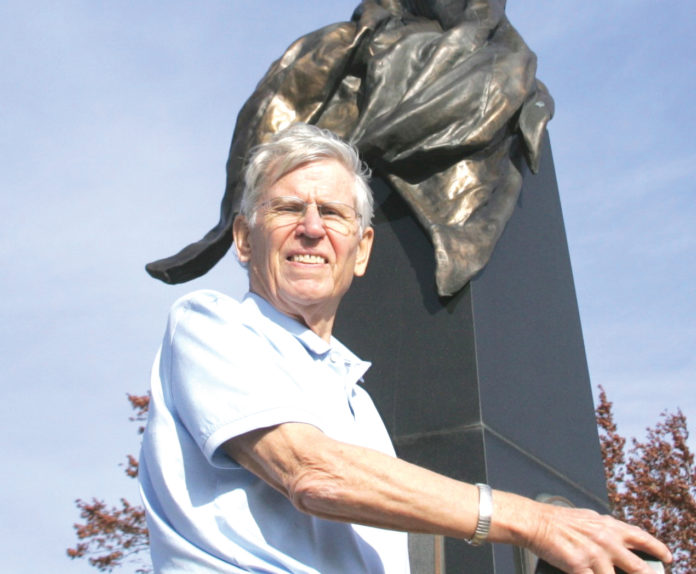
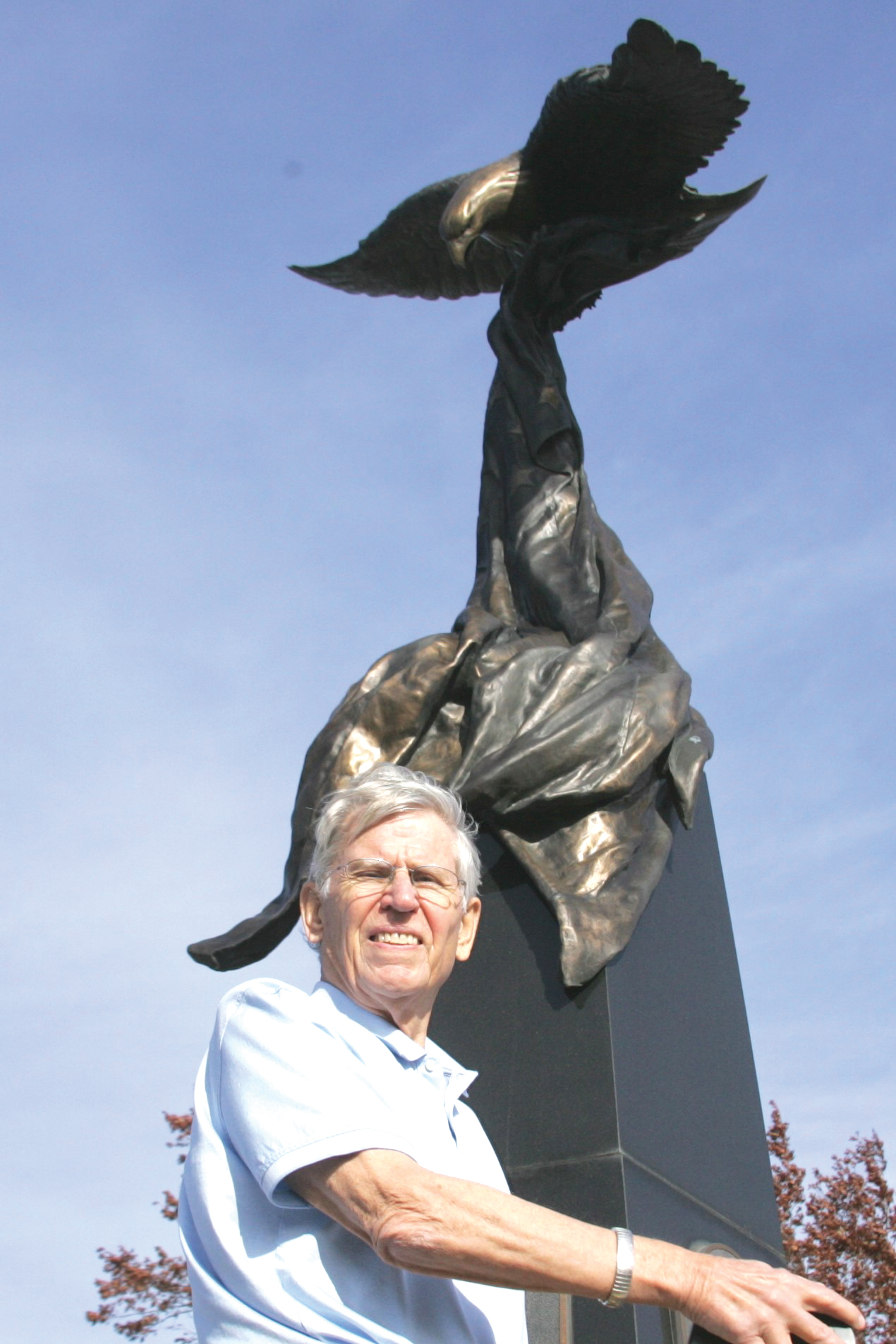
Norman veteran Stephen Reagan, 74, poses with the Cleveland County Veterans Memorial in Reaves Park that honors all county veterans and his 20-year U.S. Air Force career.
Story and photos by Darl DeVault
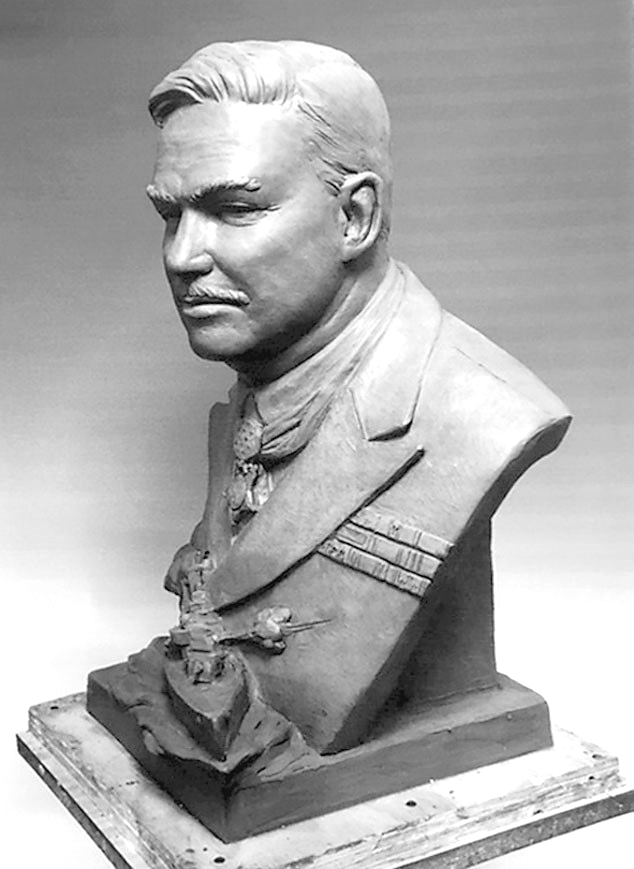
Clay bust of Medal of Honor winner U.S. Navy Commander Ernest E. Evans sculpted by Norman artist Paul Moore.
A retired U.S. Air Force lieutenant colonel and dentist, Norman resident Stephen Reagan is expanding his daily volunteer work helping fellow veterans. For several years he has volunteered helping veterans file their VA claims at the Dale K. Graham Veterans Foundation. Now he is volunteering to help honor a long-deceased Oklahoma veteran—U.S. Navy Commander Ernest E. Evans, who earned the Medal of Honor for heroism in WWII.
Since its beginning, the veteran’s organization has helped more than 25,000 veterans file their benefits claims with the Veterans Administration. Its impact spans all 77 counties in Oklahoma, 45 states, and four foreign countries.
Segueing from helping at the foundation several mornings per week to raising funds to honor Muskogee High graduate Ernest Evans’ heroism has been a change of pace. Reagan, 74, plans to ramp up his fundraising efforts to find a suitable setting for a bronze bust of Evans in 2021.
“I was inspired to do this because Evans was the commander of the destroyer USS Johnston in the Battle off Samar where his heroic actions are as impressive as any war story I have ever heard,” Reagan said recently.
Fortunately, widely acclaimed Norman sculptor Paul Moore sees Reagan’s patriotic vision. He has sculpted the bust with the USS Johnston (DD 557) in miniature at the base in clay. This act of patriotism on Moore’s part gives Reagan’s mission a real boost of professional credibility.
Upon first learning of Evans’ heroism and Reagan’s mission to honor him, Moore was immediately on board, to use a nautical phrase. Evans’ bronze bust will be accompanied by an informational plaque on a granite pedestal. A clay model has already been completed. “I am grateful a talented and famous Oklahoma sculptor like Paul Moore sculpted the bronze bust,” Reagan said.
Of Native American heritage, Evans was largely forgotten in his home state because he left Oklahoma in the mid-1920s for the Navy. He only returned for visits with his mother and siblings in the Tulsa area. He was initially awarded the Navy Cross for his gallantry, but this was upgraded to our nation’s highest military distinction at the end of WWII.
His story of heroism first resonated with Reagan in 2008. “I read about Evans in an excellent book by James Hornfischer, The Last Stand of the Tin Can Sailors, which tells the story of one of the largest naval battles in history.”
The author describes the battle near the Philippine Islands in late October 1944. A Navy taskforce called Taffy 3 was assigned to protect the U.S. Army troops committed to the vital landing on the Philippines with General Douglas McArthur. Taffy 3 was to shield the vulnerable transports of the Leyte Gulf invasion fleet.
Taffy 3 consisted of six escort aircraft carriers (known as jeep carriers), three destroyers, and four destroyer escorts. The lightly armored, smallish escort carriers were lightly armed. They were built on commercial hulls, as platforms to launch aircraft. The destroyers and destroyer escorts were assigned to protect the escort carriers.
Early in the morning of October 25, off the island of Samar, the Imperial Japanese Navy “Center Force A” appeared on the horizon with no warning.
The Japanese force consisted of 23 ships, including four battleships and six heavy cruisers. Led by the super battleship Yamato, the largest and most-heavily gunned ship ever built, the Japanese display of force strength was a daunting sight.
This battle has been cited by naval historians as one of the greatest mismatches in history. Taffy 3 was there to provide the landings shore support and screen as an anti-submarine patrol. The group was never envisioned as a force capable of mounting fleet-level combat with battleships.
The USS Johnston, a Fletcher-class destroyer under Commander Evans, was the first American ship to attack the Japanese fleet. Without being ordered to attack, Evans sailed straight for the enemy against impossible odds. It was a suicide mission.
This bravery was foretold during the Johnston’s commissioning ceremony in October of 1943. New Commanding Officer Evans told sailors assigned to the ship: “This is going to be a fighting ship. I intend to go in harm’s way, and anyone who doesn’t want to go along had better get off right now.” His sailors remained at their stations.
He ordered a smoke screen to protect himself and the rest of Taffy 3 and the wind made it effective. He first made a torpedo run toward a Japanese heavy cruiser and sank it. Being the first to attack, all this time the Johnston was taking heavy shell fire. Out of torpedoes, Evans continued to attack the Japanese with his five-inch guns.
After about two hours of fighting, the Johnston’s steering was knocked out as well as its communications. Wounded when the ship’s bridge was destroyed, Evans moved to the rear of the ship. From the fantail he controlled the ship by shouting orders through an open hatch to sailors turning the rudder by hand below.
A short while later the Johnston was dead in the water. Three hours after the battle began, a Japanese ship approached to point blank range and sank the destroyer. But by then the delaying action by the Johnston’s heroic crew and the sailors of the other small fighting ships had allowed all but one the jeep carriers to escape. The escort aircraft carrier USS Gambier Bay was sunk.
“This brief description doesn’t do justice to the heroism of Evans and his crew,” Reagan said. “The USS Johnston, with the other ships and planes of Taffy 3, fought so fiercely they surprised the Japanese. They thought they were fighting a much larger American force and retreated.”
Evans went down with his ship. His body was never recovered. Late in 1945 he was posthumously awarded the Medal of Honor for his actions. His widow accepted the award in a ceremony near San Diego.
His actions and those of many other sailors and pilots of Taffy 3 saved the Navy from a near disaster. In addition to all earning Presidential Unit Citations, the sailors and pilots earned 22 Navy Crosses, 2 Silver Stars and 2 Bronze Stars for valor in combat operations.
Inducted into the Oklahoma Military Hall of Fame in 2009, Evans received little recognition in Muskogee and in the state until this year. The Oklahoma Historical Society published a long-overdue account of his life and heroics in a 2010 issue of the society’s historical journal, Chronicles of Oklahoma.
On Veterans Day this year Oklahoma City unveiled the Oklahoma Medal of Honor Memorial at the new 27-acre Manuel Perez Park, named for a MOH winner. Evan’s valiant fighting spirit throughout his historic naval battle is honored at the plaza there with the 32 other Oklahomans who have earned the Medal of Honor.
Commander Evans graduated from Muskogee High School in 1926 and joined the Navy as an enlisted sailor. He then made his way to the Naval Academy where in 1931 he become one of the first Native Americans to graduate. At the academy he was nicknamed “Chief.” Serving in the fleet as a junior officer, he steadily advanced in rank to commanding the Johnston in 1944.
Reagan wants to see Evans honored with a bronze bust and historic marker on a pedestal. He hopes to place it in an appropriate setting. War Memorial Park in Muskogee would be one of his choices. The bronze bust, set on a base by Willis Granite of Granite, Okla., is envisioned as a patriotic fixture in Muskogee.
Reagan was born in Norman and raised in Claremore, Okla. He attended Cameron College and the University of Arkansas, playing baseball. He joined the U.S. Air Force for four years, then graduated dental school at the University of Oklahoma College of Dentistry. He went on to serve in the Air Force for a total of 20 years.
He returned to Oklahoma to teach at the OU College of Dentistry for 20 years, where he was director of the Advanced General Dentistry Program. He has been married to his wife, Alice, for 52 years.
The cost of the project is near $40,000 for the bronze bust by Moore and the granite base. Willis Granite will do the installation. As an outdoor display, the City of Muskogee would need to provide a concrete base.
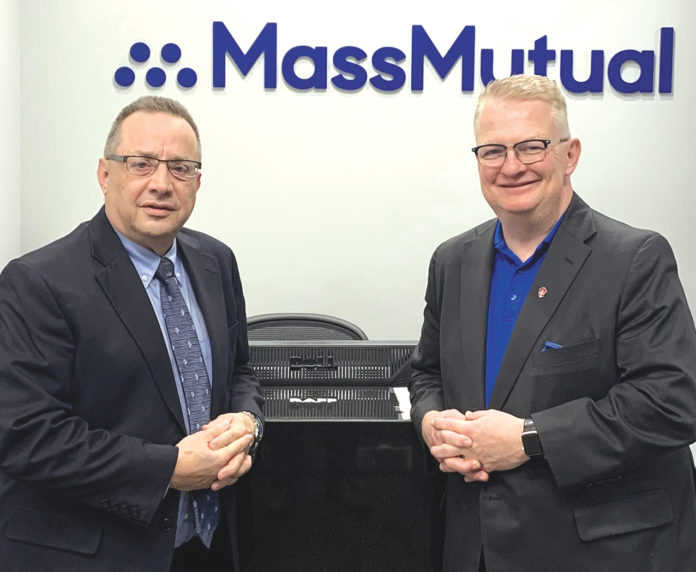
Steven Sibley of Sibley Insures and Mike McCall, with Mass Mutual announce their strategic partnership with a goal to “to help people do for their families, what we would do for our own.”
by Steven Sibley of Sibley Insures, MBA/Health Care Administration
Sibley Insures is pleased to announce their strategic partnership with Mass Mutual of Oklahoma. Mike McCall, with Mass Mutual, serves as the primary Advisor on a team of professionals focused on retirement planning. “I am very excited to have both Steve and his wife Christina as a resource for our team.” Mike noted. “Our clients expect and deserve a high level of expertise and these two have it. Their input will ensure our clients have great, affordable healthcare, with ongoing support and advocacy throughout their retirement years.”
Sibley Insures is an independent insurance broker in Oklahoma City, specializing in Medicare and ancillary healthcare products. Steve, from Tulsa and licensed in Oklahoma, is a retired Air Force and Army veteran and holds an MBA with an emphasis in healthcare administration from MACU in OKC. He manages the business and their marketing. Christina is also licensed in Oklahoma and Kansas, where she is originally from. She holds a Bachelor of Science degree in Health Studies with an emphasis in Gerontology. She spends her time focused on consumer education, plan selection and advocacy for her clients.
Together, Steve and Christina bring a unique balance of healthcare planning experience to the table. She’s spent over 20 years as a caregiver in hands-on patient care; as an EMT, a Registered Medical Assistant in physicians’ practices, the supervisor of a homecare company and a healthcare sciences educator at the college level. She is all about patient and client care. Steve explains, “I tell people it’s like having someone in your corner with all this healthcare knowledge and experience, that just happens to be your favorite niece, and she will treat you like family.”
Steve’s career in the financial services industry started over 20 years ago. During that time he also served in the Army Reserve, as a weekend warrior and eventually as an active-duty reservist, ending his 36-year military career in September of 2017. “After retirement, I wanted to be an independent broker and add a focus on health insurance to my financial services business.” Christina agreed to join him in business, got licensed and once she discovered Medicare, she loved it. Steve ended up spending the next 3 years focused on supporting Christina in her Medicare business and becoming a house husband. However, he knew that eventually he wanted to get back into the field. “With my knowledge of both financial services and how Medicare works, I knew I could carve out a niche helping advisers and their clients get a real clear picture of healthcare costs in retirement and strategically plan for it.”
That is where Mike McCall comes in. He’s also an Army Veteran and as a financial services advisor has over 20 years of education enhanced skillsets and experience. He’s continued serving people in a specialty centered around income planning for retirement. “Life is always changing; therefore, the financial planning landscape is always evolving. I believe most people are so busy living life that they need someone at their side to help them navigate the challenges of creating sustainable income during retirement. That’s what I do and I share that responsibility myself and for my family. So, it is work I take seriously and it’s work I love.” In addition to Mike’s experience, the next most important part of his knowledge and growth has been his education. “I’m fortunate that Mass Mutual invests in my continuing education and I believe that pays dividends for my clients.” With a Degree in Management and Ethics from MACU here in OKC, he also holds the esteemed professional designations of: Chartered Life Underwriter (CLU), Chartered Financial Consultant (ChFC), and Retirement Income Certified Professional (RICP). Mike’s a family man, with wife Joyce, a nurse at Baptist Hospital, and two adult sons.
“Our goal is to help people do for their families, what we would do for our own.” Mike points out. “We’ve developed a model for strategically guiding our clients through healthcare planning. We’ve also armed clients with a knowledgeable team of advocates, such as health insurance agents, who’ll guide them into the right Medicare and ancillary plans. An Advisor, who’ll skillfully recommend financial vehicles for healthcare savings to mitigate expenses not typically covered by insurance, and Attorneys, who’ll ensure the proper legal healthcare documents are put into place. Our clients can be confident they have a sound, strategic, flexible plan that works very well, which, while being affordable, offers a high level of coverage, that protects their most important assets, their health, wellness and wealth. We are looking for 2021 to be a great year for helping seniors in this area.” For more information contact Steven Sibley 405-850-1569, [email protected].
Gina Wallen-Conatser, her family and employees help people get around with their company Gogogeezers. Photo provided.
by Bobby Anderson, Staff Writer
After a career as a home builder, Gina Wallen-Conatser was happily retired.
But it seemed she kept hearing about a problem she just couldn’t shake.
Friends in the medical industry kept remarking how often seniors couldn’t make their scheduled appointments due to a lack of transportation.
Her parents in San Antonio would tell her stories about how unsafe it was to get around.
So with time on her hands, a problem to be solved and a family ready to help out she started Go Go Geezers, a ride service dedicated to helping people get around.
“We take seniors and people with disabilities to medical appointments, like dialysis and chemotherapy,” Wallen-Conatser said. “It helps keep people healthy and with early detection some illnesses may be prevented.”
“When people can get out and go on appointments, shopping and church, it helps with feelings of isolation. There is a sense of independence.”
Based in Yukon, Go Go Geezers traverses not only the metro but the state with enough notice.
“Covid has made transport a little more complicated,” she said. “We clean after every ride. We have plastic up that separates the driver from the rider. Drivers wear masks and gloves and we ask that riders wear masks.”
Drivers go through extensive training – CPR, defensive driver, passenger assistance, wheelchair ADA just to name a few.
“They treat the riders like family members,” Wallen-Conatser said. “They’re very careful. When the same drivers take the rider a couple times a week they build a friendship.”
Wallen-Conatser’s son, Blake, is a driver and partner. A customer remarked to her the other day they see him more than they see their own family
Wallen-Conatser loves the stories her drivers tell her. One of her driver’s told her a recent passenger noted her husband passed. She mentioned that a coffee would be nice but wouldn’t dream about drinking it in the new Go Go Geezer van. After the driver dropped her off to her appointment he returned at the appointed time with coffee and flowers.
Operations Manager Morgan called one night to tell her she had a rider who was going to the emergency room. Insurance normally covered their ride, but this time it wouldn’t.
Wallen-Conatser dispatched the Go Go Geezer van anyway to get her at 11:30 p.m. in a different town than normal.
“Everyday riders call and say wonderful things about all our drivers and dispatch,” she said. “When you book a ride with us, Morgan will call you the night before and verify reservation. Morgan gets to know the riders and she visits with them.”
“I tease her that she’s everyone’s granddaughter and best friend.”
Go Go Geezers took their first ride at the end of April. The service has grown to nine vehicles with three wheelchair vans.
“I want to keep growing and helping our community get to their appointments safely,” she said. “My family is in Texas and I would love to expand there. My goal is to keep hiring the best drivers who really care about the riders.”
“We can take anyone. You don’t have to be a senior or a person with disabilities,” she said. “We take riders all week long to work, or out to eat, church, shopping. We are children and pet-friendly. We have wheelchairs, walkers or car seats to use if needed. Our vehicles are new and clean.” For more information call 405-924-4248.
Oklahoma City physical therapist James Richardson still feels the effects of Covid-19 nine months after testing positive for the virus. He is participating in OMRF’s Covid-19 antibody study, helping researchers understand the body’s immune response to the virus.
When Covid-19 hit James Richardson, it hit him hard. Now, the 45-year-old physical therapist is using his experience with the virus to help others.
A distance runner who also regularly lifts weights, the Oklahoma City resident didn’t fit any of the traditional risk factors associated with Covid-19. But shortly after a work exposure at his clinic in March, the virus had him fighting for his life.
Following his recovery, he’s now participating in antibody research at the Oklahoma Medical Research Foundation.
“It was such a miserable experience. If there’s anything I can do to help others avoid that or experience it less severely, that’s what I’m going to do,” he said.
Infected by a patient in his physical therapy clinic, Richardson soon developed a fever of almost 103 degrees and blacked out repeatedly. He was admitted to the emergency room at Integris Baptist Medical Center and moved to isolation in the hospital’s Covid unit.
“It felt like my chest was tightening more with every breath, like I had a constrictor snake wrapped around me,” he remembered. For a week in the hospital, he cycled in and out of consciousness.
The low point came when his oxygen levels crashed, and the ventilator team was called. “I was able to muster the word ‘no’ when they asked to vent me,” he said. “I was afraid of the long-term consequences.”
Fortunately, Richardson pulled through without the ventilator. But nine months later, he continues to feel the lingering effects of the virus.
I’m still dealing with things that don’t feel right. I can’t breathe well, and some of the cognitive effects are scary,” said Richardson. “I find myself trying to explain something to a patient or a colleague and can’t find the words; I just want to slap myself on the back of the head and yell, ‘Spit it out already!’”
Once he’d cleared the virus from his body for a sufficient period, Richardson began donating plasma to the Oklahoma Blood Institute for use in treating other Covid-19 patients. He also volunteered for research at OMRF, where scientists are studying his antibodies as part of a two-year federal grant.
“Our goal is to understand people’s differing immune responses to the virus,” said Linda Thompson, Ph.D., one of the leaders of the project at OMRF. Using blood donated by volunteers, the scientists are looking for biological clues that might identify those individuals most likely to experience a severe response to the virus.
This information can be used to develop potential treatments and to inform vaccine design and improvement over the coming years.
“Someone like James volunteering isn’t just valuable,” said Thompson. “It’s crucial in helping us understand the effects of antibodies in fighting this virus.” When Richardson learned what taking part in the OMRF research entailed, he says the decision to participate was easy.
“All I need to do is show up to help and give a little blood?” he said. “Count me in!”
If you’ve recently recovered from Covid-19 and are interested in volunteering for OMRF’s antibody research study, please call 405-271-7221.
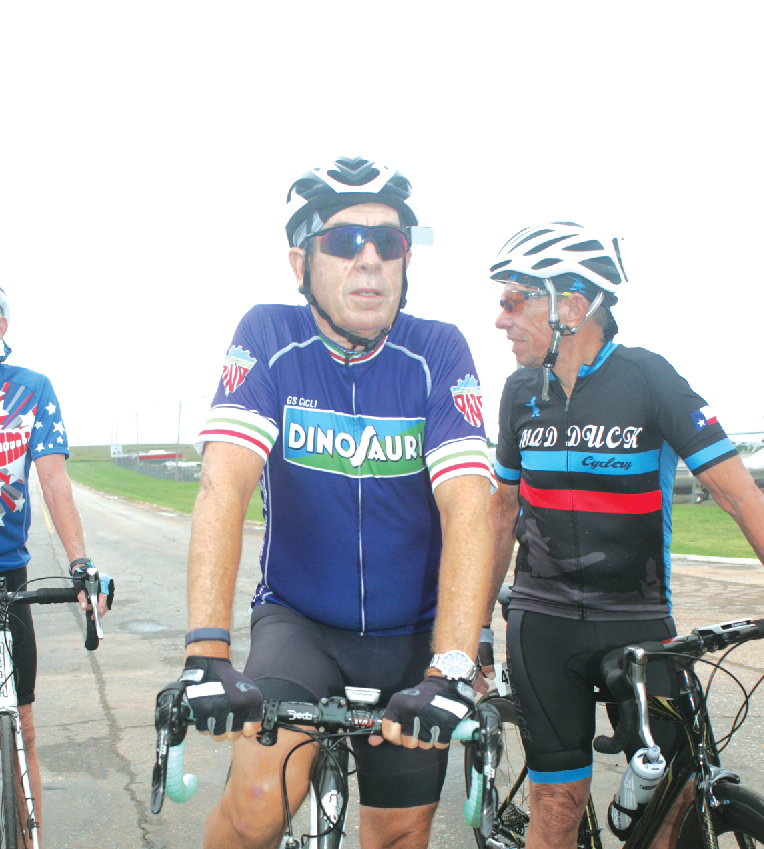
Oklahoma Senior Games Volunteer Coordinator Regina Stewart speaks to a cyclist at Lake Draper as she hands out the blue event T-shirts she is leaning upon.
Story and photos by Darl DeVault
Cyclists gathered for the start of the 2019 Oklahoma Senior Games cycling competition at Lake Draper September 21, 2019.
In 2020 Basketball was cancelled and Pickleball moved outdoors In Norman to accommodate COVID-19 while the full slate of Oklahoma Senior Games was staged.
Regina Stewart, the Games’ volunteer coordinator, a senior athlete herself, was direct in explaining how it would work. “With our two-week preregistration window, it gave us time to contact everyone if we had to cancel one of the events,” Stewart said.
The Games grew to more than 1,000 50+ athletes in 2019 and added two Native American nations as sponsors to help to conduct the many activities needed to allow the Games to run smoothly September through October 2020. The Chickasaw and Cherokee Nations are underwrote the Games for the first time in 2020.
Stewart said she counts on the community to continue embracing what has come to be known as the “Oklahoma Standard” even in the time of COVID-19.
The Games promote healthy lifestyles for seniors through education, fitness with the spirited competition of sports and recreational games. This goes along with inspiring everyone to embrace health while enjoying the value of sports related exercise.
Volunteering opportunities abound as the Games grow. Oklahomans who have a flair for community service can help stage the Oklahoma Senior Games. Volunteers can help promote healthy lifestyles by encouraging active seniors 50 and over to enhance the quality of their lives through statewide athletic and recreational competition.
Also as the Track and Field coordinator in years past, Stewart said that more than 100 volunteers helped last year. She estimates double that number are needed to help this coming year to handle the social distance requirements and growth in the many sports offered. The sports offered and sign up for volunteering is found on the okseniorgames.org Web site under the Volunteer tab.
“The organizers are counting on the warm hospitality and strong sense of community spirt Oklahomans have shown as volunteers that allow the state to thrive. “Our volunteers are a major part of how and why Oklahoma has proven itself as a great place to compete in Senior Games each year,” Stewart said. “We have grown each of the last five years because of the time and energy Oklahomans who do not compete have invested in offering the Games to those who do compete.”
Volunteers make up the largest resource for the sanctioned state organization to produce state games each year. This help allows the Games to be the qualifying site in Oklahoma for the National Senior Games Association’s National competitions.
The Games provide up to 27 sports venues, some with variations, which offer athletic training opportunities and social interaction. Along with the competitions, the Games supply healthy lifestyle educational information for seniors. For general questions call (405) 821-1500 or email [email protected].
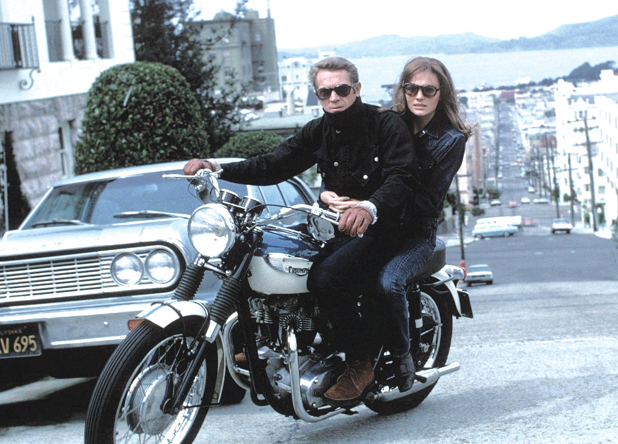
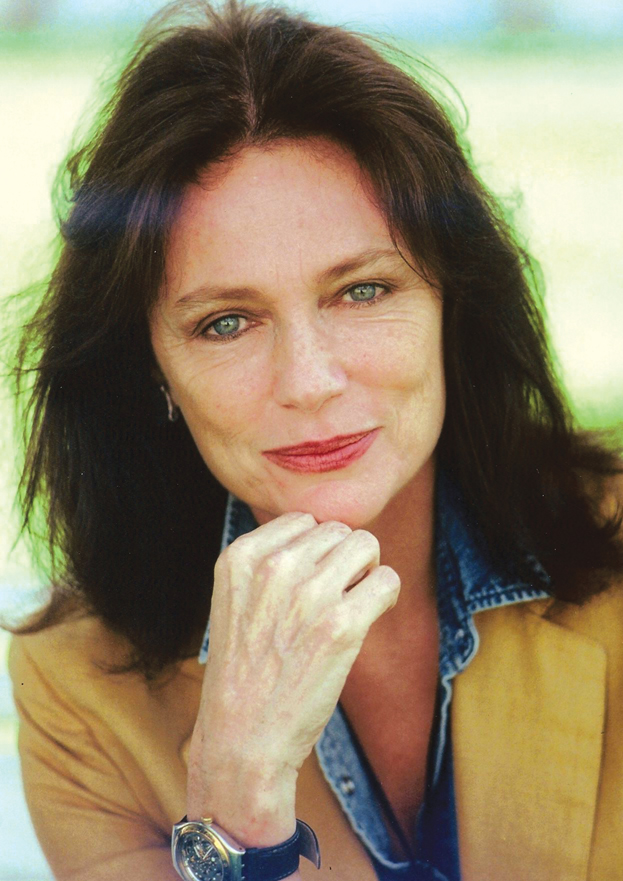
Jacqueline Bisset and Steve McQueen in a publicity shot for Bullitt - Warner Brothers-Seven Arts
By Nick Thomas
Jacqueline Bisset recent- photo from publicist.
Now in her seventh decade as a film actress, British beauty Jacqueline Bisset first hit the big screen in the mid-1960s and was soon on her way to becoming a household name after dramatic roles later in the decade in films such as “Bullitt” with Steve McQueen.
Although her role was small as McQueen’s sizzling love interest and she didn’t appear in the film’s action sequences, Bisset was on set to witness some of the legendary driving scenes often performed by McQueen, a keen race car enthusiast.
“Watching those cars jumping in the air on the streets of San Francisco was amazing,” Bisset recalled from Los Angeles. “There were also some scenes where I had to drive Steve around in a yellow convertible and remember thinking God Almighty, I don’t want to mess this up with a race car driver next to me!”
She says McQueen, a major star at the time, was “very patient with me and we would go out for meals with the director and producer when we’d break for lunch. He didn’t like getting caught in crowds and would often just jump on his bike and get the hell out of there.”
Also memorable for Bissett – and audiences for her wet T-shirt scenes – was “The Deep” a decade later. Noted for its stunning underwater sequences, the actress still has mixed feelings more than 40 years later when she speaks of the aquatic adventure.
“As a child, some stupid kids tried to dunk me and ever since I’ve been fearful of the water and swimming around others,” she explained. “But the diving crew on ‘The Deep’ were amazing and I found it a beautiful experience even though the thought of drowning was still a daily worry. I had a stunt double for some underwater shots, but she looked nothing like me so it meant I attempted more stunts that I would have liked. When you’re 90 feet underwater you have to solve any problem right there – you can’t just shoot to the surface.”
In one scene, her character attempts precisely that after encountering a moray eel (her stunt double did the eel sequence).
“It was complicated to film and very frightening – I actually thought I was going to drown. The others didn’t know if I was acting or in real trouble, which I was. I got through it, but even as I speak of it now, my throat tightens!”
With several films in post-production for 2021, Bissett has remained a busy actress throughout her career and in recent years has tackled personal roles such as 2018’s “Head Full of Honey” with its Alzheimer’s theme.
“My mother got dementia in her early 50s and lived with it for 35 years, so it’s something I knew a lot about,” she says. “The film approaches the subject with a little humor because that can sometimes help families dealing with it. It’s painful humor but can make it more bearable.” Nick Thomas teaches at Auburn University at Montgomery, Ala., and has written features, columns, and interviews for over 850 newspapers and magazines.
In the Oklahoma region many of us over the years have visited Wichita, Kansas, for a theatrical event at Century Two or to see the Chisholm Trail, or to just get a bit of Western atmosphere. I too have, over the years, visited Wichita and on a recent visit was surprised at the additions to this vibrant city. And as last month I suggested you visit Dodge City, you might as well take about a two hour drive on over to Wichita, before or after your Dodge City visit. Not recommending travel at the moment, but it’s fun to explore and plan for the new year. And remember to check current times and conditions on venues you plan to visit.
My home base was the Ambassador Hotel, an Autograph Collection Hotel, (https://ambassadorwichitaks.com) where the modern black and gray and chrome atmosphere welcomes the well-worn traveler seeking a step up from the ordinary. Located downtown with convenient self-parking and an expansive room with courteous attendants and city views, the Ambassador promises a surprise upscale experience. While I requested long in advance for one of their ADA rooms, there was no bench or chair in the walk-in shower. I re-requested such from the front desk, and by the next day, with some bumps in the road, was happily accommodated.
The hotel staff was very good in following through with requests. I only wish the food and beverage side of the hotel had not disappointed. The steak and unique charred Caesar salad were exceptional at the Siena Tuscan Steakhouse, however they did not honor a coupon., They gave me a drink coupon for the downstairs pseudo speak easy. Even after talking to the Food and Beverage manager and crew it was not accepted, even though my server agreed the coupon was misleading – almost a bait and switch situation. I did not mind paying for my drink, but the experience left a bad farewell feeling for the hotel, as I was leaving the next day. Just a heads up, as I tell it like I experience in all my travel articles. So when I say “I’m impressed,” you know it.
About a block from the hotel is the Roxy Theater, (www.roxysdowntown.com) with a disguised rear entrance for the uninitiated, to a funky building housing a dinner theater. The food was acceptable for Dinner Theater fare and their production of Avenue Q, was one of the best I have seen. The wait staff had more tables than they could easily accommodate. I’d recommend the Roxy, now you know what to expect.
A pleasant unexpected surprise is the Tanganyika Wildlife Park (www.twpark.com) where wild animals including a plethora of giraffes, a Rhino, a variety of primates are among the surprises. Roaming the expansive grounds, even during a rain shower is a recommended experience where you can slow down and enjoy nature and its creations.
Who’d think that there was a goat farm in Kansas that also served adult beverages and farm to table gourmet lunches which is Elderslie Farm. (https://eldersliefarm.com) Being a family owned operation from chef to owner tour guide, the home-grown sincerity rang throughout the farm, from goat milking and cheese making to the wood working of heritage wood into tables, shelves and doors. Admiration goes out to Elderslie Farm for their preservation of tender loving care and investment in preservation. They even have a large blackberry patch that is a community pick and share in June. The season for blackberries is brief – influenced heavily by the unpredictable spring weather. Reserve a tour and luncheon here – you will be surprised.
Talk about surprises, two dining establishments blew my critical socks off. Georges, a true French bistro, (http://georgesfrenchbistro.com/) located in an unprepossessing strip mall, will delight your taste buds. My luncheon Martini and Prosciutto Eggs Benedict with truffle frites, was accented by the continental waiter and the chatter of the accompanying “ladies who lunch,” who find this their congenial gathering place.
6Steakhouse, (www.6ssteakhouse.com) located out near the Zoo and offering lake front views, is an upscale dining experience not to be passed by. An aged steak prepared to my specification, even with a second “more heat” request, was memorable. What they call creamed corn is a unique roasted corn medley, from which you could make an entire meal. A relatively new establishment promises many years of good times with their sleek upscale interior dining and even an added education into the ageing of fine beef, I found enlightening. (if you say “6S” fast enough it can sound like, success.)
Of course, Wichita is known for its Keeper or the Plains symbolic statue with its reflections in the river, is still an attraction to be viewed anytime.
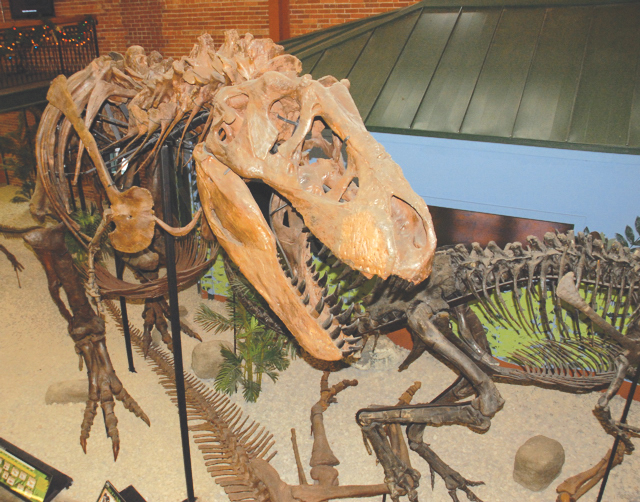
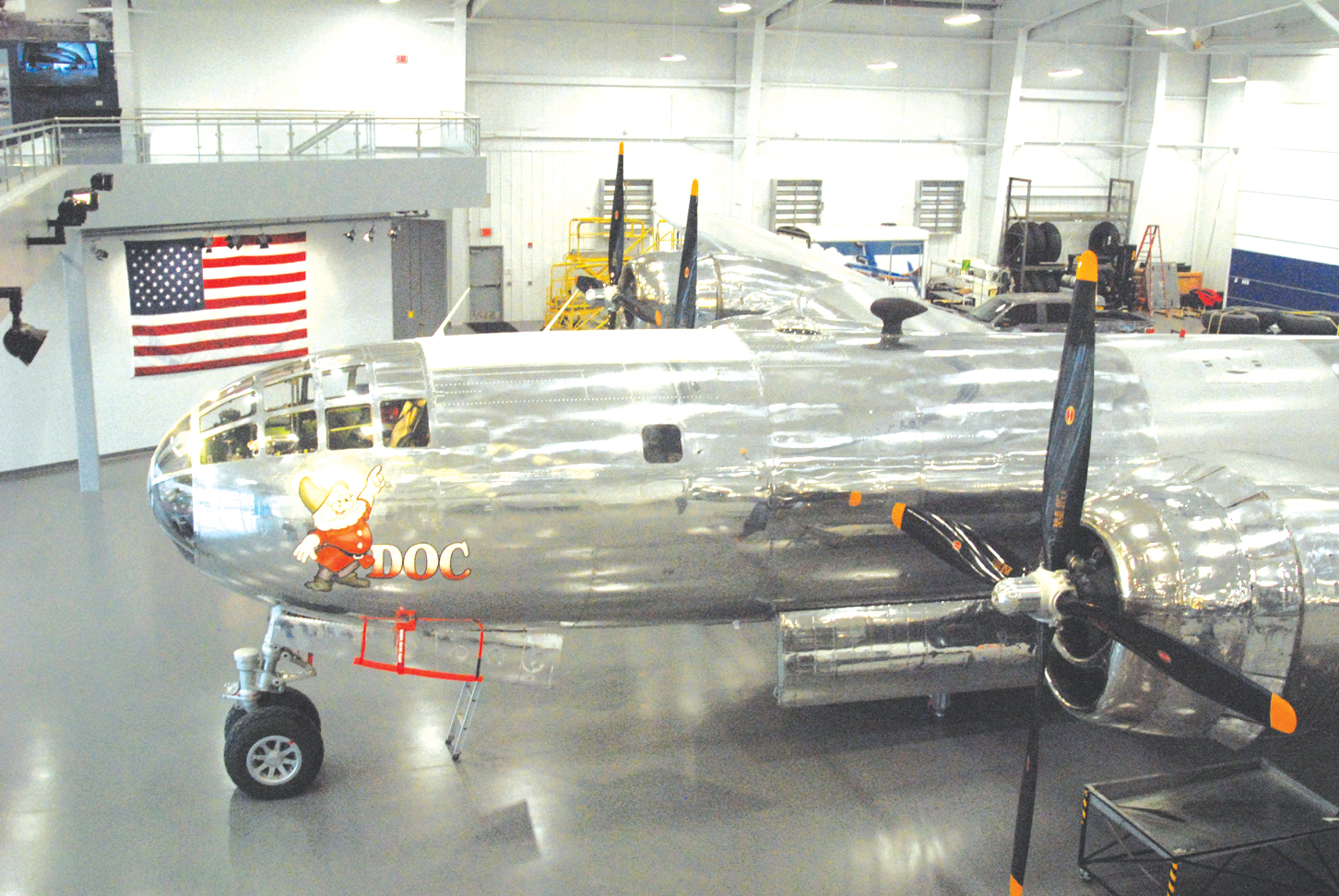
The veteran The Museum of World Treasures, warehouse style building https://worldtreasures.org is a long-time Wichita resident. It offers mainly replicas of world history documents and artifacts, (including Custer’s button up fly underwear). Seeing many letters of world figures and artifacts can be quite educational for the youth, along with the ever-popular T-Rex skeleton. Also you can enjoy the gardens of Botanica (https://botanica.org) and the restored WWII B29 bomber at B-29 Doc Hangar and Educational Center (www.b29doc.com) .
The best surprise of all was the Wichita Art Museum’s (www.wichitaartmuseum.org) limited showing of what could be called the most comprehensive overview of the Works and Life of Georgia O’Keeffe. Having seen many exhibitions of her work, I was delighted to see her paintings and timeline juxtaposed with her actual artifacts and many of her dresses. While this exhibit is over another intriguing exhibit is “Foot In the Door” photographs from local Wichita residents through April 18, 2021. Staged in conjunction with the Wichita Art Museum’s 85th Anniversary, “the exhibition is an opportunity to recognize Wichita artists and make them feel welcomed and loved at their art museum. They are critical to the lifeblood at WAM,” says director Dr. Patricia McDonnell.
To help with your Wichita surprises contact them at: www.visitwichita.com
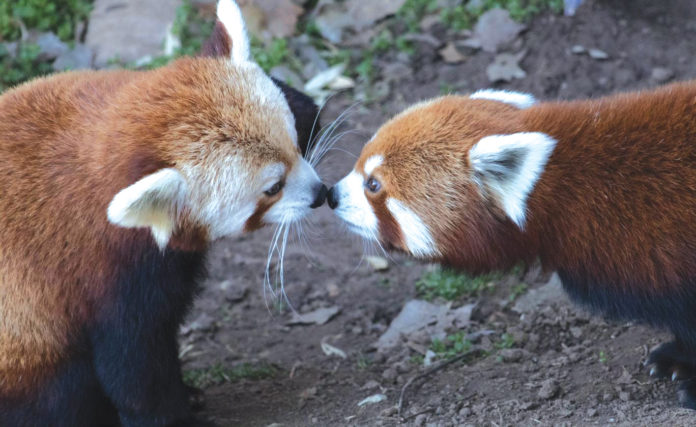
Red Pandas - Lela and Thomas. Photo provided by OKC Zoo.
Red
Virtually connect with the Zoo’s endangered red pandas from home
Shake those winter blues as you enjoy live views of the Zoo’s red pandas! The Oklahoma City Zoo’s popular red panda cam returns giving animal lovers worldwide the opportunity to enjoy endless hours of watching the Zoo’s red pandas this winter. Experience a virtual visit to the OKC Zoo’s red panda habitat at Sanctuary Asia from your smartphone, computer or tablet to watch Thomas, 7, and his daughter, Khyana, 18-months, as they play, engage with their caretakers and enjoy their favorite weather season, winter!
Now through Sunday, February 28, 2021, get an exclusive real-time look at the Zoo’s red pandas with the Zoo’s red panda cam online at www.okczoo.org/redpandacam. The red panda cam will stream live daily with optimal viewing from 10 a.m. to 2 p.m. of either Khyana or Thomas. Because red pandas are solitary by nature and Khyana has reached an age of maturity, she and Thomas do not share habitat space.
Khyana and her twin brother, Ravi, were born at the Zoo’s Sanctuary Asia habitat on June 2, 2019, to parents Thomas and Leela. Both Leela and Thomas arrived at the OKC Zoo in 2018 as part of the Red Panda Species Survival Plan™ (SSP). SSP programs were developed by the Association of Zoos and Aquariums (AZA) to help oversee the husbandry and breeding management and, as a result, the sustainability of select animal species within AZA-member zoos and aquariums, including the OKC Zoo. Many of these programs help enhance conservation efforts of these species in the wild as well. This year, Leela and Ravi, relocated to other AZA-member zoos as part of the SSP program to help further contribute to the conservation of their species.
In October 2019, Khyana underwent an amputation of her hind, left leg, due to a congenital deformity. She continues to thrive and is extremely active, always exploring her surroundings. Khyana is also eager to engage with her caretakers through training sessions.
Known for being great climbers, red pandas spend most of their lives in trees, even sleeping in branches. Red pandas grow to be about the size of a typical house cat. Their bushy, ringed tails add about 18 inches to their length and serve as a type of blanket keeping them warm in cold mountain climates.
Though previously classified as a relative of the giant panda, and also of the raccoon, with which it shares a ringed tail, red pandas are currently considered members of their own unique taxonomic family—the Ailuridae. The red panda is listed as an endangered species. Only an estimated 10,000 remain in the wild, and their habitats in remote areas of the Himalayan Mountains, from Nepal to central China, are being threatened by deforestation, agriculture, cattle grazing and competition for resources.
Click on the Zoo’s red panda cam for all the cuteness you can stand! The Oklahoma City Zoo is open Thursday through Monday from 9 a.m. to 5 p.m. with no public access on Tuesdays and Wednesdays. Advance tickets are required for all guests and ZOOfriends members and can be purchased at www.okczoo.org/tickets. Zoo tickets are limited each day to maintain social distancing among guests.