Monday, September 21, 2026

The Vietnam Veterans Memorial Brings People Together to Pay Respects to Fallen

0
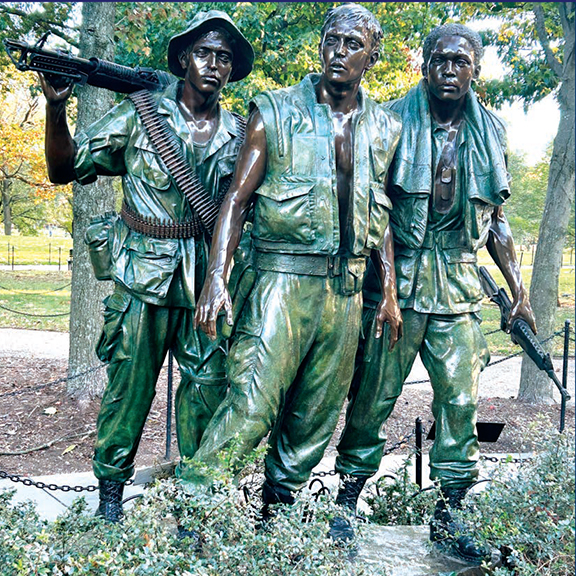
Organizers of the Vietnam Veterans Memorial wanted a physical depiction as well The “Three Servicemen Statue” by Frederick Hart (1984).

Sacrifice. Duty. Remember. Visitors use words like these as they descend into the Vietnam Veterans Memorial in Washington, D.C. Located on the National Mall near the Korean War
Veterans Memorial and west of the Washington Monument, “The Wall” draws about five million visitors a year. Jim Knotts, President of the Vietnam Veterans Memorial Fund, said, “For many years, the Vietnam Veterans Memorial just by itself has been in the top 10 of all national park sites, nationwide.”
The Memorial honors 58,281 men and women who served courageously and sacrificed their lives and those who remain missing in the Vietnam War during the most divisive war in U.S. history. The Vietnam Veteran Project recorded 2,709,918 Americans who served in uniform in Vietnam.
Members of the Vietnam Veterans Memorial Fund, a nonprofit organization, gathered private donations that funded and built the Memorial. Today, they continue to meet groups, like Honor Flights, and answer questions.

Paying Their Respects
George Gagan, a 20-year Navy Seabee from Dayton, Ohio, stood with his family and found the name of Marvin G. Shields who was killed in Vietnam and posthumously awarded the Medal of Honor.
It’s an emotional experience for Ray Dilba of Cherry Hill, NJ, visiting for the third time. He enlisted from 1966-1969 and served in Da Nang as a Medical Service Specialist with an aeromedical evacuation unit. “I have to compose (myself) every time to reflect on what happened. I almost come to tears,” he said.
For veterans like Dilba, the names etched in stone are not abstract-they are friends, brothers, and fellow service members whose absence is still felt.

Design of the Memorial
In March 1981, a national design competition drew 1,421 entries. The winning concept came from Maya Ying Lin, then a 21-year-old senior at Yale University. Her vision was simple but powerful: a park within a park, a place set apart for quiet reflection.
Dedicated on November 13, 1982, the Memorial’s polished black granite walls cut into the earth, listing the fallen in chronological order. The first casualty in 1959 appears at the center, at the lowest point of the walkway. Names continue along the east wall toward the Washington Monument, then resume at the west wall near the Lincoln Memorial, concluding again in the center with those lost in 1975.
Knotts explained its design. “(The) Vietnam Veterans Memorial, ‘The Wall,’ as we call it, is sometimes called ‘The Wall that Heals,’ because so many of the Vietnam veterans or family members of those listed here begin their healing journey by coming here and visiting the Memorial.
“One of the purposeful aspects of this design is the choice of the solid black granite. The designer chose this for two primary reasons. One, because black is the color of earth and also because she knew that when it was highly polished, it would have this reflective nature. So, if you serve with someone or you’re a family member or just a visitor, you can come up, you can touch a name on the wall. And when you do, you’ll see your own reflection in the wall. So, it’s almost as if you are joining them to visit with them. But the hopeful part of the design is that at the end of your visit, you’ll go up one of the walkways, back above ground level, to the land of the living.”
Knotts estimates that half of all visitors were not even born when the Vietnam War ended 50 years ago. “Many of them don’t have a direct connection to the Vietnam War, but when they come to D.C., they always want to come to the war Memorial.”
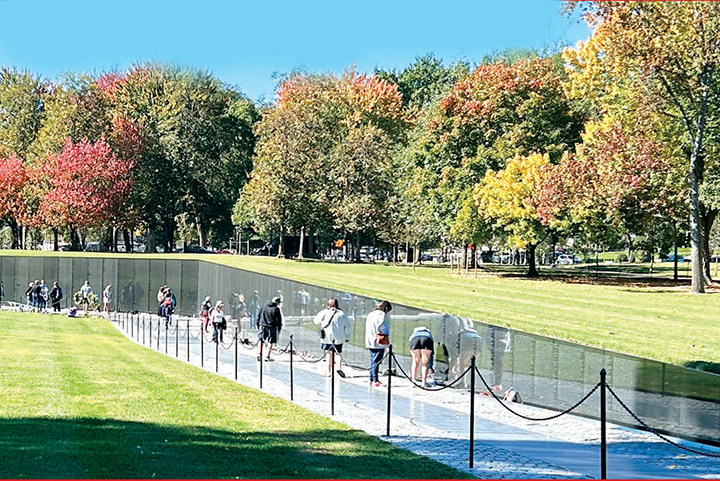
A strength of the design of the Vietnam Veterans Memorial is its ability to fit into the landscape.

Sister statues
Nearby is the Three Servicemen Statue by Frederick Hart, dedicated in 1984, depicting young, alert, weapon-carrying Vietnam soldiers. Hart said, “The contrast between the innocence of their youth and the weapons of war underscores the poignancy of their sacrifice…Their strength and their vulnerability are both evident.”
Nearby, the Vietnam Women’s Memorial from 1993, sculpted by Glenna Goodacre, honors women who served in Vietnam. The statue shows three nurses caring for a wounded soldier, reflecting the critical roles women played. Eight servicewomen died in Vietnam, and their names are inscribed on The Wall.
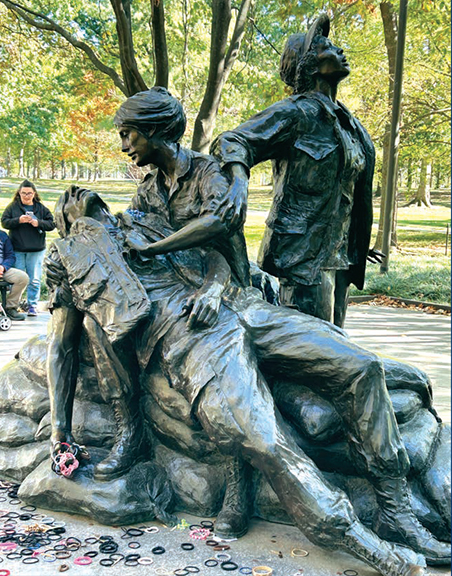
Jenna Goodacre, who sculpted The Vietnam Women’s Memorial, wanted to show three women coming to the aid of a fallen soldier. Eight servicewomen were killed.

“The Wall that Heals” brings Americans and overseas visitors, those who served in our armed forces and civilians, together to connect, reflect and quietly honor American fallen men and women.
Learn more. The Vietnam Veterans Memorial Fund, https://www.vvmf.org/.
Vietnam Era Registry of Service, registry.vvmf.org.
Vietnam Veteran Project,
https://vietnamveteranproject.org/. Or scan the QRCODE below.

• story and photos by Lt Col Richard Stephens, Jr., USAFR, Ret.

“I Went In For An Education” Gets One Joining Air Force in 1951

0
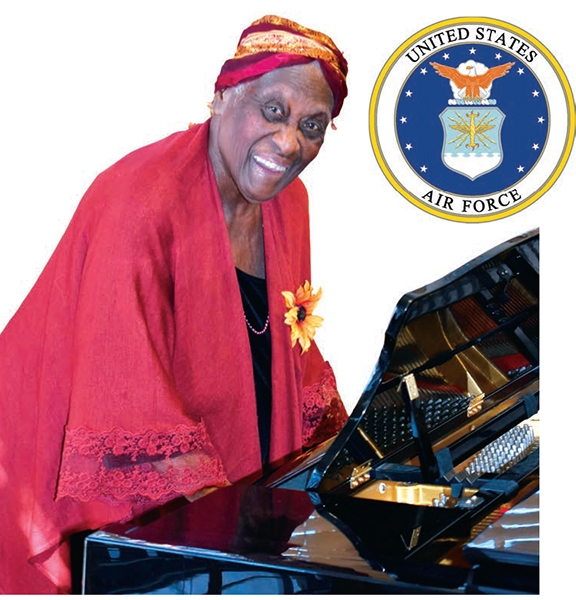
Martha Higgins

“I felt like I would be a failure if I got sent home and
didn’t complete basic (training)…I wanted to get the
benefits that the recruiting sergeant had told me about.
I wanna hang in for that. I was focused,” recalled Martha Louise Higgins, using a determined voice.
Born on January 15, 1931, in Clearwater, Florida, Higgins, now 95 years old, reflected on her military and civil service employment. Her enlistment occurred during the Korean War when only one-percent of Airmen were women.
Higgins gained knowledge and tenacity from teachers at her segregated elementary school, St. Matthew Baptist Church, and Pinellas High School in Clearwater, Florida. “I think growing up in Florida, they put a lot of confidence in us. That’s why it didn’t bother me going into the military. They had us thinking we could do anything we wanted to do. And we believed that…Because they knew what we were gonna be up against once we came outta high school.”
She graduated from high school in 1949, attended Florida A&M in Tallahassee for one year as a music major, then joined the Air Force.
Basic training
Basic military training was at Kelly Air Force Base (AFB), San Antonio, Texas. She remembered, “We had inspection every morning…we had to be in formation zero five hundred (5:00
a.m.). They didn’t play…You better time yourself… And there,
a lot of girls, they sent them crybabies home,” she said with emphasis. “You went to formation and…when they start roll call, there was a new girl on your right and maybe a new girl on your left…The sergeant would march us to breakfast. And after breakfast you had to go back to your quarters and get set up for inspection…” Lessons in discipline, time management and teamwork shaped her later service.
Preparing Military Pay
After basic training, Higgins transferred to Ent AFB, Colorado (closed in 1976), as a Disbursement Officer in the Finance Office. She explained the importance of pay accuracy. “We had a cutoff date to get our payroll ready because they knew when was payday. So, we couldn’t post anything on the cards (everything was done by hand) until you got it from personnel.”
Enlisted and officers had separate cards, each about 8” by 10,” organized by alphabet and by rank. Higgins remembers managing letters A through H.
She was the only female of the five Airmen in payroll.
She does not remember instances of sexism or prejustice; she just focused on the job. “They were very nice to me…They
just treated me like I was another Airman…You do your job and you’re rewarded for that…I wanted to get an honorable discharge.”
At Ent, she met and married Harvey Higgins of Luther, Oklahoma, on September 12th, 1953. She did not reenlist. Then Harvey, an active duty Airman, got a remote assignment and Martha went home to Clearwater.
Upon his return, and Martha now a military dependent, they were reassigned to Ent AFB, then Lockbourne AFB, Columbus, Ohio (closed in 1984). That’s where Steven and Timothy, two of her three sons, were born. Harvey’s next assignment took them to Incirlik Air Base, Turkey, in October 1964, near Adana.
Overseas Duty
Martha liked working, so she joined civil service as an intelligence coder during the Cold War. She worked in a rundown building. “I had to have a code to get in…And
then I sat at a teletype machine. But I sent out codes all day…They were classified. They cleared me to do that…I couldn’t decipher them…I didn’t know where they were going or who they were going to or what the information (was).”
The Higgins lived on the air base and went to the movies, the NCO Club and recreation center. To reduce their isolation, they drove to the Mediterranean Sea looking for Navy ships and by the American Embassy. “We were looking for the flag. Oh, we saw that flag and we just clap, clap,” she said excitedly, clapping her hands together. “We just clapped for anything that reminded us of home.”
Back in the United States, though, the military’s equality did not exist in civilian society.
Inequality
“I never went to an integrated school, said Higgins. “The first time I experienced integration was when I went into
the military…It (civil rights) was needed because it was so humiliating to us to think we had to get up outta our (bus) seat after we done paid our fare…There was no dignity in that. You going to get up outta your seat to give it to some person who was a different color than you? Now that was wrong.”
Love of Music
Higgins said, “I went back to school under the GI bill
and studied music…I studied music at Mercyhurst in Erie.
It’s a Catholic university.” She also used her musical talent commercially too.
“Oh Lord, Hear my Prayer” and other religious hymns
she wrote have been sold to music producers like Sheet
Music Plus in Minneapolis, Minnesota. Impressed by her vocal abilities, the Columbus Symphony, Columbus, Ohio, and the Erie Philharmonic Orchestra, Erie, Pennsylvania, asked her to sing with the alto section.
Retirement
These days, at the Norman Veterans Center where Higgins lives, she plays the piano for chapel service and for the Knights of Columbus.
She’s proud of her three sons, Steven Higgins, who retired as an Army Lieutenant Colonel, Timothy Higgins, who repairs and installs refrigerators, and David Higgins, a retired Marine Corps Chief Warrant Officer 2.
Higgins uses a walker but remains mobile. “I can do the twist and the electric slide!” she proudly exclaimed.
Would you like to watch Martha Higgins’ video with the “Making History Project” recorded August 8,
2021, by Patrick Russell, visit
https://making-history-project.com/ or scan this
QR CODE. •
story and photos by Lt Col Richard Stephens, Jr., USAFR, Ret.
Retired Army Veteran Charts New Path With Foundation

0
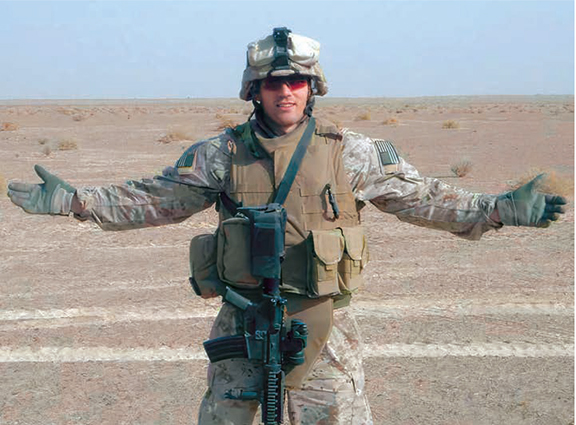
1st Lt Travis Manion, USMC, was killed in Iraq while saving his wounded teammates.
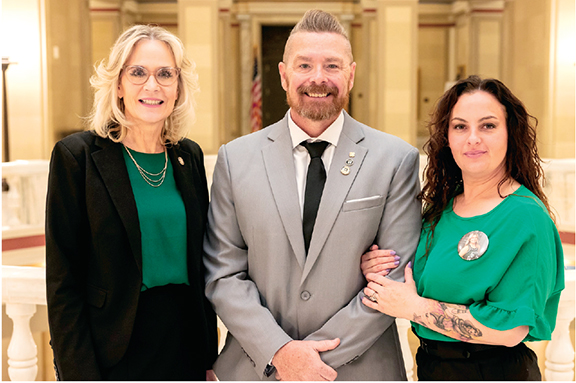
The Travis Manion Foundation Central Oklahoma Chapter was recognized in February at the Oklahoma State Capitol. Pictured left to right is District 82 State Representative Nichole Miller, (Ret.) Army MSG Aaron Hudgins, Director of the TMF Central Oklahoma Chapter, and his wife Emarie Hudgins, a 20-year Veteran with the Oklahoma Army National Guard, and currently assigned to RTI at Camp Gruber, and she was just promoted to MSG E8.

(Ret.) United States Army Master Sergeant Aaron Hudgins said the loss of his late wife J.J. Hudgins forced him to take a closer look at what his future mission in life would look like.
He found that mission through the Travis Manion Foundation (TMF) where he serves as Director of the Central Oklahoma Chapter of TMF.
TMF unites communities to strengthen our nation by empowering veterans and families of fallen heroes to develop character in future generations. In 2007, 1st Lt Travis Manion, USMC, was killed in Iraq while saving his wounded teammates. Today, Travis’ legacy lives on in the words he spoke before leaving for his final deployment, “If Not Me, Then Who…”.
Guided by this ethos, veterans continue their service, build connections with each other, and thrive in their post-military lives by serving as character role models to youth. As a result, communities prosper and the character of our nation’s heroes lives on in the next generation.
Manion gave the ultimate sacrifice on April 29, 2007, on his second deployment to Iraq. While on patrol searching for a suspected insurgent house in Fallujah, Travis, his fellow Marines, and Iraqi Army counterparts were ambushed.
Manion led a counterattack against enemy forces, drawing fire away from his wounded comrades and allowing every member of his patrol to survive. For his actions, he was awarded the Silver Star and Bronze Star with Valor. Today, over 300,000 Spartans nationwide carry forward the legacy of fallen heroes like Travis by leading with character and living out the “If Not Me, Then Who…” ethos.
TMF Chapters are local volunteer groups led by veterans, families of fallen heroes, and inspired civilians who have a passion for the Travis Manion Foundation mission. Currently, TMF Chapters exist in nearly 40 locations throughout the country – identifying and executing local service projects and hosting events that connect and unite their communities. Chapters allow Spartans to expand the reach of TMF and engage with local volunteers to make a meaningful contribution to their surroundings while upholding the “If Not Me, Then Who…” ethos.
Their best-in-class programs are designed to develop, heal and bring together veterans, families of the fallen, youth and inspired civilians from all walks of life. From their Character Does Matter youth mentoring program to community service projects and service-based trips, TMF programs give Americans an opportunity to honor the legacy of fallen heroes through service.
JJ Hudgins was injured while training for her mission at Fort Bliss. She was medically discharged from the Army after a broken hip was deemed an “unrecoverable injury.”
She was home for just 10 days before passing away on April 28, 2018.
“The truth is that my involvement in this mission wasn’t shaped by one moment or one project. It was shaped by 26 years of service in the United States Army and, more importantly, by the personal tragedy of losing my wife, Jari J. Hudgins,” Aaron Hudgins said. “That loss changed my life and forced me to confront grief, purpose, and responsibility in a way I never had before.”
He continued, “The man I am today and the work I do through the Travis Manion Foundation, is the result of both those experiences. My military career taught me about duty, leadership, and sacrifice. Losing Jari taught me the weight of that sacrifice and the importance of honoring it by continuing to serve others.”
Hudgins said TMF’s service projects caught the attention of Ava Garrett, an 8-year-old from Guthrie who was inspired to make a financial donation to the Oklahoma Chapter of the Travis Manion Foundation (TMF).

“I got an email from a little girl, Ava Garrett,” Hudgins said. “I didn’t know her. Never met her. She has a business in Guthrie where she tags people’s front yards with logos. They (parents) drive around her neighborhood and takes donations, and then she’ll spray paint 1776 or USA or OU or whatever. She raised $600 in about a month. Well, she wanted to donate a percentage of her money to an organization. Somehow, she found out about us.”
Hudgins added, “With the help of her mom, I got a random text out of nowhere. She goes, ‘My daughter wants to donate some of her money to your organization,’ and I was like, ‘Oh, okay. Yeah, sure.’ When she told me how much it was, it was $200. I was like, ‘That’s a lot of money for a kid to give.’ She’s like, ‘Yeah, but she really wants to do this.’ I was like, ‘Well then, I will personally come down there,’ so I drove to her house.”
Hudgins said Ava presented him $200, which funded overnight bags for DHS foster kids through a TMF Edmond Santa Fe High School service project.
“The biggest thing that we do is legacy projects, which are service projects for the community that are built around honoring our fallen heroes,” he said. “While I’ve been doing it, every legacy project we do for the community,nd it could be anything. We put bags together for foster care kids. Because when they leave in the middle of the night, they don’t have anything with them. We put bags together that have a blanket, snacks, a stuffy, a nightlight, something that they could take with them that is theirs.”
Hudgins continued, “She (Ava) handed me over $200, and so that funded the entire overnight bags for the DHS foster kids. She funded that entire project, all herself. So, all the money that it took to put those bags together came from an eight-year-old little girl, and I was beyond touched. We brought her back so that she could see where that money went because I was like, ‘I want you to see this.’ So, when I brought her in, I didn’t tell her, and the entire girl’s pom squad was waiting for her. I made it a point to try to recognize her every chance I get because that’s such a profound gesture of service and gratitude to give back to an organization.”
He added, “We were so proud of the Teams of Character Pom Squad and the inspiring Ava Garrett, whose heart for service continues to make a real impact in our community. These young leaders represent exactly what it means to live out character in action.”
Hudgins said the Oklahoma TMF Spartans were recently recognized at the Oklahoma State Capitol.
“Yesterday was a powerful day at the Oklahoma State Capitol as the Travis Manion Foundation, Oklahoma Chapter had the honor of being with some amazing young leaders,” he said. “This was from our event last November where we honored fallen Oklahoma Hero SPC Sarina Butcher, the first female soldier from Oklahoma killed in action on 11 November 2011. I was also recognized as Veteran of the week.”
Hudgins said during their visit, their team had the opportunity to meet with multiple state representatives and spend time with Gov. Kevin Stitt sharing the mission of TMF and highlighting how Oklahoma youth are stepping up to lead through service.
“What stood out most wasn’t just the recognition, it was seeing the next generation confidently representing values that matter: character, service, and community,” he said. “Stories like Ava’s are important because they show the mission in action. But the deeper story is how service, loss, and resilience can shape a person’s life and drive them to help others find purpose and character in their own.”
For more information about the Travis Manion Foundation visit www.travismanion.org. • by Van Mitchell, staff writer

Discipline”… Not fun but always necessary

0

by Mark Miller, Chaplain

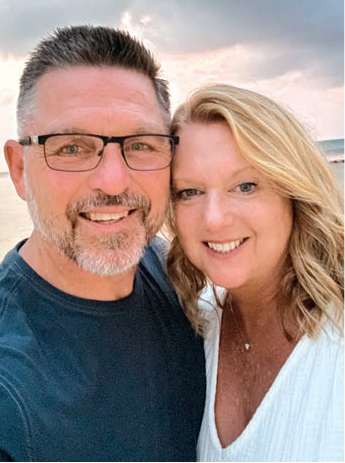
Mark Miller, Chaplain and wife Terresa.

My name is Mark Miller. I have been in ministry for over 30 years, served as a Hospice Chaplain, and now serve in the Tulsa area with SYNERGY Homecare. I was privileged to be asked to write a short devotional for The Veterans News Magazine. The word that continued to come to me when thinking of our committed men and women of our military is the word
“discipline”. Military discipline is defined as, “the prompt, willing and intelligent obedience to orders, regulations & codes of conduct, designed to ensure operational efficiency & unit cohesion under difficult conditions”. Definitely a mouth full but absolutely correct. Discipline is a necessity to succeed in most all of life’s challenges but is most recognizable under pressure. It is no less recognizable spiritually. Spiritual discipline is what enables a believer
to stand when the waves of life crash all around. Spiritual disciplines, including Bible study, prayer, fasting, submission, steadfastness and rest are all necessary for spiritual growth, spiritual assurance and it’s what enables us to make a difference for the Kingdom of God.

2 Timothy 3: 16-17 reminds us of the importance of using God’s Word as a guide for this process: “All Scripture is God-breathed and is useful for teaching, rebuking, correcting, and training in righteousness, so that the servant of God may be thoroughly equipped for every good work.”
Take a look at that list of spiritual disciplines again. Jesus did all of those things

Local Vets Administer Memorial High JROTC Program

0
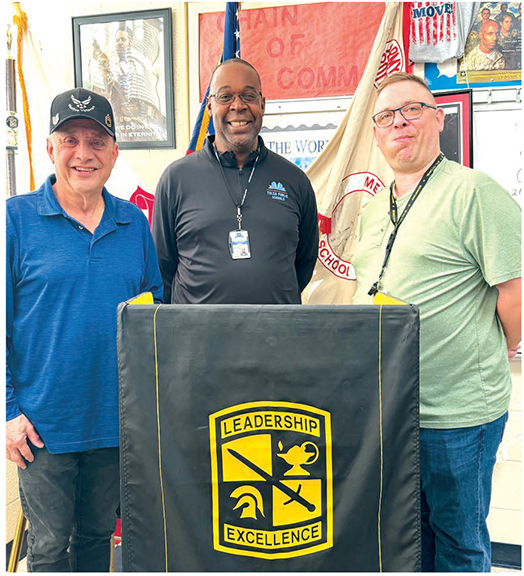
Steve Sibley, E7 RET/DV, JROTC instructors LTC Paul Jackson and 1SG James Wilcoxson.

Memorial High School’s Junior Reserve Officer’s Training Corps (JROTC) program in Tulsa is currently being administered by two storied veterans.1SG James Wilcoxson entered the program one year after the program began in 1995. As a class of 2000 graduate, he enlisted in the Army in November of the same year and served twenty-three years in the Reserves. He was a Dual Status Military Technician. He worked as a federal civilian supporting his Army Reserve Unit as a Reserve Administrator. His service also included one deployment to Afghanistan. Knowing Wilcoxson had deep and meaningful ties to the program, CSM Kenneth Powell, one of the founders, asked Wilcoxson to apply for his position in May of 2023 because he was retiring. 1SG Wilcoxson has applied for the army instructor position and is awaiting approval from the US Army Cadet Command.
LTC Paul Jackson served twenty-eight years with the United States Army Reserve, including two deployments during Operations Iraqi and Enduring Freedom. Both of his parents also served in the Army. Jackson said he always wanted to be an officer and entered the ROTC program at Kentucky State University, receiving his commission in May of 1989. He had a dual career, working in the oil and gas industry for twenty-five years while simultaneously serving in the army reserves. With a degree in mathematics, he began teaching geometry in 2024. However, when an opportunity arose to become a JROTC instructor, he jumped at the chance. His combination of military, civilian and ROTC experiences made him an ideal fit for the role of senior army instructor where he can share the wisdom he learned in the military with his cadets.
Steve Sibley, the co-publisher of Oklahoma Veteran News, is a 1974 graduate of Memorial High School. He joined the military immediately following his graduation and served for thirty-six years. He admitted he didn’t realize the significance of the school’s name until he returned for his fifty-year reunion in 2024.
Memorial High School was named as a memorial to Tulsa students and teachers who served as veterans in World War I, World War II, and the Korean Conflict, embodying values of character, equity, and excellence in honor of their sacrifice. The school was established in 1962 with its first graduating class in 1964.
Although this program has a strong heritage and tradition, it recently has had its struggles. The sudden death of COL Gregory Barack, former senior army instructor in 2004, and retirement of CSM Powell left the program without leaders for approximately two years. Jackson and Wilcoxson are both committed to rebuilding and increasing cadet enrollment and participation. Jackson cited the current freshman class as the building blocks to the future. Their success will help them recruit more students. Additionally, visits to local middle schools and parent conferences are avenues for program recruitment. The team is also looking into expanding the program curriculum to include drones, robotics and cybersecurity.
While JROTC is an Army training program, its purpose is not military recruitment. Its mission is, “To motivate young people to be better citizens.” Established by Congress in 1916, it is the oldest youth leadership program with a presence in more than 1700 high schools nationwide.
The program also follows the Army acronym of LDRSHIP which stands for Leadership, Duty, Respect, Selfless Service, Honor, Integrity and Personal Courage.
Jackson and Wilcoxson credit their participation in JROTC as a positive influence that helped teach them the skills they needed to succeed in both civilian and military careers. Both embody these qualities today and bring many years of wisdom and knowledge to the students they are teaching. Jackson stated that being the senior instructor is more about running a program than simply teaching a class. He is responsible for making sure the curriculum includes ethics and skills that are tangible. Some of those responsibilities include making certain the cadets meet mandatory requirements of community service, attendance at the veteran’s day parade, the annual military ball and the weekly wearing of the JROTC uniform.
The JROTC hosts an annual gala. It is for the cadets only; parents are not invited. It is an opportunity for them to showcase the skills they have learned throughout the year. It is held on a Saturday in April at a local restaurant. This year’s guest speaker will be Steve Sibley. As a program alumnus, he is looking forward to sharing his wisdom and passion for the military with the cadets.
If anyone is interested in donating to the JROTC program, you can mail checks designated to the program to Tulsa Memorial High School, 5840 South Hudson Avenue, Tulsa, OK 74135.
by Jill Stephenson, staff writer

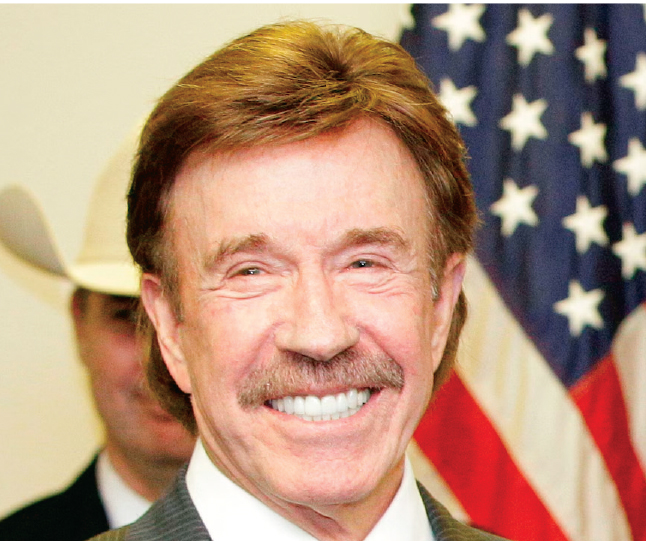
Chuck Norris Recognized with State Resolution

0

U.S. Air Force Veteran and martial arts icon and “Walker, Texas Ranger” star died on March 19, 2026, at the age of 86 in Kauai, Hawaii.

The Oklahoma State House of Representatives passed a resolution honoring actor and Oklahoma Native Chuck Norris and the bill (HCR 1021) moves to the state Senate for further consideration. The bill was authored by State Rep. Stacy Jo Adams, R-Duncan and Sen. Dusty Deevers, R-Elgin, is the bills Senate author. The bill formally recognizes Norris for humble beginnings to international fame.

Born Carlos Ray Norris Jr. in 1940, in Ryan, OK before moving to Torrance, California with his family at age 12. Chuck Norris didn’t begin life as a larger-than-life icon. He grew up shy and unassuming, far from the fearless persona he would later embody. After joining the United States Air Force, he was stationed in South Korea, where he first encountered martial arts. What began as curiosity quickly turned into obsession. Norris trained relentlessly, eventually earning black belts in multiple disciplines and becoming a world champion in karate.

His fighting career alone would have been enough to secure his place in history. Norris dominated tournament circuits in the 1960s, defeating top competitors and earning respect for his precision, speed, and discipline. But his ambitions extended beyond the mat. He saw potential in bringing martial arts to a wider audience, and that vision led him into Hollywood.

Norris’s film career began modestly, but his big break came when he fought Bruce Lee in the film Way of the Dragon. The fight scene, set in the Roman Colosseum, became iconic, showcasing Norris as a credible and formidable opponent to one of the greatest martial
artists of all time. From there, he built a career as an action star throughout the 1970s and 1980s, appearing in films like Good Guys Wear Black, Lone Wolf McQuade, and the Missing in Action series.

In the 1990s, Norris found renewed fame through television with Walker, Texas Ranger. The show became a cultural staple, running for eight seasons and introducing him to a new generation of fans. As Cordell Walker, he played a Texas Ranger who combined martial arts skills with a strong sense of justice, often delivering lessons about right and wrong alongside the action.

But perhaps the most unexpected chapter of Chuck Norris’s legacy came in the age of the internet. In the mid-2000s, “Chuck Norris facts” began circulating online—short, exaggerated jokes that portrayed him as an all-powerful figure. Lines like “Chuck Norris doesn’t do push-ups; he pushes the Earth down” transformed him into a comedic legend. Rather than resist the jokes, Norris embraced them, showing a sense of humor that only strengthened his popularity.

Beyond entertainment, Norris was also been involved in philanthropy and community work. He founded programs aimed at helping young people develop discipline and confidence through martial arts training. His emphasis on character, respect, and perseverance reflects the same values that defined his career.

What makes Chuck Norris truly fascinating is the contrast between the man and the myth. In reality, he was disciplined, thoughtful, and grounded. In popular culture, he is nearly superhuman. Yet these two versions don’t conflict—they complement each other. The myth exaggerates qualities that genuinely exist: strength, resilience, and determination.

Chuck Norris remains a symbol that spans generations. Older fans remember his films and television shows, while younger audiences know him through memes and internet culture. Few individuals manage to stay relevant across such different eras, but Norris has done so effortlessly.

In the end, Chuck Norris represents more than just action movies or jokes. He embodies the idea that ordinary beginnings can lead to extraordinary impact. Whether as a martial artist, actor, or cultural icon, his legacy continues to endure—part truth, part legend, and entirely unforgettable.

The Norris faimly said “It is with heavy hearts that our family shares the sudden passing of our beloved Chuck Norris yesterday morning.

When Scammers Call, Seniors Pay the Price

0

by Oklahoma Department of Securities

Imagine you’re a senior living in a quiet retirement community. One day you receive a phone call that sounds exactly like your bank: the number on the screen looks legitimate, and the voice on the other end is professional. The caller tells you your account has been compromised and in order to protect your money, you must act quickly: you’re coached to download a screen-sharing app and log into your account. While you believe you’re doing the right thing, you’re inadvertently handing over the reins to strangers to drain the savings you’ve built over a lifetime.

This isn’t a hypothetical situation. It’s a real scam aimed at older adults and it’s happening across Oklahoma inside the very places designed to keep them safe: retirement communities, assisted living facilities, and nursing homes.
As Administrator at the Oklahoma Department of Securities, I hear versions of this story far too often. Older adults are disproportionately targeted by financial scams including investment, banking and tech-support schemes. Each crime is carefully designed
to prey on the vulnerabilities of seniors, many of whom live in close proximity in communities and facilities for older adults where they feel insulated from crime. That proximity opens the door for entire communities to be exploited by scammers who send convincing emails, make persistent phone calls and knock on doors offering fraudulent services.
The fraudsters of today are master manipulators and skilled actors. They build trust, sometimes over weeks or months, forming relationships online and over the phone using technical jargon, and by appealing to seniors’ hopes and fears. They pose
as bank agents, financial advisors, and friendly companions, and they’re incredibly persuasive, able to coerce seniors into giving away personal information, money, and even real estate to complete strangers. The fallout can be devastating.
Criminals are savvy; they understand why older adults are attractive targets. Seniors often have significant assets, including life savings, retirement accounts and home equity they’ve worked hard for decades to accumulate. Many are navigating major
life transitions: the loss of a spouse who previously handled the finances, smaller social circles, or the move from independent living into a care setting. Some are uncomfortable with new technology, while others may be suffering from memory loss or cognitive decline. Sadly, it’s the perfect storm for opportunistic scammers.
Financial fraud harms more than just a victim’s bank account. Victims often experience shame, anxiety and depression, in addition to financial and identity theft repercussions that can follow them for years. In some cases, victims are left unable to afford the same level of care or living situation. Families may be forced into making difficult financial and caregiving decisions, and relationships can become strained. Yes, money is stolen, but so is peace of mind.
So how can we protect seniors from these devastating scams? It requires a coordinated effort among caregivers and families, but a few practical steps can make a big difference:
Prevent: Prevention begins with education. Raise awareness about common red flags like urgent requests for money or asking to download software. Financial safety should be discussed as routinely as physical safety.
Recognize: Pay attention to warning signs, such as large withdrawals, extended time on the phone with unknown callers or new online “friends” who request financial assistance.
Record: Document concerns including message screenshots, call logs and names used by suspicious individuals.
Report: Notify banks, law enforcement and agencies like the Oklahoma Department of Securities to step in. Quick reporting can prevent additional losses and help in recovering funds.
Oklahoma’s seniors deserve to spend their golden years in peace, not defending themselves from criminals looking to defraud them, and together we can make sure they’re protected. A single phone call can upend a lifetime of hard work, but
a single conversation about the dangers of financial fraud can help stop these scammers in their tracks.

Protecting Your Benefits

0

By Freddy Groves
On a recent National Slam the Scam Day for 2026, the VA stepped up, along with other federal agencies, with an array of information to keep veterans safe from scams and fraud. Thieves don’t just work one day per year, however. We need to stay vigilant all year long to protect our benefits and personal information from getting to the scammers. Why do they want us? Because we have income and benefits.
How do they approach us? Phone calls, emails, text messages, social media, phishing, impersonation, fake charities — you name it, the crooks have thought of it as a way to get to us.
If you’re approached, whether on the phone or in email, the more urgent the problem, the more likely it’s a scam. A scammer might pretend to be from the VA and try to claim there’s something wrong with your benefits — and that you need to hand over your personal information so they can “fix” the problem. They might want your bank account access info or password, your Social Security number, your date of birth. The answer is no. Don’t do a direct deposit into another person’s account — even if it’s a relative! If you need a fiduciary situation (where someone helps you with finances), have that person go through the accreditation process and be authorized to assist you. You’re protected that way.
If you’re told you need to hand over a fee to get claims assistance from the VA or to apply for increased benefits, it’s fraud.
Invest in a shredder and use it to cut up not only VA documents with personal information on them, but any documents that can go astray, even when you put out the trash.
If someone calls and claims to be from the VA and asks you to pay for something with a gift card or bitcoin, feel free to laugh as you hang up the phone. It’s an impostor. Report it to the VA at 800-827-1000.

Love of VW Beetles Connects Veterans

0
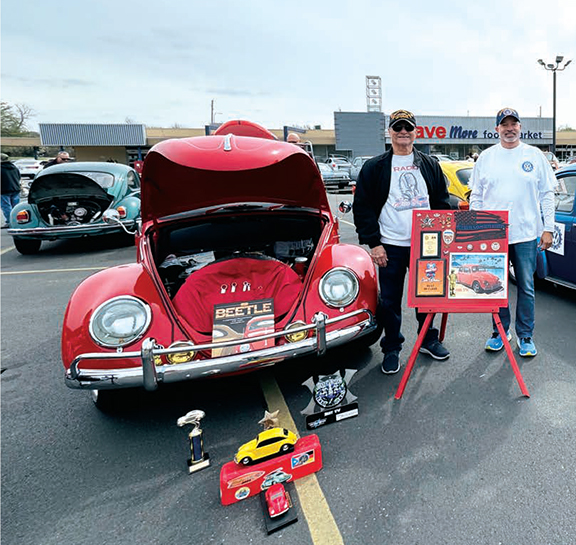
Roldan and Serrano with his VW along with awards.

Lino Roldan and Pedro Serrano met three years ago at a neighbor’s home while sharing a meal of Puerto Rican food, a cuisine representing the place they both grew up. They learned they were both veterans and also had a shared love of Volkswagen Beetles.They each currently own 1966 models, with Roldan’s being red and Serrano’s being blue.
I spoke with them at a car show in Tulsa where their classic cars stood side by side, showing off the pride they care for them with to preserve their nostalgic status.
Prior to their first meeting Serrano had not attended a car show, however Roldan encouraged him to do so and at his first show he won his first award: The Top 2 in class!

Roldan and Serrano are both career veterans that were raised in Puerto Rico. They are also bilingual which they used during
their time in service. Roldan worked for the Red Cross at the Armed Forces Emergency Center at Fort Sill service members who had been injured or killed.
Serranno served ten years in Panama and half of his career in Latin America supporting military missions, including the take down of General Manuel Noriega during Operation Just Cause in 1989.
Roldan was drafted in 1969 serving one year in Vietnam with the 25th ID and 173rd Airborne. He left service in 1971 and then
re-enlisted in 1978. He spent time in Italy and Germany and served during Desert Storm, retiring in 1995 as a Sergeant First Class. His father served in the National Guard from his native Puerto Rico, however his inspiration to serve in the military came from an uncle who was a POW during the Korean conflict. After his retirement he worked as a Brigade Family Coordinator at Fort Sill. In addition to his love for VW’s, Roldan is a digital creator and has hosted a radio show since 1991. His bilingual show highlights Hispanic culture and his love of latin music.
On a quarterly basis, the show focuses on veterans issues with “veteran to veteran” talk for two hours, fielding questions related
to service and benefits.
Serrano retired from the Air Force as a Master Sergeant after serving from 1981 to 2001. He was the first person in his family to join the military. His son followed in his footsteps serving in the Army. In the military he worked in communications and transferred those skills into his civilian career working for defense contractors on VIP and executive fleets, including Air Force One. He ended up in Tulsa because of the oil and gas industry where he retired as a Chief Information Security Officer.
Serrano’s love of VW’s started in his youth. He learned how to drive in a 1964 four-on-the floor model and owned a 1969 in his college years.
Roldan’s love for them started before he deployed to Vietnam. His father had a 1967 which is how he learned to work on them. After leaving the Army in 1971, he attended school as a tool and die maker and then bought a VW van. He had his own welding shop at home and started working on them regularly.
While serving in Italy and Germany he bought and sold them as a hobby. He says working on VW’s is easy and has helped him with his PTSD. Serrano agrees that it is a form of therapy for both of them.
Because they are neighbors, they get together often to work on their VW’s and naturally talk about veteran issues.
Both gentlemen are regular volunteers at the Tulsa VA, greeting and directing veterans.
Serrano suggests if you have a friend that served in the military and is not registered with the VA, take them with you next time you go. He recalls doing this with a friend a number of years ago – someone who felt hopeless and had not registered. He was eventually approved for 100 percent service connection and went on to start Vet Chat, a veteran support network rooted in faith and fellowship that has helped and/or saved hundreds of veterans by providing support and resources. Roldan states the basis for what he does for veterans is rooted in following Christ; never saying no or impossible, recognizing there are no closed doors and helping others.

These two gentlemen stand side by side at car shows and in helping veterans, selflessly giving back in the name of brotherhood and service.
You can listen to Roldan’s radio show at www.brisatropical.com

•by Jill Stephenson, staff writer

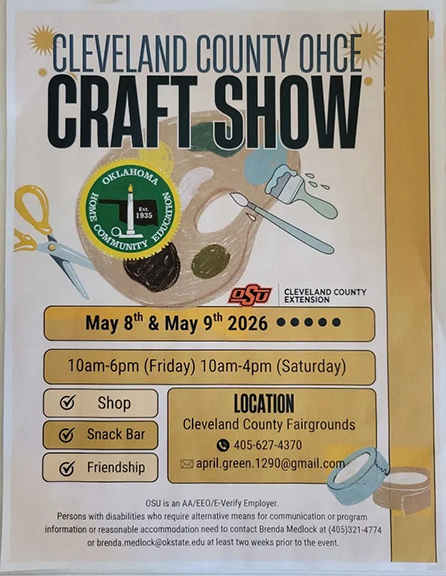
Cleveland County OHCE Craft Show in Norman May 8-9

0

The Cleveland County OHCE Craft Show will take place May 8-9, 2026, at the Cleveland County Fairgrounds in Norman, Oklahoma. Sponsored by Cleveland County OHCE, this event brings together talented local artisans and crafters for a weekend of shopping, creativity, and community engagement.
The event will feature up to 50 vendor booths showcasing a wide variety of handmade goods, including crafts, home décor, gifts, and more. Attendees will have the opportunity to meet local creators and explore unique, one-of-a-kind items.
The craft show is open to the public with free admission, making it an accessible and family-friendly outing. A concession stand will also be available on-site.
Organizers invite the community to come out and support local vendors while enjoying a vibrant and welcoming atmosphere. Whether searching for special gifts or simply wanting to experience local craftsmanship, the Cleveland County OHCE Craft Show offers something for everyone.
Who: The event will be at the Cleveland County OHCE (sponsor and host) May 8-9 at the Cleveland County Fairgrounds, 615 E Robinson St, Norman, OK 73071 and admission is FREE.
For more information, contact (405) 627-4370 or email [email protected] . Event details can also be found on Cleveland County Oklahoma Home and Community Education Facebook page.